














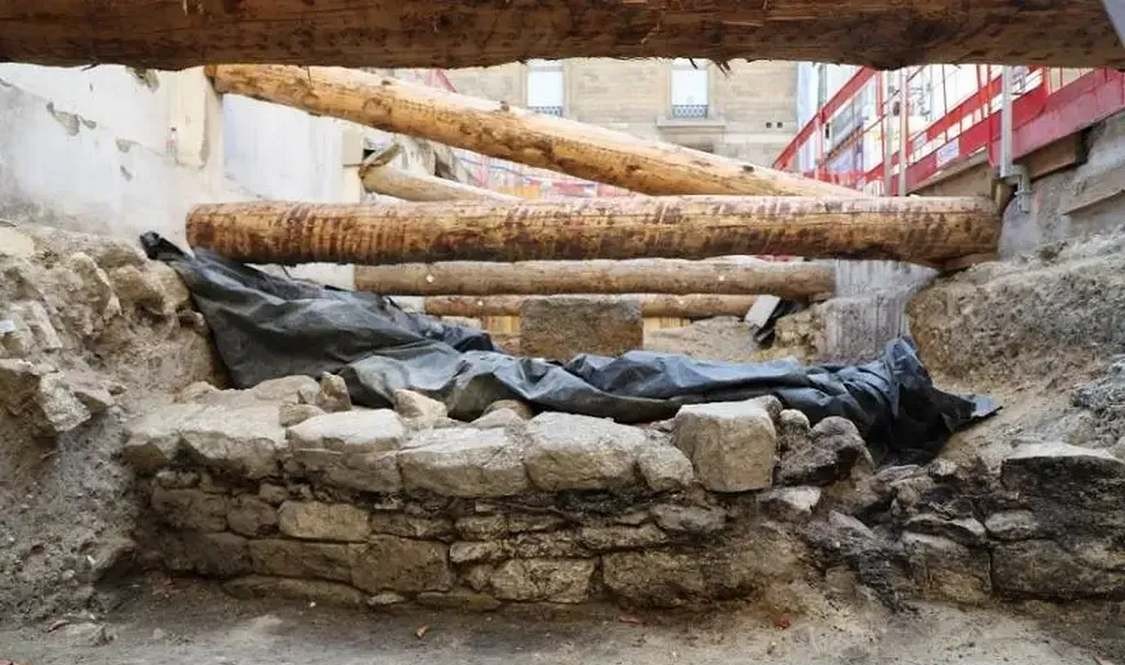
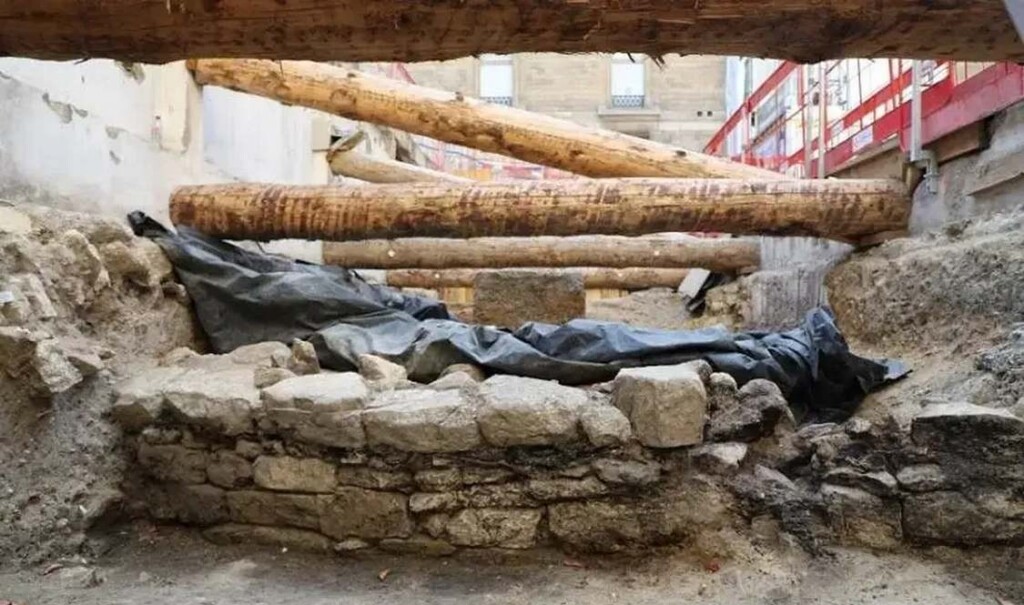
Excavations in central Paris have turned up a stone wall that may have finally settled the debate regarding the true origins of the city.
City officials described themselves as feeling “dizzy” looking down onto what is essentially Paris’ zero point in time, made all the more dramatic as it still bore the scars of Julius Caesar’s conquest.
Throughout Caesar’s wars in Gaul, an area that would become modern-day France and Belgium, the Roman general kept copious notes: including an account of a battle which many believe occurred in Paris.
According to the conqueror, the Celtic Parisii tribe had built a settlement called “Lutetia” on an island in the middle of a river (the Seine). He laid siege to it in 52 BCE, ordered the bridges burned and the oppidum, the fortified town center, torched as well.
It has long been believed that the Île de la Cité (Island of the City) in Paris had been the site of Gallic Lutetia, but Caesar did not give precise details about where on the river he’d found it, and archeological finds had been made in other areas outside Paris, complicating the picture.
Fast-forward to February 2026, and a team of national archaeologists were performing excavations on the courtyards of the Hôtel-Dieu, the oldest hospital in Paris. Preventative work uncovered traces of ancient dwellings, roads, and medieval occupations.
Smithsonian Magazine reported that in addition to these remains, a stone and wood wall, typical of Gallic fortifications, was identified, and that behind the wall excavators found a 6.5-foot-thick platform made of sand and gravel. Nearby, they found a Gallic spearhead, charred seeds, and the remains of a burned wooden building. The timbers were carbon-dated to between 200 BCE and 10 BCE.
“The architecture of the wall, with these large blocks and this system of intersecting beams, very quickly made us think of a wall of Gallic tradition,” explained Dorothée Chaoui-Derieux, heritage curator and territorial manager of Paris at the Regional Archeology Service in a statement released by the French culture ministry.
ROME IN FRANCE: Archeologists Stumble Onto Sprawling Ancient Roman Villa During Construction of a Road in France
“The presence of traces of fire and ceramic furniture contemporary to Caesar’s time reinforced this hypothesis: what if we finally had material traces of the oppidum of Lutetia, as described in The Gallic War?”
It’s incredible to think how today’s “City of Light” has origins so far back in time—something the Paris mayor thought as well.
“It’s dizzying to find oneself here and to discover what is probably the origin of the city of Paris,” Emmanuel Grégoire, the city’s mayor, tells the Agence France-Presse.
ALSO CHECK OUT: Tiny Italian Town Dug Up an Extremely Rare Roman Temple while Trying to Build Supermarket
The wall section, preserved in-situ with the damage from the fires, cannot be kept on site because of the planned hospital expansion. A casting of it is set to be made following the scientific research and study planned there, so that a reconstruction can be made for future placement in a museum.
“For centuries, the location of Lutetia has been debated. Today, with this wall and its context, we may hold the key to the mystery,” said Stéphane Deschamps, also at the Regional Archeology Service.
SHARE This Dizzying Archeological Discovery In The Heart Of France…
“a team of national archaeologists were” A team were? Please review basic grammar.