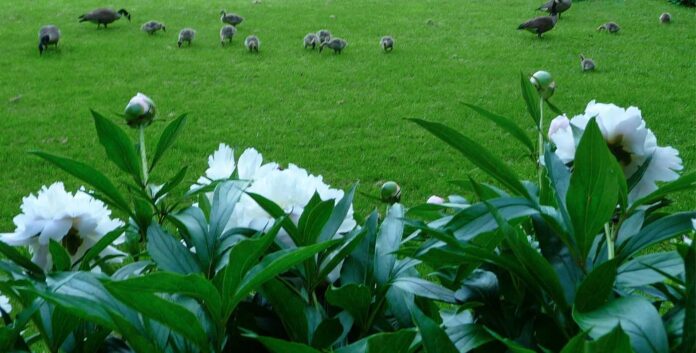
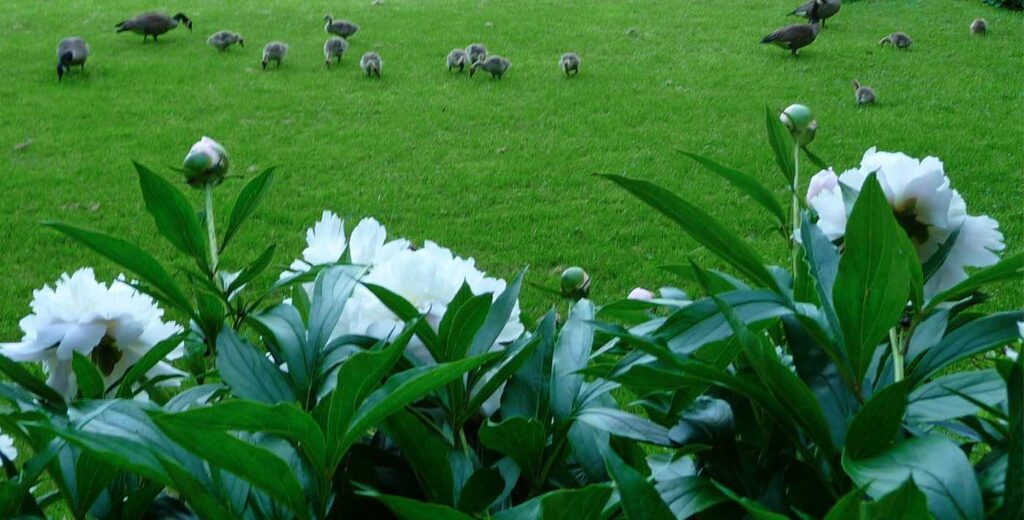
Quote of the Day: “It does not astonish or make us angry that it takes a whole year to bring into the house 3 great white peonies.” – May Sarton
Photo: copyright GWC
With a new inspirational quote every day, atop the perfect photo—collected and archived on our Quote of the Day page—why not bookmark GNN.org for a daily uplift?
Lounging on the beach may have been the No.1 destination in the past, but after a year of much sitting around, it is set to play second fiddle for more active adventures.
Peter Conlan
A survey of 2,000 adults revealed 67 percent have spent too much of the past 12 months laying around doing nothing—as a result, if they’re given the chance to get away, more than a third want to avoid sunbathing and do something more adventurous instead.
Almost one third (32 percent) would like to see the Northern Lights, but the most popular holiday activity longed-for this year is exploring the countryside on a walking adventure.
More than half (56 percent) want to go somewhere on holiday where they can take photographs of stunning scenery, or would like to visit a new country. 29 percent of respondents have already drawn up a list of locations to visit while in lockdown, dreaming of the future.
The poll, by Icelandair, found that 37 percent of those surveyed have booked a trip already.
Most people, though, are still worried about booking airline tickets in case they need to cancel—something just 27 percent were ever worried about prior to Covid.
The ability to postpone a holiday without charge is now more important than the hotel, food, drink or attractions at the destination.
Being able to get a refund is as important as the weather, while being able to postpone without charge is now four times more important than it was before the pandemic.
Almost three quarters (72 percent) also said they will not book a holiday this year if there is a possibility that they can’t cancel it or postpone it without being charged.
“If you need to change your booking, we’re flexible,” said Bogi Nils, CEO of Icelandair. “You can switch the date of your travel without any additional change fees on top of fare differences, or you can cancel and receive a voucher valid for three years.
Most major US airlines have policies in place that will waive change fees for any new travel booked by March 30-31, 2021, including American, Delta, Frontier, Jet Blue, and United—and through April if you book with Air Canada or WestJet.
Overall, six in 10 of those polled by OnePoll admitted they didn’t fully appreciate how important it was to get away until the Covid outbreak curtailed freedoms last year.
And more than two-thirds (69 percent) say the last twelve months have made them want to experience more in life.
THE TOP THINGS PEOPLE WANT TO DO ON A HOLIDAY POST-COVID
1. Walking in the countryside
2. Visit castles and other historic buildings
3. Beach lounging
4. See the Northern Lights
5. Swimming pool lounging
6. Boat trip
7. Visit museums
8. Whale watching
9. Visit a rainforest
10. Visit a theme park
11. Safari /exotic animal spotting
12. See a volcano
13. Climb a mountain
14. Watch a geyser erupt
15. Cycling
16. Zip wire
17. Rafting / Kayaking
18. Visit a desert
19. Cave exploration
20. Off-road driving
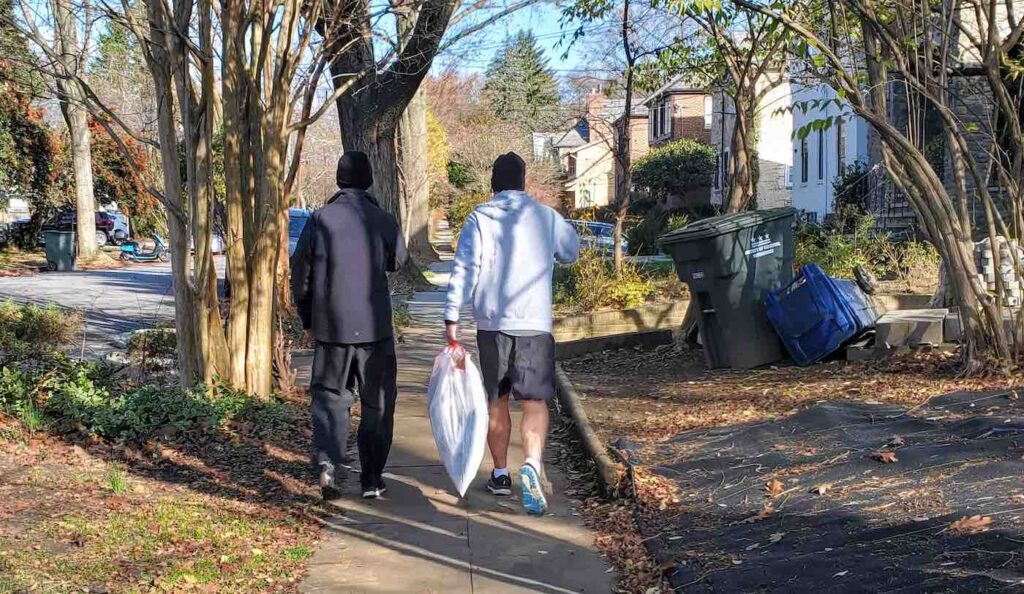
Billy Adams has found a lockdown ritual that not only benefits his health, but the mental health and beauty surrounding others in his beloved Washington, DC.
Billy Adams on his morning walk – Caroline Miller
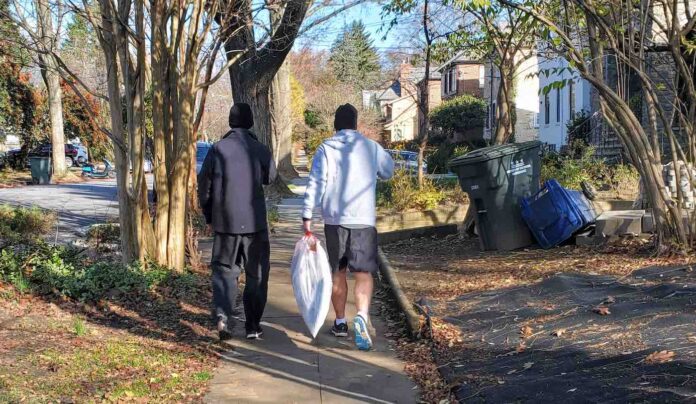
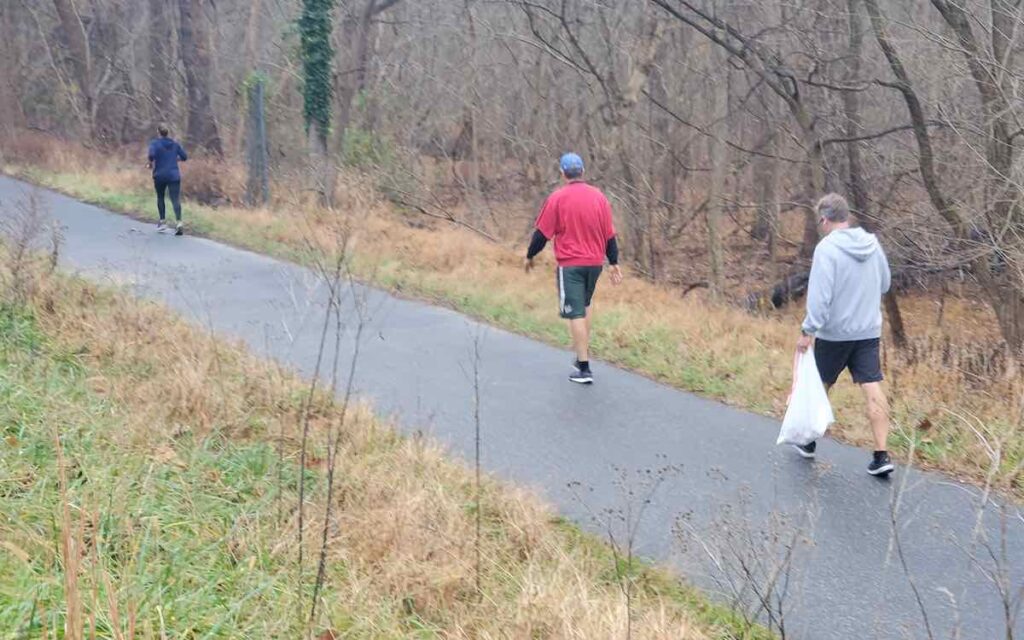
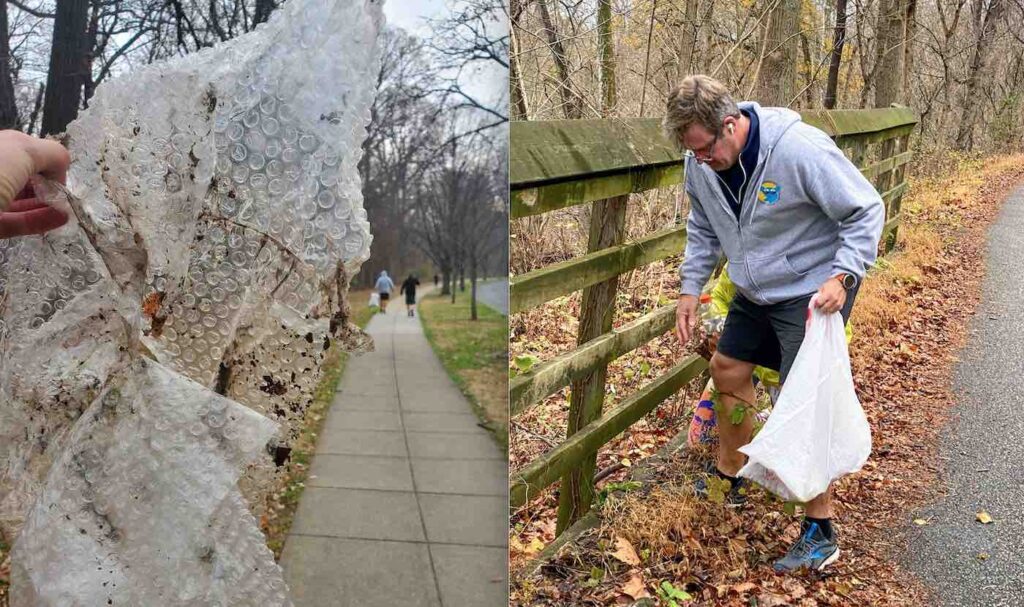
Since June the software executive has been selecting a different 12-mile route every day, picking up just about any piece of garbage on it—in rain, snow, or sleet.
He even gets an empty bag from Starbucks at the half-way mark near Canal Road in Georgetown to continue his clean-up, depositing full bags of litter in public trash cans.
He sets off from his Maryland home just over the D.C. line at 8:30am and uses his hands to pick up the trash for three hours.
Adams told the Washington Post that the habit has been immensely satisfying. “When you see it beforehand, then you walk by it after and it’s all clean, that’s a good feeling.”
Employees at the M Street Starbucks call the 54-year-old “garbage guy,” and they often have a bag ready for him when he stops in to buy a coffee, always leaving a generous tip.
Store manager Ahmed Oukchir told the Post that because of Billy he also has become inspired to be more conscious of litter.
Caroline Miller on a walk with her brother
Billy’s sister Caroline Miller has gone on the walks her husband and says it has had a “contagious impact” on her, too.
“Billy is somebody who likes to do the right thing,” she told the Post. “If he sees trash on the ground, he can’t just walk past it.”
Caroline, who was named a GNN Good News Ambassador in 2012, grew up with her brother in Bethesda, Maryland, adjacent to DC, and have deep roots here.
“It is especially important to our family because our great-great-great-grandfather was Jacob Karr, who owned the most popular watch store, within walking distance from the White House,” she told GNN. “Abraham Lincoln and all of the US presidents, from then until he retired in the early 1900s, were friendly with him and he tended to their watches.”
Caroline Miller
“Since D.C. is in his blood, I think it’s even more important to my brother that he lend a hand to beautifying the city.”
Although it is a one-man mission, Billy is thinking about organizing a weekend clean-up for Earth Day in April, so he can try to get others hooked on doing good—and feeling good, at the same time.
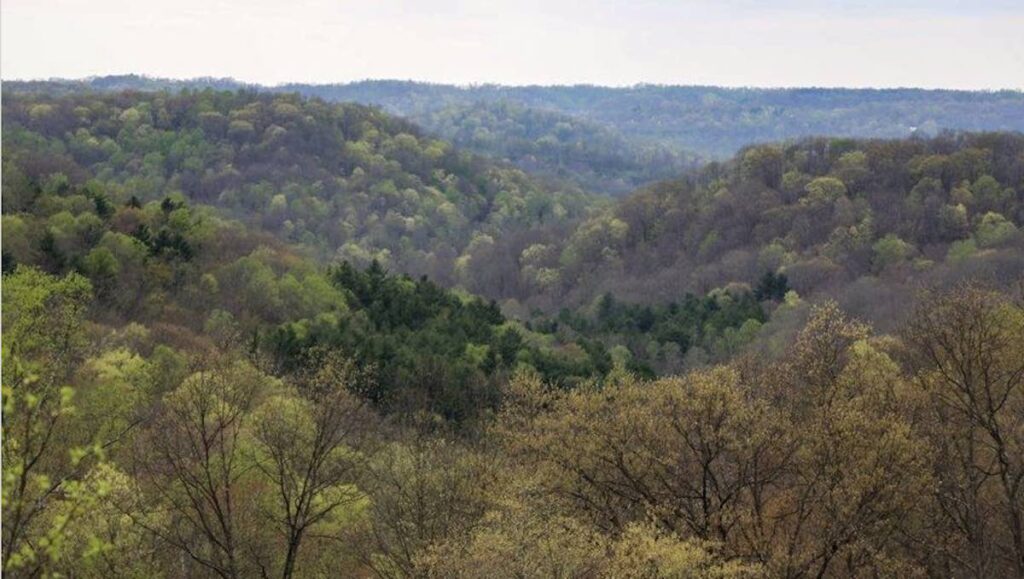
Wayne National Forest Ohio – Credit: Taylor McKinnon / Center for Biological Diversity
A federal judge blocked new oil and gas leasing and fracking in Ohio’s Wayne National Forest, a popular destination for outdoor recreation and the only National Forest located in the vast state.
Wayne National Forest Ohio – Credit: Taylor McKinnon / Center for Biological Diversityfos
The ruling rebuked the U.S. Forest Service and Bureau of Land Management (BLM) for failing to consider threats to public health, endangered species, and watersheds before opening more than 40,000 acres of the forest to fracking last year.
Pending completion of new environmental reviews, the March 9 order blocks new leases, prohibits new drilling permits and surface disturbance on existing leases, and prohibits water withdrawals from the Little Muskingum River for already-approved drilling.
“This is great news for the future of Ohio’s only national forest,” said Taylor McKinnon, a senior campaigner at the Center for Biological Diversity. “We’re grateful the judge recognized the damage fracking could do to this spectacular forest. The order will protect our climate, endangered wildlife and drinking water for millions of people.”
U.S. District Judge Michael Watson said the Forest Service and Bureau of Land Management had “demonstrated a disregard for the different types of impacts caused by fracking in the Forest. The agencies made decisions premised on a faulty foundation.”
“This is a victory for public health (and) outdoor recreation,” said Nathan Johnson, public lands director for the Ohio Environmental Council. “The Wayne is a public forest that we all own. Keeping its air and water clean, as well as its views intact, is a win that we can all celebrate.”
In May 2017 conservation groups sued the agencies over plans to permit fracking in the Wayne, saying federal officials had relied on an outdated plan and ignored significant environmental threats before approving the fracking.
The BLM’s leasing plan would industrialize Ohio’s only national forest through road-building, well pads and gas lines, the lawsuit said. This would destroy Indiana bat habitat, pollute watersheds and water supplies that support millions of people, and endanger other federally protected species in the area.
The Wayne National Forest is a patchwork of public land that covers over a quarter million acres of Appalachian foothills in southeastern Ohio, and much of the property is former coal-mining lands, where restoration has already been done to restore water quality and mitigate toxic minerals that seeped into lakes and rivers from the mines.
Currently, privately owned oil and natural gas rights underlie around 59% of the forest land, totaling about 144,103 acres. The USDA Forest Service is the managing agency when it comes to mineral leases, and, as of November 2018, there were 1,272 active vertical wells on the Wayne Forest properties—involving both federal and private mineral operations.
The ruling—along with a Biden administration moratorium on new oil and gas leasing on federal public lands—is a big win for conservation groups who fought a three year legal battle to protect the 40,000 acres in question.
SHARE the Legal Victory to Conserve Hope on Social Media…
Quote of the Day: “There’s only one thing more precious than our time and that’s what we spend it on.” – attributed to Leo Christopher
Photo by: Chang Duong
With a new inspirational quote every day, atop the perfect photo—collected and archived on our Quote of the Day page—why not bookmark GNN.org for a daily uplift?
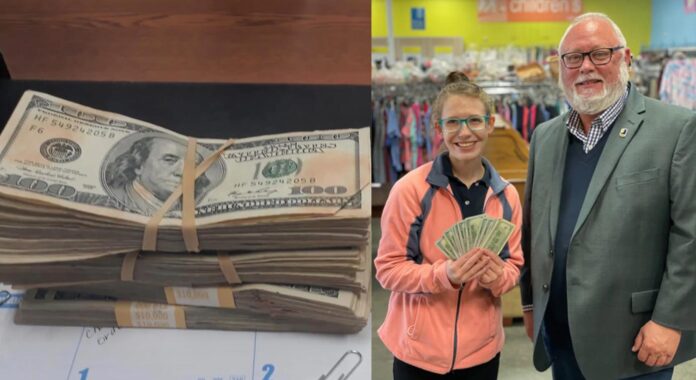
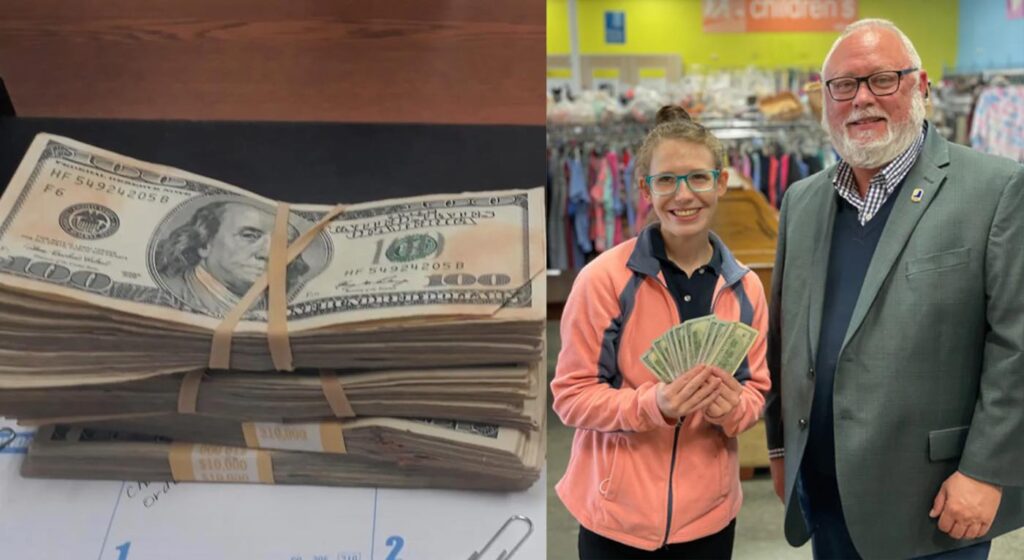
Andrea with her boss – Goodwill Industries of Central Oklahoma
When a new worker at a charity shop found stacks of $100 bills stuffed inside two old sweaters she thought they must be fake.
The store associate at Goodwill Industries then realized they were absolutely real—and the cash totaled $42,000.
Andrea Lessing was in the back sorting clothes and looking for rips or stains when she saw the treasure, and the first thing she thought of was her six-year-old daughter.
“Her birthday is coming up in July, so I can actually give her an amazing birthday party,” she told KFOR, a local news station.
But Lessing says she believes in karma, and couldn’t imagine keeping the money for herself.
She reported the lost cash, and the shop in Norman, Oklahoma was able to track down the owner, thanks to some identifiable documentation that was bundled with the money inside the donation.
The owners, who had forgotten about the money when they donated the clothing gave Andrea $1,000, which made her break down and cry.
Andrea with her boss – Goodwill Industries of Central Oklahoma
“Since we gave her the reward on Thursday. I spoke to her yesterday, and she is still in shock—and awed by their generosity,” Lacey Lett, the Director of Communications at Goodwill Industries of Central Oklahoma, told GNN.
Reportedly, it’s not just the largest cash find in Oklahoma Goodwill history, it ranks among the top finds for Goodwill internationally—and the reward will help Andrea give her daughter an ‘amazing birthday’.
“I made the right decision,” Lessing said.
And, her belief that ‘if you do something good, then something good will come back to you’ turned out to as authentic and true as the currency she uncovered.
FREE WILL ASTROLOGY – Week beginning March 26, 2021
Copyright by Rob Brezsny, FreeWillAstrology.com
ARIES (March 21-April 19):
In the novel House of Leaves, the hero Johnny Truant describes his friend Lude as wanting “more money, better parties, and prettier girls.” But Johnny wants something different. What is it? He says, “I’m not even sure what to call it except I know it feels roomy and it’s drenched in sunlight and it’s weightless and I know it’s not cheap.” In my opinion, that declaration is far too imprecise! He’ll never get what he wants until he gets clearer about it. But his fantasy is a good start. It shows that he knows what the fulfillment of his yearning feels like. I suggest you get inspired by Johnny Truant’s approximation to conjure up one of your own. Gaze ahead a few years, and see if you can imagine what your best possible future feels like. Then describe it to yourself as precisely as possible.
TAURUS (April 20-May 20):
How distraught I was when I discovered that one of my favorite poets, Pablo Neruda, was an admirer of the murderous dictator Joseph Stalin. It broke my heart to know I could never again read his tender, lyrical poetry with unconditional appreciation. But that’s life: Some of our heroes and teachers disappoint us, and then it’s healthy to re-evaluate our relationships with them. Or maybe our own maturation leads us to realize that once-nurturing influences are no longer nurturing. I recommend that sometime soon, you take a personal inventory with these thoughts in mind. I suspect there may be new sources of inspiration headed your way. Get ready for them.
GEMINI (May 21-June 20):
Self-help author Steve Maraboli has useful advice for you to consider in the coming weeks. I hope you’ll meditate on what he says and take decisive action. He writes, “Incredible change happens in your life when you decide to take control of what you do have power over instead of craving control over what you don’t.” To get started, Gemini, make a list of three things you do have power over and three things you wish you did but don’t have power over.
CANCER (June 21-July 22):
While he was alive, Cancerian author Franz Kafka burned 90% of everything he wrote. In a note to a friend before he died, he gave instructions to burn all the writing he would leave behind. Luckily, his friend disobeyed, and that’s why today we can read Kafka’s last three novels and a lot more of his stuff. Was his attitude toward his creations caused by the self-doubt that so many of us Cancerians are shadowed by? Was he, like a lot of us Crabs, excessively shy about sharing personal details from his life? In accordance with astrological omens, I urge you to at least temporarily transcend any Kafka-like tendencies you have. It’s time to shine brightly and boldly as you summon your full powers of self-expression.
LEO (July 23-Aug. 22):
To create your horoscope, I’ve borrowed ideas from Leo-born author Cassiano Ricardo. He speaks of a longing “for all that is tall like pine trees, and all that is long like rivers, and all that is purple like dusk.” I think yearnings like those will be healthy and wise for you to cultivate in the coming weeks. According to my reading of the astrological omens, you need expansive influences that stretch your imagination and push you beyond your limitations. You will benefit from meditations and experiences that inspire you to outgrow overly small expectations.
VIRGO (Aug. 23-Sept. 22):
Virgo actor and director Jean-Louis Barrault (1910–1994) aspired to “wake up a virgin each morning.” He wanted “to feel hungry for life,” as if he had been reborn once again. In order to encourage that constant renewal, he regarded going to sleep every night as “a small death.” I recommend his approach to you during the coming weeks. In my astrological opinion, the cosmic rhythms will be conspiring to regularly renew your desires: to render them pure, clean, raw, and strong. Cooperate with those cosmic rhythms!
LIBRA (Sept. 23-Oct. 22):
Is there anything more gratifying than being listened to, understood, and seen for who you really are? I urge you to seek out that pleasure in abundance during the coming weeks. My reading of the astrological omens tells me you need the nurturing jolt that will come from being received and appreciated with extra potency. I hope you have allies who can provide that for you. If you don’t, search for allies who can. And in the meantime, consider engaging the services of a skillful psychotherapist or life coach or some other professional listener.
SCORPIO (Oct. 23-Nov. 21):
“Blobs, spots, specks, smudges, cracks, defects, mistakes, accidents, exceptions, and irregularities are the windows to other worlds,” writes author Bob Miller. I would add that all those things, along with related phenomena like fissures, blemishes, stains, scars, blotches, muck, smears, dents, and imperfections, are often windows to very interesting parts of this seemingly regular old ordinary world—parts that might remain closed off from us without the help of those blobs and defects. I suggest you take full advantage of the opportunities they bring your way in the coming weeks.
SAGITTARIUS (Nov. 22-Dec. 21):
Innovative psychologist Carl Jung had a nuanced understanding of the energies at work in our deep psyche. He said our unconscious minds are “not only dark but also light; not only bestial, semi-human, and demonic, but also superhuman, spiritual, and, in the classical sense of the word, ‘divine.'” I bring this to your attention, Sagittarius, because now is a favorable time to get better acquainted with and more appreciative of your unconscious mind. For best results, you must not judge it for being so paradoxical. Don’t be annoyed that it’s so unruly and non-rational. Have fun with its fertility and playfulness and weirdness.
CAPRICORN (Dec. 22-Jan. 19):
The fantasy drama Game of Thrones appeared on TVs all over the world. But the audience that watched it in China got cheated out of a lot of essential action. Government censorship deleted many scenes, including appearances by dragons, which play a starring role in the story. As you can imagine, Chinese viewers had trouble following some of the plot points. Telling you about this, Capricorn, is my way of nudging you to make sure you don’t miss any of the developments going on in your own personal drama. Some may be hidden, as in China’s version of Game of Thrones. Others might be subtle or disguised or underestimated. Make it your crusade to know about everything.
AQUARIUS (Jan. 20-Feb. 18):
“Words are, of course, the most powerful drug used by mankind,” wrote author Rudyard Kipling. Yes, they are. I agree. They change minds, rouse passions, build identities, incite social change, inspire irrationality, and create worlds. This is always true, but it will be especially important for you to keep in mind during the coming weeks. The ways you use language will be key to your health and success. The language that you hear and read will also be key to your health and success. For best results, summon extra creativity and craftsmanship as you express yourself. Cultivate extra discernment as you choose what you absorb.
PISCES (Feb. 19-March 20):
Piscean linguist Anna Wierzbicka says the Russian expression Dusha naraspashku means “unbuttoned soul.” She continues, “The implication is that it is good, indeed wonderful, if a person’s ‘soul,’ which is the seat of emotions, is flung open in a spontaneous, generous, expansive, impetuous gesture, expressing full trust in other people and an innocent readiness for communion with them.” I wouldn’t recommend that you keep your soul unbuttoned 24/7/365, but in the coming weeks, I hope you’ll allocate more time than usual to keeping it unbuttoned.
WANT MORE? Listen to Rob’s EXPANDED AUDIO HOROSCOPES, 4-5 minute meditations on the current state of your destiny — or subscribe to his unique daily text message service at: RealAstrology.com
The Ocean Cleanup project launched by a Dutch youth a decade ago to tackle the Pacific garbage patch has in recent years begun to fix its attention on the plastic from rivers flowing into the sea.
Now they have a little help from the English band whose blockbuster hit was ‘Fix You’.
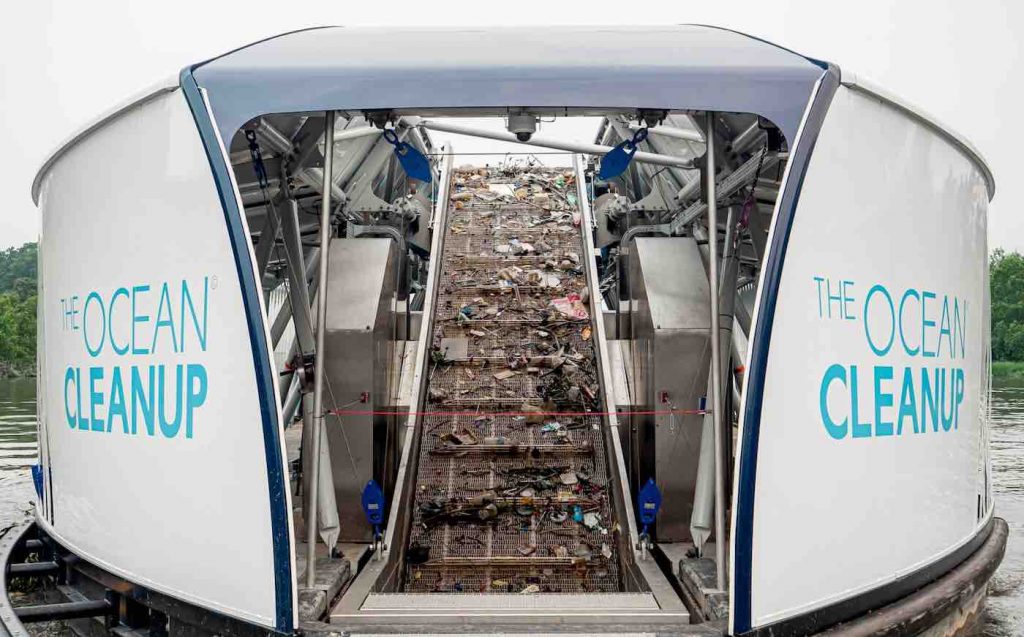
The Interceptor – The Ocean Cleanup
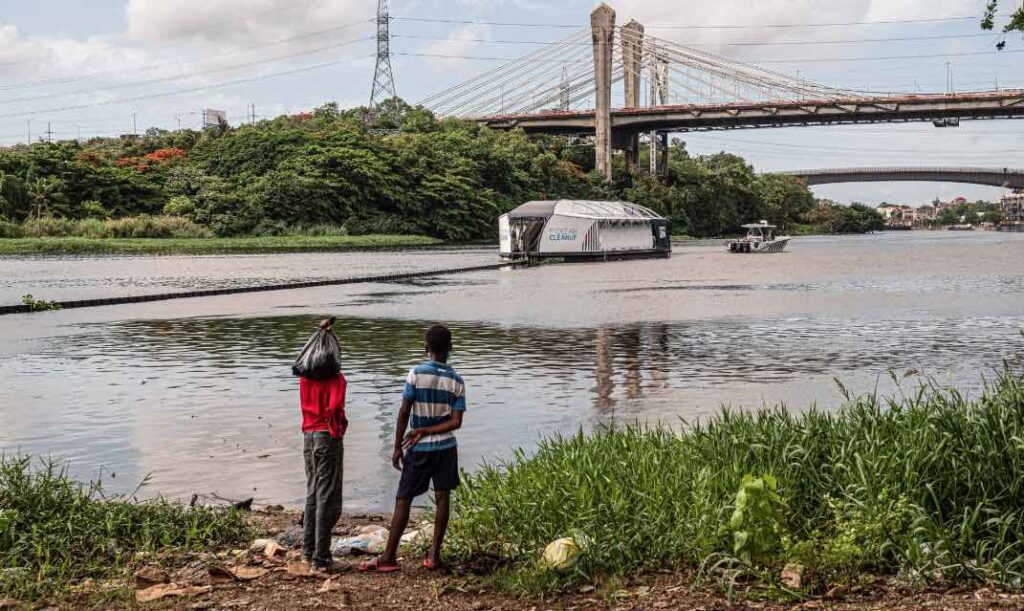
The rock group, Coldplay, is sponsoring the newest ‘Interceptor’, one of the semi-autonomous water craft developed by The Ocean Cleanup to extract plastic from rivers before it enters the ocean.
The collaboration will widen the net for the nonprofit’s goal of launching an Interceptor in each of the world’s most polluted rivers—in order to “turn off the taps” and catch the plastic along the river’s course, mostly avoiding the much more difficult task of capturing it in the ocean.
“Without action, there could be more plastic than fish in the oceans by 2050,” said Chris Martin and his bandmates. “We’re proud to sponsor Interceptor 005 which will catch thousands of tons of waste before it reaches the ocean.”
The first Interceptors, which are solar-powered barges, were launched in 2019 in the Klang River in Kuala Lumpur—which is among the 50 worst rivers for pollution—and the Cengkareng Drain in Jakarta, to extract 220,000 pounds of trash (100,000 kilos) per day.
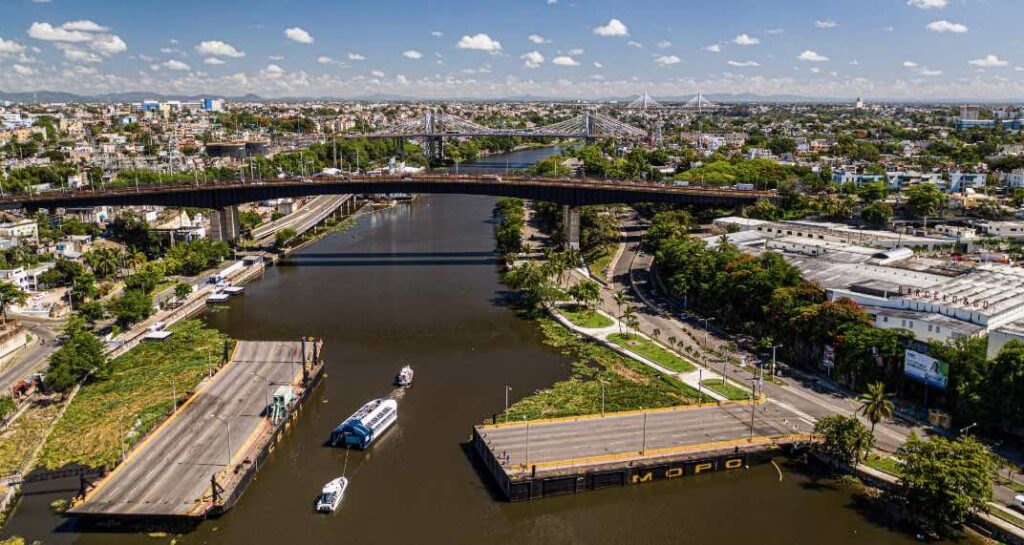
The third Interceptor to be deployed, is operating in the Rio Ozama in Santo Domingo, Dominican Republic. The barges are internet-connected, allowing teams to gather performance and collection data—and the vessels can automatically notify local operators once the onboard dumpsters are full.
Deploying The Interceptor in Rio Ozama, Santo Domingo – The Ocean Cleanup
“I’ve long admired the work of Coldplay. They are doing great things to promote a better environment, and they are world-renowned for these efforts (as well as their music), and the reach of their voice is immense,” said Boyan Slat, the CEO of The Ocean Cleanup, who launched the project while he was still a teen.
Santo Domingo in Dominican Republic – The Ocean Cleanup
Coldplay has agreed to fund the Interceptor nicknamed Neon Moon 1, which is currently being manufactured by The Ocean Cleanup’s partner, Konecranes, in their Malaysia facility, for deployment later in the spring of 2021 in that country.
From the vision of one teen, The Ocean Cleanup has grown to employ almost 100 engineers and researchers, and has plans for its Interceptor solutions to be placed in heavily polluting waterways worldwide, including in Vietnam, the United States, Jamaica, and Thailand.
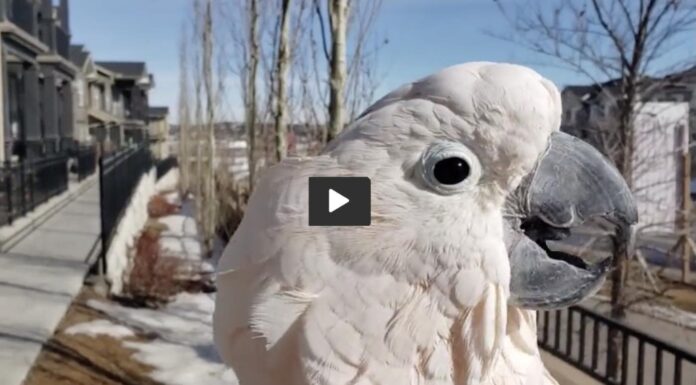
Smiles are infectious when you see Max performing his chicken impression.
The 26-year-old Moluccan Cockatoo is known on his YouTube channel as the original Cluckatoo.
When Spring arrives in Canada, and Max is out on the patio in the warm sun, he is happy to express his joy with a good ‘Bok’.
Also called the Salmon-crested cockatoo, the large species is highly intelligent, and very showy with their trademark flamingo-colored crest. It is legal to breed the bird in captivity, but not to take them from the wild.
They can live for 80-100 years, so Max is likely to be clucking like a chicken for many decades to come.
Check out his YouTube channel, where you can see updates about this gorgeous bird and all his antics…
WATCH the Moluccan mimic, which is EGGS-actly what we needed today…
SHARE This Clucking-Good Imitation With Your Flock on Social Media…
Quote of the Day: “Disaster is virtue’s opportunity.” – Seneca
Photo by: Daniel Thornton, CC license
With a new inspirational quote every day, atop the perfect photo—collected and archived on our Quote of the Day page—why not bookmark GNN.org for a daily uplift?
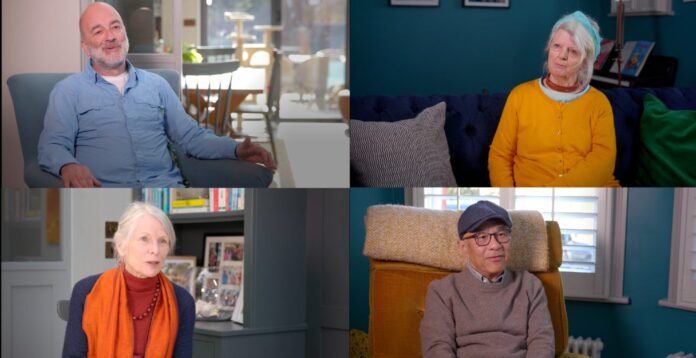
Retired Brits have revealed their top 40 ‘pearls of wisdom’ to pass on to younger generations, including saying “I love you” more often, and being confident in your own skin.
The poll of 1,000 retired adults also advised young people never to compare themselves to others—and to phone their family once a week.
Others warned the younger ones to enjoy their youth, exercise more often, and to step outside of their comfort zone.
The questionnaire found 67% of retirees do have regrets—such as not traveling the world (44%), worrying what other people thought (43%), and not keeping physically fit (40%).
A spokesman from Voltarol, which commissioned the poll, said: “It’s certainly been interesting to see the insight and wisdom the older generation would pass on to the youth of today.
“Much of the insight revolves around enjoying life, respecting others, and being the best you can be, which I’m sure most would agree with.
“It was particularly fascinating to see how the older generation would recommend appreciating your younger body, and wishing they’d kept physically fit.”
The poll also found that when casting their minds back to their childhood years, older retirees miss hot summers (37%, playing outside until the streetlights came on (36%), and family holidays (30%).
The study also revealed retirees would like to pass on more practical advice such as getting on a company pension scheme, saving for your retirement in your twenties, and investing in property.
Regardless of ability, 89% said they might be old, but they’re young at heart.
And one in 10 have tried yoga or tai chi since retiring, 23% have gone to concerts, and 29% have taken on a community garden plot—showing there’s always time to take on new hobbies and interests.
TOP 40 TIPS RETIRED BRITS WOULD GIVE TO YOUNGER GENERATIONS
1. Treat others how you’d like to be treated yourself
2. Manners don’t cost a thing
3. Always try your best
4. Accept a company pension scheme if offered
5. Don’t spend all your time on social media and live in the real world
6. Start saving for retirement in your twenties
7. Don’t take anything for granted
8. You don’t have to go to university for a successful career
9. Hold onto those closest to you
10. Be confident in your own skin
11. Respect your elders
12. Enjoy your youth
13. Never give up
14. Do what makes you happy
15. Family comes first
16. Don’t waste your time on jealousy
17. Don’t compare yourself to others
18. Don’t go to sleep on an argument
19. Invest in a property
20. Phone your parents every week
21. Say I love you more
22. Don’t have any regrets
23. Don’t sweat about the small stuff
24. Spend more time outside
25. Exercise more often
26. Never go to bed angry
27. Laugh more at everything
28. Be more patient
29. Be more confident
30. If you don’t ask, you don’t get
31. Don’t compare your style to others
32. Appreciate your younger body
33. Try something new
34. Don’t take things personally
35. Spend more time with children
36. Step outside your comfort zone
37. Don’t overindulge
38. Phone your grandparents every week
39. Remember the compliments you receive
40. Less is more
Changes to food allergy guidelines has led to a 16% decrease in peanut allergy among infants, according to new study.
The research, led by the Murdoch Children’s Research Institute (MCRI), also found a significant increase in parents introducing peanut into their babies’ diet since the guideline changes.
Introducing peanut early in a child’s life has been shown to prevent peanut allergy during randomized controlled trials. But MCRI PhD candidate and study lead author Victoria Soriano said this research was the first to test the approach in homes and to analyze what impact the guideline changes have had on peanut allergies.
International infant feeding guidelines changed in 2016 to recommend introduction of peanut and other allergenic foods before 12 months.
“In the 1990s some guidelines recommended avoiding allergenic foods until age 1-3 years and avoidance of these foods in infancy became widespread,” Ms Soriano said.
“By 2008, this advice started to be removed based on increasing evidence that delaying allergenic foods was associated with an increased food allergy risk. However, evidence was still insufficient for specific recommendations for what age these foods should be introduced.”
The Melbourne study compared data from the 1,933 infants enrolled in the EarlyNuts study in 2018-2019 to the 5,276 infants recruited in the HealthNuts study across 2007-2011.
The research found the peanut allergy prevalence in 2018-2019 was 2.6 per cent compared to 3.1 per cent in 2007-2011, which amounted to a 16% decrease after accounting for migration and population changes.
In 2018-2019, infants who did not consume peanut until 12 months or later, 4.8% were allergic. Severe reactions to introducing peanut early were uncommon, the data showed.
Ms Soriano said despite initial concern that parents may not follow the advice to introduce peanut early there was a high uptake.
Peanut consumption by 12 months increased from 28% to 89% in the 10 years to 2019, which may have halted the rise in peanut allergy, the study found.
Melbourne mom Megan Chappel began feeding her son Stellan, 10 months, peanut product from five months of age. Stellan is enrolled in MCRI’s Vitality allergy trial.
“We try to incorporate peanut products into his diet as much as we can,” she said. “It’s reassuring to see peanut allergy has not only deceased but that many parents are following the new guidelines.”
MCRI’s Dr Jennifer Koplin said despite the decrease in peanut allergy, the prevalence overall continued to be high.
Australia has the highest reported rates of childhood food allergy in the world, with about one in 10 infants and one in 20 children up to five years of age being allergic.
“The safety of early peanut introduction at home is of significant interest to parents as well as health professionals around the world,” Dr Koplin said. “More research must be done to look closer at these trends to help us understand how well early introduction to peanut works to prevent peanut allergies in real-life situations.”
The Vitality trial is recruiting Melbourne infants aged six to 12 weeks testing whether taking a vitamin D supplement over the first year of life can help prevent food allergies. To find out more about MCRI’s allergy trials visit the Centre for Food and Allergy Research website.
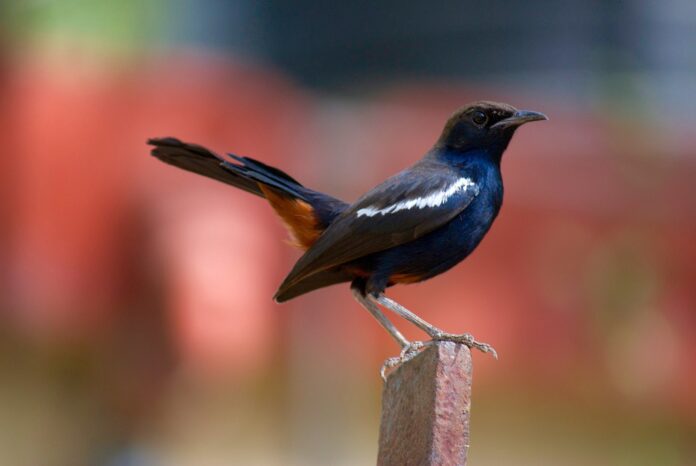
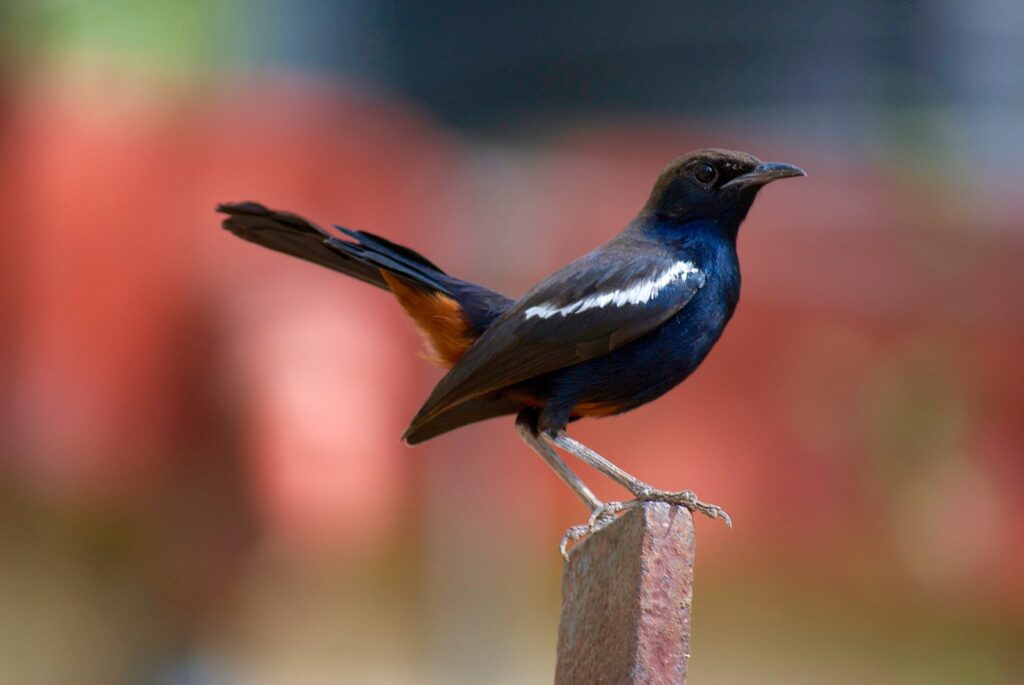
When man and nature attempt to co-exist, man usually wins out. But that wasn’t the case in a small town in southern India when a native Robin recently chose to build her nest in an extremely inconvenient location.
The village of Potthakudi contains only 120 homes and has a total of 35 streetlights. Unfortunately, the misguided mama bird had decided to set up housekeeping in the town’s main lighting switchboard.
The nest and its inhabitants were first discovered by Karuppu Raja, the man tasked with turning on the streetlights each evening. A lifelong bird lover, Raja posted his find to local social media to alert the citizens of his discovery and ask for their cooperation in taking a hands-off approach to the unexpected temporary guests.
“I wrote on WhatsApp that switching off the lights was the only solution because the bird will fly once it realizes there is a human touch or contact near its nest,” Raja told the Deccan Herald. “I also told the group that we should save the bird and its hatchlings at any cost.”
While some initially voiced concerns the lack of nighttime illumination would be inconvenient, Raja was eventually able to persuade his fellow villagers that any sacrifice would be worth it in the long run. “I explained that so many bird species have become extinct and we should not let Indian Robin go the same way,” Raja told DH.
So, rather than oust the feathered brood, the residents agreed to observe a blackout until the nestlings were old enough to fly the coop. The town spent a total of 45 days—and nights—in the dark, even disconnecting the switchboard from the power source to keep mom and her chicks safe.
After mama robin and her fledglings finally took off, the blackout was lifted, but the village’s extraordinary conservation efforts for the sake of one lone avian and her babies didn’t go unnoticed.
A bird in the hand may be worth two in the bush, but a bird in the switchboard has earned Potthakudi a reputation for kindness that’s likely to light up smiles for quite some time to come.
Tweet the Good News—Share This Story With Friends…
North Carolina-based writer Judy Cole has a new rom-com murder mystery debuting for Kindle at Amazon: And Jilly Came Tumbling After (from Red Sky Presents).
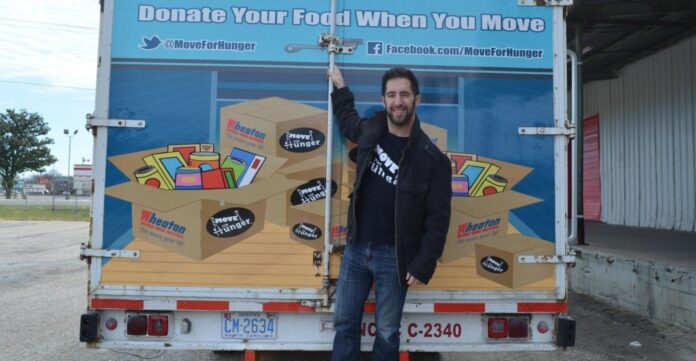
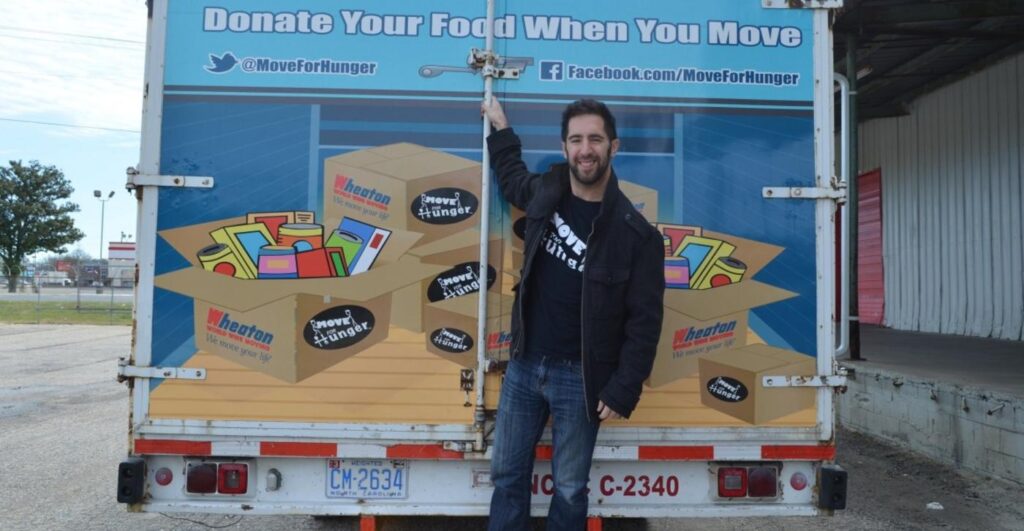
A New Jersey moving company has sparked an initiative capitalizing on the amount of food left behind in clients’ fridges in order to help increase supply to local food banks.
Over 1,050 moving companies and 22 million pounds of food later, and Adam Lowy—founder of Move for Hunger—has turned leftovers into enterprise-level charity.
“When people move, they throw away a whole bunch of stuff: food, clothing, furniture, you name it,” Lowy told TODAY. “And what bothered us was the perfectly good, nonperishable food that was getting left behind in the pantry, or simply thrown in the trash.”
It’s true. When you’re trying to get all the little odds and ends, pots and pans from your kitchen into a box and out again a few hours later, the last thing you want to think about is packing up 6-month-old canned peas and dried spaghetti.
“Moving’s stressful, you know? It’s not a fun experience, there’s a lot going on,” Lowy said. “And we started by asking a very simple question: ‘Do you want to donate your food when you move?'”
That question, posed first in 2009, led to the creation of Move for Hunger, which links moving companies with food banks in their area, and these pairings with apartment offices, corporate housing, relocation management companies, real estate agents, and other entities to reach as many tenants and homeowners as possible about the impact they can make by donating their food before they change addresses.
Once one of these partners gets word that someone wants to move, Move for Hunger provides a broacher about local hunger problems, a large plastic bag, and a cardboard box—all to help people donate any food they don’t feel like bringing along with them.
Then a local moving company will bring those packed-up pantry staples to a local food bank, helping ensure nothing gets wasted.
Their February 2021 Spread the Love event? It saw 16,000 meals donated across 300 separate food drives, and 20,000 pounds of peanut butter and jelly being used.
Hunger affects one in six American children, and it’s only gotten worse during the pandemic as government-mandated business closures have ravaged the economy, destroyed jobs, and disrupted supply chains.
In the first month of Lowy’s idea, he managed to collect 300 pounds of food, begging the question, “If one moving company could make this kind of impact in their local community,
what could an entire network of moving companies do?”
Those are the kinds of questions and ideas that can make that one in six become zero in six.
SPREAD the Generosity—Share This Story With Friends…
As a quadriplegic, Jon Ayers can’t move his limbs, but his voice is filled with excitement. His eyes dart around his office, projecting the illusion of a rainforest that’s filling his imagination with such enthusiasm that soon trees and vines begin to appear in the corners of my office as well.
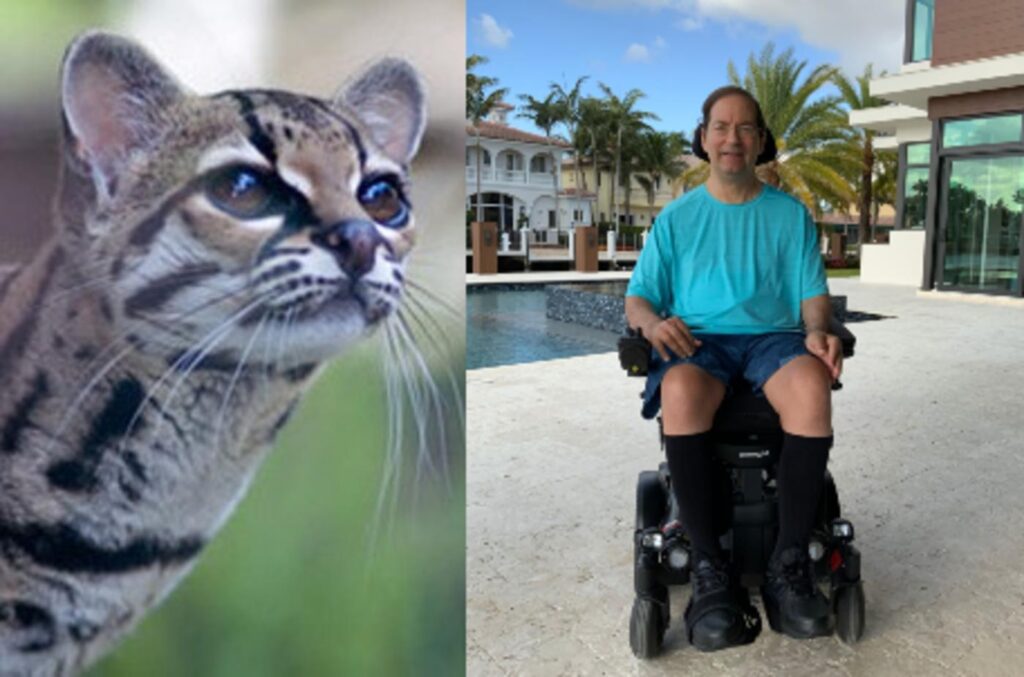
Margay, Gab 2212, CC license/Jonathan Ayers at home in Florida, Hejung Kim
Jon is describing to me a margay, a tree-dwelling species of wild cat from Central and South America, and the only species that can climb down a tree head first—a trait which endears the 4 kilogram cat to him above all others.
The margay is just one of more than 30 different small wild cat species, many of which are little known—going unseen under a big shadow cast by the big cats like lions and tigers.
But Jon is not willing to sit by and watch these charismatic animals go extinct, so is investing a $20 million personal fortune in an effort to reverse declining trends in small wild cat populations around the world.
Ayers is a panthera person, a felid person, as well as the former-CEO of one of the world’s most successful veterinary diagnostics companies: IDEXX Laboratories. For 17 years he captained the company which appreciably advanced the standard of care for veterinary medicine.
Under his leadership, from 2002 to 2017, IDEXX’s annual revenues went from $380 million to $2.4 billion, while its share price enjoyed a more than 40-fold increase. Jim Cramer from NBC’s Mad Money called IDEXX “one of the hottest stocks on the market,” in an in-studio interview with Jon on May 2019.
Shortly after that appearance, a cycling accident tragically terminated the use of his limbs, with only his helmet keeping him from passing away. Stepping down from the leadership of IDEXX to focus on his health and recovery, he is now speaking to the public again for the first time since the accident, and is eager to share the details of his new adventure—a leadership and funding position at one of the most effective conservation organizations in the world: Panthera.
“What’s the plan?”
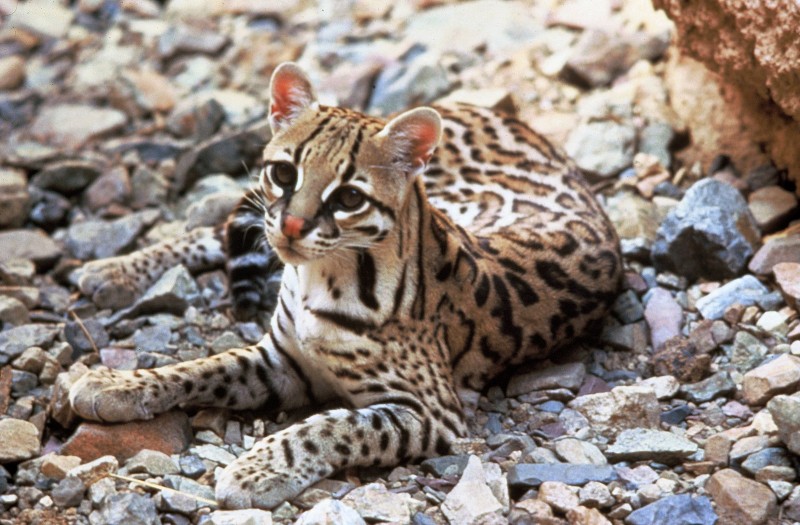
Ocelot/Tom Smylie, CC license
“When you go through a catastrophic accident, you’re dealing with a number of challenges,” Jon Ayers explains to GNN. Jon, who had taken up a proximal role in wild cat conservation with several foundations—one of which he started with his wife Helaine in 2018—sees it as a kind of mental therapy.
Their organization, The Ayers Wild Cat Conservation Trust, works alongside Panthera, a conservation group with a focus on getting the job done, rather than creating the most-detailed body of scientific research. Panthera’s work with jaguars, preserving their migration corridors from Argentina to New Mexico, or the Furs for Life and Arabian Leopard Initiatives for the other big spotted cat, have produced conservation successes that are as good as anything being done today.
“It’s not easy going through something like this and most people don’t do very well,” says Jon. “Not that I’m perfect, but being able to work on something like this is the greatest gift to me… because it helps me through a transition in my life, and because it gives me purpose.”
“I mean I lost so much. There are a lot of things I can’t do anymore, really basic things like brushing my teeth and clipping my fingernails…”
“The thing about spinal cord injuries is that no two are the same. My recovery has been much more slow, although I’ve worked hard at my recovery, and I’ve made a lot of progress, but then you ask yourself, ‘well what’s my purpose?’ And I realized my purpose is to support wild cat conservation.”
His trust contributed a few thousand here or there to Panthera, as they were one of the only conservation missions that really had an awareness of what was needed to begin creating a brighter future for some 33 species of small wild cat that altogether receive around 1% of total cat conservation efforts. Along with his massive cash contribution, Jon also took up a board position.
“It was something I was starting to do, it was something that I have, very fortunately, the financial resources for, but I also have the mental ability and I just think God spoke to me and said: ‘this is the plan.'”
In Jon, Panthera’s founder and wild cat-brainiac Dr. Thomas Kaplan feels he’s found “someone who wakes up in the morning and says ‘what can I do to turn the screw of history just a little bit?’”
“Jon’s out of central casting,” Kaplan told GNN. “I’ve really been waiting for someone with Jon’s talents and his passion and his dedication to come into the story.”
There but for the shadows unseen
Leopardus tigrinus/Groumfy69, CC license
As I sat down with Jon and Dr. Kaplan on Zoom, the latter had already made his background a photograph of cheetahs lounging on the African Savanah, blending his fiery-orange hair with the grass in the picture, and lending a Bob Ross-like glow to his character.
“The advent of Jon coming into the picture… is really a game changer for small cat conservation,” said Kaplan. “I think it’s probably fair to say that nobody is doing and nobody will have done more to save the 33 species of small cats than Jon and his family.”
“We’re prioritizing the cat species and we’re doing that according to a certain matrix, in order to enable ourselves to know where to begin first. We’re obviously going to give priority to those where the ecology is least well-known,” he explains. “[What is] the rarity? Do they overlap with other small cats or big cats within their landscapes so that we can leverage and harness existing programing and scientific know-how. How vulnerable are they to extinction, how pervasive are the threats?”
He details that the overall mission is “a very ambitious one.” They hope that by 2025, they’ll have more or less filled-in the ecology and devised protection plans for 50% of all the small cat species. By 2030, Panthera wants to be at 100%, but the initial injection of Jon’s capital will be put to work right away prioritizing 11 cat species across Asia, the Americas, and Africa. Especially Asia, where islands like Borneo and Sumatra can contain four or five small cat species, like the Sunda clouded leopard, Borneo bay cat, the flat-headed cat, which goes fishing, and the marbled cat.
“Our aim is that when we commence a program, we want to be able to have observable, measurable impact within five years in being able to save that landscape for those cats,” says Kaplan. “The U.S. government basically said, ‘if Panthera can’t save the big cats then nobody can.’ It’s what we’re known for.”
In the course of our discussions, Kaplan eagerly seasons the ambitious rhetoric with the names of cats it’s likely you’ve literally never heard of before, and for some of which, the only entry in the scientific record is a confirmation that, yes, they indeed, exist.
“Across the Americas we’re working on a variety of species ranging from the first wild cat I ever saw: the bobcat, but also extending further south to ocelots, margays, jaguarondis, oncilla, Geoffroy’s cat.”
“At the end of the day, we’re not academic in the sense that we’re doing this in order to prove a point; for us it’s all about applied science. What Jon is enabling us to do is really to fight the battle across the entire arc of the small cat trajectory and be able to do everything simultaneously.”
A match made in heaven
“I think what’s unique [and what] really attracted me to Panthera, they had a focus dedicated to species conservation. So it was cats and nothing else, and I’m a cat person. I’ve always loved cats,” says Jon.
“Panthera had a focus, [and] wanted to grow. Now I don’t know that much about conservation but I’m willing to learn and I’ve learned a lot. But I know how to grow things, and so it seemed like those skills could be applied to a different type of organization.”
Jon is confident he can contribute more than just money to the efforts of saving small cat species around the globe. He has nearly 20 years of business acumen, during which almost every action he took sent the value of the services, the veterinary field, and the stake of the shareholders, up.
“We’re actually supporting people who are doing work with other small cats through the Small Cat Action Program.
“Our goal here is to grow Panthera’s impact on the ecosystems around the world that support cats, and so that takes certain leadership, it takes seeing around corners, it takes some disciplines that maybe aren’t traditionally a strong part of conservation organizations, things like financial management.”
Large cats are often protected—tigers for example—by utilizing apex predator or umbrella species conservation strategies.
“Even small cats can be on top of the food chain. You can’t just conserve the cat without conserving the ‘catscape’ which means of course, the entire ecosystem has to be supported. So through cats we’re having a much broader impact on the conservation of nature,” says Jon.
What’s your favorite small wild cat?
“It’s kind of like asking me what’s my favorite child!” Jon answered me, eliciting laughter from all the three of us. He would answer that it was the tree-loving margay.
“They’re like monkeys. They can climb up trees, they can climb vines upside-down, and they can climb down trees headfirst. How can they climb down trees head first? Because they’ve evolved over time to rotate their paws to go in the opposite direction.”
“As an entrepreneur I have a special affinity for the black-footed cat,” explains Kaplan. “It’s Africa’s smallest wild cat, but if you think of it as a fighter pilot, it has a 60% success rate when it goes out hunting.”
Amongst all the stuff one hears about biodiversity these days, small cats just don’t get much attention. But if philanthropists in the future start donating to small cat conservation, it will be a direct consequence of the union that’s just been made at Panthera—a match made in heaven it seems—as Jon, who nearly lost all of his nine lives, reflects on his horrific injury and reminds me “God always has a plan.”
HELP Your Friends Get a Feline For the Good News—Share This Story With Them…
Quote of the Day: “The best is yet to come—and won’t that be fine.” – Frank Sinatra
Photo by: Marina Lakotka
With a new inspirational quote every day, atop the perfect photo—collected and archived on our Quote of the Day page—why not bookmark GNN.org for a daily uplift?
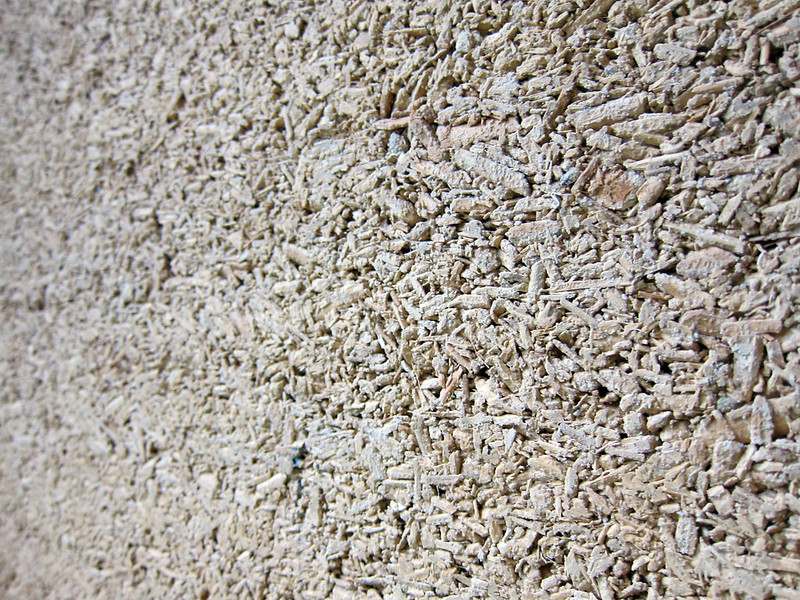
After the hempcrete is cast and before the plaster is added/Tommygibbons46, CC license
It has become almost a cliché to discuss the benefits of hemp, the supposed wonder plant with almost endless uses—from woven fibers to edible seeds to bioplastics.
“Of course, hemp is that magic crop that does everything,” says Nicholas Carter, an environmental researcher who, along with Tushar Mehta, a Toronto-based doctor, runs the website Plant Based Data.
His work involves reading through scientific papers and studies and summarizing the most important work supporting plants as a source of food and other important uses. Given the hype, Carter wondered just how much power hemp really had. “I wanted to see the research out there on it, to see what’s actually real, what’s actually backed by evidence,” he says.
Magic? Not exactly. But Carter came away from his attempted debunking a hemp believer. And one of the most promising of its many uses, he found, is its application as a building material known as hempcrete.
Like its namesake concrete, hempcrete is a material mixed with a binder that hardens it into a solid in the form of blocks and panels. Made from the dried woody core of hemp stalks and a lime-based binder, hempcrete can be cast just like concrete.
But unlike concrete and its binding cement, which accounts for about 8% of human-generated carbon dioxide emissions annually, hempcrete actually sequesters CO2. According to a recent study, hempcrete can sequester 307 kilograms of CO2 per cubic meter (19 pounds per cubic foot), roughly the equivalent of the annual carbon emissions of three refrigerators.
“While we’re growing it and building hempcrete, it’s sucking CO2 the whole time and encapsulating the CO2 in the structure,” says Eric McKee, founder of the U.S. Hemp Building Association.
S.R. Karade, senior principal scientist of the Central Building Research Institute in Roorkee, India, outside New Delhi, has been studying hempcrete and wrote in a recent paper for the Journal of Cleaner Production about how hempcrete performs as a building material in terms of insulation, durability, structural strength and acoustic control, among other criteria. Overall, Karade found, hempcrete meets the current standards of most building applications and in many cases outperforms materials currently used, particularly for insulation.
Hempcrete, Jnzl’s photos/CC license
Hempcrete is not a direct replacement of concrete, Karade cautions. In the lab he’s been able to make hempcrete with a compressive strength of 3 megapascals (MPa). “Typical concrete blocks, used for making walls, have compressive strength values varying between 5 MPa and 20 MPa,” he wrote in an email. “Due to its poor mechanical strength, it cannot be sufficiently relied upon to undertake any structural loads. However, considering its impressive functional properties, in terms of thermal resistance and [moisture-absorbing] behavior, hemp concrete may be at the top spot in the list of walling materials in the future.”
In other words, it can’t supply the load-bearing structure of a building, but it can insulate and cover its walls.
That’s part of what makes hempcrete such a potentially transformative building material, says Steve Allin, director of the International Hemp Building Association. Not only can hempcrete itself sequester carbon, but its use can help reduce the production of more CO2. “What’s really important about this material is we can create new structures or we can update or retrofit existing structures so that they don’t need air conditioning,” Allin says.
As Karade notes, hempcrete has a high thermal capacity compared with concrete, making it good for both the structure of a wall and its insulation.
Hempcrete can also cut down on another big problem: construction waste. Concrete represents more than half of the debris generated by building construction and demolition. The U.S. Environmental Protection Agency estimates that more than 23 million tons (more than 20 million metric tons) of concrete debris was created during construction in 2015. And while hempcrete can’t be used for structural sections of a building, it can be used to replace non-structural elements of walls that traditionally could use concrete. Hempcrete can also be used in place of common construction materials like drywall and plaster, which account for about 8% of building construction debris.
Allin says builders are beginning to see value in hempcrete. Buildings have been built or renovated with hempcrete in France, the U.K., Belgium, Ireland, the Netherlands, Italy, and Australia. He says the British Science Museum Group’s artifacts storage facility used hempcrete, as have public housing towers and even renovations on stone buildings hundreds of years old.
The challenge, he says, is availability. There are only about a dozen hemp processing plants that are able to process hemp into a form usable in the creation of hempcrete, and most are in Europe, according to Allin. “That’s really the logjam,” he says. “What we really need is investment in primary processing. And that investment needs to be on the longer term, rather than people expecting quick returns and thinking of it as some other standard quick buck.”
Karade notes that the other major challenge is the legality of growing hemp, which can be hard to distinguish from marijuana plants. “The commercial off-take of hemp concrete is still limited by the regulatory constraints of hemp cultivation,” Karade says.
But laws are beginning to change. In the U.S., the 2018 Farm Bill allows for the broad cultivation of “industrial hemp,” but with tight restrictions on grower licenses and the crop’s psychoactive content, tetrahydrocannabinol, or THC.
Allin hopes this will lead to more farmers producing hemp crops and entrepreneurs seeing the opportunity to build the processing plants necessary to turn that hemp into building products. He says builders are willing to use hemp in their projects, but the products have to be available, which relies on the processing, which relies on the farmers. “Once those things are in place, it will all become profitable,” Allin says. “In a way we’re talking about starting an industry from the ground up.”
Build More Good News In Your Friends’ Lives—Share This Story…
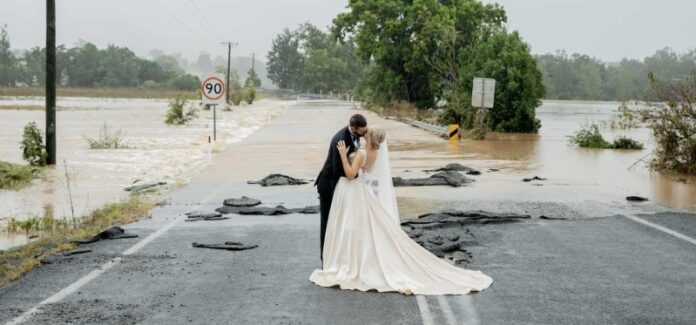
Usually, when you think wedding crashers, you picture uninvited guests hoping to score some free cocktails and hors d’oeuvres. But as rowdy as such pests can be, they’re nothing in nuisance value compared to the “100-year floodwaters” that recently crashed a wedding in New South Wales.
All photos by Amanda Hibbard
Kate Fotheringham and Wayne Bell were set to wed on a Saturday in March this year, but Mother Nature decided to throw a huge spanner in the works. The night before the nuptials, she R.S.V.P.’d with an epic deluge that left much of the town of Wingham where Fotheringham’s family live at least partially underwater.
With the only bridge between Fotheringham’s home and the wedding venue impassable—and with the bride and groom trapped on separate sides of the divide—it looked as if the ceremony would have to be postponed.
Miraculously, however, despite the soggy circumstances, the determined pair succeeded in tying the knot on their appointed day.
“It took three months to plan the wedding, 12 hours for it go to hell and six hours for it come together again,” Fotheringham told The Guardian.
“I had accepted the fact it was going to be raining and I was wearing gumboots, but I didn’t know how I was going to deal with a one-in-a-hundred-year flood and a natural disaster.”
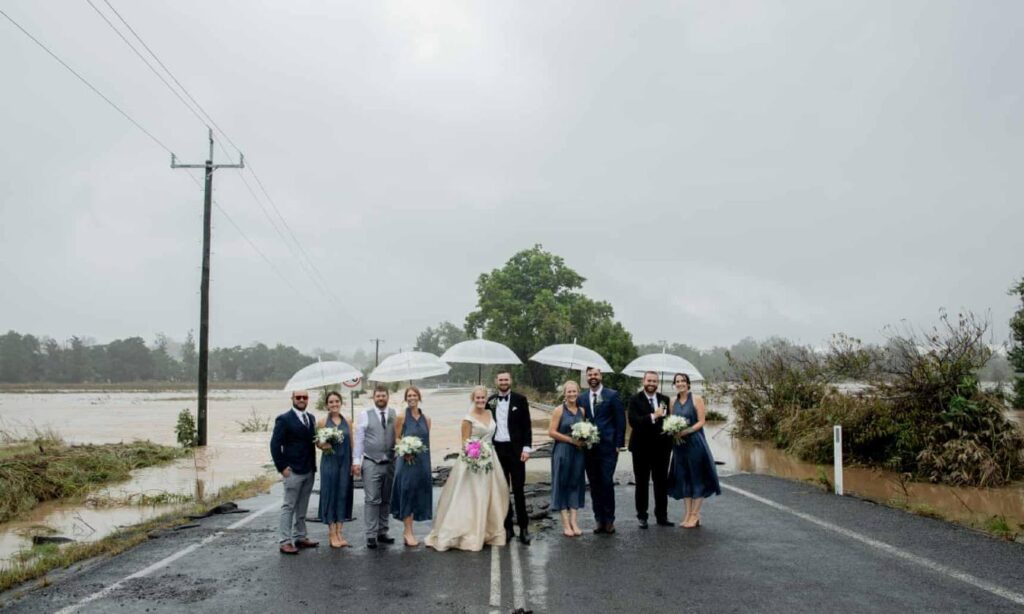
All photos by Amanda Hibbard
After some frantic social media posting, the couple was able to snag a helicopter from a local TV station to ferry the bride and her family members across the swollen waters.
In less than an hour, Fotheringham, her crew, and her wedding dress were safely on their way, but when they touched down on the other side, there were still hurdles to overcome.
Fortunately, most of the guests had camped out near the groom. Unfortunately, the caterer, makeup artists, and wedding singer were sidelined by the storm. Thanks to a reverse situation where a caterer and hairdresser due for weddings across the bridge were instead stuck in town, those bases were fortuitously covered.
Other than the women in the bridal party having to do their own makeup, the ceremony went off as planned.
Update, I made it to the church and married the love of my life! Affinity Helicopters in Port Macquarie came to the rescue and made sure we all got there. This is the bridge that blocked us from making the 5minute drive into town! What a day! #fotherbellwedding#floodwinghampic.twitter.com/u7OlsFsTjQ
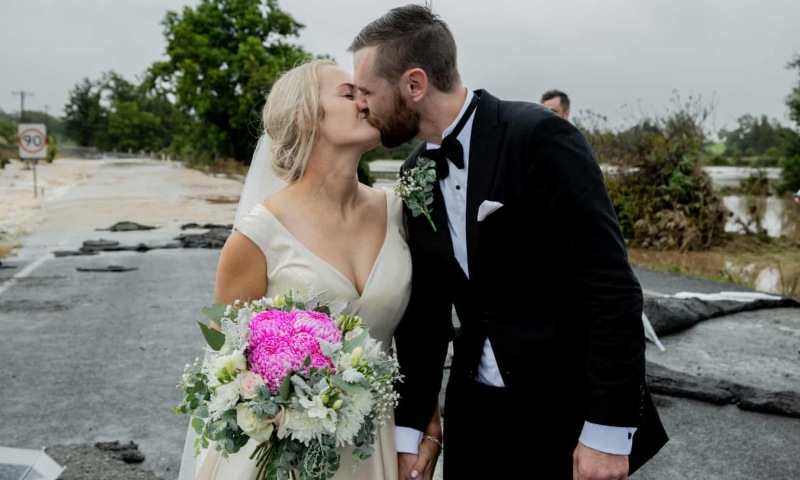
Only 15 minutes behind schedule, the couple was officially hitched. With nowhere to go, the reception turned into something of a celebratory marathon, continuing into the next day.
While the new Mrs. Bell admits the situation was so far-fetched as to be almost beyond belief, she credits her kin’s wherewithal for making what could have been a disaster into a triumph instead. “I can’t believe that we pulled it off,” she told The Guardian. “My family is incredible. We’re not ones to back down from something difficult, we can deal with a challenge—or 10.”
Perhaps the courageous couple should have changed their vows to read, “And what God has joined together, let no flood set asunder”?
(WATCH the video about the amazing wedding below.)
This Australian bride-to-be had to be airlifted to her wedding after her farm was left stranded by dangerous floods.
18,000 people in New South Wales have had to leave their homes, while many more are on evacuation alert with worse rain still to come.@VinnyMcAv | #5Newspic.twitter.com/zYB1U7Ph7t
North Carolina-based writer Judy Cole has a new murder mystery / rom-com debuting for Kindle at Amazon: And Jilly Came Tumbling After (from Red Sky Presents).
Everyone has different gut microbiomes, but eating avocado as part of a daily diet is a sure way to improve gut health—a new study from researchers at the University of Illinois shows.
Avocados are a healthy food that is high in dietary fiber and monounsaturated fat. However, it was not clear how avocados impact the microbes in the gastrointestinal system or “gut.”
The researchers found that people who ate avocado every day as part of a meal had a greater abundance of gut microbes that break down fiber and produce metabolites that support gut health. They also had greater microbial diversity compared to people who did not receive the avocado meals in the study.
“Microbial metabolites are compounds the microbes produce that influence health,” lead author Sharon Thompson says. “Avocado consumption reduced bile acids and increased short chain fatty acids. These changes correlate with beneficial health outcomes.”
The study included 163 adults between 25 and 45 years of age with overweight or obesity—defined as a BMI of at least 25 kg/m2—but otherwise healthy.
They received one meal per day to consume as a replacement for either breakfast, lunch, or dinner. One group consumed an avocado with each meal, while the control group consumed a similar meal but without the avocado. The participants provided blood, urine, and fecal samples throughout the 12-week study. They also reported how much of the provided meals they consumed, and every four weeks recorded everything they ate.
While other research on avocado consumption has focused on weight loss, participants in this study were not advised to restrict or change what they ate. Instead they consumed their normal diets with the exception of replacing one meal per day with the meal the researchers provided.
The purpose of this study—published in the Journal of Nutrition—was to explore the effects of avocado consumption on the gastrointestinal microbiota, says Hannah Holscher, assistant professor of nutrition in the Department of Food Science and Human Nutrition at U of I and senior author of the study.
“Our goal was to test the hypothesis that the fats and the fiber in avocados positively affect the gut microbiota. We also wanted to explore the relationships between gut microbes and health outcomes,” Holscher says.
Avocados are rich in fat; however, the researchers found that while the avocado group consumed slightly more calories than the control group, slightly more fat was excreted in their stool.
“Greater fat excretion means the research participants were absorbing less energy from the foods that they were eating. This was likely because of reductions in bile acids, which are molecules our digestion system secretes that allow us to absorb fat. We found that the amount of bile acids in stool was lower and the amount of fat in the stool was higher in the avocado group,” Holscher explains.
Different types of fats have differential effects on the microbiome. The fats in avocados are monounsaturated, which are heart-healthy fats.
Soluble fiber content is also very important, Holscher notes. A medium avocado provides around 12 grams of fiber, which goes a long way toward meeting the recommended amount of 28 to 34 grams of fiber per day.
“Less than 5% of Americans eat enough fiber. Most people consume around 12 to 16 grams of fiber per day. Thus, incorporating avocados in your diet can help get you closer to meeting the fiber recommendation,” she notes.
Eating fiber isn’t just good for us; it’s important for the microbiome, too, Holscher states. “We can’t break down dietary fibers, but certain gut microbes can. When we consume dietary fiber, it’s a win-win for gut microbes and for us.”
Holscher’s research lab specializes in dietary modulation of the microbiome and its connections to health. “Just like we think about heart-healthy meals, we need to also be thinking about gut healthy meals and how to feed the microbiota,” she explains.
Avocado is an energy-dense food, but it is also nutrient dense, and it contains important micronutrients that Americans don’t eat enough of, like potassium and fiber.
“It’s just a really nicely packaged fruit that contains nutrients that are important for health. Our work shows we can add benefits to gut health to that list,” Holscher says.
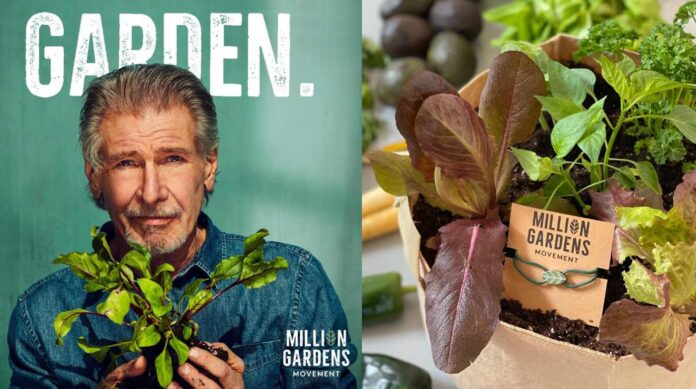
What do ten dollars, a garden, Harrison Ford, and Elon Musk’s brother have in common? They’re all being used to combat food insecurity, malnutrition, and to build the world’s single biggest gardener community.
Launched on the equinox, the Million Gardens Movement (MGM) is a charitable and educational initiative that hopes to put a garden in every household—whether that’s on a fire escape, in a window box, or as part of a community garden initiative—and fresh fruit and veg on every plate.
The brain child of Frank Giustra and Kimbal Musk, the former the owner and publisher of Modern Farmer magazine, the latter the Executive Director of the non-profit Big Green, MGM puts Little Green Garden units in homes and classrooms for just a $10 donation.
The Little Green Gardens are at their core ready-to-use fruit and veg garden beds—and over 5,000 of them have already been distributed.
Kimbal Musk explains that each garden bed comes “with a customized growing plan and online lessons and activities to support the growing of culturally relevant at-home veggie gardens.”
“We’ve been so humbled by the overwhelmingly positive response and the passion surrounding our mission,” says Frank Giustra. “When Warwick Saint was photographing gardening activists for our launch, activists like Salma Hayek and Jonathan Scott were asking us “What more can I do for the Movement? What else can I do to help get more people involved? That’s a real sign of how dedicated people are to making a difference.”
“Ten years ago I co-founded Big Green to focus on under-resourced communities to increase access to fresh food and improve food literacy,” says Musk. “Today it’s a national non-profit working with schools in several major cities with almost 640 outdoor Learning Garden classrooms.”
“Frank Giustra reached out with the idea of… Big Green and Modern Farmer [starting] the Million Gardens Movement to make it simple for anyone to give a family a garden. Planting a seed is an act of hope for a brighter tomorrow. We hope millions will join us to grow their own garden and give a garden to a family.”
Seed of hope
The seed of hope planted by Giustra and Kimbal certainly sprouted. With thousands of gardeners already joining up with the movement, celebrities are tagging along like Harrison Ford, Zooey Deschanel, Nicole Scherzinger, and Maye Musk, mother of Kimbal—and a certain billionaire named Elon, who happens to be Kimbal’s brother.
The hashtag #milliongardensmovement has over 300 posts on Instagram. 7,300 gardens in total have been started, including some done out-of-pocket, while 632 have gone into schools to teach kids about gardening and grow a new generation of gardening-savvy adults.
“The most successful aspect of the Million Gardens Movement has been the continual growth of an online gardening community,” says Giustra in an interview. “Our Movement, just like gardening, is about developing our best aspects slowly and steadily as we grow in numbers towards one million gardeners. Seeing people donate is wonderful because they are helping others garden, and those who donate might also take up gardening.”
“We’ve been able to deliver garden kits to Denver, Detroit, Memphis, and Indianapolis so far,” he adds. “We’re working to deliver 5,000 kits in Denver alone in April for Earth Month, and we’re working on delivery plans for cities after that drop.”
Turning the tide
The reality is that food insecurity was a problem in America long before the pandemic began. One study from 2017 found that 5.6% of Americans don’t have adequate access to fresh food. And just in Atlanta, Georgia, as GNN reported, 125,000 people live outside of a convenient distance from the supermarket.
The benefits of a home garden can significantly reduce these impacts—even something the size of the Little Green Gardens given out by MGM can help.
“Our hope is to quickly expand to Canada this year with sights on Vancouver and Toronto,” says Musk. “We hope to expand to Mexico and beyond to make this a worldwide movement to encourage millions of people to grow their own food.
GROW the Good News in Your Friends’ News Feeds—Share This Story…