













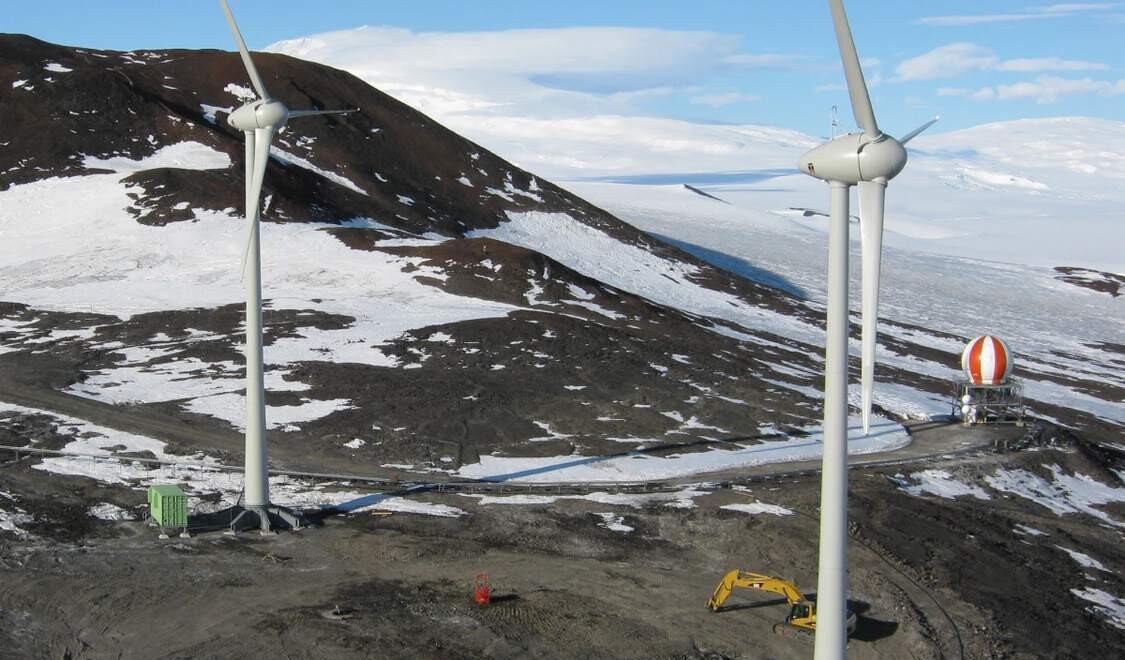
As they near the end of their productive lives, the 3 wind turbines spinning on Antarctica’s Ross Island have made an enormous impact on the energy market of the continent.
Built and commissioned over 2008-2009, the Ross Island Wind Farm was a daunting and technical engineering challenge that nevertheless mitigated roughly 122,000 gallons of diesel fuel consumption, and all the associated costs of shipping fuel there.
Powering America’s McMurdo Station and New Zealand’s Scott Base, the wind farm has proved beyond a shadow of a doubt that renewable installations can survive in even this harsh environment.
It was built by Meridian Energy, a New Zealand firm which had to approach the challenge of the wind farm in stages. Diesel generation was the only source of energy for the two bases for years, but the cost of shipping the fuel down towards the southern pole was a major draw on research funding.
Yet the long Antarctic winter is no place for weak machines. Meridian needed a novel design for the wind turbines to succeed. Project managers detail how each one was bolted onto Ross Island’s Crater Hill like a spider. A set of legs were drilled into precast concrete blocks, themselves set into “Antarctic cement” which was basically a mixture of water and gravel that just freezes solid in perpetuity.
Necessitating the ability to resist fearsome winds, the turbines spin without transmissions, eliminating problems associated with oil viscosity and friction, as well as working with simply fewer moving parts. Components were robustly designed to withstand -30°C temperatures.
WIND FARMS IN UNLIKELY PLACES: Jet Engine Exhaust is Turned into Electricity to Power Dallas International Airport
The only vessels that go down to Ross Island do so at the end of Antarctic summer, which meant that unless the turbines could be assembled by penguins, they’d have to sit all winter until crews could come down the following summer to put the turbines together. This problem imposed size restraints on the design: they had to be small enough to fit in shipping containers.
Despite all these challenges, the purpose built Enercon E33 turbines, each delivering 330 kilowatts, have survived 15 years of Antarctic service. When the wind is weak, which is rare, traditional diesel generation still makes up the difference.
They will be replaced with larger, more powerful turbines with a battery storage system when they reach the end of their lives in 2030 as part of a power-sharing agreement between the US and NZ.
RENEWABLE FRONTIER: Two-Headed Wind Turbine Could Solve Every Challenge in the Offshore Industry
During the 2024/25 season, the construction team completed the first foundation for one of the new wind turbines.
For the scientists working at Scott and McMurdo, the wind farm has allowed them to substantially reduce operating costs while simultaneously reducing carbon emissions, the consequences of which many scientists who’ve lived and worked at the bases over the years will have been trying to measure. It’s estimated 1,200 tons of CO2 have been prevented by the wind turbines.
WATCH a company recap below…
SHARE This Incredible Engineering Challenge And Its Big Rewards…