













Another of the infamous gentleman art thief “Erik the Belgian’s” heists have been solved.
For nearly half a century, a 13th-century carving of the Virgin Mary sat in a Spanish police database as an unsolved case.
The Romanesque sculpture vanished in 1979 from the Church of San Pedro de Meoz, a small parish in Navarre, swept up in a wave of church robberies that hit rural Spain hard where rich heritage was paired with almost no security.
The man blamed for it was René Alphonse van den Berghe, better known as Erik the Belgian, one of the most prolific art thieves in Modern history.
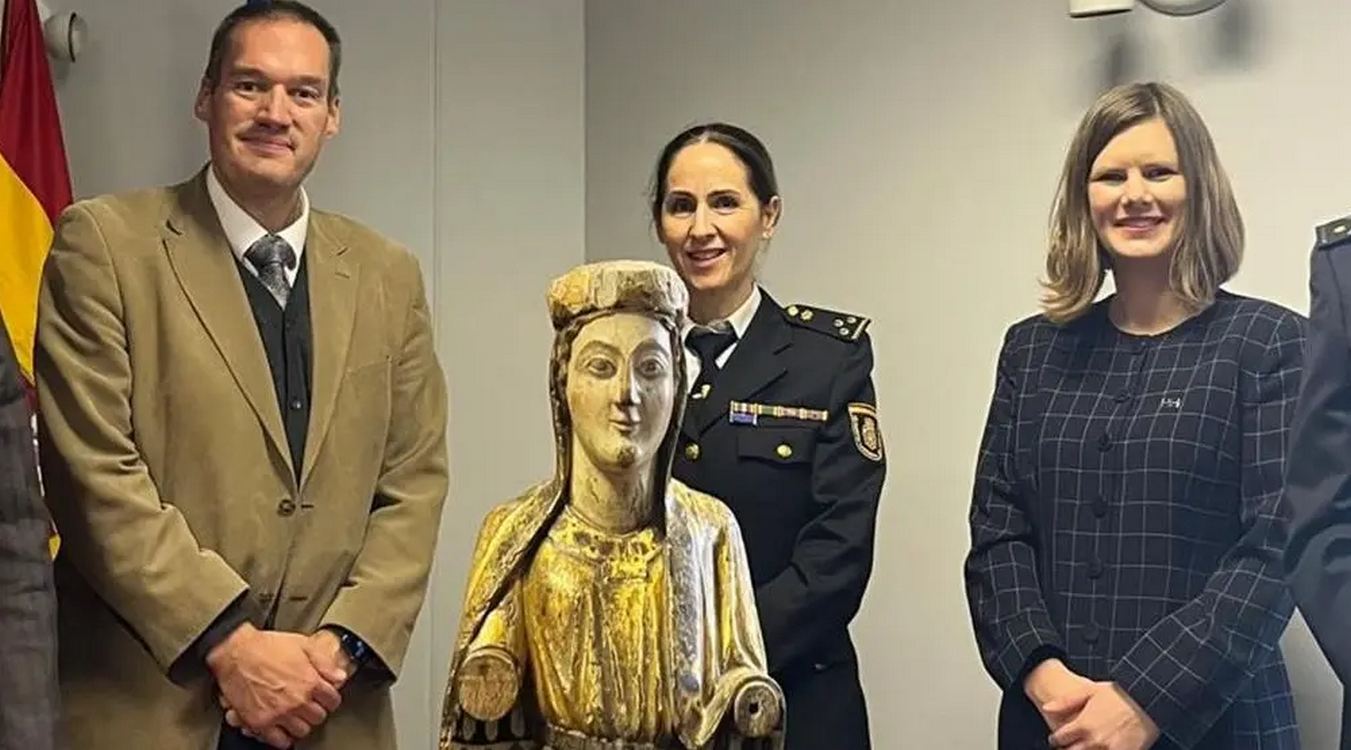
Now, at last, the piece is back where it belongs. Spain’s National Police announced its recovery from a collection in the United Kingdom, closing a trail that ran through Belgium, London and the Netherlands.
The sculpture is a seated walnut-wood Virgin, still carrying traces of its original gilding and polychrome, measuring 54 centimeters tall and holding the figure of the Christ Child—though she’s missing both forearms. Small enough to wrap in a blanket, valuable enough to disappear into the antiques trade for decades, that combination made her exactly Erik’s type.
A veritable manifestation of the fictional Arsène Lupin, Van den Berghe (1940–2020) robbed churches and monasteries across sparsely populated parts of his adopted country of Spain and elsewhere in Europe.
Thousands of crimes have been attributed to him, much of it involving medieval sacred art. He was also a painter and a forger, and in his later years leaned hard on his reputation as a “gentleman thief,” giving interviews, recounting heists, and even helping recover some of his own marks.
In 2023, GNN reported that a two-foot by two-foot square cut away from the bottom left corner of a 17th-century tapestry was recovered with the help of none other than the man who had held the scissors: The Belgian.
Van den Berghe’s most famous job was the 1980 theft of the silver Ark of Sant Martirià from the monastery of Sant Esteve de Banyoles in Girona, the prized reliquary of the town’s patron saint forged from silver in the 15th century.
The investigation into the Virgin Mary work was restarted in April after authorities got a useful lead, and quickly confirmed a long-suspected method of Erik: the loot went out by road to countries with hungrier art and antiques markets.
LEGENDARY HEISTS: A Hungry Cleaning Lady Bit into an Apple and Solved the Case of Legendary Diamond Heist
From there the paper trail was unusually legible. A Belgian dealer, Bernard Descheemaker, sold the Virgin in 2012; by 2017 she was in the collection of the Daniel Kanz Gallery in London; in 2020 she appeared at TEF Art Fair in Maastricht, a prestigious event that’s no stranger to the occasional stolen artwork.
She then passed through various dealers and collectors before ending up in a Spanish art collection in Britain. Spanish authorities were prepared for a legal fight.
“We are lucky, which does not always happen, that [the owner] understood that it was the virgin that Erick the Belgian stole from San Pedro de Meoz and they immediately wanted to return her. We can only be grateful,” Chief Inspector Montserrat de Pedro, responsible for the Historical Heritage Brigade of the Spanish National Police, told El Paìs.
MORE ART THEFTS RESOLVED: Italian Police Recover Stolen Renoir, Cézanne and Matisse Artworks Worth Millions
In charge of the investigation, de Pedro said that in such instances when two people of good faith exchange a stolen work, legal avenues for its recovery can be difficult. Yet here, no such avenues needed exploring.
The formal transfer took place at the Spanish Embassy in London, with help from the Metropolitan Police and the embassy’s interior counsel. Erik the Belgian—who titled his 2012 memoir For the Love of Art, died in 2020, but one might wonder whether he would have been happy to see the Virgin conclude her long journey and return to the town he lifted her from.
We’ll leave that to the romantics.
SHARE This Amazing Story From The Art Markets Of Europe…