













176 years ago today, a hero of the Japanese nation was born on the Greek island of Lefkada. Scarcely could one find a life as strange and colorful as that lived by Patrick Lafcadio Hearn, who was the first Westerner to write extensively on everyday life in Japan. His unrivaled affection for the country that would become his home and resting place “lies in the glimpses he offered of an older, more mystical Japan lost during the country’s hectic plunge into Western-style industrialization and nation building,” wrote the Times. “His books are treasured as a trove of legends and folk tales that otherwise might have vanished because no Japanese had bothered to record them.” READ about his incredible life… (1850)
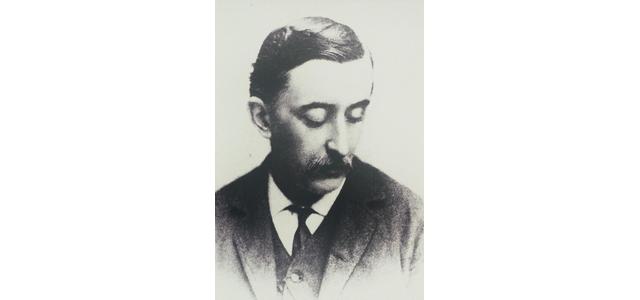
The strange and colorful life mentioned earlier can be summarized thusly. Born to a Greek mother and Irish-English father, Hearn would emigrate and grow up in Dublin only to be abandoned first by his mother then his father, then by his aunt before moving to the US. At 19 he arrived in Cincinnati before relocating to New Orleans where he would become a journalist and be sent on assignment to French Martinique for 2 years and eventually Japan where he would remain forever.
Incredibly, he was able to obtain a teaching position in a town on the western coast of Honshu, where today a museum honors his life, works, and memory.
Hearn’s observations were remarkably keen, and he recorded extensive details of the mythology and mystery of Shintoism for the people and villages who kept it alive amid the Meji Restoration.
Hearn would eventually marry and sire 4 children in his adopted country, before taking his wife’s name and becoming a Japanese citizen, teaching English at the Imperial University in Tokyo, and passing away at age 56. For those who admire Japanese culture, his books are a must, and this passage describing one’s first impressions of Japan makes for superb introduction to Hearn.
“They are effervescent, you know; they will never come to you again, once they have faded out… you will feel none so charming as these. I am trying now to reproduce them from the hasty notes of the time, and find that they were even more fugitive than charming; something has evaporated from all my recollections of them–something impossible to recall. I neglected the friendly advice in spite of all resolves to obey it: I could not, in those first weeks, resign myself to remain indoors and write, while there was yet so much to see and hear and feel in the sun-steeped ways of the wonderful Japanese city. Still, even could I revive all those lost sensations of those first experiences, I doubt I could express and fix them in words. The first charm of Japan is intangible and volatile as perfume.”
MORE Good News on this Day:
- President John F. Kennedy visited his ancestral homeland from where his great-grandfather set sail for America during the Irish potato famine of 1848, and reporters covered the joyful return (1963)
- President Richard Nixon, having made great progress over the previous two years in US-Soviet relations, visited the USSR for the second time, arriving to a welcome ceremony, cheering crowds, and a state dinner with Brezhnev at the Grand Kremlin Palace—and for discussions of a proposed mutual defense pact, détente, and nuclear weapons (1973)
- Queen played their first gig featuring Freddie Mercury (possibly still known as Freddie Bulsara) on vocals, guitarist Brian May, drummer Roger Taylor, and Mike Grose on bass at Truro City Hall, Cornwall, England (1970)
- The Indigenous and Tribal Peoples Convention adopted the ILO-169, a major binding international convention to respect the rights of indigenous peoples. It was ratified by 22 countries (1989)
- US President Bill Clinton and China’s Communist President Jiang Zemin appeared in a live joint news conference that was seen throughout China, with questions and answers that gave viewers an uncensored look at the differences between the two nations, with discussions about trade, human rights, Chinese freedoms, and their views on the 1989 Tiananmen Square massacre and the Dalai Lama [See the full one-hour video on YouTube] (1998)
- The first federal Do-Not-Call list went into effect with the US registering more than 735,000 phones for a list that blocks some of the unwelcome solicitations of telemarketers–except for charities and political groups (2003)
146 years ago today, Helen Keller was born with full sight and hearing in Alabama. But before the age of two, she was stricken with disease that left her deaf and blind. Yet, at age 24, she became the first deaf and blind American to earn a bachelor’s degree (cum laude), and she became a world-famous speaker and author of twelve books—the first while she was still in college.
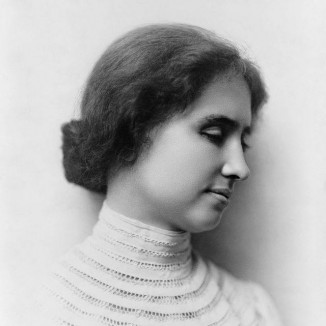
She traveled to 39 countries and was remembered as a suffragist and leftist activist, but mostly, being a powerful advocate for people with disabilities and transforming others’ view of them. Her life—and her education with radical teacher, Anne Sullivan—was immortalized on Broadway and film. The play and film version of, The Miracle Worker, were based on Helen’s autobiography, The Story of My Life. WATCH a short video and learn more… (1880)
On this day 128 years ago, Joshua Slocum completed the first solo circumnavigation in the world, amazingly, on a sailing yacht he built himself from scratch. His journey began in Nova Scotia, in April, and he wrote a book about the trip as he went, entitled, Sailing Alone Around the World which contains such literary skill as to make one jealous, for no one who should be so excellent at one skillset, sailing, should be able to be so excellent at another. Throughout his trip he sailed almost exclusively with primitive navigation skills such as judging the movements of weather, seabirds, and currents, and at one point, a passing yacht used the then-state-of-the-art chronometer to give him a lat. long. bearing, of which his own mind had perfectly estimated.
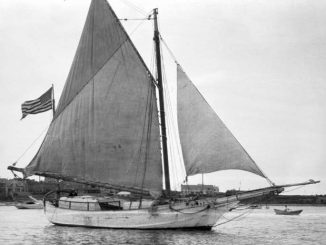
After leaving Briar Island in Nova Scotia he passed up along the northern reaches of Canada, Greenland, and then across the Atlantic to the Azores and down to Gibraltar where he was dissuaded from talking the Suez Canal to the Red Sea due to an attack on his boat by pirates. From there he re-crossed the Atlantic and made south from Rio to the Straits of Magellan where he entered the Pacific from Tierra del Fuego. Crossing the South Pacific he went up South Asia, the Indian Ocean, around South Africa, and back to Nova Scotia.
Along the way, the reader of his journey can see that Slocum is stuck between two epochs, the first of mass commercialized sea travel with steamships into which he is going, and the kindly, skill-oriented life of sailing and seamanship from which he is born into. He encounters pirates, and hostile Native Americans provides endless insight into sea animals and sea weather, and will fill your vocabulary with more ship terms than you could possibly remember. (1898)
20 years ago today, the British Foreign and Commonwealth Office Minister wrote an essay to remind everyone that Muslims have been an integral part of Britain and its way of life for centuries—and Islam is not something that’s arrived in the last few years.

Lord Triesman’s essay, originally printed in the Jordan Times and reprinted with permission here at Good News Network, reminded Westerners that the rich scientific tradition in Muslim countries, with advances in medicine and mathematics—and countless other civilizing influences—“triggered the Renaissance and allowed Europe to slowly emerge from the Dark Ages.” (2006)
Also, on this day in 1987, Whitney Houston became the first woman in US history to enter the album chart at #1 with ‘Whitney’. She is the only artist ever to chart seven consecutive #1 songs on Billboard’s Top 100, and also became the first woman to top the singles chart with four consecutive releases, when ‘I Wanna Dance With Somebody’ hit No.1.
Houston was also an actor, and her first role was starring in The Bodyguard (1992). The film’s original soundtrack won the 1994 Grammy Award for Album of the Year. Its lead single, “I Will Always Love You“, won the Grammy Award for Record of the Year and became the best-selling single by a woman in music history. In 2009, Guinness World Records cited the New Jersey native who died at age 48 of drug use as the most awarded female act of all time. (1987)
And, 27 years ago today, skateboarder Tony Hawk became the first person ever to land the 900, or two-and-a-half full rotations in the air on a skateboard, when he completed the trick at the fifth edition of the X Games, in California. It took him twelve attempts, but managed it, and declared it was the “best day of my life.”

Over 20 years later, Tony is adamant that he was the first person to perform the trick successfully, and that of the three other skaters sometimes touted as having done it before him, Hawk will point out that all were able to spin, but none were able to ‘land’ the trick, which is the big difference as one can see in the video below. (1999)
SHARE the Milestones, Memories, and Music…