














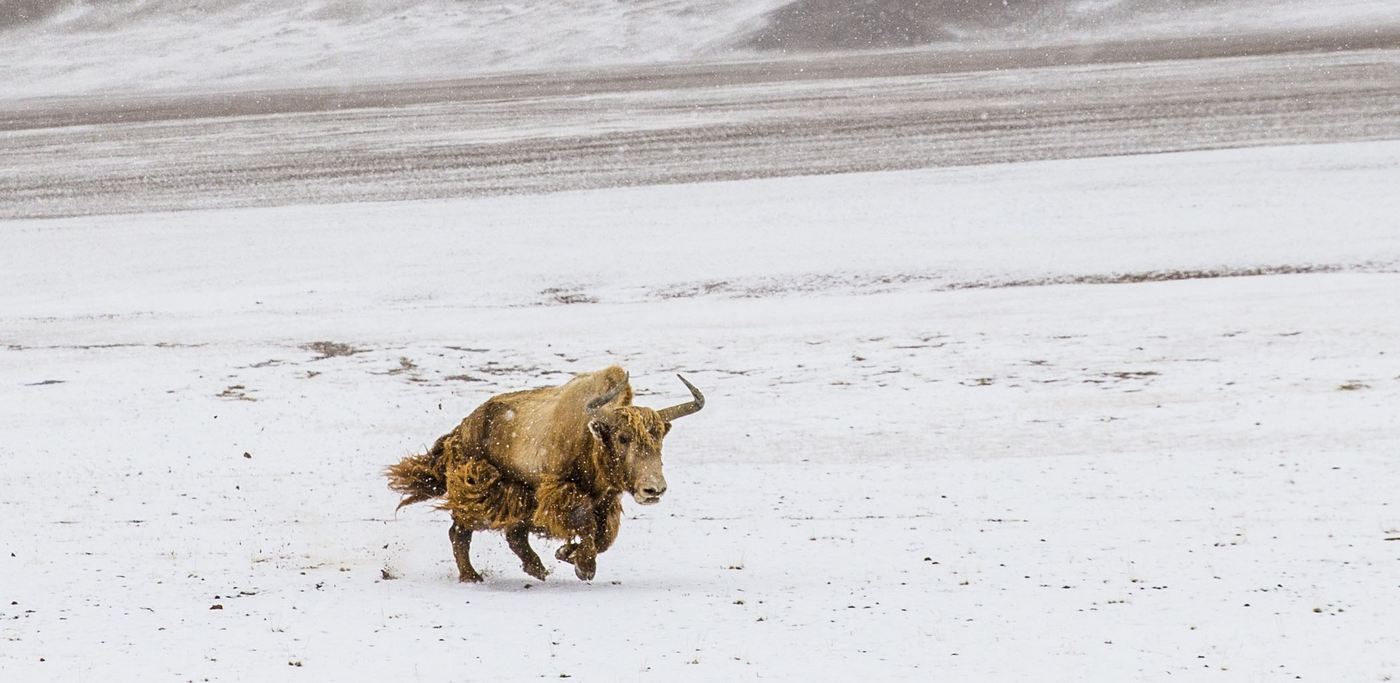
China has performed the first single and multiple cloning of wild yaks in a bid to reinforce this keystone herbivore, and save one of the rarest and most beautiful animals in China.
Legend has it that when Mount Buye on the Tibetan Plateau was married to Mount Zhaxiangqian, 7 golden wild yaks were given as a dowry. This is why, locals have it, the golden yak can only be found high in these mountains.
Conservationists and geneticists studying this enigmatic and stunning creature might say that the reason they’re only found high in these mountains is because they have been hunted, outcompeted, and outbred such that today they’re considered Critically-Endangered.
Now though, a comprehensive cloning program has seen biologists produce wild yak embryos that were then delivered organically, without assistance, by wild yak females, indicating that the first step towards potentially saving this legendary creature—with the small side benefit of increasing the “Vulnerable” wild yak population—is now possible.
Native to the Qinghai-Tibet Plateau (QTP), the wild yak (Bos mutus) evolved for thousands of years to thrive in the high altitude and frigid environment. It is the ancestor of the domestic yak (Bos grunniens) and most closely related to bison.
As humans domesticated the yaks, they quickly became the difference between life and death in the Himalayas. Their wool provided clothing to keep out the cold; their milk provided food and even oil for lighting; their dung provided fuel for the fire.
A genetically-distinct subspecies of the wild yak exists in the highest reaches of the QTP whose coats flush a brilliant burnished gold, and which seem to be even more well-equipped genetically speaking for their mountain home.
Ka Bu, a documentarian who filmed the golden population for a 2016 documentary called Golden Wild Yak, explains that protections for this animal are as stringent as can be provided under Chinese law, and that over 700 local herders and farmers are employed in keeping domesticated yaks away from their strongholds in Changtang National Park, and performing poaching patrols over the vast landscape.
Nevertheless, the population may number as few as 170 to 300, and genomic studies that have ruled out the golden yaks as being merely wild yaks with a case of leucism, have found that the population suffers from inbreeding.
In 2023, a partnership between Zhejiang University in China’s southeast, and the Institute of Plateau Biology of Xizang saw biologists sequence whole genomes of almost 9,000 wild yaks to create a total genetic inventory in advance of a cloning program. Cloning often gets misrepresented as duplicating a living animal, when really the infant thusly birthed carries entirely different genetics to its parents.
MORE CHINESE CONSERVATION:
- Chinese Pangolin Numbers Growing Steadily in the Wilds of Southern China for the First Time This Century
- 40 Years of Work Returning 900 Wild Horses to China’s Steppes is Celebrated in Year of the Horse 2026
Cloning was successfully used in America in 2008 to keep the black-footed ferret from falling back into extinction due to limited genetics. The offspring of that animal have subsequently reproduced naturally in captivity.
Last July, the Zhejiang-Xizang team succeeded in the first yak cloning in history, a feat they then surpassed by cloning 10 at a time just recently. Their aim is to establish a new wild herd with genes taken from across the wild yak gene pool, and then turn their attention to the golden yak.
The golden wild yak subspecies has already had its whole genome sequenced, and the traits that give it its robustness and golden color are well known. The scientists that performed that work, independent of the cloning program, cited the animal as a “an Evolutionarily Significant Unit (ESU) of high conservation value.”
DRASTIC MEASURES: How ‘Frozen Zoos’ Are Helping Save Vanishing Species
“Special attention should be paid to preventing genetic deterioration caused by elevated inbreeding, as well as mitigating the risk of genetic swamping through hybridization with large sympatric and neighboring populations of common wild yak,” the authors wrote, who found the golden wild yak to carry additional unique traits associated with hypoxia tolerance, reproductive function, and immune response typical of a high-elevation living.
With time and hope, this beautiful mountain ‘dowry’ just may, with the help of the most advanced biological sciences, maintain its place among the legends of its beloved mountain home.
SHARE This Cloning Success In Preparation To Save A Living Legend…