














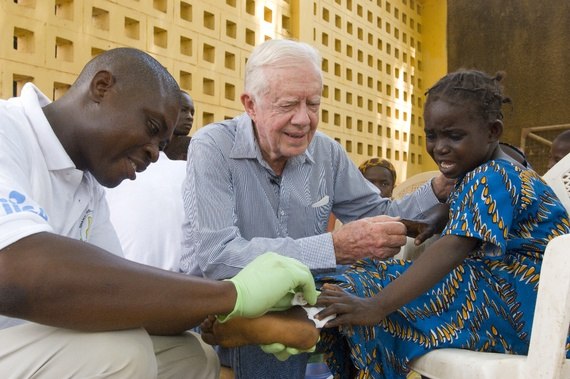
Only 10 human cases of Guinea worm were reported worldwide in 2025, the lowest number ever recorded, bringing the ancient disease closer than ever to eradication.
Poised to be only the second human disease eradicated after smallpox, the 10 Guinea worm cases mark a 33% decline from the 15 cases reported in 2024.
Shared in a statement from the Carter Center, the historic number follows the one-year anniversary of the passing of former US President Jimmy Carter who campaigned tirelessly to achieve this outcome, and in the 40th year since he began to do so.
When The Carter Center embarked of its global Guinea worm eradication campaign in 1986, an estimated 3.5 million human cases occurred annually in 21 countries in Africa and Asia.
Together with partners, including the countries themselves, the campaign has reduced the waterborne, parasitic disease by more than 99.99% compared to 40 years ago. This equates to more than 100 million cases of this devastating disease averted among the world’s most marginalized and neglected populations.
“Guinea worm causes immense suffering—not just for the individual but for their family and community as well,” said Adam Weiss, director of the Carter Center Guinea Worm Eradication Program.
“Every case is a real person we know by name. They are enduring a disease we know how to prevent, and we’ve been given this rare opportunity to wipe it out completely. We’re energized by this year’s progress, but zero is the only acceptable number, and that’s why our commitment to finishing this job is unwavering.”
The scope of the achievement is difficult to understate. Guinea worm is slated to be the first parasitic disease eradicated in history and the first without a medicine or vaccine.
However, the parasite that spreads the disease can infect both humans and animals, so eradication would require zero cases in either group. Currently, hundreds of cases are still detected every year in domestic animals. Human cases were only detected in South Sudan, Chad, and Ethiopia. Mali has now recorded zero cases for the second year in a row.
PROGRESS AGAINST TROPICAL DISEASE: Key Discovery Could Be a ‘Valuable Starting Point’ To Saving Children from Deadly Disfiguring Condition
The Carter Center wrote that eradication efforts are driven by strong partnerships, community-based interventions, and behavior change, with a network of hundreds of thousands of community-based volunteers trained to provide health education.
For a disease to be declared eradicated, every country in the world must be certified free of human and animal infections, even in those where transmission has never been known to occur. To date, the World Health Organization has certified 200 countries free of Guinea worm; only six have not been certified.
OTHER STORIES LIKE THIS: WHO Declares Kenya Free of This Deadly Tropical Parasite After Decades of Suffering
“This campaign reflects the values that shaped my grandparents’ lives—the conviction that hope, hard work, and respect for everyone can change the world,” said Jason Carter, Carter Center board chair and eldest grandchild of President and Mrs. Carter.
“Seeing Guinea worm cases reach historic lows is one of the clearest expressions of that legacy and our commitment to the communities where trust has been earned.”
SHARE This Incredible Achievement Coming Close To Ultimate Success…