














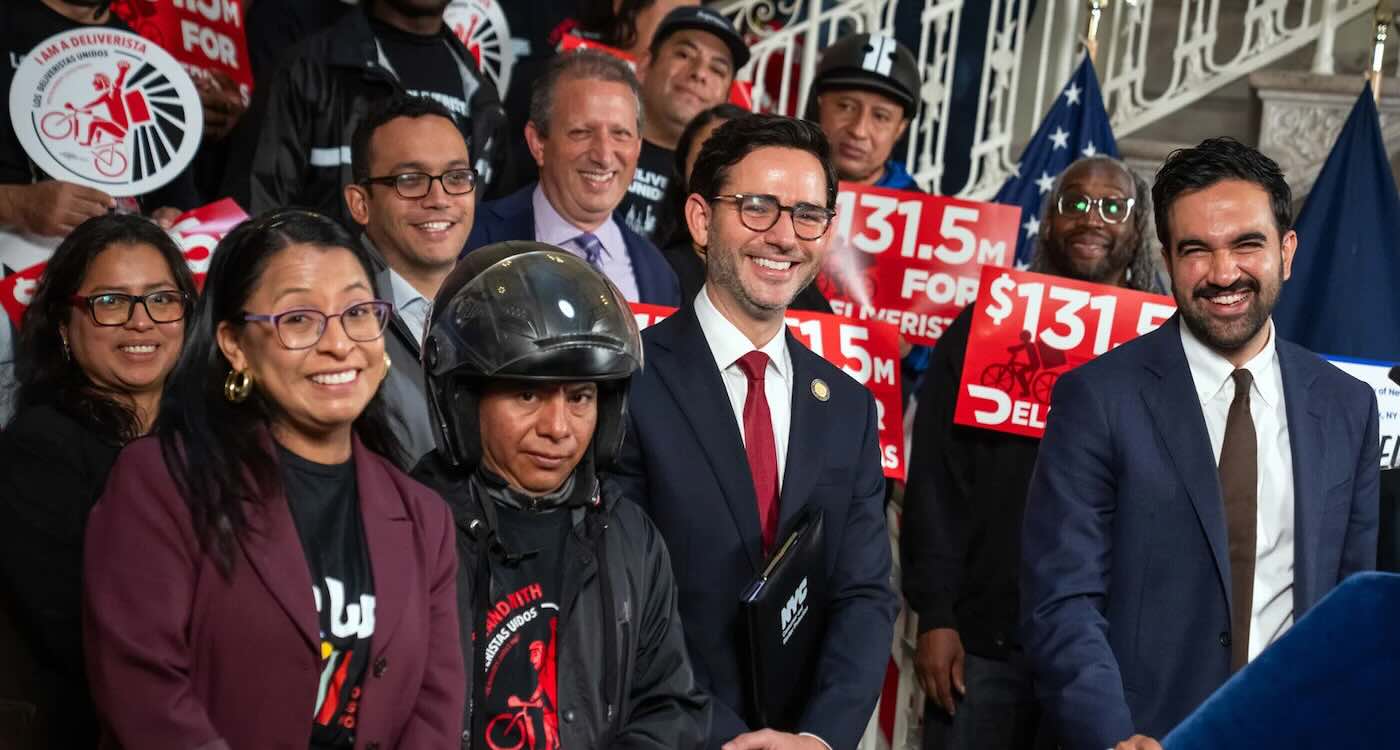
The New York City Department of Consumer and Worker Protection (DCWP) announced a historic $131.5 million enforcement action against DoorDash for systematic violations of the local Delivery Worker Laws.
The settlement will place more than $115 million directly into the pockets of delivery workers and pay for $16 million in civil penalties and costs. More than 260,000 workers were underpaid by DoorDash, including workers who were not paid at all, or were paid late for work they had already performed.
It’s the largest worker settlement in New York City history.
“DoorDash underpaid more than 260,000 workers, and today we are getting that money back,” said Mayor Mamdani. “When a worker earns a wage, they deserve to be paid that wage, on time and in full.”
He reminded the public that no corporation is above the law—especially when it earns $13.7 billion in revenue, like DoorDash did in 2025, a 28% increase compared to their 2024 revenue of $10.72 billion.
“Today, New York City’s delivery workers are showing that opaque algorithms will not have the final word when it comes to how much they are paid for the hard work they do,” said DCWP Commissioner Samuel A.A. Levine.
The settlement is about more than recovering money that workers are owed. It also puts in place a new monitoring system ensuring DoorDash follows the law going forward—one that gives workers a direct role in identifying violations and gives the City data it needs to act.
A Princeton University partner, the Workers’ Algorithm Observatory, will develop software that will allow the drivers to share their DoorDash trip and earnings data directly with the agency. It will allow DCWP to monitor DoorDash’s compliance with minimum pay, maximum trip distances, trip disclosures, pay transparency, and tip transparency.
DCWP’s citywide investigation began after dozens of workers filed reports with the Department.
The agency found that DoorDash failed to pay thousands of workers at all for work they had performed and failed to pay thousands more on time. These workers will receive compensation calculated at approximately 200% of the amount they were underpaid.
For example, a worker who was owed $1,000 but received no payment will receive $3,000. A worker who was paid $1,000 later than allowed under the law will receive $2,000.
Workers don’t even need to file a claim or submit evidence to receive payment. DCWP has identified all individuals owed money through its analysis of DoorDash’s records—and payments will be sent out this fall.
MORE IMPROVEMENTS FOR NYC: New York City is Putting ‘The Park’ Back in Park Avenue – And Adding a Protected Bike Lane (LOOK)
The case’s Settlement Administrator will send personalized emails to each worker who experienced an underpayment from April 22, 2022 to June 28, 2026. Workers will be able to choose between an electronic payment and a check by mail.
More details of the case is available at nyc.gov/doordash.
As part of the investigation, DCWP obtained terabytes of data from DoorDash, including billions of rows documenting the company’s treatment of delivery workers. DCWP’s Research and Analytics Division analyzed the data to identify more than 152 million individual payment transactions and 110 million working hours connected to the investigation.
DoorDash will be required to make software updates to prevent the company from offering a delivery to a worker in New York City unless that worker’s time is being recorded as compensable on-call time or trip time. The updates will also provide workers with additional information about their work time and pay and ensure DoorDash complies with the Minimum Pay Rule for “batched” trips, ending the unlawful practice of paying a lower rate for certain legs of a trip.
“Amidst a cost of living crisis, delivery workers deserve to rest assured that work completed means compensation earned,” said Council Member and Consumer and Worker Protection Chair Harvey Epstein.
The city passed a minimum wage law in 2021 which is adjusted annually for inflation and currently sits at $22.13 per hour.
“DoorDash thought they could shortchange their workers and get away with it,” said Council Member Sandy Nurse. “As DoorDash pulls in record profits, the workers who make them rich are entitled to their fair share.”
SEND A DELIVERY OF GOOD NEWS By Sharing This on Social Media….