













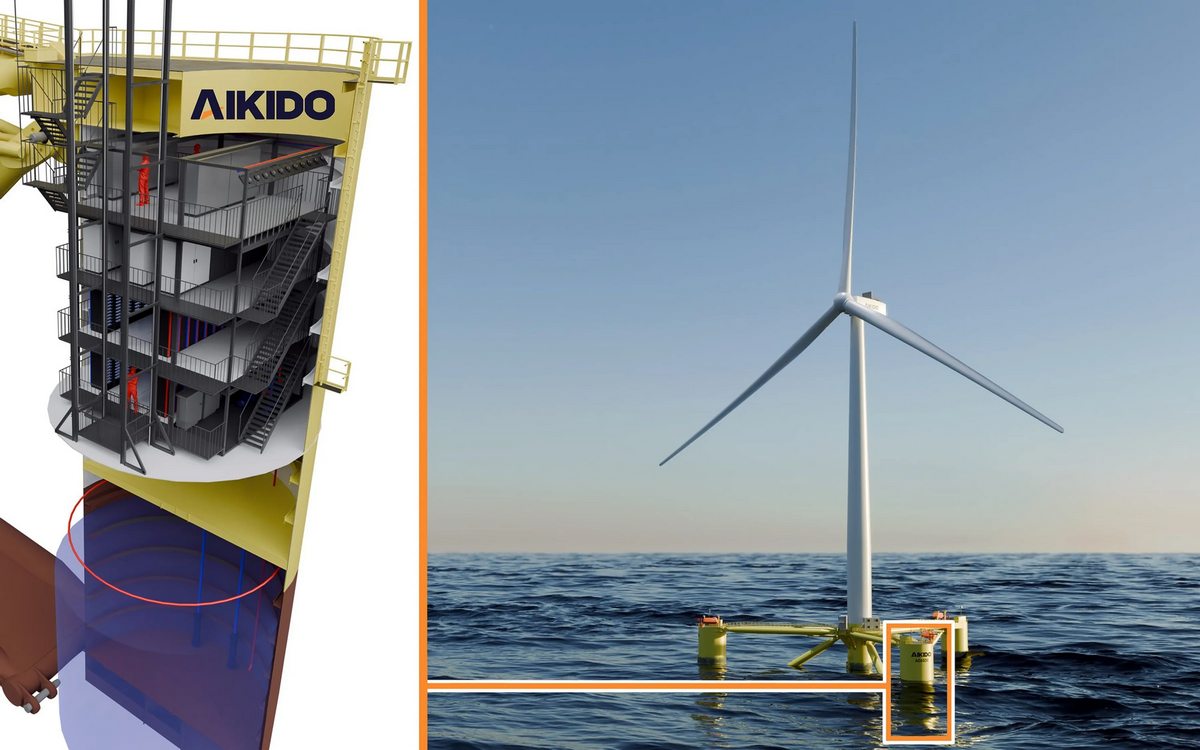
An offshore wind power firm has developed a prototype turbine that hosts a 12-megawatt data center within its ballast tanks.
The demands of AI computing have driven data center developers to seek creative solutions when building these incredibly power-hungry installations.
One is to build them into floating offshore installations where renewable energy can be gathered to power them, and where the cold ocean waters can disperse the heat generated by the data banks.
Wind power company Aikido has developed a novel data bank/wind turbine product that will be deployed in the North Sea as a prototype in 2027. With 100 KWh of computing power, it will test whether or not Aikido’s design can work effectively to disperse heat and resist the famously corrosive marine environment.
“We have this power from the wind. We have free cooling. We think we can be quite cost competitive compared to conventional data-center solutions,” Aikido CEO Sam Kanner told IEEE Spectrum.
“This crunch in the next five years is an opportunity for us to prove this out and supply AI compute where it’s needed.”
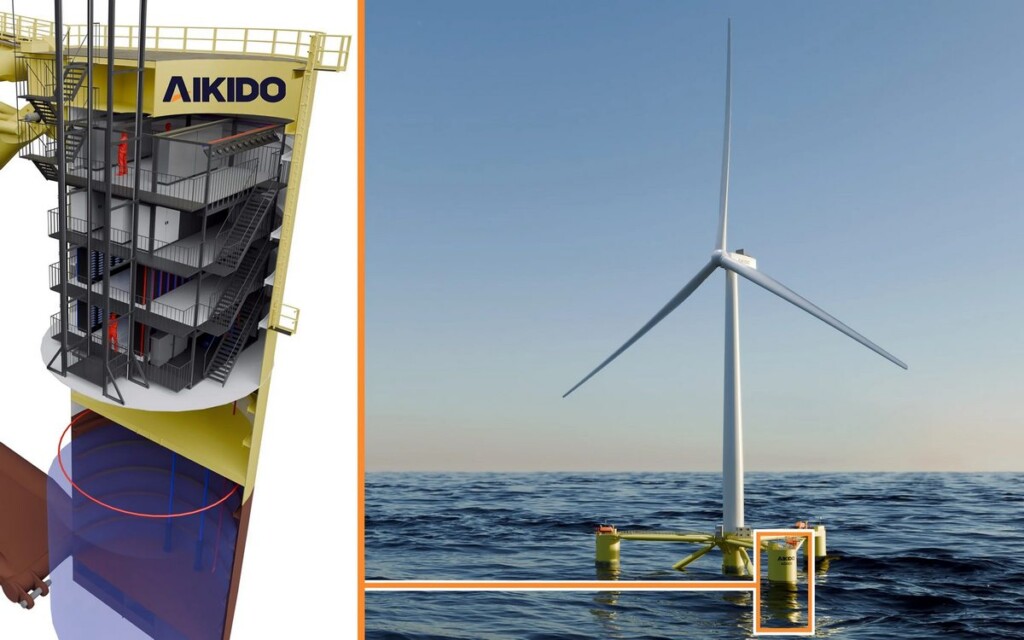
If the prototype works, a full-scale device could be deployed by 2028. The design piggybacks off of state-of-the-art, floating, offshore wind turbines. Rather than being drilled into the seabed, the installation will float on the waves supported by a tripod of ballast tanks that extend 60 feet down into the sea.
The bottom two-thirds of the tanks will be filled with freshwater to keep the structure upright, while the top third will be where the data banks are stored. Fresh water is pumped up to a combination safety-cooling chamber that divides the two units, where it will quickly absorb the heat from the devices.
Afterwards the water will be pumped back to the bottom of the ballast tank and disperse the heat into the colder marine environment.
Data centers currently suffer from a “not-in-my-backyard” phenomenon on land. Their incredible rate of energy consumption has been found to drive up local electricity costs, while they also require substantial amounts of land and cooling power. There is noise pollution complaints as well.
As a result of these obstacles, developers are looking more and more at how to build a data center without community input—far offshore is one solution, another one is even crazier: outer space.
Orbital is a space startup looking to transfer humanity’s computing power into Earth’s orbit where the frigid vacuum of space would deal with the cooling issue, and unlimited power from the Sun would generate the electricity.
Orbital’s first satellite is set for a 2027 launch aboard a SpaceX Falcon 9 rocket, aiming to validate GPU operations in space and support AI inference workloads with no demand for real estate or grid-level power demand.
COMS AND COMP: NASA Sends Data Over 10 Million Miles for the First Time Using a Laser
Current data center footprints in just the US consume 75 gigawatt hours of electricity, and this is expected under economic conditions without a recession to grow to 135 gigawatt hours by the end of the decade. Only nuclear power, it’s believed, is dense and modular enough to satisfy these requirements.
In space, the solar constant of 1,361 Watts/m² is uninterrupted by Earth’s reflection, particle scattering, and weather conditions. That power is limitless, predictable, and guaranteed, allowing for precise, deliverable computing without any interruption.
The idea seems to reflect the early stage of the “Dyson sphere” concept put forward in the 1960s by renowned British American physicist Freeman Dyson.
MORE BIG DATA STORIES: Maryland to Become First US State to Ban Surveillance Pricing That Charges More After Mining Personal Data
His idea was that, similarly to how metal smelting marked the end of the Stone Age and the start of the Bronze Age, all advanced civilizations would eventually harness the power of the star at the center of their home star system.
They would likely build a sphere, Dyson wrote, consisting of “a loose collection or swarm of objects traveling on independent orbits around the star.”
SHARE These Great Alternatives To Land-Based Data Centers…