All News - Page 1676 of 1688 - Good News Network
Home Blog Page 1676

Nation Overcomes Turbulent History; Christian and Muslim Tanzanians Live in Peace

125px-Flag_of_Tanzania.svgWith all the bad news associated with Africa, it is refreshing to read about the successes. Tanzania is a haven of co-existence between two peoples joined in unification in 1964, Tanzanian mainlanders, who are primarily Christian, and the Zanzibaris, who are 98 percent Muslim. Terry Mosher writes in the Montreal Gazette of the “lovely, helpful people” just south of the equator.

Tanzania is one of the poorest countries in the world, but it got a boost yesterday from the United Arab Emirates who made a large donation out of concern for the country’s food shortages wrought by draught, the Tanzanian IPP Media reports.

While the people are suffering from poverty and hunger, the government does not lose sight of the future.

Realizing that the health of its ecosystem is critical to their fortunes as a country, Tanzania used financial assistance from the World Bank to transfer seventy-two Kihansi spray toads to US zoos in 2002 following fears that they were on their way to extinction.

After remarkable success in the well-managed American zoos, where the toads multiplied by 200 percent, the exiled amphibians are on their way home.

“While many species of flora and fauna may appear to have no consumptive value today for humanity, the same species may prove to be extremely useful in future.”

Nerve Regeneration One Step Closer in MIT Lab

Christopher Reeve, a quadripelegic since his traumatic fall from a horse resulted in the severing of nerves in his spinal cord, always held fast to the belief that one day he would walk again. Reeve didn’t survive long enough to realize his dream, but today, scores of research scientists, many funded by his foundation, now believe that nerve regeneration is not only possible, it is within reach.

This month, neuroscientists at MIT, lead by Dr Rutledge Ellis-Behnke, repaired traumatic nerve injuries in hamsters with severed optical nerves, not by surgery, but by causing the nerves to grow together and mend. Their breakthrough was founded in the fledgling science of nanotechnology, which applies engineering on a microscopic scale.

One for the History Books, George Mason in the Final Four

Tom Boswell has worked in the Washington Post Sports Department since 1970, and been a D.C. sports fanatic for 50 years, and in terms of local sports drama he says, "In my book, nothing’s close."


For shock impact, for underdog glory and for the inspirational value of watching perfect team play, (it’s) George Mason.

The perfect David and Goliath story…

Valuable Borneo Forests Set Aside to Sustain Endangered Orangutans, Elephants and Rhinos

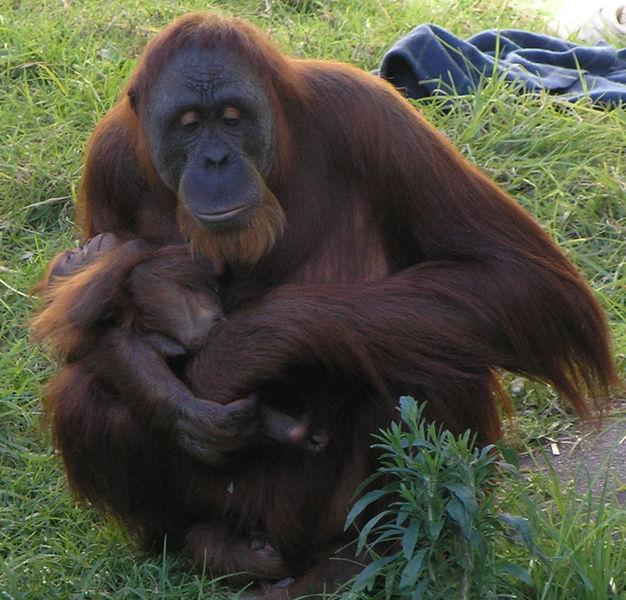
orangutan mother and babyThe government of the Malaysian state of Sabah announced Friday it will protect its most important remaining lowland forests on the island of Borneo. The surprising decision will permanently preserve one of just two places in the world where the endangered orangutans, Bornean Pygmy elephants and the critically endangered Sumatran rhino co-exist, and where forests are still large enough to maintain viable populations of each.

The plan, long sought by conservationists, places three forest reserves, which cover an area the size of Rhode Island, under sustainable forest management. Large-scale timber harvesting would end by 2007 and be replaced with sustainable forest management practices.

“This is one of the most important actions ever taken to secure the future of Borneo’s endangered wild mammals,” said Carter Roberts, CEO and President of Word Wildlife Fund – U.S.

Ruling Gives Political Bloggers Same Protection as Media

The FEC did the right thing for democracy in a 6-0 ruling today. It is only fitting that we should turn to a blogger for the story. Thanks to Rose Colored News for the link, hot off the press.

Responsible Forest Management in South America

Georgetown, Guyana — In a record-setting accomplishment for tropical forest conservation, Barama Company announced that 570,000 hectares (about 2,200 square miles) of Barama’s forests in Guyana is being certified as meeting the rigorous environmental, social and economic standards of the Forest Stewardship Council (FSC). Thanks to technical and financial support from the World Wildlife Fund, Barama’s certified forest becomes the largest tropical natural forest certified by FSC in the world.

In another example of how rigorous social and environmental practices can improve business as a whole, the certification enables Barama not only to retain access to its current markets in the United States, but opens the door to new buyers in Europe and North America that demand forest products from well-managed forests. As a result, in a country with a high unemployment rate, Barama is able to employ at least 1,500 persons. Before certification, the company was in danger of down-sizing its operations. Today, Barama forecasts increasing employment in the area. Barama’s employees benefit from a better work environment and the company provides social services for local communities such as health services, medicines, transportation in and out of remote areas and emergency assistance. (more info)

Cancer Survivors to Get Better Insurance Rates

The Hartford Financial Services Group is announcing today that they will begin selling insurance at normal rates to men over 60 who have been surgically treated for moderate levels of prostate cancer. In the past, the men would have been forced to wait up to three years following treatment to qualify for life insurance coverage and would have paid much higher rates. (read the full Seattle P-I story)

Oregon Governor Pushes Renewable Energy

blue sky

An ambitious plan for using renewable energy: photo by John Stone, eyeclectic.net

Oregon Governor Ted Kulongoski wants all the electricity used by state agencies to come from brand-new renewable sources such as wind and sun power — and he wants that done in an ambitious four years. (read the March 11 Oregonian report)

The New Medicine Airs on PBS March 29

dana reeve, hosts The New Medicine

dana reeve as hostA burgeoning movement is taking place in hospitals and clinics across the country, integrating the best of high-tech medicine with a new attitude that recognizes it is essential to the healing process to treat the patient as a whole person, and not a cog in an assembly line. A new public television documentary, The New Medicine, suggests that medical practice in America may be on the brink of a transformation. As scientific findings reveal that the mind plays a critical role in the body’s capacity to heal, the medical community is beginning to embrace a new range of treatment options, including many once considered fringe.

The program, which airs this Thursday on most PBS stations, is hosted by the late Dana Reeve, who died last month with lung cancer following the death of her husband Christopher. The two-hour show visits medical schools, healthcare clinics, research institutions, and private practices to show physicians at work on the cutting edge of this new approach. It explores why even some of the most conservative health institutions are now prescribing meditation and self-hypnosis along with high-tech modern medicine.

Rival Gangs in Jamaica Find Common Ground: A New Woman Prime Minister

“Portia Simpson-Miller, 51, who will be sworn in next week as the first woman Prime Minister of Jamaica, has prompted a rare dose of political unity with her pledge to succeed where decades of male leadership have failed in tackling the country’s notoriously high crime rate, joblessness and poverty.”

common ground reached by rival gangs where gunfire used to be commonplace between supporters of the new Prime Minister’s party, the PNP, on one side of the road, and backers of the Jamaican Labour Party, JLP, on the opposite side:

“While flare-ups here and in other ghetto communities continue, prompted by turf wars and gang disputes, the factions have at least found common ground in Mrs Simpson-Miller.

“The PNP like her, the JLP like her. On this we agree,” Michael Traill, a community leader in the JLP stronghold, said. “She gives us promises — schools, development, help for the children. She came from a poor background like ours.”

The Christian Science Monitor reports on the rising of women in Jamaica and features an inspiring photo of Simpson-Miller among supporters.

Polio Vaccines in Somalia

The World Health Organization has launched a five-day polio immunization campaign in Somalia to vaccinate nearly one and a half million children under age five against the crippling disease, which is on the decline there.

Saving Wildlife Also Helps Reduce Poverty

A World Wildlife Fund report this week says that efforts to save pandas and tigers and gorillas can also reduce poverty and improve the lives of local communities in rural areas, like Nepal, Uganda, India, Namibia, Costa Rica and China. Species work not only helps eradicate poverty and hunger, but also promotes sustainable and fair development, and in some cases generates significant amounts of money through eco-tourism projects, which allow tourists to observe species in the wild, like marine turtles, pandas and mountain gorillas.

Wind Power up by 25% Over Last Year

AeroVironment wind turbines were used by Blue Sea

wind-turbines-rooftop-logan-airport-AeroVironment The wind energy industry worldwide installed more than US$14 billion worth of new generating equipment last year, an increase of 25 percent over 2004, according to a recent report by the Global Wind Energy Council. The Environment News Service reports the United States led the way, with an addition of 2,431 megawatts of capacity, enough to power 680,700 U.S. households per year. Germany was next with 1,808 MW, and Spain was third with 1,764 MW of new generating capacity.

Coral Reef Discovered

A new coral reef was discovered off the Thai coast, which is home to over 30 types of hard corals and at least 112 species of fish, including a parrot fish never seen in Thailand until now — and as a rare species of sweet lips. It’s an area of 1.4 square miles, 270 hectares, and scientists call it “spectacular.”

A Sure Sign of Spring: Wild Whooping Cranes Return to Wisconsin

Among the signs of springtime these days in central Wisconsin is the arrival of wild whooping cranes on Necedah National Wildlife Refuge and along the rivers and wetlands these majestic birds call their summer homes.

Thanks to the efforts of the Whooping Crane Eastern Partnership (WCEP), there are now 64 endangered whooping cranes migrating across the skies of eastern North America for the first time in more than a century using their eastern ancestral route.

Biologists with WCEP, an international coalition of public and private groups, announced today that 15 reintroduced whooping cranes had arrived on or near Necedah, and two others were roosting along the Wisconsin River.

Whooping cranes were on the verge of extinction in 1941, down to a low of just 21 birds. Today, about 300 birds exist in the wild. Aside from the 64 Wisconsin birds, the only other migrating population of whooping cranes nests at the Wood Buffalo National Park in Northwest Canada and winters at an Arkansas refuge on the Texas Gulf Coast. A non-migrating flock of approximately 60 birds also lives year-round in the central Florida Kissimmee region.

The newly arrived whooping cranes represent the migration ‘classes’ of 2001 through 2004, which were guided southward by ultralight aircraft from their fledging grounds at Necedah to their winter habitat at Chassahowitzka Reserve on the Gulf coast of Florida.

The migrations began, as GNN reported in 2001, when pilots, like surrogate parents, first led whooping crane chicks, who had been conditioned to follow, away from Necedah in their ultralight aircraft (disguised to look similar to a crane). The same technique was featured in the movie, Fly Away Home. Each subsequent year, WCEP biologists and pilots have conditioned and guided other groups of juvenile cranes southward on the 1,250 mile journey (40-70 days) to central Florida.

The whooping crane chicks that take part in the reintroduction project are hatched at the Patuxent Wildlife Research Center in Laurel, Md., where they are introduced to ultralight aircraft and raised in isolation from humans. To ensure the impressionable cranes remain wild, project biologists and pilots adhere to a strict no-talking rule, and use recorded adult crane calls to communicate with the young birds. Researchers wear costumes designed to mask the human form whenever they are around the cranes.

New classes of cranes are taken to Necedah each June to begin a summer of conditioning behind the ultralights to prepare them for their fall migration. Pilots lead the birds on gradually longer training flights at the refuge throughout the summer until the young cranes are deemed ready to follow the aircraft over Illinois, Indiana, Kentucky, Tennessee, Georgia, and into Florida.

The 19 birds in the Class of 2005, the most recent ultralight- reintroduced cranes, arrived in Florida on Dec. 13, 2005, after a 64-day migration. The 19 remain at their pensite in Florida and have begun taking short evening flights in the immediate area of the pen.

In addition to the 19 chicks that migrated behind ultralights in 2005, biologists also released four additional chicks last fall into the company of older birds at Necedah, in the hopes that the chicks would learn the migration route from adult whoopers or sandhill cranes.

WCEP is using this “direct autumn release” technique to complement the known success of the ultralight-led migrations. The chicks are reared in the field and released with older birds after fledging, or developing their flight feathers. This method has proven successful with sandhill cranes.

As of March 24, two of the 2005 direct autumn release birds had embarked on migration and were in Indiana; the other two remain in Florida.

Project staff from the International Crane Foundation and the U.S. Fish and Wildlife Service track and monitor cranes in an effort to learn as much as possible about their unassisted migrations back up North, and the habitat choices they make along the way. Wisconsin DNR biologists, join them in monitoring the cranes while they are at their summer locations, in 35 of 72 Wisconsin counties.
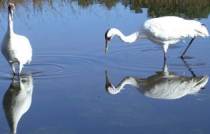
whooping cranesWhooping cranes, named for their loud and penetrating unison calls, live and breed in wetlands, where they feed on crabs, clams, frogs and aquatic plants. They are distinctive animals, standing 5 feet tall, with white bodies, black wing tips and red crowns on their heads.

Many other states, provinces, private individuals and conservation groups
have joined forces with and support WCEP with funding and personnel and by donating resources, like opening up private lands for the cranes along the migration route. More than 60 percent of the project’s budget comes from private sources in the form of grants, donations and corporate sponsors.

For more information on the project, like what to do if you see a Whooping crane, and to see the amazing photo of the ultralight disguised as a crane, visit the WCEP website at www.bringbackthecranes.org.

Photos by Jason Mrachina, CC (top) Whooping Crane Eastern Partnership (middle)

India Makes Peace Overtures to Pakistan

peace sign - human chain

peace-sign-human-chainVoice of America reports India is again warming toward rival Pakistan and calling for progress on Kashmir.

India’s Prime Minister has called for a treaty of peace and friendship with Pakistan. The overture aims at injecting fresh momentum into a flagging peace initiative between the two nuclear powers.

Clicks Against Breast Cancer, and Hunger, and Deforestation, and…

My friend Katharine sent me a message that the Breast Cancer Site was having trouble getting enough people to click on their site for donating free mammograms every day to underserved women. She said, “It takes only a few seconds to go to their site and click on “donating a mammogram” (the pink button in the middle). It doesn’t cost you a thing. Their corporate sponsors and advertisers use the number of daily visits to donate mammograms in exchange for advertising. Here’s the web site!” www.thebreastcancersite.com

This sounded just like the Hunger Site. (Have you ever clicked there to donate a free bowl of food for a hungy person?) In 1999, it had become one of most popular destinations on the internet. The Good News Network featured it in 1999, the first online activist web site. Well, whaddya know? I went to donate a mammogram with a simple click of my mouse and found — on the same page — not only the Hunger Site, but the Rainforest Site, The Child Health Site, the Literacy Site, and the Animal Rescue Site!

Carnegie Hero Fund Cites 21 for Extraordinary Heroism

carnegie.jpg

The Carnegie Hero Awards were announced today. The bronze medallion and $4,000 were awarded to 20 individuals who risked their lives to an extraordinary degree while saving the lives of others. The heroes announced today bring to 8,981 the number of awards made since the fund’s inception in 1904. An additional prize was awarded posthumously to Leslie Joseph Staniowski, who died in the performance of his act. Staniowski, 51, was felled by a gunman when he attempted to restrain the man, who was shooting at a bartender in a Las Vegas casino.

To nominate someone for the Carnegie Medal, write the Carnegie Hero Fund Commission, 425 Sixth Avenue, Suite 1640, Pittsburgh, PA 15219, or call toll free 1-800-447-8900. Read about all 21 acts of heroism, including a man who found a baby on the couch while crawling through a smoke-filled home looking for casualties in the midst of a blaze. www.carnegiehero.org

Killing is over, say Basque terrorists

change-for-good-Lostdog-dot-co-image

change-for-good-Lostdog-dot-co-imageThe Basque separatist group in Spain, announced a permanent ceasefire after four decades of armed military resistance. The Scotsman reports:

The news prompted jubilation across the country, where ordinary citizens say they can hardly believe the end has come for a group blamed for more than 850 deaths…

Green Australians Reusing 90% of Food Waste

A report by the Australian Food and Grocery Council revealed that about 90% of waste and by-products from the food and grocery manufacturers surveyed was being reused or recycled, with less than 10% going to landfill.

Industry participants in the survey have also reduced energy use by 14%, water use by 21% and greenhouse emissions by 29% since 2003.