












All News - Page 219 of 1734 - Good News Network
Home Blog Page 219

Teen with Incredibly Rare Genetic Condition is Cured in World First By British Doctors

Kai Xue with her mom and team members from University Hospitals at North Midlands –  NHS Trust via SWNS
Kai Xue with her mom and team members from University Hospitals at North Midlands – NHS Trust via SWNS

A teen diagnosed with an incredibly rare genetic condition has become the first person in the world to be cured, thanks to a team of pioneering British doctors.

13-year-old Kai Xue is one of just 21 people in the world stricken with a disease called WILD syndrome, which impairs cells, causes lymphedema and warts, and leads to infections—but she was also diagnosed with severe chylous ascites, a potentially fatal illness that caused 28 liters of lymphatic fluid to collect within her abdomen.

It took over a decade to find a special team of doctors who could locate the cause of the fluid buildup from chylous ascites—and stop it for good.

Kai was born with an abnormal lymphatic system and her mother Ning Chen said they spent her daughter’s childhood in the UK visiting different hospitals and had even travelled to China to see if she could get treatment there.

But more than a decade later, Kai was finally cured after she was diagnosed by Dr. Mona Mossad, a national expert in lymphatic intervention.

The doctor went on to work alongside experienced surgeons to remove the excess fluid from Kai’s body, while also fixing a leak that had developed in her liver.

After a five-week stay at Staffordshire Children’s Hospital at Royal Stoke, which is run by University Hospitals at North Midlands NHS Trust, she was finally able to return home to her grateful family.

“Throughout her childhood, we were under the care of a number of different hospitals to try to find out what the matter was, but nobody knew the cause,” said her relieved mom.

AMAZING CUREBelgian Boy is the First Child in the World to Have Been Cured of Brain Stem Glioma, a Brutal Cancer

“We tried everything, from restrictive diets to even flying to China for treatment. “We’re very excited to finally be going home, I still cannot believe it.”

When Dr. Mossad, a consultant interventional radiologist, was first introduced to Kai, there was still some debate over her diagnosis.

“Kai was in a very difficult situation. Nobody could diagnose the cause of the leak that was leading to the build-up of lymphatic fluid into her abdomen over the years.

“That leak caused two major problems. The first being the large amount of fluids which were leaking into her abdominal space causing severe abdominal distention and pressure on internal organs. The second was that if we drained these fluids to relieve the pressure, we would be removing all the nutritional fluid from her body- protein, fat, antibodies, electrolytes and white blood cells.

CANCER CURED: Kinder-Than-Chemo Cancer Drug Cured Boy of Leukemia–Available in the US

“These types of leaks are usually very difficult and multifactorial, there is not just one cause for it. So clinically and radiologically we tried to eliminate the causes starting with the least-invasive,” recalls Dr. Mossad.

After initially carrying out a procedure to improve her lymphatic drainage, they then embarked on more challenging surgery to block lymphatic vessels in her liver that measured less than one-tenth of a millimeter.

Dr. Mossad said that because of Kai’s age and size, they had to special order smaller needles that would work.

“We successfully managed to find a large leak that was going into her abdominal cavity from the left lobe in her liver and were able to repair the leak using a special surgical glue.”

ALSO SEE: Toddler Is First to Be Cured of Rare, Deadly Condition, Using New Versions of a Faulty Gene

Kai was also under the care of Dr. Yvonne Slater, a Consultant Pediatric Gastroenterologist at the teaching hospital, who was thrilled that the young teen had responded so well.

“We are all over the moon for Kai, who is the first child to undergo this treatment anywhere in the world.” said Dr. Slater.

“It was an extremely long, difficult, and specialized case, over the two procedures that (also) involved the skills and dedication of many teams at University Hospitals at North Midlands—including Radiology, Anesthetics, Children’s Intensive Care, Gastroenterology and Dietetics.

“Despite this, Kai has remained remarkably robust, and after coming to us very weak, she has left a completely different girl, smiling for the first time in a long time.

CHECK OUT: Vaccine that Could Cure and Even Prevent Brain Cancer Developed by Scientists

“I’m delighted that everybody has moved heaven and earth to do the right thing for them.”

Kai’s mother praised the doctors and surgeons following the successful outcome.

“I’m so happy for the excellent care, and everybody was so nice and helpful and they tried their best to help us. The whole team is amazing.”

SHARE The Breakthrough With Doctors and Families on Social Media…

U.S. Unveils First-Ever Regulations to Remove ‘Forever Chemicals’ in Drinking Water

Despite a huge amount of political opposition from the chemical industry, the US Environmental Protection Agency (EPA) announced its first regulations aimed at limiting quantities of PFAs, or ‘forever chemicals,’ in American drinking water.

For decades, Polyfluoroalkyl substances or PFAs have been used for coatings that resist fire, oil, stains, and water and are now found in a wide variety of products like waterproof clothing, stain-resistant furniture, food packaging, adhesives, firefighting spray foams, and non-stick cooking surfaces.

There are thousands of PFAS compounds with varying effects and toxicity levels, and the new EPA regulations will require water utilities to test for 6 different classes of them.

The new standards will reduce PFAS exposure—and thereby decrease the health risk—for 100 million people in the U.S.

A fund worth $1 billion for treatment and testing will be made available to water utilities nationwide—part of a $9 billion investment made possible by the 2021 Bipartisan Infrastructure Law to assist communities impacted by PFAS contamination.

“Drinking water contaminated with PFAS has plagued communities across this country for too long,” said EPA Administrator Michael S. Regan in a statement Wednesday.

CHECK OUT: All the Positive GNN News About PFAs Over the Years

Under Regan’s leadership, the EPA began in 2021 to establish a roadmap for dealing with widespread PFAS contamination, and so far they’ve gathered much data, including monitoring drinking water, and begun requiring more reports from businesses about use of the unregulated substances.

The agency reported that current peer-reviewed scientific studies have shown that exposure to certain levels of PFAS may lead to a myriad of health issues that are difficult to specify because of the variety of compounds coming from different places.

SOLUTION: Breakthrough Might Finally Destroy the Harmful ‘Forever Chemicals’ in Our Water

Regardless, the 66,000 water utility operators will have five years to test for the PFAS pollution and install necessary technology to treat the contamination, which the EPA estimates that 6%–10% of facilities will need.

Records show that some of the manufacturers knew these chemicals posed health hazards. A few major lawsuits in recent years have been settled that sought to hold chemical companies, like 3M, accountable for the environment damage.

BE GONE: Researchers Develop Water Treatment that Zaps ‘Forever Chemicals’ for Good

MULTIPLY THE GOOD By Sharing the News on Social Media…
Your Weekly Horoscope – ‘Free Will Astrology’ From Rob Brezsny

Our partner Rob Brezsny, who has a new book out, Astrology Is Real: Revelations from My Life as an Oracle, provides his weekly wisdom to enlighten our thinking and motivate our mood. Rob’s Free Will Astrology, is a syndicated weekly column appearing in over a hundred publications. He is also the author of Pronoia Is the Antidote for Paranoia: How All of Creation Is Conspiring To Shower You with Blessings. (A free preview of the book is available here.)

Here is your weekly horoscope…

FREE WILL ASTROLOGY – Week of April 13, 2024
Copyright by Rob Brezsny, FreeWillAstrology.com

ARIES (March 21-April 19):
Is there any value in discussing happiness? It’s an amorphous term that has a different meaning for everyone. What makes me feel happy may be utterly unlike your definition. And the truth is that perfect happiness is impossible to achieve. We are always a mix of being happy and unhappy. Nevertheless, I invite you to ruminate about the subject in the coming days. I believe you are as close as you can get to crafting a realistic understanding of happiness—and then raising your happiness levels by at least 15 percent. Now here’s a possibly helpful clue from philosopher Friedrich Nietzsche: “Precisely the least, the softest, lightest, a lizard’s rustling, a breath, a flash, a moment—a little makes the way of the best happiness.”

TAURUS (April 20-May 20):
I invite you to take an inventory of your taboos, inhibitions, and restrictions. Ruminate on why you originally adopted them. Evaluate how well they have served you and whether they are still meaningful to you. If you find any of them have become unnecessary or downright injurious, get rid of them! And be excited and happy about getting rid of them! If you decide that some of your taboos, inhibitions, and restrictions are still wise for you to cultivate, thank them for their service and honor the feelings they evoke in you.

GEMINI (May 21-June 20):
“You could catalog the thousand ways people shrink from life, as if chance and change are by their nature toxic, disfiguring.” So says Gemini novelist Gregory Maguire. Your assignment in the coming weeks is to  live your life in such ways as to contradict his theory about human nature. If you are game to try this experiment, you will interpret all chance and change as potentially expansive, redemptive, and interesting. You will never shrink from life, but will rather rise boldly to meet every challenge and embrace every twist of fate as a golden opportunity. Based on my interpretation of astrological omens, I have radiant faith in your ability to carry out this joyous project.

CANCER (June 21-July 22):
I nominate you to be the Top Toxin and Waste Purger of the Zodiac, beginning now and continuing through all of February. Do it both for yourself and on behalf of those you care about. Your assignment, if you choose to accept it, will be to eliminate nonessentials that obstruct the flow of the good life. These might include defunct fantasies, mistaken understandings, apathetic attitudes, and unloving approaches. Among the other dross or dreck you could root out is any clutter that’s making beloved environments feel oppressive. By the way, fellow Cancerian, this should be quite fun. If it’s not, you’re doing it wrong.

LEO (July 23-Aug. 22):
My goals right now are to inspire you: 1. to be full of love for your daily life; 2. to adore yourself exactly as you are; 3. to replace any numbness or boredom you feel with alert aliveness. Toward these ends, I offer three quotes: “The invariable mark of wisdom is to see the miraculous in the common,” by Ralph Waldo Emerson; “The universe is full of magical things patiently waiting for our wits to grow sharper,” by Eden Phillpotts; and, “I have the mysterious feeling of seeing for the first time something I have always known,” by Bernardo Bertolucci.

VIRGO (Aug. 23-Sept. 22):
In the coming weeks, I hope you avoid sucking up to egotistical manipulators. Please also refrain from being an unappreciated beast of burden and a half-willing pawn in a boring game. If you are interested in paying off a karmic debt, make sure it’s yours, not anyone else’s. If you plan to work hard to lay the foundation for a future liberation, get a guarantee that YOU will be at least one of the people liberated. PS: I’m fine with you doing unselfish things as long as they will also have selfish benefits.

LIBRA (Sept. 23-Oct. 22):
The greatest undiagnosed malady affecting us modern people is atrophy of the soul. This misfortune is related to another: apathy of the soul. So much of the colorful stimuli that scream for our attention is engineered to feed our egos; our poor souls are left to starve. Please note that I have no problem with our egos—they are an important part of our make-up and are essential for healthy functioning. But it’s a damn shame they hog all the glory and nourishment. Now here’s my main message for you: It’s high time to celebrate a holiday I call Nurture the Soul. Make it last at least three weeks. Homework: Identify three actions you will take to excite, love, and nurture your soul.

SCORPIO (Oct. 23-Nov. 21):
Psychologist Carl Jung wrote, “Motherlove is one of the most moving and unforgettable memories of our lives, the mysterious root of all growth and change; the love that means homecoming, shelter, and the long silence from which everything begins and in which everything ends.” To place yourself in rapt alignment with current cosmic rhythms, Scorpio, you will do whatever’s necessary to get a strong dose of the blessing Jung described. If your own mother isn’t available or is insufficient for this profound immersion, find other sources. Borrow a wise woman elder. Be intensely intent on basking in a maternal glow that welcomes you and loves you exactly as you are—and makes you feel deeply at home in the world.

SAGITTARIUS (Nov. 22-Dec. 21):
Sagittarian computer scientist Grace Hopper (1906–1992) wrote, “The most damaging phrase in the language is: ‘It’s always been done that way.’” For your inspiration, I’ll expand on that wisdom. The most obvious meaning is that we risk ignoring our individualized needs and suppressing our creative inspirations if we mindlessly conform to the habits of society at large and our own community. But it’s equally important not to blindly repeat our own previous actions. Maybe they were brilliant and appropriate in the past, but there’s no guarantee they will always be so. In conclusion, Sagittarius, I recommend you rebel against your own personal “it’s always been done that way” as well as everyone else’s.

CAPRICORN (Dec. 22-Jan. 19):
Which would you prefer in the coming weeks: itches, prickles, twitches, and stings? Or, instead, tickles, tingles, quivers, and shimmers? To ensure the latter types of sensations predominate, all you must do is cultivate moods of surrender, relaxation, welcome, and forgiveness. You will be faced with the former sensations only if you resist, hinder, impede, and combat. Please keep in mind that this is not always sound advice. Sometimes, it’s wise to boldly refuse to go with the flow. But this is not one of those phases. I encourage you to cultivate an elegant and graceful receptivity.

AQUARIUS (Jan. 20-Feb. 18):
It’s the 17th annual Brag Therapy Holiday, for you Aquarians only. During this celebration, we expect you—indeed we want you—to boast extravagantly. Tell us in exquisite detail why you are such a marvelous creation. Explain how you have overcome seemingly insurmountable odds to transform yourself into a masterpiece of gorgeous intelligence. Regale us with stories of your winsome qualities, your heroic triumphs, your hilarious and poignant adventures on the edge of reality. Make sure we understand how educational and healing it would be to absorb your influence. Show us why we should consider regarding you as a role model.

PISCES (Feb. 19-March 20):
I invite you to resolve old business, draw unrewarding projects to a close, and finish your lessons at the School of Hard Knocks. You don’t have to carry out my next proposal, but if you do, I won’t be upset: Politely and quietly scream “Get out of my life forever” at anyone who doesn’t give you the respect and kindness you deserve. I also recommend that you do a Wrap-It-Up Ritual. Make an altar that pleases you with its beauty. Take five scraps of paper and write on every piece a description of an influence or experience you want to purge from your life. As you rip each scrap into little bits, say this: “I’m grateful for what I have learned from you, but now I am leaving you behind.”

WANT MORE? Listen to Rob’s EXPANDED AUDIO HOROSCOPES, 4-5 minute meditations on the current state of your destiny — or subscribe to his unique daily text message service at: RealAstrology.com

(Zodiac images by Numerologysign.com, CC license)

SHARE The Wisdom With Friends Who Are Stars in Your Life on Social Media…

“I love you not only for what you are, but for what you are making of me.” – Elizabeth Barrett Browning

Quote of the Day: “I love you not only for what you are, but for what you are making of me.” – Elizabeth Barrett Browning

Photo by: Jack Ward

With a new inspirational quote every day, atop the perfect photo—collected and archived on our Quotes page—why not bookmark GNN.org for a daily uplift?

Indigenous Rangers Photograph Blind ‘Marsupial Mole’ Seldom Seen by Humans Amid its Strange and Wild Land

Northern marsupial mole – Courtesy of KJ Rangers

This tiny creature is a northern marsupial mole, a card-carrying member of one of the strangest landscapes on Earth.

The Western Deserts of Australia bristle, slither, and burrow with life; much of it unseen by the few passersby. The extreme aridity and heat have caused these animals to adapt in strange ways; few stranger than this marsupial mole which is seen just a few times every decade.

Small, blind, hairy, and shy, the marsupial moles carry their young around in a pouch like kangaroos, but burrow underground using their noses to make up for their lack of eyesight like moles.

“Some people’s first thought was, ‘Are these photos an April Fools’ Day joke?'” desert wildlife expert Gareth Catt told ABC News Down Under. “To see a close-up photo like this is really exciting—I’ve never seen one myself so I’m pretty jealous of the rangers!”

The rangers Mr. Catt is referring to are the Kanyirninpa Jukurrpa (KJ) Martu rangers, a group of Aboriginal conservationists who make their homes and their bread in the Western Deserts in the state of Western Australia.

Documenting wildlife, implementing conservation strategies, performing fire management, and other activities, the KJ are like custodians of the Outback.

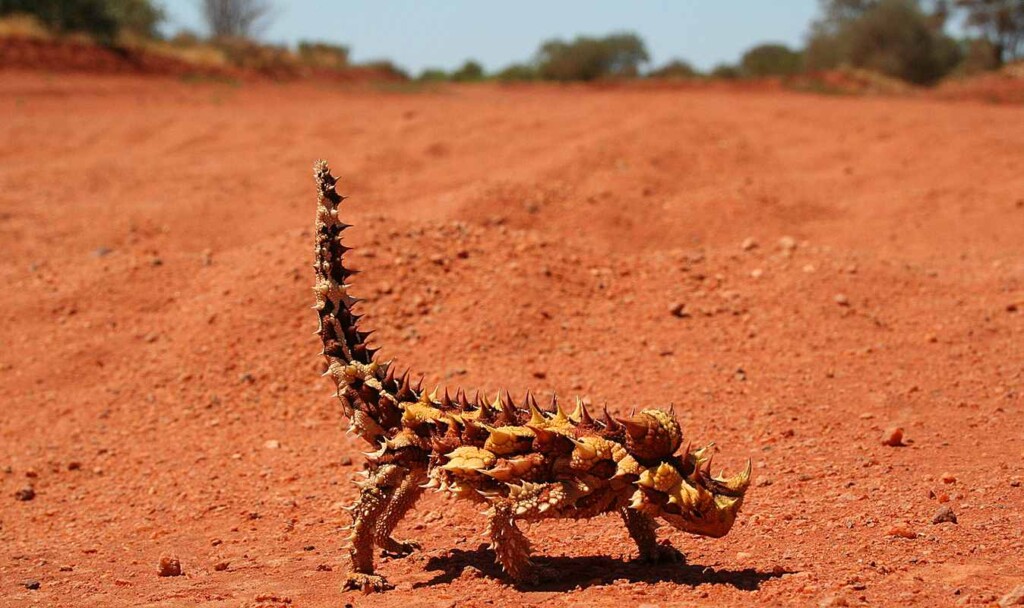
The wildlife living in the deserts of Australia are as odd as the fish and invertebrates of the deep ocean are odd when compared with those in shallow seas. The most charismatic must be the thorny devil (Moloch horridus.)

This small lizard may look impenetrable with its bristling spikes, but its skin is actually hydrophilic, meaning that if any part of it touches moisture—dew for example—it can be absorbed into the body without the lizard requiring to drink it.

A thorny devil along the Great Central Road – credit CC 3.0. Bäras

But this thirsty-skinned lizard is nothing compared to the powers of the “water holding frog” (Cyclorana platycephala) which can go 5 years without ever drinking water. Aborigines will actually dig up this frog, gently squeeze it, and drink the water excreted from its skin before putting it back, or carrying it with them to the next watering hole, as the unwelcome theft of their water will most likely prove fatal to this amphibian in the dry season.

MORE AUSSIE ODDITIES: Woylies Are the Ecosystem Engineers of Australia–Critically Endangered but They’re Making a Comeback

Water-holding frog – CC 3.0. Tnarg

Aside from these oddities, there are beautiful birds like the Galah, or rose-breasted cockatoo, and the blindingly iridescent scarlet-chested parrot, and even a tiny species of freshwater, desert-dwelling fish, which itself sounds like a contradiciton, called a gobby.

As for the marsupial mole, part of Mr. Catt and the rangers’ work in the deserts includes monitoring populations to see how they are coping. There are reasons to suggest that rainfall and temperature patterns are making desert life more difficult for some animals, and though many are not even threatened with extinction, signs of population decline need to be carefully monitored.

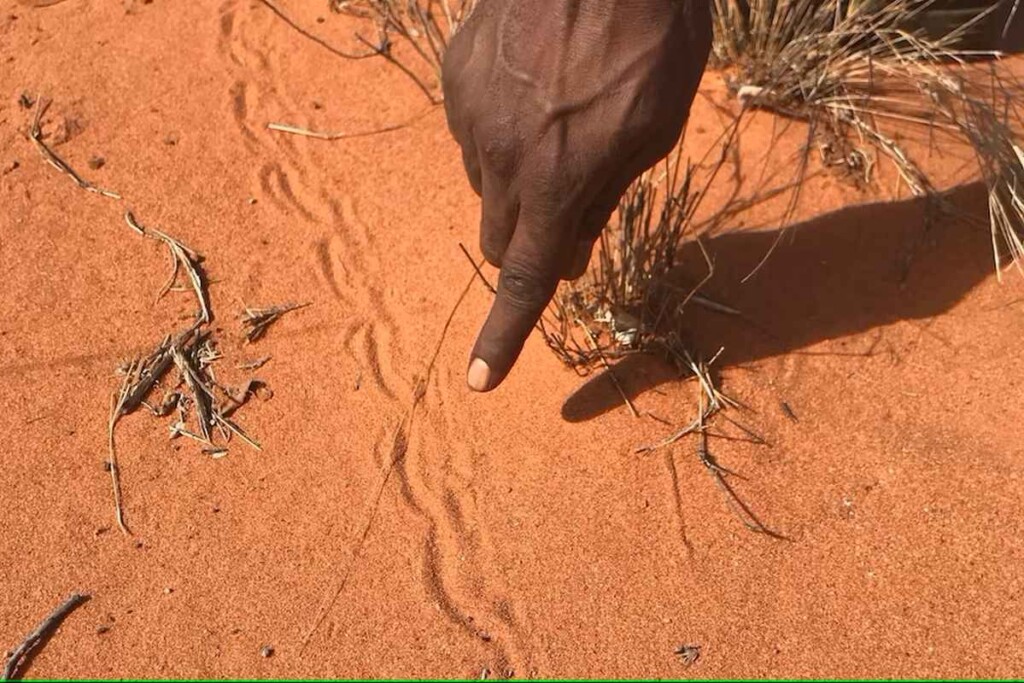
For a tiny recluse like the northern marsupial mole, this sees the KJ rangers hiking up and down sand dunes until they spot the tell-tale traces of a mole’s rare above-ground excursions. Once located, they will dig a trench to look for holes and log any they find in a central database.

YOU’LL ALSO LIKE: Australian Lyrebirds Give Singing Lessons to Juveniles–Mimicking 10 Different Species–LISTEN

Northern marsupial mole tracks – Courtesy of KJ Rangers

In this way they can keep track of where the population is dispersed and how densely they inhabit the areas where they are found.

“The monitoring by Aboriginal ranger groups is really important, especially as desert species are being impacted by rainfall and temperature patterns changing due to climate change,” Mr. Catt said.

SHARE These Wild And Wonderful Critters With Your Friends… 

French Woman Smashes Previous World Rope Climbing Record by Reaching Eiffel Tower’s 2nd Floor–(WATCH)

Garnier's climbed a rope suspended down the center of the Eiffel Tower to the second floor level - CC 2.5. IvanAndreevich

Remember the free hanging rope climb exercise in PE class, remember how difficult that was? Well, evidently there are some people who turned that challenge into a passion.

Frenchwoman Anouk Garnier’s new world-record rope climb is stunning. The arms of a normal fit person scream with lactic acid burn just watching it.

Climbing 360 feet, or 110 meters, in 18 minutes allowed her to climb up through the center of the Eiffel Tower into the iron bosom of its second floor.

Her attempt was in the name of raising money for cancer research and prevention after her mother was diagnosed with the disease.

The previous world record, the Guardian reports, was held by the South African athlete Thomas Van Tonder, who climbed around 300 feet up a rope suspended between the Soweto Towers in Johannesburg.

Garnier’s climb supplanted the female world rope climb record held by Ida Mathilde Steensgaard a staggering 4.5-times over.

“My dream has come true. It’s magical,” Garnier told the gathered media. “If there was one thing I never doubted, it was that I was going to do it. I never stopped believing in it. The satisfaction and joy I derive from it today are all the greater. It’s a crazy dream come true.”

MORE WORLD RECORDS BEING BROKEN: Dutch Woman Smashes a World Record Unbroken For 41 Years–While Her Home Audience Cheers

Garnier’s specialty isn’t rope climbing per se, but rather obstacle challenges. She won the world obstacle course championship for her age category in 2022, the same year she decided to go for Steensgaard’s record of 26 meters, which she described thinking “wasn’t that high” when she first heard about it.

Garnier will be carrying the Olympic torch in Marseille in May for the lead-up to the Summer Olympics.

SHARE This Woman’s Dream Come True With Your Friends… 

Waste Heat Generated from Electronics to Warm Finnish City in Winter Thanks to Groundbreaking Thermal Energy Project

An illustration of Varanto's seasonal energy storage facility - credit, Varanto Energy, released
An illustration of Varanto’s seasonal energy storage facility – credit, Varanto Energy, released

Heat stored underground in caverns can be set aside in Finland’s summer months to be re-used during frigid winters thanks to a state-of-the-art ‘seasonal energy’ storage facility.

Slated for construction this summer near Helsinki, it will be the largest in the world by all standards and contain enough thermal energy to heat a medium-sized city all winter.

Thermal exchange heating systems, like those built underground, or domestic heat pumps, are seen as the most effective way available of reducing the climate-impact of home heating and cooling.

Their function relies on natural forces or energy recycling to cool down or heat up water and then using it to radiate hot or cold energy into a dwelling.

In Vantaa, Finland’s fourth largest city neighboring the capital of Helsinki, the ambitious Varanto seasonal energy storage project plans to store cheap and environmental friendly waste heat from datacenters, cooling processes, and waste-to-energy assets in underground caverns where it can be used to heat buildings via the district heating network whenever it is needed.

In Finland and other Nordic countries, the heat consumption varies significantly between seasons. Heat consumption in the summertime is only about one-tenth of the peak load consumption during the cold winter months.

Varanto will utilize underground caverns equal in space to two Maddison Square Gardens—over a million cubic meters—filled with water heated by this waste heat and pressure that will allow the water to reach temperatures of up to 300 degrees Fahrenheit without the water boiling or evaporating.

“The world is undergoing a huge energy transition. Wind and solar power have become vital technologies in the transition from fossil fuels to clean energy,” says Vantaa Energy CEO Jukka Toivonen.

“The biggest challenge of the energy transition so far has been the inability to store these intermittent forms of energy for later use. Unfortunately, small-scale storage solutions, such as batteries or accumulators, are not sufficient; large, industrial-scale storage solutions are needed. Varanto is an excellent example of this, and we are happy to set an example for the rest of the world.”

The total thermal capacity of the fully charged seasonal thermal energy storage is 90 gigawatt-hours. This capacity could heat a medium-sized Finnish city for as long as a year. Broken down into smaller energy units, this amount of energy is equivalent to 1.3 million electric car batteries.

MORE HEAT EXCHANGE IDEAS: Refrigerator-Sized Data Center Transfers Its Heat to English Swimming Pool, Saving Thousands in Energy Costs

“Two 60-MW electric boilers will be built in conjunction with Varanto,” adds Toivonen. “These boilers will be used to produce heat from renewable electricity when electricity is abundant and cheap. Our heat-producing system will work like a hybrid car: alternating between electricity and other forms of production, depending on what is most advantageous and efficient at the time.”

The project cost is estimated to be around $217 million (€200 million,) and it has already been awarded a €19-million investment grant from Finland’s Ministry of Economic Affairs and Employment. Construction of the storage facility’s entrance is expected to start in summer 2024, while it could be operational as early as 2028.

District heating is by far the most popular form of heating for buildings and homes in Finland.

YOU MAY ALSO LIKE: Microsoft Campus Set to Use Geothermal Energy to Heat/Cool Millions of Sq Ft. of Office Space

In district heating networks, the thermal energy produced in production plants is transmitted to customers as hot water in a closed, two-pipe system. In these pipelines, the hot water flows to the buildings, and the water that has released its heat flows back to the production plant for reheating. The heat is always transferred to the building via heat exchangers, so the district heating water itself does not circulate in the heating networks of the buildings.

There are more than 600 kilometers of underground district heating networks in Vantaa, and around 90% of Vantaa residents live in a home heated by district heating.

In 2023, a total of 37.3 terawatt-hours of district heat was produced in Finland. Of this, 53% was produced from renewable heat sources and 14% from waste heat.

WATCH a short illustration below… 

SHARE This Groundbreaking Innovation In Underground City Heating… 

Fish Swim in Schools for Stealth–as 100 Fish Make Less Noise Than an Individual Swimming Alone

Kris-Mikael Krister - Unsplash
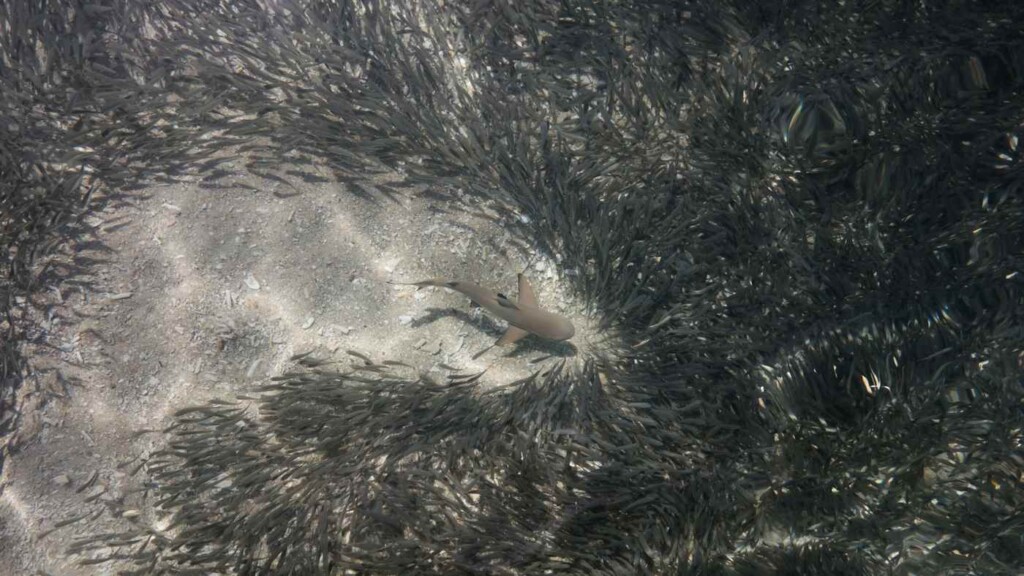
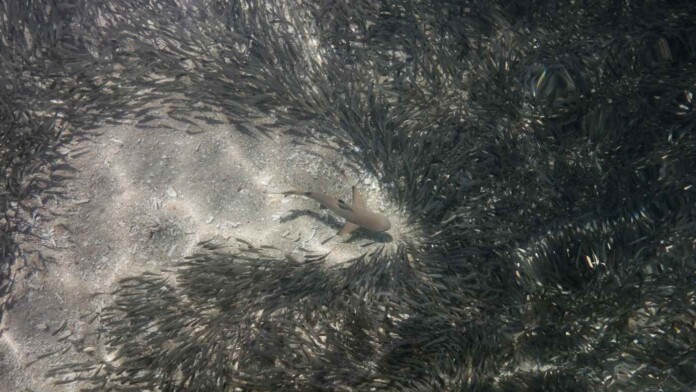
Schooling makes fish more stealthy, allowing them to avoid predators like sharks from far away. Kris-Mikael Krister – Unsplash

Watching a school of fish move can be hypnotic. The way they turn in near-perfect synchronicity is equal parts beauty and evolutionary brilliance.

While scientists know that fish school as a defense mechanism against predators, what researchers from Johns Hopkins University have just discovered is that, while this is true, it’s true not only for the reasons you might expect.

Along with increasing the chance hungry jaws will chomp down on your friend rather than you, swimming in schools actually makes fish more silent, with a group able to sound like a single fish.

“It’s widely known that swimming in groups provides fish with added protection from predators, but we questioned whether it also contributes to reducing their noise,” said senior author Rajat Mittal. “Our results suggest that the substantial decrease in their acoustic signature when swimming in groups, compared to solo swimming, may indeed be another factor driving the formation of fish schools.”

The team created a 3D model based on the common mackerel to simulate different numbers of fish swimming, changing up their formations, how close they swam to one another, and the degrees to which their movements synched. The model, which applies to many fish species, simulates one to nine mackerel being propelled forward by their tail fins.

The team found that a school of fish moving together in just the right way was stunningly effective at noise reduction: A school of seven fish sounded like a single fish.

“A predator, such as a shark, may perceive it as hearing a lone fish instead of a group,” Mittal said. “This could have significant implications for prey fish.”

The single biggest key to sound reduction, the team found, was the synchronization of the school’s tail flapping—or actually the lack thereof.

If fish moved in unison, flapping their tail fins at the same time, the sound added up and there was no reduction in total sound. But if they alternated tail flaps, the fish canceled out each other’s sound, the researchers found.

“Sound is a wave,” Mittal said. “Two waves can either add up if they are exactly in phase or they can cancel each other if they are exactly out of phase. That’s kind of what’s happening here though we’re talking about faint sounds that would barely be audible to a human.”

MORE WONDERFUL ETHNOLOGY: Scientists Discover Butterflies Originated in America 100 Million Years Ago When Upstart Moths Wanted to Bask in the Sun

The tail fin movements that reduce sound also generate flow interaction between the fish that allow the fish to swim faster while using less energy, said lead author Ji Zhou, a Johns Hopkins graduate student studying mechanical engineering.

“We find that reduction in flow-generated noise does not have to come at the expense of performance,” Zhou said. “We found cases where significant reductions in noise are accompanied by noticeable increases in per capita thrust, due to the hydrodynamic interactions between the swimmers.”

MARVEL AT LIFE BELOW THE SEA: Drone Captures Mesmerizing School of Rays that Appear Like Confetti in the Water

The team was surprised to find that the sound reduction benefits kick in as soon as one swimming fish joins another. Noise reduction grows as more fish join a school, but the team expects the benefits to cap off at some point.

“Simply being together and swimming in any manner contributes to reducing the sound signature,” Mittal said. “No coordination between the fish is required.”

SHARE This Surprising Discovery With Your Friends Who Love Science… 

“Fall in love over and over again every day. Love your family, your neighbors, your enemies, and yourself.” – Frederic and Mary Ann Brussat

By Becca Tapert

Quote of the Day: “Fall in love over and over again every day. Love your family, your neighbors, your enemies, and yourself.” – Frederic and Mary Ann Brussat

Photo by: Becca Tapert

With a new inspirational quote every day, atop the perfect photo—collected and archived on our Quotes page—why not bookmark GNN.org for a daily uplift?

A Teacher Promised His 1978 Class an Eclipse Party in 50 Years–And He Just Hosted It

Patrick Moriarty and a group of his former students watched the solar eclipse together on Monday in New York. (Caitlin Moriarty Hynick)
Patrick Moriarty (center, blue shirt) and a group of his former students watched the solar eclipse together on Monday in New York. (Caitlin Moriarty Hynick)

The year was 1978: Prime Minister Aldo Moro had been kidnapped in Italy, the US Senatorial proceedings were broadcast on the radio for the first time, and Patrick Moriarty was teaching his high science class about solar eclipses.

Explaining their trajectories, the path of totality, and other such details, the class took a look at which upcoming eclipses would pass over their hometown of Rochester, New York.

“Hey, circle that one on April 8th, 2024,” Moriarty recalled telling his students. “We’re going to get together on that one.”

Laughing, the class carried on the lesson, and every new group of 17-year-olds that came through his classroom got the same joke, with inevitably the same reaction.

The years went by. The Berlin Wall fell, the Dot Com Bubble crashed the stock market, the US elected a black man to be president, social media embedded itself into our lives; and then suddenly, Moriarty was looking at the calendar and it said ‘2022.’

He always used to tell his students that he’d take out an ad in the newspaper, but since people don’t really do newspapers anymore, he set up a Facebook group to track down some of his old charges and see if his promise meant as much to them as it did to him, but didn’t expect much forty to fifty years on as one might imagine.

But the group soon circulated among former students who kept up connections, and hundreds expressed interest in the event. Soon plans began to take shape, and Moriarty hired a local pizzeria to cater the event, and bought 130 pairs of eclipse glasses.

MORE HEARTWARMING STORIES LIKE THIS: After Teen Dies, Friends Visit His Grandma for Breakfast Every Wednesday to Ease Their Loss

Then the big day came, and the head-spinning reconnection began with all the students, whose faces Mr. Moriarty mostly did not remember, but whose names he did. The students came from all over the country, with children, with life stories, and with 45 years of life experiences to share.

Jokes were made: ‘you seemed taller’ said one, ‘this has got to be the longest homework assignment ever’ said another.

In the hour before the eclipse, Moriarty was back in class: teaching the variety of middle-aged students exactly as he once did about the science behind an eclipse.

ALSO CHECK OUT: Blind Jazz Sax Teacher Inspires Students to ‘Feel’ Their Instruments–Uses His ‘Disability’ as Teaching Tool

Eventually, the Moon passed over the Sun, but even the spectacular stargazing event couldn’t eclipse the incomprehensible moment shared between strangers who were nevertheless bound by an almost 50-year joke.

“When teachers go into education, they hope that they can be that kind of teacher that would have an impact on people and make a difference for people,” Moriarty, 68, told The Washington Post’s Kyle Melnick.

“And this event right here just firmed it up for me that I guess I did okay.”

SHARE This Amazing And Heartwarming Story With Your Friends… 

Playful Competition Brings Together Muslims and Non-Muslims Over Street Vendor’s Ramadan Snack

A takjil stand on the first day of Ramadan. credit Trugiaz CC 2.0.

In the world’s largest Muslim nation, a street food vendor’s tasty sundown snack has become so popular that people rush to get one whether they’re breaking a Ramadan fast or not.

The resulting rush has created a kind of friendly competition in the decidedly laid-back country of Indonesia, and even though the vendor first made the snacks for Muslims, he and thousands like him relish how it is bringing people together.

Mr. Kusmanadi opens a stall to sell his “takjil” every year during Ramadan, the holy month in Islam wherein Muslims forsake water and food between sunrise and sunset. This year however, non-Muslims are commonly seen “hunting takjil” which is the phrase used in situ.

Takjil is an Indonesian word that means a snack for breaking the Ramadan fast, but this year, Kusmanadi is serving all kinds of people. Every country has its own “takjil” but in Indonesia, it’s often just traditional snacks like coconut milk compote, pandan glutinous rice balls filled with palm sugar, and mung bean and sesame balls.

“So even though it’s Ramadan at the moment and the ones fasting are Muslims, the non-Muslims are also hunting,” Kusmanadi told ABC News Australia. “I’m… also happy that non-Muslims are participating. I think this is a good thing. It’s very Indonesian.”

Natasya Salim and Erwin Renaldi, writing for ABC, report that social media is beginning to swell with the content of non-Muslims partaking at takjil stands, with some humorous results, such as vendors quizzing them on the Five Pillars of Islam and teasing them about not knowing the answers.

ALSO CHECK OUT: Fishermen Getting Paid to Collect Plastic Trash at Sea, As Indonesia Slashes Pollution

The ultimate humor is the origination of the trend to seek out takjil at sundown, which came from a Christian preacher at the Tiberius Church in Jakarta of all places.

“Our religion is tolerant, but when it comes to takjil, we have to be first,” the pastor joked during a sermon that was being recorded by a congregant who posted it on TikTok where it went viral.

MORE INTERFAITH STORIES: School Teaches Students on Opposite Ends of Violent Conflicts – Reconciliation Over Revenge

The clip of the sermon now has about 23.8 million views. Asked about the “takjil war” as social media has dubbed it, Pastor Saerang who made the original comment said it demonstrates how Indonesia practices “tolerance on the next level.”

“But with the takjil war, we are actually leveling up… We support and also become a part of a religious ceremony of our brothers and sisters whichever their religion is,” Saerang said, according to Salim and Renaldi. “I think that’s the real Indonesia.”

SHARE This Wonderful Story Of Tolerance And Humanity In Southeast Asia… 

A Pat on the Back Statistically Improves Free Throw Numbers in Basketball–Demonstrating the Power of Touch

Sylvia Fowles shoots a free throw, Minnesota Lynx vs Washington Mystics game at Capital One Arena, Washington DC - CC 3.0. Lorie Shaull, Flickr
Sylvia Fowles shoots a free throw, Minnesota Lynx vs Washington Mystics game at Capital One Arena, Washington DC – CC 3.0. Lorie Shaull, Flickr

In difficult situations, physical touch like a hug or a pat on the back can reduce stress; so much so that researchers from the University of Basel have found it can statistically improve free throw points in collegiate basketball.

The research demonstrates just how sensitive humans are to physical touch, and how marriage and family therapist Virginia Satir’s famous quote “we need four hugs a day for survival, eight hugs a day for maintenance, twelve hugs a day for growth,” is spot on.

One of the most stressful situations during any basketball game is a free throw, which happens when a player is fouled while attempting to score. Unlike in soccer where anyone can take a penalty kick, in basketball, it is only the fouled player who gets the free throw.

They can win one point per successful shot, and typically get 2 per foul. Games are decided by free throws.

Of the 10 most successful NCAA teams (based on win percentage) since 2001, only one (Michigan State) shot fewer free throws than the median of 20.6 per game. Estimates of the number of games decided by free throws during a single season range from four to as many as one-half of all games according to published research.

Evidently then, whatever can improve free throw completion can only be a good thing for a team.

A team of researchers headed by Christiane Büttner at Basel’s Faculty of Psychology investigated this phenomenon, with their results appearing in the journal Psychology of Sport & Exercise.

MORE POSITIVE PSYCHOLOGY: How Self-Compassion Can Help People Achieve Weight Loss Goals Despite Setbacks–and Resume Dieting Faster

Büttner and her colleagues at the University of Landau and Purdue University studied the situation using videos of basketball games. The study included a total of 60 games played by women’s basketball teams and 835 incidents of two free throws.

The researchers counted how many of her four teammates touched the shooter before a shot, for example by tapping her on the shoulder or squeezing her hand. They then calculated whether there was a statistical association between the number of touches by teammates and the success rate of the subsequent shot.

The data showed that the chance of scoring rose when teammates showed their support through touch. The effect only appeared after a failed first shot, which makes sense because such a scenario is likely to spike stress levels.

“So support from teammates is most helpful when your stress level is already high because you’ve missed the first of the two shots,” Büttner says in summary.

OTHER NEWS LIKE THIS: Participating in Group Sports Can Offset High Stress and Contribute to Academic Competence During Challenges

It’s conceivable that a pat on the back or squeeze of the hand could also help manage stress and improve performance in other team situations, says the psychologist.

Stress management is key in sports such as golf, tennis, and racing events since the onus is entirely on the single athlete. In basketball, soccer, and other team sports, certain game mechanics put aside the collective responsibility for brief moments in which it’s all put on the shoulders of a single player.

These situations offer an exceptional insight into how high-functioning athletes deal with stress, and it’s interesting to note that even for such supremely confidant members of society—professional athletes—a physical touch of encouragement and support can make all the difference.

SHARE This Tremendous Insight Into Human Sports Psychology… 

Dog That Flunked Out of Police Academy Becomes a Hero in Taiwan’s Earthquake Response

Credit – Kaohsiung Fire Department

To be a drug-sniffing dog you have to be impassionate, which is exactly what this golden retriever was not.

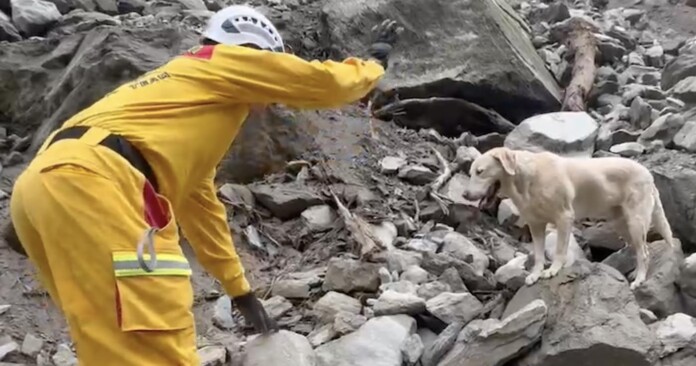
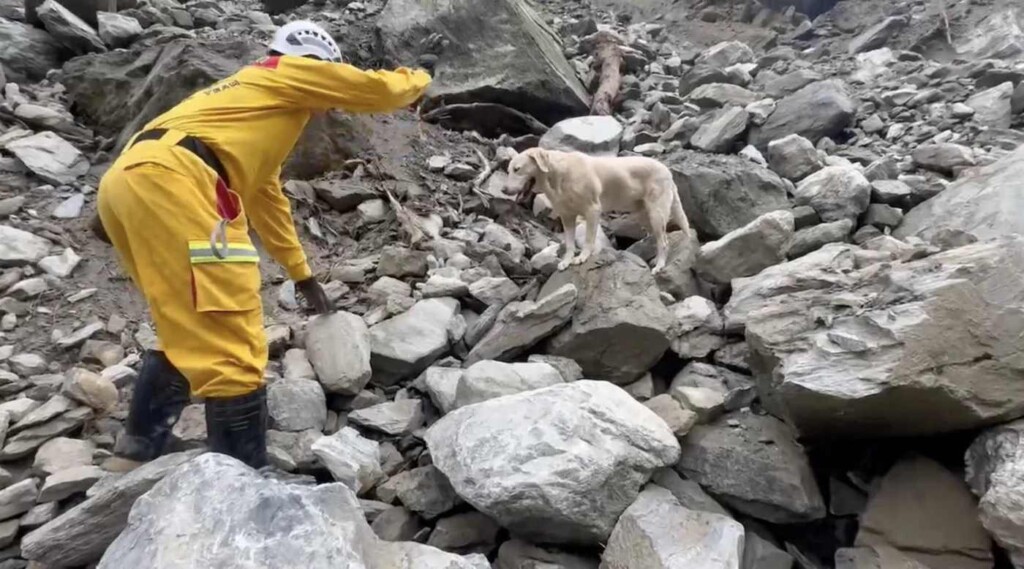
Though Roger flunked out of the Kaohsiung City police academy in Taiwan, his career in public service was not over, and has now captured the hearts of his people with his rescue efforts during Taiwan’s recent earthquake.

Striking the northern part of the island with a magnitude of 7.4, it caused a landslide in a popular national park that destroyed several buildings and claimed a dozen victims.

Roger flunked out of police academy for being too jubilant – credit Kaohsiung Fire Department

8-year-old Roger was quickly deployed to the area, where his exuberance and independent streak put him in good stead for locating the body of a 21-year-old victim who hadn’t been found.

Whether Chen Chih-san, captain of the rescue dog unit of the Kaohsiung Fire Department has other dogs that assisted in the rescue efforts, it was only Roger who captured the island nation’s hearts because of his earlier career setback and subsequent redemption arc.

OTHER SERVICE DOGS: ‘Hero’ Dogs From Rescue Operation in Turkey Get First Class Seats on Airliners Flying Them Home

“I’m not saying he was not good or that he didn’t get along with others. But the requirement for narcotic detection dogs is that they can’t be too restless and independent,” Chen said. “But (these attributes) are what we want in rescue dogs.”

These attributes were perfectly on show when he lunged for the reporter’s microphone as his handler was being interviewed by Taiwan’s official Central News Agency.

MORE STORIES LIKE THIS: India Deploys Super-Sniffer Dogs to Protect Newly-Introduced Cheetahs from Poachers

Having participated in 7 rescue organizations throughout his career, which included his being certified by the International Rescue Dog Organization in 2022, an accolade last achieved by a Taiwanese rescue dog in 2019, Roger’s retirement is fast approaching.

CNN reports that he will have a wonderful home suitable for an active precocious dog like him, but before he puts his paws up for his golden years, one family will have the closure of laying a loved one to rest because of his excellent nose and personality.

SHARE This Dog’s Career Calling With Your Friends On Social Media… 

“Words are, of course, the most powerful drug used by mankind.” – Rudyard Kipling

Quote of the Day: “Words are, of course, the most powerful drug used by mankind.” – Rudyard Kipling

Photo by: Matt Botsford

With a new inspirational quote every day, atop the perfect photo—collected and archived on our Quotes page—why not bookmark GNN.org for a daily uplift?


Astronauts Watched the Eclipse From ISS Space Station And Grabbed Some Cool Pictures and Video

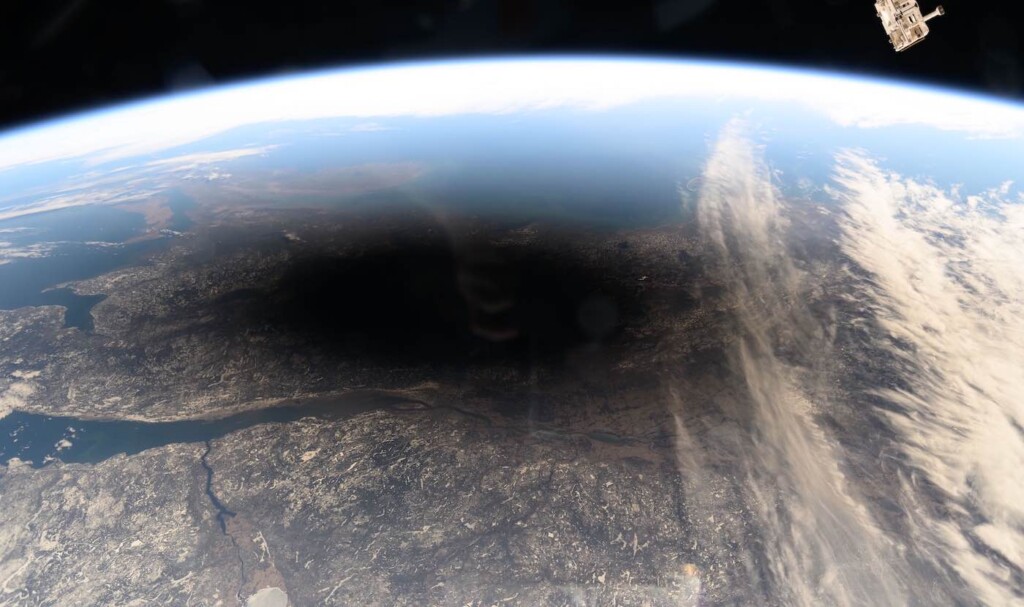
The Moon's shadow is seen covering portions of Canada and the U.S. in unique eclipse images taken from the International Space Station. Orbiting 260 miles above the Northeastern coast of the United States – NASA
The Moon’s shadow covering portions of Quebec and New Brunswick and the state of Maine – ISS / NASA

Astronauts aboard the International Space Station orbited right past the solar eclipse Monday and grabbed some intriguing photos.

The path of totality in the Moon’s shadow can be seen plunging the Northeastern coast of the US and part of Canada into darkness, while seven crew members watched from space.

Orbiting 260 miles above the ground, members of the Expedition 71 crew experienced the shadow, or umbra, moving across portions of Quebec and New Brunswick and the American state of Maine.

Then, it was gone—because the ISS is traveling at 17,500 miles an hour.

Aboard the International Space Station to witness the celestial event were NASA astronauts Matthew Dominick, Michael Barratt, Jeanette Epps, and Tracy Dyson, as well as cosmonauts Oleg Kononenko, Nikolai Chub, and Alexander Grebenkin.

The Moon’s shadow is seen covering portions of Canada and the U.S. in unique eclipse images taken from the International Space Station. Orbiting 260 miles above the Northeastern coast of the United States – NASA

Other satellites captured unique images like these, too.

WATCH the video from NASA and Starlink satellites below…

FLY THESE Across the Country By Sharing This on Social Media…

Florida Police Officers Complete Grocery Delivery After Arresting Delivery Driver (WATCH)

credit - Joe Neu
credit – Joe Neu

“Hello, uh, you ordered groceries? Your driver got arrested, so we’re delivering your groceries!”

It would have been difficult to summarize the sense of surprise that homeowner Joe Neu and his family felt when Florida police officers arrived carrying bags of produce and groceries.

The story made national news on Fox 35 Orlando, where in a neighborhood called Titusville on March 26, two police officers went “above and beyond” to finish the job that the man they had just arrested was carrying out.

Suspect Richard Robertson, 40, was wanted on felony charges both in Florida and Texas. Officers who spotted his plate numbers and pulled him over confirmed his identity, but also noticed a large delivery order in the car.

Having finished the “protect” part of the job, they switched over to the “serve” part, which had a woman in the home remarking that she would make sure the officers received Robertson’s tip.

MORE GOOD COP-GOOD-COP STORIES: Police Give Motorists a Thanksgiving Surprise–Handing Out Free Turkeys Instead of Tickets

Arriving at the house, the policewoman rang the doorbell, and video captured by the Ring camera on the door and shared on social media, shows her noting with a smile on her face “funny” while waiting for an answer.

“My dad was a police officer when I was growing up, so I have the utmost respect for them, so when I saw that, it was wonderful to see,” Mr. Neu told Fox.

WATCH the video below… 

SHARE These Cops Protecting And Serving With Your Friends On Social Media… 
Mexican Wolf Numbers Growing in U.S. for 8th Consecutive Year, Soon to Be Howling at a Reserve Near You

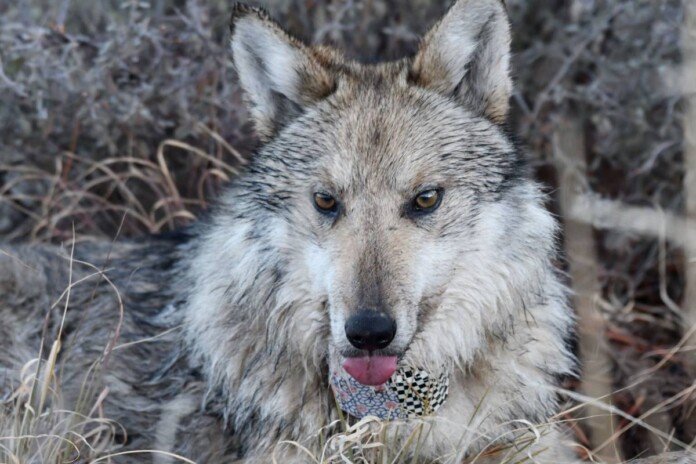
A collared Mexican wolf around Eagle Creek - credit Aislinn Maestas, Public Domain
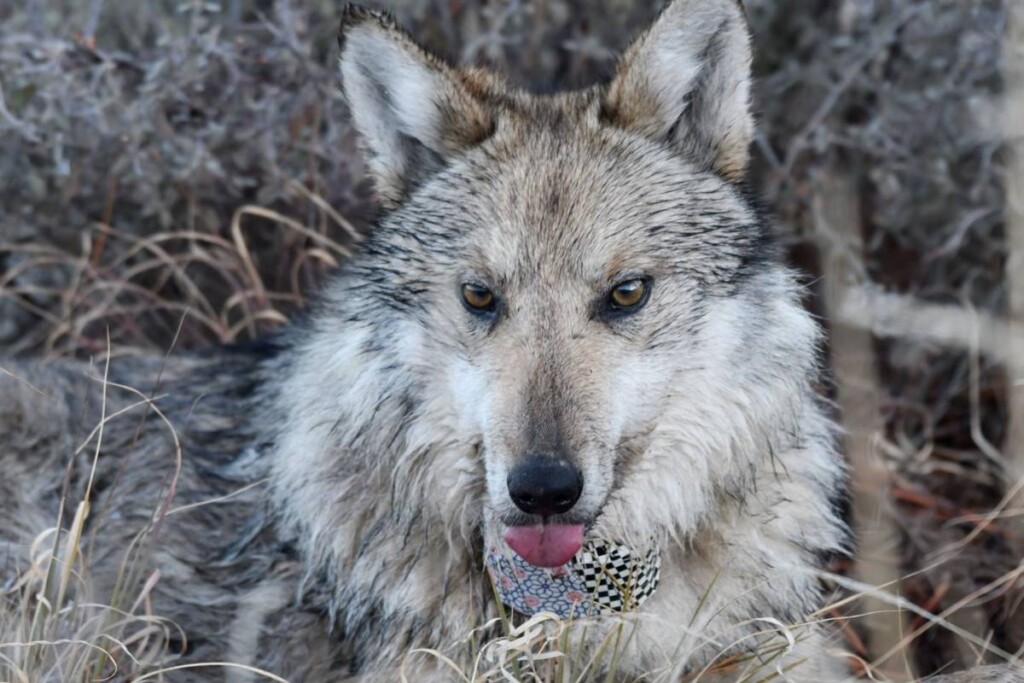
A collared Mexican wolf around Eagle Creek – credit Aislinn Maestas, Public Domain

The wild population of Mexican wolves saw another year of growth in 2023, according to the results of the annual survey published by the US Fish and Wildlife Service.

The 2023 population census revealed a minimum of 257 Mexican wolves distributed across Arizona and New Mexico. This increase marks the eighth consecutive year of population growth, the longest continuous streak since recovery efforts began.

The 2023 population minimum count represents a six percent increase from the minimum of 242 wolves counted in 2022.

“In the aggregate, the 2023 data points out that Mexican wolf recovery has come a long way since the first release,” said Jim deVos, Arizona Game and Fish Department Mexican Wolf Coordinator.

“Each year, the free-roaming Mexican wolf population numbers increase and the areas they occupy expand. Genetic management using pups from captivity is also showing results. In total, 99 pups carefully selected for their genetic value have been placed in 40 wild dens since 2016, and some of these fosters have produced litters of their own. While recovery is in the future, examining the last decade of data certainly provides optimism that recovery will be achieved,” added deVos.

Mexican wolf population information is gathered from November through February by the Interagency Field Team. During this time, the team conducts ground and aerial surveys, using a variety of methods, including remote cameras, scat collection, and visual observation. Counting the population at the same time each winter allows for comparable year-to-year trends at a time of year when the Mexican wolf population is most stable.

The field team documented additional success with fostering efforts in 2023. To date, a minimum of 15 fostered Mexican wolf pups have survived to breeding age, and at least 10 fostered wolves have successfully bred and produced litters in the wild. Fostered Mexican wolves have produced more than 20 litters and several of those offspring have gone on to produce pups of their own.

YOU’LL DEFINITELY LIKE: Birth For World’s Critically Endangered Red Wolf Brings Rising Population to Nearly 250

“It’s encouraging to see success across the board with our recovery efforts,” said Brady McGee, U.S. Fish and Wildlife Service Mexican Wolf Recovery Coordinator. “Having fostered Mexican wolves survive, disperse, pair up, breed, and start packs of their own tells us that fostering is working. These genetically diverse wolves, which came from captivity as pups and were placed into wild dens, play a vital role in boosting the genetic diversity of the wild population.”

The Mexican wolf is listed separately from the gray wolf as an endangered subspecies under the federal Endangered Species Act. In 1977, the Service and its partners initiated efforts to conserve the subspecies by developing a bi-national captive breeding program stemming from just seven Mexican wolves. Mexican wolves were first reintroduced to the wild in 1998.

In addition to the minimum wild population, there are approximately 350 Mexican wolves currently maintained in more than 60 facilities throughout the United States and Mexico under the Mexican Wolf Saving Animals From Extinction program.

MORE WILD CREATURES RETURNING: Camera Catches Sighting of a Tiger with Cubs for First Time in 10 Years, Raising Hopes for Species in Thailand

The only reason that any of these wolves are held in these facilities today is because of the work of Rory T. McBride, a legendary trapper of these beautiful animals who hung up his rifles and traps to work with the US government to rescue them from the brink of extinction.

A recognized subspecies, (Canis lupus baileyi) the Mexican wolf was extirpated from the United States in 1970, leaving only a small and reviled population hiding out in the remote reaches of northern Mexico. From the individuals McBride captured, the FWS was able to begin a captive breeding program, the fruits of which are on show today.

SHARE This Inspiring Trendline For The Cause Of Hearing Wolves Howl Out West…

Millions of Wildflowers Now Delight the Town After Vermont Couple Got Tired of Mowing the Lawn All Day

Natalie Gilliard and her husband John Yacko - credit, Natalie Gilliard, released to the Post.
Natalie Gilliard and her husband John Yacko – credit, Natalie Gilliard, released to the Post.

From a small Vermont countryside community comes the story of two Long Islanders who ditched mowing their massive lawn and planted wildflowers instead—delighting the neighbors, birds, bees, and butterflies.

They’ve steadily grown their wildflower meadow to 2-1/2 acres, which has become so popular that it’s inspired others nearby to do the same.

Jonathan Yacko and Natalie Gilliard started their makeover during the pandemic when Gilliard lost her job and Yacko’s hours were cut. He still worked remotely for the same company he had when they lived on Long Island, and told the Washington Post that their 5-acre property in Chittenden used to boast a sea of grass that required a whole day to mow and trim.

Wanting to do something different, they explained their predicament of exhaustive mowing to a local whom they had befriended who just so happened to work for a company called American Meadows.

It would cost a couple hundred dollars and require a fair amount of initial work, but the friend suggested they plant a wildflower meadow that would grow on its own ever afterward.

They liked the idea and so ripped up an acre’s worth of grass, tugged out all the large stones, tilled the land, threw down the contents of a 50-pound bag of wildflower seed containing 27 species, and then waited.

In the spring of 2021, they arrived.

First came ‘baby’s breath’ or Gypsophila elegans, then came “red and yellow poppies, pink catchfly, bright orange sulphur cosmos, red columbine, and purple foxglove,” reports Vermont Public, which was the couple’s first taste of national media.

“We had no idea what we’d be looking at after we first planted the meadow, but that was part of the fun,” Yacko told the Post.

credit – Natalie Gilliard, released to the Post

“And what’s so cool is every couple of weeks the meadows look totally different,” Yacko said, this time to Vermont Public. “You don’t know exactly what’s gonna come up or when it’s going to come up and that’s part of the magic.”

MORE ALTERNATIVE LAWNS: ‘No Mow May’ Gives You a Reason to NOT Mow the Lawn: Leave the Weeds to Feed the Bees

The beauty of the meadow was striking, and soon it began to draw attention among the local community. People offered gratitude for coloring up their morning commute, people brought baked goods, bouquets, and most importantly for newcomers who had had difficulties meeting new people on Long Island, they brought friendship.

– credit, Natalie Gilliard, released to the Post.

Neighbors Jenna Baird and her partner Jacob Powsner were so inspired by the meadow that they asked to work together with Yacko and Gilliard on seeding another acre on their property to connect with an additional half-acre plot which the couple had started after their first dazzling year of blooms.

MORE ALTERNATIVE LAWNS: Ditch That Hard-to-Grow Lawn And Start Cultivating Moss, Instead

“We started this as not wanting to mow grass, never expecting it would become what it has,” Yacko said. “Now we’re helping the bees, we’re adding beauty to the landscape and we’re making the community happy.”

SHARE This Couple’s Beautiful Story And Even More Beautiful Meadow… 

India Approves Massive $9 Bil. Rooftop Solar Plan with Panels for 10 Million Homes

- Architect Eskew Dumez Ripple
– Architect Eskew Dumez Ripple

Passed in February, a massive subsidy program to help Indian households install rooftop solar panels in their homes and apartments aims to provide 30 gigawatt hours of solar power to the nation’s inventory.

The scheme, called PM-Surya Ghar, will provide free electricity to 10 million homes according to estimates, and the designing of a national portal—a sort of Healthcare.gov for solar panels—will streamline the process of installation and payment.

The program was cooked up because India had fallen woefully behind on its planned installations for rooftop solar. In many parts of the subcontinent, the sun is absolutely brutal and relentless, but by 2022, Indian rooftop solar power generation topped out at 11 gigawatts, which was 29 gigawatts under a national target set a decade ago.

Part of the challenge, Euronews reports, is that approval from various agencies and departments—as many as 21 different signatures in some cases—was needed to place a solar array on your house. Aside from this bureaucratic nightmare, the cost of installation was often higher than $5,000; more than half the average yearly income for a working Indian urbanite.

Under PM-Surya Ghar, subsidies for a 2-kilowatt solar array will cover as much as 60% of the installation costs, falling to 40% for arrays 3 kilowatts or higher. Loans set at around 7% interest rates will help families in need get started. 750 billion Indian rupees, or $9 billion has been set aside for the project.

MORE SOLAR STORIES: ‘A Beautiful Idea’: This French Town Is Making its Cemetery a Source of Solar Energy

Even in New Delhi, which can be covered in clouds and smog for days, solar users report saving hundreds during summer time on their electricity costs, with one apartment shaving $700 every month off energy bills.

GREEN INDIA: A Coal Billionaire Is Building the World’s Biggest Clean Energy Plant to Power 16 Million Homes in India

PM-Surya Ghar is also seen as having the potential to cause a boom in the Indian solar market. Companies no longer have to go running around for planning and permitting requirements, and the government subsidies ensure their customer base can grow beyond the limits of household income.

SHARE This Ambitious Plan With Your Friends Worries About Climate Change… 

“The very winds whispered in soothing accents, and maternal Nature bade me weep no more.” – Mary Shelley

Quote of the Day: “The very winds whispered in soothing accents, and maternal Nature bade me weep no more.” – Mary Shelley

Photo by: Zooey (CC license)

With a new inspirational quote every day, atop the perfect photo—collected and archived on our Quotes page—why not bookmark GNN.org for a daily uplift?