In 2019, an albino giant panda was spotted in a nature reserve in Sichuan, China, and quickly made rounds on the internet as the first and only one of its kind.
Based on the footage of the animal, its gait and stature are that of a healthy young adult, GNN wrote at the time, and researchers expected it to continue thriving in the wild.
Now it’s been seen again, and this time on video. Now believed to be 5 to 6 years old and still in good health, its fur has turned the color of light honey reminiscent of Winnie the Pooh.
There were fears it might be treated as an outcast by the famously-choosy members of the species, but the footage captured by wildlife conservationists in the Wolong National Nature Reserve shows it interacting with other black and white pandas.
Though albinism can be found throughout the animal kingdom, it’s a very rare occurrence. Albinism usually comes as a result of a genetic mutation that prevents an animal from producing melanin. Apart from being more sensitive to light, however, albinism does not affect the reproductive or physiological functions.
“The picture clearly shows the unique morphological characteristics of the panda: the hair is white, the claws are white, and the eyes are red, passing through the lush native deciduous broad-leaved forest,” the nature reserve said in a press release regarding the 2019 sighting.
WATCH the bear footage below…
SHARE This Stunning Example Of Albinism With Your Friends…
In the ultimate pump-up story, a daredevil job seeker landed a new position after jumping out of a plane with a cardboard sign asking for work.
Chris Serrano, a creative director living in Florida, filmed himself skydiving whilst holding a piece of cardboard reading ‘Open4Work.’
He posted the clip on LinkedIn with the caption: “I got laid off last week. So I will be freefalling until I find a new gig—literally.
“If you’re looking for an award-winning creative that works hard, takes risks, and knows how to pack a parachute, reach out,” his post concluded, before going viral and amassing 49,000 likes on the professional social media platform.
Serrano’s post caught the eye of Manchester-based entrepreneur Jack Peagam the Co-founder and CEO of the social app Linkup who responded to the freefalling creative with a job offer.
“I was hoping for the best, but I had no idea this little stunt would go on to be seen by so many people,” Serrano admitted.
But in a twist from the usual email or letter, Peagam responded in kind with a video of himself skydiving with a cardboard sign which read “Hey Chris, sorry 2 see you got laid off. We’ve got work 4 U”.
Fast forward two weeks and the pair of thrill-seekers have released a new video showing Serrano signing a new contract with Peagam’s Manchester-based outfit—after diving out of a plane together.
“Chris’ job-seeking ad featured everything I love about creative talent—it was bold, daring, and showed him to be one of life’s risk-takers,” said Peagam. “I can’t wait to see how he can help take our thriving app to new heights… maybe into space.”
“When I lost my job, I was a bit nervous as to what could be next, but taking a leap of faith from a plane is sometimes all you can do,” admitted Serrano. “I’ve been blown away by the support from everyone who shared my video.”
Linkup launched in February 2023 with a mission to be the first major real-life social app that connects users to meet new friends with similar interests, hobbies, and passions, in real life.
Harley and Vinny the morkie dogs - @harleymacthemorkie
Harley and Vinny the morkie dogs – @harleymacthemorkie
In California, a little dog was saved from a prowling coyote when his friend, a 10 lbs. Maltese “hero in a fur suit” summoned all his wolfish instincts to chase the predator out of his yard.
It happened in a flash; just 10 seconds as Erin Macaluso recounted on Facebook.
Coming back from a nighttime walk, she and her husband forgot to put the cover on the doggie door.
“We are super vigilant dog owners,” she wrote. “Unfortunately, on this one night, we had just taken the dogs out to go potty, and forgot to put the cover on the doggie door.”
A coyote slipped through the bars of the metal fence, and, hearing his intrusion, Macaluso’s two dogs quietly went outside to investigate the noise.
They were a 12-pound Morkie, which is a mix between a Maltese and a Yorkshire terrier, named Harley, and Vinny, an 11-year-old Maltese with just three teeth.
Californians lose hundreds of pets every year to coyote attacks. With few larger predators to keep their numbers in check, they regularly roam directly into urban and suburban areas to snatch cats and dogs.
In a video posted on Facebook, security camera footage shows a little dog immediately being chased around the yard by a coyote while another beast lurks beyond the fence. Then, a white knight bolts from the house towards the coyote and scares it away.
“Our little HERO Vinny is 10 lbs, 11 yrs old, and only has 3 teeth! But he’s always been scrappy,” wrote Macaluso in celebration of her tiny dog. In the post she encourages pet owners to never let their guard down. She claims to have lived in the town of Mission Viejo, California, for 30 years without ever seeing a coyote in the yard.
If that’s true, the one time she left the doggie door unlocked, the coyotes were ready to pounce.
Harley the dog suffered major injuries but will make a full recovery, the vets said.
WATCH the video below…
CELEBRATE This Tiny Hero With Your Friends On Facebook…
Quote of the Day: “The words you speak become the house you live in.” – Hafiz
Photo by: Amador Loureiro
With a new inspirational quote every day, atop the perfect photo—collected and archived on our Quotes page—why not bookmark GNN.org for a daily uplift?
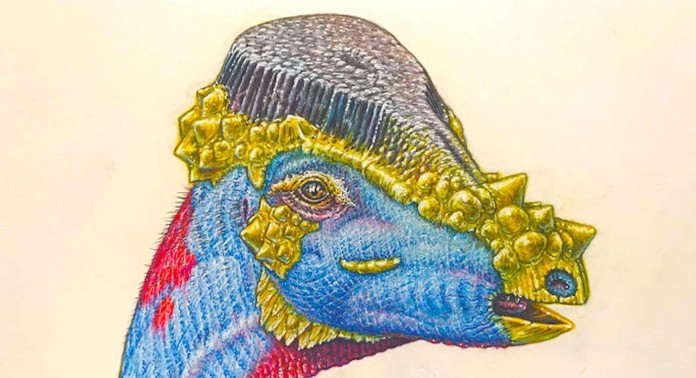
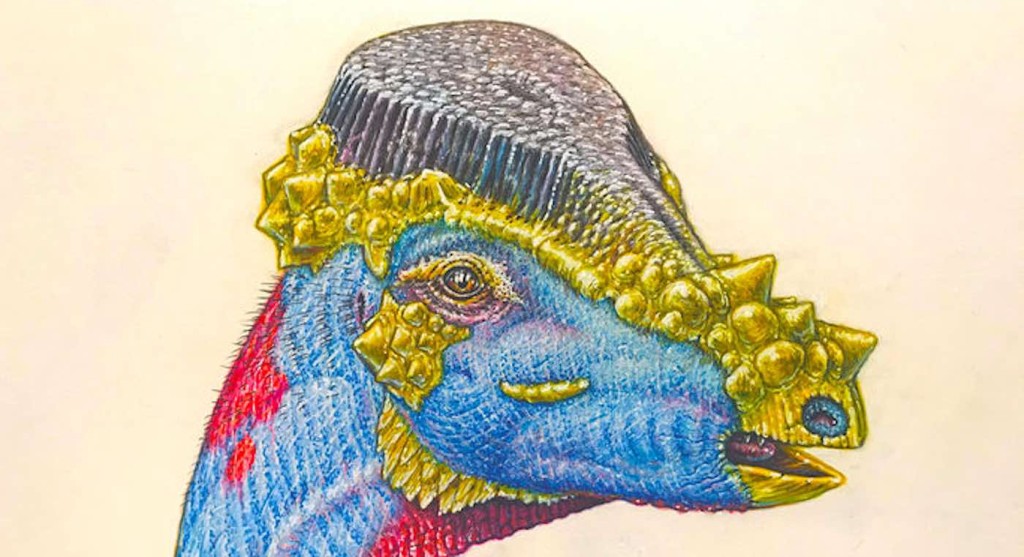
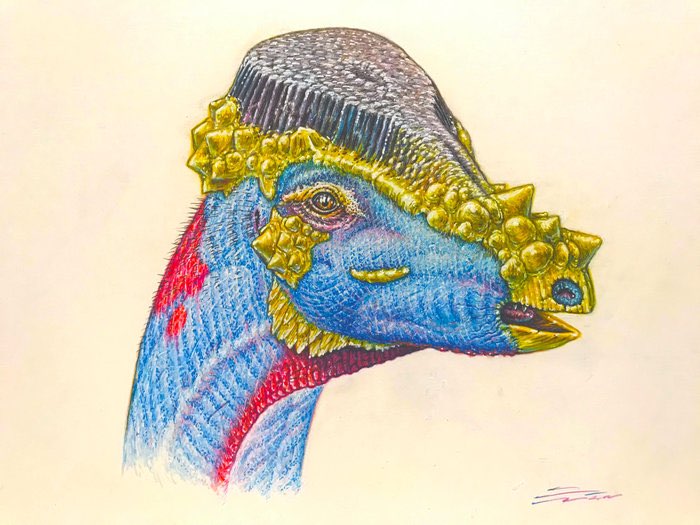
Artist depiction of a pachycephalosaur named Platytholus clemensi – SWNS
Artist depiction of a pachycephalosaur named Platytholus clemensi – SWNS
Researchers say this strange, dome-headed, bristle-bristling dino from 68 million years ago has traces of keratin, what fingernails and rhino horn are made of, sticking up from its skull.
The paleontologists who discovered the beast completed a CT scan on the partially-completed skull and revealed these keratin bristles, described as giving the animal the appearance of having a “brush cut.”
The animal is called Platytholus clemensi, and is a type of pachycephalosaur discovered in 2011 in Montana’s Hell Creek Formation. It was a plant-eating dinosaur that grew up to 15 feet long and walked on two legs.
Dinosaur skulls sport an amazing variety of bony ornaments, ranging from the horns of Triceratops and the mohawk-like crests of hadrosaurs to the bumps and knobs covering the head of Tyrannosaurus rex.
There is a theory that pachycephalosaurs bashed heads in courtship rituals much like some mammals do today. But despite a gash being discovered on the skull which had healed up, the researchers say there is no real evidence to support this, and the discovery of bristles is currently considered more like an elaborate headdress.
“We don’t know the exact shape of what was covering the dome, but it had this vertical component that we interpret as covered with keratin,” said Dr. Mark Goodwin of the University of California, Berkeley. “A bristly, flat-topped covering biologically makes sense. Animals change or use certain features, particularly on the skull, for multiple functions.”
The head wound is about half an inch deep but it could have been caused by anything from a falling rock to a chance encounter with a tree or another dinosaur.
“We see probably the first unequivocal evidence of trauma in the head of any pachycephalosaur, where the bone was actually ejected from the dome somehow and healed partially in life,” said Dr. Goodwin. “We don’t know how that was caused. It could be head-butting—we don’t dispute that.”
However his colleague and co-author of the paper describing the curious animal, Dr. John Horner at the University of California, Orange, believes that since Dinosaurs’ closest living relatives are birds, they should look at skull ornamentation among them, rather than their distant lizard precursors as a guide for what the purpose of these bristles was.
Artist depiction of a pachycephalosaur named Platytholus clemensi – SWNS
“That’s the first place everybody wants to go—let’s crash them together. And, you know, we just don’t see any evidence of it, histologically,” said Dr. Horner. “Any features, any accouterments that we find on the heads of dinosaurs, I think, are all display—it’s all about display.”
He said that reptiles and birds, the closest relatives to dinosaurs, have head ornamentation for display and rarely butt heads like mammals such as sheep. While crocodiles bash their heads together over territorial and mating disputes, sometimes for hours, dinosaurs diverged from crocodiles more than 200 million years before this animal was living.
Pachycephalosaurs also lack a pneumatic chamber above the braincase, as found in bighorn sheep, which protects their brain from injury.
“I don’t see any reason to turn dinosaurs into mammals, rather than just trying to figure out what they might be doing as bird-like reptiles,” Dr. Horner said.
The study in the Journal of Vertebrate Paleontology said that blood vessels in the skull ended abruptly at the surface of the dome, indicating that the blood originally fed some tissue that was sitting atop the dome.
And as the vessels were perpendicular to the surface they most likely fed a vertical structure.
“What we see are these vertical canals coming to the surface, which suggests that there might be keratin on top, but it’s oriented vertically,” Horner continued.
“I think these pachycephalosaurs had something on top of their head that we don’t know about. I don’t think they were just domes. I think there was some elaborate display on top of their head.”
The authors added that it could have been high, colored, or even subject to changes in color depending on the seasons. It suggests they were used for sexual display and courting, though they may have been used to butt the flanks, as opposed to the heads, of male rivals.
Dr. Goodwin said he suspects that dinosaurs likely distinguished gender by color, as do most modern birds, such as cassowaries, peafowls, and toucans, which have bright integumental colors around the face and head for visual communication.
SHARE This Wild Hairdo With Your Flock On Social Media…
One of the most popular hiking apps has made 27,000 trail maps available for download for free in a bid to increase hiker safety.
Most hikers, if they’re honest, will at some point have experienced this situation: they thought they needed to follow one trail, but instead they followed another. Seeking to reorient themselves, they timidly pulled out their smartphone and see, as they suspected, there was no reception of any kind.
Last year, search and rescue missions were up 32% across the US. This is mainly down to the hikers being inadequately prepared. Access to offline maps would help ensure that all hikers can be best prepared for their hike.
To that end, the Irish hiking app HiiKER has released all trail maps in its database for download free of charge. They can either choose to download them directly to their smartphone or as a GPX file to their smartwatch—saving the battery of their device while away from electricity access.
“Hiker Safety is our absolute priority. Offering hikers Free Offline maps on HiiKER, means that everyone can feel confident that they’re on track, regardless of mobile service,” said Paul Finlay, CEO and Founder of HiiKER.
The app team claims that other incumbent Hiking apps such as Alltrails, Strava, and OutdoorActive charge for access to offline maps. As this service is critical to hiker safety, HiiKER is offering it to hikers for free.
Now used by over 600,000 hikers worldwide, the app which began life on the Emerald Isle three years ago is now one of the most-used hiking apps on the market, with over 27,000 hiking routes available to users.
Hadasseh University Medical Center credit AVI HAYOUN
Hadassah University Medical Center credit AVI HAYOUN
An experimental cancer treatment developed in Israel has become so effective for an incurable form of cancer, the hospital administering it has a waiting list more than 6 months long.
Oncologists at the immunology department at Hadassah University Medical Center in Jerusalem used the revolutionary CAR-T, or Chimeric Antigen Receptor T-Cell Therapy, to achieve remission of multiple myeloma in 90% of the 74 patients who undertook the experimental treatment.
Multiple myeloma is a kind of bone marrow cancer that distinguishes itself by developing in several areas at once, including the pelvis, ribs, skull, and spine. It accounts for one-tenth of all blood cancers.
CAR-T cell therapies are changing the world of cancer treatments by utilizing the patient’s own immune system to target and kill cancer tumors. Until the 1990s, it was almost completely unknown how to accomplish this, since cancers disguise themselves to avoid immune responses.
“We have evidence of a very positive overall response rate with minimal side effects, and they are mild,” Professor Polina Stepensky, head of the department at Hadassah. “These are dramatic results. This is a huge hope for patients with a disease that has not yet had a cure.”
Jerusalem Post reports that the treatment will also be available across the US in the coming months, quoting Dr. Stepensky.
“IMMX Bio has acquired a patent license, and we are about to open a clinical trial in the US,” Stepensky said. “The plan is to reach commercialization and FDA approval as a drug within a year.”
The way this particular CAR-T cell therapy treatment works is by taking donated blood and separating out the red blood cells from the white blood cells. Then, a genetic engineering procedure is undertaken in which a deactivated virus is filled with the necessary signals to train the white blood cells, in particular the immune weapon known as a T cell, how to target the cancer tumors.
Hadassah is actually the second institution to make headlines recently over a multiple myeloma CAR-T cell treatment. GNN reported on the development at a state-run hospital in Barcelona in 2021 that achieved a 75% remission rate.
credits from left to right and top to bottom - Chandra: NASA/CXC/SAO, XMM: ESA/XMM-Newton; IR: JWST: NASA/ESA/CSA/STScI, Spitzer: NASA/JPL/CalTech; Optical: Hubble: NASA/ESA/STScI, ESO; Image Processing: L. Frattare, J. Major, and K. Arcand
credits from left to right and top to bottom – Chandra: NASA/CXC/SAO, XMM: ESA/XMM-Newton; IR: JWST: NASA/ESA/CSA/STScI, Spitzer: NASA/JPL/CalTech; Optical: Hubble: NASA/ESA/STScI, ESO; Image Processing: L. Frattare, J. Major, and K. Arcand
Looking for a cool way to get your kids involved in astronomy? Just show them this picture.
These images are composite pieces of technological artwork that would be invisible to the naked eye. Five space-based observatories teamed up with one down here on Earth to color in famous regions of space with X-rays and infrared light—neither of which can be seen by us.
The image in the top left is of NGC 346, a star cluster in the Large Magellanic Cloud, 200,000 light years from Earth. The purple and blue haze on the left are X-rays, a form of high-energy light, left over from a supernova explosion. On the right, infrared data from the James Webb and the now-retired Spitzer space telescopes shows plumes of gas and dust that all those twinkling stars are either currently using, or have used to create their shining, burning forms.
The X-rays are being detected by the space-based Chandra X-ray Observatory, developed by Harvard, and humanity’s flagship X-ray observatory.
To the right side, NGC 1672 is a spiral galaxy, but one that astronomers categorize as a “barred” spiral, meaning that the arms close-in to the center appear more like straight bars rather than curved tentacles. Here, Chandra’s purple-colored X-rays reveal black holes amid the James Webb and Hubble telescopes infrared and optical light picture of this galaxy.
Messier 74 is also known as the “Phantom Galaxy” because it’s relatively dim and difficult to spot with telescopes in a region that is otherwise pretty close to Earth. It’s anything but dim in this image, captured face-on thanks to our planet’s position.
Webb outlines gas and dust in the infrared lights which we see as green, yellow, red, and magenta, while Chandra’s data spotlights high-energy activity from stars at X-ray wavelengths colored in Purple. Hubble’s optical data showcases additional stars and dust along the dust lanes.
Messier 16, also known as the Eagle Nebula, is a famous region of the sky often referred to as the “Pillars of Creation.” The Webb image shows the dark columns of gas and dust shrouding the few remaining fledgling stars just being formed. The Chandra sources, which look like dots, are young stars that give off copious amounts of X-rays.
Here, the X-rays are in red and blue, and highlight the huge activity given off by some stars in the area.
SHARE This Stunning Work With Your Friends On Social Media…
Quote of the Day: “To a brave person, good and bad luck are like her left and right hand. She uses both.” – St. Catherine of Siena
Photo by: Budka Damdinsuren
With a new inspirational quote every day, atop the perfect photo—collected and archived on our Quotes page—why not bookmark GNN.org for a daily uplift?
A Welsh photographer incidentally found that a familiar harbor area bore an uncanny resemblance to a dolphin.
Photographer Rhys Jones was amazed to see the likeness in the photograph he took with his camera drone over Pwllheli in Wales.
Rhys says he has taken his drone over the marina many times but this was the first time he noticed the aquatic appearance of the landscape.
“Once seen, it cannot be unseen,” said the 37-year-old, who has been taking drone photos as a hobby for the past two years. “In all my flight time over the Pwllheli harbor, I have never noticed this as much as last night, spectacular!”
“I have taken many photos of the beautiful area we live in. I have been over the marina many times but only just noticed this amazing landscape on this occasion.”
The pictures have gained a lot of interest from locals on his Facebook page, Pwllheli Drone Photos, where he does his cultural duty to showcase the insane beauty of the Welsh landscape.
“Was this created on porpoise?” one commenter asked.
It’s a completely appropriate coincidence because that area of the sea has a pod of around 300 dolphins who occasionally visit the harbor.
Drone photo by Rhys Jones-SWNS
SHARE This Beautiful Coincidence With Your Friends On Social Media…
In 2020, GNN celebrated the hard work of 18-year-old Rehan Staton, who worked for years as a garbage man to support a charge into Harvard Law School via classes at the University of Maryland.
Now, after years of a different sort of hard work, Staton has graduated and has a job lined up in a New York law firm.
A long journey of sweat and tears, and literal blood preceded his walk out onto the stage in a cap and gown, one in which he gave as good as he got.
The boxing analogies come from the fact that Rehan Staton excelled in the martial arts including boxing, winning several competitions until a rotary cuff injury put an end to that permanently. With grades so bad he was rejected from every college he applied to, the part where he took a job as a sanitation worker wasn’t rock bottom as one might expect.
“It was the first time in my life a group of individuals that weren’t my father or my brother just came around me and… really just empowered me, uplifted me, told me I was intelligent,” he said in 2020.
The sanitation team helped him to enroll, successfully this time, at Bowie State University, after which his grades improved from terrible to 4.0—landing him a spot at Maryland State U. His father would suffer a stroke years later, requiring Rehan to wake up at 4:00 a.m. to haul trash for payment of the medical bills and ensure he still had time for his studies.
This story, as NBC news reports, went viral on social media which attracted celebrity Tyler Perry to pay his tuition. He was accepted into Harvard for the 2020 semester. After that, he began to give back, befriending all the school janitors and other staff who were surprised he wanted to speak to them.
“She said, ‘I’m sorry, I’m sorry, students don’t talk to me. Students would rather look at the wall than talk to me,’” he recalled one worker telling him.
Starting a non-profit called the Reciprocity Effect that works with support staff affiliated with educational institutions, he was able to give out several prizes at organized ceremonies to honor them with recognition and awards. The non-profit helps to crowdfund financial assistance for these hard-working folks in the case of personal tragedies.
English media is gushing over the news of the first “de-extinction event” that saw a yellow wildflower unique to northeast England brought back to life.
Extinct since 1991, the York groundsel managed to carry on thanks to a handful of seed that was shed from three potted specimens on a windowsill at the University of York.
Stored at the Millennium Seed Bank in the Kew Gardens, botanists at Natural England organized a resurrection for the York groundsel after they received word the seeds were reaching the end of their lifespan.
A plastic greenhouse was constructed for the experiment at the Rare British Plants Nursery in Wales, and thanks in no small part to its excellent fecundity, 98 of the 100 seeds germinated, and soon, those three survivors on a windowsill had passed their genes on to literally thousands of offspring, three whole decades after they died.
“It’s a smiley, happy-looking yellow daisy and it’s a species that we’ve got international responsibility for,” said Alex Prendergast, a vascular plant senior specialist for Natural England. “It’s also got an important value as a pollinator and nectar plant in the area because it flowers almost every month of the year.”
“It only lives in York, and it only ever lived in York. It’s a good tool to talk to people about the importance of urban biodiversity and I hope it will capture people’s imagination,” he told the Guardian.
This groundsel is the only known species to have evolved in England within the last 50 years as it dumped all its evolutionary vigor into figuring out how to live successfully in urban environments.
It grew out of every crack in the pavement during the stagflationary recession of the 1970s, but soon fell prey to widespread weedkiller application.
Prendergast said that this de-extinction event is likely to be a one-off because of the unique nature of the York groundsel, but added that it nevertheless demonstrated the immense importance of the Millennium Seed Bank.
SHARE This Hopeful Inspiring Story With Your Friends…
Archaeologists working in Spain’s most famous archaeological site have uncovered a 5,400-year-old tomb that perfectly aligns to the summer solstice sunrise in such a way as to be described as “domesticated sunlight”.
That strange term is used because of the rich variety of designs that appear in shadow on a stone stele on the right-hand side of the tomb when hit by the light of the rising sun on June 21st, producing an effect not unlike Newgrange in Ireland.
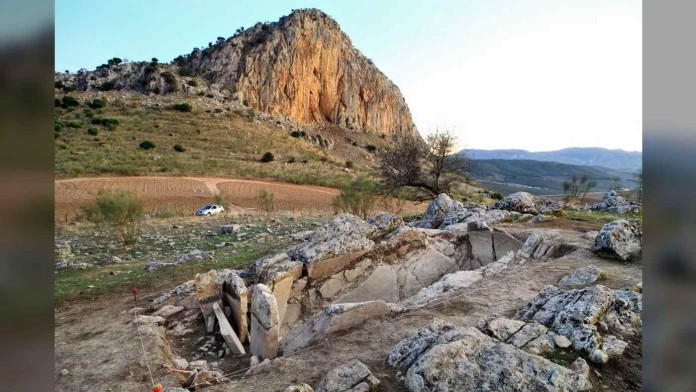
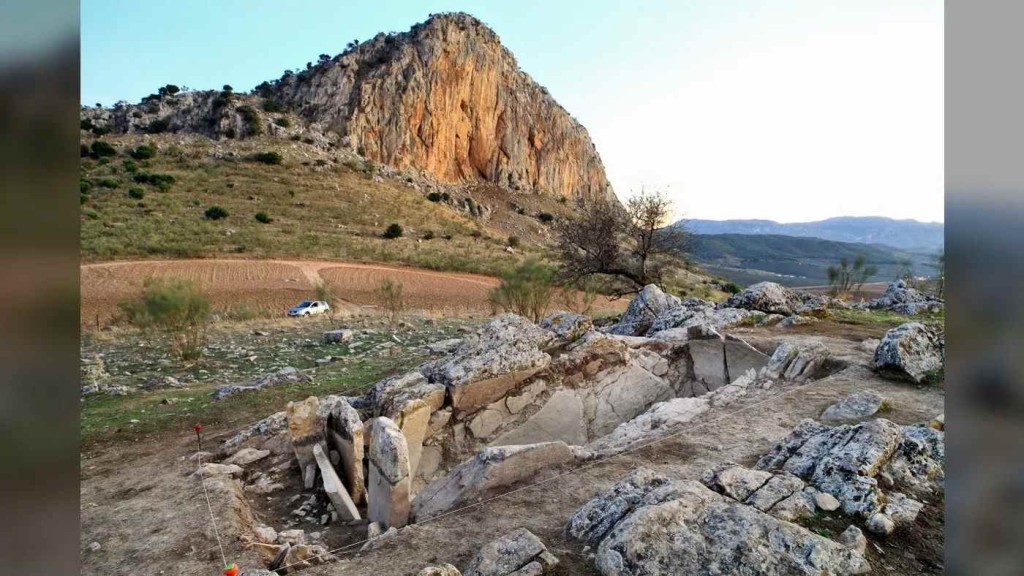
The tomb was discovered in the Antequera Dolmens UNESCO World Heritage Site near the town of Antequera, southern Spain. The 6,100-acre (2,446-hectare) site contains a mix of megalithic and dry stone Neolithic burial architecture unsurpassed in all of Europe, many of which contain archaeo-astronomical alignments.
“Newgrange is much bigger and more complex than the tomb we have discovered [in Spain], but they have something in common — the interest of the builders to use sunlight at a specific time of the year, to produce a symbolic—possibly magic—effect,” Leonardo García Sanjuán, an archaeologist at the University of Seville, told Live Science reporting on the discovery.
In the case of this tomb, called Piedras Blancas, or “White Stones” the base had exposed bedrock layers that tilted away from the sunrise, and so workers deliberately carved out a channel for light to enter and dance with shadows upon the walls inside.
The tomb was found quite near a remarkable limestone formation called La Peña de los Enamorados—the Rock of the Lovers—named after a legend that says two star-crossed lovers once killed themselves by jumping off it. It’s even closer to the Matacabras rock shelter, which is adorned with pictographs thought to be painted about 5,800 years ago.
“Antequera illustrates the power by which nature presided over the Neolithic worldview, inspiring and guiding the creation of monuments,” Sanjuán and his colleagues wrote in a paper on the site, published in Antiquity. “Is it mere chance that the largest and most sophisticated Neolithic monumental landscape in Iberia is in a region with not one but two remarkable natural formations?”
“Due to their different textures and carbonate content, processes such as dissolution, gelation, and wind action have differentially dissolved the limestones to form corridors, sinkholes, and caves. Neolithic settlers in the region may not have understood the formation processes that created El Torcal, but for a millennium and a half they lived among geological towers, corridors, and chambers that very much resembled a natural architecture”.
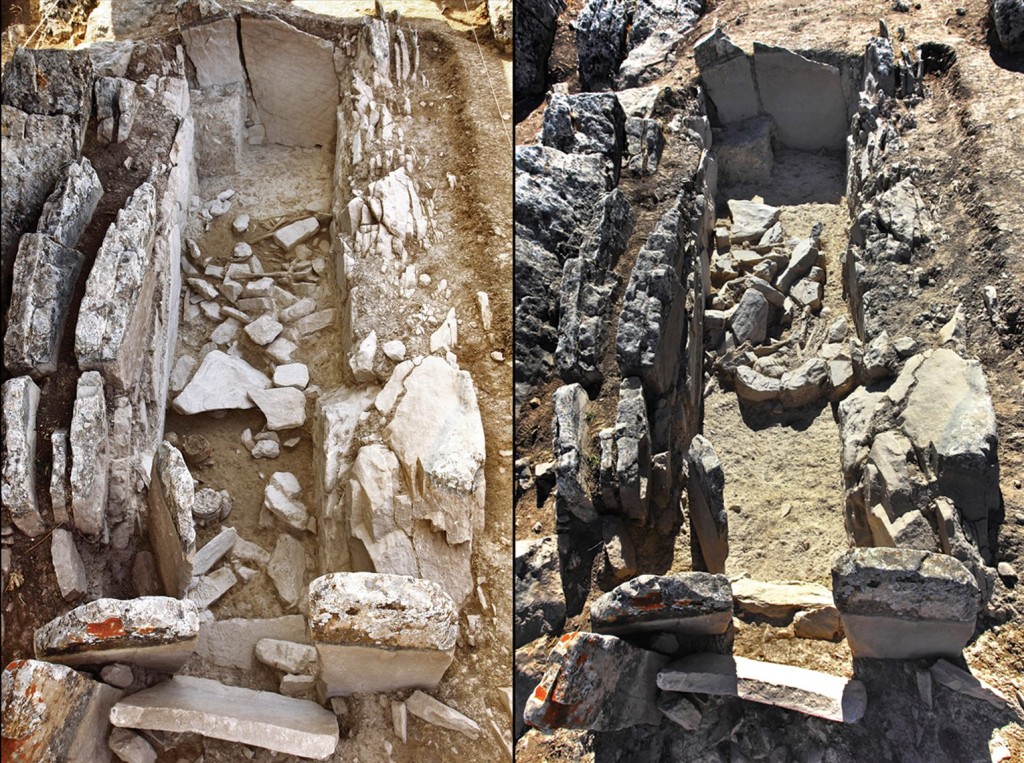
A side-by-side view of the oldest strata of the tomb (left) and a second period of use dating to about 500 years later (right) that began with a filling in with sediment of the earlier surface. credit – M. Ángel Blanco de la Rubia, Cambridge University Press.
What was found inside
Built probably around 3,400 BCE, or 5,400 years ago, the site was still regularly inhabited or at least visited 1,400 years later at the onset of the Bronze Age in Andalusia, highlighting its importance in local culture.
The tomb contained a large “assemblage” of human remains, compared to other megalithic tombs at Antequera whereby no human bones have ever been found.
At White Stones, the entrance to the tomb was free of all cut rock and human remains, and in fact played host to funerary offerings, to which 10 complete ceramic vessels bear witness. Further towards the back of the chamber, a complex arrangement of medium-sized stones tightly bonded with mud appears to have acted as a platform on which to place bodies and/or bones.
All this was recorded in the layer of earth closest to the bedrock, and dates to the oldest period of use around 3,000 BCE. Then about 500 years later, a dramatic transformation occurred which saw all these features buried with a layer of sediment.
In this layer were discovered two adult skeletons, one male, one female, of about 75% completeness, but nothing that could be construed as grave goods. The tomb was then subject to yet another renovation, with yet more skeletons.
Perhaps more interesting than anyone found inside were two slabs of rock that made up the right-hand side wall. The first, covered in undulating wave or scale-like shapes, was taken from an area that used to make up the shallow seabed. It was on this rock that the light from sunrise on the summer solstice would fall.
Just below it, two flat stones were affixed to the bedrock of the tomb’s floor with mud mortar, which point directly to the rising sun on the solstice circ. 3,400 BCE. The orientation of the pointing stone passes exactly through the gap between the eastern end of the wall and two stones placed there, perfectly channeling the light onto the stone with the wave patterns.
“These people chose this stone precisely because it created these waving, undulating shapes,” Sanjuán told Live Science. “This was very theatrical… they were very clever in producing these special visual effects”.
A European thing
The authors note in their study that Neolithic Europeans in Spain, Ireland, England, and even Sweden, have aligned megalithic structures to solar movements, such as sunrise or sunset during the solstices, or the vernal and autumn equinox.
Sanjuán notes that the importance of the sun is of obvious focus: the sun was the center of the worldview for Neolithic Europeans. It kept them warm, allowed them to see, grew plants, melted the snow, and guided the changing of the seasons.
The Dolmen de Menga pictured above is one of the largest in Europe, but it isn’t aligned with any astronomical event. Instead, its opening points directly at La Peña de los Enamorados, with White Stones at its base.
Clearly, the hill was of great importance to the people of Neolithic Antequera, but why such an enormous megalithic monument would be made to point at a much smaller one, by comparison, was not something the archaeologists could answer at this time.
At the end of their work, they had nevertheless proven once again the incalculable value of Antequera for understanding the history of Europe.
SHARE This Truly Amazing Discovery With Your Friends…
Quote of the Day: “Nothing would be done at all if you waited until you could do it so well that no one could find fault with it.” – Cardinal Newman
Photo by: Filip Mroz
With a new inspirational quote every day, atop the perfect photo—collected and archived on our Quotes page—why not bookmark GNN.org for a daily uplift?
A window cleaner has become an online sensation after pressure washing his hometown’s filthy pavement and sidewalks in his spare time.
Andrew Carr has been dubbed a hero by TikTok users for his efforts and his videos that have attracted thousands of followers from around the world.
Carr, who owns ABC Cleaning Services, says he was fed up with the paths and cobbles in Alnwick, Northumberland, being covered in chewing gum and dog poo.
One day he simply couldn’t take it anymore, and after finishing a job washing windows and gutters in a town shop, the 32-year-old turned his powerful pressure washer on the path outside and was amazed to see patterns on the paving slabs that had been hidden under decades of dirt.
Satisfied with his efforts he contacted the local council and offered to spruce up the rest of the historic town in his spare time, and they agreed.
Now, every Sunday morning, Carr blasts the paths and pavements around the town center until they sparkle.
“I was cleaning windows and gutters and just looked down and was really disappointed at the state of the pavements,” recounts Carr. “I looked further up the high street and every paving slab was covered in chewing gum and there was a dog mess. It was a sad sight.”
“Right there and then I set myself a goal of cleaning the center of town up. I thought to myself that everyone complains about dog mess and chewing gum but no one does anything about it.”
“I contacted the town council and said I wanted to clean the paths up and they were delighted. It’s really lifted the spirits of people living here.”
He now wants to tackle the pavements around the edges of the town, including the rundown bus station and nearby residential streets, elated with the feedback he hears from people, especially from visitors.
For example, 60-year-old life-long Alnwick resident Angela Davies said that she “never knew the paving slabs had patterns before they were washed.”
“It may seem a small thing to be excited about but the clean pavements have transformed the place,” she said.
“The work clearing chewing gum is very time-consuming but the results are a revelation,” said town Councillor Gordon Castle. “On behalf of the town, I thank him for his public-spirited work.”
WATCH Carr get to work in a compilation of his TikTok videos…
SHARE This Public Servant With Your Friends And Keep His Star Shining…
There are poisonous books—the Communist Manifesto, or Mein Kampf for example—and then there are books that are literally poisonous.
Covered in vibrant green bookcloth, hundreds of 19th-century volumes are actually laced with a toxic pigment, and one researcher who’s used to creating databases of volumes for research, has instead created one as a public health service; aptly named the Poison Book Project.
Emerald green, also known as Paris green, Vienna green, and Schweinfurt green, is the product of combining copper acetate with arsenic trioxide—yes, that arsenic.
Arsenic can cause permanent organ damage and death in the worst of cases, but even minimal exposure can cause fatigue, cramps, and diarrhea as your body works to purge the heavy metal.
“The toxic pigment was commercially developed in 1814 by the Wilhelm Dye and White Lead Company in Schweinfurt, Germany,” reports National Geographic. “It was used everywhere, from clothing and wallpaper to fake flowers and paint.”
But arsenic was just the start, as Poison Book Project explains.
Over 50% of the 19th-century, cloth-case bindings analyzed for this project to date contain lead in the bookcloth, across a range of colors. Analysis of a range of bookcloth colors has identified… the following highly toxic heavy metals: arsenic, chromium, lead, and mercury.”
Volumes used to be bound in leather until bookcloth became a more affordable substitute. The bookcloth also meant that publishers could use dyes and more heavy pigments to color the exteriors.
One such emerald green book, Rustic Adornments for Homes and Taste, was the subject of examination by Melissa Tedone at the Winterthur Museum, Garden & Library in Delaware, and founder of Poison Books Project.
Examining the volume, she found a black excretion on the damaged part of the 162-year-old cover, which led her to a laboratory for testing. She discovered the substance was a mix of copper and arsenic, with the latter averaging a concentration of 1.42 milligrams of arsenic per square centimeter.
That’s 1.4% of a lethal dose for an adult. However, the risk is essentially limited to those who would handle books like these regularly—such as conservationists, librarians, literature professors working in historic libraries, or museum curators, for whom Poison Books Project has important safefty information.
But the next time you think to buy a shiny blue, red, or especially green set of antique books, make sure you stop by the pharmacy for some latex gloves before hand.
SHARE This Public Health Service Announcement On Social Media…
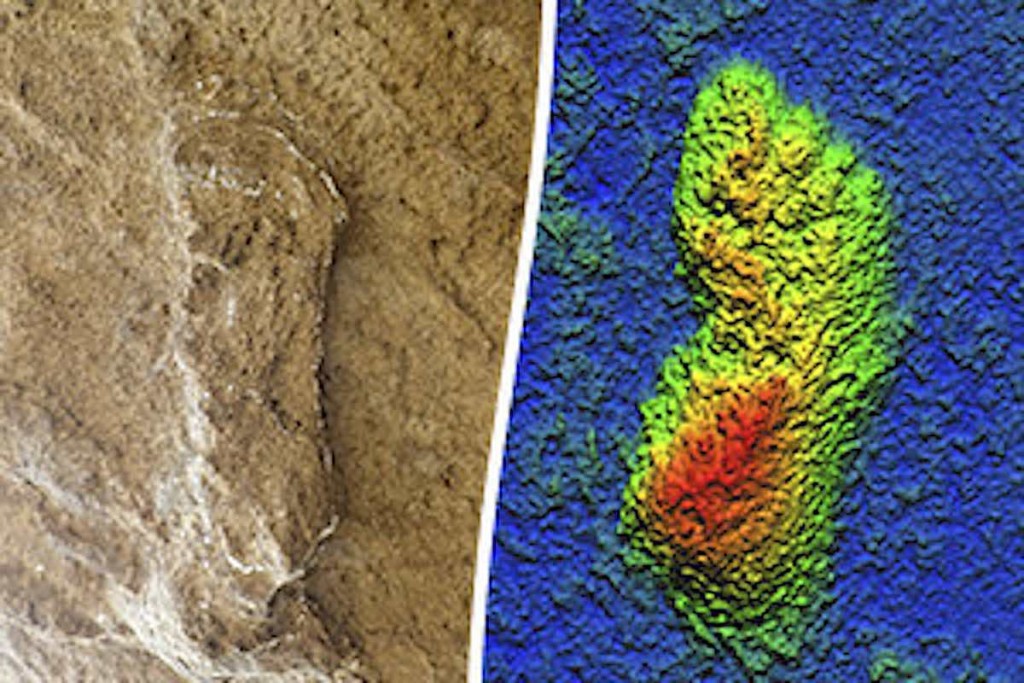
Nelson Mandela University / University of Leicester (SWNS)
Nelson Mandela University / University of Leicester (SWNS)
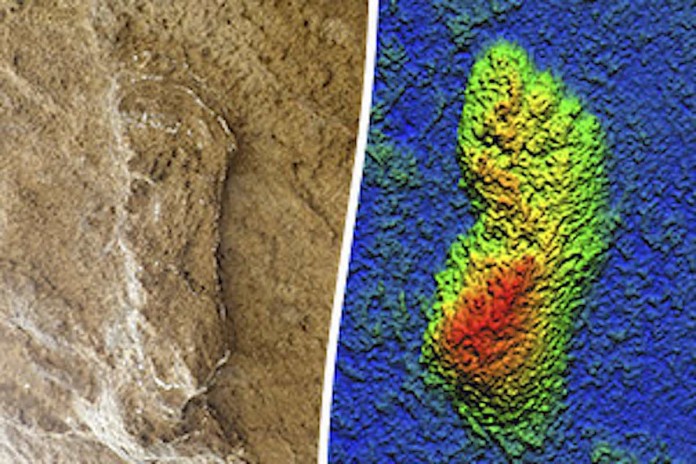
A 153,000-year-old footprint found in South Africa could be the world’s oldest ever made by our species.
Older footprints from the Homo genus have been found in Spain, but it’s not perfectly clear which species they belonged to as they pre-date the earliest evidence of neanderthals in Europe.
Scientists working in Africa identified the track made by Homo sapiens in the Garden Route National Park, west of the Cape Coast town of Knysna, and that it’s older than the two previously oldest tracks in Nahoon and Langebaan by 25,000 years.
“Just over two decades ago, as the new millennium began, it seemed that tracks left by our ancient human ancestors dating back more than about 50,000 years were excessively rare,” explained Charles Helm, Research Associate at Nelson Mandela University, and Andrew Carr, Senior Lecturer at University of Leicester, who together published a paper on their findings in the journal Ichnos.
“In 2023 the situation is very different. It appears that people were not looking hard enough or were not looking in the right places. Today the African tally for dated hominin ichnosites (a term that includes both tracks and other traces) older than 50,000 years stands at 14.
That count includes 4 from East Africa and 9 from South Africa. Another 10 ichnosites are spread across the world and can be found in places such as the UK and Arabian Peninsula.
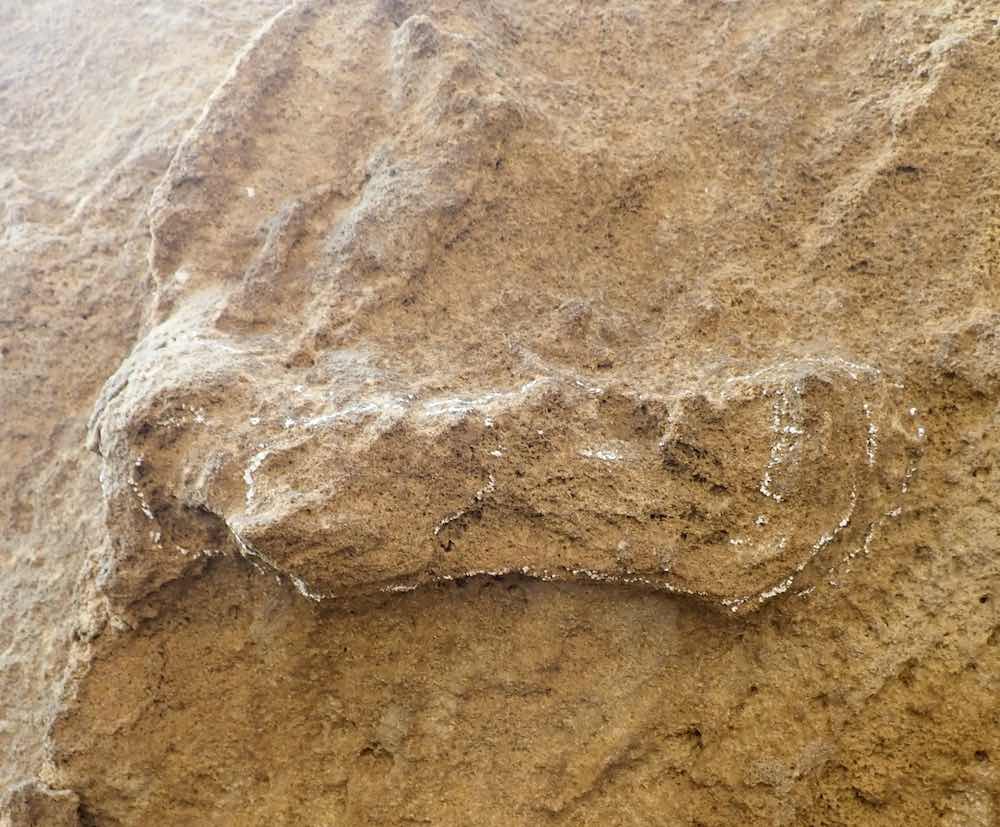
“The footprints are ‘natural casts’, i.e. they are from the layer of sand that filled the footprints in,” says Dr. Helm.
“The South African hominin track sites are globally unusual in that this is a common mode of preservation. It means that, counterintuitively, we look on cave ceilings and rock overhangs for such footprints.”
Nelson Mandela University / University of Leicester (SWNS)
The South African sites on the Cape Coast, attributed to Homo sapiens, bear tracks that tend to be fully exposed when they’re discovered, in rocks known as aeolianites, which are the cemented versions of ancient dunes.
Excavation is therefore not usually considered, and because of the sites’ exposure to the elements and the relatively coarse nature of dune sand, they aren’t usually as well preserved as East African sites.
“They are also vulnerable to erosion, so we often have to work fast to record and analyze them before they are destroyed by the ocean and the wind,” said Dr. Helm. “A key challenge when studying the palaeo-record—trackways, fossils, or any other kind of ancient sediment, is determining how old the materials are.”
In the case of the Cape Coast aeolianites, the dating method of choice is often optically stimulated luminescence.
This method of dating shows how long ago a grain of sand was exposed to sunlight; in other words, how long that section of sediment has been buried.
“Given how the tracks in this study were formed—impressions made on wet sand, followed by burial with new blowing sand—it is a good method as we can be reasonably confident that the dating “clock” started at about the same time the trackway was created,” the researchers write.
When a struggling Californian attempted to alleviate his financial stress by robbing a bank, Michael Armus Sr. recognized it was out of sadness and not malice.
Stepping in with words, and eventually a hug, 69-year-old Michael diffused a situation potentially explosive situation, as the bank robber claimed he was carrying a bomb.
Everything seemed a normal day for Armus, who walked into the Bank of the West in Woodland, California when he noticed a former neighbor of his speaking to the teller with irritation and depression in his voice.
Unbeknownst to Armus, the neighbor, Eduardo Placensia, had passed a note to the teller claiming he was armed with explosives and demanded money to avoid detonation. However, the fact that Placensia’s shirt was pulled over his nose and mouth mixed with the teller’s frightened expression and quickly alerted Armus to the fact that all was not well.
“So, I just approached him, and I asked him, I said, ‘What’s wrong?… You don’t have a job?'” Armus told Good Morning America. “He said, ‘There’s nothing in this town for me. Nothing in this town for me. I just want to go to prison.'”
Quote of the Day: “Trust those that you have helped to help you in their turn.” – Neil Gaiman
Photo by: krakenimages
With a new inspirational quote every day, atop the perfect photo—collected and archived on our Quotes page—why not bookmark GNN.org for a daily uplift?
What makes a vacation truly memorable? There may be a reliable formula, at least for younger people.
A poll of 2,000 travelers between 18 and 34 identified some of their favorite ingredients.
Traveling with a group of at least four people, enjoying a minimum of four new experiences, and doing something “unexpected” were among the most essential.
36% felt stepping out of your comfort zone was necessary for an unforgettable trip, wanting to push their boundaries at least four times during any given adventure.
32% believe making new friends is desirable, with a memorable vacation defined as meeting three new people.
At least three new dishes should also be tried.
Conducted by OnePoll and commissioned by Contiki, a social travel company, the survey recipients pointed to a successful vacation as including 45 photos and 15 videos to capture the “perfect moments” they want to remember.
Respondents have been on an average of seven memorable trips. Almost 30% of those who’ve traveled solo feel that those vacations created more memories than any other.
“Exploring a new destination and culture is opening yourself up to the unknown with the potential to create memories that can last a lifetime,” said Rachel Storey, Brand Director of Contiki.
The research also found that 34% feel they need to make every moment count when traveling due to increased work pressure. Nearly half (47%) feel so strongly about this that they would quit a job that didn’t allow them to take time off needed for a meaningful trip.
36% have a vacation bucket list that they want to tick off.
But 53% prefer a perfect moment to happen naturally or organically, rather than be something that is engineered—and 81% believe it’s the imperfect or unexpected moments that can make a vacation the most memorable.
“When you reflect on trips from the past, it’s often the moments you couldn’t have imagined, that leave the deepest impact,” continued Rachel. “Whether it’s a moving encounter with a local, making a new friend, ordering an unusual item in a restaurant, or taking a leap of faith on a new activity – the ultimate souvenir is the memories you make along the way.”
TOP PERFECT MOMENTS TO EXPERIENCE ON VACATION
Watching a sunrise or sunset with friends or family
Some kind of joke or funny event that becomes a running joke
Something that becomes a story to tell for years to come
Doing something that takes you out of your comfort zone
Drinks or food with a view
Making a connection with a local or group of locals
Trying the local delicacy which is considered unusual at home
Taking a detour or getting lost and finding an empty beach or amazing view
Seeing a famous landmark
Swimming in the sea
Doing something adrenaline-spiking, such as bungee jumping or parachuting
Ticking something off your bucket list
Getting a full tour of a beautiful city
Seeing animals in their natural habitat
Finding the ideal souvenir or gifts
Getting a tour around a local town or village
Marriage proposed or witnessing a proposal
A romantic kiss
Climbing a mountain