Two security guards are being hailed as heroes after assisting a mother whose infant son was choking.
It was just before noon that Joey Madrigal and Niko Nesbeth pulled into a gas station at a busy Beverley Hills intersection and saw a scene unfolding before them.
A mother with a baby in her arms was screaming if anyone was a doctor, and Nesbeth, a former marine, rushed to help despite the fact he wasn’t a doctor.
Before he knew what was happening, the mother practicaly threw the baby into Nesbeth’s arms, who convenes with his partner and, noticing the infant’s face is blue, immediately flipped him over to start patting his back to clear his airways.
“Then he tells me baby isn’t breathing. Right then and there, I then turn and one thing I’ve learned through training and everything is that you gotta slow down time, and you gotta realize and just get all the facts and put it all together because I was pretty much in charge of getting the rescue as fast as possible,” said Madrigal.
As private security guards for the company Covered 6, Madrigal used his private communication line to 911 to get an ambulance there immediately.
The whole incident was captured on the station’s security cameras, and the two men are being hailed as heroes whose quick and decisive actions saved the baby’s life.
Nesbeth and Madrigal believe it was a sort of divine intervention that saw them arrive on the scene at that moment.
Quote of the Day: “Don’t fight back. Fight forward.” – Ted Lasso(Sam’s father in Season 3)
EDITOR’S NOTE: Have you watched the 3 seasons of Ted Lasso? We highly recommend it as one of the best ‘good news’ comedy/workplace dramas in history—and well worth subscribing to the Apple+ streaming service for a month or two, for the pleasure and inspiration it delivers.
Photo by: Apple TV+ / Jason Sudeikis – Ted Lasso (Fair use)
With a new inspirational quote every day, atop the perfect photo—collected and archived on our Quotes page—why not bookmark GNN.org for a daily uplift?
Pippa Ashton (left) and Emma Redman of EWE Talk – SWNS
Pippa Ashton (left) and Emma Redman of EWE Talk – SWNS
A new animal therapy business using cuddly, wooly neighbors to help struggling kids and adults with their mental health, and the results are unbaalievable
EWE Talk was launched by Emma Redman and Pippa Ashton last year after Emma was given the opportunity to buy a unique breed of sheep called a Valias Blacknose.
Known for a dog-like temperament that makes them perfect for providing emotional support. The pair now has a flock of seven sheep and two goats to help those that are finding life challenging.
Studies have shown that animal therapy can have both psychological and physiological benefits.
Emma’s life has included accomplishments, joy, and memories, but was also filled with un-or-misdiagnosed mental alterations including OCD, anxiety, eating disorders, and ADHD. These life experiences have proven to be a big drive for creating something new and innovative as a way of supporting others
“One of the things we have always known is how useful animals are as a tool to help those struggling with diversities and mental health issues,” said Emma. “Sheep aren’t used as therapy animals—people usually think of horse and dog therapy.”
From there, Emma and Pippa realized there was a gap in the market for a unique animal therapy venture and decided to give it a go.
“We offer a safe space, if they want to talk to us then they can but maybe they just want to play and giggle and laugh and run around with the sheep,” said Emma. “We want to be there to help anyone that needs us—we’ve got so much belief that what we can do is make a difference.”
Their flock includes the original duo Autumn and Maggy, the Valias Blacknoses, as well as their lambs Nelly and Ziggy. Also on the farm are two Cotswolds sheep Hope and Pearl.
While their goal is to visit schools and educational settings with their fluffy friends, currently they only host children on their farm.
Pippa Ashton (left) and Emma Redman of EWE Talk – SWNS
“A young girl came to the farm who had tried all different types of therapies and for the first ten minutes, she didn’t want to engage,” said Emma. “After that, she was in the stable with the sheep being cuddled. Over the hour we started to talk and there was laughter and smiles and she’s come back weekly since.”
On some occasions however, they’ve transported the flock to locals in need of emotional support.
“We are a mobile service which is unique,” said Emma, explaining that they hope to secure more funding to expand their services. “We can go to people’s houses and help those struggling with loneliness and isolation. Every time we see a child benefit from their time with the animals it gives us that passion to move forwards and make a difference.”
WATCH Emma, Pippa, and their sheep below…
SHARE This Baawsome Story With Your Flock On Social Media…
The first day of summer; June 21st; the longest day of the year in the Northern Hemisphere. It’s a time marked by most ancient cultures as the most important day in the calendar, and probably the New Year as well.
But there’s no need to spend “Midsummer” buried in your history books, there are several cities in Europe that have summer solstice festivals today. “Midsommar” for example is one of Sweden’s most important holidays, and with a winter so cold it’s easy to see why.
Because the Earth orbits the sun in an ellipse, there’s no single earliest sunrise and latest sunset, rather these vary by a few days depending on where you live in the Northern Hemisphere.
In terms of that singular moment when the sun reaches its highest point in the sky of the year, it will occur at 10:58 on the east coast of America, but at 14:58 for Central Europeans.
There are several ways that you or your friends and family can enjoy the solstice. English Heritage, a government non-profit, hosts a livestream of the moment of sunrise at Stonehenge, perhaps the world’s most famous monument to be attuned to the solstice. The 2023 stream starts a few hours before sunrise which is 04:49 BST.
Summer Solstice taken by the Himawari-8
Other events like this include Manhattanhenge, where Americans can see the sunrise climb perfectly above the east-west streets of that most famous urban island. The most famous spot for Manhattanhenge photos is the elevated Tudor City Bridge on 42nd Street.
14th, 23rd, and 34th streets are all additionally good spots to see the sunrise.
If you prefer a festival to a spectacle, the most raucous ones are in Europe. The Secret Solstice Music Festival in Reykjavik, Iceland’s capital, attracts some 8,000 visitors yearly, and is a perfect way to celebrate summer with people who can truly appreciate the opportunity to wear short sleeves. The highlight is seeing the headlining band perform under the midnight sun.
Iceland’s neighbor Sweden has turned the solstice into a national holiday. In fact, it has been suggested as Sweden’s de facto National Day, which this year falls on June 23rd. Here like in Iceland, the sky never truly darkens, and festivities often go on through the night.
On the Visit Stockholm website, one can read all about celebrating it in the big city, or in the surrounding countryside where flower picking, garland wearing, and raising of the Maypole, are still the chief activities.
In Egypt, you can see the sunset between the Pyramids of Giza, while on the island of Orkey, one can see the sunrise paired in perfect alignment with the Standing Stones of Sternness, perhaps even older than Stonehenge.
SHARE This Story And PLAN A Solstice Celebration With Your Friends…
A man named Michael can thank his lucky stars that when his heart stopped aboard an airplane, there was a healthcare angel sitting just a few rows back.
Emily Raines, an acute care nurse at a Baltimore hospital, was flying back from a vacation in the Bahamas with her boyfriend when the flight attendant asked if there was anyone onboard with medical training.
The attendant over the intercom said a passenger was having a medical emergency, and Raines quickly volunteered.
“On our way up there I was trying to pregame like ‘hey if we have to do compressions, I need you to do compressions. I’ll take care of everything else,'” Raines described the tense moments during the emergency, discussing the game plan with her boyfriend, a former nurse who now works in finance.
She told CBS News that once she got to the passenger’s seat, he was slumped over, flush purple, and not breathing. Together they did chest compression, or CPR, for about 23 minutes before with just 7 minutes until landing, their good work revived the man.
He was rushed to the hospital as soon as the plane came to a halt, while Raines was treated to a hero’s welcome as she returned to her seat further back in the plane.
“We were amped because it’s so awesome to have that feeling, and afterwards, you’re just like, ‘oh wow, we did this, we saved somebody’s life,'” Raines exclaimed.
A short time later, Raines received a message from Michael’s wife, expressing her deep gratitude for the saving of her husband.
“I cannot possibly thank you enough for saving Michael’s life. There are no words. if I could, I would like to at least make you some cookies,” the woman said.
Sulawesi crested macaque monkey born at Chester Zoo - SWNS
Sulawesi crested macaque monkey born at Chester Zoo – SWNS
Conservationists are celebrating the birth of one of the world’s most endangered primates at a UK zoo.
The rare Sulawesi crested macaque was born on May 16th at the Chester Zoo to proud new mom Rumple and dad Mamassa.
Adorable photographs show the new arrival clinging on to its mother as it made its first outside appearance at its enclosure at the UK’s largest and most-visited zoo.
The species is listed as Critically Endangered by the International Union for Conservation of Nature (IUCN) and fewer than 5,000 remain in their natural habitat on the Indonesian island of Sulawesi.
Though the adults’ faces are jet black, the babies are born with a buckskin leather tone that highlights their beautiful eyes.
Rumple and baby Sulawesi crested macaque monkey at Chester Zoo – SWNS
“Sulawesi crested macaques are highly sociable animals that live in large groups, and so the new baby is currently being passed around by mom Rumple to several other females, who are all sharing parenting duties, which is great to see,” explained Mark Brayshaw, head of mammals at the zoo.
“Every birth is a step forward for the international conservation breeding program that’s working to safeguard the future of this critically endangered species. It also provides an opportunity to learn more about their behavior, biology, and social structures, which all help to inform the efforts to protect the species globally.”
Sulawesi is the world’s 11th largest island at about 70,000 square miles and is located east of Borneo. A large percentage, 62% (79 species) of the mammals on the island are endemic, meaning that they are found nowhere else in the world.
WATCH the newborn below…
SHARE This Inspiring Little Face With Your Friends On Social Media…
Quote of the Day: “Our happiness depends on wisdom all the way.” – Sophocles
Photo by: thumbnail of painting by Claudia
With a new inspirational quote every day, atop the perfect photo—collected and archived on our Quotes page—why not bookmark GNN.org for a daily uplift?
When X-rays (in blue) illuminate an iron atom (red, center), core level electrons are excited. – Animation via SWNS
When X-rays (in blue) illuminate an iron atom (red, center), core level electrons are excited. – Animation via SWNS
Many laymen will not be aware that science has never been able to X-ray a single atom.
The best that current state-of-the-art synchrotron scanners can manage is to X-ray an attogram—about 10,000 atoms—but the signal produced by a single atom is so weak that conventional detectors cannot be used. Until now.
This landmark feat was achieved thanks to a purpose-built synchrotron instrument at Argonne National Laboratory in Illinois using a technique known as SX-STM (synchrotron X-ray scanning tunneling microscopy).
The researchers behind the breakthrough say it paves the way for finding cures for major life-threatening diseases, the development of superfast quantum computers, and other advancements in materials and eco-science.
Atoms are the particles that build molecules, and the limit to which any substance can be broken down chemically. There are as many in a golf ball as golf balls would fit into Earth.
SX-STM can now measure them to an infinitesimal degree. The feat has been described as the ‘holy grail’ of physics, and a long-standing dream of Professor Saw Wai Hla of Ohio State University, the lead author on the paper explaining the discovery.
“Atoms can be routinely imaged with scanning probe microscopes—but without X-rays one cannot tell what they are made of,” explained Dr. Hla. “We can now detect exactly the type of a particular atom, one atom-at-a-time, and can simultaneously measure its chemical state. This discovery will transform the world.”
Since its discovery by Roentgen in 1895, X-rays have been used in dozens of applications and fields, from medical examinations to security screenings in airports.
NASA’s Mars rover Curiosity is equipped with an X-ray device to examine the composition of the rocks.
An important usage of X-rays in science is to identify the type of materials in a sample. Over the years, the quantity of materials in a sample required for X-ray detection has been greatly reduced thanks to the development of synchrotron X-rays.
SX-STM collects excited electrons, particles on the outside of an atom that move around the protons and neutrons inside, and the spectrum thus produced is like a fingerprint that enables the precise detection of what the atom is.
“The technique used, and concept proven in this study broke new ground in X-ray science and nanoscale studies,” said first author Tolulope Michael Ajayi, a PhD student at Ohio.
“More so, using X-rays to detect and characterize individual atoms could revolutionize research and give birth to new technologies in areas such as quantum information and the detection of trace elements in environmental and medical research, to name a few.”
“This achievement also opens the road for advanced materials science instrumentation.”
SHARE This Interesting Holy Grail Of Physics With Your Sciency Friends…
Ayub is rescued by his uncle - credit Roan Carr-Hartley
Ayub is rescued by his uncle – credit Roan Carr-Hartley
Kenya’s vast Tsavo East National Park is no place for the solitary. It’s easy to get lost in the dense bush, a fact 4-year-old Ayub from the Asa community will remember for the rest of his life.
The boy faced a terrifying ordeal, lost for 6 days amid a territory 66% larger than Yellowstone, and populated by killers like elephants, buffalo, and rhinos.
But this story of survival had a happy ending thanks to the help of two Kenyan-British pilots: The Carr-Harleys—Roan and Taru.
“When I was flying around, I saw lots of hyenas, jackals, and it was pouring with rain,” Roan Carr-Hartley, a helicopter and fixed-wing aircraft pilot who works with his brother at Sheldrick Wildlife Trust, told CBS News about the rescue efforts.
“It’s such a harsh and unforgiving environment for a tiny boy, there’s nothing or no one there. And so you start worrying and fearing the worst, you feel so hopeless.”
Ayub went missing from his village during a storm. The community chief had phoned the Carr-Hartleys asking for help because he and some other villagers were already tracking the boy’s footprints.
They searched for days with no luck, until on the 6th, Roan got a call from the chief saying they had picked up fresh tracks about 15 kilometers north of their village, and shortly after arriving in the area, Roan spotted Ayub under his left wing, describing him as this “tiny guy in the middle of nowhere” who was weak and stumbling.
Coordinating with the searchers on the ground, it was Ayub’s uncle who got to him first, picking him up and swinging him in the air.
Roan explained that it’s tradition in Asa culture to chant songs of gratitude on a walk back to the village.
“When his mother saw him, she just burst into tears. She couldn’t believe it. She was totally in hysterics,” Roan said. “He also reunited with his dad and the rest of his family. It was an amazing moment. Doctors arrived, we administered first aid, replenished his electrolytes, and tested him for malaria.”
While Roan and his brother Taru normally are looking for humans with malintent (poachers) and rescue four-legged members of the Tsavo East community (elephants), Ayub is not the first person they’ve rescued this year.
GNN reported on a Sheldrick Wildlife Trust release in May when the brothers piloted their helicopter to the rescue of a tanker truck driver who had been stranded on a flooded road section.
Dwarfed by the angry river, the tanker had flipped onto its side, and the driver, James Rufus Kinyua, had climbed out of the cab and was lying on the door. Slowly, the pilot lowered the helicopter closer and closer to the tanker where the driver sat crouched in the swirling winds from both the flooding and the rotors.
“I was told he had been there since 10 am, in extreme fear I am sure,” Taru Carr-Hartley told Nation Africa. “He was hanging half out of the window, lying on top of the truck, and I could see the windscreen was smashed and the whole cabin was filled with water.”
All in a day’s work for the Carr-Hartleys, born as the third generation of British-Kenyans who work in wildlife conservation and biology in the East African nation.
In a “landmark” phase III trial, a skin patch to combat peanut allergies in children under the age of 4 has shown to be safe and more effective than placebo.
The patch works like exposure therapy, slowly training the toddlers’ bodies to tolerate proteins in peanuts that may cause an immune response in normal cases.
For 12 months, more than 300 children participated in the study. By the end of that period, 67% of the children didn’t experience adverse reactions to peanuts, double that of the placebo group.
The trial is considered the “gold standard,” which is to say it was double-blinded and placebo-controlled, meaning neither the kids nor the scientists knew who received the skin patch and who received the placebo patch.
The group that received the actual patch experienced more symptoms of peanut allergies during the 12 months of treatment—typical of exposure therapy—but side effects of the medicine itself were less than half of one percent.
“We were excited to contribute to this landmark study that carries so much promise for our young patients with peanut allergy,” said co-author Melanie Makhija, MD, who was the Principal Investigator of the study at Lurie Children’s Hospital.
“Children who originally reacted to a small fraction of a peanut were able to tolerate the equivalent of one to four peanuts after completing the treatment course. This means that these children will be well protected from accidental exposure to peanuts. Importantly, we found that the peanut patch was safe, with very low chances of a severe allergic reaction.”
“This is terrific news for families of kids with peanut allergies,” she concluded.
Unlike allergies to shellfish or stonefruit, peanut allergies can be particularly dangerous because many facilities that jar and pack spices, grains, tree nuts, and other dry foodstuffs do so in the same facility as peanuts.
The trial, the results from which were published in the New England Journal of Medicine, is the first to demonstrate the safety and efficacy of a treatment for children under the age of 4.
SHARE This Landmark Trial On An Everyday Medical Issue On Social Media…
A Missouri middle schooler was so determined to make it to his graduation, he ended up walking 6 miles.
Losing out on an opportunity for a ride there, 8th-grader Xavier Jones asked his friend and brother to walk along with him, remembering something a mentor at Yeatman Middle School had told him.
“‘If I want it, I got to go get it,’” Jones told Fox News, remembering the advice. Together, the young men walked over 10,000 steps and two-and-a-half hours through St. Louis to arrive at the school.
As it happened, when the 14-year-old arrived at the graduation, the purveyor of that advice, mentor Darren Seals, was speaking at the ceremony. Hearing that one of his students had walked two hours to be there, he paused to inform the audience.
“I had to stop my speech and call him on board and was like, ‘Hey, everybody get off your feet and give him a standing ovation,’” Mr. Seals also told Fox. “They clapped for him. They were like, ‘Woah, this boy walked.’”
Also as it happened, the President of Harris-Stowe State University, Dr. Latonia Collins Smith was in attendance that day, and was moved by the perseverance and determination shown by young Mr. Jones.
She decided to offer him a “ride” to college, although considering the circumstances, this terminology confused Jones. Mr. Seals recounts the conversation.
“She said, ‘You got a full ride,’ and I said [to Xavier], ‘Do you know what that means,’ and he said, ‘They’re going to give me a ride to school?’” Seals said. “I was like, ‘No, you’re getting a ride to college. He said, ‘Wait a minute, I don’t have to pay for college. Then it started hitting him.”
Fox reports that Dr. Smith offered the young man the Presidential scholarship, complete with tuition and money for four years of attendance including rent and textbooks.
That’s not the end of the story however, because over the weekend, it came out that Miami Dolphins NFL player Terron Armstead, who grew up in a similar part of town to Xavier, had bought his family a minivan, and an electric bike to ensure transportation options are no longer a problem.
Moved by Xavier’s story, the NFL star said he was happy to step in and offer help to a boy who had lost his mother some years ago, and who was being raised by his grandfather.
“It’s humbling, it’s motivating, it’s inspiring,” Armstead said of Jones.
The story is a reminder to young people that even the most straightforward demonstrations of commitment are valuable, and more philosophically, that the journey of 1,000 miles really does begin with one step; though in this case, perhaps around 10,000.
WATCH the videos below, the first of Jones’ walk, and the second of Armstead…
SHARE This Inspiring Turn of Events With Your Friends On Social Media…
Quote of the Day: “Yield to temptation. It may not pass your way again.” – Robert A. Heinlein
Photo by: Forja2 Mx
With a new inspirational quote every day, atop the perfect photo—collected and archived on our Quotes page—why not bookmark GNN.org for a daily uplift?
The original demo tape that landed Prince his first record contract is being auctioned.
Boston-based RR Auction calls the sale a “stunning revelation for music enthusiasts and Prince fans worldwide.”
The demo tape, recorded on a 1/4″ reel-to-reel tape in 1976, contains unreleased versions of three Prince originals: The catchy pop tune “Just As Long as We’re Together” and the disco-pop song “My Love is Forever,” from his debut album. (Listen to the released songs below…) It also included the never-released “Jelly Jam.”
At just 18 years old, Prince single-handedly wrote, arranged, sang, and played all the instruments for the tracks at Sound 80 Studios in Minneapolis.
The historic artifact, obtained from the estate of the late Warner Bros. Records executive Russ Thyret, “serves as a testament to the visionary talent of the enigmatic musician and marks the inception of one of the most legendary careers in popular music.”
The reel, enclosed in its original custom-made box, has a hand-written label with the notice: (c) 1977 Prince Nelson. It comes with a plexiglass display case, a business card belonging to Russ Thyret, and a CD transfer of the tape’s audio.
The original demo tape that landed Prince his first record contract – RR Auction / SWNS
Prince signed with Warner Bros. on June 25, 1977, less than three weeks after celebrating his nineteenth birthday.
Russ Thyret, who later ascended to become Chairman and CEO of Warner Bros. Records, worked closely with Prince throughout his illustrious career. Following Thyret’s passing in 2021, archivist Jeff Gold, a former Warner Bros. Executive Vice President/General Manager who had collaborated with both Prince and Thyret, discovered the demo tape in Thyret’s attic.
RR Auction says: “Now, this extraordinary piece of music history is poised to find a new home, offering fans and collectors a chance to own a museum-quality Prince collectible, steeped in unparalleled provenance.
Additionally, it is accompanied by a letter of provenance from Jeff Gold, a former Warner Bros. executive who worked closely with both Prince and Thyret, which RR Auction claim solidifies “its authenticity and significance”.
“It captures the genesis of an artist who reshaped the landscape of popular music.”
The online auction which ends 23 June currently has a single bid of $5,000.
PLAY a Pop of Prince By Sharing With Fans on Social Media…
Reprinted via EarthTalk®, From the Editors of E – The Environmental Magazine
Are there any environmentally friendly air conditioners out there?
Traditional air conditioning units consume significant amounts of energy and rely heavily on refrigerants that contribute to global warming. The good news is that there are several environmentally-friendly air conditioning options available today.
One notable advancement is the development of energy-efficient air conditioners. These units are designed to use less electricity and reduce their carbon footprint—while lowering your energy bills compared to older units.
In the US, Energy Star certified air conditioners meet strict energy efficiency standards set by the Environmental Protection Agency (EPA) and can help reduce energy usage by up to 15 percent. By choosing an Energy Star certified model, consumers can make a positive impact on both the environment and their wallets. There are also some solar air conditioning options available today.
Another eco-friendly air conditioning solution gaining popularity is the use of evaporative coolers, also known as swamp coolers. Unlike conventional air conditioners, which use refrigerants and compressors to cool the air, evaporative coolers work by passing air over water-soaked pads, causing evaporation and cooling the air. These units consume significantly less energy than traditional air conditioners, but they may only be a suitable option for dry climates. They’re not as effective in areas with high humidity.
In recent years, researchers and engineers have been exploring more sustainable alternatives to refrigerants used in air conditioners. One such alternative is hydrofluoroolefin (HFO) refrigerants, which have a much lower global warming potential compared to hydrofluorocarbon (HFC) refrigerants commonly used today. HFOs are less harmful to the ozone layer and have a significantly lower impact on global warming. Some manufacturers have already started producing air conditioners that use HFO refrigerants, offering a greener cooling solution.
Additionally, there is a growing trend towards the use of geothermal heat pumps for cooling purposes. These systems utilize the constant temperature of the earth to provide cooling, rather than relying on electricity to generate cool air.
Geothermal heat pumps are highly efficient and can save up to 30-60 percent on energy costs compared to traditional air conditioners. They also have a longer lifespan and require less maintenance. While the initial installation costs may be higher, the long-term environmental and financial benefits make them a viable option for those looking to minimize their ecological impact.
Finally, it is essential to consider proper maintenance practices when using air conditioners. Optimizing insulation, reducing air leaks, and shading windows can help reduce the load on air conditioning systems. Regular maintenance, such as cleaning filters and ensuring proper airflow, ensures that the unit operates at maximum efficiency.
Energy-efficient models, evaporative coolers, safer refrigerants, and geothermal heat pumps are good alternatives to reduce the ecological footprint of cooling our buildings. By making informed choices and adopting sustainable practices, we can stay cool without worsening the health of our planet.
EarthTalk® is produced by Roddy Scheer & Doug Moss for the 501(c)3 nonprofit EarthTalk. See more at emagazine.com. To donate, visit Earthtalk.org. Send questions to: [email protected].
SHARE THE COOL TIPS With Earth Lovers on Social Media…
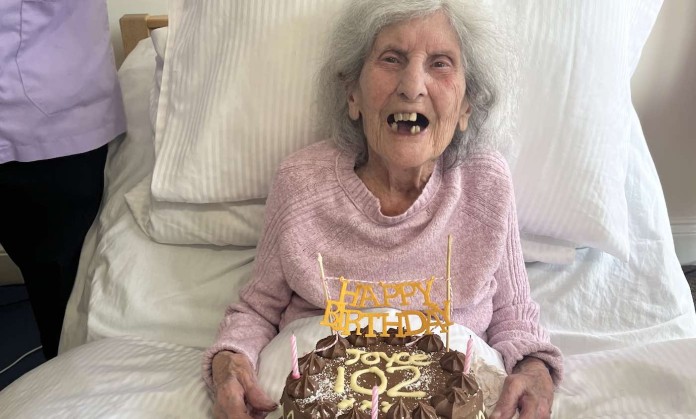
Joyce Jackman celebrates with family on her 102nd birthday – SWNS / Care UK’s Silversprings
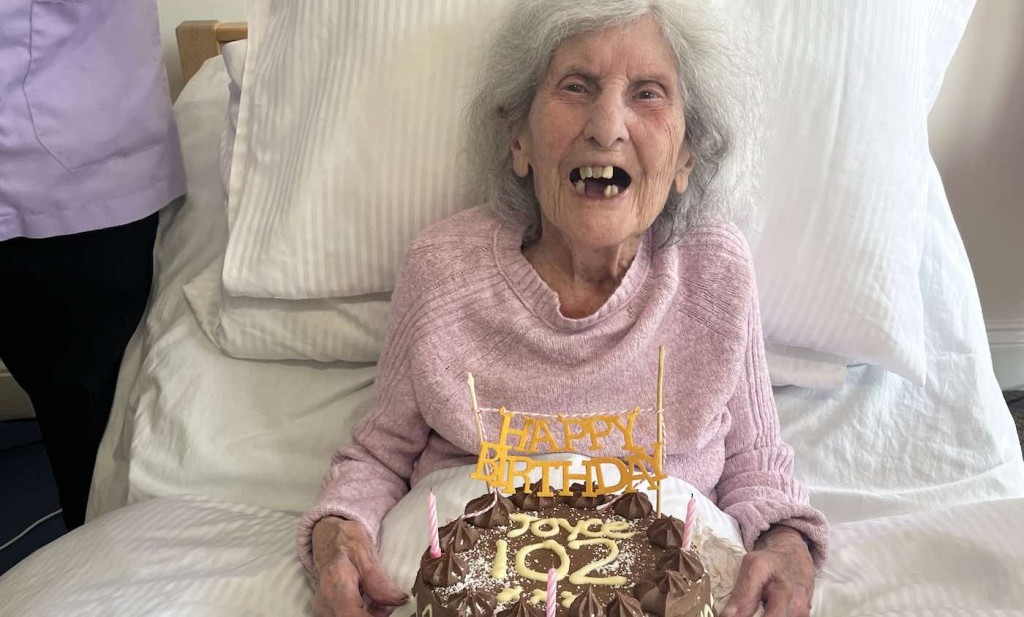
Joyce Jackman celebrates her 102nd birthday – SWNS / Care UK’s Silversprings
A 102-year-old British woman who reads the paper every day revealed her secrets for a long and happy life—and you might be surprised, or thrilled.
Joyce Jackman celebrated her 102nd birthday on May 9, and shared her advice for living for over a century.
A former chef in the UK’s Royal Air Force, Joyce told the staff at her care home that she credits “good sex and good sherry” as two of the key to her satisfying life.
The woman from Colchester, Essex, was feted at the Silversprings senior home in Thorrington, where some family members and the staff surprised her with a cake.
The centenarian said she “didn’t want the day to end”.
“I had such a lovely day.
“I can’t believe I’m 102,” she said, quickly revealing her third secret for longevity. “It must be all the chocolate I eat that’s helped!”
When she was young, Joyce worked in a sweet shop, before joining the RAF as a chef during World War II.
Joyce Jackman celebrates with family on her 102nd birthday – SWNS / Care UK’s Silversprings
Now widowed, she married her childhood sweetheart, Terence Jackman, in 1945, the year the war ended.
While they never had children, Joyce loved to help out by looking after the children in her neighborhood. She enjoyed baking with her mother and going out with her friends.
These days, she enjoys keeping her mind busy at Silversprings, regularly doing crossword puzzles and staying up-to-date with the daily newspaper.
There’s always plenty of chocolate on hand—and the cake was, of course, chocolate.
“Joyce is a much-loved resident at the home,” said Home Manager Joanne Rix. “She’s always making us laugh with her fantastic sense of humor and outlook on life.”
People over 60 who take a daily multivitamin pill may be slowing age-related memory decline, according to a new study that amplifies similar findings from last year.
More than 3,500 American adults over the age of 60 were randomly assigned to take either a daily multivitamin supplement or placebo for three years.
At the end of each year, participants performed a series of online cognitive assessments at home designed to test memory function of the hippocampus, an area of the brain that is normally affected by aging.
By the end of the first year, memory improved for the people taking a daily multivitamin, compared with those taking a placebo—and the benefits were sustained over the three-year period.
The researchers at Columbia University and Brigham and Women’s Hospital at Harvard said the results are consistent with another recent study from Wake Forest University that followed more than 2,200 older adults and found that taking a daily multivitamin improved overall cognition, memory recall, and attention.
The earlier study showed that three years of multivitamin supplementation roughly translated to a 60% slowing of cognitive decline, equating to around 1.8 years of normal mental capacity.
“Because of our innovative approach of assessing cognitive outcomes using internet-based tests, we were able to examine the effects of a multivitamin in thousands of study participants,” said Professor Adam Brickman, of Columbia University.
“The aging brain may be more sensitive to nutrition than we realized,” said first author Dr. Lok-Kin Yeung, also of Columbia.
“Our study suggests that supplementation with multivitamins may be a simple and inexpensive way for older adults to slow down memory loss.”
Co-author Dr. JoAnn Manson, chief of the Division of Preventive Medicine at Brigham and Women’s Hospital, said: “The finding that a daily multivitamin improved memory in two separate cognition studies…is remarkable.”
The effect was even more pronounced in participants with underlying heart disease, according to the findings published in the American Journal of Clinical Nutrition.
“There is evidence that people with cardiovascular disease may have lower micronutrient levels that multivitamins may correct, but we don’t really know right now why the effect is stronger in this group.”
The researchers, whose work was partially funded by the National Institutes of Health, did not look at whether any specific component of the multivitamin supplement was linked to the improvement in memory.
“Though it may not be so important to find out which specific nutrient helps slow age-related cognitive decline,” said Yeung.
“The findings are promising and certainly set the stage for important follow-up studies about the impact of multivitamin supplementation on cognition,” concluded Brickman, who reminds people that getting nutrients from your food is always preferable.
Quote of the Day: “Judge a man by his questions rather than his answers.” – Voltaire
Photo by: Kenny Eliason (cropped / colorized)
With a new inspirational quote every day, atop the perfect photo—collected and archived on our Quotes page—why not bookmark GNN.org for a daily uplift?
MeerKAT image of the galactic center with color-coded position angles of filaments - Northwestern University / SWNS
MeerKAT image of the galactic center with color-coded position angles of filaments – Northwestern University / SWNS
Astronomers have found hundreds of mysterious filaments pointing towards the Milky Way’s supermassive black hole, which could uncover fresh secrets about the dark abyss at the centre of our galaxy.
The strange horizontal strands are 25,000 light years from Earth and have been likened to spokes spreading out on a wheel.
“It was a surprise to suddenly find a new population of structures that seem to be pointing in the direction of the black hole,” said Professor Farhad Yusef-Zadeh, of Northwestern University.
“I was actually stunned when I saw these. We had to do a lot of work to establish that we weren’t fooling ourselves. And we found that these filaments are not random but appear to be tied to the outflow of our black hole.
“By studying them, we could learn more about the black hole’s spin and accretion disk orientation. It is satisfying when one finds order in a middle of a chaotic field of the nucleus of our galaxy.”
Known as Sagittarius A*, the black hole is a staggering four million times the mass of our Sun.
Positioned radially, the filaments measure less than 10 light years in length and look like the dots and dashes of Morse code, punctuating only one side of Sagittarius A*.
The new discoveries are being made possible by enhanced technology, particularly from the South African Radio Astronomy Observatory’s (SARAO) MeerKAT telescope.
To uncover the filaments, estimated to be about six million years old, the researchers used a technique to remove the background and smooth the noise from images to isolate them from surrounding structures.
“The new MeerKAT observations have been a game changer,” said Prof. Yusef-Zadeh, lead author of the paper published in The Astrophysical Journal Letters. “The advancement of technology and dedicated observing time have given us new information. It is really a technical achievement from radio astronomers.”
He believes the filaments, pointing radially toward the black hole, appear to be tied to activities in the galactic center.
Diagram of the outflow from Sagittarius A* – Northwestern / SWNS
They appear to emit thermal radiation, accelerating material in a molecular cloud. There are several hundred vertical compared to just a few hundred horizontal.
The new discovery is filled with unknowns and work to unravel its mysteries has just begun. For now, he can only consider a plausible explanation about the new population’s mechanisms and origins.
“We think they must have originated with some kind of outflow from an activity that happened a few million years ago.
“It seems to be the result of an interaction of that outflowing material with objects near it. Our work is never complete. We always need to make new observations and continually challenge our ideas and tighten up our analysis.”
Black holes are formed when a dying star collapses inward under the pressure of its own weight. The pull of gravity is so strong that even light can’t escape. This is what makes them invisible. This leads to a supernova, a star’s extremely powerful explosion.
Supermassive black holes can be billions the size of our sun and astronomers believe they can be found at the centre of all large galaxies.
POINT YOUR FRIENDS to This Mystery By Sharing on Social Media
Expert Chris Sim, who cooks community meals for more than 2,000 people every year, says hosts need to learn to delegate, not sweat the small stuff and create a meal ‘timeline’.
He honed his expert know-how for putting on a foodie event by volunteering in the UK with FoodCycle for the last six years. The charity aims to reduce food poverty and social isolation with community meals—and Chris transforms surplus food into restaurant-standard meals, inspired by cuisines from around the world.
Much like the contestants on Top Chef, when Chris and his fellow volunteers turn up each Saturday, they have no idea what surplus ingredients they will receive until they enter their community kitchen. They then only have three hours to create three courses for 40-50 guests.
Pre-planning is essential when you cook for a big party. Creating a timeline of preparation can help create a process that should get everything served on time. The timeline could include everything from when the food needs to go into the oven to dressing the table, chopping and food preparation, and chilling the wine.
“When you are preparing food and a lovely occasion for many people, as soon as you relinquish a little bit of control, things tend to run a lot smoother,” said the chef from London, England.
“From the outset, pull in helpers and give a few tasks for others to own while you can focus on what you’re best at.
Sim’s dinner party advice comes as a new poll of 2,000 adults found 72% of people enjoy hosting dinner parties.
The survey from OnePoll, also asked what qualities make a good host or hostess and 74% believed ‘being welcoming’ was important. Likewise, 64% said ‘being relaxed’ was crucial. Being attentive was most important for over half of respondents.
Not surprisingly, when it comes to hosting a great dinner party, the quality of food is a top trait for 57%.
The poll was commissioned by the community dining charity, FoodCycle, which hopes to rally home chefs and dinner party hosts to help meet their target of engaging 10,000 volunteers.
They found that 23% would like to extend their hosting or cooking skills by sharing them with the local community.
“Over the last year, we’ve seen a 59% increase in the number of community meals being served,” said CEO Mary McGrath. “Volunteers Week, which started June 1, presents the perfect time for people to get more involved.”
Chris’s Top Tips for Hosting the Perfect Dinner Party:
Collaboration enables delegation. Pool ideas from different people, then get people to buy into a shared vision for a meal. It will make those helping you more motivated.
Don’t fret about the smallest details – as long as it’s done with love and care, your guests will appreciate it.
Pre-planning is key when you have many mouths to feed. Creating a timeline of prep can help to create a smooth process to getting everything served on time.
Utilize ideas from your travels or family and friends from other parts of the world. Try to remember a dish, flavor combination, or ingredient that made your vacation that little bit more memorable.
Try to smile, relax, and even have a laugh during the process. You’re more likely to enjoy cooking, which will translate into a more memorable event.
A 98-year-old dementia patient and veteran of World War II got to relive his career by riding in a retro ambulance and donning the old uniform—which opened the floodgates of precious memories.
Albert Gibbs, who worked on ambulances in London for a quarter-century, was visited by two paramedics in a 1960s ambulance, wearing familiar gray uniforms—just like the ones he used.
They were dispatched to a care home in Essex where Gibbs lives, so the great-grandfather could relive his days as a medic.
Paramedics Craig Henty and Terence Thomson drove up in an original 1967 Morris Wadhams ambulance, complete with period uniforms, that instantly took Gibbs right back to the old days when he was based in East London.
“I wore the same uniform and the same hat,” he exclaimed, as his memories sparked details.
“I recognize your badge. It’s from the north-east sector, where I used to work. I was stationed at Ilford, but sometimes also worked in Romford.”
He also recalled some important moments from his 25-year career, saying, “I delivered five babies and saved a person who fell under a train.
Elaine Dettmar, Gibbs’ daughter, said: “That was a huge part of my dad’s life – it was moving to help him relive it.
“As he talked and engaged, more memories were coming out.” (See short video below…)
Before visiting, Craig and Terence researched the archives from Albert’s time at the Service through its Historic Collection and traced thank you letters from patients that Albert had cared for and photos, too.
The head nurse at the Elizabeth House Care Home, Tracy McGuinness, said many dementia sufferers can benefit from visual and sensory cues to stimulate their brain and trigger memories of their lives—which keeps their brain engaged and can reduce cognitive decline.
The pictures included images from a work holiday that Albert organized to Spain.
“I had a holiday club that people called ‘Gibbs Tours’, and I once arranged a weekend in Benidorm and got 43 people to go, including ambulance workers, nurses, doctors, and their families,” he said.
Gibbs also had a cheeky, mischievous side.
“I had a good time and a lot of laughs at the service, especially when I rang the ambulance bell on the Woolwich ferry.
“We weren’t allowed to do that, but I did it once and then sped down the ferry. It got me into some trouble.”
He became a medic in 1965 and joined a new London-wide service that was formed when nine existing ambulance corps merged, uniting nearly 1,000 vehicles and 2,500 staff. Known today as ‘London Ambulance Service’, it is the busiest emergency ambulance service in the world.
Craig Henty, London Ambulance Service paramedic and head of Historic Collections, said: “I sat with Albert in the back of the ambulance for a chat and it felt as if we had just finished a job together.
“His mannerism and familiarity with the vehicle are classic of someone who works in an ambulance. He even rested his feet on the rail in front of him and that’s exactly what an ambulance crew would do.
“I was amazed to see that the experience brought him right back.”
You can donate to the Historic Collection—which includes horse carriages and blitz ambulances from the Second World War, and is maintained entirely by volunteers—by visiting their website. The uniforms and vehicles are available for hire to film/TV crews, weddings, funerals, and other events.
DON’T FORGET to Share The Sweet Service to Inspire Others on Social Media…