













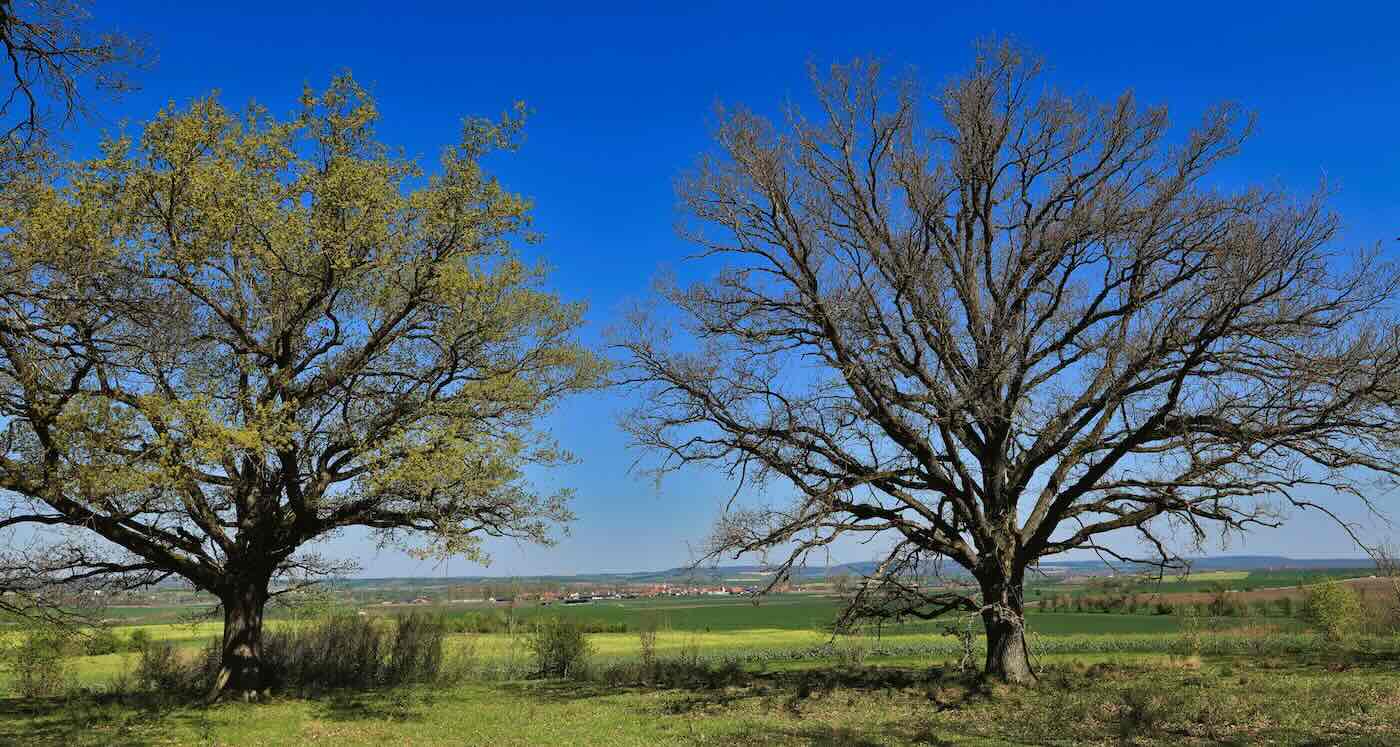
New research reveals oak trees deliberately delay sprouting their leaves by three days to avoid being infested by hungry caterpillars, after it happened the previous year.
The trees’ clever tactic to outwit potentially deadly predators was detected by scientists in Germany using data from satellite.
They found that many insects, particularly caterpillars, hatch in the Spring just when the trees’ nutrient-rich leaves are still young and soft—an ample food source.
But if oak trees are heavily infested by caterpillars in a given year, they react the following Spring by delaying their leaf emergence by three days.
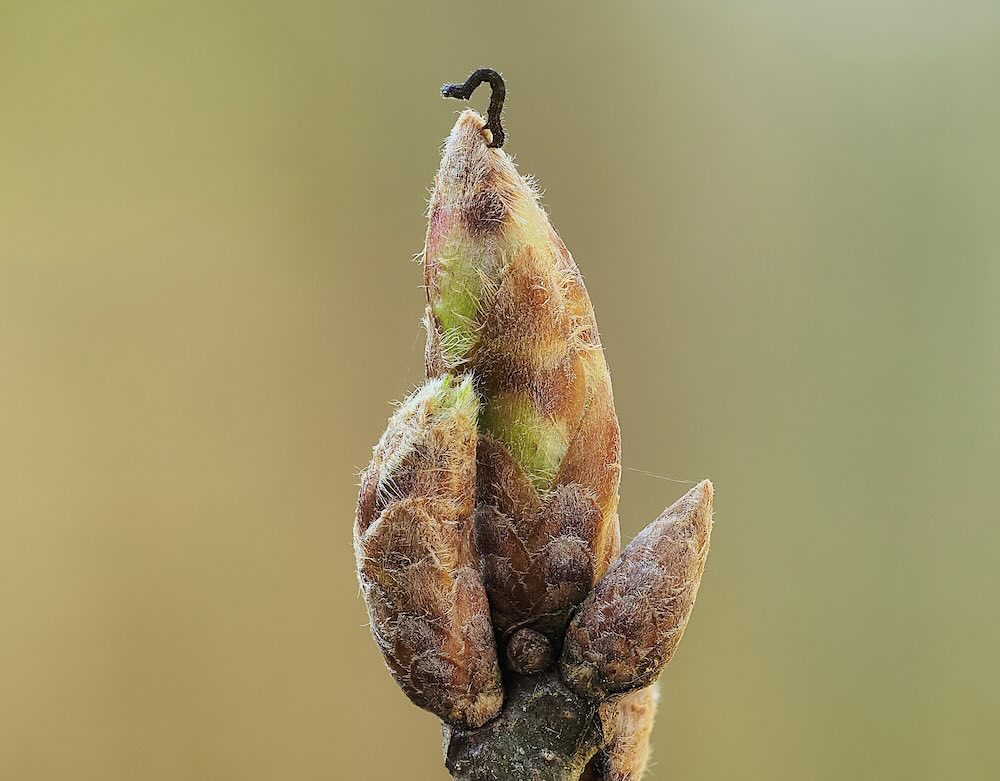
That means the caterpillars have nothing to eat after hatching because the oak leaves are still firmly hidden in the buds.
The strategy is “highly effective” because the three-day delay is sufficient to drastically reduce the insects’ survival rate—and reduce the damage on the tree by 55 percent, according to the study published in the journal Nature Ecology and Evolution.
“The delaying tactic is more effective for the oak than a chemical defense, such as bitter tannins in the leaves, because the tree would have to expend a great deal of energy to increase tannin production,” said lead author Dr. Soumen Mallick, of the University of Würzburg, Germany.
“This discovery fundamentally changes our previous understanding of the onset of spring in the forest.
“It shows that trees do not merely react passively to the weather in timing their leaves to emerge but also respond flexibly to biological threats.”
Previously, scientists had to laboriously observe individual trees on the ground, but now they are using state-of-the-art interdisciplinary methods from ecology and remote sensing.
For the new study, a 2,400-square-km (925 sq mile) area in Northern Bavaria was monitored continuously using Sentinel-1 satellite data. The radar satellites provide precise data on the condition of tree canopies even in thick cloud cover.
The research team analyzed a total of 137,500 individual observations spanning five years, from 2017 to 2021.
The satellites provided data at a resolution of 10×10 meters per pixel, which roughly corresponds to the crown of a single tree. A total of 27,500 such pixels were analyzed across 60 forest areas.
The researchers said the year 2019 proved particularly revealing as the region experienced a massive gypsy moth outbreak.
“The radar sensors recorded exactly which trees were stripped bare and how they reacted in the following year,” explained study co-author Professor Jörg Müller, from the University of Würzburg.
The researchers say their findings conclusively explain, for the first time, why in some Springs the forest does not turn green as quickly as temperatures would suggest.
WINNING NATURE NEWS:
• Numbers of Rare Butterfly Eggs are Best on Record After Hedges Allowed to Grow Wild
• She Used Nature to Transform Dry Stream Beds into Lush Oasis During USGS Study
Previous computer models often calculated the state of the forest inaccurately because they took into account almost exclusively “lifeless” factors such as temperature and ignore biological interactions between plants and insects.
The researchers explained that trees find themselves in an “evolutionary tug-of-war” with rising temperatures caused by climate change pushing them to sprout leaves ever earlier, and pressure from insect feeding is forcing them to hold back.
They say a key advantage of the delaying tactic is that it is temporary and reversible.
Study co-senior author Professor Andreas Prinzing said as the trees only sprout later following an actual infestation, the insects cannot adapt permanently.
Prof. Prinzing, of the University of Rennes, France, added: “This dynamic interplay is an example of the forest’s high resilience and adaptability in a changing world.”
RESTORATIVE EARTH: A Mass Blossoming Is Occurring in Wake of Floods to Feed Honeyeater Birds in Australia Where Just 300 Remain
The team plans further experiments to help understand the delay mechanisms more precisely.
INSPIRE SOME AWE FOR THE EARTH BY Sharing The Discovery on Social Media…