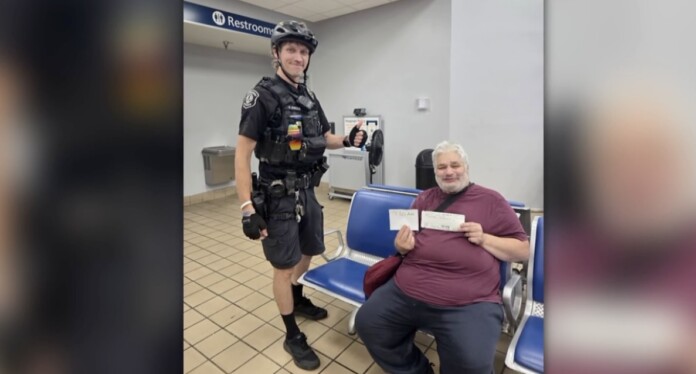
Officer Steven Harris of Pittsburgh Police via KDKA
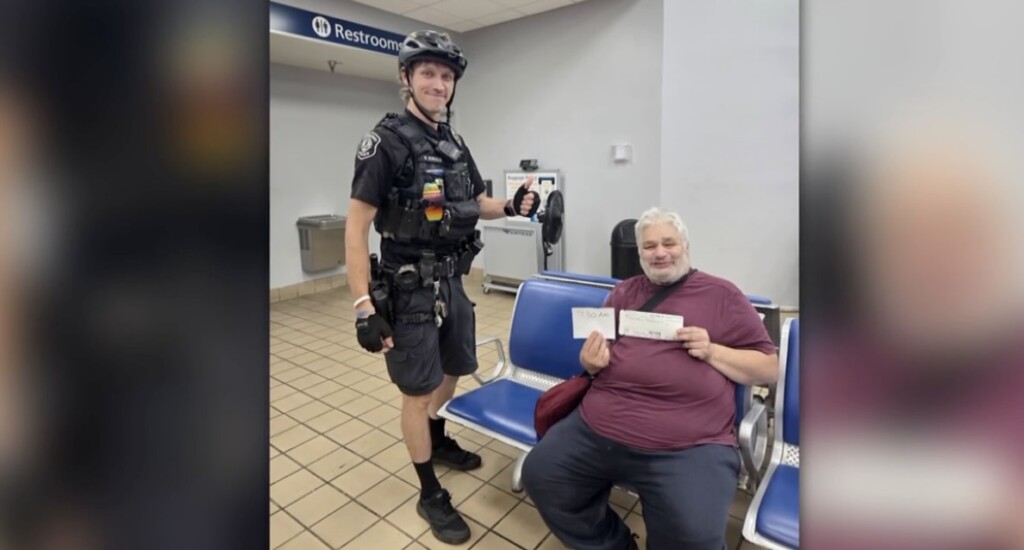
Officer Steven Harris of Pittsburgh Police via KDKA
“We’re supposed to be good men,” said Officer Steven Harris.
Harris was responding to a question from local news in Pittsburgh about why he would spend $113 of his own money to solve a stranger’s problem. It’s a suggestion that all of us, from cops to kids, should hear every now and then.
The story of how Harris got into position to solve the problem comes from the Greyhound bus depot in Pittsburgh where the Police Department received a call about a man behaving “unruly.”
Harris and Officer Keso responded to the call on their bicycles, and arrived to find a much different picture.
“He was just a male who was deaf and didn’t speak English or read English, so it just turned out he needed help to get back on a bus to New York and eventually Montreal,” Officer Harris told reporters.
Keso called a translator line police use in such situations and was able to get a French-speaker to help, though didn’t explain whether sign language was needed or not.
It turned out the man had stepped off the bus to stretch his legs, but obviously didn’t hear the call from the driver that it was time to go, and watched helplessly as the bus took off for New York—his luggage and cash still onboard.
With no options for a bus, Harris “simply” used his bank card to buy an Amtrak ticket to New York.
When asked why he thinks differently, Harris responded that he was raised by his great-grandmother—a different kind of woman, from a different sort of era.
When he reached for his own wallet, she must have been smiling—watching her great grandson the cop helping someone in need, trying, as she urged, to be a good man.
WATCH the story below…
SHARE Officer Harris’ Kind Deed And Wise Words With Your Friends…
The Denver Botanic Gardens recently hosted a worldwide competition to see who could stack the most weight on a water lily pad before it sank, and the results were simply extraordinary.
Known as the Water Lily Weigh Off, more than 30 zoos and gardens in 9 countries around the world took part.
The sight of frogs sitting these one-assumes-to-be-delicate aquatic plants is a picturesque necessity in any pond scene, but don’t assume these lovely lilies to be shrinking violets, they’re actually incredible strong.
The Missouri Botanic Gardens posted a video on Instagram of their largest lily floating upright under 182 pounds of weight, while that of Florida’s Bok Tower Gardens beat Missouri’s score with 183 pounds.
Watching the videos of botanists stacking sandbags, oranges, bricks, and other weighty objects on the lily pads, also known as platters among botanists, have to be seen to be believed.
The Denver staff spoke to various local news outlets about the competition, describing it and the participants in glowing terms.
“I’m really proud of what we have been able to build out of this silly little idea we started,” says Vanessa Callahan, assistant manager of learning engagement at Denver Botanic Gardens, to KMGH-TV.
“[The participating gardens are] just showing so much creativity, so much storytelling, so much earnest about them, experiences and personality, and I’m having so much fun watching it.”
Third place went to a specimen at the Huntsville Botanical Garden in Alabama, which held 176 pounds.
The species in question were the Victoria cruziana and the Victoria amazonica, giant water lilies that can produce a pad 6 feet in diameter in a mere 3 months. The pads act like solar panels, soaking up sun to produce chlorophyll to feed the underwater plant.
The pads themselves have a “highly engineered network of radiating ribs and cross-veins,” the Denver Gardens explains, with each of these becoming stiff and trapping air. The edges of the pads are turned up to prevent water accumulating on the pad, while the underside is covered in razor-sharp barbs that shred any encroaching vegetation.
The famous American renegade architect Frank Lloyd Wright famously used water lilies as inspiration for the support structure in the Johnson Wax Headquarters building in Wisconsin, especially because their design could withstand far more load than traditional columns.
Quote of the Day: “Lend yourself to others, but give yourself to yourself.” – Michel de Montaigne
Photo by: Giulia Bertelli
With a new inspirational quote every day, atop the perfect photo—collected and archived on our Quote of the Day page—why not bookmark GNN.org for a daily uplift?
Happy Birthday to Shaun White, the three-time Olympic gold medalist in half-pipe snowboarding, who turns 39 today. He was a champion skateboarder in his teens after undergoing two open-heart surgeries as an infant. He became first person to compete in and win both the Summer and Winter X Games in two different sports–including historic wins four years in a row and tallying more X-Games gold medals than anyone. READ more about White… (1986)
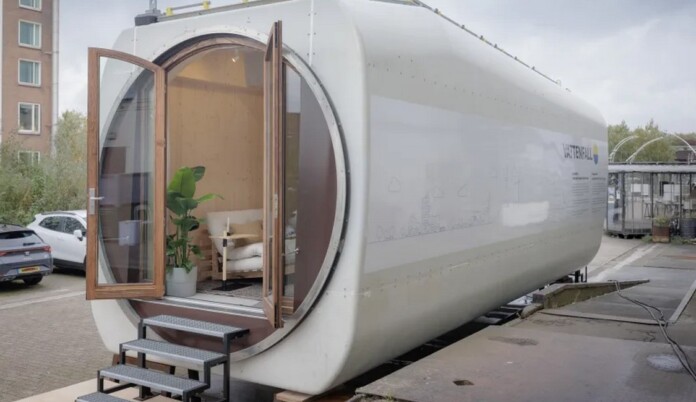
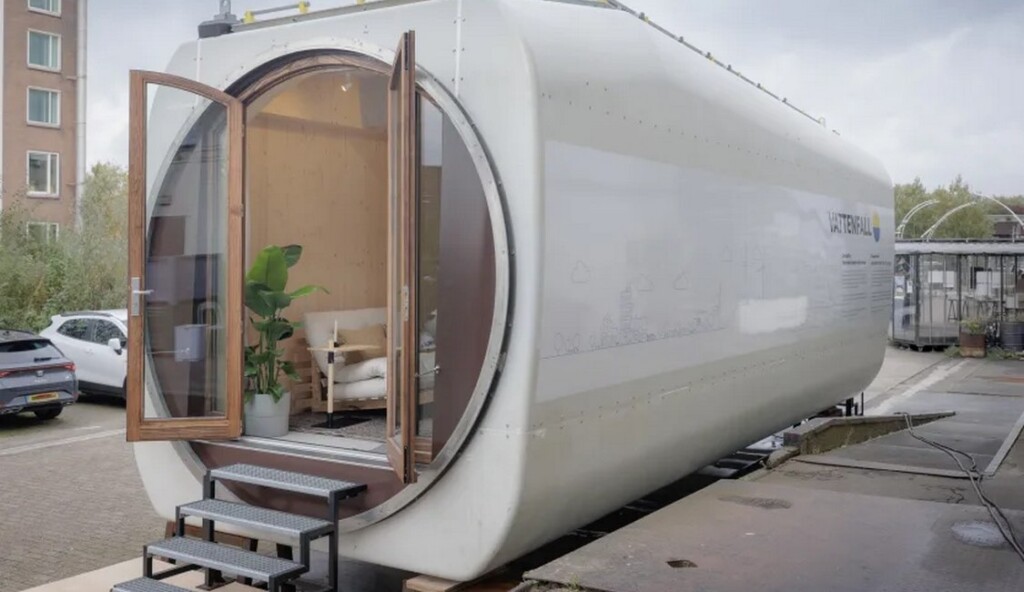
The Nestle, made from a wind turbine - credit, Jorrit Lousberg / Blade-Made
The Nestle, made from a wind turbine – credit, Jorrit Lousberg / Blade-Made
For some, a 4 bedroom 3 bath with a basement theater, wrap-around deck, and two-car garage is the dream. For others, housing that’s quaint, that’s economical—even portable, is the aim.
The market should provide options to everybody, and for those in the latter category of taste, a Dutch company is making little trailer-sized homes from the bosoms of decommissioned wind turbines.
Known as a Nestle—a play on words referring to the turbine component known as a “nacelle”—this two room human hutch is surprisingly luminous and chic.
The 35-square-meter (376-square-foot) pods are built by a company called Blade-Made that uses decommissioned wind turbine parts that are impossible to recycle as materials to build new structures like benches, highway barriers, playgrounds, and even housing.
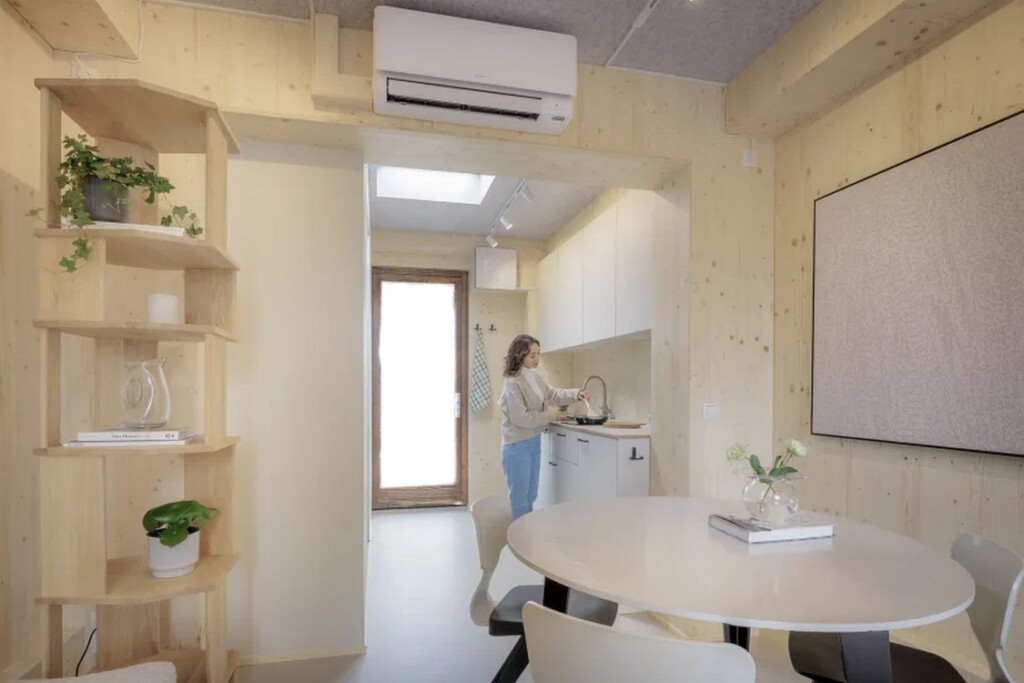
Inside, a warm north-European wooden finish on the walls and furnishings embody the project’s name, and help convince the occupant to nestle into Nestle’s living space.
Perhaps designed more as a statement on the challenges and potential of upcycling rather than as a direct-to-market product, Blade-Made has nevertheless received orders for 10 of these nacelle homes, having been certified by Dutch authorities under the nation’s building codes.
Nestle’s interior is light and airy, with fully functional plumbing and electricity – credit, Jorrit Lousberg / Blade–Made
“Everything in the built environment—everything that you see around you—has an end of life,” Blade-Made’s Jos de Krieger told CNN Style via videocall. “And we need solutions besides waste or landfill, incineration or something without value.”
A challenge facing wind energy is the millions of pounds of fiberglass-heavy material that cannot be recycled but which nevertheless must be replaced every few decades. The initial wind turbine boom has seen its first wave of mass decommissioning, and hundreds of thousands of tons of nacelles and blades will need new homes or purposes.
“This is basically the most complex thing that you can do with it,” said De Krieger, who’s also a partner at the architecture firm Superuse Studios, one of the home’s designers. “So, all the other less complex things are now easier to imagine and to realize, because this has already been done.”
Many partners were involved with the debut Nestle. Woodwave build the interior, which was designed by Superuse and Reliving.nl. Business in Wind provided the decommissioned V80 turbine nacelle for use in the first model, which was sponsored by Swedish power company Vattenfall.
By 2050, no doubt hundreds of nacelles will be in need of replacing every month across Europe and the world, and every one of them becoming a home seems doubtful. But as is so often the case, design helps us reimagine the potential of many different things, and if by 2050 there are hundreds of people living in Nestles, humanity stands only to benefit.
SHARE This Wild Yet Tempting Idea For Tiny Housing Enthusiasts…
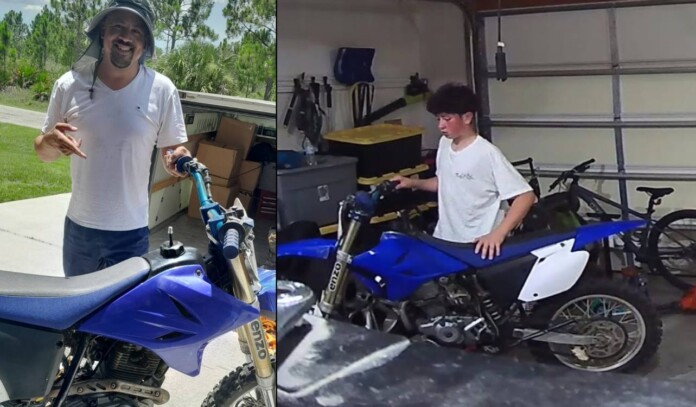
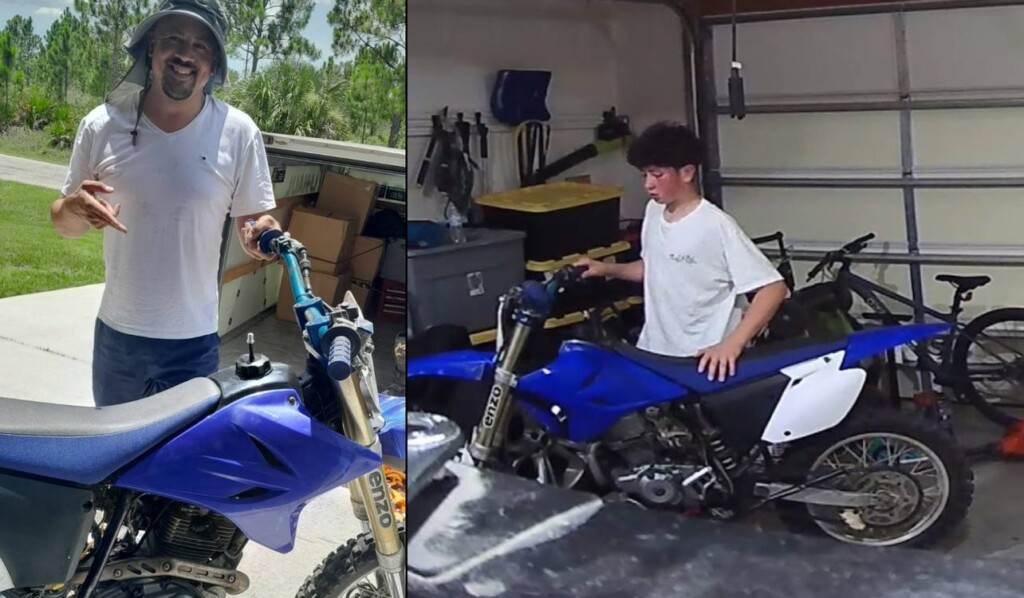
The bike's owner (left) and young Noah who unknowingly bought it after it was stolen -credit, Glen Timoteo
The bike’s owner (left) and young Noah who unknowingly bought it after it was stolen -credit, Glen Timoteo
In a feel-good story that proves hard work pays off, a stranger decided to reward a young man who accidently bought his own stolen dirt bike off Facebook Marketplace.
The teen, 13-year-old Noah from Kansas, had spent the entire summer mowing lawns and doing other chores to save up money for the dirt bike, a sacrifice of the entire inter-scholastic period for a promise of much greater joy to come: the kind of behavior that all Western society was built upon.
But the bike was actually stolen property, little did Noah know it, and tied to a 2023 storage-unit burglary in Wichita.
Referencing the criminal case number, Glenn Timoteo, the dirt bike’s true owner, organized a GoFundMe “to help Noah get the dirt bike he truly earned, and to show him that there’s still good in the world.”
“He had no way of knowing. He did everything right, following the steps his dad taught him about making a fair deal,” Timoteo wrote on the GoFundMe page. “Then came the knock on the door: police had to take it back. Noah had done nothing wrong, yet he lost both the bike and the money he worked so hard to earn.”
“I remember the pride of working for the things I earned as a kid, and I don’t want him to lose that sense of pride or his belief that hard work and honesty still matter. Every contribution, big or small, helps get him back on two wheels,” he finished.
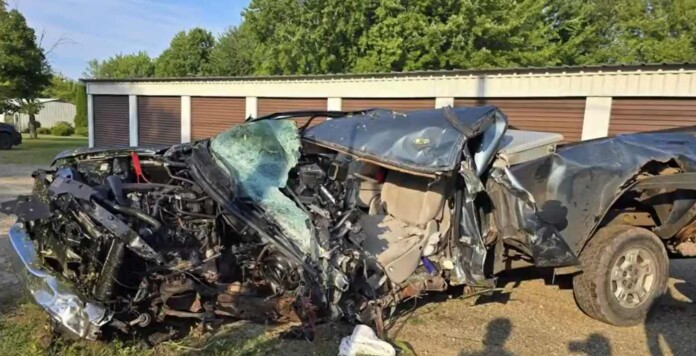
Lindsay's vehicle after the crash - credit, Leskovac
Lindsay’s vehicle after the crash – credit, supplied by the Leskovacs
A tragedy suffered, an even greater tragedy avoided: that’s the narrative on Laura Leskovac’s mind since her daughter was seriously injured in a car crash.
The greater tragedy? What would have almost certainly happened had her daughter Lindsay not had the crash detection feature activated on her iPhone 14.
Falling asleep at the wheel and obliterating her car against two poles and a tree, the phone knew what had happened and immediately called 911 emergency services.
“The person from the fire and rescue told me that 911 said the phone initiated the call, so I looked further into that to find out…” Laura told ABC 21 WFMJ. “And I discovered that iPhones […] have an automatic crash detection on it, if you have the setting on.”
Laura said the phone was connected to 911 for 22 minutes, during which Lindsay, who broke both her femurs, as well as bones in her pelvis, hips, and cervical spinal region, managed to help the paramedics find her location where she lay trapped under the car.
“We’re so blessed that she’s alive; it’s a miracle. We’re also blessed that there’s no paralysis,” Laura said.
The mother added her daughter has a long road to recovery, but that the most important thing was that she had the technology and that it was activated, for otherwise, there may have been no road left at all for the teenager.
If you have an iPhone 14 or newer, you too can activate the detection system by scrolling down to Emergency SOS under the settings menu and activating Crash Detection. From that menu, you can also select which number it is your phone should automatically dial—911 in most cases—although you can change it—for example to an embassy number if you’re traveling out of country.
A Dutch architecture and design firm has renovated the infrastructure in a famous geopark, converting the bland and grating modernity into a nature-inspired welcome mat.
Jialeshui is a well-known scenic area in the southernmost part of Taiwan, known for its remarkable rock formations shaped by wind and water in Pingtung county.
The local government recently selected the design proposal submitted by MVRDV together with HWC Architects that was based around a series of key structures and paths that take the rocks themselves as inspiration.
Called Nature Rocks, MVDRV designed a network of new pathways and public spaces that improve accessibility while seamlessly blending into the rocky environment.
Over thousands of years, strong winds and sea waves have shaped the area’s soft sandstone coastline into a series of sculptural rock formations, many of which resemble animals and carry names such as Rabbit Rock, Toad Rock, and Seal Rock.
Currently, the forest just behind is separated from the rocky shoreline by a single road that cuts through the landscape—a narrow, largely straight route shared by shuttle buses, pedestrians, and cyclists. The pavilions and kiosks peppered along the road have been damaged by typhoons and seawater, and the whole ensemble looked exploitative and a bit ramshackle.
“Our goal was never to impose architecture on the landscape, but to let it emerge from the natural conditions; to break the monotony of the straight line… and to emphasize that Nature Rocks,” explained MVRDV founding partner Winy Maas.
All of the new construction will be confined to areas that are already developed to avoid disrupting the original natural landscape. Inspired by the layered forms of the coastline, the design breaks up the existing straight road and reimagines recreational pathways as a cracked, rocky, naturalistic landscape that stitches the forest and the coastline back together.
The rock-like fragments define various zones for circulation and public activities while some are extruded into buildings that echo the natural features of the local rock formations, blending into the surrounding environment.
At the entrance to the park, three sculptural buildings form a welcoming cluster. The largest of these “rocks” contains the welcome centre, a café, and a souvenir shop. A second building provides spaces for exhibitions and environmental education, while the third contains restrooms.
The main building’s roof doubles as a terrace for stargazing and panoramic views. This entrance cluster is set within a sloping landscape of small plateaus and plazas designed for events, markets, or simply to enjoy the view.
For the rest of the route, the existing road will be transformed into a more accessible route for pedestrians, cyclists, and shuttle buses, as well as clear zones for movement and relaxation. Several smaller “stops” are positioned at existing points of interest: the stone viewing deck, a sea lookout point, and the waterfall. At each stop, the site’s existing outdated structures are replaced with viewpoints, kiosks, and other facilities.
SHARE This Great Use Of Nature And Imagination With Your Friends…
Quote of the Day: “The aim of education is the knowledge, not of facts, but of values.” – William Inge
Photo by: Getty Images for Unsplash+ (cropped)
With a new inspirational quote every day, atop the perfect photo—collected and archived on our Quote of the Day page—why not bookmark GNN.org for a daily uplift?
Happy 61st Birthday to Keanu Reeves, the actor who might be called one of the nicest guys in show business. The Canadian started his career with humor and light-hearted films like Bill and Ted’s Excellent Adventure, before moving onto becoming an action star with his protagonist role as Neo in The Matrix trilogy, Point Break, and the John Wick movies. In addition to his career as an actor and musician, Reeves is the co-writer and creator of the BRZRKR comic book franchise. GNN reported on its release. READ more about this charismatic star… (1964)
Russel McKeehan (center) and his daughter - credit, family photo.jpg
Russel McKeehan (center) and his daughter – credit, family photo
When combined with his patient’s grit and determination, a Denver neurosurgeon’s skills in performing a rare surgery may have allowed a man to walk his daughter down the wedding aisle against all the odds.
For Russell McKeehan, that simple dream for so many fathers has been something like the north bearing on a compass in a storm of health issues that started when he himself was a paramedic.
In 1995, his ambulance driver fell asleep at the wheel and rolled the vehicle, significantly damaging McKeehan’s nervous system—though he didn’t know it at the time.
It wasn’t until 2007 that the damage took full effect. McKeehan entered the hospital for chronic headaches, and woke up a few days later paralyzed from the neck down.
In 2017, after a long battle to accomodate life with his new limitations, McKeehan sought a surgical intervention from Dr. Scott Falci, a neurosurgeon at Denver’s HCA HealthONE Swedish, with hope of regaining some of his lost mobility.
The surgery was a success.
“I often joke,” McKeehan told CBS News Denver, “you can’t write soap opera as bad as what I’ve lived through.”
True enough, the surgery allowed McKeehan to regain the ability to use his arms and legs—a miracle, one might say—yet not enough to black out his unlucky stars from striking again—in the exact same way.
Driving his son’s pickup at a mere 45 mph, the truck flipped over 4 times after lug nuts that had not been fully tightened came loose and McKeehan lost control of the vehicle. He broke his neck, humerus, several ribs, and bones in his sternum. His recovery—then in its 12th year, took a major step back.
This year, the broken man returned to Dr. Falci for another, rarer surgery; one that only 10% of patients will ever receive, in the hopes of achieving a single goal: to walk his daughter, now engaged, down the aisle on her wedding day next month.
“In my mind, I want her day to be about her and not be about me, and the more normal I can be, the more happy she can be about this situation,” he said.
Dr. Falci described his patient as an “amazing” and “highly-motivated guy.”
“Twelve hours after the surgery, we weren’t expecting this, he’s moving his arm, he’s pulling his arm up to his face, and he’s kicking his left leg,” the doctor told CBS. “He’s a highly motivated guy, and he’s been through a lot, and, yeah, what he’s achieved, just with self-determination and desire is amazing.”
SHARE This Inspiring Story Of Recovery With Your Friends…
Forestry expert Anna Wierzbicka who's involved with the robot's development - credit, Wierzbicka, via Facebook
Forestry expert Anna Wierzbicka who’s involved with the robot’s development – credit, Wierzbicka, via Facebook
With 30% of Poland still covered in forests, the nation’s foresters play many critical roles—soon to be aided with the world’s first goat-inspired forestry robot.
The robogoat is envisioned to perform many crucial tasks that foresters are trained to do in difficult terrain, including compiling tree inventories, land surveys, tick collection, species counting, and even archaeological surveying.
It’s being designed at the University of Life Sciences in Poznan (UPP) with the help of scientists from Italy and Cyprus, making it a cross-continental effort predicted to substantially aid in addressing forest-related issues as the continent struggles with a severe dearth of employees in the forestry profession.
With around 2,000 protected areas of forest in Europe, there’s no shortage of work that the robot, envisioned to cost around 1.8 million euro to develop, could or should do.
These span from the flat woodlands of the country’s Puszcza Zielonka National Park to rocky and uneven ground of a Mediterranean climate. As a result, mobility was to be a chief focus of this early stage in development.
“For now, we have the idea that this will be a walking robot, with legs similar to an Alpine chamois to enable it to move over steep mountain slopes,” UPP’s Anna Wierzbicka told TVP World, a Polish news agency that used AI to generate an image of what a goat-inspired forestry robot would look like.
Counting tree species, diagnosing them for pests or diseases, as well as recording other plant and animal species will be the robot’s main efforts. It’s normally a kind of work that requires specialists, “and there are fewer and fewer of them,” says Wierzbicka.
“Additionally, inventorying such areas is hard fieldwork that also demands knowledge of plants and animals. [The robot] is a response to the decreasing availability of competent staff and would also satisfy the need to reach hard-to-access areas.”
“Ticks are also important for research reasons, so we decided that [enabling the robot to collect ticks] would be an interesting additional element that could contribute to improving our knowledge about them,” she adds.
Archaeologists have joined the project to contribute their excavation and survey methods to perhaps enable the forestry robot to passively be scanning the ground over which it walks for artifacts.
Wierzbicka and her colleagues expect the first prototype to be ready by 2026, and an operation-ready model to be finished before 2030.
SHARE This Awesome Robotics Project Needed For Europe’s Forests…
In India, a 3,000-year-old technology is hitting the shelves—and flying off them—as South Asians struggle with rising summer temperatures.
Terracotta’s porous surface makes it a uniquely timeless passive cooling system. As water soaks into the pores, it permits evaporation to carry the heat of the vessel’s immediate surroundings out and away.
This principle has been cooling Indian homes since the Harappan Civilization that lived in the Indus Valley from ancient times. Yet it still has a role to play in the India of today, where companies are leveraging terracotta’s passive cooling to chill everything from buildings to food.
MittiCool is a company that manufactures terracotta refrigerators—capable of keeping items cool and preserved for 3 to 5 days in optimal conditions—all without power or ice. Currently sold out, it works by placing a tray of water in an upper chamber that seeps through the pores in the terracotta and cools the 50 liter interior space.
Another way that terracotta can replace electric cooling systems is through something called the Venturi effect. It states that as air moves from a large space into and through a narrow space, it must not only cool, but also speed up.
For this reason, Indian homes and verandah have been shaded by terracotta screens known as jaali for centuries. If air is to pass through the jaali it must necessarily speed up, leaving its moisture content behind in the pores of the terracotta. That moisture can then evaporate, repelling heat and cooling the area behind the jaali.
CoolAnt is a design studio that’s using terracotta materials and designs to skin buildings and homes to mitigate the effects of the harsh summer sun. The same principles at work in a jaali could be applied at scale to a whole building facade.
“We’ve harnessed its hydrophilic properties and observed average temperature drops of [14F°] across more than 30 sites,” in India, CoolAnt studio founder Monish Siripurapu told Scientific American.
Scientific American had reported that just 20% of Indian households can afford to run an air conditioner, while just 35% can afford to run a refrigerator. That’s a substantial home-life challenge when summer temperatures routinely climb above 100°F in most of the country.
If, as some scientists predict, the intensification of the greenhouse effect from carbon emissions will lead to a worldwide increase of 3.6°F on average before the end of the century, there will have to be more adaptations to a warmer climate beyond just continuing to innovate with refrigeration.
Civilizations have dealt with extreme temperatures for millennia, and their best methods shouldn’t be overlooked in urban and suburban planning today.
SHARE These Ancient Ideas Turned Modern Innovation Today…
A final rendering courtesy of the Florida Dept. of Transportation
A final rendering courtesy of the Florida Dept. of Transportation
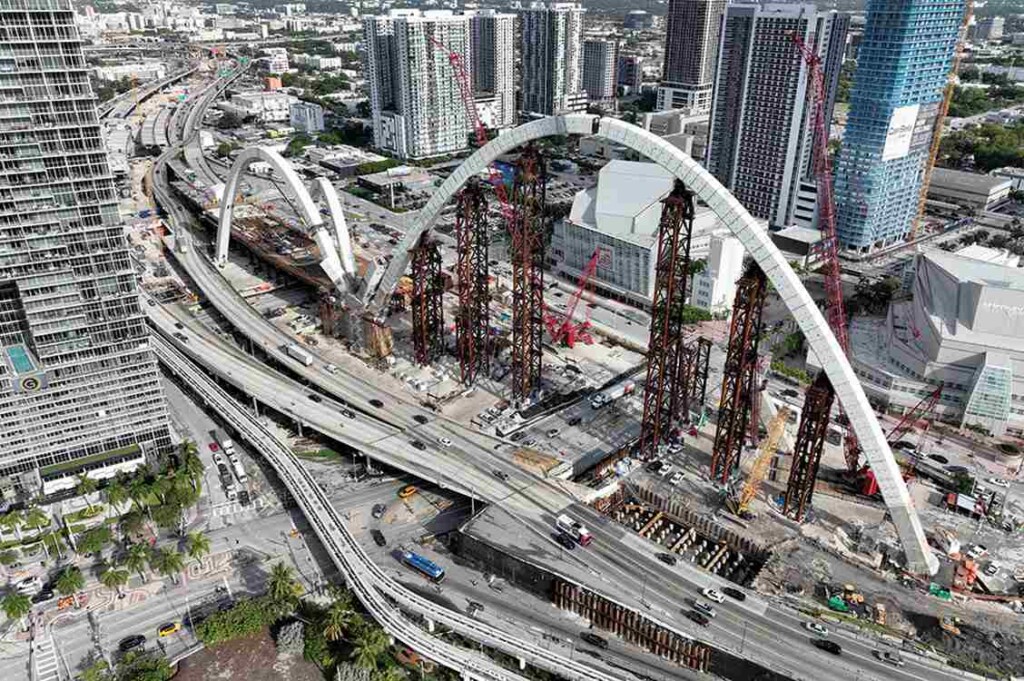
In Miami, the most “complex bridge in the world,” has passed the midway point of completion, with 3 of its 6 magical arches now firmly in place.
Known as “The Fountain Bridge,” the arches are inspired by streams of water the lead developer saw in a Barcelona fountain. It will sit on I-395 and be lit with LED lights to represent the colorful life and heritage of the city of Miami.
The Fountain Bridge as it currently sits – courtesy of the Florida Dept. of Transportation
Though its completion will add a rapturous feature to the city’s skyline, the expected completion date has already been extended 5 years past its original, 5-year timeline, owing not only to the massive work going on simultaneously on I-395 and nearby interchanges the bridge will connect, but also to the fountain design itself.
Engineering News Record spoke with project leads about the bridge, who said that it was the most complex they had ever conceived of or worked on.
“This is the most complex design-build segmental bridge, honestly, in the world,” says Riccardo Castracani, business development director for Rizzani de Eccher, the firm responsible for precasting, or at least attempting to precast, the majority of the bridge’s 345 arch segments.
“We’ve never encountered something of this magnitude. As complex as it looks from afar, you can multiply that by ten,” when viewed close up.
By the numbers, the scale of the materials should give an indication as to the project’s scope. More than half a billion cubic yards of earth will be moved, and the arches will require 10 million pounds of just post-tensioning cables. 1.4 miles of interstate highway and several state routes will also be redeveloped to ease current traffic headaches.
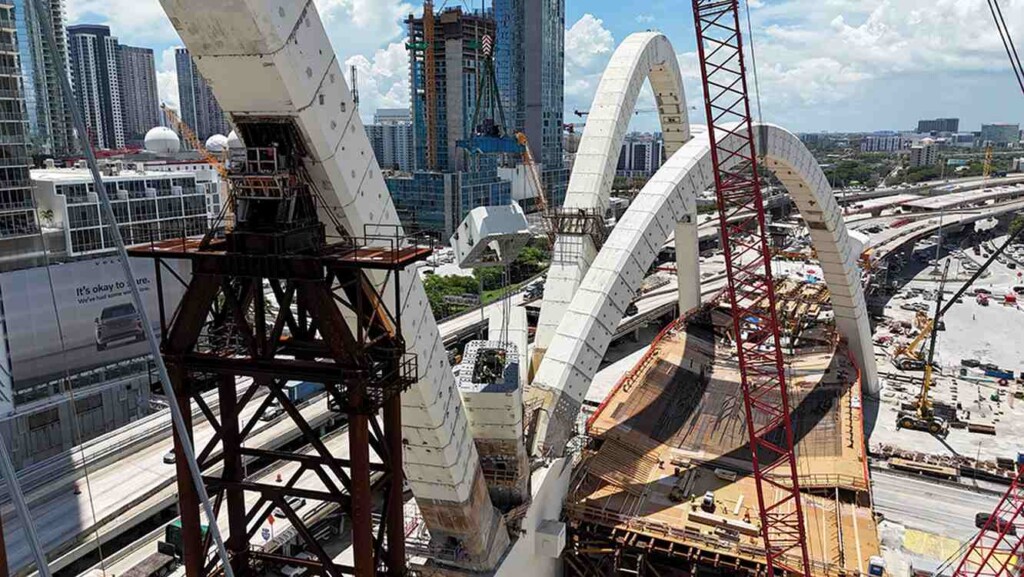
The central pier, from which all 6 arches sprout from, will be built with 5,000 cubic yards of concrete set in place, with 1.7 million pounds of steel reinforcements. The superstructure is being built concurrently, and will be mounted on between 19 and 55 staying cables per arch to transfer their weight to the arches. Additionally, the bridge has had to be designed to withstand wind speeds of 140 mph.
Cabling on typical suspension bridges is uniform and unidirectional, but because each arch stands alone, is of different size to the others, and supports different components of the superstructure, the challenges are significant.
A close up on the central pier from which the six arches are in construction – credit, Florida Dept. of Transportation
“Depending on where you are in the arch, and which way the cables are pulling, you may have post-tensioning on one side and not the other,” Mike Lamont, major bridges technical director for HDR, the engineering firm of record on the project, told ENR.
“It’s not just the final condition we’re designing for; it’s all of these intermediate construction stages. Cables are pulling on the arches from different angles, which results in a lot of bending in the arches that is an unconventional loading condition for an arch,” he said.
Some of the precast segments of the arches have, as Castracani mentioned, had to be cast according to individual specifications—such as interior cable anchorages where post-tensioning is carried out on just one half of one segment, and maybe just one corner on the next one. Sometimes it would take a week just to cast a single arch segment.
Another architect responsible for overseeing the joining of each arch segment noted similar challenges, saying they hadn’t dealt with a single segment for which the process of joining and tensioning could be replicated to another. The procedure for each one had to be planned out individually.
Some arches just aren’t behaving in ways that were predicted, and challenges arose on Arch 5 that saw work extended multiple months beyond schedule.
Through it all though, the work is coming together, and the dramatic shape of the bridge is beginning to become more and more defined. Chief architect and engineer Donald McDonald is looking forward to the completion. It will grant Miami a one-of-a-kind object of stunning technical complexity and form.
“It’s so unique, there’s nothing like it in the world,” he says. “So it’s really going to be a dynamite thing.”
SHARE This Remarkable Engineering Challenge With Your Friends On Social Media…
Quote of the Day: “Blue, green, grey, white, or black; smooth, ruffled, or mountainous; that ocean is not silent.” – H. P. Lovecraft
Photo by: Silas Baisch
With a new inspirational quote every day, atop the perfect photo—collected and archived on our Quote of the Day page—why not bookmark GNN.org for a daily uplift?
880 years ago today, Ibn Jubayir was born in Moorish Spain. This pilgrim and talented writer went on the Hajj to Mecca in 1183, and penned a valuable, beautiful, first-hand account of the places and people he saw, which included the Crusader states of Acre and the island of Sicily as controlled by the Norman dynasty. He included epic descriptions of the monuments of ancient Egypt, the cities of Iraq, and the goings on at Mecca during the holy month, while also mundane relatable things like the customs que in Alexandria, and the most comfortable kind of saddle to use when riding a camel. READ more about this traveler… (1145)
The blood pressure lowering effect of nitrate-rich beetroot juice in older people may be due to specific changes in their oral microbiome, according to the largest study of its kind.
Researchers at the University of Exeter in England conducted the study which was published in the journal Free Radical Biology and Medicine. It followed previous research that had shown a high nitrate diet can reduce blood pressure—which, in turn, can reduce the risk of heart disease.
Nitrate is crucial to the body and is consumed as a natural part of a vegetable-rich diet. When older adults drank a concentrated ‘shot’ of beetroot juice twice a day for two weeks, their blood pressure decreased – an effect not seen in a younger group used for comparison.
“Encouraging older adults to consume more nitrate-rich vegetables could have significant long term health benefits,” said study author Professor Anni Vanhatalo, of the University of Exeter.
“We know that a nitrate-rich diet has health benefits, and older people produce less of their own nitric oxide as they age.”
“The good news is that if you don’t like beetroot, there are many nitrate-rich alternatives like spinach, rocket, fennel, celery and kale.”
The study recruited 39 adults under age 30 and 36 adults in their 60s and 70s (through the NIHR Exeter Clinical Research Facility).
In both groups, the make-up of the oral microbiome changed significantly after drinking the nitrate-rich beetroot juice, but these changes differed between the younger and older age groups.
According to Exeter News, “The new study provides evidence that this outcome was likely caused by the suppression of potentially harmful bacteria in the mouth. An imbalance between beneficial and harmful oral bacteria can decrease the conversion of nitrate (abundant in vegetable-rich diets) to nitric oxide—which is key to healthy functioning of the blood vessels, and therefore the regulation of blood pressure.”
The older age group experienced a notable decrease in the mouth bacteria Prevotella after drinking the juice, along with an increase in the growth of bacteria known to benefit health, such as Neisseria. The older group had higher average blood pressure at the start of the study, which fell after taking the nitrate-rich beetroot juice, but not after taking the placebo supplement.
“This study shows that nitrate-rich foods alter the oral microbiome in a way that could result in less inflammation, as well as a lowering of blood pressure in older people,” said co-author Professor Andy Jones.
“This paves the way for larger studies to explore the influence of lifestyle factors and biological sex in how people respond to dietary nitrate supplementation.”
“By uncovering how dietary nitrate affects oral bacteria and blood pressure in older adults, the study opens up new opportunities for improving vascular health through nutrition,” said Dr. Lee Beniston from BBSRC, which funded the research.
SHARE THE AGING TIP With Friends and Family on Social Media…
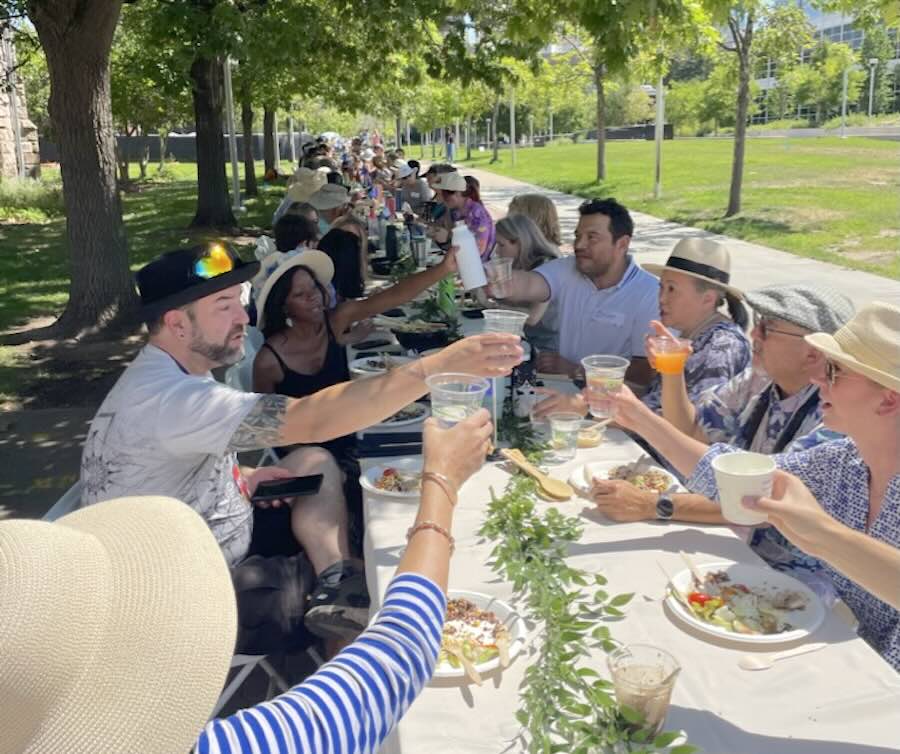
Longer Tables, a nonprofit that believes in the power of shared meals to connect people, welcomed over 3,400 locals who signed up to sit down at the first-ever “Mile Long Table”.
The 5,280-foot long table at the Auraria Campus in downtown Denver, Colorado, served up tons of produce from local farmers, as the perfect side dish for the community on the beautiful Saturday afternoon.
“The community response to our first Mile Long Table has been overwhelmingly positive,” said Tim Jones, founder and executive director of Longer Tables. “It’s really powerful and deeply encouraging to hear guests talk about how eager and appreciative they are to connect with people from diverse backgrounds and cultures.
“Our goal is creating meaningful connections—and the table makes it all possible.”
Hundreds of volunteers set up and served the guests at the ‘Mile Long Table’, named as an homage to ‘the Mile High City’. (See the video below…)
One of the sponsors, Southwest Airlines, even provided 10 surprise roundtrip airline tickets to reconnect loved ones over the scrumptious feast provided by Serendipity Catering.
The airline selected ten people nominated by community members, and also covered lodging costs so they could take a seat at the table—reuniting with loved ones but also creating new friendships.
Credit: Longer Tables
Kim Evans was flown to Denver from Philadelphia to reconnect with Hannah Kahan, a longtime friend who had recently graduated from the University of Denver—and she called the experience “truly a blessing”.
Kim made new friends at the event and plans to stay in touch with her ‘tablemates’.
“The energy at the Mile Long Table was infectious,” said Lexi Muller, a senior manager at Southwest Airlines. “We believe that community is more than a place; it’s the heart of what brings us all together.”
One of the diners, Diana Samet, was “delighted” by the notion of the Mile Long Table and was thankful she attended.
“We met lots of folks and just felt a warm spirit of coming together as a community.”
Longer Tables began its mission of promoting shared meals in 2013. The organization has since hosted more than 100 gatherings in five states to ‘help cities, organizations, businesses and neighborhoods create cultures of connection and belonging’.
The organization vowed to make the ‘Mile Long Table’ for Denverites an annual event. But new tables are also in the works to celebrate the United States’ 250th birthday and Colorado’s 150th birthday—both in 2026. Learn more at longertables.org.
WATCH some local news coverage from Denver…
SPREAD THE IDEA in Your Community By Sharing on Social Media…
Pudge locker room press conference – Bowling Green University / Youtube
Pudge locker room press conference – Bowling Green University / Youtube
The game of football is often a testament to tough guy testosterone—with brute force, pain tolerance, and toughness considered to be hallmarks of the sport.
But every once in a while, it reveals a softer side too—like Pudge the cat.
During a recent practice at Bowling Green University in Ohio, a player suffered a serious injury and the team was devastated.
But number 47, George Carlson, knew a cat who could help. He carried the fluffy, exotic short-haired cat into the locker room believing he could lift everyone’s spirits.
Pudge did the rest. Players were captivated by the new tawny mascot. He received pats and scratches and brought smiles to everyone in the room.
Eventually, a feline-sized brown and orange jersey showed up in the locker room—and videos of Pudge with players went viral on social media. A reporter recently even tried to interview Pudge. (The cat had no comment).
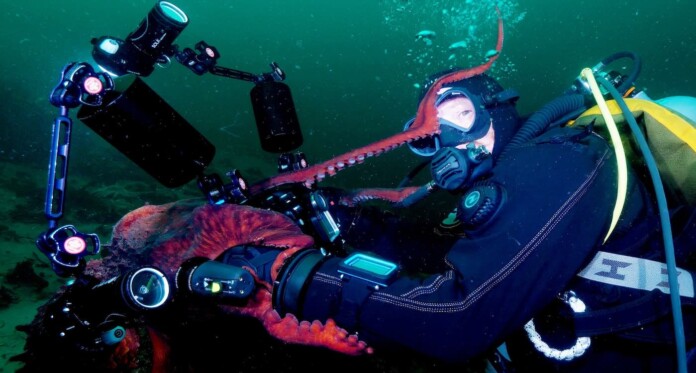
Octopus hugs diver and plays with camera - SWNS / Chris Mullen
Octopus hugs diver and plays with camera – SWNS / Chris Mullen
Two stunned divers have spoken about the ‘crazy’ moment the world’s largest species of octopus came out to play with them before taking a selfie.
35-year-old Canadian Chris Mullen was scuba diving off the coast of his hometown of Vancouver Island with his friend John Roney when they encountered a Giant Pacific octopus.
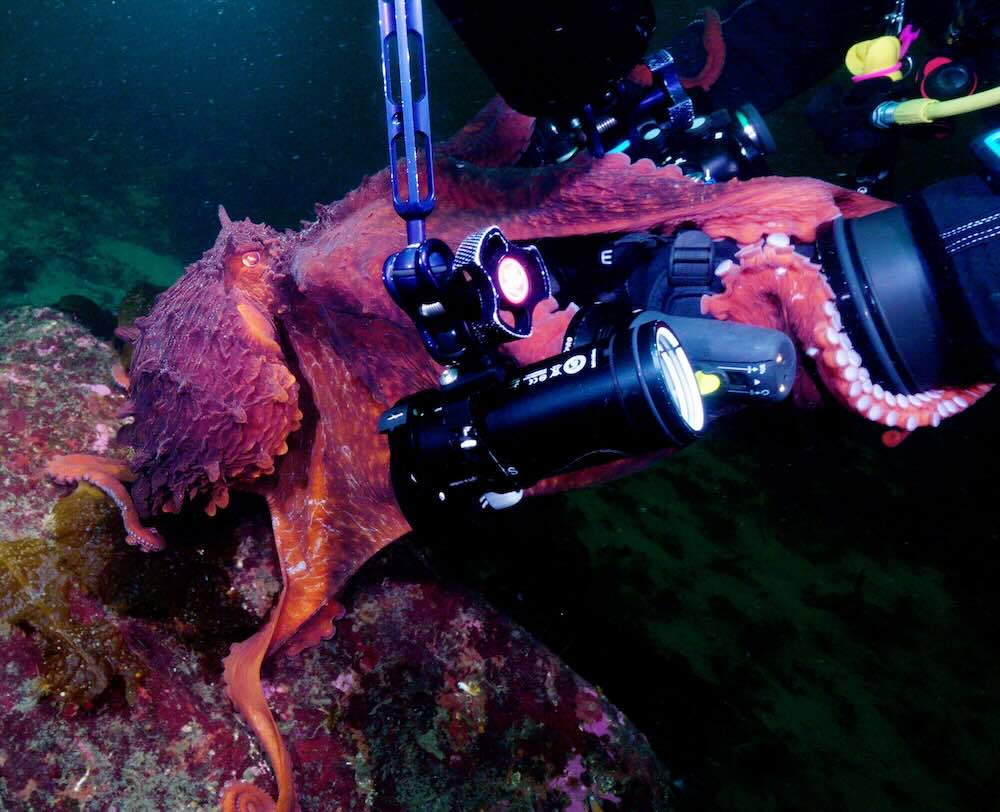
While nearing the end of their dive in early August, the curious cephalopod came out from underneath a rock and stretched out its arms to take hold of John’s camera and become a videographer itself.
“(It was) carrying around my camera for about five minutes,” John told CBC news. Then suddenly, it “was jumping over to give Chris a big hug.”
Chris, who has been diving since 2015, told SWNS news: “We originally saw it on our way out, we passed it at the beginning of the dive, and took a couple of pictures when it was underneath a rock.
“30 minutes later, we passed back on the way home and it stretches quite far from where it was to grab hold of the camera. It really went out of its way to get hold of John and his camera.” (See the video at the bottom…)
Giant Pacific Octopus Plays With Dive Camera – SWNS / Chris Mullen
“I like to give them space, but as I tried to swim away, it dropped the camera and started moving towards where I was going to—effectively following me.
“It briefly stopped to interact with another octopus, and then saw me up higher filming it, and it made a beeline right for me and jumped on me next.
“It was wild,” recalled Chris. “It was crazy what was going on.”
Video of the encounter off Canada’s western coast has racked up thousands of views on Chris’s Instagram page.
Fellow diver John added, “The moments where you see these animals, where they’re choosing to have this interaction and controlling the interaction, willingly participating in it, it really displays in the intelligence of these animals.