











All News - Page 401 of 1715 - Good News Network
Home Blog Page 401

Billionaire Mark Cuban Opens Online Pharmacy To Provide Affordable Generic Drugs

Mark Cuban by Gage Skidmore, CC license

Mark Cuban has officially launched his newest venture—the online pharmacy Cost Plus Drugs.

GNN previously reported on Cuban’s support for Texas radiologist Dr. Alex Oshymansky, who started a public benefit company to provide cheap pharmaceutical drugs.

The launch comes just weeks after the company’s pharmacy benefit manager (PBM) operation was established; both are efforts in the pursuit to help shield consumers from inflated drug prices.

According to a September 2021 Gallup poll, 18 million Americans were recently unable to pay for at least one prescription medication for their household due to ever-rising costs, and 1 in 10 Americans have skipped doses to save money. The pharmacy’s launch represents the first milestone in bringing affordable medications to millions.

Notable medications that epitomize the pharmacy’s savings include Imatinib, a leukemia treatment that has a retail price of $9,657 per month but with MCCPDC costs $47 per month; Mesalamine, an aulcerative colitis treatment that retails at $940 per month comes in at $32.40 per month with MCCPDC; the gout treatment Colchicine retails at $182 month, the lowest price with a common voucher is $32 per month, and with MCCPDC it costs $8.70 per month.

Consumer-first pricing

“We will do whatever it takes to get affordable pharmaceuticals to patients,” said Alex Oshmyansky, CEO of Mark Cuban Cost Plus Drug. “The markup on potentially lifesaving drugs that people depend on is a problem that can’t be ignored. It is imperative that we take action and help expand access to these medications for those who need them most.”

RELATED: First-of-its-Kind Clinical Study Finds That Microdosing THC Can Reduce Chronic Pain

As a registered pharmaceutical wholesaler, MCCPDC can bypass inflated markups. The pharmacy’s prices reflect actual manufacturer prices plus a flat 15% margin and pharmacist fee.

Because the company refuses to pay spread prices to third-party PBM administrators in order to be allowed to process insurance claims, the online pharmacy will be a cash pay venture.

However, its model means patients can immediately purchase a broad array of medications at prices often less than what most insurance plans’ deductible and copay requirements would total.

READ: In World First, AI Develops New Drug, Cuts R&D Costs By 80%, Moving it to Trials For OCD Patients in 1/5 the Time

In November 2021, MCCPDC entered the PBM industry to serve companies providing prescription coverage in their employee benefit plans. MCCPDC has pledged to be “radically transparent” in its own negotiations with drug companies as a PBM, revealing the true costs it pays for drugs and eliminating spread pricing and misaligned rebate incentives.

MCCPDC anticipates its PBM could save companies millions of dollars with no changes to its benefits, depending on the size of the employer, because it will eliminate the traditional PBM model.

The company plans to integrate its pharmacy and wholesaler with its PBM, so any company that uses such services will have access to wholesale pricing through its online pharmacy.

Source: Mark Cuban Cost Plus Drug Company

PASS on the Generosity by Sharing This Good Medical News… 
New Company Turns 100 Tons of Non-Recyclable Plastic Into Building Blocks For Construction

ByFusion
ByFusion

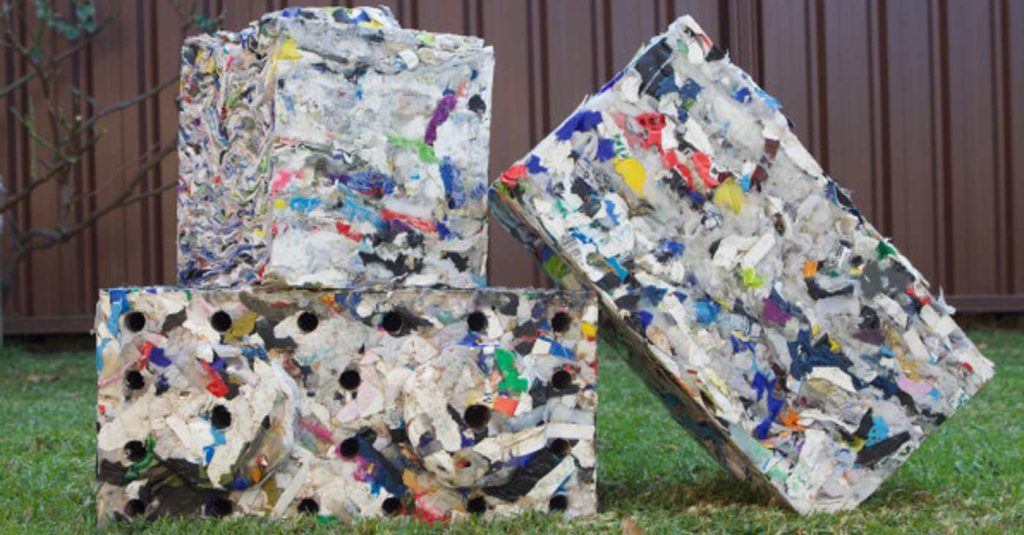
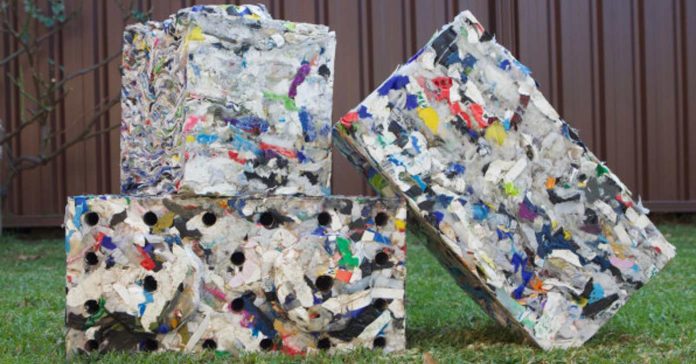
Recycling doesn’t always mean chemically separating things into component parts, or finding a new life for an old object. An LA-based startup is proving that landfills need not be dug for plastics, if one can merely smash enough of them together into a Minecraft-like block.

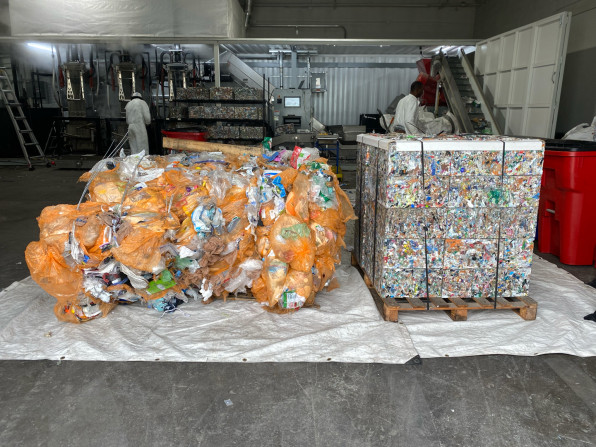
103 tons of nonrecyclable plastics, in fact, have been diverted from entombment since the company was founded, all through ByFusion’s patented machines known as “Blockers.” Blockers have a simple yet ingenious design. They shred the plastic, and then apply mass multiplied by acceleration repeatedly, until the “nonrecyclable plastic” is so squished together that it fuses.

Composite plastics have advanced the world standard of living no end, but often they tend to be unrecyclable.

Many minds are trying to develop thermal or chemical methods of separating the polymers in these materials to allow them to be recycled. ByFusion have avoided this problem by cutting out that middleman and simply turning the material as is into a new, composite, and ridiculously durable construction block.

Called “ByBlocks,” they are a simple 16x8x8 shape and can be used to build bus stops, fences, retaining walls, curtain walls, public terraces, and more.

MORE: This ‘Floating Continent’ Could Collect and Recycle Plastic from the Ocean in Future

ByFusion’s full-service operation in LA can process 450 tons of plastic per year into blocks, and hope to install 12 more Blockers soon.

RELATED: New Solution to Ridding Oceans of Microplastics Uses Acoustic Waves

They have partnered with cities across the country, from the island of Kauai, to Boise in Idaho, to get as many blockers into the hands of people who want to use them.

ByFusion

A big advantage of the Blockers is their indiscrimination; they turn every kind of plastic, even fishing nets, into blocks of the same material properties. The only thing they can’t tackle is polystyrene or Styrofoam.

ByFusion

Not one ounce of adhesive glue, mortar, or any kind of extra substance is used. If 22 pounds of plastic go in, a 22 pound block comes out.

The machines come in two sizes, one for industry, and another for community. The latter comes in a shipping container, while the former features an array of blockers for companies that really crank out the plastic waste.

ByFusion

Watch a durability comparison between the ByBlocks and classic, hollow cement blocks, and see the difference.

SHARE This Good News in Sustainability With Friends…

Goldie the Pufferfish Went to the Dentist for Work – Now Look at Her Smile

SWNS
SWNS

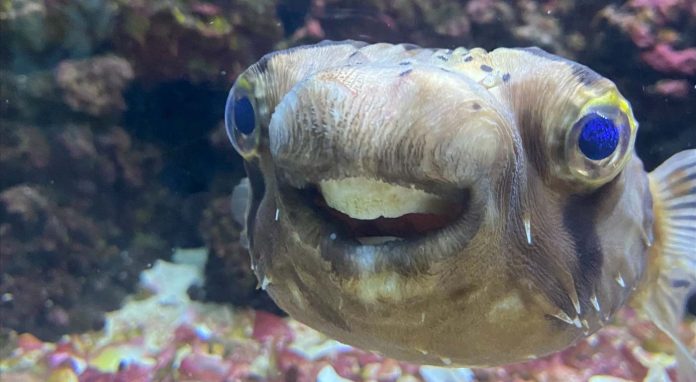
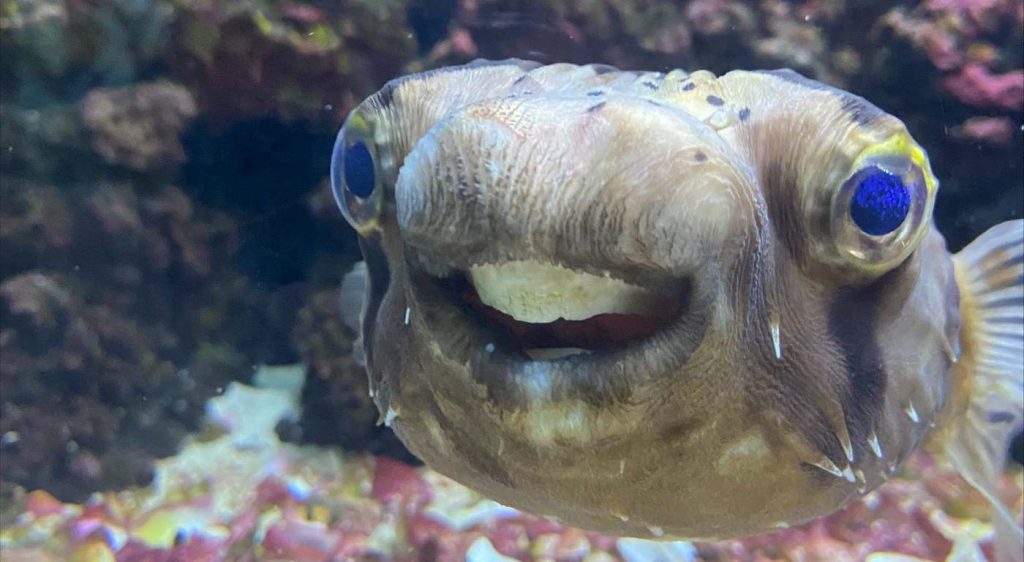
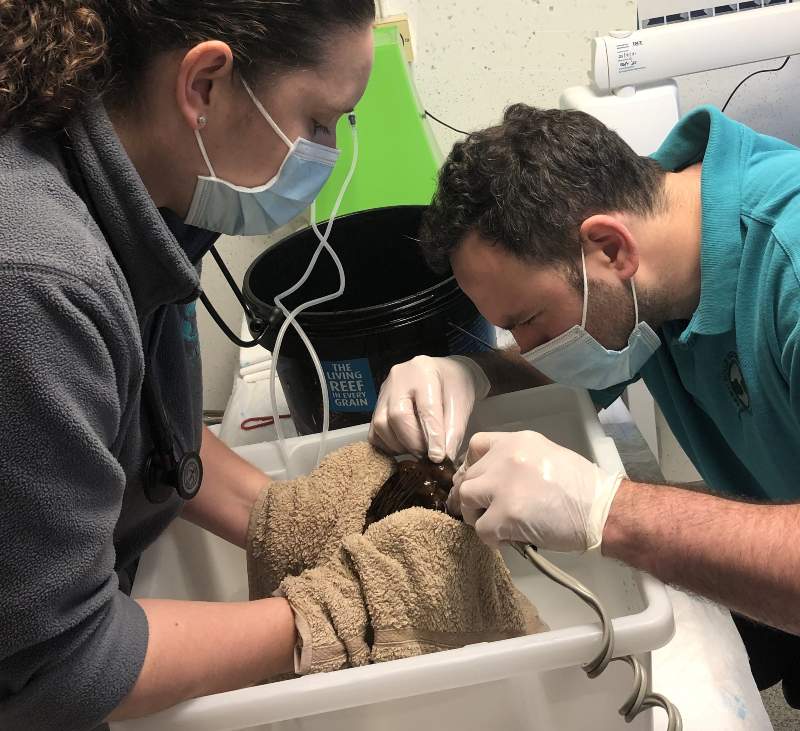
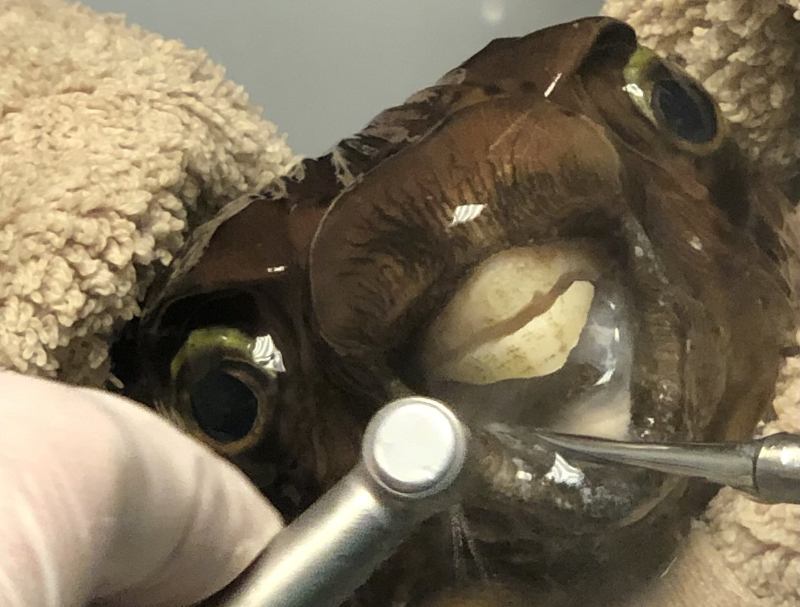
A pufferfish was recently rushed to an animal dentist to have her teeth sawed in half, after they grew so long she was unable to eat.

Goldie the porcupine pufferfish was losing weight because of her giant gnashers.

Her worried owner Mark Byatt rushed the five-year-old fish to the vets who sedated her by filling her water bowl with a mild anaesthetic solution.

Expert animal dentists at Linnaeus-owned Sandhole Veterinary Center in Snodland, Kent, then used a special saw to gently trim her inch-long teeth in half to allow her to eat.

Vet Daniel Calvo Carrasco said, “Porcupine pufferfish teeth are known as beaks and grow continuously throughout their lives.

“They’re usually kept short naturally, as they’re worn down on their regular diet of hard-shelled foods but, while these foods are provided in her home environment, she is not as forthcoming in eating them as her other tank mates.

RELATED: Diver Gets Glorious Glimpse of Giant Sea Worm That Normally Only Comes Out at Night’

“As a result, her upper beak grew to the point where it was hindering her ability to eat effectively.

“Goldie was brought into the practice in a large watertight container containing water from her home tank and a licensed fish anaesthetic was placed into the water until she achieved a light plane of anaesthesia.

“To support her further, the water was oxygenated throughout.

“This meant she was still breathing nicely throughout but was able to be held for brief periods out of the water without becoming too stressed.”

SWNS

Veterinary nurse Debbie Addison held Goldie in a damp towel to prevent her from drying out or triggering a defence mechanism which can see pufferfish inflate to twice their size.

Daniel added, “Debbie was able to hold Goldie in a damp towel to prevent her becoming too dry, while also ensuring she was protected if she did trigger her defence mechanism to inflate her body and activate her spines.

“It was during those brief periods out of the anaesthetic water that I was able to use a dental burr to cut through her upper beak and reduce its length by half.

“Once the procedure had been completed, Goldie was placed into a second large
container with water from her home tank to recover from the anaesthetic.

“She responded well. Within five minutes, she was able to stay up right in the water and within ten minutes she was back to happily swimming around.

CHECK OUT: Dutch Citizens are Using a “Doorbell” to Help Fish Pass Through the Canal Gate

“The whole procedure went swimmingly and was conducted in under an hour without any stress at all and Goldie was back home and eating well within two hours.”

Goldie is now back in her tank at home in Leybourne, England following her trip to the dentist earlier this month.

SWNS

Relieved owner Mark said, “About three months ago, we noticed her front beak was growing very quickly even though she was eating cockle in shell every day.

“We aren’t sure why Goldie’s teeth never really managed to grind themselves naturally but we knew we needed to get them filed, although we were unsure about how to achieve this.

MORE: Scientists Excited by Odd Fish Sounds Recorded in a Restored Coral Reef—the Coolest Thing You’ll Hear All Week

“I was also very concerned about the process of getting Goldie to the surgery, as transporting large tropical fish is not without risk.

“We’re just thrilled to have Goldie back home. She is thriving back in her tank and none the worse for her visit to the dentist.”

SWIM These Sweet Story to Your Social Channels…

“We join spokes together in a wheel, but it is the center hole that makes the wagon move.” – Lao Tzu

Quote of the Day: “We join spokes together in a wheel, but it is the center hole that makes the wagon move.” – Lao Tzu

Photo: by Erik Mclean

With a new inspirational quote every day, atop the perfect photo—collected and archived on our Quotes page—why not bookmark GNN.org for a daily uplift?

Babies Use Kissing and Sharing Their Food as Signals to Interpret Their Social World, Says New Study

By Stephen Andrews

Learning to navigate social relationships is a skill that is critical for surviving in human societies. For babies and young children, that means learning who they can count on to take care of them.

By Stephen Andrews

MIT neuroscientists have now identified a specific signal that young children and even babies use to determine whether two people have a strong relationship and a mutual obligation to help each other: whether those two people kiss, share food, or otherwise share saliva.

In a new study, the researchers found that babies actually expect those who share saliva to come to one another’s aid if any one person is in distress—much more so than when people share toys or interact in other ways that do not involve the mouth.

The findings suggest that babies can use these cues to try to figure out who around them is most likely to offer help, the researchers say.

“Babies don’t know in advance which relationships are the close and morally obligating ones, so they have to have some way of learning this by looking at what happens around them,” says Rebecca Saxe, the John W. Jarve Professor of Brain and Cognitive Sciences, a member of MIT’s McGovern Institute for Brain Research, and senior author of the new study in the journal Science.

Sharing saliva

In human societies, people typically distinguish between “thick” and “thin” relationships. Thick relationships, usually found between family members, feature strong levels of attachment, obligation, and mutual responsiveness. Anthropologists have also observed that people in thick relationships are more willing to share bodily fluids like saliva.

“That inspired both the question of whether infants distinguish between those types of relationships, and whether saliva sharing might be a really good cue they could use to recognize them,” Thomas says.

RELATED: Dogs Can Differentiate Between Languages, Study Finds

To study those questions, the researchers observed toddlers (16.5 to 18.5 months) and babies (8.5 to 10 months) as they watched interactions between human actors and puppets. In the first set of experiments, a puppet shared an orange with one actor, then tossed a ball back and forth with a different actor.

After the children watched these initial interactions, the researchers observed the children’s reactions when the puppet showed distress while sitting between the two actors. Based on an earlier study of nonhuman primates, the researchers hypothesized that babies would look first at the person whom they expected to help. That study showed that when baby monkeys cry, other members of the troop look to the baby’s parents, as if expecting them to step in.

The MIT team found that the children were more likely to look toward the actor who had shared food with the puppet, not the one who had shared a toy.

POPULAR: Why Cats Love to Sit in Boxes – Even Fake Ones, According to Science

In a second set of experiments, designed to focus more specifically on saliva, the actor either placed her finger in her mouth and then into the mouth of the puppet, or placed her finger on her forehead and then onto the forehead of the puppet. Later, when the actor expressed distress while standing between the two puppets, children watching the video were more likely to look toward the puppet with whom she had shared saliva.

Social cues

The findings suggest that saliva sharing is likely an important cue that helps infants to learn about their own social relationships and those of people around them, the researchers say.

“The general skill of learning about social relationships is very useful,” Thomas says. “One reason why this distinction between thick and thin might be important for infants in particular, especially human infants, who depend on adults for longer than many other species, is that it might be a good way to figure out who else can provide the support that they depend on to survive.”

In future work, the researchers hope to use functional magnetic resonance imaging (fMRI) to study what parts of the brain are involved in making saliva-based assessments about social relationships.

(Source: Massachusetts Institute of Technology)

Watch Incredible Moment Young Opera Fan Stands Up During Soprano’s Verdi Performance to Sing Tenor Part

opera social media TikTok- Babatunde Hiphopera_YouTube- 359度
TikTok; Babatunde Hiphopera_/YouTube; 359度

When a famous soprano was solo performing a Verdi aria that’s normally a duet, she received a helping hand by a fan—who happened to be a tenor—in the audience.

In a beautiful story that highlights the international confluences in opera singing, Chinese music student Liu Jianwei was in Parma, Italy, to watch a Cuban-American soprano, Lisette Oropesa, perform a recital.

“Sempre Libera,” or forever free, from Giuseppe Verdi’s La Traviata, is meant to be sung principally by a female, with a male tenor’s voice from off stage, as if singing from below a balcony.

After Oropesa finished the first bar without any male voice responding to her, Liu summoned the lion’s share of his courage and joined in during the second bar. Captured on social media, Oropesa’s voice and face is one of sheer delight and surprise, and the video has gone properly viral.

Violette, Oropesa’s character, is written as saying “Oh” in the libretto, but the soprano’s subsequent “Oh Grazie” was a bit of clever improvisation, one which the crowd caught and enjoyed.

MORE: Visit ‘Fortlandia’ Where Designers Have Built Odes to Childhood Fort-Building in Austin, Texas

Liu, the perfect gentleman, took to Chinese social media after the videos took off on TikTok, to renounce his actions and remind people not to disturb singers while they are performing.

LOOK: After Asking His Neighbor to ‘Take His Trash Bin Out’ – He Received a Photo Shoot of Their Day on the Town

It was only because he had studied the tenor part of the aria thoroughly that he decided to take the risk, he explained.

“It is definitely not something worthy of pride, nor something worthy of being advocated,” Liu stated in a video. “Please don’t interrupt singers when they are singing on stage. It’s impolite behavior. Don’t imitate me and I will never do this again in the future.”

Despite his regret, he was welcomed back stage with autographed photos and selfies.

(WATCH the video for this story below.)

RAISE Your Voice for This Story; Share it on Social…

Get Your Body Moving to Put the Brakes on Early Parkinson’s, Study Says

A new study suggests that people with early-stage Parkinson’s disease who regularly got one to two hours of moderate exercise twice a week, like walking or gardening, may have less trouble balancing, walking, and doing daily activities later.

Researchers found that those who exercised regularly over five years did better on cognitive tests and had slower progression of the disease in several aspects.

“Our results are exciting, because they suggest it may never be too late for someone with Parkinson’s to start an exercise program to improve the course of their disease,” said study author Kazuto Tsukita, MD, of Kyoto University in Japan and a member of the American Academy of Neurology. “That’s because we found that to slow progression of the disease, it was more important for people with Parkinson’s to maintain an exercise program than it was to be active at the beginning of the disease.”

The study looked at 237 people with early-stage Parkinson’s. They had an average age of 63 and were followed by researchers for up to six years.

Participants’ exercise levels at the start of the study were determined using a questionnaire that measures time and intensity during the previous week of leisure activity, like walking and biking; household activity, like gardening; and occupational activity, like taking care of others. Common cognitive tests were used to measure people’s verbal and memory skills and how much time it took to complete mental tasks.

CHECK OUT: Coffee is Now Linked to Reduced Risk of Many Ailments, Including Liver Disease, Parkinson’s, Melanoma, Even Suicide

Researchers found that people’s physical activity level at the start of the study was not associated with the progression of their Parkinson’s later on. Instead, they found it was more important to maintain physical activity over time.

People who got at least at least four hours per week of moderate to vigorous exercise like walking or dancing had slower decline in balancing and walking five years later, compared to those who did not get that much exercise.

RELATED: Chemists Find Breakthrough Treatment for Alzheimer’s and Parkinson’s That Protects Brain Cells From Amyloid Plaque

Researchers used a common test to rate each person’s Parkinson’s symptoms on a scale of zero to four, with higher scores indicating more severe impairment. People who got below average levels of moderate to vigorous exercise, or less than one to two hours, once or twice a week, increased from an average score of 1.4 to 3.7 over six years. That’s compared to those who got above average levels of moderate to vigorous exercise, who on average increased from a score of 1.4 to 3.0 during that time.

One cognitive test researchers used was a common paper-and-pencil test used to measure mental processing speed. The test gives the participant 90 seconds to match numbers with geometric figures and has a maximum possible score of 110.

People who did less than 15.5 hours of work per week, on average, dropped from a 44 to a 40 on the test six years later. That’s compared to an average drop from a score of 44 to 43 for those who did more than 15.5 hours of work over the same period.

MORE: The Inspiring Story of The Parkinson’s Painter Who Finally Followed His Dream

“Although medications can provide people with Parkinson’s some symptom relief, they haven’t been shown to slow the progression of the disease,” Tsukita said. “We found that regular physical activity, including household tasks and moderate exercise, may actually improve the course of the disease over the long run. Best of all, exercise is low cost and has few side effects.”

The study does not prove that maintaining an exercise program will delay the effects of Parkinson’s disease. It only shows an association.

A limitation of the study, published in Neurology, 2022, is that activity levels were self-reported and may not be accurate.

Source: American Academy of Neurology

Get the Word Out; Share the Results of This New Study…

Gigantic Planet Found Hidden in Plain Sight

A gas giant exoplanet that orbits a G-type star, which is similar to TOI-2180 b. (NASA) public domain
A gas giant exoplanet that orbits a G-type star, which is similar to TOI-2180 b. / NASA

An astronomer and a group of eagle-eyed citizen scientists have discovered a giant gas planet hidden from view by typical stargazing tools.

The planet, TOI-2180 b, has the same diameter as Jupiter, but is nearly three times more massive. Researchers at UC Riverside also believe it contains 105 times the mass of Earth in elements heavier than helium and hydrogen. Nothing quite like it exists in our solar system.

“TOI-2180 b is such an exciting planet to have found,” said UCR astronomer Paul Dalba, who helped confirm the planet’s existence. “It hits the trifecta of 1) having a several-hundred-day orbit, 2) being relatively close to Earth (379 lightyears is considered close for an exoplanet), and 3) us being able to see it transit in front of its star. It is very rare for astronomers to discover a planet that checks all three of these boxes.”

Dalba also explained that the planet is special because it takes 261 days to complete a journey around its star, a relatively long time compared to many known gas giants outside our solar system. Its relative proximity to Earth and the brightness of the star it orbits also make it likely astronomers will be able to learn more about it.

MORE: Mysterious Purple Coating Found on Mars Rocks in Every Direction

In order to locate exoplanets, which orbit stars other than our sun, NASA’s TESS satellite looks at one part of the sky for a month, then moves on. It is searching for dips in brightness that occur when a planet crosses in front of a star.

“The rule of thumb is that we need to see three ‘dips’ or transits before we believe we’ve found a planet,” Dalba said. A single transit event could be caused by a telescope with a jitter, or a star masquerading as a planet. For these reasons, TESS isn’t focused on these single transit events. However, a small group of citizen scientists is.

Looking over TESS data, Tom Jacobs, a group member and former U.S. naval officer, saw light dim from the TOI-2180 star, just once. His group alerted Dalba, who specializes in studying planets that take a long time to orbit their stars.

RELATED: New Study Further Resolves Stephen Hawking’s Black Hole Paradox – With String Theory

Using the Lick Observatory’s Automated Planet Finder Telescope, Dalba and his colleagues observed the planet’s gravitational tug on the star, which allowed them to calculate the mass of TOI-2180 b and estimate a range of possibilities for its orbit.

Hoping to observe a second transit event, Dalba organized a campaign using 14 different telescopes across three continents in the northern hemisphere. Over the course of 11 days in August 2021, the effort resulted in 20,000 images of the TOI-2180 star, though none of them detected the planet with confidence.

However, the campaign did lead the group to estimate that TESS will see the planet transit its star again in February, when they’re planning a follow up study. Funding for Dalba’s research is provided by the National Science Foundation’s Astronomy and Astrophysics Postdoctoral Fellowship Program.

CHECK OUT: ‘Orion’s Fireplace’: Flame Nebula is Ablaze With Color and Captured in Stunning New Images

The citizen planet hunters’ group takes publicly available data from NASA satellites like TESS and looks for single transit events. While professional astronomers use algorithms to scan a lot of data automatically, the Visual Survey Group uses a program they created to inspect telescope data by eye.

“The effort they put in is really important and impressive, because it’s hard to write code that can identify single transit events reliably,” Dalba said. “This is one area where humans are still beating code.”

The corresponding study has been published in The Astronomical Journal.

Source: University of California – Riverside

SHARE This Far Our News On Those Social Feeds…

“Those who are wise see their life like stepping stones across a great river. Everyone misses a stone from time to time. No one can cross the river without getting wet.” – Colleen Houck

Quote of the Day: “Those who are wise see their life like stepping stones across a great river. Everyone misses a stone from time to time. No one can cross the river without getting wet.” – Colleen Houck

Photo: by Sam Barber (cropped)

With a new inspirational quote every day, atop the perfect photo—collected and archived on our Quotes page—why not bookmark GNN.org for a daily uplift?

After Asking His Neighbor to ‘Take His Trash Bin Out’ – He Received a Photo Shoot of Their Day on the Town

Carl Stanojevic & MackaySeen

In a story of neighborly jest that grew into epic proportions, a green garbage bin got to wheel about the whole town with a handsome man on her arm.

Carl Stanojevic & MackaySeen

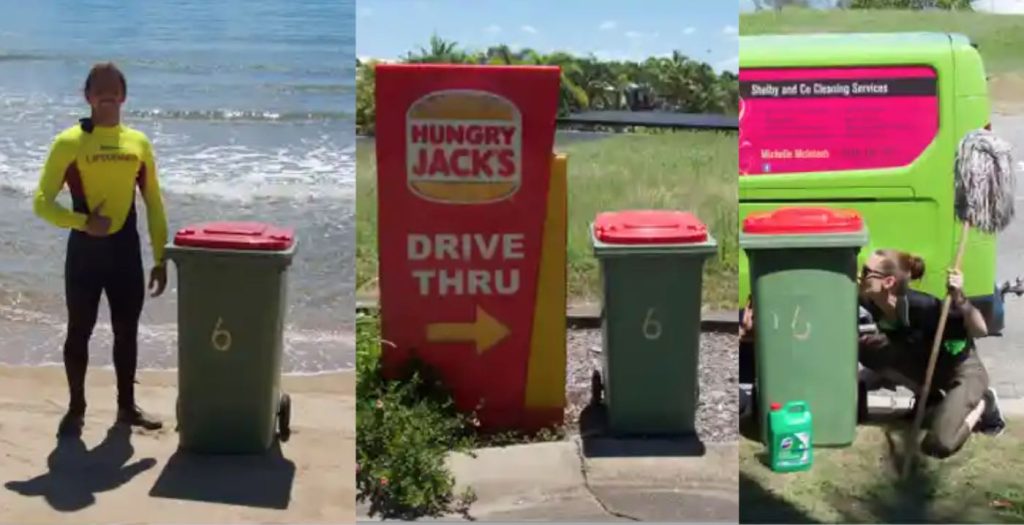
When 54-year-old Carl Stanojevic got a text from his neighbor Nick with a request to “take my bins out,” he responded “yeah sure no problem any particular place?”

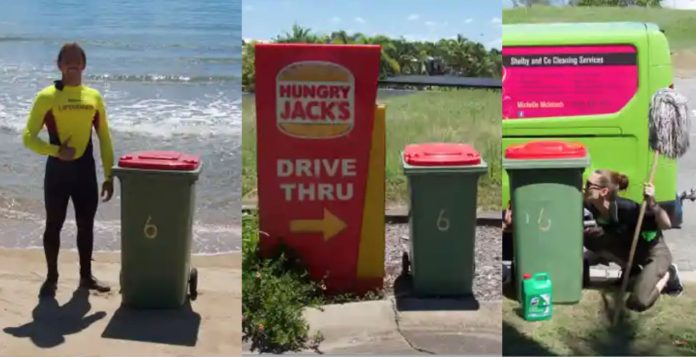
He took the lucky wheelie bin he was ‘caring’ for to the local beach in Mackay, Queensland—then to the surf club, then to do some chores including a stop at a hardware store for socializing. After stopping at several restaurants, they took some R&R.

“We went for a massage and then to the tattoo parlour to get a couple of extra 6s on the bin. A bit of a tattoo, then stopped at the pub for a coldie,” Stanojevic told the Guardian on Friday.

Noticing the presence of the bin, some garbage men and women stopped to take a picture, and later the green bin, now sporting her tattoo, stopped to make a phone call “to talk trash,” as Stanojevic recounted.

MORE: A Talking Crow Befriending a School Has a Foul-Mouth But is Still Beloved by Kids in Oregon

After five hours spent around the Australian town, Stanojevic returned home with news he had completed the favor—sending a photo album of the day’s events, which reportedly blew Nick away.

Local news reported “Bin day not half rubbish for Mackay man doing his neighbour a favour,” adding that the image of bin #6 gazing pensively across the water was “anything but rubbish.”

Stanojevic told the Guardian that putting a smile on people’s faces, especially his neighbor’s, was totally worth it, especially since Mackay is a town that relies on tourism and so was hit hard during the lockdowns.

LOOK: Tom Brady FaceTimes With High School Team After They Dialed the Wrong Number

He said of his neighbor, “We catch up for a beer when we can and have a chat and a few laughs. He’s a beautiful person. You’d do anything for him. He said take my bin out. If he had said put my bin out it would have been just a normal day in Mackay.”

Cheers to japes that can be enjoyed by all.

SHARE the Fun; Share This Story From Down Under…

New Species of Tarantula That Lives in Bamboo is Discovered by Wildlife YouTuber

tarantular L CC license Narin Chomphuphuang; r cc license jocho
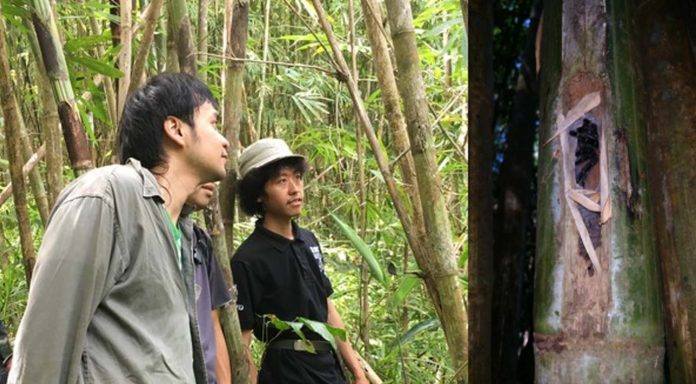
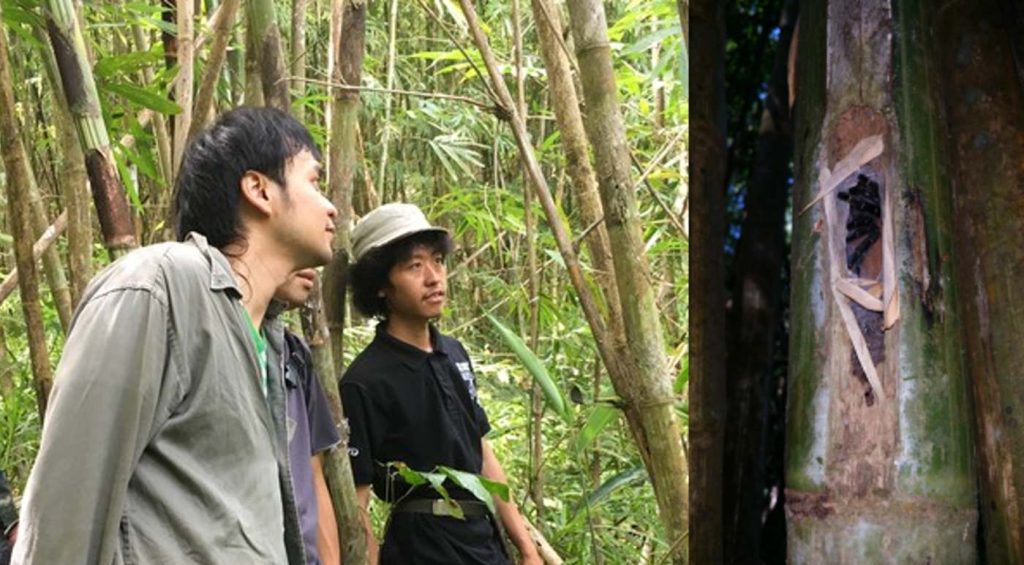
(L) Looking at the entrance hole of a bamboo culm tarantula, Narin Chomphuphuan; (R) JoCho Sippawat, CC license

A wildlife YouTuber knew immediately when he saw a tarantula curled up in a stalk of bamboo: he had just discovered a new species.

What’s more, the discovery marked not only that of a new species, but a new genus, as none of the 1,000-strong member of the tarantula family has ever been documented living inside bamboo.

JoCho Sippawat is a Thai YouTuber with 2.5 million subscribers. The young man seeks out rainforest creatures in much the same way the television greats of yesteryear—Jack Hannah, Steve Irwin, and Jeff Corwin, used to.

After finding the spider near his home in Tak Province, Sippawat emailed a photo of the spider to arachnologist Narin Chomphuphuang of Khon Kaen University. His team spent the summer of 2020 surveying the area, and when they were finished they declared it new to science.

Colloquially called the bamboo-culm tarantula, the scientific name is Taksinus bambus after Taksin the Great—a famous king from the Tak Province. “Culms” are the individual chambers inside bamboo, into which the black and silver spider makes its home; normally through small slivers or fractures in the outer bark. Once inside, it spins a silken and conical home.

RELATED: 70 New Species Were Discovered in 2021 – Including 2 Guitarfish and a Pink Pygmy Pipehorse

“This species is unique because it is associated with bamboo, and we have never observed this tarantula species in any other plant,” Chomphuphuang writes. “It is not an exaggeration to say that they are now Thailand’s rarest tarantulas.”

JoCho Sippawat (L), with the research team; Narin Chomphupchuang, CC license

But how can a spider—itself having no tools with which to puncture or pierce the hard bamboo, make its way inside to nest?

“Bamboo is preyed upon by a variety of animals, including the bamboo borer beetle, bamboo worm, bamboo-nesting carpenter bee, and small mammals such as rodents. Furthermore,”Chomphuphuang adds. “Bamboo cracking is primarily caused by rapid changes in moisture content induced by the atmosphere, uneven drying, or drenching followed by rapid drying or by human activities.”

MORE: See 1,000 Glorious Fin Whales Feeding Together: Share Their Comeback From Near Extinction

The spider is also of interest to science because of its small sexual organs, and the fact that while arboreal tarantulas, which tend to spend their time in the trees, are found in Indonesian islands like Sumatra, Sanghi, and Sulawesi as well as Malaysia and Singapore, none of them have ever been found in Thailand.

GNN previously reported on the discovery of a new species of Kukri Snake in the Himalayas found on Instagram. A young man who was shut in at home due to the pandemic started rapidly posting pictures of animals on social media, which led a research team to first describe the intriguing snake.

CRAWL This Fascinating Discovery From Thailand Over to Friends…

College Seniors Fix Erosion in New Orleans By Resuming Citywide Bottle Recycling to Crush Them For Sand

Glass Half Full
Glass Half Full

It was during a conversation over a bottle of wine, one which they knew would simply end up in a landfill, that a pair of New Orleans residents started their own non-profit glass recycling service.

In what appears a no-brainer, the pair collect glass bottles and grind them down into super soft sand to use for disaster relief, eco-construction, and even new glass.

Glass Half Full is taking on the problem that hundreds of municipalities in the U.S. have stopped offering glass recycling, their native New Orleans among them. Their efforts saw them recently receive The Most Innovative Program award from the Keep Louisiana Beautiful Conference.

The U.S. is branching away from curbside glass recycling because too often the glass they receive is contaminated, or breaks apart and acts as a contaminant in other waste streams such as metal and paper.

If responsibility recycled, glass is 100% reusable, but despite this only a quarter of glass in the U.S. is recycled.

A new vision

Glass Half Full

Enter Glass Half Full, the largest grassroots recycling program in the world, funded mostly by donations. They collect glass either from businesses curbside or from their specified drop-off points, and bring them to the processing facility.

MORE: New Technology is Recycling Tons of Lithium-Ion Batteries in Canada and the U.S.

After that the glass is sorted, cleansed of metal and cork objects, pulverized, and sifted into sand of respective colors which they pile into sandbags, heat into new glass objects, or sell out for eco-construction.

Glass Half Full is currently 90% of the way to finishing their fundraiser to scale-up their operations.

“A single piece of glass in your recycling bin in NOLA will cause the entire load to be sent to the landfill, where it will never decompose,” write Glass Half Full. “New Orleans wastes millions of tax dollars… importing millions of pounds of sand. We are preventing these unnecessary, wasteful, and expensive practices by providing a sustainable alternative.”

RELATED: 20,000 Pounds of Trash Removed From Pacific Garbage Patch: ‘Holy mother of god. It worked!’

But they see their sand as having way more potential than creating more wine bottles.

They hope to help restore Louisiana’s shoreline with the recycled glass amid a worldwide sand shortage. Dredging for sand is an extremely laborious process that’s harmful to riverine and other ecosystems near where the mining takes place.

“Sand is a crucial tool for rebuilding the barrier islands and sandbars that protect our coast from tropical storms and hurricanes,” they write, pointing out that much of the flood prevention systems Louisiana has built over the years prevent sediment from flowing out into the Gulf and other coastal ecosystems.

CHECK OUT: Plant Opens to Change the Recycling Game by Breaking Down Plastic Bottles With Enzyme From Leaves

“Returning sediment to wetlands combats erosion and promotes the return of native foliage and wildlife, which will ultimately strengthen Louisiana’s economy and preserve our food supply.”

If you live in New Orleans and want to get involved or recycle your glass, all the program information can be found on the Glass Half Full FAQs. 

Recycle This Good Green Story With Your Friends…

19-Year-Old Just Set the Record for the Youngest Woman to Fly Solo Around the World

Instagram/@fly.zolo

19-year-old Zara Rutherford has made a grab bag of records after completing a 32,000 mile (52,000km) circumnavigation of the Earth.

Landing at Kortrijk-Wevelgem Airport in western Belgium on Thursday, she became the youngest woman, and first Belgian to fly solo around the world—as well as the first person ever to do it in an ultralight aircraft. It took her 155 days.

The previous youngest-ever woman to accomplish the celebrated feat of aviation was American Shaesta Waiz, who also founded a non-profit called Dreams Soar which Rutherford was supporting on her long journey. A funny twist of fate saw the two globe trekkers united on a stopover.

Rutherford made the 41-country crossing to inspire more women and girls into entering other STEM fields, but obviously and particularly aviation. Remarking on how only 5.1% of pilots are women, she described the occupation to CNN last year as “a career where you basically get paid to travel around the world.”

She’s also supporting the non-profit Girls Who Code.

RELATED: English Teenager Discovers Hoard of 3,300 Year-Old Axes and Becomes Metal Detecting Celebrity

Chalks away

It wasn’t all smooth sailing for the 160-mph ultralight aircraft, and both extreme weather and visa difficulties took their tool on the plane and the pilot. Originally planned for three months and 52 countries, the route had to be changed due to unscheduled landings such as to avoid wildfires in California, and a denial for crossing permission over China.

“I would say the hardest part was definitely flying over Siberia—it was extremely cold. It was minus 35 degrees Celsius on the ground,” Rutherford said during a press conference on Thursday.

“If the engine were to stall, I’d be hours away from rescue and I don’t know how long I could have survived for.”

MORE: Rookie Lifeguard Faced With Saving a Kangaroo From Rough Surf in Her First Ever Rescue

Rutherford was piloting the carbon fiber and epoxy Shark Aero, one of the fastest ultralight aircraft in the world—built by specialists and modified for the rigors of circumnavigation.

(WATCH the video reel from Zara below.)

SHARE This Round-the World Story on Social Media…

“Nothing will tell you where you are. Each moment is a place you’ve never been.” – Mark Strand

By Anastasiya Romanova

Quote of the Day: “Nothing will tell you where you are. Each moment is a place you’ve never been.” – Mark Strand

Photo: by Anastasiya Romanova

With a new inspirational quote every day, atop the perfect photo—collected and archived on our Quotes page—why not bookmark GNN.org for a daily uplift?

By Anastasiya Romanova

Almost $13 Million Raised For Animal Shelters to Honor the Late Celebrity With the #BettyWhiteChallenge

Actors & Others For Animals

JoAnne Worley and Loretta Swit were among the celebrities who began a campaign on social media called the #BettyWhiteChallenge in honor of Betty White’s 100th birthday.

The comedic actress died on New Year’s Eve, just weeks before her centennial celebration of January 17th—but because she is so beloved, the campaign has taken flight to raise millions for animals.

Actors & Others For Animals, the charity for which she served on the Board of Directors, launched the campaign asking for donations of $100 for Betty’s 100th birthday.

Dozens of other groups benefitted, too, as the public began sending in money to local shelters in Ms. White’s name.

Almost 400,000 people used Facebook and Instagram to donate to the challenge, raising an incredible $12.7 million dollars for animal shelters and rescuers all over the country—with 100% of the pledges going directly to the organizations.

Two Philadelphia shelters brought in $100,000; a Los Angeles zoo charity got $70,000; an Arkansas shelter was flooded with over $12,000; and Dubuque, Iowa shelters received $13,000.

LOOK: Baby Donkey is Named ‘Betty White’ to Honor Celebrity Who Donated to Their Animal Sanctuary For Years

Betty had prepared a video to share on her 100th birthday which was recorded just days before her death. Her team posted the video on her Instagram page as a farewell greeting for her fans.

“I just want to thank you all for your love and support over the YEARS. Thank you so much, and stick around!”

Her team added an update from the #BettyWhiteChallenge to the posted video, “As we continue to see numbers coming in from all over the world, it’s just absolutely amazing how much money all of you raised for animals.”

WATCH the video…

HOWL Your Love for Animals By Sharing This on Social Media…

Visit ‘Fortlandia’ Where Designers Have Built Odes to Childhood Fort-Building in Austin, Texas

By Leonid Furmansky for Perkins & Will architects

An annual mass ‘fort building’ event is going on now which for years has brought smiles uncountable to the faces of children visiting in Austin, Texas.

Hosted at the Lady Bird Johnson Wildflower Center and Botanic Gardens, Fortlandia is a celebration of childhood fort building, in which architects create different forts to tickle the imagination of young and old.

Building forts is a universal childhood experience. Whether out of blankets and pillows, sticks and leaves, or refrigerator boxes, it is the pinnacle of big picture creativity.

Now open until January 31st, Fortlandia 2022 features 8 forts built by professional architects and artists arrayed along a nature trail for kids, so they can explore and pretend to their heart’s content.

Color Space Architecture from San Marcos, for example, contributed ‘The Critter Stack’, which creates a play and meet and greet environment for kids and forest critters.

“By integrating natural stacked materials within and on the installation, The Critter Stack invites Fortlandia attendees to consider life forms smaller than themselves and to take a closer, respectful look at the wilderness that we can help support outside our front doors.”

Color Space – Critter Stack, designed for Fortlandia 2021

“Children are also invited to crawl right up and into the installation and imagine what it is to become a little critter themselves,” they added.

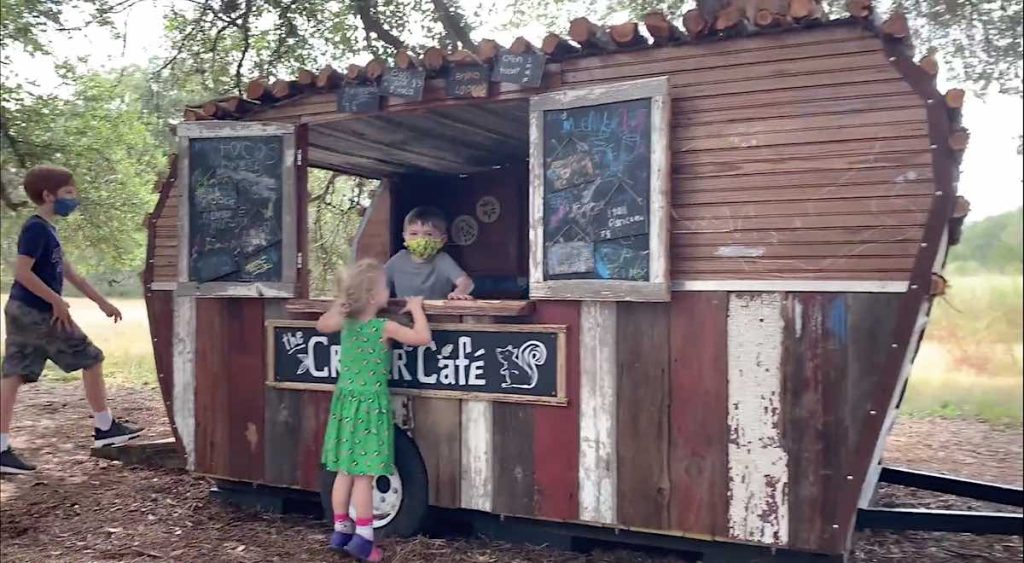
Critter Cafe By Designer Jodi Bade

Designer Jodi Bade made ‘The Critter Cafe’, which is pulled by a vintage garden tractor and filled with child-safe kitchen equipment for that most persistent of childhood fancies, tea time. Watch her video showing the remarkable detail on the inside.

By Leonid Furmansky / Perkins & Will

For the 2020 exhibition, Perkins & Will built a fort entirely of bamboo tubes, allowing kids’ tireless knees to crawl them about inside an enclosed yet natural space.

By Leonid Furmansky for Perkins & Will architects

Each year since it debuted in 2018, up to ten different forts each year dot a 16-acre stretch of the Texas Arboretum (part of the Botanic Gardens), with majestic trees framing the model forts.

Before starting their journey to the secret hideouts in the woods that most of us only dreamed of, kids can pick up their “Passforts” to document their adventures, map the fort locations, along with the animals and plants they find along the way—and the friends they’ve made—and compare notes for the next year.

WATCH one family’s adventure in 2019…

LET Your Friends Discover This Hidden Gem By Sharing it on Social Media…

Inspired by Lava, New Nontoxic Coating Can Halt Fire in its Tracks

Photo by DDP
Photo by DDP

Lava is one of the hottest substances found on the Earth’s surface and also a source of inspiration for the design of a potentially life-saving fire retardant coating.

A research team, led by University of Southern Queensland chemical engineer and Australian Research Council Future Fellow, Professor Pingan Song, has developed a non-toxic, fire extinguishing coating that could save buildings from being engulfed in flames.

Professor Song said lava sparked his idea of a hybrid coating that would melt and then gradually form a flowing but non-combustible ceramic layer when exposed to extreme heat.

“Melton lava is like a viscous flowing liquid but non-flammable,” Professor Song said.

“Once cooled, it solidifies to become a ceramic layer that does not support fire.

“Inspired by this interesting phenomenon, we designed a fire retardant coating that can create a non-combustible ceramic layer which can offer fire protections for the underlying substrates, just like a fire shield.”

RELATED: Not Only Does New Solar Chimney Design Cut Energy Costs By 50%, It Can Also Save Lives During a Fire

Professor Song said spraying the coating on building materials, such as thermal insulation foam, timber and steel structures, during construction could prevent disasters like the 2017 Grenfell Tower blaze in London, where 72 people died.

“Polymer foams were identified as the main cause of recent catastrophic disasters, particularly the Grenfell Tower fire,” he said.

“Solid wood materials, also widely used in buildings but extremely combustible, can also trigger fires, like the Notre-Dame de Paris blaze in 2019.”

CHECK Out: Futuristic ‘Green’ Fabric That Works Like a Smartphone Unveiled by Scientists

Fire retardants have been used in building materials for decades, but most are not effective enough, costly and sometimes difficult to mass produce.

Professor Song said their version offered better protection and could be used in other application settings, such as wooden furniture, mining, tunnels and transportations.

“Our fire retardant coating produces a very robust and thermally stable ceramic layer, compared to existing coatings, which usually produce a protective layer that is fragile and degrades at high temperatures,” he said.

Professor Song said the fire-retardant coating still had to undergo further testing and refinement before it could be commercialized and put to widespread use, which he hoped would be within the next three years.

The research, which was financially supported by an Australian Research Council Future Fellowship, was published in the journal Matter.

Source: University of Southern Queensland

SEND Some Sizzle to Friends on Social Media…

Mystery ‘Garbage Man’ in Wisconsin Neighborhood is Revealed to Be a 75-Year-old Man

WFRV Local 5 / Youtube

For weeks, in the frigid Wisconsin winter, neighbors in Appleton were puzzling over a sudden mystery.

On garbage days, they would trudge with their trash bins down their long driveways of snow and ice—and in the evenings the bins appeared back at their garages.

Melody Luttenegger, who lives in the neighborhood of Grand Chute, first asked her husband—but he replied, ‘no, I’m not bringing the garbage cans up.’

Then, she thought it was the garbage company, and decided to stake out the area to discover the identity of the good deed-doer.

“It was the day before Christmas Eve,” she told WFRV Local 5’s Barrett Tryon. “And I got a little gift for them… and stood there, waiting and waiting.”

At 8:21 in the morning, she saw Dick Pontzloff, a 75-year-old senior who lives a few streets over, coming up the driveway with the Luttenegger’s garbage cans.

WFRV broadcasts a regular segment called ‘Positively Wisconsin’, to showcase inspiring people.

And, Dick turned out to be quite inspiring.

“When I retired, I got sick of doing nothing, so I started going around and picking up garbage cans. Not just certain ones, everyone’s,” he told Local 5 News, from nearby Green Bay.

LOOK: Sanitation Heroes Dig Through 2,000 Pounds of Trash to Reunite Man With His Lost Wallet

He’s lived in Wisconsin most of his life, and always loved winter.

“I put this mask on because it makes your face nice and warm. That’s the reason I’m wearing it. I don’t normally wear it,” he laughed again.

“Just be nice to all people,” he said. “It’s just what you gotta do. Just think if you were at home and you needed someone for help.”

Luttenegger benefitted from something more intangible than help: “You know, the kindness that strangers give is an unexplainable feeling.”

WATCH the WFRV video below…

BRING Some Good News Up Your Social Media Driveway…

“The joy of strife: Next to trying and winning, the best thing is trying and failing.” – L.M. Montgomery

Quote of the Day: “The joy of strife: Next to trying and winning, the best thing is trying and failing.” – L.M. Montgomery (Anne of Green Gables)

Photo: by Javad Esmaeili (colorized)

With a new inspirational quote every day, atop the perfect photo—collected and archived on our Quotes page—why not bookmark GNN.org for a daily uplift?

Watch the Jubilant Christmas Message These Surprised Tesla Owners Got From Their Car

These Tesla owners have loved their electric car, ever since they carefully decided to wade into the EV world—and they’ve never regretted the move.

The lower fuel costs have roughly equaled the higher purchase price, and they do feel good about making less of an impact on the planet as they drive.

Their Tesla also provided a holiday surprise for the owners in the form of a dazzling Christmas light show.

After downloading the latest operating software for the vehicle, the Tesla instructed Dave to press the start button and then get out and enjoy a special message.

Dave and his wife watched as the car began to play a majestic orchestral performance of Carol of the Bells, synchronized with not only the lights on the car, but the movements of the trunk, mirrors, windows, and charge port.

The whole family watched in amazement as the exciting holiday greeting emerged from their car.

RELATED: With EV Battery Prices Dropping 87% in a Decade, Tesla is Now Making a Car That Will Cost $25,000

Another feature they found was a cozy fireplace video that plays on the control screen, synchronized with the heaters in the car that send out a gentle warm breeze to match the fire. Aptly referred to as “romance” on the control menu, this caused a giggle as the screen lit up.

Another ‘Easter egg’ the found in the software was the option to play the sound of coconuts clopping as the car drives—reminiscent of the epic scene from Monty Python as the knights gallop across the highlands without horses.

WATCH the Christmas light display below…

SHARE The Tesla Love on Social Media…