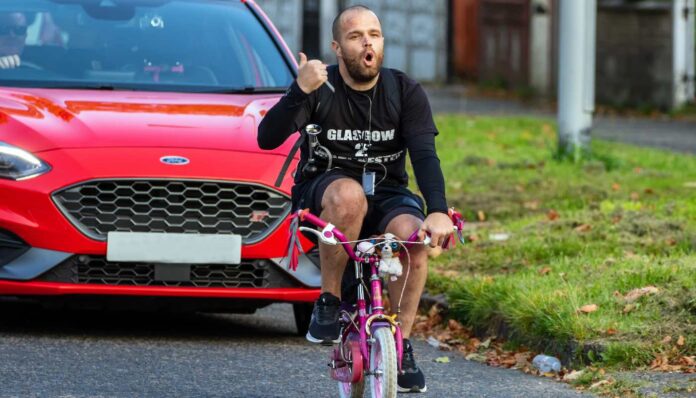
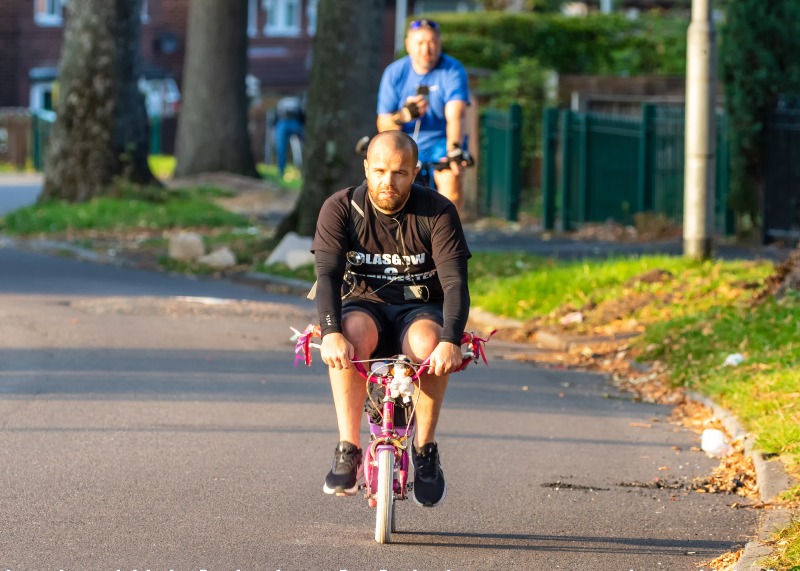
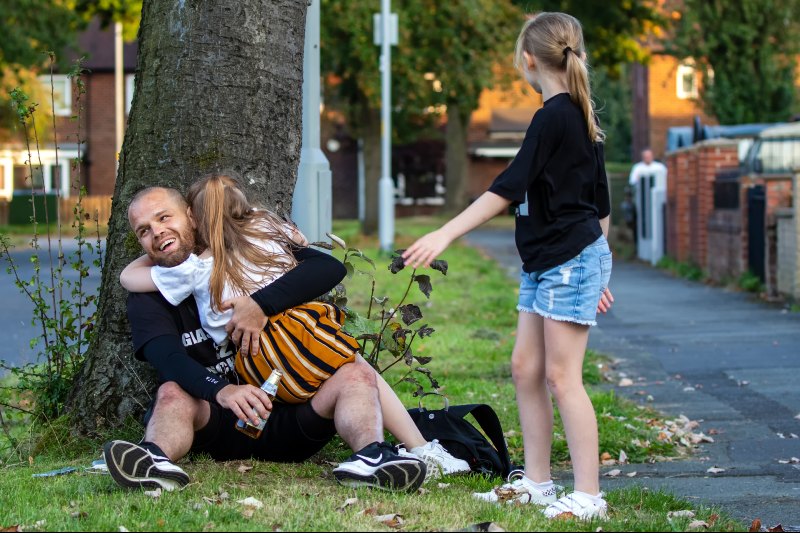
A determined dad has cycled a staggering 200 miles while riding his eight-year-old daughter’s tiny pink bike.
Over six days, Wesley Hamnett pedaled from Glasgow, Scotland to Manchester, England on a £20 ($26) bike with 12-inch wheels.
SWNS
The dad-of-two had wanted to raise funds for various charities and hospitals which were close to his heart after he lost his granddad to cancer last year.
He’d originally planned to cycle 1,250 miles from Russia to his home in Lancashire. But due to the pandemic, he was forced to backpedal and turn to the drawing board.
He decided he would cycle from Glasgow to Manchester while riding a comically small bike his two young daughters learned to ride on “as a laugh.”
After a grueling cycle which included a six-hour long stretch and eight busted tyres, the cargo handler managed to drag the 12-inch wheels to his home near Manchester on September 21.
SWNS
Wesley said, “I wasn’t sure if I was going to make it. Hell, I wasn’t sure if the bike was going to make it all the way. I felt like I was going to die during certain stretches, but it was all worth it.
He endured gruelling pain and reached peaks as high as 1,350 feet at the Shap Summit in Cumbria, England which he says—with some understatement—the bike “wasn’t built for”.
“I kept pushing because any time there’s an uphill climb, there must be a downhill climb… I felt like a little kid going down. I couldn’t stop if I tried. It was scary, but amazingly fun.”
“We’ve gotten so much incredible support on this journey and none of it would have been possible without the bike.”
Wesley is fundraising for Macmillan Cancer Support, Christie Charitable Fund, British Heart Foundation and Wythenshawe Hospitals MFT Charity.
He has raised just over £8,300 ($10,730) so far and still hopes to make the trek from Russia to Manchester next spring.
37-year-old Wesley says, “I want to thank everyone who has donated—they’ve been absolutely amazing. I feel so overwhelmed but it’s been a real blessing.” If you’d like to give to his fundraiser, you can head to the GoFundMe page here.
(WATCH Wesley’s footage from his pink bicycle in the SWNS video below.)
PEDAL The Good News To Your Friends By Sharing It To Social Media…
Last year, Tim Gjoraas, a veteran teacher of 22 years, was forced to face one of life’s hardest lessons when he was diagnosed with colon cancer.
This July, despite chemotherapy treatments, doctors told the 45-year-old father he had only a few months to live.
Tim Gjoraas
Gjoraas decided to spend what precious time he has left at home with his wife and three kids. After revealing the circumstances of his retirement from Washington High School on social media, the Sioux Falls, South Dakota community immediately rallied to his support.
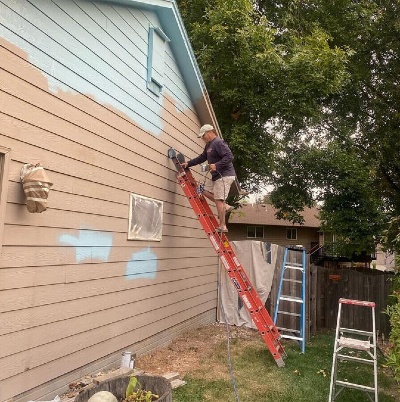
One thing Gjoraas was determined to take care of before time ran out was to make sure the family home got painted blue—a color his wife loves—even if he wasn’t there to do it himself.
Gjoraas turned to his friend Doug Rinken, a retired chemistry teacher, for help. “I just asked him if next summer, which I probably won’t be here for, if he can paint it for my wife,” Gjoraas told CNN.
Rinken did better than that.
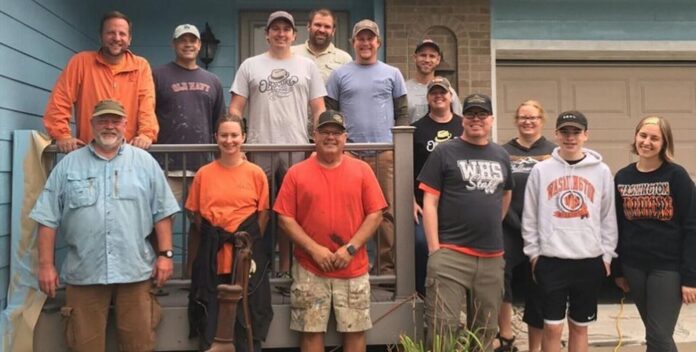
The following Saturday, a painting crew comprised of Gjoraas’ former coworkers arrived armed with donated brushes, sprayers, drop cloths, and paint.
Tim Gjoraas
“[Doug] told me he got quite a bit of help, but I didn’t know it was going to represent my whole career, people from all my years at Washington High,” Gjoraas told the Argus Leader.
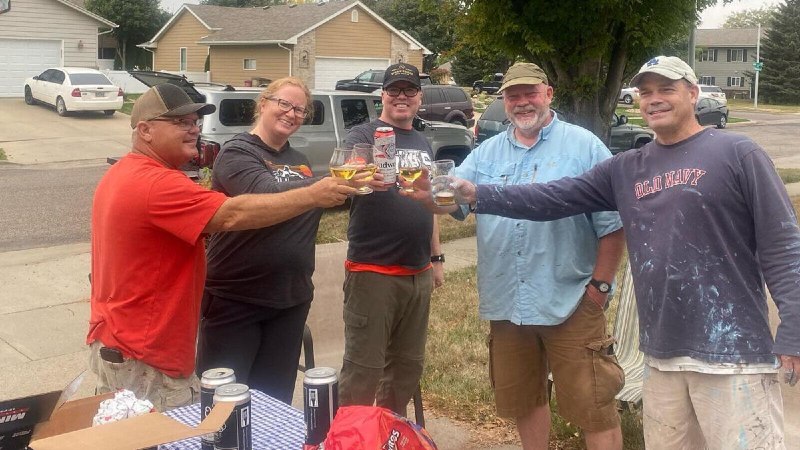
Five hours later, after the facade of the once brown house was light blue, everyone celebrated with an impromptu get-together in the family driveway.
As thrilled as Gjoraas was at having his wish fulfilled, he was equally happy for a chance to spend time with the colleagues he so missed and reminisce over a few well-earned beers.
Tim Gjoraas
“If you spend your life being a good person and hanging around good people, trying to make a positive impact on your community, if you need something, people show up,” Gjoraas reflected humbly. “It’s pretty amazing the outpouring of love my family’s had.”
Quote of the Day: “You call it procrastinating. I call it thinking.” – Aaron Sorkin
Photo: by Karl JK Hedin
With a new inspirational quote every day, atop the perfect photo—collected and archived on our Quote of the Day page—why not bookmark GNN.org for a daily uplift?
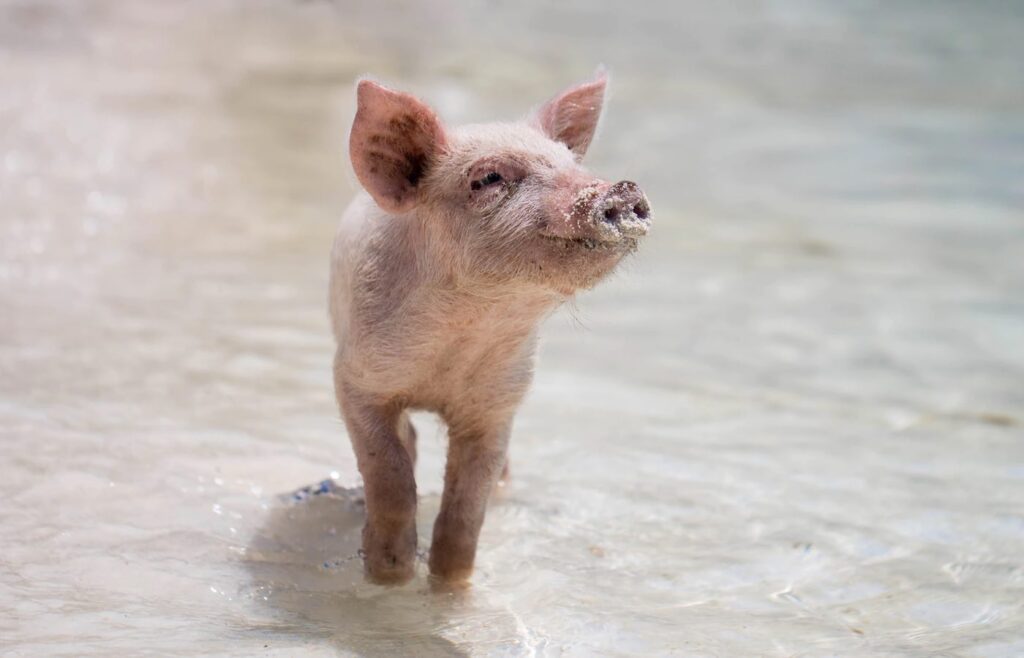
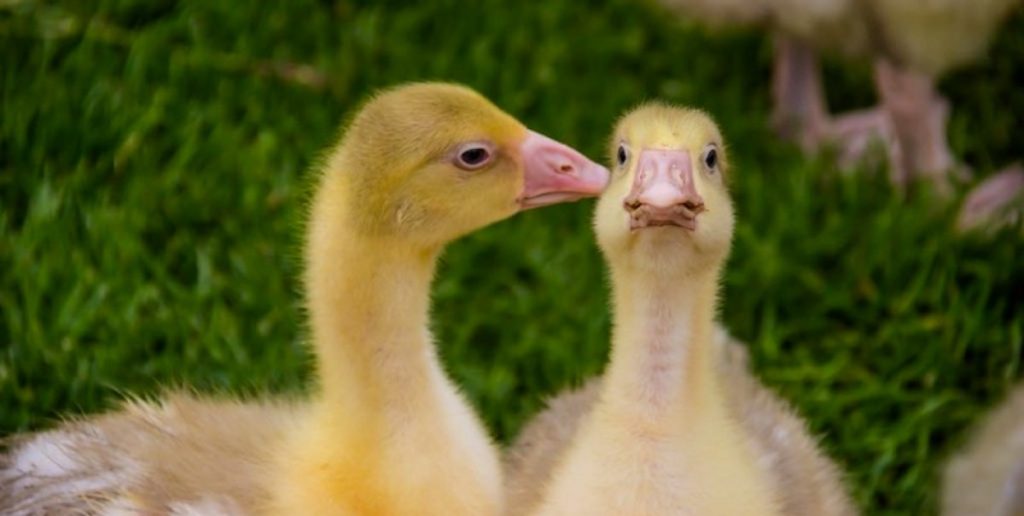
There may be a good reason for why we love to watch little piglets and fluffy ducks online.
Seeing adorable animals actually helps to reduce stress levels in humans, researchers at England’s University of Leeds have found.
Forest Simon
And we don’t need to see adorable critters in real life for them to have an impact on our sense of wellbeing.
Partnering with Tourism Western Australia, the University of Leeds explored the physiological and psychological impact of ‘cute’ animals on students and staff at the college.
According to a statement, 19 participants were asked to watch a 30-minute slide show that included images and short video clips of a range of animals, including Australia’s iconic marsupial the quokka.
15 of the 19 participants were due to take an exam 90 minutes after watching the slide show. The remaining four participants were academic support staff who had declared they were feeling stressed at work.
Infomastern, CC license
Heart rates for every single participant dropped after viewing images and videos of cute animals for just 30 minutes.
The average blood pressure (BP) across all participants also dropped: from 136/88 to 115/71—moving the group average to within the ideal blood pressure range.
Participants who watched the half-hour slideshow also had to answer 20 questions so researchers could assess stress levels under the State-Trait Anxiety Inventory.
In individual cases, anxiety levels dropped by almost 50%: proving viewing cute animals can be a powerful stress reliever and a mood enhancer.
In fact, across all measures there was a drop in anxiety and stress as a result of watching the short slide show.
So what’s best: images of cute animals, videos, or the real thing?
Dr. Andrea Utley, who led the study, commented, “It would appear that images appeal but video clips are more meaningful, and I would therefore expect that physical closeness [with animals] would be even better.”
There were meant to be eight sessions total, but because of the pandemic the remainder have been postponed. According to CNN, Utley is nevertheless looking at online options so the study can continue.
Microplastics emitted from vehicle tires as they wear down is a growing pollution problem. In fact, tire particles are the second-largest microplastic pollutant in our oceans.
Luckily, four students have come up with a solution to the issue—and it’s just been recognized as a national winner in the prestigious James Dyson Awards.
The Tyre Collective
Every time a vehicle brakes, accelerates, or turns a corner, the tires wear down and tiny particles become airborne—producing half a million tonnes of tire particles annually in Europe alone.
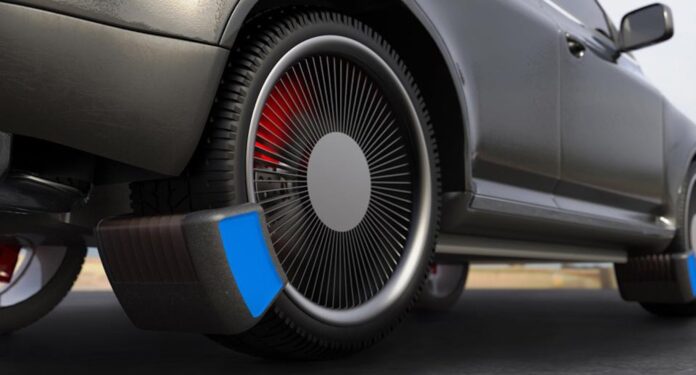
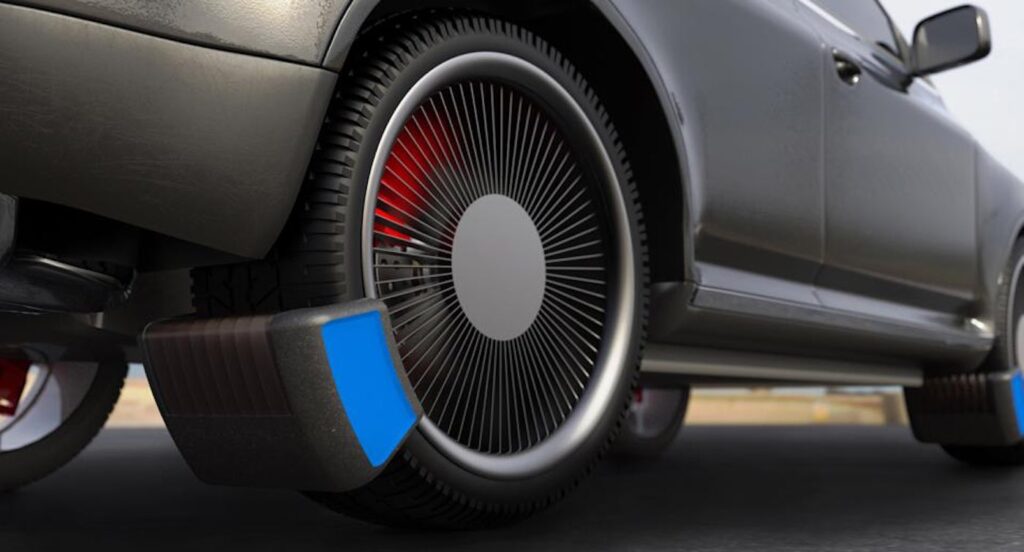
According to a statement from Imperial College London—where the students who founded the Tyre Collective study Innovation Design Engineering in a course offered jointly with Royal College of Art—the team’s winning device is fitted to the wheel of the vehicle and uses electrostatics to collect charged particles as they fly off the tire.
Based on results from their test rig, the group believes their prototype can collect 60% of all airborne particles from tires.
Once collected, the fragments can be reused in new tires, or even in other materials such as ink.
The team is made up of four students from around the world: They are Siobhan Anderson, Hanson Cheng, M Deepak Mallya, and Hugo Richardson.
“As a team, our strength lies in our diversity,” Hugo Richardson explained to the Guardian. “We come from all four corners of the globe and bring with us a wealth of knowledge in mechanical engineering, product design, architecture and biomechanics.”
While greater adoption of electric vehicles will help reduce exhaust emissions, tire dust will continue to contribute to air pollution. With wide-scale adoption of the Tyre Collective’s patent-pending technology, however, this problem can be much reduced.
The overall international winner of the James Dyson Award will be announced on October 17. We’ll be sure to share good news from the ceremony with you then.
(WATCH the video from the Tyre Collective below to see how their invention works.)
PASS The Innovation On And Share This Story With Your Pals…
The hills are alive with the sound of ‘Happy birthday’—and we hope Dame Julie Andrews has a Supercalifragilisticexpialidocious day!
2015 Photo by Eva Rinaldi, CC license
Andrews has appeared in 44 films and countless broadway shows, but it was her movie debut at age 21 in Mary Poppins that won her the Academy Award for Best Actress—and her role as Maria von Trapp in The Sound of Musicthat won our hearts.
She turns 85 years old today, and this year was set to be pretty special.
She was due to be honored this year with the prestigious AFI Life Achievement Award, but the April gala was postponed due to the pandemic.
It’s no wonder she was chosen for the honor. Her stellar singing, dancing, and acting have earned her awards in three of the big contests—Grammys, Emmys, and Oscars—and The Sound of Music, after remaining in theaters for over a year in 1965, is still the 6th highest-grossing movie of all time (when adjusted for inflation).
Here are eight more things you may not know about Julie Andrews…
1. She never finished high school—too busy performing vaudeville—and regrets never having gone to college.
2. She launch a new podcast calledJulie’s Library in which she and her daughter, Emma Walton Hamilton, host story times—reading their favorite children’s books during 18 episodes, so far.
3. She wasn’t exactly “G-rated” on the set of The Sound of Music—the wind in the Alps made her cuss like a sailor. A lot.
4. She once played a woman pretending to be a man pretending to be a woman in the movie Victor Victoria.
5. Her singing voice has never recovered since a 1997 surgery damaged her vocal cords. While she has performed a few musical numbers since then, she says it has all been “speech singing,” effectively talking with the music because she can only reach a few bass notes. (At the 2015 Academy Awards she joined Lady Gaga on stage and gave her a hug after the 50th anniversary tribute to The Sound of Music.)
7. She almost didn’t get the part of Maria in The Sound of Music, until Walt Disney stepped in. Director Robert Wise had heard of her, but not seen her on film, and while Andrews had just completed “Mary Poppins,” it hadn’t been released yet. Walt Disney generously sent Wise a clip of his movie — and it cinched the role for Andrews.
8. One of her biggest lifelong fans is Jon Stewart, who told her on the Daily Show he considers himself an “honorary Von Trapp.”
Walk with Julie down memory lane in this ABC interview from 2019.
SHARE The Birthday Wishes on Social Media… (Featured image by Eva Rinaldi, CC license)
When a stressed-out mom rolled up to a McDonald’s drive-thru to purchase a meal for her children, she realized with dismay on making her order that she’d left her purse at home. But the teenage server at the window didn’t send her away.
Wyatt Jones said he’d happily pay for the meal.
Brittany Reed was more than grateful. It had already been a long day at soccer practice with her 4- and 7-year-old.
Later that night, purse in tow, Brittany drove back to the McDonald’s to give Wyatt his money back. But the Waynesville, Ohio local insisted the meal was on him.
Brittany wrote in a Facebook post, “I just want his parents to know how KIND & COMPASSIONATE your son was tonight! He made this stressed out momma pause for a moment and realize this is exactly what we parents are trying to do, raise great humans,” she explained. “Wyatt, do not let this world change your kind heart young man for its people like YOU that will change this world for the better!”
Wyatt had shown Brittany such kindness. How to thank him even more?
On hearing that he was saving up to buy a car, Brittany began a GoFundMe campaign on his behalf. As of October 1, she’s raised nearly $32,000 for him. How’s that for a gratuity?
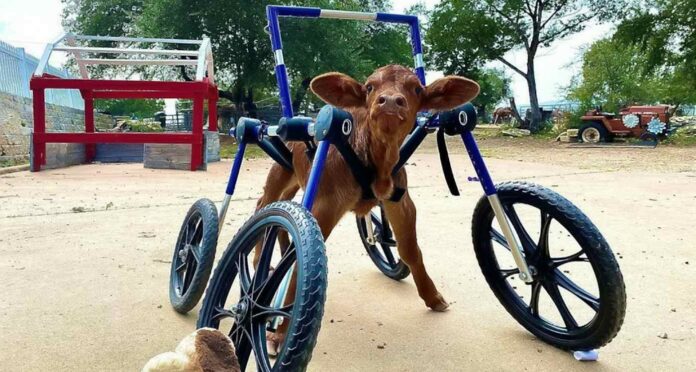
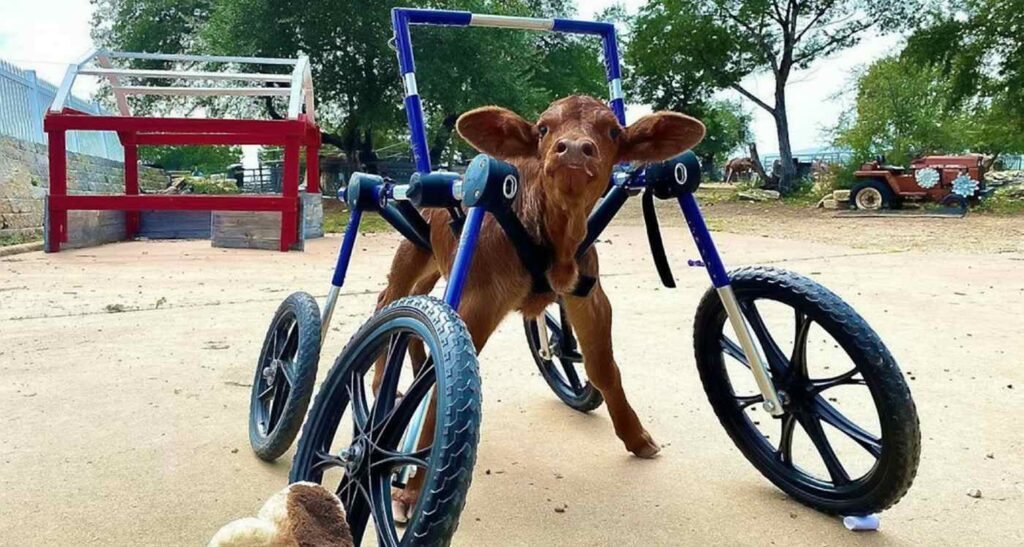
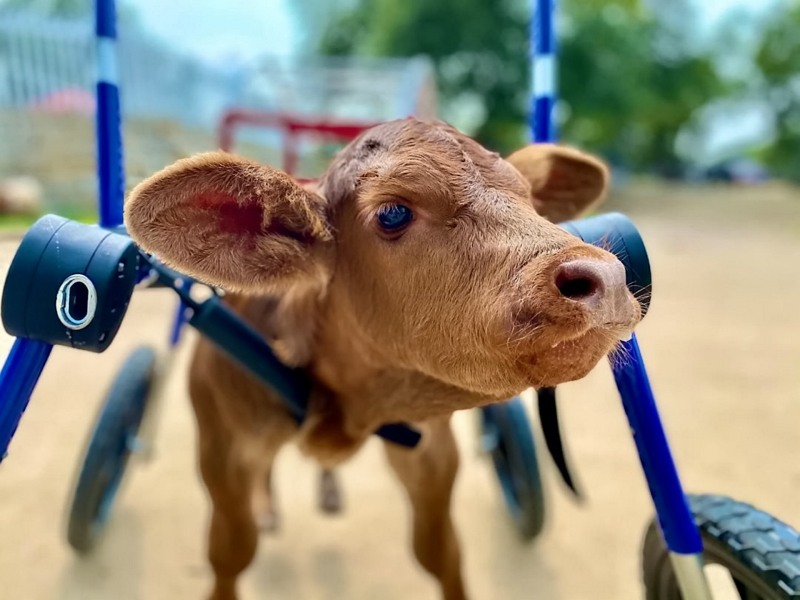
This adorable calf has been able to take her first steps, thanks to a custom-made wheelchair that was donated to her.
SWNS
Ruby Sue was born with her back legs fused together and would have been euthanized if it wasn’t for animal lovers at the ‘Safe in Austin Rescue’ ranch in Texas.
Vets discovered that despite her disability Ruby Sue was happy, healthy, and pain-free. She just needed something to help her walk.
That’s when experts at the pet mobility company Walkin’ Pets stepped in to save the day.
“With only her front legs to support her, Ruby was unable to stand or walk on her own” said Jennifer Pratt, Marketing Manager for the New Hampshire-based company.
The team at Walkin’ Pets decided to donate a custom-made chair to the two-week old calf, so she can run on the grass with her furry friends at the Safe in Austin Rescue.
“Because of these wheels, Ruby Sue is able to stand on her own, allowing her to get the exercise she needs to strengthen her front legs and learn how to walk for the very first time,” added Jennifer.
SWNS
For the last 20 years, Walkin’ Pets has been helping animals to walk, run, and play with their nifty inventions.
Each wheelchair is equipped with sturdy wheels and soft bands that support the pet—no matter what their size.
As the years have progressed, the company has expanded the capabilities of their wheelchairs to accommodate ducks, chickens, and even tortoises around the world.
Rear wheelchairs, which are built similarly to training-wheels, can range anywhere from $150 to $400 depending on the size of the animal.
Reps at the company say they’ve made a commitment to design wheelchairs that provide a high quality of life for every animal, regardless of whether it quacks, barks, or—in this case—moos.
MOO Your Approval Of This Good News And Share The Story With Your Friends…
A pelican named Percival learned something about the infertility game that many human couples go through—but this year he got some human help, and now he is the proudest pelican dad of all.
Twinnies Pelican and Seabird Rescue/Facebook
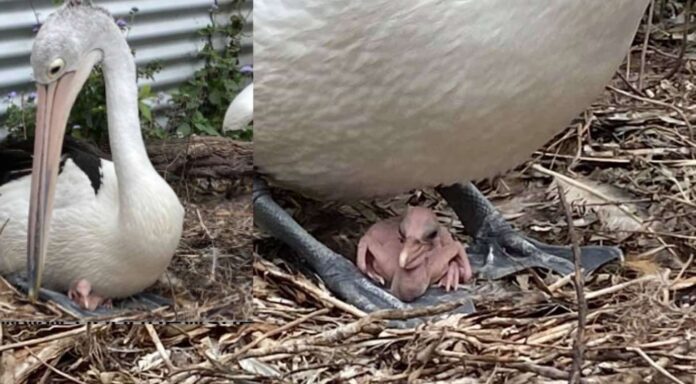
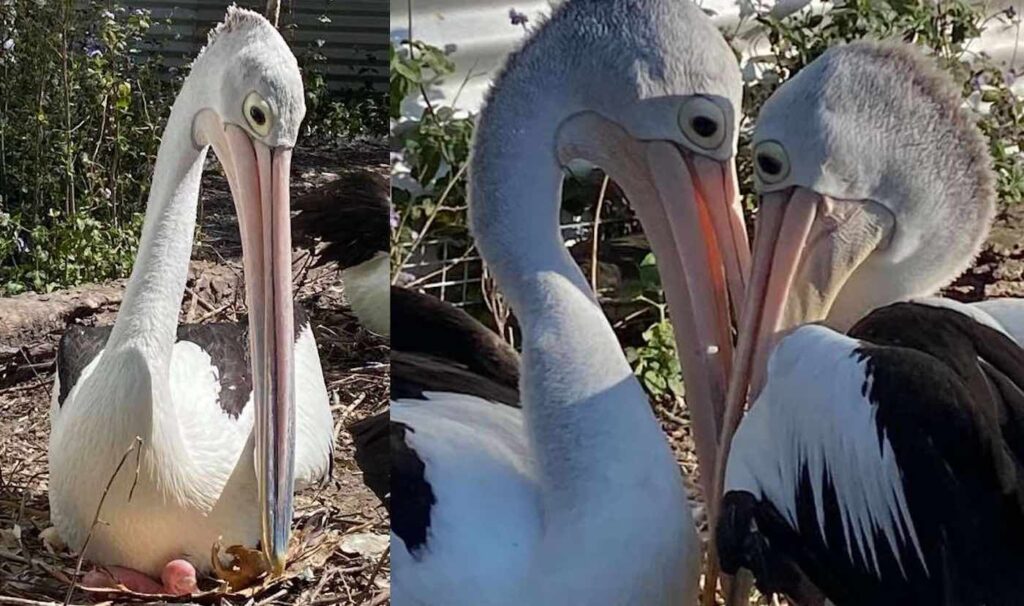
For six years, his licensed handlers watched as the bird faithfully nestled atop eggs in a bid to see them hatch. He and his mate would share egg-sitting duty—but they never got to see any chicks emerge. It looked like the couple was simply unable to produce any eggs that were fertile.
Percival would look on, year after year, as other pelicans proudly trundled their feathered broods near the Queensland, Australia sanctuary called Twinnies Pelican and Seabird Rescue. (The sanctuary’s owners, women who are twins, could almost hear him sigh.)
Unable to bear Mr. Percival’s distress for yet another mating season, they decided it was time to step in and help Mother Nature along.
Unbeknownst to Mr. and Mrs. P., they swapped a fertile egg from another nest into the one on which the pair so patiently sat in shifts, waiting for their little miracle.
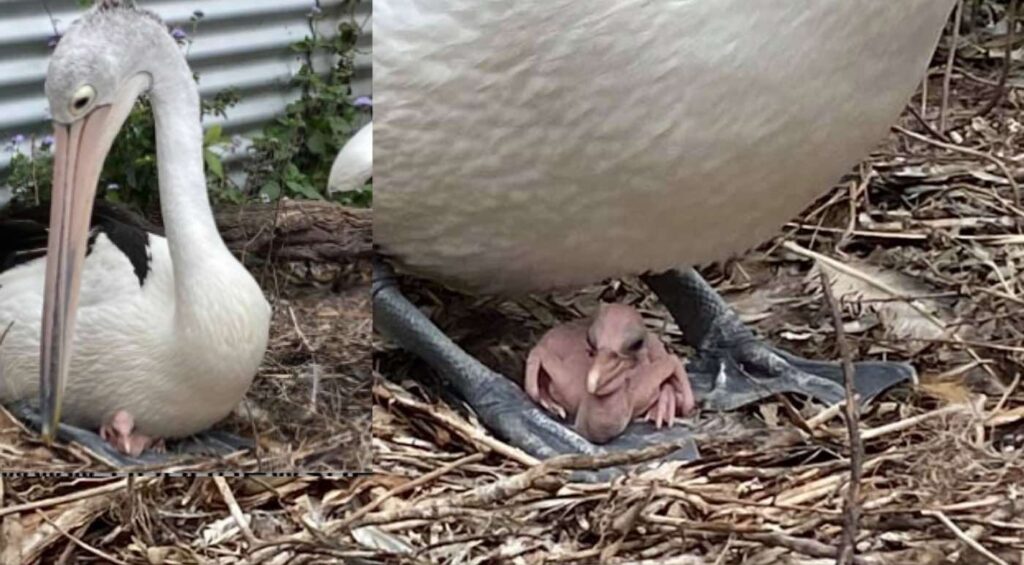
After that, all anyone could do was cross their fingers, hope for the best, and wait. To everyone’s joy, the adopted egg hatched right on schedule.
An ‘eggstatic’ post to the Twinnies’ Facebook page proclaimed, “We are so proud of him, as we can see the baby pelican chick is growing beautifully.”
Twinnies Pelican and Seabird Rescue/Facebook
Finally, ‘just one of the dads’, Percival has taken up the task of feeding and raising his offspring with nothing less than total commitment.
The same quality can be attributed to Percival that Dr. Seuss wrote into his story about a determined pachyderm named Horton: “I meant what I said and I said what I meant. A pelican’s faithful one-hundred percent!”
The economic impact of the bushfires and then the COVID-19 pandemic has meant tough times for the whole country, but especially Twinnies bird sanctuary, a 24-hour rescue and rehabilitation center for sick, injured, and orphaned pelicans, seabirds, and native birds located in Landsborough.
If you’d like to help keep the pelicans and other native seabirds in fine feather, please help out by making a donation here.
SHARE The Happy News With Your Pals On Social Media…
Quote of the Day: “There is something in October sets the gypsy blood astir: We must rise and follow her, when from every hill of flame she calls, and calls each vagabond by name.” – William Bliss
Photo: by Rula Sibai
With a new inspirational quote every day, atop the perfect photo—collected and archived on our Quote of the Day page—why not bookmark GNN.org for a daily uplift?
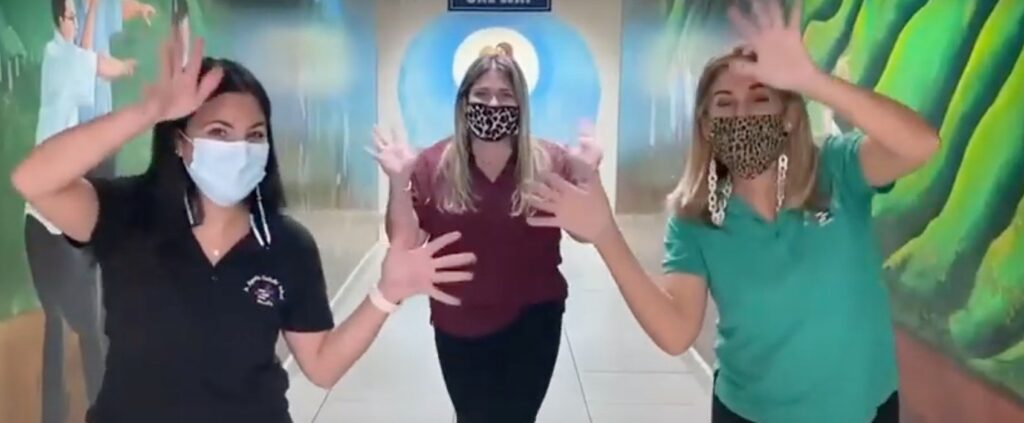
Teachers saying hello by dancing and singing to the Jackson 5? The kids at at one Miami school have received just such a welcome this fall.
St. Agatha Catholic School
After seven months of virtual teaching, the faculty at Florida’s St. Agatha Catholic School wanted to greet their students back to school in the warmest way possible. So they created a fun video for all their pupils.
“Our middle school teachers were the ones that first came up with the idea,” Dr. Diana Gonzalez-Eastep, the school’s counseling psychologist, told GNN. “They wanted to select a song that was happy with a great beat.”
Literature teacher Mrs. Marisa Quesada suggested the Jackson 5 song, and the theme of “We Want You Back” was born.
The 1969 smash hit has been updated by the teachers for 2020, with lyrics like “Oh baby, give me one more chance (To show you that I love you)” being replaced with “Oh students time to grab your masks (And your sanitizer).”
As St. Agatha is a Catholic school, there are some faith-based lyrics thrown into the latter part of the song too.
The performance is sure to bring you a smile in these trying times, just as it did for the school’s students—and watch for the mascot that gets involved in the dancing, too.
(WATCH the video below and get ready to tap those toes.)
PASS ON The Good Vibes And Share This Story With Your Friends…
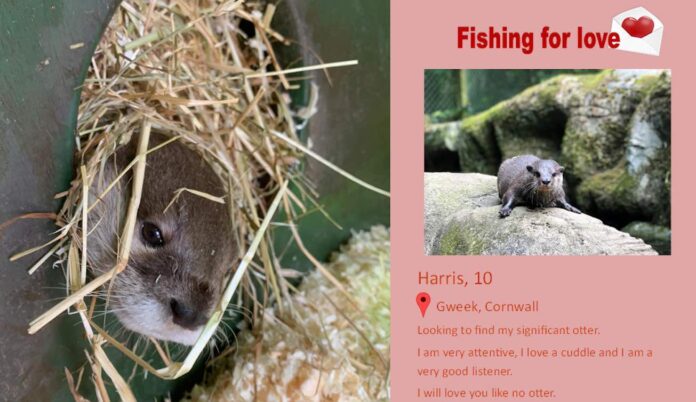
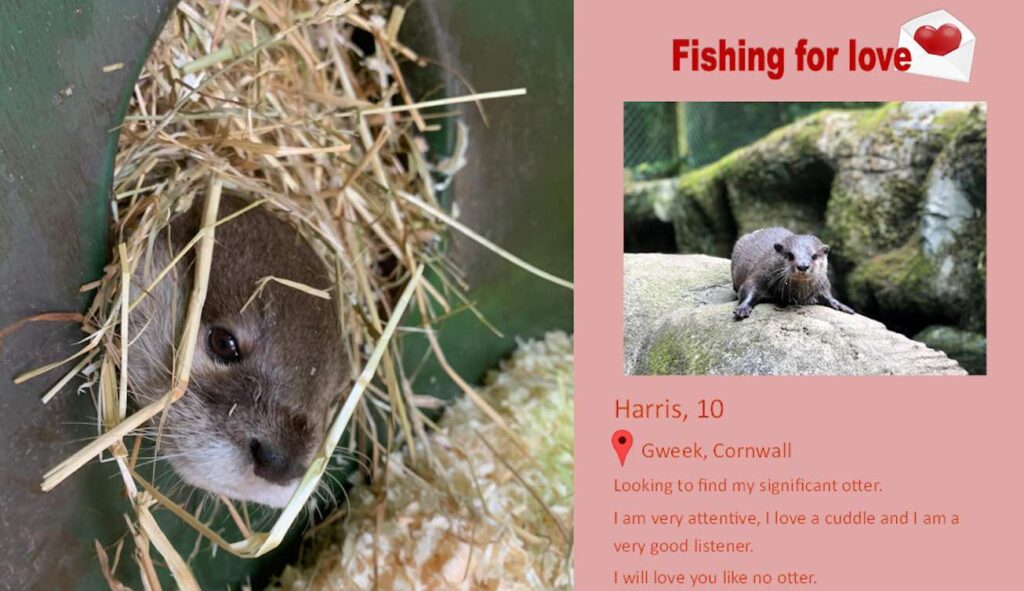
A lonely otter has found love after being set up with a Tinder-style dating profile.
SWNS
Asian short clawed otter Harris had been left single after his partner of four years Apricot recently passed away.
His keepers desperately wanted to find him a new partner, so they set him up on “Fishing for Love,” a website created just for him.
Staff at Cornish Seal Sanctuary made the dating profile for Harris, highlighting all he has to offer and sent it out in the hope of finding his new perfect match.
The team were delighted to receive photos back from a female otter called Pumpkin who was also looking for love at Scarborough SEA LIFE after recently losing her elderly partner Eric.
The ‘first date’ has now been arranged, but the matchmakers said the introduction of Asian short-clawed otters can be nerve-racking and difficult to get right.
SWNS
Experts say to ensure the best chance of a new pairing getting off on the right foot, it’s best to introduce a new male into a female’s territory so that the male more easily submits to the female on first meeting.
For this reason, Harris will be moving up to Pumpkin’s enclosure to ensure it goes as smoothly as possible.
Tamara Cooper, curator at the Cornish Seal Sanctuary said “Harris came to us from the Welsh Mountain Zoo in 2016 after being rejected by his family.
“There was certainly something about Harris that ticked all the boxes for our female otter Apricot, and after a few days of careful introductions they settled in beautifully together.
Fabric cuttings and textile leftovers are a difficult class of waste to recycle, but in a fashion industry first—a door-to-door New York City recycling service meant exclusively for textile waste is helping the uglier side of fashion get a green makeover.
Fabscrap runs an internet store and a physical location that’s part second-hand shop, part recycling facility based around fashion industry waste collected from top brands like J. Crew, Nautica, and Macy’s.
Jessica Schreiber, the founder of Fabscrap, discovered while working at New York City’s Bureau of Recycling and Sustainability that many of the city’s iconic fashion industry names were ringing her office asking what to do with textile waste.
Being that NYC law requires the recycling of any material if it amounts to more than 10% commercial waste, she realized the problem represented an unfulfilled niche that would make a great business model.
She pitched her idea to “Project Runway: Fashion Startup” and was awarded seed money for her vision of a company that would pick up textile waste from fashion houses and find ways to reuse or recycle it.
Accumulating 20 clients in her first year, Schreiber now manages the waste of 434 different brands, and her work has seen 600,000 pounds of textiles and fabric spared from entering New York City’s landfill network, with each pound saved representing around 2.06 pounds of CO2.
A volunteer effort
The cutting room floor of a fashion brand’s studios is a messy place, and the bags of waste Fabscrap collects weekly must be sorted by hand. In the past year alone, 2,017 volunteers have helped out at the warehouse.
Separating the textiles by fiber—from cotton to wool and more, the people at Fabscrap will weigh and document each bag. The organization sells the fabric by the pound on their website and out of their retail headquarters in Brooklyn, and ships the unsellable waste to be recycled and turned into stuffing for furniture, or insulation for things like moving blankets.
According to the Environmental Protection Agency, textile and fabric represents 5% of total landfill space, while a life-cycle analysis found that fabrics for all purposes account for 10% of global greenhouse gas emissions— most of which is methane, a GHG that is 28 times more powerful than CO2.
Furthermore, the dyes and other chemicals used to treat clothing can contaminate groundwater sources.
New York City has very progressive recycling laws on the books for fabric and textiles. However, these laws are difficult to track or enforce since private companies haul away trash, and the waste of buildings tends to get mixed together.
For fashion brands that value sustainability over other corporate goals, Fabscrap represents the ultimate partner, and Schreiber has made several close connections with brands focused on reducing waste.
Schreiber hopes to expand to other cities and countries, notably Los Angeles, the center of the country’s largest cut-and-sew manufacturing facilities.
“I think opening in LA gives us a really good blueprint for how we might be able to franchise this to other major cities,” Schreiber said in an interview with the Sierra Club.
Stressful times call for stressless measures, and one of the most important ways to improve your ability to resist stress and anxiety is to get a good night’s sleep.
However, in our 24-hour, interconnected world, sleep is an illusive necessity that’s often the first thing to be sacrificed in a busy schedule. A reduction of regular sleeping hours has been linked with everything from Alzheimer’s to younger mortality rates.
Furthermore, with the presence of the coronavirus, it’s worth noting the results of two studies: the first finding that a night of sleep lasting less than 7 hours resulted in 70% fewer immune cells being produced the following day, and the second finding that a person sleeping less than 6 hours is four times more susceptible to the flu.
Fortunately, polysomnography sleep studies can offer us science-backed insights into better habits to improve the quality, if not the quantity, of the sleep we do manage to get.
According to renowned English sleep expert Dr. Matthew Walker, author of “Why We Sleep: Unlocking the Power of Sleep and Dreams,” every living thing on Earth is attached in some way to the day-night cycle, and spends at least part of the day in something resembling sleep.
He reminds us of our evolution, and that if sleep was not an absolutely necessary trait in animals, it would strongly be selected against during natural selection: as sleeping animals cannot reproduce, search for food, or protect themselves from predators.
Indeed, time spent sleeping proved to be more valuable—for all cellular life, than these three most critical activities which it could have otherwise been engaged in.
Here are 10 good habits, tips and tricks, and scientific findings to help you sleep better tonight, and in all the nights to come.
1) Keep your room like outer space: cold and dark
The Mayo Clinic, along with the CDC and others, suggest creating a cold, dark sleeping environment (around 60-67 Fahrenheit).
This has to do with our history as hunter gatherers, who were exposed to the elements and the day/night cycle. Drops in temperature and light perception signals to our brain that the hour of sleep is nigh, and a bedroom that reflects those changes is typically ideal.
2) Clean up your room
All kinds of strange things can affect sleep performance, including serious clutter. A study from the American Academy of Sleep Medicine found that people at risk of hoarding disorder scored significantly higher on several categories in two different academic scales meant to measure sleep performance.
What you see before you go to sleep could potentially be preventing you from entering the deepest reaches of sleep cycles, thereby withholding the most powerful restorative effects.
3) Avoid blue light
Brooke Cagle
Most devices, including smartphones, tablets, and computers come with built in blue-light filters, and those that don’t will have access to the internet or an app store where you can download a filter.
Blue light is the prominent spectrum present in daylight, while the red or orange light spectrum is the one experienced during the setting of the sun. Most of us are able to stay up far later because cool-white, blue-spectrum rays from our indoor lighting tricks our brains into thinking it’s still the day.
Therefore, put orange light filters on your devices so you correctly begin to feel the effects of melatonin secretion in response to the perception of the red light spectrum.
4) Find your extra-special mattress
One of the most significant technological advances in the last two decades has been in mattress technology. In our parents’ time, you had to wait until a public holiday to get a good deal and avoid paying $2,000 for a queen size mattress.
Now, you can go on Amazon and use their buying guide—which helps you find mattress of different firmnesses, made for back, side, and stomach sleepers—and it will be sent rolled up in a box to your house for less than $400.
Daylight exposure, physical exercise, and a day totally void of naps will all take you a little bit further towards a good night of sleep, and a simple Google Scholar search can reveal studies examining these activities and their consequences — especially sunlight exposure, in every aspect of circadian biology.
6) Take note of your coffee consumption
Gaelle Marcel
The biological half-life of a molecule of caffeine is between 3-7 hours, after which it has another half-life to burn before the psychoactive effects are finally finished.
Caffeine, normally consumed in coffee, has many health benefits. However, most sleep experts would recommend calling it curtains on coffee consumption by noon: that way very little of the caffeine molecules are left in your bloodstream by the time you lay down to sleep.
One cup of coffee in the evening is enough to disrupt sleep by 20%, according to Dr. Matthew Walker.
7) Stick to a sleep schedule
Another of the CDC and Mayo Clinic’s suggestions for sleep quality is to try and stick to a schedule, going to bed and waking up at the same time every day.
Obviously this can be difficult, especially on the weekends, but it’s a very powerful acclimatizer for the brain’s sleep hardware.
The popular mediation and mental wellness app Headspace adds this to the list of things that can disrupt sleep: checking emails before bed.
They note a study done at Virginia Tech from 2018 which found that the mere expectation of checking work email after hours can cause anxiety and stress, not to mention expose your eyes to the blue light of your tablet, phone, or computer screen.
9) Make your bedroom the most quiet room in the house
Lillie Kate, CC license
Returning to Dr. Walker’s commentaries on sleep, the Englishman notes in a radio interview that a study found the brain can detect noise while sleeping, which rather than causing us to wake up, can actually cause it to lift itself out of the deeper, more restorative cycles of sleep, and into shallower, less-restorative ones.
The host, Rhonda Patrick Ph.D., suggests that street noise, such as cars honking or doors slamming, could be enough to cause this shift, however the study mentioned was done only with ambient tones in a sleep laboratory.
If you sometimes wake up feeling weak and disoriented, and the windows of your bedroom face the street you live on, try relocating to a different room to prevent yourself from being partially woken in the night. Ear plugs may also help.
Walker concluded the same radio interview by suggesting Ambien and other sleep aids are not sleeping pills, but sedatives. As such, they don’t place the brain in the same level of restorative sleep as natural sleep does.
If you feel you need help, there are several natural chemicals you can try, these include melatonin, aka “the Sleep Hormone,” or tryptophan, one of the essential amino acids—it’s a primary precursor to melatonin production.
One can also acquire tryptophan from their diet. As an amino acid it is most abundantly found in meat, but bananas, nuts, and seeds are also sources of tryptophan.
Don’t Snooze! Share These Handy Sleeping Tips With Your Friends…
Quote of the Day: “The leaves are changing; I feel poetry in the air.” – Laura Jaworski
Photo: by Stephen Ellis
With a new inspirational quote every day, atop the perfect photo—collected and archived on our Quote of the Day page—why not bookmark GNN.org for a daily uplift?
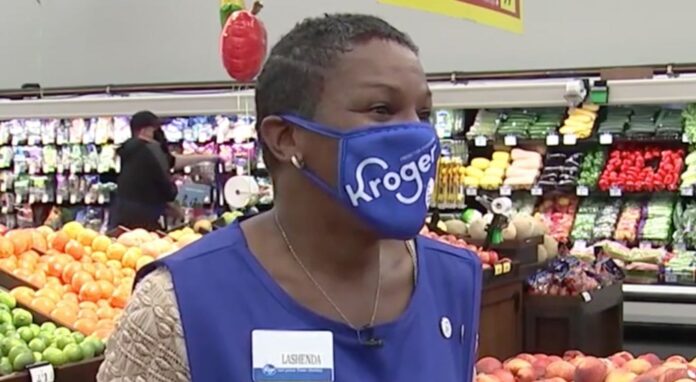
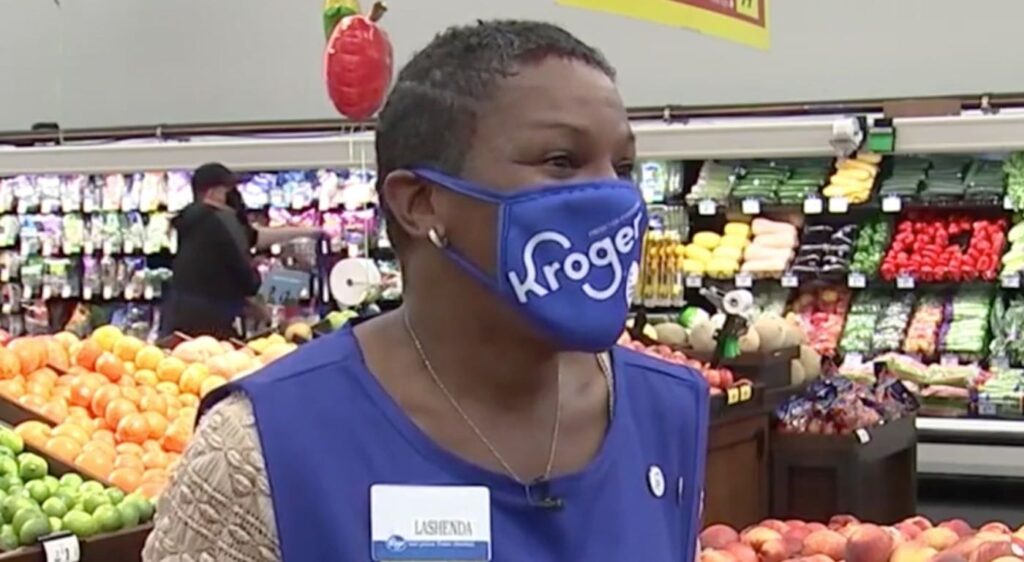
Not that long ago, LaShenda Williams was living in her car and wondering where her next meal was coming from. Raised in the foster care system, Williams never had a stable home life.
WKRN-TV
“I spent my life moving from foster care to foster care, dealing with child abuse and things like that,” Williams told CNN. “In the end, nobody wanted me, and I stayed in the system until my senior year [of high school].”
In addition to the abuse she suffered in foster care, Williams was hampered by a learning disability that made finding jobs more difficult. But even so, she never stopped trying.
Whether it was luck or fate that led her to the parking lot of an East Nashville, Tennessee Kroger grocery store, Williams’ life was about to change for the better.
By day, she became a store regular, striking up conversations and making friends, even when she couldn’t afford to buy food. At night, she’d move her car to a new location, hoping that the staff wouldn’t realize she was living in the parking lot.
When associate store manager Jackie Vandal heard Williams mention her goal of working at the store one day, she told her about an upcoming job fair.
Impressed by Williams’ can-do, upbeat people skills, Vandal made sure she made the cut from candidate to new hire, helping Williams with her application and even tweaking her résumé.
It only took Williams a month to get her first promotion, from part-time cashier to full-time checkout associate. Soon after, she was able to afford a new place to live. As it turned out, it was the very first apartment she’d ever had with her name on the lease.
When Kroger customer V.L. Williams (no relation) learned his favorite sales associate was getting her first place but didn’t have anything to furnish it with, he looked to social media for help. “She is always trying to help someone always trying to be a light in a world that may seem very dark,” V.L. told WZTV Nashville.
His post to the East Nashville Facebook group got more than 200 responses. Furniture, small appliances, and just about anything you’d need to furnish a home started pouring in.
“You don’t know how good this feels. I’ve been through a lot. Thank you… this means the world to me,” an emotional Williams told her benefactors.
Thanks to the life-altering chain of events that started in a Kroger parking lot, Williams now considers her co-workers and her customers—whom she calls “her babies”—to be her true family.
“When I was hungry, they fed me. When I needed a pair of gloves, they gave them to me. These workers that I work with, they are my family,” she told Good Morning America.
The feeling is more than mutual, with manager Jackie saying, “I wish we had 120 of her!”
With her indomitable spirit, welcoming attitude, and warm as sunshine energy, happily for Williams, sometimes what goes around really does come around—and nowhere has it been more well-deserved.
(WATCH LaShenda Williams’ uplifting story on Nashville’s WKRN-TV.)
PASS On The Good News And Share This Story With Friends…
Nearly six in 10 Americans have a new appreciation of nature during quarantine, according to a new survey.
The poll asked 2,000 Americans about how they’re keeping their moods up in light of social-distancing measures.
58% of respondents shared they didn’t appreciate nature as much as they should have before the COVID-19 pandemic.
Conducted by OnePoll on behalf of the Recreational Boating & Fishing Foundation and their Get on Board campaign, the survey showed three-quarters of respondents are starting to feel a boost in their moods thanks to spending more time outdoors—with 66% sharing they’re doing more outdoor activities close to home.
Six in 10 shared they’ve been able to finally take the time to explore their local communities, with local parks, trails, and lakes topping the list of new-found areas.
A time to bond
Robert Pearce
Just over half of respondents have also gone fishing during their time in quarantine, and 27% have specifically done so to boost their mental health. That this activity can be done while adhering to social distancing guidelines is also a boon for many. A quarter of those who go out with a rod also said a perk of the activity is the bond they can share with their loved ones.
With a plethora of options for outdoor activities, nearly four in 10 respondents have actually become more physically active during their time in quarantine. In fact, 32% of respondents are participating in more outdoor activities than ever.
One of the joys of this newfound appreciation of nature? It brings many people right back to happy childhood memories of being out in the open air with family.
It looks like few want to stop with their nature-based activities anytime soon: 69% of respondents are planning to incorporate more outdoor activities into their lifestyle even after the COVID-19 pandemic subsides.
“We can all use a little mood boost these days,” said Stephanie Vatalaro, RBFF’s Senior Vice President of Marketing and Communications. “The outdoors has lots of activities to pick from, so there’s something for everyone.”
TOP OUTDOOR ACTIVITIES THAT BRING AMERICANS’ BACK TO CHILDHOOD
Fishing – 37%
Camping – 34%
Going to the beach – 31%
Going to a lake – 31%
Outdoor cycling – 28%
Running – 24%
Going to a river – 23%
Boating – 23%
Flying a kite – 23%
Hiking – 22%
Gardening – 21%
Bird watching – 17%
Outdoor rock climbing – 11%
Kayaking – 10%
SHARE The Results With Others Who Love To Be Out In The Fresh Air…
The construction of an electric road will make Tel Aviv the first city worldwide to institute the large-scale rollout of a technology that can charge vehicles as they drive.
Guy Yechiely
Tel Aviv-Yafo Municipality, in partnership with ElectReon and Dan Bus Company, has launched a pilot to install wireless electric roads for charging public transportation in the city.
The project will be carried out between Tel Aviv University Railway Station and Klatzkin Terminal in Ramat Aviv—a two-kilometer route including 600 meters of electric road.
According to a statement, the project will enable specially equipped electric buses, capable of being charged directly from under-road electric infrastructure, to travel on the route.
This means the buses won’t need expensive, heavy batteries. They won’t need to go to charging or gas stations. When traveling along the necessary infrastructure, they’ll actually have unlimited journey times.
Tel Aviv-Yafo Municipality
Following the completion of tests and integration of the technology, a Dan Bus Company electric bus will commence regular journeys on the route, serving passengers traveling to Tel Aviv University.
From there, the city will evaluate the possibility of additional electric transportation: including distribution trucks and private and autonomous vehicles.
The execution of the pilot project forms part of a wider municipal policy that attaches great importance to electric vehicles and reducing air pollution in the city.
The electric roads will also aid municipal efforts to reduce noise pollution in order to improve quality of life for residents and visitors to the city.
Meital Lehavi, Deputy Mayor for Transportation at Tel Aviv-Yafo Municipality, said, “We have no doubt that, if the wide-scale experiment is successful, it will not only benefit the public, but also save resources, improve the operational efficiency of public transportation, and maybe even a new world-class method of electrification will emanate from Tel Aviv-Yafo.”
TAKE This News To The Road And Share It With Your Pals On Social Media…
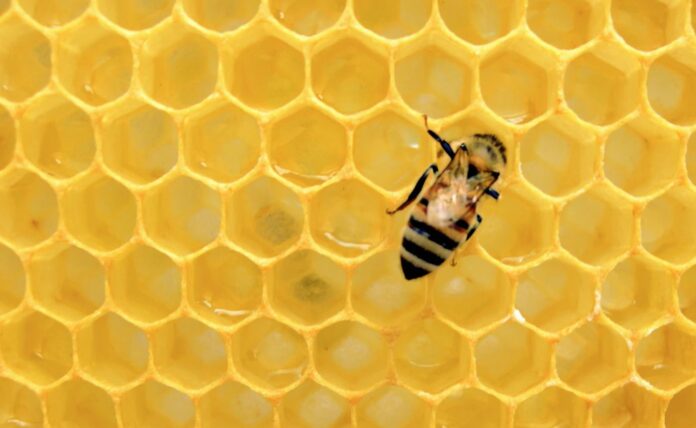
It’s not often you hear good news about the health and prosperity of bee colonies in the United States or globally for that matter, but recent data collections released by the U.S. Department of Agriculture show that some states are experiencing growths in colony numbers of 70% or more.
Matthew T Rader
Not only was there a 14% increase in the number of honey bee colonies from the period of January 2019 to January 2020, but the states experiencing the broadest increase in colony growth—Michigan, Nebraska, Oklahoma, and Maine—added tens of thousands of colonies.
Maine, the number one state for thriving bees, grew colony numbers by 73% since 2018, while Michigan also saw a 50% increase over the same period.
Between January and June 2020, Texas saw its bee population grow by 38%; between 2018-2019, it added almost 100,000 colonies, roughly totaling another 33% overall increase.
Indeed, in the first half of 2020, the United States as a whole added roughly 420,000 more colonies to its bee populations than were lost.
The New York Bee Sanctuary offers gardening and landscape practices to maintain nearby bee populations, as pollen and nectar from flowers are an important source of food for bees who could be out foraging and in need of energy.
Good News Network also describes in this article how there are plants—dandelions for instance—that are often treated as weeds but which also offer bees important nectar and pollen supplies. Time to start thinking about next spring’s planting?
BUZZ The Good Bee News Over To Your Friends On Social Media…
A California company is employing ocean microorganisms to convert methane into physical material in order to make a line of single-use straws and cutlery.
Newlight/Restore Foodware
Newlight hopes their revolutionary technology, which Popular Science called “the most important innovation of the year,” will go a long way in removing the burden of single-use plastic straws and other takeaway food components from the ocean.
The manner in which the material, that Newlight calls “Air Carbon,” is made, comes straight from the example of nature—taking in a greenhouse gas is something co-founder and CEO Mark Herrema notes happens every day in the form of photosynthesis in plants. Since 2003, the company has been wondering if it were possible to harness that action.
Underwater, however, microorganisms don’t merely dine on CO2, but more powerful greenhouse gases like methane as well.
Harvesting methane from an abandoned mine in California, engineers at Newlight add the gas to a tank containing 15,000 gallons of seawater and millions of microbes.
The microbes consumed the methane and turned it into a meltable energy source inside themselves, which Newlight promptly extracted and dried into a fine white powder that’s dishwasher-safe, carbon-negative, and ocean-degradable.
Form and Function
Newlight has been able to generate a line of hyper-sustainable products; the aforementioned flatware and straws, but also fashion products.
Covalent makes a line of wallets and sunglasses out of the same Air Carbon material, neutralizing the greenhouse gases associated with the production of leather and synthetic materials with the special carbon-negative ocean-born material, eliminating greenhouse gasses in every stage of the value chain.
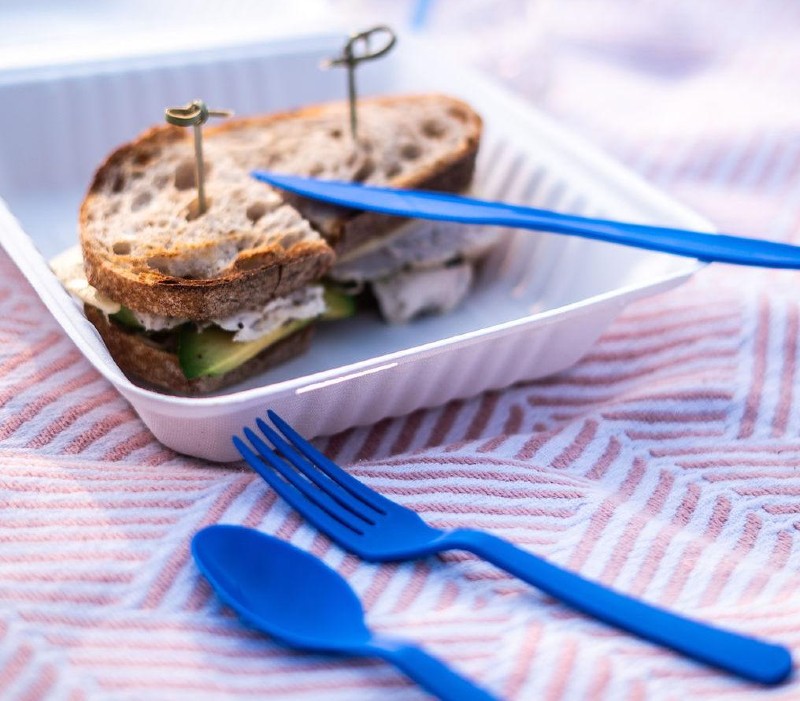
Meanwhile, Restore Foodware, dissolves in seawater like cellulose, which actually provides food to everything from microorganisms to fish.
Their line of cocktail and jumbo straws along with takeaway flatware won Technology Pioneer Award from the World Economic Forum.
The cutlery and fashion items are available for pre-order—with shipping estimated to begin by October 30 as production ramps up at a new facility in Southern California.
The people at Newlight feel that the unique way in which Air Carbon is made infuses a bit of the earth and humanity into our day-to-day lives, and can represent the circular economy in a meaningful way.
The methane born of human productivity goes to feed nature’s microbes that create a product which we can then use in our homes again; the cycle concludes after it returns to the ocean, whose waters it and ourselves also emerged from, to breakdown and feed the life which produces the material once again.
INFLUENCE Your Friends to See Eco-Friendly Items Anew – SHARE On Social Media…