Quote of the Day: “There is no love that is not an echo.” – Theodor Adorno
Photo by: Getty Images for Unsplash+
With a new inspirational quote every day, atop the perfect photo—collected and archived on our Quote of the Day page—why not bookmark GNN.org for a daily uplift?
60 years ago today, Singapore became the first country ever to gain independence unwillingly, after it was expelled from Malaysia. Affirmative action policies that granted privileges to Malays over other ethnic minorities caused significant unrest after a merger with Sabah, Sarawak, Malaysia, and Singapore. Two years later, the Malaysian Prime Minister Tunku Abdul Rahman decided to expel Singapore from the federation. The Parliament of Malaysia voted 126–0, with all Singaporean MPs boycotting the vote, in favor of the expulsion on 9 August 1965. READ the miracle that happened next… (1965)
An illustration of Demosthenes of Athens and a photograph of King George VI, both of whom had stutters
An illustration of Demosthenes of Athens and a photograph of King George VI, both of whom had stutters
A genetic analysis of a million individuals with stutters has clued Australian researchers into a potential genetic component that would revolutionize the diagnosis and treatment of this common disorder.
400 million people worldwide have stutters, and a cross-Pacific partnership between Curtin Stuttering Treatment Clinic in Western Australia a Wayne State University in Detroit, Michigan, identified 48 genes that show a hereditary link.
Scientists will almost always feel that pause will give pride, yet the authors heralded their work as “groundbreaking” and something that will help pave the way towards pre-verbal diagnosis of stuttering.
Stutters tend to emerge shortly after a child becomes verbal, but the longer a stutter is in the child’s speech motor system, one of the study authors said, the more of a habit it becomes.
“[The study finding] means those particular young people will be offered early intervention straight away hopefully, and in doing that we can curtail what can be otherwise a lifelong disability,” said Associate Professor at the Curtin Clinic, Janet Beilby, told ABC News Australia.
“We found consistent DNA results, 48 of them, and in addition to that we found 57 [genomic] hot spots so it’s very exciting because with these hot spots we can dig further,” she added.
Stuttering, or stammering as it’s called in British English, has afflicted hundreds of notable people over the years, from public figures like Demosthenes of Classical Athens and King George VI of the UK, to entertainers like Bill Withers and Hugh Grant.
It can be corrected through speech therapy, and the earlier such therapy starts the better are the outcomes it produces. Beilby et al’s research will go along way toward reducing the impact of stuttering on the self-esteems of the next generation.
SHARE This Breakthrough Research With Your Friends…
credit (left) Unsplash (right) Brian Johnson, from ACDC - credit Matt Becker, CC 3.0. BY-SA
credit (left) Unsplash (right) Brian Johnson, from ACDC – credit Matt Becker, CC 3.0. BY-SA
From Wyoming and Oregon comes a story most bizarre: Scarlett Johansson’s voice being used to frighten away wolves.
Famed for their emotional intelligence, the gray wolf population around Greater Yellowstone are obviously not adept enough to detect acting when they hear it, as it was a scene from Johansson’s film Marriage Story that has them spooked.
Ever since gray wolves were reintroduced to Yellowstone National Park, farmers have had to deal with attacks on their livestock. Some were seeing double digit losses of cattle in a single month.
They are protected and cannot be fired upon or poisoned, so according to multiple reports farmers are using drones to pass over their land playing AC/DC music and the aforementioned Johansson film.
Most could probably understand how “Hell’s Bells” could scare an animal away, but biologists have noted that wolves, for whatever reason, find the sounds of humans arguing disturbing enough to be deterred by them.
“I need the wolves to respond and know that, hey, humans are bad,” the aptly-named Paul Wolf, a USDA district supervisor in Oregon, told the Wall Street Journal, who first confirmed that Johansson’s voice from that particular film clip was being played by the drones.
Euronews reports that the drones and their broadcasts have worked dramatically to lesson predation, with one monitoring period seeing wolf attack numbers fall from 11 in 20 days to just 2 in 85 days.
That’s a huge economic relief to ranchers, and probably good for a laugh and a story for dinner guests too.
WATCH the scene that the wolves find frightening…
SHARE This Bizarre Method Of Protecting Livestock With Your Friends…
One of the first things we learn about the Maya is that they played a curious ball and court game, and that these courts can be found in all the major Mayan archaeological sites.
From the former Maya stronghold of Belize comes the story of the slow revival of this ancient ball game—perhaps the oldest of its kind, and of the pride and ethnic joy that comes along with it.
Pok-ta-pok is billed as the world’s oldest team ballgame, and today is the national sport of Belize. They were the reigning world champions three times in a row before Mexico unseated them in 2023.
No one knows for certain how long pok-ta-pok has been played. Some scholars believe it originated with the Olmec culture, but it has been played among the Maya for probably 2,000 years. Thousands of ball courts have been found across Mesoamerica, including Mexico, Belize, and Guatemala, all bearing similar features of a long court with tapered sides ending in stone walls and two vertical-standing hoops mounted to the sides of the walls.
It was played with a ball, probably weighing around 9 pounds, made from the congealed sap of the Panama rubber tree, and various versions of the game saw players strike the ball with their hips, or potentially also the forearms.
Carved reliefs on the side of the Great Ball Court in the Mexican Mayan city of Chichen Itza suggest it was played with teams of men. Courts bore stone markers on the floors or walls that archaeologists believe were part of the scoring system, though the ball was likely kept in continuous play, with a well timed and angled strike from one player holding the power to send the ball soaring 90 feet across the court.
When Spanish Catholic missionaries witnessed pok-ta-pok in the 1600s, they were equally awed and offended, but fortunately it was their accounts that give us some details about the game.
Points were scored by striking the ball through the ring, moving it into the opponent’s “end zone,” or hitting stone markers. On important occasions, certain players would have almost certainly been ritually murdered at the end as a nod to a Mayan creation myth where a pair of twins defeat the lord of the underworld in a ball game, according to Smithsonian.
Youth athletes play pok-ta-pok on a modern court in a regulation match – credit, Asociación Centroamericana y del Caribe del Deporte Ancestral de la Pelota Maya, via Facebook
The modern version of the game is often called “Pelota Maya” in Spanish, and was played in secret by Mayan communities in the Mexican state of Sinaloa. This state eventually gave an exhibition of the game at the 1968 Summer Olympics in Mexico City.
Since then, it’s gradually grown into an internationally federated sport, with national teams competing from Honduras, Belize, Guatemala, Panama, and nine Mexican states. Additionally, Las Vegas, East Los Angeles, and Yuma, Arizona, along with the San Bernadino Valley in the US have teams.
The game is played on a 200 by 13 feet court, A fajado or leather and suede loincloth, is worn around the waist with extra padding on the dominant hip bone used to strike the ball.
If a poor hip strike causes the bounce to fade, players still use their hips to strike the ball by scooting themselves along the ground. Penalties are incurred for performing this maneuver and accidently sitting on the ball, as well as allowing the ball to strike other parts of their body.
Scoring a hoop goal during the game results in 10 tens, while in a semifinal or final match of a tournament, a hoop goal results in an automatic victory. A hoop goal is particularly difficult since the hoop is about the same size as the ball itself.
Belize’s talent pool is about 40 athletes deep, from youth teams to senior and women’s teams as well.
WATCH a an exhibition match below…
SHARE This Ultimate Living Maya Experience With Your Friends Traveling South…
(left the Xerxes blue butterly in a museum collection (right) the silvery blue butterfly - credit, Brianwray26 CC 4.0. / D Gordon Robertson, CC BY-SA 3.0.
(left the Xerxes blue butterfly in a museum collection (right) the silvery blue butterfly – credit, Brianwray26 CC 4.0. / D Gordon Robertson, CC BY-SA 3.0.
The coastal dunes of the San Francisco peninsula serve as the natural backdrop to the dramatic curve of the Golden Gate Bridge, but just recently they also became the test bed for an “amazing” experiment in rewilding.
Can an extinct species, which played a key role in its ecosystem, live on through its close relatives? That’s what ecologist at the California Academy of Sciences are trying to figure out.
Using silvery blue butterflies, the ecologists are attempting to replicate the role and activity of the extinct Xerxes blue butterfly, an important regional pollinator that became the first known invertebrate species to go extinct in North America post-industrialization.
The Gold Rush saw rapid urban development, and populations boomed in the Golden State. On the Presidio Peninsula, coastal dunes with vegetated and forested upper reaches were the home of the Xerxes blue, but the loss of this habitat meant we lost the Xerxes as well.
Professor Durrell Kapan, senior research fellow at the academy who led the field work, confirmed through lab tests that the closest living relative of the Xerxes blue was the silvery blue, and now that the Presidio dunes were restored through 30 long years of protection by the Presidio Trust and the Golden Gate National Recreation Area, it was time to give them back their butterflies.
“[The project is] an amazing opportunity to try to regenerate those missing connections using its closest relative,” Kapan told CBS. “It’s an opportunity to try to practice how we fix the environment.”
On an early morning, Kapan and colleagues arrived on the vegetated hillsides carrying cooler bags filled with small plastic ramakins containing one silvery blue each, which were contentedly feeding away on a cotton ball soaked in fruit juice.
Released upon native flowers, volunteers tracked their movements for one hour post-release. Several immediately laid eggs, others flitted about feeding on nectar.
This is the second year in a row that silvery blues have been released in the Presidio. The original batch were released with marks on their wings for identification, but the team said they’re now seeing butterflies without marks, suggesting success.
Dr. Phoebe Parker-Shames, a wildlife ecologist for the Presidio, said it’s as much about preparing for the future as it is about correcting mistakes made in the past.
“If one year it’s too hot for a particular species and their population sort of has a dip, there’s another species there that can help fill the same role,” she noted.
WATCH the story below from CBS…
SHARE This Story With Your Bay Area Friends On Social Media…
Quote of the Day: “Every song is like a painting.” – Dick Dale
Photo by: Meg Aghamyan for Unsplash+
With a new inspirational quote every day, atop the perfect photo—collected and archived on our Quote of the Day page—why not bookmark GNN.org for a daily uplift?
Nawal El Moutawakel - CC 2.0. Agência Brasil Fotografias
41 years ago today, Nawal El Moutawakel, the Amazigh-Moroccan athlete, became the first Moroccan, and the first woman from a Muslim nation to win Olympic gold when she finished top in the 400-meter hurdle event. A member of the IOC, and Minister of Sport for Morocco, she was a pioneer for Muslim and African athletes in that she confounded long-held beliefs that women of such backgrounds could not succeed in athletics. READ about her career after the games… (1984)
Hero pitbull –Credit: Gary ‘Ellgene‘ Thynes via Facebook
Hero pitbull –Credit: Gary ‘Ellgene‘ Thynes via Facebook
A Pittsburgher and a mysterious dog recently teamed up to save two unconscious individuals in a story that has earned the pair thousands of plaudits.
Gary Thynes shared both on Facebook and to local news station WTAE that he was playing with his own dog in a park when a leashed male pit bull arrived without an owner and made what was clearly a plea for attention.
“He would get just close enough where he was out of arms reach and he would bark and turn and run a few steps and turn back around,” Thynes shared on Facebook. “Something put the idea in my head, VERY STRONGLY, that this dog wanted me to follow him. So I did.”
That Facebook post opened with a dedication of personal gratitude for his sobriety—that it allowed him to get in touch with his intuition, which told him the dog was trying to get help.
That personal journey of sobriety, which Thynes told WTAE has stretched now for 16 months, clued him in on what was wrong when the pit bull he was following led him down a secluded, overgrown path to a tent encampment, where he found a pair of unresponsive bodies lying on the ground.
“At first I saw just the one gentleman, I tried to get his attention and wake him up, but he was completely unresponsive,” Thynes said. “I didn’t even know if he was breathing or not. Then I turned around and I saw a pair of legs sticking out of the tent, and I tried to shake them, and it was a woman who would not respond to me either.”
He called 911 and emergency dispatchers arrived in minutes to take a male and female to the hospital for unconfirmed reasons. As the only eyewitness though, Thynes was contemplative.
“As someone in recovery myself that’s dealt with similar—I’m assuming—issues that they have… I’m 16 months sober from heroine addiction, I know how quick you have to react to save someone’s life,” he said.
Since then, the Guardian, reporting on the story, added that when Thynes recounted the story on Facebook, a commenter reached out sharing that she was the woman whose life he had saved, and that she would sincerely like to meet him.
Thynes responded in the affirmative, and that her dog—whom he had agreed to foster while the pair were in the hospital, was waiting for her.
“It is an honor for me to take care of this guy until his humans are well enough to reunite with a dog that loves them very much,” Thynes had written in his post.
He told the news that the pit bull is “a persistent little puppy, … amazing, and … definitely saved some lives.”
WATCH the story below…
SHARE This Hero Dog And The Good Samaritan He Found With Your Friends…
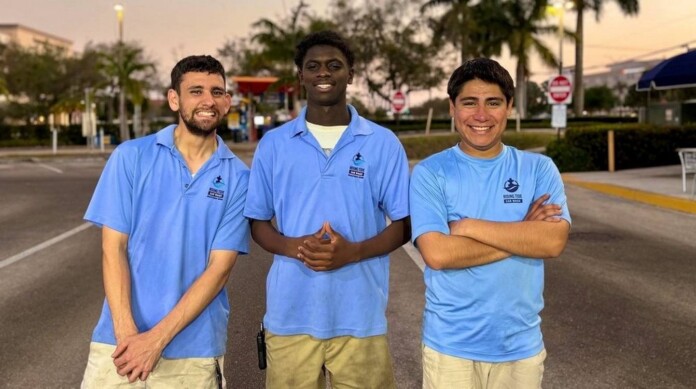
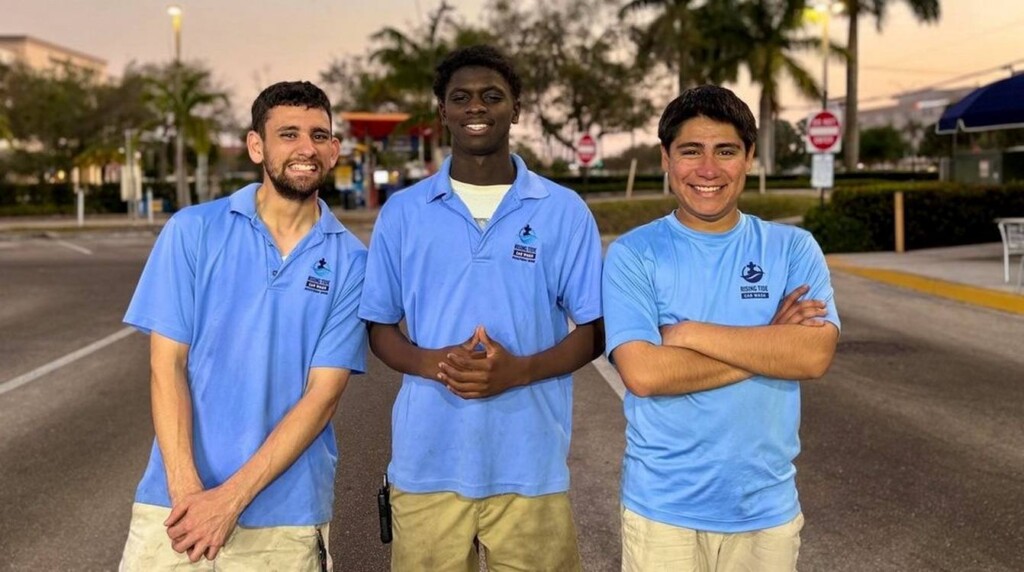
In 2015, GNN reported on the opening of Rising Tide Car Wash in Florida, where a man’s autistic son could acquire all the merits of hard work, earn a paycheck, and become more independent.
Now 10-years-later, founder John D’Eri’s original vision has been shared by thousands—both on the spectrum and off of it; both in the driver’s seat, and out of it.
Washing, buffing, and waxing at Margate, Parkland, and Coral Springs, with a fourth location set for Pompano Bay in 2026, Rising Tide now employs 90 neurodivergent adults.
“I don’t want him to sit in a room, taken care of by others once I’m gone,” John D’Eri said at the time “I want him to have a job, I want him to have friends.”
He was imagining life after his son Andrew graduated high school; what would fill up his days? How would we be able to take care of himself?
Other fathers and mothers around Florida and the country bedsides will undoubtedly have had a similar questions, but if there’s one the last 10 years of operations has answered, it’s that a Rising Tide lifts all boats.
“I like working on the cars because it’s so easy for me,” said Ryan Brodie, one of the employees who works with Andrew. “The best thing of having a job is that I make so much money.”
“There’s not many meaningful opportunities for individuals who have high-functioning autism, and this is something that they can do and be successful at and feel a part of,” said Michelle Hintz, a psychologist at Cadenza Center for Psychotherapy & the Arts in Hollywood, who regularly patronizes Rising Tide.
Speaking with CBS, she said there’s a clear arc of success in cleaning a car, which arrives dirty, is covered in suds, and then gradually, through application, begins to sparkle and shine.
There’s a metaphor in there, maybe, but for now WATCH them in action below…
SHARE This Uplifting Story About Capable People Given A Chance…
A camel and calf milking - credit, krebsmaus07, CC BY 2.0 via Flickr
A camel and calf milking – credit, krebsmaus07, CC BY 2.0 via Flickr
In an exclusive for AP, Somalia’s camel dairies speak with hope about the future in a country that often has very little to hope about.
From outside government meddling and invasions, to regular bombings, insurgencies, famine, and piracy, “Somalia” and “investment” are two words that rarely go hand in hand.
But the country and its people are master camel herders since time immemorial, and armed with modern veterinary practices, scientifically selected fodder, and industry-standard hygienics, a new camel milk industry boom is poised to play a small part in advancing the economy.
Camel milk contains nutrients like magnesium, vitamins B12, C, D, and A, iron, and zinc, while simultaneously carrying very low-levels of lactose. It’s a critical nutritional staple in one of the few countries in the world that has undergone a true, bona fide famine in the last 25 years.
Beder Camel Farm is one establishment in this new generation of camel dairies that are trying to modernize the ancient production and consumption methods of camel milk.
Each milking camel can produce 2.5 gallons per day, which is about twice as much as what’s collected by traditional pastoralists. Holding 40% of the nation’s market share, and employing hundreds of both seasonal and full-time employees at the farm and dairy facilities, Beder is leading this movement.
The country is eager to see the camel milk industry develop. It not only provides milk—for all its uses—but has graduated to yogurt; produced and packaged for sale in the markets of Mogadishu.
“The benefits of camel milk are countless,” Dr. Kasim Abdi Moalim, Director of Animal Health at Somalia’s Ministry of Livestock, told AP. “In countries like the UAE, camel milk is also used for cosmetics. Somalia must catch up and develop the full value chain.”
Future initiatives for Beder involve educational outreach to the country’s pastoralist community who raise millions of camels (there are more camels in Somalia than any other country). If they can better select the animal’s fodder, apply basic hygiene, and keep an eye on the camel’s health, these pastoralists could access Beder’s supply chain, bringing more value to the country.
In economics, one of the most fundamental principles is that wealth is created, not distributed. Everything in society today came about from a state of empty nature, wherein a product or service was offered that customers liked, and the rise in demand caused a genesis of supply that created production methods, employment opportunities, paychecks, etc.
One solid market institution like Beder can transform whole regional economies, and there are few regions more in need of transformation in the economic sense than the Horn of Africa.
SHARE This Rich News For A Poor Country With Your Friends…
Wisconsin residents called in by the dozen: “there’s a bear in my yard,” they said.
But wildlife authorities were taken aback at the next detail, “it has a jar on its head!”
The Winnie the Pooh wannabe was a 2-year-old female black bear who had obviously followed her nose about 18 inches too far. Feasting on cheese balls, pretzels, or something else that’s sold in those massive plastic snack jugs, the animal couldn’t extract its head after it had finished.
“My immediate neighbor was like, ‘hey, just heads up, here is what’s heading towards your house,'” said Jayme Morey, coordinator for the Chequamegon Humane Association in Ashland, Wisconsin.
Used to spreading the word about missing dogs and cats, this emergency was rather more different. The Wisconsin Department of Natural Resources had been tracking the bear for a week, as Morey’s call wasn’t the only one they had received.
They were finally able to find it, tranquilize it, and remove the jug from its head. Clearly skinny, the bear had been trapped for at least 11 days based on the record of sightings by locals. It could still get water by dunking its head and slurping up what entered through the sides of the jug.
“We’ve seen this come up from time to time, often with a bear, occasionally a deer,” Randy Johnson, a large carnivore specialist with the Wisconsin DNR, told CBS News. “The good news is this is the time of year when food is the most abundant in the woods, and she’s got two months to kind of get back into healthy shape going into winter.”
credit – USDA Aphis Wildlife Service via Facebook
Indeed, the bear was just 70 pounds when rescued—about the same as some of the largest dog breeds. A bear of that age at that time of year should weigh over 150, Johnson said.
Quote of the Day: “The words of kindness are more healing to a drooping heart than balm or honey.” – Sarah Fielding
Photo by: Thomas Bennie
With a new inspirational quote every day, atop the perfect photo—collected and archived on our Quote of the Day page—why not bookmark GNN.org for a daily uplift?
26 years ago today, Tampa Bay third baseman and MLB Hall of Famer Wade Boggs joined the “3,000 Club” scoring his 3,000th career hit in the Devil Rays’ 15-10 loss to the Cleveland Indians. It also happened to be a home run, the only time such an event has ever happened. READ about how hitty Boggs could be… (1999)
Muhammad Ali and Michael J Fox, two of the most famous Parkinson's patients, prepare to speak to the Senate - public domain
Muhammad Ali and Michael J Fox, two of the most famous Parkinson’s patients, prepare to speak to the Senate – public domain
For 10 million worldwide patients with Parkinson’s disease, news out of Japan that a large pharmaceutical corporation is seeking approval for a new stem cell-based treatment should be hugely encouraging.
Following a successful clinical trial in which seniors between 50 and 59 years of age received injections of induced pluripotent stem cells (iPS) and saw either a halting or reversal in symptoms, Sumitomo Pharma have applied for manufacturing and marketing authorizations in Japan and the United States.
Parkinson’s is a debilitating neurodegenerative disease characterized by a progressive loss of dopamine producing cells that results in a loss of motor functions.
The clinical trial was led by Kyoto University, and the published results in Nature showed that 4 out of 7 patients saw improved symptoms during a two-year monitoring period, while the other 3 did not, but suffered no negative side-effects.
Induced pluripotent stem cells are cells in the body that have been reprogrammed to return to a very young state, and which can then form any cell in the body. The discovery of the genetic process was made by Dr. Shinya Yamanaka, and the Kyoto U. researcher won the Nobel Prize for that work.
It allowed stem cell treatment research to completely bypass the existing ethical debate around the harvesting and use of placental or fetal stem cells. The 4 so-called Yamanaka Factors are genes which when altered cause a cell to return to a youthful state.
In the clinical trial, iPS from healthy donors were programmed to form dopamine producing cells lost in Parkinson’s cases and given in the form of two shots, one on each side of the brain.
Currently available therapies “improve symptoms without slowing or halting the disease progression,” the Parkison’s Disease Foundation said.
Famous suffers of Parkinson’s disease include the actor Michael J. Fox, boxer Muhammad Ali, and singer Ozzy Osbourne, who died of the disease last month.
SHARE This Hopeful Progress Toward Effective Treatment For Parkinson’s…
A male Montagu's harrier in a wheat field - credit, Sumeetmoghe CC 4.0. BY-SA
A male Montagu’s harrier in a wheat field – credit, Sumeetmoghe CC 4.0. BY-SA
Adrift amongst a sea of wheat on an English farm, 4 extremely rare birds have successfully fledged, and are almost ready to strike out on their own.
The successfully raised chicks are Montagu’s harriers, England’s rarest breeding bird, and the news the young ones were flying was herald as an “incredible” accomplishment.
For months, tall predator-proof wire fencing has surrounded the nest, sat in the middle of a private landowner’s field of milling wheat.
Conservationists from the Royal Society for the Protection of Birds (RSPB) have worked hand in hand with landowers for years to ensure the harrier clings on.
For six years, no chicks have survived to fledge; an unsustainable trend as the population is incredibly small. Nesting on the ground in wheat fields puts the chicks at risk of predators like foxes, and machines like combine harvesters and crop sprayers.
Populations are much higher in Spain and France, but on Great Britain, each breeding pair has to be monitored from start to finish of the breeding season. In this case, a pair returning from their wintering grounds in sub-Saharan Africa were spotted moving into a field in an undisclosed part of the country.
Once it was confirmed via drone that they had nested, RSPB sprung into action, installing predator-proof fencing and monitoring cameras.
Channel 4 reported that the fences are marked out with flags so that combines can steer well clear of the nests and the chicks, which strangely don’t seem to give a tweet about the giant, noisy machines of death passing by.
As for the farmer, one might think they’d take issue with the lost crop, but quite the contrary.
“It’s fantastic to have these amazing birds on the farm and a just reward for the extensive conservation work we have been undertaking for decades,” the farmer who owns the land where this particular nest was located, told the RSPB.
As the first chicks to successfully fledge in 6 years, these young ones—the males already sporting their iconic “battleship grey” feathers—carry the hope of the British population on their wings.
WATCH the story below from Britain’s Channel 4
SHARE This Story With Your Friends On Social Media…
Lost and found rings – Courtesy of Laura Emanuel and Jeffrey Laag
Lost and found rings – Courtesy of Laura Emanuel and Jeffrey Laag
That little beep of a metal detector can often mean nothing but trash, but every once and a while, it can lead to fame, fortune, and even “happy tears.”
Laura Emanuel from southern New Jersey was on the beach enjoying the sun over Cape May when, after taking off her wedding band and another ring to put sunscreen on, she promptly forgot about them.
Debating what to do, she called 23-year veteran of the Cape May Fire Department Jeffery Laag, who runs “Ring Finders Cape May” a hobby-helper service that allows him to spend mornings metal detecting on the beach looking for lost valuables.
After Laag’s first sweep of the beach with his trusty metal detector, he had to call Emanuel with some unhappy news: he had found nothing.
Just a few days after she lost her rings, wild weather struck the coast with high winds and pummeling rain, complicating any future searches. Incredibly though, a family playing in the sand days later found the second ring, and through the magic of social media identified Emanuel as its owner before giving it to the management at The Grand at Diamond Beach for safekeeping.
That would have been a happy ending, but it gave Emanuel the impetus to reach out again to ask Laag for another sweep of the shore.
“I immediately went back down the next morning at 5:00 a.m., got a little closer to the water, and I was able to recover her diamond and platinum band for her,” Laag told ABC 7 news.
“I didn’t believe it,” she said. “The emotion, and just the happy tears that it had been recovered—by this stranger. He picked up the ring that had been returned, got the wedding band, took both rings and literally brought them to my doorstep like a superhero!”
WATCH the story below…
SHARE This Great Lost Ring Story With Your Friends…
Helsinki has completed a full 12 months without a single traffic fatality.
The success is being attributed to a multi-faceted approach by city and residents that involves lower speed limits, public transport improvements, and better street planning.
In the 1980s, the city saw around 30 fatalities per year from hundreds of injurious crashes and collisions. Over the years, as public transportation systems like buses and trams improved, fewer people relied on their cars to get around, and the rates began to fall.
Similarly, cars themselves became safer for the passengers inside of them. But deaths were still routine, as were calls that had to be made to mothers and fathers, next of kin and relatives that someone they loved had died for something as meaningless as a trip to the grocery store.
Over time, a focus on street safety led to lower speed limits along more and more city lanes, from 30 mph to 18 mph.
“A lot of factors contributed to this, but speed limits are one of the most important,” Roni Utriainen, a traffic engineer with the city’s Urban Environment Division, said to Yle news.
A data-driven approach helped city planners redesign old grid layouts to incorporate better cycling and pedestrian infrastructure in safer locations. More traffic cameras and automated speed limit enforcement mechanisms have also been deployed.
The result is that across the last 12 months ending in July, there hasn’t been a single traffic fatality since a man was killed in the city’s Kontula district.
“The direction has been positive for years,” Utriainen said, pointing out that no pedestrians were killed in Helsinki traffic in 2019 either.
The city’s approach has to be constantly updated as new trends emerge on roads, such as the arrival of electric scooters that proliferated remarkably quickly.
DRIVE This News Over To Your Friends’ Social Media Feed…
With a new inspirational quote every day, atop the perfect photo—collected and archived on our Quote of the Day page—why not bookmark GNN.org for a daily uplift?
34 years ago today, Tim Berners-Lee released documents describing his invention of the World Wide Web. The English computer scientist designed and built the first web browser to access the new information management system. His Hypertext Transfer Protocol (HTTP) would be used for contacting informational servers anywhere in the world, the first of which was the CERN HTTPd. READ more… (1991)