














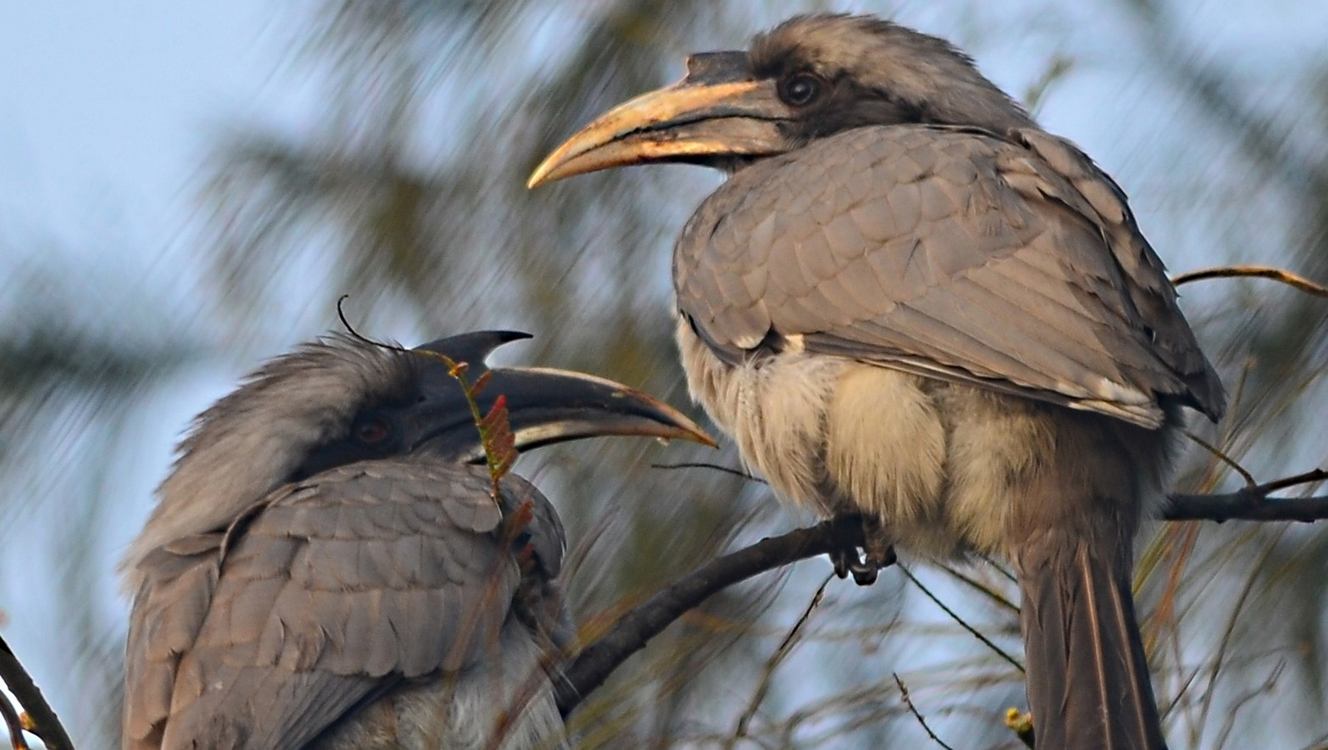
For the 4th year in a row, Indian grey hornbills have successfully bred in Gujarat state where they’d been absent for more than 50 years.
Despite being listed as a species of “Least Concern” by the IUCN, the animal has habitat requirements that can see it quickly succumb to displacement.
Indeed even Gir National Park, an internationally renowned reserve stretching 540 square miles across West India’s deserts, hadn’t seen a nesting grey hornbill pair since the 1960s.
But after a strategic reintroduction program was initiated in 2021, these large social birds now number 40-strong and counting.
It’s the 4th year since the program became that nesting pairs have been recorded raising chicks. The bird requires large, mature, native tree species old enough to develop hollows that can fit the 24-inch-long bird inside where they build their nests. They also need an abundant supply of fruit from nearby trees.
Because of this, Indian conservationists describe the Indian grey hornbill as one of the sub-continent’s indicator species, one which owes its flourishing to the flourishing landscape, and its decline to an early landscape decline that may soon come to affect other species.
MORE STORIES LIKE THIS:
- Critically Endangered White-Rumped Vulture Returns to Cambodia Refuge After Years of Effort
- Fabulous Vietnam Pheasant Not Seen in 20 Years Returns to Wild Thanks to Zoo Coalition
- Bald Ibis ‘the Herald of Spring’ Saved from Extinction in Turkey Thanks to Semi-Wild Breeding
To attain that arboreal flourishing, areas inside Gir had to undergo years of habitat restoration and careful protection to get them ready for the birds.
The Better India reports that this strategy has seen them successfully reach the point whereby the population can breed in a self-sustaining manner, without future reintroductions required to support the animals.
SHARE This Great Bird Comeback In West India’s Deserts On Social Media…