













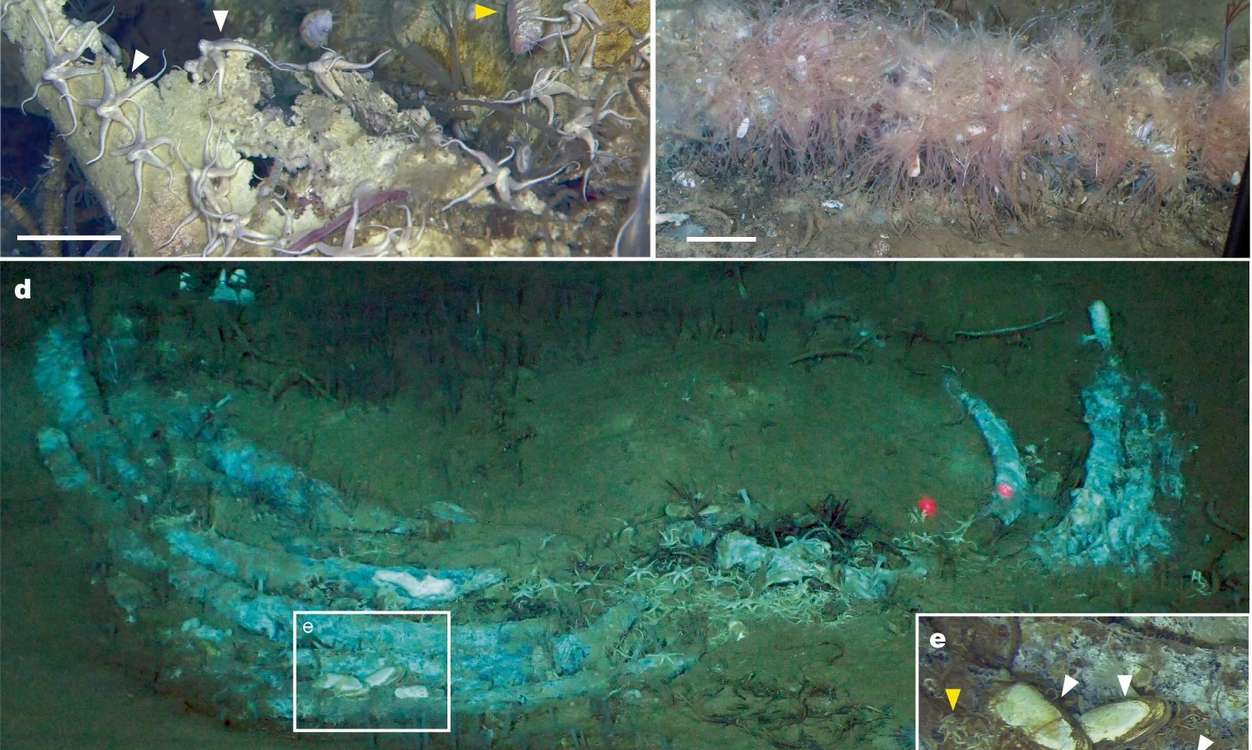
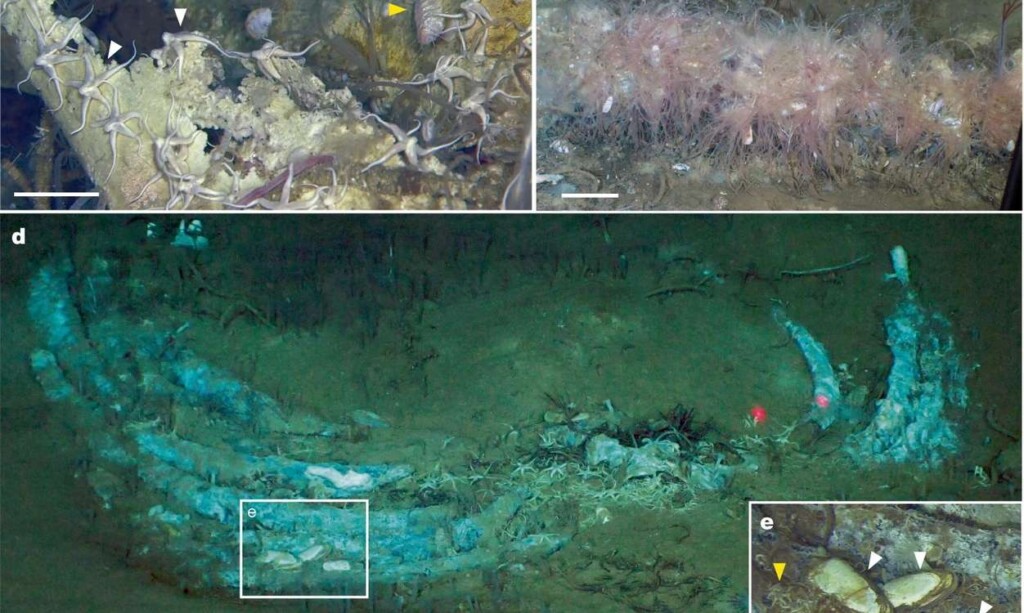
Chinese scientists have discovered the world’s largest “whale graveyard” in a trench deep below the Indian Ocean—and it teems with life.
Bivalves, brittle stars, different kinds of worms, and jellyfish—many of which may be new to science, thrived in what the scientists suggested might have acted as an “evolutionary hotspot.”
Since the phenomenon of “whale falls” was first discovered in the 1980s, it’s quickly become apparent that for dozens if not hundreds of deep-sea-dwelling species, the carcasses of whales that sink to the seafloor are the most important of lifelines.
Rich foraging habitat or other areas where whales congregate may also harbor so-called ‘whale graveyards—areas of sea where many whale falls can be found.
But nothing could have prepared Xiaotong Peng, Peng Zhou, and their co-authors for what they would find during submersible dives to the Diamantina Fracture Zone, 20,000 feet below the surface.
They had suspected to find whale remains, but admitted to AFP that it was more than they could have ever imagined.
“Discovering a necropolis of this scale was completely unexpected: the size of distribution, the depth and the age range were far beyond anything we had imagined,” Xiaotong Peng said.
They recorded almost 500 different skeletons and used a robotic arm on their submersible to bring some 485 individual bones—including fossils some 5.3 million years old—back to the research vessel. The team’s estimations suggest there may be 10 million dead whales across a 660-mile-long area, most of them various species of beaked whale.
Andrew’s beaked-whale and the strap-toothed whale are known to inhabit the southern Indian Ocean today, while an Antarctic minke whale was also identified. Two known but extinct species Pterocetus and Izikoziphius were identified via their skulls.
ALSO CHECK OUT: Another Trawling Ban, Another Big Recovery for Sea Life
A fossilized sei whale, alive today, was also found, as well as several unidentified bones—perhaps from undiscovered species.
Around these were thousands of sea creatures, some of them known to live around hydrothermal vents in other deep sea zones. That spawned the hypothesis that a whale carcass and a hydrothermal vent may be offering these simple organisms a similar bounty of sustenance, one which the sea life cannot do without, but both of which they can exploit equally well.
UNDERSEA WONDERS: 24 New Species Including a New Family of Amphipods Identified in Deep Sea Survey
“The vibrant ecosystems we saw offered a completely different perspective on this otherwise dark and cold ocean floor,” said co-author Zhou.
“The results support the hypothesis that deep-sea whale falls act as evolutionary hotspots and biogeographic stepping stones for sulfide-dependent fauna in the deep ocean,” the study’s authors write.
SHARE This Incredible Discovery Deep Below The Indian Ocean…