












Even as the final scimitar-horned oryx was felled for meat and leather on the Saharan dunes, a network of zoos, hunting reserves, and even a royal menagerie, guaranteed they would live on in captivity.
Now, 9 years after these graceful antelope were first introduced back into the lands they once roamed, they have become one of the only species in history to go from being “Extinct in the Wild” to “Endangered.”
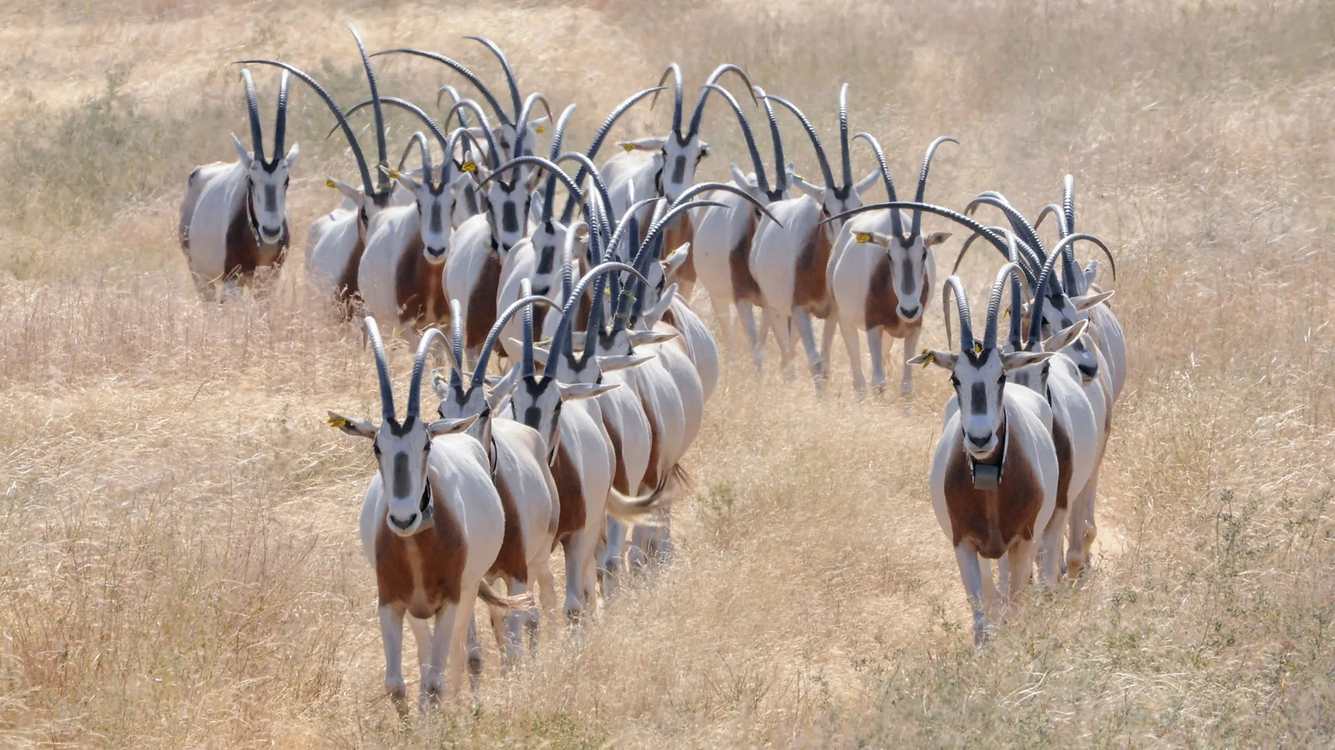
With reintroduced populations in Chad, Tunisia, and Morocco, the wild oryx has risen in number from a whopping zero to around 600 animals, each bearing a remarkably-high amount of genetic diversity for a species once considered Extinct in the Wild.
The secret to that genetic heritage was a small number of concerned, well-to-do citizens who took action during the antelope’s downfall. These include a group of West Texas ranchers who learned in the 1970s that these animals were going extinct and decided to front up what must have been not-insubstantial funds to transfer some to Texas where they have settled brilliantly, and grown to a larger number (some 12,000, it’s estimated) than ever even existed in Africa.
Other benefactors include the far-sighted Englishman John Knowles, who established Britain’s first zoological collection specifically for breeding endangered animals at the 400-acre estate of Marwell Hall. Here, despite their Saharan birth, the scimitar-horned oryx thrived in captivity.
Marwell is the keeper of the scimitar-horned oryx studbook, a sort of thoroughbred racehorse record for the oryx. As the animals shuffled around various zoos in Europe, the studbook ensured that inbreeding was avoided, and that it lineages with healthy and robust genetic heritage could be tracked.
Today, the studbook lists 3,295 animals in 182 zoos and institutions, and Marwell is now conducting some studies on the US-based oryx for the purpose of seeing how more genes could be introduced to the breeding pool.
Combined with those individuals in Texas and a small herd maintained by royal family of Abu Dhabi, the number and natural diversity meant it was only a matter of time before the species returned to the Sahara.
As it now has; and how. In March of 2016, in one of the world’s largest solitary conservation landscapes called the Ouadi Rimé-Ouadi Achim Faunal Reserve, a cargo plane touched down in Chad with 25 specially-chosen oryx from what the BBC described as a “World Herd”—individuals handpicked from the US, Europe, UK, and Abu Dhabi that would have the highest chance of surviving and breeding.
“The first phase of the operation has been a success. We’ve got the animals back into the wild, they’re breeding, they are pretty secure,” John Newby, who prepared a habitat assessment in the Republic of Ireland-sized Ouadi Rimé-Ouadi Achim Faunal Reserve, told the BBC.
MORE ON THIS ORYX: In World First, Horned Oryx Upgraded from Extinct in Wild to Endangered Owing to Decades of Zoo Work
“So far, 347 oryx have been released, mostly in herds of around 25,” the BBC reports. “In total, there are now somewhere between 550 and 600 oryx free-roaming in Chad, according to research by Sahara Conservation.”
Several dozen can also be found in disparate populations in Tunisia and Morocco, results of earlier reintroduction attempts that have had mixed success.
AN EXTREMELY SIMILAR STORY: Miracle Recovery for World’s Rarest and Strangest Deer – Just 39 Became 8,200
Phil Robbins, who manages antelopes and other ungulates at Marwell, says the “Wow” moment is always the moment of release: when workers standing atop 25 custom-built release crates lift the doors, and the sword-headed beasts charge out into their ancestral home. That’s the moment for celebration, the moment that turns heads and opens wallets, but it belies this incredible story’s true triumph, which were those few concerned parties who successfully acted in the face of onrushing disaster, and the decades of careful work to get them to that moment.
SHARE This Great Story Of Foresight, Hard Work, And Reward…