














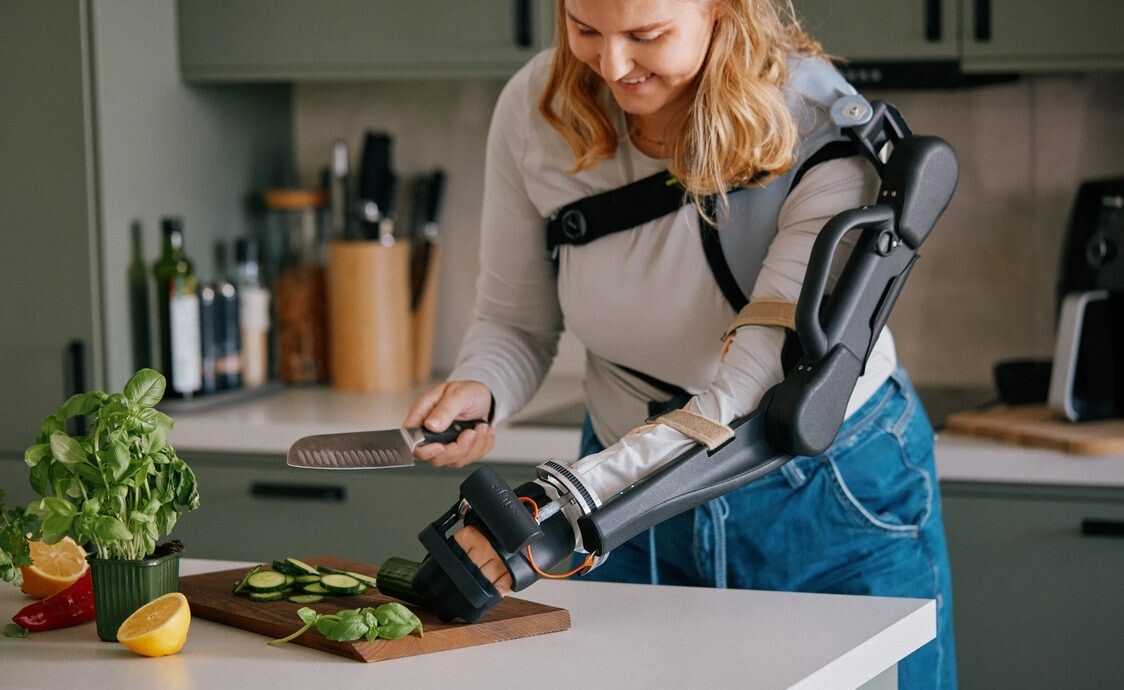
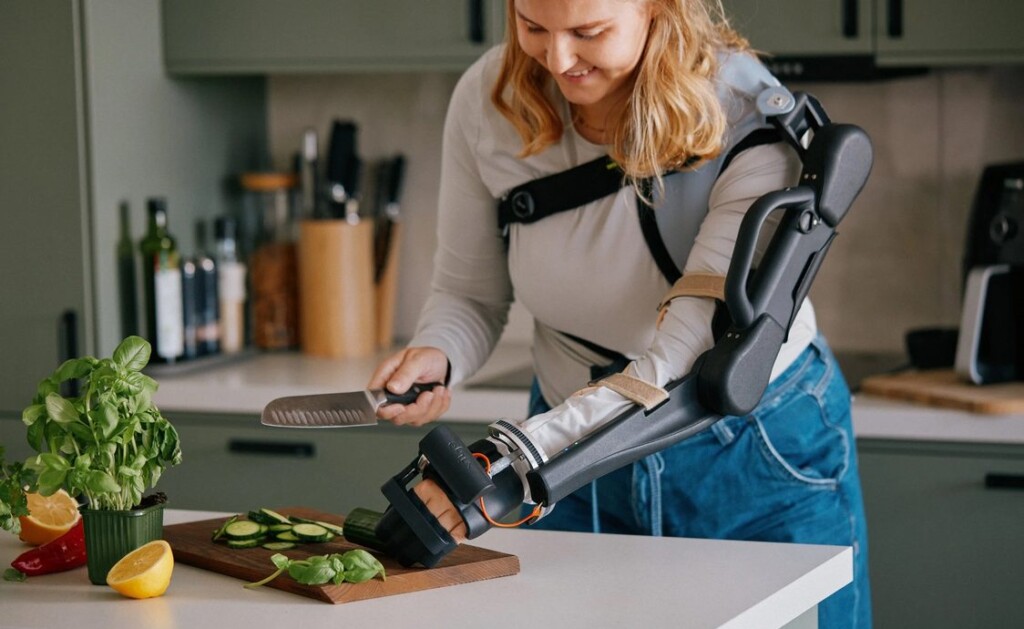
An exoskeleton for the entire arm has been invented and designed in Norway to help stroke victims recover the use of their arms.
It detects and then amplifies tiny movements through the arm and shoulder, and the developers hope to launch it as a fully commercial product this year.
Today, more and more people are surviving strokes, and living longer and longer with disabilities resulting from them. This creates the need for better therapies, accommodations, and regenerative treatments.
Vilje Bionics, the company behind the shoulder-mounted exoskeleton, says that most below-the-elbow prosthetics are for amputees, an few if any exist for victims of partial paralysis—like Johanne Marie Hemnes.
In 2017 Hemnes suffered a brain hemorrhage and collapsed in her living room. The resulting stroke paralyzed her down her left side—usually the result of a stroke in the right half of the brain.
All her rehab and focus was on the left leg to ensure she could walk again, and while that was successful, her arm was entirely neglected.
“I call my arm Jenny, because it feels like it’s not a part of me, because it doesn’t do what I want it to do,” she told Euro News, adding that she even considered cutting it off because it just got in the way. “But when I actually have this on, it feels like me again. It doesn’t just feel like another human being’s arm.”
Vilje Bionics’ robotic arm assists movements for the shoulder, elbow and hand, which makes it the world’s first exoskeleton for the entire arm. Many of the components were 3D-printed, and Vilje’s founder Saeid Hosseini, says it works by the user “thinking how they’d use their arm.”
“Because if you think, you make a small movement and then it amplifies that movement,” Hosseini said. “It detects very small movements of a residual movement of a paretic arm and amplifies those movements.”
EXOSKELETON INVENTIONS:
- Exoskeleton Walker Allows Children to Take Their First Steps After Doctors Said They Couldn’t
- Italian-Made Exoskeleton Gets Disabled Users Walking and Standing
- Robotic Glove that ‘Feels’ Lends a ‘Hand’ to Those Relearning to Play Piano After a Stroke
40 people have trailed the Vilpower exoskeleton so far, and the company hopes it will be ready in the first 4 to 6 months of 2026 starting in Norway.
The robotic arm may be used for rehabilitation purposes in the future, but the company is currently focusing on helping “patients with lasting and significant disabilities to be more independent.”
According to the World Stroke Organization, one in four people will suffer a stroke at some point in their life.
Hemnes has been able to get used to cutting vegetables and opening bottles again, exactly the kind of independence Hosseini wants his product’s users to be able to reclaim.
WATCH the story below…
SHARE This Great Innovation With Your Friends…