












Belarus’ authoritarian President Lukashenko has sacked two of the nation’s top defense officials after two Swedish advertising agency employees piloted a light plane into the country’s heavily guarded airspace, dropping 879 teddy bears decked out in parachutes and slogans supporting human rights.
Following the incident, Belarus (also known as the last dictatorship in Europe) denied the flight took place but then jailed a journalist for posting a photo of the bears on the internet.
A squamous cell carcinoma tumor - Photo by Ed Uthman, CC license on Flickr
Three independent studies have now shown that our understanding of the physical makeup of cancer tumors has been based on a myth.
The conventional view of cancer is that it results from genetic mutations within ordinary cells that cause them to divide uncontrollably into a tumour that can then spread to other parts of the body. This suggests all cancer cells are created equal.
But, a portion of the cells are now seen to be “cancer stem cells” which are responsible for causing a tumor to grow and develop. Treatments, therefore, can be focused on killing these cells rather than targeting the wider community of tumor cells.
Belarus’ authoritarian President Lukashenko has sacked two of the nation’s top defense officials after two Swedish advertising agency employees piloted a light plane into the country’s heavily guarded airspace, dropping 879 teddy bears decked out in parachutes and slogans supporting human rights.
Following the incident, Belarus (also known as the last dictatorship in Europe) denied the flight took place but then jailed a journalist for posting a photo of the bears on the internet.
A University of Washington researcher listened to the audio picked up by a recording device that spent a year in the icy waters off the east coast of Greenland. She was stunned at what she heard: whales singing nearly constantly for five months using the most remarkable variety of songs.
In 2008, oceanographer Kate Stafford set out to discover how many endangered bowhead whales populated the area. The species was hunted to near-extinction in the 1800’s.
A University of Washington researcher listened to the audio picked up by a recording device that spent a year in the icy waters off the east coast of Greenland. She was stunned at what she heard: whales singing nearly constantly for five months using the most remarkable variety of songs.
In 2008, oceanographer Kate Stafford set out to discover how many endangered bowhead whales populated the area. The species was hunted to near-extinction in the 1800’s.
if you are watching too much “news” in America these days, you’re not hearing the truth about the economy as much as political messaging and strategy. The truth is, the U.S. still has the strongest economy on the planet. We should be touting that.
America’s performance should be measured against the current competition, not against the records it set in the 1990s or 2000s. Everything is relative to expectations, even global economic competition. These days, the United States is an underestimated underdog, while China is still widely seen as a dominant sprinter, even though it is carrying a worse burden in terms of national debt.
Carbon dioxide (CO2) emissions from energy use in the first quarter of this year fell to their lowest level in the US in 20 years, as demand shifted to natural gas-fired generation and away from coal-fired electricity due to record low gas prices, the energy department said.
The nation’s carbon emissions fell 8 percent from the same period a year ago.
Greenland’s ice seems less vulnerable than feared to a runaway melt that would drive up world sea levels, according to a study showing that a surge of ice loss had petered out.
The discovery of fluctuations casts doubt on projections that Greenland could be headed for an unstoppable meltdown, triggered by manmade global warming.
A unique, not-for-profit business school in South Africa recently held its fifth graduation ceremony. Their students are not required to pay for their education monetarily, but rather to ‘Pay it Forward’ by transferring the knowledge, skills, and resources into their communities.
Since its first classes in 2004, 760 students have been awarded full scholarships to the private Tertiary School in Business Administration who would otherwise be unable to access higher education. The accredited school’s goal is to ignite student opportunities to enlighten the world as leaders and entrepreneurs. It has produced four Mandela Rhodes scholars, awarded to African students who display academic excellence and broad leadership potential.
A unique, not-for-profit business school in South Africa recently held its fifth graduation ceremony. Their students are not required to pay for their education monetarily, but rather to ‘Pay it Forward’ by transferring the knowledge, skills, and resources into their communities.
Since its first classes in 2004, 760 students have been awarded full scholarships to the private Tertiary School in Business Administration who would otherwise be unable to access higher education. The accredited school’s goal is to ignite student opportunities to enlighten the world as leaders and entrepreneurs. It has produced four Mandela Rhodes scholars, awarded to African students who display academic excellence and broad leadership potential.
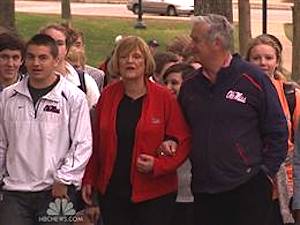
Last Saturday a 22 year-old woman performed ‘the impossible’ when she found her father unconscious having been crushed by his car which slipped off its jack.
The former basketball player managed to pick up the BMW weighing a ton and a half and shove it away from her father’s body. When she discovered he was not breathing, her skills as a former lifeguard kicked in and she brought his limp body back to life.
“I just lifted up kind of right here and just kind of threw it, shoved my body as hard as I could then I came back and dragged him out and started CPR,” Lauren said. “It flashed like, I’m going to lose my dad.”
Last Saturday a 22 year-old woman performed ‘the impossible’ when she found her father unconscious having been crushed by his car which slipped off its jack.
The former basketball player managed to pick up the BMW weighing a ton and a half and shove it away from her father’s body. When she discovered he was not breathing, her skills as a former lifeguard kicked in and she brought his limp body back to life.
Doomsday watchers of the US economy did not get the depressing monthly jobs number they were perhaps hoping for. The country’s private sector businesses added 172,000 jobs in July, the most in five months, the US Labor Department reported this morning.
That is well above the forecast of 100,000 that most economists had predicted.
Manufacturing was one of the bright spots, adding 25,000 jobs.
A Stradivarius violin – possibly worth several million dollars – has been handed in to a lost-and-found office in Switzerland office after a hapless musician left it on a train.
The owner had lent the precious instrument to a musician friend who took it on a train on Friday but forgot it when he got off at Bern, police said.
This is the third time in four years that a musician’s priceless Stradivarius was returned by kind strangers. Two cabbies from Newark and New York City were each hailed for their honesty toward forgetful musicians in 2008 and 2009.
Crowds cheered as Kieran Maxwell, donning a cane and heavy prosthetic leg, carried the Olympic flame through northeast England in June.
During the torch relay, the young teen, who became an amputee after a battle with a rare form of cancer, was tripped up by the awkward artificial leg.
His parents had been fundraising to buy him a lighter replacement limb, and this week Britain’s biggest lottery winners stepped in to supply the money.
His mother Nicola said he started “yelling and dancing” when he found about the “brilliant” donation.
The limb will allow him to do “everything”, the same as other kids.
Crowds cheered as Kieran Maxwell, donning a cane and heavy prosthetic leg, carried the Olympic flame through northeast England in June.
During the torch relay, the young teen, who became an amputee after a battle with a rare form of cancer, was tripped up by the awkward artificial leg.
His parents had been fundraising to buy him a lighter replacement limb, and this week Britain’s biggest lottery winners stepped in to supply the money.
Feeling good usually makes us smile, but does it work the other way around? Can smiling actually make us feel better?
In a study to be published in the journal of the Association for Psychological Science, scientists Tara Kraft and Sarah Pressman of the University of Kansas investigated the potential benefits of smiling by looking at how different types of smiling, and the awareness of smiling, affects individuals’ ability to recover from episodes of stress.
“Age old adages, such as ‘grin and bear it’ have suggested smiling to be not only an important nonverbal indicator of happiness but also wishfully promotes smiling as a panacea for life’s stressful events,” says Kraft. “We wanted to examine whether these adages had scientific merit; whether smiling could have real health-relevant benefits.”
Smiles are generally divided into two categories: standard smiles, which use the muscles surrounding the mouth, and genuine or Duchenne smiles, which engage the muscles surrounding BOTH the mouth and eyes. Previous research shows that positive emotions can help during times of stress and that smiling can affect emotion; however, the work of Kraft and Pressman is the first of its kind to experimentally manipulate the types of smiles people make in order to examine the effects of smiling on stress.
The researchers recruited 169 participants from a Midwestern university. The study involved two phases: training and testing. During the training phase, participants were divided into three groups, and each group was trained to hold a different facial expression. Participants were instructed to hold chopsticks in their mouths in such a way that they engaged facial muscles used to create a neutral facial expression, a standard smile, or a Duchenne smile. Chopsticks were essential to the task because they forced people to smile without them being aware that they were doing so: only half of the group members were actually instructed to smile.
photo: College Degrees 360, CC
For the testing phase, participants were asked to work on multitasking activities. What the participants didn’t know was that the multitasking activities were designed to be stressful. The first stress-inducing activity required the participants to trace a star with their non-dominant hand by looking at a reflection of the star in a mirror. The second stress-inducing activity required participants to submerge a hand in ice water.
During both of the stressful tasks, participants held the chopsticks in their mouth just as they were taught in training. The researchers measured participants’ heart rates and self-reported stress levels throughout the testing phase.
The results of the study suggest that smiling may actually influence our physical state: compared to participants who held neutral facial expressions, participants who were instructed to smile, and in particular those with Duchenne smiles, had lower heart rate levels after recovery from the stressful activities. The participants who held chopsticks in a manner that forced them to smile, but were not explicitly told to smile as part of the training, also reported a smaller decrease in positive affect compared to those who held neutral facial expressions.
These findings show that smiling during brief stressors can help to reduce the intensity of the body’s stress response, regardless of whether a person actually feels happy.
“The next time you are stuck in traffic or are experiencing some other type of stress,” says Pressman, “you might try to hold your face in a smile for a moment. Not only will it help you ‘grin and bear it’ psychologically, but it might actually help your heart health as well!”
For a copy of the article “Grin and Bear It: The Influence of Manipulated Positive Facial Expression on the Stress Response”, visit www.psychologicalscience.org.
Feeling good usually makes us smile, but does it work the other way around? Can smiling actually make us feel better?
In a study to be published in the journal of the Association for Psychological Science, scientists Tara Kraft and Sarah Pressman of the University of Kansas investigated the potential benefits of smiling by looking at how different types of smiling, and the awareness of smiling, affects individuals’ ability to recover from episodes of stress.
“Age old adages, such as ‘grin and bear it’ have suggested smiling to be not only an important nonverbal indicator of happiness but also wishfully promotes smiling as a panacea for life’s stressful events,” says Kraft. “We wanted to examine whether these adages had scientific merit; whether smiling could have real health-relevant benefits.”
Some good news was celebrated Sunday on Global Tiger Day by the 13 countries where big cats still live.
In Nepal’s Bardia National Park, the wild tiger population doubled, from 18 to 37, in the two years before 2011. Camera traps in the park showed the marked increase, according to the conservation group World Wildlife Fund.