A user of the online bulletin board Reddit got hold of a great little video to uplift the heart and remind all parents of those special moments of immense pride.
In the video, a relatively new father has a toddler resting in his arms and is attempting to talk with him.
Clearly not of talking age yet, the little boy seems confused at first, until he picks up on his father’s attempts to sound out the words “I love you.”
With all the effort he can manage he contorts his mouth to imitate his dad—and the room erupts with joy.
“It’s moments like these that make all the sleepless nights and diaper changes worth it, LOL,” one commenter noted.
A ground-breaking contraceptive pill for men could be just around the corner after scientists identified a gene that, once removed, temporarily renders sperm infertile.
The potentially historic breakthrough contraceptive pill would also have no hormonal side effects and could be additionally used on animals to quell overpopulation and replace castrations.
The research team discovered a protein encoded by this gene, found solely in the testicular tissue of most mammals, which reduced sperm counts and deformed remaining sperm to make them incapable of fertilizing an egg when altered.
Crucially, and exactly like the female contraceptive pill, the destabilization of the infertility protein is not permanent, meaning sperm will recover once the person or animal stops taking the pills.
The team from Washington State University (WSU) observed that male mice lacking the gene called Arrdc5 located in testicular tissues produced 28% less sperm which moved 2.8 times slower than in normal mice.
The results of the study appear to indicate that the protein encoded by this gene is essential for normal sperm production.
Study authors Dr. Jon Oatley and Dr. Mariana Giassetti have already filed a provisional patent for the development of a male contraceptive based on this gene and the protein it encodes.
The WSU team next plans to work on designing a drug that would inhibit the production or function of this protein.
But disruption will not require any hormonal interference; a key hurdle considering the multiple roles testosterone plays beyond sperm production in men, including the building of bone mass and muscle strength as well as red blood cell production.
“You don’t want to wipe out the ability to ever make sperm—just to stop the sperm that are being made from being made correctly,” said Dr. Oatley, senior author and a professor in WSU’s School of Molecular Biosciences. “Then, in theory, you could remove the drug and the sperm would start being built normally again.”
The scientists analyzed available data on DNA and protein sequences in mammals and found this particular gene in nearly every known mammal species.
This, Oatley said, has the potential to open up development for male contraception in animals which could replace cruel castrations in livestock populations and help manage the overpopulation of some wild animals.
However, the WSU scientists insist they are for now focused on producing an effective contraceptive pill for men to hand them more control over their reproduction.
“Right now, we don’t really have anything on the male side for contraception other than surgery, and only a small percentage of men choose vasectomies,” said Dr. Oatley. “If we can develop this discovery into a solution for contraception, it could have far-ranging impacts.”
SHARE This Breakthrough Discovery With Your Friends…
An invasive seaweed species from the Caribbean has been turned into a compostable plastic wrap that has the potential for mass production.
Furthermore, it may have the properties to transform the whole supply chain of this ubiquitous product used in huge quantities every day in restaurants around the world.
The breakthrough comes from the University of Leeds, in the UK, where Keeran Reed and his colleagues were looking to turn the brown seaweed species called sargassum, (Sargassum natans) which inundates the shores of Reed’s home of Trinidad and Tobago, into a sort of biopolymer.
Sargassum is made up of long chains of molecules similar to those found in conventional plastic. the researchers found that mixing it with acid, salt, and some chemicals rendered it thicker and pliable.
They then turned it into sheets of film like normal plastic wrap to study how it held up in heated conditions, and when thrown into the compost bin. Existing biodegradable plastics can take months, even more than a year, to break down in a compost heap. By contrast, the sargassum needed two to three weeks.
Despite this rapid decomposition, the films were robust and held together at temperatures of around 450°F (230°C). Also, the film didn’t leach out any of the chemicals when left in water over a period of 10 days, meaning it can be safely used to cover moist containers of food like chopped fruit.
“Studying the whole supply chain really is where ideas for sustainable materials make it or don’t. We want to find one best application for our material and study the environmental impact of pursuing it from the lab to the consumer,” Koon-Yang Lee at Imperial College London, part of the research team, told New Scientist.
For that, they would need to test just how flexible and stretchy the material could be when subjected to the conditions of mass production. In factories that produce plastic clinging wrap, the plastic is formed into sheets by being blown into huge bubbles.
If that existing production method couldn’t be utilized as is, then the researchers would need to determine how much water and energy new methods might take.
Photo from first date (Courtesy Brenda Rivera Stearns)
Photo from first date (Courtesy Brenda Rivera Stearns)
When a woman texted an uplifting Bible verse to the wrong number, she couldn’t have imagined what this small mishap would lead to.
It was 2009, and Brenda Rivera hoped merely to cheer up her friend with the Lord’s council of “do nothing out of selfish ambition or vain conceit,” but instead cheered up a total stranger named Isiah Stearns.
Isiah replied, “Amen to that, who is this?” and Brenda quickly realized she had the wrong number, and so apologized. But Isiah saw it differently.
He told TODAY he saw someone trying to help with his walk with god, and resolved not to let the happening pass quietly.
The next day he called her, which left Brenda “a little creeped out” but who nevertheless hoped the stranger would leave a voicemail—which he did—saying the Bible verse really brightened up his day.
“I could just tell he was very genuine. So I decided OK — I’m gonna call him back,’” Brenda said, adding that she learned he lived just 50 minutes away from her parents and sister in Ohio. “I said maybe we could meet up when I visited my family. We had an immediate connection.”
Today, Isiah and Brenda Stearns have had 13 years of marriage and 6 children: Victoria, 11, Veronica, 10, Samuel, 9, Vanessa, 7, Benjamin, 4, and Ezra, 1. Isiah meanwhile ditched the skinhead look for a thick head rug of salt and pepper.
The Lord works in mysterious ways, and Brenda said that she could never imagine having such a brood without Isiah beside her.
SHARE This Inspiring Love Story With Your Friends…
Quote of the Day: “Love sought is good, but given unsought, is better.” – William Shakespeare
Photo by: Becca Tapert
With a new inspirational quote every day, atop the perfect photo—collected and archived on our Quotes page—why not bookmark GNN.org for a daily uplift?
Entrepreneurs in Jordan have created a sophisticated machine that pulls water from the desert air at a rate that could cure the country’s water woes.
1,000 units of their flagship device have already been pre-ordered by the Jordanian government, and the success of the invention has allowed the innovators to attract dozens of promising scientists who can hopefully expand on their success and bring water resources up to speed in the relatively-stable Near Eastern nation.
Jordan has an interesting contradiction of celebrating the highest academic involvement in the Arab world, but also suffering in one of its least-successful entrepreneurial landscapes and from a problem with water insecurity that ranks among the highest in the world.
Stepping up to address this problem is Aquaporo, a relatively straightforward, air conditioning-sized machine that can harvest 35 liters of water every day in a desert climate of 20% humidity.
Much of Jordan’s population may only have access to 200 cubic meters of water per year, and only 36 hours of tap water per week provisioned by the authorities. The WHO warns these levels can create harm to human health and economic development.
Aquaporo CEO Kyle Cordova and engineering director Husam Almassad got their start at Jordan’s Royal Scientific Society with a group of trainees. Their invention looked a bit like a chest freezer, but now more an A/C unit above a normal water cooler.
Inside, rows of nanomaterials formed into tubes and other shapes act like a sieve that filters water out of the air. The physics behind it are much the same as those found in this Classical Indian architectural feature and takes advantage of air’s tendency to speed up as it moves through a narrow passageway; called the Venturi Effect.
It leaves behind the heavier water vapor, which condenses, drops into a collection apparatus, and is fed then into a reservoir in a Jordanian home, for example.
Research on the efficacy of Aquaporo’s invention shows it can achieve levels of water purity greater than Nestle brand bottled water, and collects it from the air at double the rate of existing moisture capture technology.
Indeed, humans have been harvesting water from the air for thousands of years. More and more, these old ways of doing things are being utilized in desert areas in developing nations. This company is using fog nets, for example, to harvest the water in low-lying clouds coming off the ocean in southern Morocco.
“This was a Jordanian invention, made for Jordan. Young people in Jordan have great ideas,” Cordova told Fast Company. “My job is to show that research can make it out of the lab.”
You can watch how the unit works by visiting the Aquaporo website here.
SHARE This Bottom-Up Solution For Water Harvesting With Your Friends…
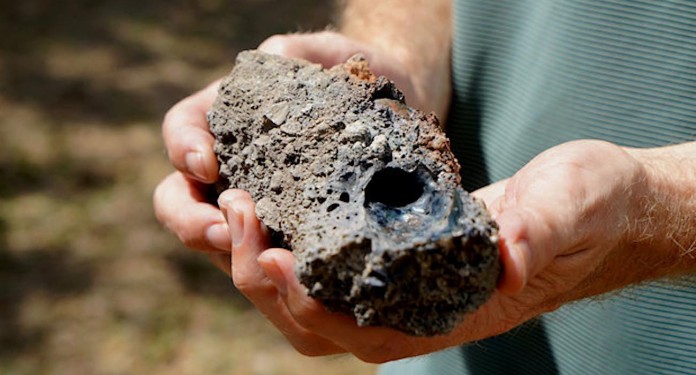
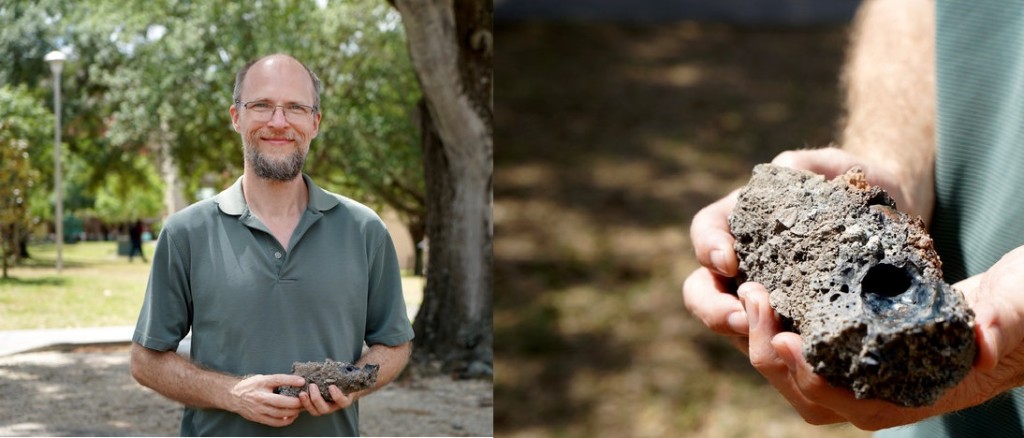
Matthew Pasek holding a fossilized lighting bolt – SWNS
A lightning strike has produced a brand new phosphorus mineral, similar to that found on meteorites and in space.
The bolt created a chemical reaction in a rock, leading to what could be a member of a new mineral group, somewhere between space minerals and minerals found on Earth.
And researchers believe strikes like this one might have produced chemicals that kick-started life on Earth.
The find was made following the strike on a tree in New Port Richey, Florida, when a fulgurite was sold by the landowners to a geoscientist who then had it analyzed.
Fulgurites are formed by the high-energy electrical discharge of lightning through rock, soil, and sand, melting them all together in a small tube—effectively making a fossil out of a lightning strike.
Fulgurites have been studied in the desert landscapes of the Sahara to try and map out the weather patterns of a pre-desertified North Africa.
“When lightning strikes a tree, the ground typically explodes out and the surrounding grass dies, forming a scar and sending electric discharge through nearby rock, soil, and sand, forming fulgurites,” said Professor Matthew Pasek, from the University of South Florida.
“Minerals similar to it can be found in meteorites and space, but we’ve never seen this exact material anywhere.
The study containing the discovery was published in the journal Communications Earth & Environment, and came about after Professor Pasek teamed up with Luca Bindi, a professor of mineralogy and crystallography at the University of Florence in Italy.
Together, the team set out to investigate unusual minerals that bear the element phosphorus, especially those formed by lightning, to better understand high-energy phenomena.
Inside the fulgurite, which formed when lightning not only melted the iron in the tree roots, but also the carbon in the roots, a colorful, crystal-like matter revealed a material never before discovered.
Co-principal investigator Dr. Tian Feng, a graduate of USF’s geology program, attempted to remake the material in a lab but failed.
Dr. Feng said this research may reveal other forms of reduced minerals are plausible and many could have been important in the development of life on Earth.
Professors Pasek and Bindi plan to further investigate the material to determine if it could be officially declared a mineral and bring additional awareness to the scientific community.
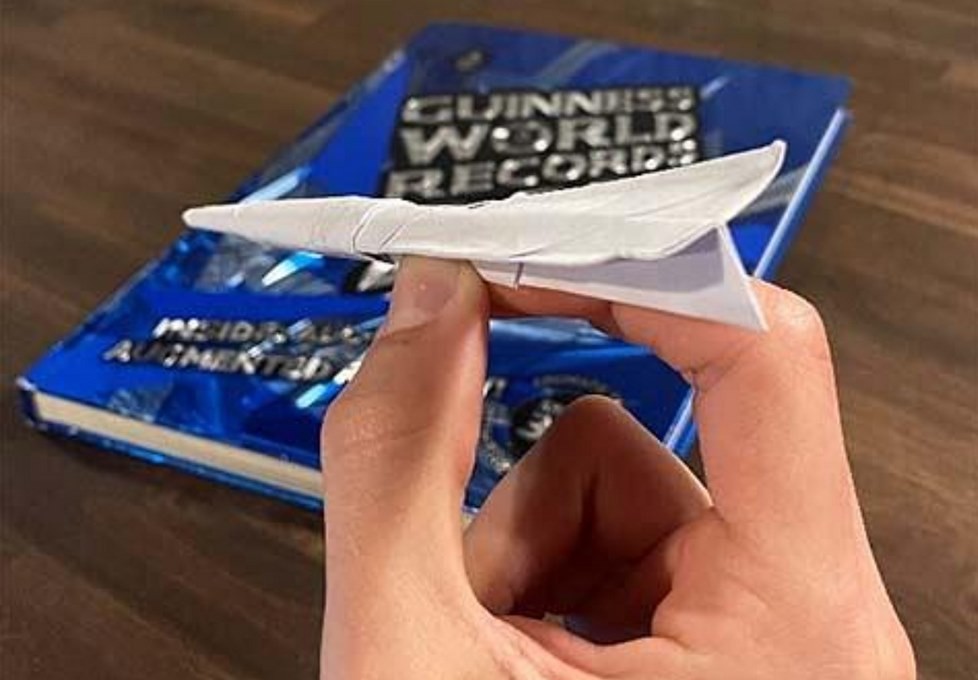
A duo of third-generation Boeing engineers aimed a little lower than a 757, and designed the world’s best paper airplane.
As one would expect from aerospace engineers, the pair of young men knew what they were doing, and it took 20 minutes to fold the airplane which eventually flew 290 feet—a Guinness World Record.
Boeing engineers Dillon Ruble and Garrett Jensen grew up the sons of Boeing engineers and loved folding paper airplanes at company picnics.
In Middle school, they attended paper airplane contests hosted by the company.
Far from your classic paper airplane design, they used their knowledge of aeronautics and origami to design something with the same characteristics as a supersonic aircraft.
“We tried to mimic the design of various hypersonic vehicles, which travel at speeds over Mach 5 (five times the speed of sound). So, we decided to call our plane Mach 5,” Ruble told Boeing news.
Their prototype airplane
When the day to try for the record came, the pair were carefully watched by witnesses. They selected the A4, or European-size paper, with the maximum weight of 100 grams per square meter, reasoning that the heavier the airplane, the farther one could throw it.
“We found the optimal angle is about 40 degrees off the ground. Once you’re aiming that high, you throw as hard as possible. That gives us our best distance,” Jensen said. “It took simulations to figure that out. I didn’t think we could get useful data from a simulation on a paper airplane. Turns out, we could.”
Stepping up, Ruble threw the plane as hard as he could. It caught a bit of wind in its wings and sailed for about 6 seconds before striking the ground. They broke the previous world record of 252 feet by 38 feet, but told CNN that they had no intention of touching the record for total air time.
“The design objectives for an air-time record would be vastly different from the low-drag version we built for the longest-distance record,” Ruble said via email. “Increasing the wingspan and decreasing the aspect ratio would be the first steps in producing this type of plane.”
WATCH the record being made below…
SHARE This Nice Story With Your Friends In The Aerospace Industry…
credit Todd Slatt with permission - www.aurorahunter.com
credit Todd Slatt with permission – www.aurorahunter.com
For Todd Slatt, a.k.a the “Aurora Hunter” photographing the northern lights is nothing out of the ordinary, but last Saturday, he witnessed something emerging from the darkness of the night sky that shocked and inspired him.
A spiral of pale blue light began to form in the distance, growing ever larger and coming ever closer to the man holding his camera and his breath.
Eventually, it completely passed over his viewing spot in Delta Junction, Alaska, leaving the expert photographer mystified.
“It was a beautiful piece of art in the sky,” Slatt told Anchorage News Daily. “I would say this was maybe the most bizarre thing I’ve ever seen in my life.”
Residents farther north, who are used to wild weather phenomenon, also saw the spiral and wondered what it was.
Like many others that night, Slatt did some research and soon appeared on his Facebook with a stunning image of the spiral and a surprising explanation for its origin.
“After doing some online research, this phenomenon appears to be rocket engine exhaust from a SpaceX Transporter-7 mission that launched on the Falcon 9 about three hours earlier in California,” he wrote.
“Water vapor in the exhaust (or jettisoned fuel causing it to spiral?) from the second stage engine freezes and catches high-altitude sunlight, effectively glowing and creating this spiral-galaxy-looking display of light.”
The beauty of the aurora is augmented no end by the blue spiral atop it, and serves to make the sky look somewhat like a national flag.
SHARE This Inspiring And Beautiful Photography With Your Friends…
Quote of the Day: “All the art of living lies in a fine mingling of letting go and holding on.” – Havelock Ellis
Photo by: Paul Felberbauer
With a new inspirational quote every day, atop the perfect photo—collected and archived on our Quotes page—why not bookmark GNN.org for a daily uplift?
Svetlana's request and ChatGPT's response - via SWNS
When a New Yorker received a notice from her landlord about a rent increase after two years of neglecting to fix the washer/dryer unit in her building, she saved money on a lawyer and used ChatGPT instead.
Svetlana, who didn’t wish to reveal her last name, used the chatbot to write an email in “legalese” to her landlord, which saw them agree to fix her washer and dryer.
The exchange with her landlord started after she received a rent increase notice of 0.4%, from $1,389 to $1,395, just days after she had filed for a decrease in rent because her washer and dryer had been out of order for more than two years.
The 28-year-old feared she wouldn’t be able to get her point across herself, so she asked the AI chatbot to act like a housing lawyer and draft an email opposing the rent raise.
Svetlana’s attempt was successful, and her landlord fixed both machines that month.
“The rent increase alone was not my gripe!” Svetlana said. “It was the audacity to increase the rent, seemingly in retaliation after I filed a complaint and request for a rent decrease on the basis of decreased building-wide services.”
In two and half years, Svetlana had lodged several complaints with her landlord to get the machines fixed, but she never received a response.
“I prompted Chat GPT to add more legalese,” she said. “It’s like a super-smart, objective, real-time sounding board.”
Svetlana’s request and ChatGPT’s response – via SWNS
ChatGPT even quoted specific sections of the New York rent stabilization code and posited that the rent increase was retaliatory.
Svetlana, an executive assistant, already uses the AI chatbot for work, but the experience has her considering using it to resolve other legal conflicts.
“I never received an official response from my landlord, but there was a sign posted in my building announcing that the laundry rooms were back in service.”
“It’s definitely reinforced my faith in the, what feels to be, limitless future of AI. We’re living in super fun times and it’s clear that we’re only just scratching the surface of what’s possible.”
There are now no shortage of precautionary voices and stories of these AI services, whether for photo and image manipulation, or instances like this one, but it’s nice to see it being used to tackle a situation almost all of us can relate to.
CHIME In On The ChatGBT Convo On Social Media With This Cool Story…
Artist illustration of the runaway black hole NASA, ESA, Leah Hustak (STScI)
Artist illustration of the runaway black hole NASA, ESA, Leah Hustak (STScI)
Perhaps the most astonishing phenomenon ever discovered by astronomers was recently observed “accidentally” by the Hubble Space Telescope.
What Hubble saw was a supermassive black hole three times the diameter of our whole galaxy, speeding through the universe so fast that it would pass the Earth and arrive at the Moon in just 14 minutes.
Almost as amazing was what was behind it—a bright “contrail” of newborn stars clearly visible in the telescope image like a colorful scratch on a record. The trail was so unusual that scientists originally dismissed it as the result of a malfunction, but follow-up spectroscopic observations revealed it was a 200,000-light-year-long chain of young blue stars.
Nothing even remotely similar to this has ever been seen before, and scientists are speculating it was the result of a sort of “cosmic billiards” when two or perhaps three large black holes bounced into one another.
“Rather than gobbling up stars ahead of it, like a cosmic Pac-Man, the speedy black hole is plowing into gas in front of it to trigger new star formation along a narrow corridor,” NASA press writers reported.
“The black hole is streaking too fast to take time for a snack. Nothing like it has ever been seen before, but it was captured accidentally by NASA’s Hubble Space Telescope.”
credit NASA, ESA, Pieter van Dokkum (Yale); Image Processing Joseph DePasquale (STScI)
A very bright ball of ionized oxygen can be seen at one end of the column, a result of the black hole’s speed of movement.
“Gas in front of it gets shocked because of this supersonic, very high-velocity impact of the black hole moving through the gas. How it works exactly is not really known,” said Pieter van Dokkum of Yale University. “This is pure serendipity that we stumbled across it.”
While looking for globular star clusters in a nearby dwarf galaxy, van Dokkum spotted the trail of stars and dismissed it as a cosmic ray refracting in the lens of the telescope, but after they removed all cosmic rays, it was still there, prompting a spectroscopy analysis at the Kek Observatories in Hawai’i.
Confirmations of the star formation in the contrail led to the theory of it being a black hole, which van Dokkum and colleagues then had to explain.
The idea is that two supermassive black holes merged to form a spinning binary black hole system around 50 million years ago. Along came a third galaxy which also had a supermassive black hole in the middle of it, and as it was pulled into the existing binary, the violent gravitational force was so strong that it pinged the third black hole out of its own galaxy and sent it whizzing away.
The original binary may still be intact, or it could have similarly rebounded in another direction like the third one did. There is a feature seen on the opposite side of the host galaxy that might be the runaway binary black hole. Circumstantial evidence for this is that there is no sign of an active black hole remaining at the galaxy’s core.
Follow-up observations are planned with the more sensitive James Webb Space Telescope, and the research was published in Astrophysical Journal Letters.
SHARE This Never-Before-Witness Phenomenon With Your Friends…
In an incredible story of luck and survival, a Texan was pulled from her submerged car after 3 hours under the water.
The woman had been reported missing by loved ones but was only discovered because a fisherman happened to see the faint outline of a car roof sticking up out of the water in a Texas lake.
The call to the Marion County Sheriff’s Office came in on Friday morning, according to a press release. At Lake O’the Pines, a fisherman said he saw a Jeep about 40 feet from the boat ramp.
It took 18 minutes for deputies to arrive. They determined it was too dangerous to wade out to the vehicle and instead took the fisherman’s boat out to the car after a wrecker had arrived to tow it out.
“It was at that time they saw the woman,” Police Capt. Chuck Rogers told Business Insider. “The fisherman and wrecker employee were able to help the woman from the jeep. They placed her into the boat and she was brought to shore.”
Longview Police Department in Texas, located about 25 miles south of the lake, had the woman, whose identity was not released, listed as a missing person, though no reports have emerged as to why or when.
Emergency services arrived and treated her for hypothermia—it had been a brisk morning and the water was not warm.
Regarding the woman’s survival, details haven’t been released as to how much water entered the Jeep, how much air was available, or how long she was under; she claims at least several hours.
As soon as a car begins sinking in water, a very limited amount of time exists to save oneself, but there are effective methods that everyone should know of. The first step is to try and open the door, though usually sinking occurs too fast, or the weight of the water outside prevents this. The second step would be to open the window.
A car door, if unlocked, can be opened once the car is fully submerged and the air pressure inside and outside equalizes. If there are passengers in the backseats, the first priority is to stay calm, unlock all the doors, unbuckle all seatbelts, and open all the windows. If no one can escape during the sinking, everyone should be able to open the door and swim out once the whole car is submerged.
In the case of the Texas woman, her car was not fully submerged, which removed the immediate risk of drowning but meant the door and windows were stuck shut. She managed to survive in the cold water for 3 hours.
In such a case as this, hypothermia becomes a real risk, especially for young children and the elderly. Breaking the windows should become a top priority if there is a tool inside that’s capable of doing so.
If oxygen is entering the car from outside, continuously move the limbs as that will help generate heat, but if air is not coming into the cabin, the best option is to remain as calm as possible, slow and control your breathing, and use a phone if possible to call for help.
Other than that, the best advice could simply be: buy a Jeep.
SHARE This Harrowing Tale Of Survival With Your Friends…
A personalized skin cancer vaccine has almost halved the risk of death or relapse in patients with the deadliest form of melanoma.
The trial involved men and women who had surgery to remove melanoma from lymph nodes or other organs and were at high risk of the disease returning.
About 1.3 million Americans are currently diagnosed with melanomas, and scientists predict skin cancer will become the second most common type in the US by 2040.
In February the US Food and Drug Administration granted “Breakthrough Therapy” designation to help speed along a pairing of the mRNA-4157/V940 vaccine in combination with the immunotherapy drug pembrolizumab.
It triggers immune system T cells to attack tumors. To spare normal cells, the system uses ‘checkpoint’ molecules on T cell surfaces to turn off their attack against viruses when they clear an infection.
“Our phase 2b study shows that a neoantigen mRNA vaccine, when used in combination with pembrolizumab, resulted in prolonged time without recurrence or death compared with pembrolizumab alone,” said senior investigator, professor Jeffrey Weber, of New York University.
Among 107 participants treated with both the vaccine and immunotherapy pembrolizumab, the cancer returned in only 24 patients (22.4%) within two years, compared with 20 out of 50 (40%) who received only pembrolizumab.
The reason that pembrolizumab was needed was that the body may recognize tumors as abnormal, but cancer cells, and especially melanoma cancers, hijack checkpoints to turn off, evade and avoid immune responses.
Immunotherapies like pembrolizumab seek to block checkpoints, making cancer cells more ‘visible’ and vulnerable again to immune cells.
Larger studies will be needed to confirm the findings, which were presented at a meeting of the American Association for Cancer Research in Orlando. Phase 3 trials of the combination are already being planned in New York and globally.
Like the experimental Covid-19 vaccines, mRNA-4157/V940 is based on messenger RNA, a chemical cousin of DNA that provides instructions to cells for making proteins.
It’s designed to teach the body’s immune system to recognize cancer cells as different from normal cells. In designing a vaccine against melanoma, researchers attempted to trigger an immune response to specific abnormal proteins, called ‘neoantigens’, made by cancer cells.
The study volunteers all had their tumors removed. Researchers were able to analyze their cells for neoantigens that were specific to each melanoma and create a ‘personalized’ vaccine for each patient.
The vaccine took about six to eight weeks to develop for each patient and could recognize as many as 34 separate neoantigens.
Severe side effects were similar between the two arms of the study, they said, with fatigue being the most common side effect specific to the vaccine reported by patients.
SHARE The News Of This Potential Life-Saving Drug On Social Media…
Quote of the Day: “Loss is nothing else but change, and change is nature’s delight.” – Marcus Aurelius
Photo by: Jonatán Becerra
With a new inspirational quote every day, atop the perfect photo—collected and archived on our Quotes page—why not bookmark GNN.org for a daily uplift?
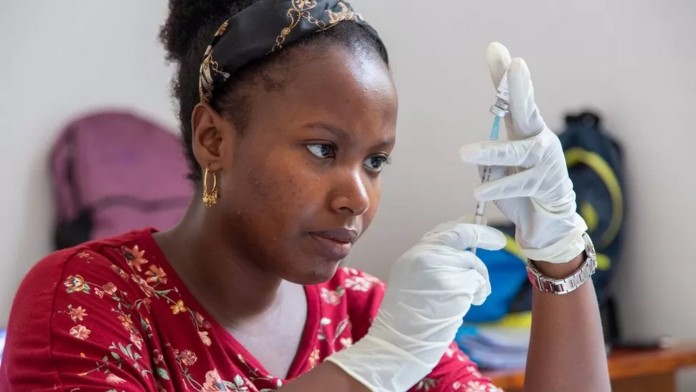
A health worker prepares the vaccine at a Tanzanian clinical testing site - credit Tom Wilkinson - University of Oxford
After 8 years of testing and trials, the long-awaited decision on whether or not Oxford’s R21 malaria vaccine would be approved has been made.
Two of West Africa’s biggest economies, Ghana and Nigeria, have approved it for immunization in infants between 5 months to 3 years of age, one of the highest mortality groups for malaria.
Scientists have been trying to create a vaccine for malaria for more than a century. Currently, the final trial data—a study of R21 shots in 5,000 children in Burkina Faso, has been shown to various African health or drug authorities but has not been made public yet.
“We expect R21 to make a major impact on malaria mortality in children in the coming years, and in the longer term [it] will contribute to overall final goal of malaria eradication and elimination,” Professor Adrian Hill, director of the Jenner Institute at the University of Oxford, where the vaccine was invented, told the BBC.
At the moment the Serum Institute in India is preparing between 100 and 200 million doses of the vaccine for use in Africa.
Ghana, the first country to approve it for use, is also constructing a factory in its capital of Accra, where R21 will be manufactured for a few dollars per dose.
The R21 trains the body to create “very strong” antibody levels by inoculating it to the circumsporozoite protein coating found on between 10 to 20 of the various malaria parasites injected by the mosquito. It has an 80% efficacy rating, the highest ever achieved with the appropriate degree of safety.
Ghana and Nigeria have already approved the vaccine, and others may follow, including the World Health Organization. Between them, Ghana, Nigeria, and their Francophone neighbor the Ivory Coast make up a quarter of the GDP of the entire continent, with a combined population of over 160 million people.
WATCH the news below from Africa News…
SHARE This 100-Year Dream, Potentially Realized For The First Time…
In life’s equation of work put in vs fulfillment taken out, there may be nothing that beats gardening, but these awesome concrete garden blocks make the equation even more favorable, as they allow for the quick and toolless assembly of raised garden beds.
The ageless activity of gardening is backed up by countless studies showing its ability to improve quality of nature, health, and mental wellness, but depending on the characteristics of the soil you’re working with, sometimes it can be a battle against weeds.
Raised garden beds remove the need for constant de-weeding, but they need to be built, which may involve tools one is not knowledgeable in the use of.
Oldcastle Planter Wall Blocks, which may also be called Permacon Wall Blocks, are Lego-like concrete corner blocks formed to easily hold in place a 2×6 wooden board of any length.
Costing between $14.00 to $4.00 per block depending on the retail location (they are readily available at Lowes and Home Depot) three of them can be stacked on top of one another creating 18 inches of soil depth, enough to accommodate most ornamental shrubs and any kind of vegetable.
Another big advantage of the planter wall blocks is that they can be deconstructed just as easily, and don’t involve prying out any nails or drawing out any screws; just simply empty out the soil and pull the wooden board out of its slot.
With a dozen of these and some lumber, a person might be able to make two or four raised beds at around $45-$60 per bed, which the New York Times ‘Wirecutter’ section reports is half to a third of the price of existing kits.
WATCH a demonstration video from Permacon below…
SHARE This Great Produce With Your Friends Looking To Green Their Thumbs…
Brooklyn Faith and Nanuq (center) - Credit Mandy Iworrigan
Brooklyn Faith and Nanuq (center) – Credit Mandy Iworrigan
Off the coast of the far-northern Alaskan town of Nome, and closer to Russia than the US, lies Saint Lawrence Island, where in a town called Gambell, a young girl was recently reunited with her dog who had a month-long meander around the frozen Bearing Strait.
Mandy Iworrigan is the mother to three beautiful children, each of whom is the brother or sister to three beautiful dogs, but on a trip to their Uncle’s town of Savoonga in March, two of the three dogs, Starlight, and an Australian shepherd called Nanuq, disappeared.
Iworrigan believes it could have been that her uncle’s dog, Ghost, led them on a merry dance around the frozen landscape. Ghost routinely strikes out for several days to a week before coming home, but maybe Starlight and Nanuq don’t have the familiarity with the area.
In any event, Starlight reappeared about two-and-a-half weeks later. Nanuq on the other hand, was still at large, and Nanuq’s 8-year-old human sister, Brooklyn Iworrigan, was frightened.
A week later, Mandy’s father texted her to say that a dog which looked like Nanuq was seen in the tiny town of Wales on the Seward Peninsula, a staggering 166 miles from Svoonga. People were posting images of a dog they didn’t recognize to a Facebook page used by residents of Nome and the surrounding communities for trading, goods, and gossip.
Sure enough, after Mandy reactivated her Facebook account, she discovered it was in fact her daughter’s dog.
Nanuq means “polar bear” in the language of the Siberian Yupik, and despite coming from Down Under, he had negotiated 166 miles of frozen ice flows that stack up against each other in the small Bearing Strait separating Asia from North America, through which real Nanuqs prowl, all in the tail end of winter.
“I have no idea why he ended up in Wales. Maybe the ice shifted while he was hunting,” Iworrigan told Anchorage Daily News. “I’m pretty sure he ate leftovers of seal or caught a seal. Probably birds, too. He eats our Native foods. He’s smart.”
Aside from a bite mark on his leg, the dog was healthy, and Iworrigan organized his return via charter flights that were already arranged for the Bering Strait School District’s Native Youth Olympics.
“Wolverine, seal, small nanuq, we don’t know, because it’s like a really big bite,” she said, adding that “if dogs could talk, both of them would have one heck of a story.”
SHARE The Story Of This Amazing Pooch With Your Friends…
The major storms that battered parts of the state of California this year were intense, disruptive, and in some cases, tragic; but many people must have remembered back to 2019 and anticipated a spring to remember.
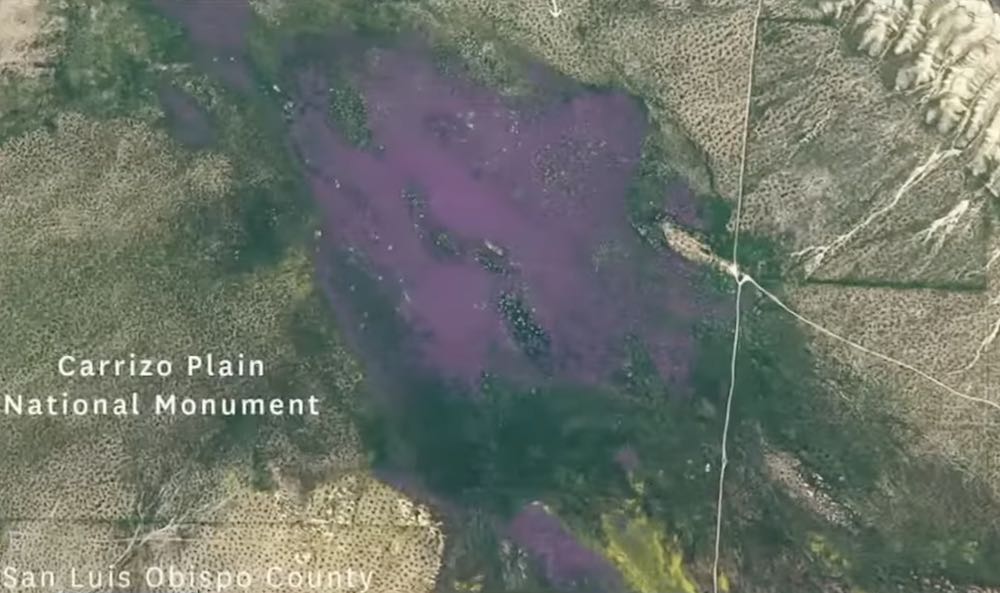
Indeed, the new ‘Superblooms’ emerging across the state are so large and so colorful, they can be seen from space.
The LA Times talked to a scientist who pointed out that there is no natural definition of a Superbloom—they are rather a cultural phenomenon when humans decide enough flowers emerge at one time in one place.
“The California Department of Parks and Recreation recommends seven sites in Southern California where visitors can see the blooms, which have already arrived and, in many cases, are projected to continue for about a month,” writes the LA Times.
Parks and Rec staff are recommending that residents out enjoying the wildflowers should download the iNaturalist app to learn more about each flower species.
The knowledge of what a flower is, who its cousins are, when it emerges, and what species co-exist with it often fosters a closer appreciation and connection to the flower and the land itself, sometimes without the reader even knowing it’s happening.
Satellite image – Twitter
Superblooms are among the best moments to appreciate the duality of nature which makes the Great Outdoors so spiritually fulfilling. If the beauty of a flower is in its brevity on the Earth, if the beauty of autumn leaves comes from their changing and eventual passing, then the beauty of a Superbloom arises out of the necessity of several years of drought.
Superbloom of purple – Youtube
During dry times, seeds released by parent plants can’t germinate due to a lack of moisture, but being the miracle of nature which seeds are, they lay dormant season after season until a refreshing and continuous rain causes several years’ worth of seed to sprout all at once.
A great day trip to start Superbloom viewing is Red Rock Canyon State Park, east of Bakersfield and about 120 miles from downtown LA, where several canyons are flush in yellows and blues.
WATCH the story below from local news…
ALERT Your Friends To This Once-In-A-Decade Opportunity…
Quote of the Day: “It is so easy to give, and so exquisitely rewarding.” – John Steinbeck
Photo by: Rikonavt
With a new inspirational quote every day, atop the perfect photo—collected and archived on our Quotes page—why not bookmark GNN.org for a daily uplift?