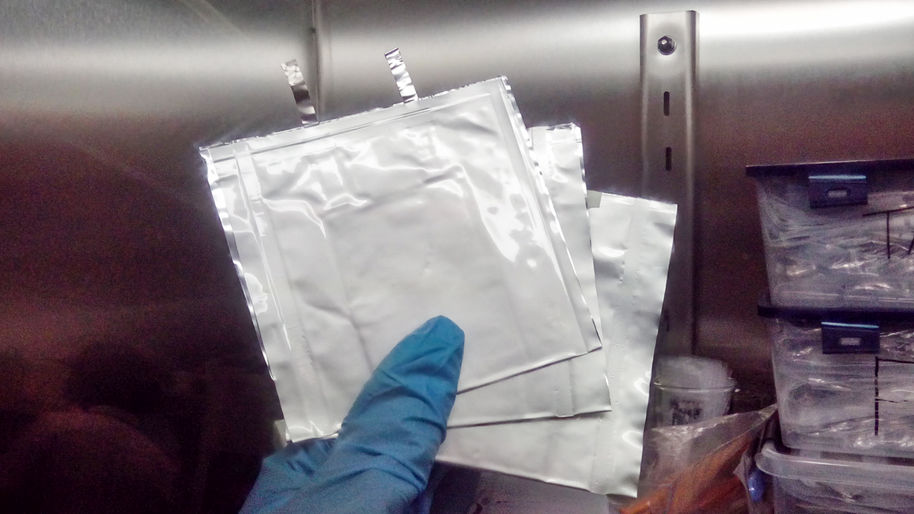
Researchers in Finland have discovered that electrodes in lithium batteries containing cobalt can be reused following a special process.
In comparison to traditional recycling, which typically extracts metals from crushed batteries by melting or dissolving them, the new process—which newly saturates the electrodes with lithium—saves valuable raw materials, and likely also energy.
Aalto University
The rechargeable batteries problem
The proliferation of electric cars, smartphones, and portable devices is leading to an estimated 25 percent increase globally in the manufacturing of rechargeable batteries each year.
Many raw materials used in the batteries, such as cobalt, may soon be in short supply. The European Commission is preparing a new battery decree, which would require the recycling of 95 percent of the cobalt in batteries. Yet existing battery recycling methods are far from perfect.
Almost like new
Rechargeable lithium-ion batteries have two electrodes between which electrically charged particles move. Lithium cobalt oxide is used in one electrode and, in most of the batteries, the other is made of carbon and copper.
In traditional battery recycling methods, some of batteries’ raw materials are lost and lithium cobalt oxide turns into other cobalt compounds, which require a lengthy chemical refinement process to turn them back into electrode material.
The new method from scientists at Aalto University sidesteps this painstaking process: by replenishing the spent lithium in the electrode through an electrolysis process—commonly used in industry—the cobalt compound can be directly reused.
The results, published in ChemSusChem journal, show that the performance of electrodes newly saturated with lithium is almost as good as that of those made of new material.
Aalto University Professor Tanja Kallio believes that with further development the method would also work on an industrial scale.
‘By reusing the structures of batteries we can avoid a lot of the labour that is common in recycling and potentially save energy at the same time. We believe that the method could help companies that are developing industrial recycling,’ Kallio says.
Is it really any surprise that the world’s largest scuba diver training organization is instructing a new generation of freedivers in the art and techniques of “mermaiding?”
PADI, the aforementioned organization, now offers four levels of mermaid diving certification, which is essentially freediving but with a large and sometimes heavy artificial tail that requires a different kind of human locomotion.
Humans have always been drawn to forms of extreme movement, and since ancient times, bungee jumping with jungle vines, surfing with primitive boards, or skiing with pieces of wood covered in leather and fur have allowed people alternative ways to move around and get their thrills.
That hasn’t stopped, and modern technologies like parachutes, or in this case artificial mermaid tails, have continued this millennia-old pastime.
The genesis of these mermaid diving courses is Dada Li, the world’s first Chinese woman to hold a Master Freediving training certification from PADI—shecreated the first professional underwater performance team composed of freedivers only.
Atlantis Sanya/PADI
“I was inspired by an old movie called ‘Splash’ in the 1980s,” Li tells CNN Travel. “The heroine is a mermaid who lives in the sea… That image has lived in my head ever since.”
“A mermaid tail ties both legs together so they can’t move freely, [so] we need to use our belly and waist to move like a dolphin. It requires practice to make this movement smooth and elegant like a real mermaid.”
Since 2012, Li has been enchanted with freediving, a skillset that involves a deep understanding of human physiology, and one which doesn’t include any equipment but regular flippers and a pair of goggles with a snorkel. She was the first female freediving instructor in her home country of China, where she now holds position of PADI ambassador.
Li decided to use her skills to pursue her dream of becoming a mermaid, and in doing so she stumbled upon a growing sport which is now exploding in popularity worldwide.
Worldwide mermaiding
Atlantis Sanya/PADI
Standardized mermaiding (and mermanning for that matter) schools, techniques, and competitions have swept across the globe in the last decade, and the percentage of international diving licenses given out for mermaid diving will surpass all other kinds if the trend continues.
Corinna Davids, head of development of the mermaid courses offered by SSI (Scuba Schools International), told CNN Travel they have mermaid diving programs in more than 3,000 diving schools worldwide, and more than 1,000 certified instructors in China alone.
In 2015, after years of working to find, and then eventually to make, a functional “merfin,” she founded a performance diving team consisting entirely of mermaid divers to perform at aquariums and other watersport events in China.
The market for performance mermaid diving is growing, not just in terms of licenses issued, which has helped diving license issuing grow by 40% in China in 2018, a rate eight-times the world average, but also for venue demands, as mega-resorts like Atlantis in Sanya pay regularly for live mermaid performances; recently they broke the Guinness world record for the largest ever.
SWIM This Fun Story Over to Friends on Social Media…
When NASA’s Perseverance rover touched down on Mars two months ago, it did so with a helicopter attached to its belly. Now the Ingenuity Mars Helicopter has made history as the first to take a powered, controlled flight on another planet.
On April 19, the chopper rose three meters above the floor of a crater, stayed aloft in the Red Planet’s extremely thin red air for 39 seconds, then come down for a pinpoint landing at its take-off spot.
The 4-pound rotorcraft is being used as a demonstration to help determine whether future explorations on Mars could include an aerial perspective. That means lots more flying tests for this helicopter.
On Friday, Ingenuity ascended to five meters, then was pushed to new limits: flying south for 84 meters, passing over rocks and small craters—and taking photos the whole way.
(WATCH the NASA video of Ingenuity’s historic first flight below.)
SHARE The Far-Out News With Friends on Social Media…
Quote of the Day: “Everything negative—pressure, challenges—is all an opportunity for me to rise.” – Kobe Bryant
Photo: by nikko macaspac
With a new inspirational quote every day, atop the perfect photo—collected and archived on our Quote of the Day page—why not bookmark GNN.org for a daily uplift?
Second Chance Adoption Center/@PrancertheChihuahua, Instagram
Second Chance Adoption Center/@PrancertheChihuahua, Instagram
Some pet owners get a kick from dressing their mellow-tempered puppers in ‘Chuckie’ garb for Halloween, but in everyday life, when dogs aren’t treated with care and socialized properly, the behavior that ensues can be, let’s just say, a little ornery—no costume required.
And that was exactly the case for Prancer, whose cheerful name belied a four-legged “demon” dog his frazzled foster mom feared was never going to find his furever home.
Ariel Davis
“Ok, I’ve tried. I’ve tried for the last several months to post this dog for adoption and make him sound…palatable. The problem is, he’s just not,” Tyfanee Fortuna’s now-viral Facebook post began.
In addition to her belief that rather than a dog, Prancer was “a vessel for a traumatized Victorian child that now haunts our home,” Fortuna ruefully admitted, “There’s not a very big market for neurotic, man-hating, animal-hating, children-hating dogs that look like gremlins.
“But I have to believe there’s someone out there for Prancer, because I am tired and so is my family. Every day we live in the grips of the demonic Chihuahua hellscape he has created.”
Placing the ill-tempered pup was beginning to seem a near-impossible task, but love and social media work in mysterious ways. When Ariel Davis read the hilariously blunt profile description Fortuna had posted for the itsy-bitsy Beelzepup, it seemed as if her life had come full circle.
Several years earlier, Davis had been forced by circumstance to surrender Doodle, a Chi/Jack Russel terrier mix she’d raised from a puppy that was eerily similar in personality to Prancer.
Second Chance Adoption Center
“He had a lot of the same qualities as Prancer,” she told TODAY. “He was a little neurotic and he barked a lot and he didn’t work well with other people and other animals. I spent a lot of time working with him and understanding his personality and learning about myself through him.”
With her life back on track after rehab, Davis felt she was ready to take on the commitment of dog ownership again, and she was pretty certain Prancer was her doggy soulmate.
“Reading about Prancer brought back intense memories of the dog I still love so much,” Davis wrote on her email application to Prancer’s sponsor, The Second Chance Adoption League. “They were very similar in demeanor… I am not looking to replace Doodle, but I am looking for a companion that I can take proper care of and give a loving home.”
Davis, who is single, has a female housemate, works at a women’s rehab center, and has no other pets seemed like Prancer’s perfect match. Their first meeting confirmed it.
“I got there and we just connected,” Davis told TODAY. “Prancer took pretty well to me. Eventually, I took [him] for a walk and he wasn’t nipping at me or biting at my heels. We just got along. With my story and the fact that I didn’t come off as incredibly crazy just kind of meshed and everything seemed to go well. He went home with me that day. He was a perfect little gentleman in the car.”
Perfect gentleman or demon may be in the eye of the beholder, but one thing’s for sure: Prancer’s a lucky dog that’s going to be loved for the rest of his life.
And Fortuna, whose snarky adoption strategy won the Internet couldn’t be more pleased. “Time flies when you’re having fun. Time also flies when the Chihuahua who held your family hostage for 6 months finally gets adopted. Prancer is almost a distant nightmare to me now, even though he was adopted just over a week ago. His adoption day was one of the best days of my life,” she posted.
“On the flip side, I couldn’t help but feel a bit wrong….it was like expelling myself of a demon and passing it on to someone else. I justify it by knowing it was a consensual exchange, and I couldn’t have made the terms and conditions anymore clear. It also helps that his new victim is madly in love with him (or she has Stockholm syndrome already.)”
A devoted 79-year-old husband (pictured) visited a beauty school to get lessons in hair and make up to help his "beautiful" wife who can no longer get ready by herself. See SWNS story SWOCmakeup; This devoted husband walked into a beauty school to ask for hair and makeup lessons - as his wife can no longer get ready by herself. The 79-year-old gentleman walked in to the college and told director Carrie Hannah that he wanted to learn how to use the curling wand. His wife's vision was failing and she keeps burning herself as a result, so wanted to enquire about lessons at Delmar College of Hair and Esthetics in Alberta, Canada.
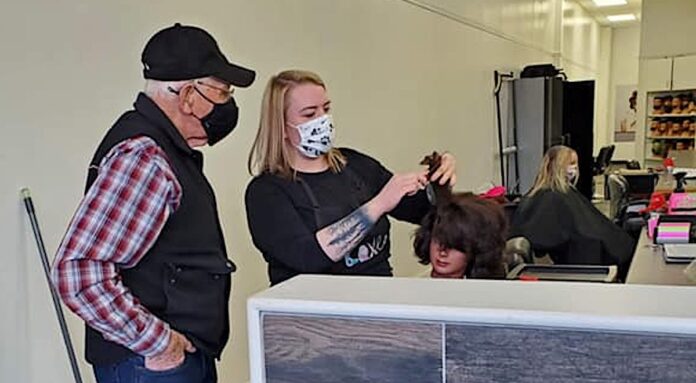
A devoted 79-year-old husband visited a beauty school to get lessons in hair and make-up to help his “beautiful” wife who can no longer get ready by herself.
The gentleman walked into Alberta’s Delmar College of Hair and Esthetics and told director Carrie Hannah that he wanted to learn how to use the curling wand.
SWNS
His wife’s vision was failing and she keeps burning herself as a result, so he was looking for a few tips.
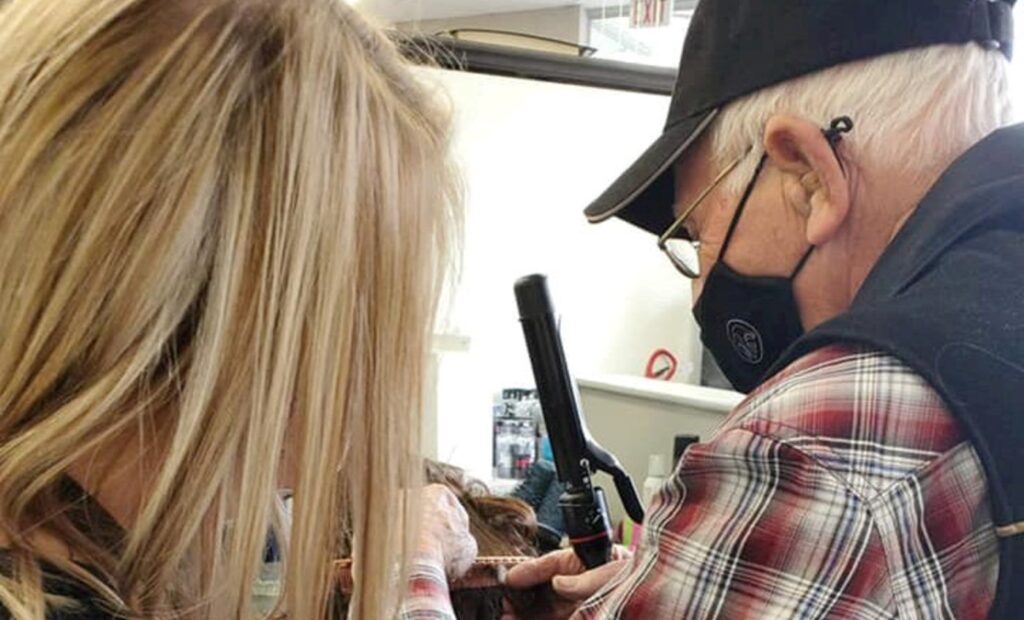
The man was paired with a student and mannequin and was taught how to operate the curling wand and protect his wife’s skin. He also asked for tips on applying her mascara.
The adorable OAP also asked for tips on applying her mascara.
Carrie said: “My staff and students were so touched by his sincere wish to help his wife of 50 plus years.
“He lovingly pulled pictures from his wallet, showing everyone his wife, and boasted about how beautiful and talented she has always been.
“Her appearance has always been something she has taken pride in and it’s important to her so therefore important to him.”
SWNS
“He is turning 80 in May, and I think he is also a very brave man for stepping into a hair college and asking for lessons on styling hair, as I don’t think too many men would do that.
“In an age of staged social media photos, it was really great to see an authentic real human gesture of love.”
This week, we’ll be treated to one of spring’s best stargazing events as the Eta Aquarid meteor shower lights up the skies.
You’ll want to set your alarm for before dawn on Wednesday, May 5, as that’s when the greatest number of meteors—originating in the debris trail of ice and rock particles from Halley’s comet—will alight the night.
The mornings of May 4 and 6 are also set to have a decent number of meteors.
The Aquarids are famously fast—rushing into Earth’s atmosphere of speeds around 148,000 miles per hour (66 kilometers per second), according to NASA. Such meteors can leave glowing trains of light—or incandescent bits of debris—which can be seen for seconds or even minutes.
Readers in the Northern Hemisphere can expect around 10 meteors per hour at its peak. In the north, the meteors are more likely to be seen as ‘earthgrazers’: shooting stars with long, bright trails that appear to ‘graze’ the earth as they streak across the sky from just below the horizon.
The moon is pretty full this week, so the sky may be quite bright where you are—impeding optimal meteor viewing. Still, with a little patience, you should get a great show in the coming nights.
Just look east towards the Aquarius constellation—specifically at the bright Eta Aquarii star—and maybe get that wide-angle lens ready so you can capture the event?
Featured image: Channone Arif, CC license
GIVE Friends a Glimmer of the Good Night Sky News—Share This Story…
Weeds compete for soil nutrients, water, space, and sunlight with the crops farmers grow to help feed people. Now a third-generation weeding robot, armed with lasers and powered by AI, offers the ultimate labor-saving device—while also eliminating the need for chemical herbicides.
The Autonomous Weeder by Carbon Robotics can eliminate 100,000 weeds per hour, and clear 15-20 acres in a single day—numbers that require a person working an entire season to match.
Trundling down a row of crops, a battery of twelve cameras scan the ground, identifying weeds through machine-learning and killing them with a CO2 laser. CO2 lasers use reactions between nitrogen, helium, carbon, and oxygen to generate powerful beams of light that are concentrated through mirrors inside the laser.
The robot’s onboard supercomputer ensures millimeter precision with its laser so as to avoid accidently clipping crops.
“This is one of the most innovative and valuable technologies that I’ve seen as a farmer,” said James Johnson of Carzalia Farm in a statement, who has utilized Carbon Robotics’ technology on his farm.
“I expect the robots to go mainstream because of how effectively they address some of farming’s most critical issues, including the overuse of chemicals, process efficiency, and labor. The sky’s the limit.”
If a farmer wants to avoid using chemical herbicides, which have flooded nearly every corner of our food and water supply chains with a probable carcinogen in the form of glyphosate, they must find enough unskilled workers to pull weeds manually—a difficult task in the already shorted market of agricultural labor.
Solving both problems, it’s no surprise that the 2021 model of the Autonomous Weeder has already sold out, even considering its price tag which was quoted at “hundreds of thousands of dollars.”
Attempting to make the device more accessible, lease options are available from the company, as they have already made the 2022 models available for preorder.
The de-weeding method of the robot is Certified Organic and in line with regenerative farming practices. Cost-effective weed control is the biggest barrier to entry with organic farming, and agriculturalists looking to make the switch finally have a seriously scalable alternative to help them get their veg out to people.
WEED Out the Bad News and Share This Good News Story With Pals…
A professional yacht racer in France, annoyed by the constant sightings of floating mats of plastic garbage in coastal waters, has designed an ocean-cleaning sailboat that is powered by the waste it collects.
The 56-meter (184 feet) Manta is the first offering from racer Yves Bourgnon’s SeaCleaners Project, and would be one of the largest waste-collecting vessels on the seas, according to Reuters.
At the end of the film Back to the Future, Dr. Emmet Brown has famously managed to replace his plutonium-powered generator with one which uses ordinary garbage. Like the DeLorean in the movie, the Manta uses garbage to power an electric motor that works in conjunction with the sails to propel the large catamaran.
In between the three pontoons, conveyor belts scoop up trash as small as 10 millimeters, over which the Manta glides, while three trawl nets drifting behind (to a depth of 1 meter, thereby avoiding sea life) add to the onboard collection. This trash is then fed into a processing machine where crewmen sort it before moving it into an incinerator that shreds and melts the plastic—and even uses the heat and gases—to power a turbine to creates the electric power.
Paired with solar panels lining the decks and a wind turbine that harvests power from the wind coming off the sails, the Manta would be 70% self-sufficient in terms of energy, allowing it to sail around sucking up 3 tons of waste an hour, without almost ever needing to return to harbor and refuel or offload plastic.
There’s also room onboard for a scientific laboratory, allowing marine biologists and chemists to study the effects of plastic on the ecosystem.
Unveiled purely as a concept, the SeaCleaners want to put a working prototype on the waves by 2024. Bourgnon believes that if 400 of the vessels were made, they could eventually remove 33% of the ocean’s plastic pollution.
Quote of the Day: “Love nothing but that which comes to you woven in the pattern of your destiny. For what could more aptly fit your needs?” – Marcus Aurelius
Photo: by Amber Flowers
With a new inspirational quote every day, atop the perfect photo—collected and archived on our Quote of the Day page—why not bookmark GNN.org for a daily uplift?
Unilever has partnered with LanzaTech and India Glycols to produce a laundry soap made from industrial carbon emissions—instead of from fossil-fuels.
The innovative shift in production utilizes biotechnologies and a newly configured supply chain between the three partners, who are working together for the first time.
Typically derived from fossil fuels, surfactants are a critical ingredient for creating the foam and cleaning action of many household cleaning and laundry products—from dish soaps to fabric detergents. The new process now allows surfactants to be made using recycled carbon.
Recycled carbon is a key form of renewable carbon and is essential to eliminating the use of fossil fuels.
The process marks the first time a surfactant made using captured carbon emissions will be offered to consumers in a mainstream cleaning product. The new surfactant launched in China on April 22nd, Earth Dan, in an OMO (Persil) laundry capsule—and, best of all, will not increase the price of the product.
Unilever consumer data from 2020 found that 87% of consumers in China considered climate change as serious a threat as Covid-19, the highest of all countries polled.
The breakthrough process involves primarily three stages:
Capture– LanzaTech, a “world leader in CarbonSmart products”, uses biotechnology to capture industrial waste emissions at its Beijing Shougang plant and converts these emissions to ethanol, which is estimated to cut the greenhouse gas emissions by 82% compared to the traditional fossil-fuel process, according to a company study.
Conversion: India Glycols converts the ethanol into ethylene oxide, a key feedstock to make surfactants at their site in India.
Formulation: Unilever uses the surfactant in the new OMO laundry capsules, manufactured at its Hefei factory in China.
The partnership is just one way that Unilever is making good on its September 2020 Clean Future pledge, which states that the multinational company hopes to eliminate fossil-fuel based chemicals from its cleaning and laundry product formulations by 2030.
“Advancements in technology like this mean we can now reinvent the chemistry of our products, asserts Peter ter Kulve, President of Home Care, Unilever. “Instead of valuable carbon being released directly into the atmosphere, we can capture it and recycle it in our products instead of using fossil fuels.
“New innovations like this help move our iconic cleaning brands away from fossil fuels without compromising on performance or affordability,” he added in a company statement.
Jennifer Holmgren, the CEO of LanzaTech said, “Our planet is running out of time and how we treat carbon requires urgent revision. By working with Unilever and IGL we can turn waste carbon into an opportunity, keeping fossil fuels in the ground and enabling new circular processes to make the products we use every day.”
A recent report estimates that renewable carbon production will need to increase by a factor of 15x by 2050 to phase-out the use of fossil carbon in consumer products.
The Unilever Home Care division also has committed to achieving Net Zero emissions from all products by 2039.
SHARE the Amazing Corporate Good News on Social Media…
A proud mom posted a beautiful video that her daughter made, marking the day her little brother was starting school this year.
Tania Van Bree / Facebook
Tania Van Bree, wrote on Facebook that Elli created this video to help spread as much information about autism as possible to the classmates at Elm Grove Elementary School who will be surrounding Willem for the next four years.
“Sometimes new kids, or loud places, scare him because his ears and eyes are extra sensitive,” she explains.
Elli, in fifth grade, who will be attending the same school until next year, provides 4 tips for how to be prepared for meeting Willem.
“Overall, he’s a kid like you and me,” she concludes. “And, I hope you love him as much as I do.”
A giant agricultural company’s years of work on a renewable, sustainable diesel fuel is finally coming to fruition—and it’s made from 100% waste products.
A 50-50 joint venture between Cargill and Love’s Travel Stops, will produce and market a green fuel under the name Heartwell Renewables.
Its new production plant now under construction in Hastings, Nebraska, will have the ability to produce approximately 80 million gallons of renewable diesel fuel annually—while creating 50 new jobs there.
Cargill will provide feedstock in the form of tallow, the animal fat discarded during its beef processing, and also used cooking oil. Once the diesel is produced, the Love’s Family of Companies, which owns and operates truck stops in 41 states, will transport and market the product in the U.S.
Heartwell Renewables will be the only entity of its kind to both produce and market renewable diesel all the way to the retail pump.
“When considering the environmental benefits and performance enhancements of renewable diesel, the creation of Heartwell Renewables is a long-term win for not only the companies involved, but also for consumers and the environment,” said JP Fjeld-Hansen, a vice president at Love’s Family of Companies.
The production process makes renewable diesel chemically identical to petroleum diesel with significant improvements in environmental performance due to its drop in carbon intensity and emissions. Renewable diesel also has a faster combustion speed, which brings more power to an engine and has been shown to lead to lower vehicle maintenance, according to a company statement.
“Through the partnership with Love’s, both companies can leverage their unique expertise and resources to address the growing demand for biofuels, while making an impact in the communities where we operate,” said Cargill’s John Niemann.
Operations should start in the spring of 2023. Once the plant opens, it will be one of only a handful of renewable diesel plants in the United States, according to the U.S. Energy Department.
(Featured photo by Khamkéo Vilaysing)
Show Your Support By Driving This Over to Your Social Media Feed…
Australia last week committed $100 million to ocean conservation in an effort to protect ‘blue carbon’ environments and reduce emissions.
Uniquely suited to care about marine life, as the world’s only island continent, the investment package will also support Australian Marine Parks, expand the Indigenous Protected Areas in the Sea Country and protection of marine species.
Much of the funding will go towards ecosystems that involve seagrass and mangroves, which play a key role in drawing carbon out of the atmosphere.
Prime Minister Scott Morrison said Australia’s oceans would be key to the country’s role in driving down emissions.
“The climate and the planet’s oceans are inextricably linked. This investment is a major contribution to domestic and international efforts to build healthier oceans and combat climate change,” said Morrison.
“This investment will boost the seagrass and mangroves that will help cut emissions and it’ll mean cleaner beaches, lower fisheries bycatch, more fish stocks, better protection for turtles and seabirds, and help for coastal and Indigenous communities reliant on the ocean for their livelihoods.”
Around 85 percent of the Aussie population lives within 50 kilometers of the coast.
Minister for the Environment, Sussan Ley said $39.9 million will go towards reinforcing Australia’s position as a world leader in marine park management which includes:
$19.4 million to be delivered through two additional rounds of the successful Our Marine Parks Grants program which will create opportunities for industry, community organisations and Indigenous communities to further engage and connect with the management of Australian Marine Parks.
$15 million towards ocean discovery and restoration projects to help us understand more about our marine parks.
$5.4 million for steps to support the health and sustainability of the pristine waters around Australia’s Indian Ocean Territories.$11.6 million will be delivered over two years to incorporate Sea Country in Indigenous Protected Areas in nine locations, to provide Indigenous communities with economic and employment opportunities.
$30.6 million will be invested in practical action to restore and account for blue carbon ecosystems. This will improve the health of coastal environments in Australia and around the region and export Australia’s internationally recognized expertise in ocean accounting, while boosting regional employment and enabling us to account for the value of these habitats as blue carbon repositories:
Almost $19 million will go to four major on-ground projects restoring coastal ecosystems across the country, including tidal marshes, mangroves and seagrasses
$10 million will provide four major on-ground projects to assist developing countries in the region restore and protect their blue carbon ecosystems
Over $1 million will help to solidify Australia as a leader in ocean and natural capital accounting assistance – this enables us to understand and account for the environmental and economic benefits of protecting these critical ecosystems.
$18 million will target practical actions to protect iconic marine species, improve the sustainability of our fisheries through reducing bycatch and stimulate investment in our oceans:
$10 million will deliver ocean health through at least 25 targeted projects to restore and protect threatened marine species, eradicate invasive species from our islands and restore coastal habitats.
$5 million will fund new and innovative measures to support the marine environment and sustainable fisheries through practical measures to avoid bycatch of threatened species
$3 million will support the roll-out of ocean accounting at a national scale
The package will create regional jobs, engage coastal and Indigenous communities and the private sector, deliver actions to improve environmental outcomes for species and ecosystems, and provide a clear pathway for working with all sectors to realize Australia’s ocean potential.
The Government has also newly pledged $59.9 million to develop a high-integrity carbon offset scheme in its Indo-Pacific region to stimulate investment in high-quality projects that deliver carbon offsets that meet the requirements of the Paris Agreement.
“The Emissions Reduction Fund is one of the largest and most robust offset schemes in the world. We see an opportunity to work with our Indo-Pacific partners, and pass on the know-how and success of that program to reduce emissions and create jobs,” Angus Taylor said.
The investments are in addition to more than $1.1 billion the Morrison Government has this week announced it will invest in low emissions energy technologies such as hydrogen and carbon capture and storage—and is in addition to the $18 billion of investment the Government is making alongside the Technology Investment Roadmap over the next 10 years to drive at least $70 billion of total new investment in low emissions technologies in Australia by 2030.
(Source: Australia.gov.au / Photo licensed by SWNS)
SAIL This Good News to Ocean-Loving Friends on Social Media…
Quote of the Day: “You gotta meet faith with action. When they meet, that’s when you can see some progress.” – Dwayne ‘The Rock’ Johnson (turns 49 today)
Photo: Niyas Khan
With a new inspirational quote every day, atop the perfect photo—collected and archived on our Quote of the Day page—why not bookmark GNN.org for a daily uplift?
FREE WILL ASTROLOGY – Week beginning April 30, 2021
Copyright by Rob Brezsny, FreeWillAstrology.com
TAURUS (April 20-May 20):
In her poem “Mirror,” Taurus poet Halina Poświatowska wrote, “I am dazed by the beauty of my body.” I applaud her brazen admiration and love for her most valuable possession. I wish more of us could genuinely feel that same adoration for our own bodies. And in accordance with current astrological omens, I recommend that you do indeed find a way to do just that right now. It’s time to upgrade your excitement about being in such a magnificent vessel. Even if it’s not in perfect health, it performs amazing marvels every minute of every day. I hope you will boost your appreciation for its miraculous capacities, and increase your commitment to treating it as the treasure that it is.
GEMINI (May 21-June 20):
Gemini poet Buddy Wakefield writes that after the Indian Ocean earthquake and tsunami of 2004, “the only structure still standing in the wiped-out village of Malacca [in Malaysia] was a statue of Mahatma Gandhi. I wanna be able to stand like that.” I expect you will indeed enjoy that kind of stability and stamina in the coming weeks, my dear. You won’t have to endure a metaphorical tsunami, thank Goddess, but you may have to stand strong through a blustery brouhaha or swirling turbulence. Here’s a tip: The best approach is not to be stiff and unmoving like a statue, but rather flexible and willing to sway.
CANCER (June 21-July 22):
No educator had ever offered a class in psychology until trailblazing philosopher William James did so in 1875. He knew a lot about human behavior. “Most people live in a very restricted circle of their potential being,” he wrote. “They make use of a very small portion of their possible consciousness, and of their soul’s resources in general, much like a person who, out of his whole bodily organism, should get into a habit of using only his little finger.” I’m going to make an extravagant prediction here: I expect that in the coming months you will be better primed than ever before to expand your access to your consciousness, your resources, and your potentials. How might you begin such an adventure? The first thing to do is to set a vivid intention to do just that.
LEO (July 23-Aug. 22):
“Someone in me is suffering and struggling toward freedom,” wrote Greek author Nikos Kazantzakis. To that melodramatic announcement, I reply, good for him! I’m glad he was willing to put himself through misery and despair in order to escape misery and despair. But I also think it’s important to note that there are other viable approaches to the quest for liberation. For example, having lavish fun and enjoying oneself profoundly can be tremendously effective in that holy work. I suspect that in the coming weeks, Leo, the latter approach will accomplish far more for you than the former.
VIRGO (Aug. 23-Sept. 22):
Virgo novelist Agatha Christie sold hundreds of millions of books, and is history’s most-translated author. While growing up, she had few other kids to associate with, so she created a host of imaginary friends to fill the void. They eventually became key players in her work as an author, helping her dream up stories. More than that: She simply loved having those invisible characters around to keep her company. Even in her old age, she still consorted with them. I bring this to your attention, Virgo, because now is a great time to acquire new imaginary friends or resurrect old ones. Guardian angels and ancestral spirits would be good to call on, as well. How might they be of assistance and inspiration to you?
LIBRA (Sept. 23-Oct. 22):
“To hurry pain is to leave a classroom still in session,” notes Libran aphorist Yahia Lababidi. On the other hand, he observes, “To prolong pain is to miss the next lesson.” If he’s correct, the goal is to dwell with your pain for just the right amount of time—until you’ve learned its lessons and figured out how not to experience it again in the future—but no longer than that. I suspect that such a turning point will soon be arriving for you.
SCORPIO (Oct. 23-Nov. 21):
In her poem “Every Day,” Scorpio poet Denise Levertov wrote, “Every day, every day I hear enough to fill a year of nights with wondering.” I think that captures the expansive truth of your life in the coming weeks. You’ve entered a phase when the sheer abundance of interesting input may at times be overwhelming, though enriching. You’ll hear—and hopefully be receptive to—lots of provocative stories, dynamic revelations, and unexpected truths. Be grateful for this bounty! Use it to transform whatever might be stuck, whatever needs a catalytic nudge.
SAGITTARIUS (Nov. 22-Dec. 21):
I hope you’re not too stressed these days. There has been pressure on you to adjust more than maybe you’d like to adjust, and I hope you’ve managed to find some relaxing slack amidst the heaviness. But even if the inconvenience levels are deeper than you like, I have good news: It’s all in a good cause. Read the wise words of author Dan Millman, who describes the process you’re midway through: “Every positive change, every jump to a higher level of energy and awareness, involves a rite of passage. Each time we ascend to a higher rung on the ladder of personal evolution, we must go through a period of discomfort, of initiation. I have never found an exception.”
CAPRICORN (Dec. 22-Jan. 19):
We can safely say that writer Anais Nin was a connoisseur of eros and sensuality. “Sex must be mixed with tears, laughter, words, promises, jealousy, envy, all the spices of fear, foreign travel, new faces, stories, dreams, fantasies, music.” In response to Nin’s litany, I’m inclined to say, “Damn, that’s a lot of ambiance and scaffolding to have in place. Must it always be so complicated?” According to my reading of upcoming cosmic rhythms, you won’t need such a big array of stuff in your quest for soulful orgasms—at least not in the coming weeks. Your instinct for rapture will be finely tuned.
AQUARIUS (Jan. 20-Feb. 18):
“One is always at home in one’s past,” wrote author Vladimir Nabokov. I agree. Sometimes that’s not a good thing, though. It may lead us to flee from the challenges of the present moment and go hide and cower and wallow in nostalgia. But on other occasions, the fact that we are always at home in the past might generate brilliant healing strategies. It might rouse in us a wise determination to refresh our spirit by basking in the deep solace of feeling utterly at home. I think the latter case is likely to be true for you in the coming weeks, Aquarius.
PISCES (Feb. 19-March 20):
“Not everything is supposed to become something beautiful and long-lasting,” writes author Emery Allen. “Not everyone is going to stay forever.” Her message is a good one for you to keep in mind right now. You’re in a phase when transitory boosts and temporary help may be exactly what you need most. I suspect your main task in the coming weeks is to get maximum benefit from influences that are just passing through your life. The catalysts that work best could be those that work only once and then disappear.
ARIES (March 21-April 19):
Poet Allen Ginsberg despairingly noted that many people want MORE MORE MORE LIFE, but they go awry because they allow their desire for MORE MORE MORE LIFE to fixate on material things—machines, possessions, gizmos, and status symbols. Ginsberg revered different kinds of longings: for good feelings, meaningful experiences, soulful breakthroughs, deep awareness, and all kinds of love. In accordance with astrological potentials, Aries, I’m giving you the go-ahead in the coming weeks to be extra greedy for the stuff in the second category.
WANT MORE? Listen to Rob’s EXPANDED AUDIO HOROSCOPES, 4-5 minute meditations on the current state of your destiny — or subscribe to his unique daily text message service at: RealAstrology.com
We heard that the annual National Day of Prayer has also spurred atheists to action—and they’re using the occasion to do good works in their community.
ACPC atheists clean up roadways
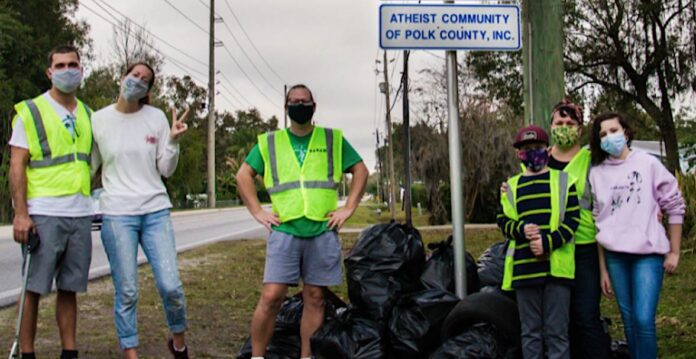
The Atheist Community of Polk County, Florida, for instance,11 is organizing a number of community service events and an awareness campaign to suggest that “fellowship” doesn’t require “faith”.
It’s all part of an annual effort to celebrate a national Secular Week of Action instead of observing the National Day of Prayer, which was set aside in U.S. federal law for people of faith to pray for the nation on the first Thursday in May.
In place of observing a day of thoughts and prayers, secular groups nationwide organize service projects. This year’s emphasis is on a compassionate response to hunger and homelessness, which were exacerbated due to the COVID-19 pandemic.
The nonprofit which covers the metro areas of Lakeland and Winter Haven, runs several ongoing programs to address social issues. They even partnered with a church in a unique food pantry coalition as a direct response to the COVID-19.
Joining the Unitarian Universalist Congregation of Lakeland, the project, called It Takes a Village, uses volunteers to deliver food pantry supplies directly to the homes of recipients who may be quarantined or unable to visit the pantry.
These local atheists also run a chapter of Street Warriors to provide hot meals to people experiencing homelessness, and a Backpack Program that supplies weekend groceries for elementary students.
ACPC Street Warriors pack food for homeless
In addition to providing much-needed food to folks throughout the County, the Secular Week of Action includes a litter clean-up of the group’s adopted roadway in Haines City on Sunday May 2 at 8:45am.
Their Street Warriors service project will also be meeting on Sunday (4:00 PM to 6:00 PM) in Winter Haven to pack up food, then hit the streets, to feed people experiencing homelessness.
Under the slogans ‘Good without God’, ‘Community without Church’, and ‘Fellowship without Faith,’ Polk County Atheists Co-founder Sarah Ray says that one of the most important thing her group provides is a sense of community.
“We want to let other nonbelievers know that there is a secular community here they can turn to. And we want to challenge the misconceptions and stereotypes about atheists. We are good people, we’re your neighbors, co-workers, and friends.”
They will also be providing a secular invocation at the Polk County Board of County Commissioners Meeting two days before the National Day of Prayer. “Providing secular invocations gives us an opportunity to remind elected officials at all levels that nonbelievers exist in their constituency.”
Nearly seven in 10 Americans identify their mom as “the cool mom,” according to a new poll.
By leah hetteberg
The survey of 2,000 American adults identified the attributes they think set their mother apart from the parenting pack.
So what makes a mom a “cool” mom?
Among the 68% of respondents who agreed that their mom was a “cool mom,” 62% said it was because she talked with her kids openly about anything and everything.
Relaxing the rules a bit may be another key, as over half said their mom’s coolness stemmed from the fact that she let them get away with things a “normal” mom wouldn’t when they were growing up. (See all the top reasons at the bottom.)
Being an epic gift-giver, or having great style, seemed to be a component as well, with 52% saying that her tendency to spoil both her loved ones and herself was what made their mom a cut above the rest.
Conducted by OnePoll on behalf of Angara.com in celebration of Mother’s Day, the survey also probed the most important lessons Americans have learned from their moms over the years.
The answers from respondents ranged from how to “be responsible” and “live in the moment” to “how to be a super parent.”
“Don’t judge others, even if you think you have the whole story,” said one respondent.
“It’s not a crime to pamper yourself when life gets too stressful,” added another. One learned to “respect yourself and others will respect you.”
Nearly seven in 10 respondents (68%) report that they learned how to juggle responsibilities from watching their moms “do it all” over the years.
In fact, over 60% saying that their mom has been juggling more in the past year than she ever has before.
So it’s perhaps unsurprising that three-quarters of respondents think that, after a long and taxing year, their mom deserves to be fully spoiled this holiday.
“Every mother’s relationship with their child or children is different,” said Ankur Daga, Founder and CEO of Angara.com. “It’s worth keeping your unique relationship with your mom in mind when planning how to make her feel special this Mother’s Day.”
“But spending a lot (of money) is less important than finding a gift that’s truly ‘her’.”
Top Reasons to Think Your Mom is the ‘Cool Mom’
1. She talks openly with her kids about anything and everything 62%
2. She spoils herself and her loved ones 52%
3. She’s always on top of the latest trends 46%
4. My mom let me get away with things a “normal” mom wouldn’t when I was growing up 52%
5. My mom is a daredevil, and will try anything once 37%
6. She is more of a friend than a mom 39%
7. My mom knows how to party 23%
8. My mom is my best friend 25%
Post This –Along With Your Own Story of a ‘Cool Mom”– on Social Media…
Scientists have figured out how to modify the unrivaled gene-editing tool CRISPR to extend its reach to the epigenome, which controls how genes are switched on or off.
The researchers from the University of California, San Francisco, and MIT’s non-profit Whitehead Institute for Biomedical Research and have already used the tool in the lab to mostly deactivate the gene that makes the protein Tau, which has been implicated in Alzheimer’s disease.
The novel CRISPR-based tool called “CRISPRoff” allows scientists to switch off almost any gene in human cells without making a single edit to the genetic code—and once a gene is switched off, it remains inert in the cell’s descendants for hundreds of generations, unless it is switched back on with a complementary tool called CRISPRon.
Because the epigenome plays a central role in many diseases, from viral infection to cancer, CRISPRoff technology may one day lead to powerful epigenetic therapies that are safer than conventional CRISPR therapeutics because it doesn’t involve any DNA edits.
“Though genetic and cellular therapies are the future of medicine, there are potential safety concerns around permanently changing the genome, which is why we’re trying to come up with other ways to use CRISPR to treat disease,” said Luke Gilbert, PhD, a professor at UCSF and co-senior author of the new paper, published in the April 9 journal Cell.
How it was built
Conventional CRISPR is equipped with two pieces of molecular hardware that make it an effective gene-editing tool. One component is a DNA-snipping enzyme, which gives CRISPR the ability to alter DNA sequences. The other is a homing device that can be programmed to zero in on any DNA sequence of interest, imparting precise control over where edits are made.
To build CRISPRoff, the researchers dispensed with conventional CRISPR’s DNA-snipping enzyme function, but retained the homing device, creating a stripped-down CRISPR capable of targeting any gene. Then they tethered an enzyme to this barebones CRISPR. But rather than splicing DNA, this enzyme acts on the epigenome, which consists of proteins and small molecules that latch onto DNA and control when and where genes are switched on or off.
The new tool targets a particular epigenetic feature known as DNA methylation, which is one of many molecular parts of the epigenome. When DNA is methylated, a small chemical tag known as a methyl group is affixed to DNA, which silences nearby genes. Although DNA methylation occurs naturally in all mammalian cells, CRISPRoff offers scientists unprecedented control over this process.
Credit: Jennifer Cook-Chrysos/Whitehead Institute
Another tool described in the paper, called CRISPRon, removes methylation marks deposited by CRISPRoff, making the process fully reversible.
“Now we have a simple tool that can silence the vast majority of genes,” said Jonathan Weissman, PhD, Whitehead Institute member, co-senior author of the new paper and a former UCSF faculty member. “We can do this for multiple genes at the same time without any DNA damage, and in a way that can be reversed. It’s a great tool for controlling gene expression.”
‘Major surprise’ upends a basic tenet
Based on previous work by a group in Italy, the researchers were confident that CRISPRoff would be able to silence specific genes, but they suspected that some 30 percent of human genes would be unresponsive to the new tool.
DNA consists of four genetic letters – A, C, G, T – but, in general, only Cs next to Gs can be methylated. To complicate matters, scientists have long believed that methylation could only silence genes at sites in the genome where CG sequences are highly concentrated, regions known as “CpG islands.”
Since nearly a third of human genes lack CpG islands, the researchers assumed methylation wouldn’t switch these genes off. But their CRISPRoff experiments upended this epigenetic dogma.
“What was thought before this work was that the 30 percent of genes that do not have CpG islands were not controlled by DNA methylation,” said Gilbert. “But our work clearly shows that you don’t require a CpG island to turn genes off by methylation. That, to me, was a major surprise.”
Enhancing CRISPRoff’s therapeutic potential
Easy-to-use epigenetic editors like CRISPRoff have tremendous therapeutic potential, in large part because, like the genome, the epigenome can be inherited.
When CRISPRoff silences a gene, not only does the gene remain off in the treated cell, it also stays off in the descendants of the cell as it divides, for as many as 450 generations.
To the researchers’ surprise, this held true even in maturing stem cells. Though the transition from stem cell to differentiated adult cell involves a significant rewiring of the epigenome, the methylation marks deposited by CRISPRoff were faithfully inherited in 90 percent of cells that made this transition, which showed that cells retain a memory of epigenetic modifications made by the CRISPRoff system even as they change cell type.
Alzheimers and the Tau protein
They selected one gene to use as an example of how CRISPRoff might be applied to therapeutics: the gene that codes for Tau protein, which is implicated in Alzheimer’s disease. After testing the method in neurons, they discovered that using CRISPRoff could be used to turn Tau expression down—although not entirely off. “What we showed is that this is a viable strategy for silencing Tau and preventing that protein from being expressed,” says Weissman. “The question is, then, how do you deliver this to an adult? And would it really be enough to impact Alzheimer’s? Those are big open questions, especially the latter.”
Even if CRISPRoff does not lead to Alzheimer’s therapies, there are many other conditions it could potentially be applied to. Their findings suggest that CRISPRoff would only need to be administered once to have lasting therapeutic effects, making it a promising approach for treating rare genetic disorders – including Marfan syndrome, which affects connective tissue, Job’s syndrome, an immune system disorder, and certain forms of cancer – that are caused by the activity of a single damaged copy of a gene.
While delivery to specific tissues remains a challenge, “we showed that you can deliver it transiently as a DNA or as an RNA, the same technology that’s the basis of the Moderna and BioNTech coronavirus vaccine,” Weissman says.
Because the epigenome plays a central role in so many diseases, this exciting new technology may one day lead to powerful therapies to tackle our deadliest foes, although “further work is needed to realize its full therapeutic potential.”
EDIT Your Social Media Feed With This Hopeful Good News…
Quote of the Day: “The month of May was come, when every lusty heart beginneth to blossom, and to bring forth fruit.” – Thomas Malory
Photo: Paul Felberbauer
With a new inspirational quote every day, atop the perfect photo—collected and archived on our Quote of the Day page—why not bookmark GNN.org for a daily uplift?