This blog was submitted to GNN by one of our readers for publishing. If you have an interesting story of kindness or positivity, be sure and send it to us for review.
Every year, thousands of hikers attempt to complete the 2,000-mile Appalachian Trail, stretching from Georgia to Maine, but only one-in-four are able to conquer the mountainous terrain that has an elevation gain and loss equivalent to hiking Mt. Everest from sea-level and back 16 times.
Hikers typically carry only three days of food and sometimes run short, as they endeavor to reach the next town to resupply. Fortunately, trail angels sprinkle their magic along the way to provide weary hikers food, drink, and a comfy chair in which to rest.
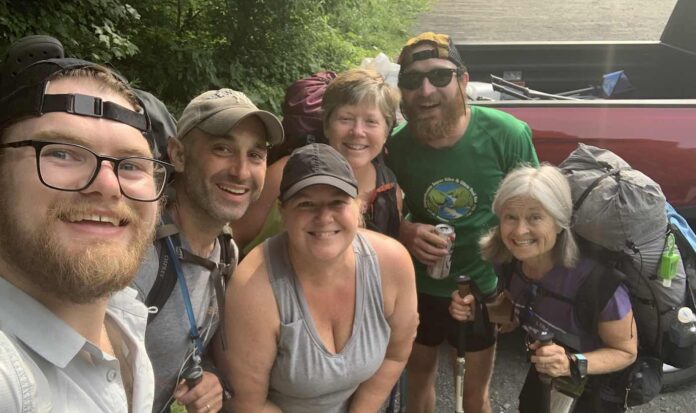
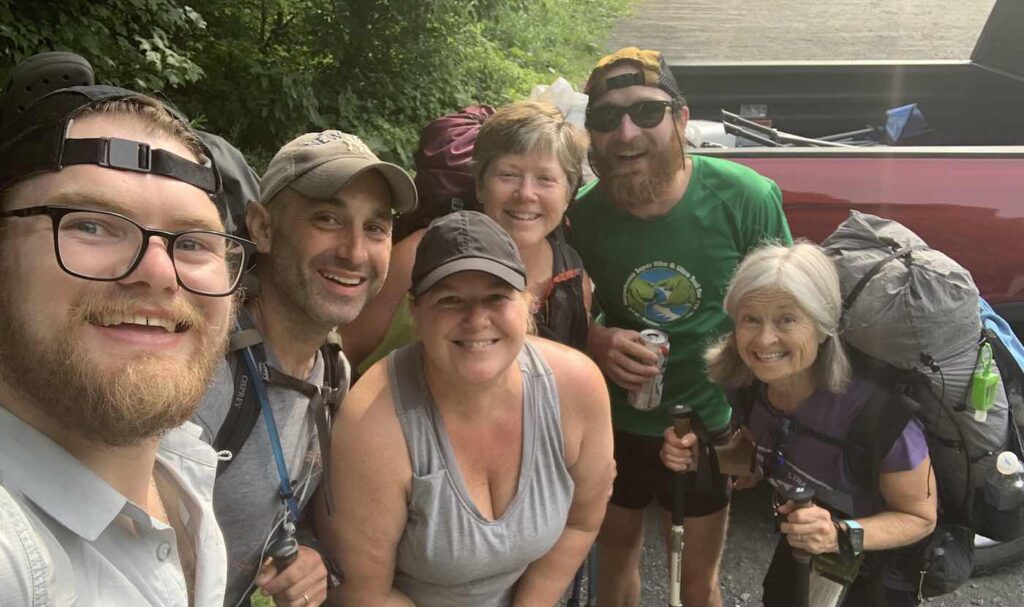
Michele Staudenmaier had never heard of trail angels or trail magic before her son Zach began a thru-hike of the Appalachian Trail (A.T.) in March. Zach told her how hikers so appreciated real food and drinks from volunteers, nicknamed “trail angels” by the hiking community.
And so Michele decided she would become one such angel.
She and her husband Dave, had already arranged to stay in Airbnb’s along the A.T—in Georgia, Tennessee, West Virginia, Pennsylvania, Vermont and Maine—during the 6 months Zach had planned to hike.
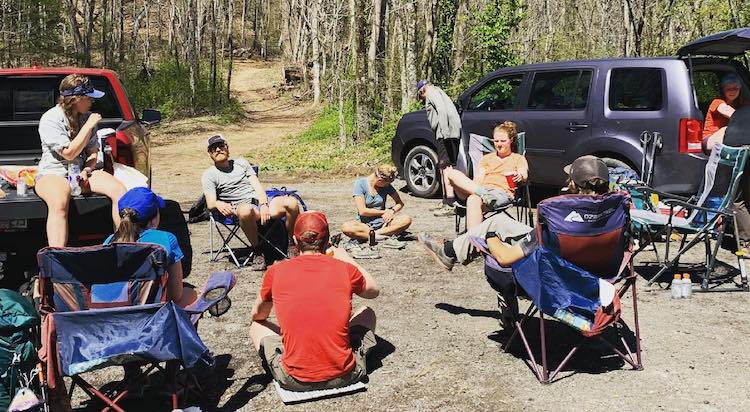
There are many remote places where the trail crosses a road, which offers a perfect place to set up some ‘trail magic’—a term coined by long-distance hikers to describe an unexpected occurrence that lifts a hiker’s spirits. There, typically an hour or so from any town, she would often encounter other trail angels spreading their own magic.
Trail Magic in Bristol, Tennessee
“I was very surprised”, said Michele, “when I realized there was a massive community of volunteers that spend their time and money to support Appalachian Trail hikers. I had no idea!”
An average hiker will burn as much as 600 calories per hour hiking up and down mountains carrying a 30-pound pack—and they are always ravenous.
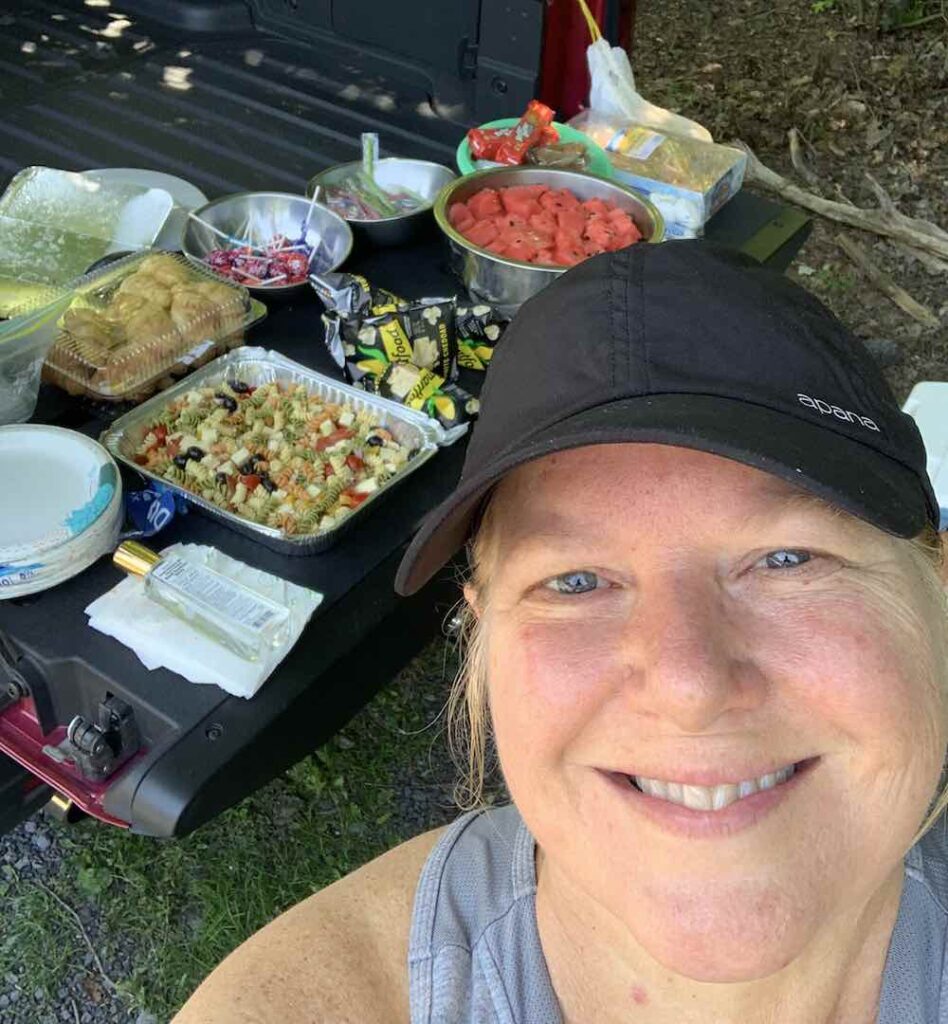
One time Michele cooked and wrapped 50 hot dogs to serve along with chips, fruit, sweet treats, sodas, and Gatorade.
Michele Staudenmaier
Another time she served up buckets of Kentucky Fried Chicken and pasta salad to delighted hikers. Typically as many as 20 or 30 hikers come through and spend a half hour or so resting, eating and telling stories of the A.T. before resuming their hike.
One hiker had completely run out of food the day before and expressed undying gratitude while quickly devouring six hot dogs.
Another said “you have no idea how good this chicken tastes after eating camp food!” It is unusual to have any food left over from a trail magic excursion.
Michele looks forward to spreading more trail magic and hearing the stories from hikers and other trail angels as she works her own way towards Maine.
SEND This to Friends Ravenous For Good News on Social Media…
FREE WILL ASTROLOGY – Week beginning June 25, 2021
Copyright by Rob Brezsny, FreeWillAstrology.com
CANCER (June 21-July 22):
“I was so flooded with yearning I thought it would drown me,” wrote Cancerian author Denis Johnson. I don’t expect that will be a problem for you anytime soon. You’re not in danger of getting swept away by a tsunami of insatiable desire. However, you may get caught in a current of sweet, hot passion. You could be carried for a while by waves of aroused fascination. You might find yourself rushing along in a fast-moving stream of riled-up craving. But none of that will be a problem as long as you don’t think you have something better to do. In fact, your time in the cascading flow may prove to be quite intriguing—and ultimately useful.
LEO (July 23-Aug. 22):
In my opinion, psychology innovator Carl Jung, born under the sign of Leo, was one of the 20th century’s greatest intellects. His original ideas about human nature are central to my philosophy. One of my favorite things about him is his appreciation for feelings. He wrote, “We should not pretend to understand the world only by the intellect; we apprehend it just as much by feeling. Therefore, the judgment of the intellect is, at best, only half of the truth, and must, if it be honest, also come to an understanding of its inadequacy.” I bring this to your attention, Leo, because the coming weeks will be a favorable time to upgrade your own appreciation for the power of your feelings to help you understand the world.
VIRGO (Aug. 23-Sept. 22):
For the indigenous Ojibway people, the word Adizokan means both “story” and “spirit.” In fact, story and spirit are the same thing. Everything has a spirit and everything has a story, including people, animals, trees, lakes, rivers, and rocks. Inspired by these thoughts, and in accordance with cosmic omens, I invite you to meditate on how your life stories are central elements of your spirit. I further encourage you to spend some tender, luxurious time telling yourself the stories from your past that you love best. For extra delightful bonus fun, dream up two prospective stories about your future that you would like to create. (Info from SweetWaterVisions.com.)
LIBRA (Sept. 23-Oct. 22):
Author Aslı Erdoğan writes, “It had been explained to me from my earliest childhood that I would know love—or that thing called ‘love’—as long as I was smart and academically brilliant. But no one ever taught me how to get that knowledge.” I’m sorry to say that what was true for her has been true for most of us: No one ever showed us how to find and create and cultivate love. We may have received haphazard clues now and then from our parents and books and movies. But we never got a single day of formal instruction in school about the subject that is at the heart of our quest to live meaningful lives. That’s the bad news, Libra. The good news is that the rest of 2021 will be one of the best times ever for you to learn important truths about love.
SCORPIO (Oct. 23-Nov. 21):
Before he journeyed in a spaceship to the moon in 1971, Scorpio astronaut Alan Shepard didn’t think he’d get carried away with a momentous thrill once he arrive at his destination. He was a manly man not given to outward displays of emotion. But when he landed on the lunar surface and gazed upon the majestic sight of his home planet hanging in the sky, he broke into tears. I’m thinking you may have similar experiences in the coming weeks. Mind-opening, heart-awakening experiences may arrive. Your views of the Very Big Picture could bring healing upheavals.
SAGITTARIUS (Nov. 22-Dec. 21):
Sagittarian author Clarice Lispector observed, “In a state of grace, one sometimes perceives the deep beauty, hitherto unattainable, of another person.” I suspect that this state of grace will visit you soon, Sagittarius—and probably more than once. I hope you will capitalize on it! Take your time as you tune in to the luminescent souls of the people you value. Become more deeply attuned to their uniquely gorgeous genius.
CAPRICORN (Dec. 22-Jan. 19):
Trailblazing Capricorn psychoanalyst Ernest Jones (1879–1958) said, “There is no sense of contradiction within the unconscious; opposite ideas exist happily side by side.” In other words, it’s normal and natural to harbor paradoxical attitudes; it’s healthy and sane to be awash in seemingly incongruous blends. I hope you will use this astrologically propitious time to celebrate your own inner dichotomies, dear Capricorn. If you welcome them as a robust aspect of your deepest, truest nature, they will serve you well. They’ll make you extra curious, expansive, and non-dogmatic. (PS: Here’s an example, courtesy of psychologically savvy author Stephen Levine: “For as long as I can remember the alternate antics of the wounded child and the investigations of the ageless Universal played through me.”)
AQUARIUS (Jan. 20-Feb. 18):
Aquarian guitarist Django Reinhardt was a celebrated jazz musician in occupied France during World War II. Amazingly, he was able to earn good money by performing frequently—even though he fit descriptions that the rampaging Germans regarded as abhorrent. Nazis persecuted the Romani people, of which he was one. They didn’t ban jazz music, but they severely disapproved of it. And the Nazis hated Jews and Blacks, with whom Reinhardt loved to hang out. The obstacles you’re facing aren’t anywhere near as great as his, but I propose we make him your role model for the next four weeks. May he inspire you to persist and even thrive in the face of challenges!
PISCES (Feb. 19-March 20):
Piscean author Richard Matheson believed we’ve become too tame and mild. “We’ve forgotten,” he wrote, about “how to rise to dizzy heights.” He mourned that we’re too eager to live inside narrow boundaries. “The full gamut of life is a shadowy continuum,” he continued, “that runs from gray to more gray. The rainbow is bleached.” If any sign of the zodiac has the power to escape blandness and averageness, it’s you Pisceans—especially in the coming weeks. I invite you to restore the rainbow to its full vivid swath: red, orange, yellow, green, blue, indigo, and violet. Maybe even add a few colors.
ARIES (March 21-April 19):
Author Albert Camus advised everyone to “steal some time and give it freely and exclusively to your own self.” That’s excellent advice for you to heed in the coming days. The cosmos has authorized you to put yourself first and grab *all* the renewal you need. So please don’t scrimp as you shower blessings on yourself. One possible way to accomplish this goal is to go on a long stroll or two. Camus says, “It doesn’t have to be a walk during which you’ll have multiple life epiphanies and discover meanings no other brain ever managed to encounter.” But I think you are indeed likely to be visited by major epiphanies and fantastic new meanings.
TAURUS (April 20-May 20):
Robert Mugabe was Zimbabwe’s leader for 37 years. In the eyes of some, he was a revolutionary hero. To others he was an oppressive dictator. He was also the chancellor of the University of Zimbabwe, where his wife Grace received her PhD just two months after she started classes. I suspect that you, too, will have an expansive capacity to advance your education in the coming weeks—although maybe not quite as much as Grace seems to have had. You’re entering a phase of super-learning.
GEMINI (May 21-June 20):
“We were clever enough to turn a laundry list into poetry,” wrote author Umberto Eco. Judging from astrological omens, I suspect you’re now capable of accomplishing comparable feats in your own sphere. Converting a chance encounter into a useful new business connection? Repurposing a seeming liability into an asset? Capitalizing on a minor blessing or breakthrough to transform it into a substantial blessing or breakthrough? All these and more are possible.
WANT MORE? Listen to Rob’s EXPANDED AUDIO HOROSCOPES, 4-5 minute meditations on the current state of your destiny — or subscribe to his unique daily text message service at: RealAstrology.com
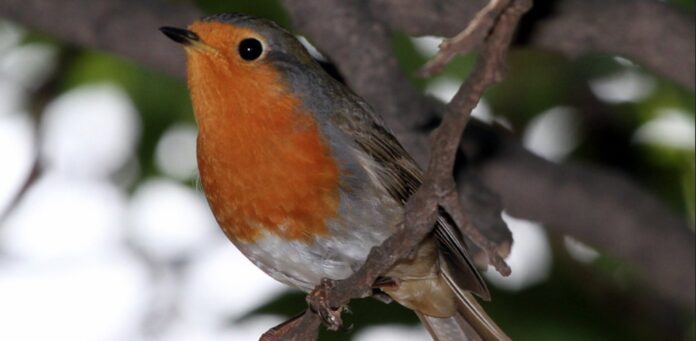
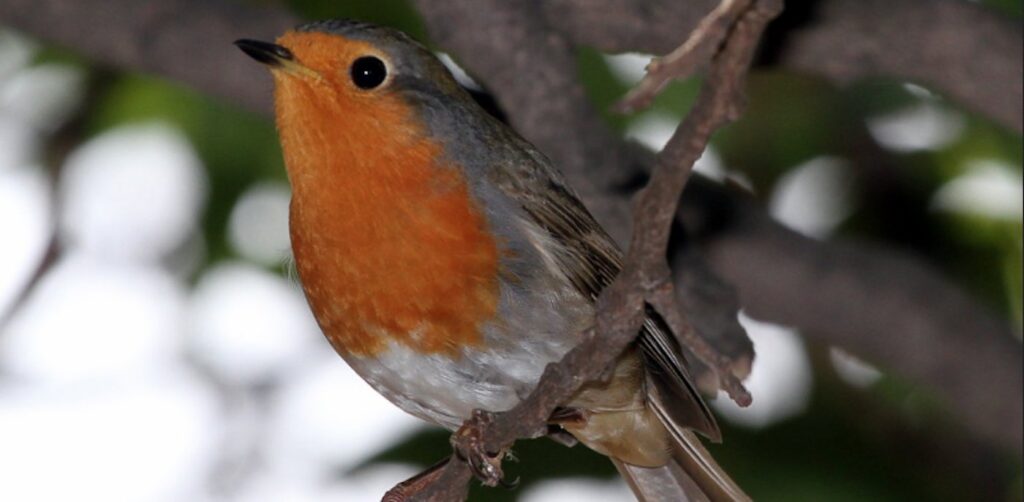
European robin by Greg Schechter, CC license on Flickr
Birdwatchers may compliment each other by saying “you have the eyes of a hawk,” but now they might want to say “you have the eyes of a robin”.
European robin by Greg Schechter, CC license on Flickr
Within the European robin’s eye, scientists have identified a protein which they believe acts as the bird’s biological attunement to Earth’s magnetic field, the key to the long-sought mechanism behind how they are able to migrate mass distances.
Whether it was in school or from parents, or through watching Mutual of Omaha’s Wild Kingdom and Planet Earth, everyone learns that birds migrate, but rarely does one ever learn how birds manage it.
‘Cryptochromes’ are not a new form of digital currency, but rather a group of light-sensitive flavoproteins found in the retinas of birds and other groups of animals. Cryptochrome 4 (cry4) is posited in a new study to be the organ behind magneto-sensitivity.
Following an experiment using quantum mechanics, The Scientist reports that researchers at the University of Oxford, searching for such a means, were left with “overwhelming evidence that cry4 [is] the hottest candidate.”
One of the reasons for this was that, of the three other cryptochromes in the robin’s eye, cry4 was the only one that bound to a particular molecule which gave it the ability to sense light, an important first step in the ability to sense magnetic fields.
Furthermore, unlike the other three which had 24-hour responsiveness, cry4 was not attuned to the day-night cycle, but instead had seasonal variation, which in turn the other three did not possess.
The cryptochrome proteins in chickens and pigeons, birds which don’t migrate, could not detect the magnetic field generated in the laboratory, further reinforcing the theory.
While there is still debate about the conclusion, the theory is that cry4 detects light and the position of the earth during the seasons. How does this create an ability to sense magnetism?
When bound with molecules, the cry4 are known to create a pair of free radicals. These free radicles have unpaired electrons, which lead them to hop along a string of tryptophan amino acids. It was the quantum spin of these radicles that was thought to give the birds their ability to detect the magnetic fields of the earth, through a photo-chemical reaction.
Some Reddit commenters in the heavily-moderated science forum, suggested that one half of the Robin’s field of vision would possess a different shade of color to the other.
Research from the Theoretical and Computation Biophysics Group at the University of Illinois at Urbana-Champaign produced a series of images after researcher Klaus Schulten first predicted magnetoreceptive cryptochromes years ago, positing that they might provide a magnetic field “filter” over the bird’s field of view—like in the images above.
Writing to The Scientist, the authors of the paper responded directly to peers who disputed the relevance of their findings, and explained that none of the evidence put forward to disprove their findings were replicable in their lab.
So, though there are unanswered questions currently, this chemical reaction created by the missing electrons seems to be the strongest existing theory on how birds are able to travel thousands of miles without getting lost.
FLY This Fascinating Finding to Friends on Social Media…
Quote of the Day: “The greatest thing in the world is to know how to belong to oneself.” – Michel de Montaigne
Photo: by Dollar Gill
With a new inspirational quote every day, atop the perfect photo—collected and archived on our Quote of the Day page—why not bookmark GNN.org for a daily uplift?
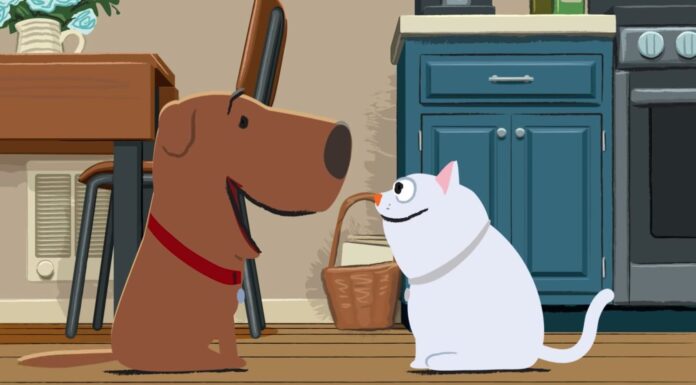
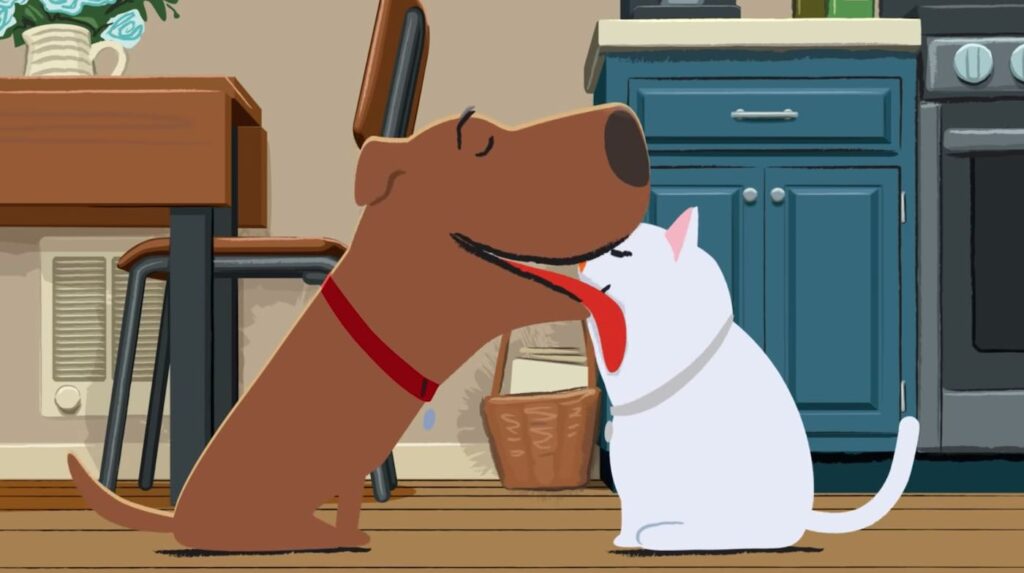
A Portland man’s adorable animated short about friendship, love, and ‘getting through tough times’ is generating thousands of smiles.
Steve Cowden
Born of grief, when his nephew died unexpectedly, Steve Cowden spent most of 2020 working on the video during lockdown, and now hopes to pitch it as a heartwarming series.
After a family gathering to honor the nephew, Cowden’s 22-year-old son Trent began spontaneously playing chords on the old piano.
“My twin brother Scott joined in with singing the words ‘Chocolate Cake and Ice Cream.’ We had just eaten dessert and he sang the silly words, I think, to lighten our hearts,” Cowden told GNN.
“I was upstairs with my mom and the tune was so sweet that I ran downstairs to be part of the moment. We all sang in harmony together. It kind of felt magical and seemed to help us. It was just a jingle at the time but it stuck with me.”
Chocolate Cake and Ice Cream, Some things are just better together
After returning to Oregon, while commuting to work, he began singing it and adding more words. He pulled out his voice memo app and made some recordings. By the time he had arrived at work (about 40 minute drive) the song was complete, and he and Trent later recorded the final version using another old piano.
“The song was so catchy, I almost immediately had the idea of making it into an animated short about a dog and cat.”
Steve Cowden
Cowden’s cute animation includes a moment when the cat, in order to amuse the doggie in the window, dances the moonwalk across a fence top.
“The response has really been amazing. One woman told me she shared the video with her network of 400 families who have experienced the loss of a loved one.”
I’ll always treasure these times forever, and whenever I see your smile. Some things are better when they’re together, so let’s never say goodbye. Chocolate cake and ice cream—I hope we never part.
Cowden has been an illustrator for 30 years, and in 2000 he did the art for a children’s book entitled Cheese Louise. Since releasing the video, Steve has dreamed up additional characters, and written more episodes that he hopes can be make them into a series.
(Watch ’til the end to get all the ‘feels’!)
SHOW Your Friends How Much You Care – Share the Love on Social Media…
By mimicking how a spider spins silk at room temperature, an Oxford University venture has created a high performance, biodegradable textile that is 1,000 times more efficient than current methods for making man-made fabrics, which emit tons of carbon.
Biomimicry Institute
Over the course of millions of years, spiders have evolved the ability to create one of the world’s strongest and most adaptable materials—silk.
The secret to a spider’s ability to create silk lies within their spinnerets, a specialized organ that turns the liquid silk gel within the spider’s abdomen into a solid thread.
After years of research into this unique mechanism, Spintex has managed to mimic the spider’s amazing ability: The company has created a process to spin textile fibers from a liquid gel, at room temperature, with water and biodegradable textile fibers as the only outputs.
Last week, the nonprofit Biomimicry Institute awarded $100,000 to the English researchers, naming Spintex the winner of this year’s Ray of Hope Prize, which honors the world’s top nature-inspired startups.
“By learning from nature, Spintex is creating new products, materials, and processes that solve fundamental sustainability challenges,” says the media release.
“The textile industry is searching for sustainable technologies and solutions that will reduce waste, greenhouse gas emissions, and pollution, and enable a circular economy. Spintex is uniquely positioned to replace not only silk used in fashion, but also oil-derived synthetic fibers. As they scale, their goal is to expand upon their textile capabilities, creating high-performance textiles with properties, such as stretch and embedded color, all while creating biodegradable and non-bioaccumulating textiles.”
More than 50% of silk’s environmental footprint lies in the raw material processing, which uses thousands of liters of water that must be boiled every day, so it’s very energy intensive. Currently, there are no sustainable alternatives to traditional silk.
“Spintex provides the only truly sustainable option for silk production that can produce fibers with the quality, performance and luster of traditional silk,” says the company website. “The room temperature processes completely remove the high-energy costs seen in the silk industry, while providing an equivalent or superior product.”
“Going through the Ray of Hope program has been a fantastic experience,” said Alex Greenhalgh, CEO and co-founder of Spintex. “All of us are deeply honored to be selected as the winners of the 2021 prize and are so grateful for the opportunity given to us.”
Spintex told GNN they currently have ongoing development projects with some big fashion and textile brands, but nothing is yet commercially available.
Besides fostering the growth of top nature-inspired startups, the Biomimicry Institute hosts a cool website called AskNature.org, which is a free online tool that contains strategies found in nature and examples of ways they’re used in design.
SPIN This Yarn And Share it With Your Friends on Social Media…
Quote of the Day: “The reason birds can fly and we can’t is simply because they have perfect faith, for to have faith is to have wings.” – J.M. Barrie, The Little White Bird
Photo: by Navi Photography
With a new inspirational quote every day, atop the perfect photo—collected and archived on our Quote of the Day page—why not bookmark GNN.org for a daily uplift?
Lots of teens look for novel ways to supplement their summer income. After surfing YouTube for ideas, this 16-year-old came up with a plan and is now uplifting people who are down on their luck.
It was only after setting the wheels in motion, however, that Shane Jones discovered turning his money-making scheme into a nonprofit venture would earn him a lot more satisfaction.
A DIY video detailing the steps for buying repossessed storage units online and selling the contents appealed to the Rhode Islander’s entrepreneurial spirit. Taking $100 he’d saved up from his job at a used bookstore, last August, he put in a bid on his first unit—and won.
Per the terms of the auction, the youth from Wakefield bought the unit sight unseen—but when he realized the contents contained a raft of personal treasures likely worth more to their former owners than for any potential resale value, the experience was eye-opening.
“I started out thinking that bidding at a storage auction was kind of like a yard sale, but now I know that’s not true,” Shane told The Washington Post. “These people didn’t choose to give me this stuff. They didn’t have a choice. It’s almost like a duty to give it back.”
A little sleuthing revealed the original owner of the unit was in prison. Sensing the man hadn’t given up the batch of mementos and documents voluntarily, with the help of his parents, Shane was able to track down the incarcerated man’s mother and return his possessions to her.
The thankful mom was so thrilled by Shane’s thoughtful actions, he was inspired to keep the momentum going. While the owners of the second unit Shane bought had passed away, clues inside led him to heirs to whom he was able to pass along a passel of family heirlooms.
The owner of Shane’s third storage auction win turned out to be a woman whose life had taken a downward spiral. After losing a baby to sudden infant death syndrome, she eventually lost her job as well. Even though the locker contained the precious keys to her past—baby items and family photos—she’d been unable to afford its upkeep.
Shane contacted the locker’s former owner, who’d since relocated to Connecticut, and made arrangements for a front-porch rendezvous at his home to return her belongings. When she arrived, she was moved to tears by the teen’s kindness.
The high school sophomore was recently recognized for his amazing good deeds with a shout-out on the South Kingstown School District’s Facebook page. While the kudos are appreciated, his mom, Sarah Markey, hopes her son’s compassion and caring actions will motivate others to follow his example.
“I couldn’t be more proud of this kid, for going the extra step, for people he doesn’t know. It is actually a lot of work that he puts into this effort,” Sarah told the Post. “And I think that part of what he has learned by meeting people who he gifted with this kindness is that putting good into the world is one of the most gratifying things that he can do.”
A simple lesson, perhaps, but certainly one we could all benefit from learning.
On Wednesday, philanthropist and investor Warren Buffett announced he would be donating $4.1 billion to various charitable foundations.
Fortune Live Media, CC license
The world’s seventh-richest person explained how in 2006 he pledged to distribute all of his Berkshire Hathaway shares—more than 99% of his net worth—to philanthropy. With his latest $4.1 billion distribution, he’s already more than halfway there.
The rest of his 238,624 shares, worth about $100 billion, remain destined for charity—with Buffett planning to continue giving to the Susan Thompson Buffett Foundation, the Sherwood Foundation, the Howard G. Buffett Foundation, the Novo Foundation, and the Gates Foundation.
Buffett puts his generosity simply: “Over many decades I have accumulated an almost incomprehensible sum simply by doing what I love to do. I’ve made no sacrifice nor has my family. Compound interest, a long runway, wonderful associates, and our incredible country have simply worked their magic. Society has a use for my money; I don’t.”
He states, “A much more admirable form of philanthropy than mine involves the giving of personal time and effort. I’ve done little of that. Those who give their love and time in order to directly help others—perhaps adding a monetary gift that requires them to give up the purchase of something meaningful for their own use—are the heroes of philanthropy. America has millions of such givers.
“These people receive no recognition whether they mentor the young, assist the elderly or devote precious hours to community betterment. They do not have buildings named after them, but they silently make those establishments—schools, hospitals, churches, libraries, whatever—work smoothly to benefit those who have received the short straws in life.”
Buffett joined the exclusive club of people worth more than $100 billion in March, after shares in Berkshire Hathaway rose to history levels in 2021.
Though some of the advice in Buffett’s latest statement goes out only to the few, it’s still wise and worth heeding: “After much observation of super-wealthy families, here’s my recommendation: Leave the children enough so that they can do anything but not enough that they can do nothing.
“I’m delighted that my three children—now in their mid-60s—pursue philanthropic efforts that involve both money and time. More important, they are happy that they can be involved in helping others. They have their mother’s genes.”
A co-founder of the Giving Pledge—which encourages the uber-rich to give their wealth away—the billionaire businessmen finishes his latest release on a hopeful note: “America’s best days most certainly lie ahead.
“What’s happened here since 1776 has not been a historical fluke. Philanthropy will continue to pair human talent with financial resources. So, too, will business and government. Each force has its particular strengths and weaknesses. Combined, they will make the world a better place—a much better place—for future generations.”
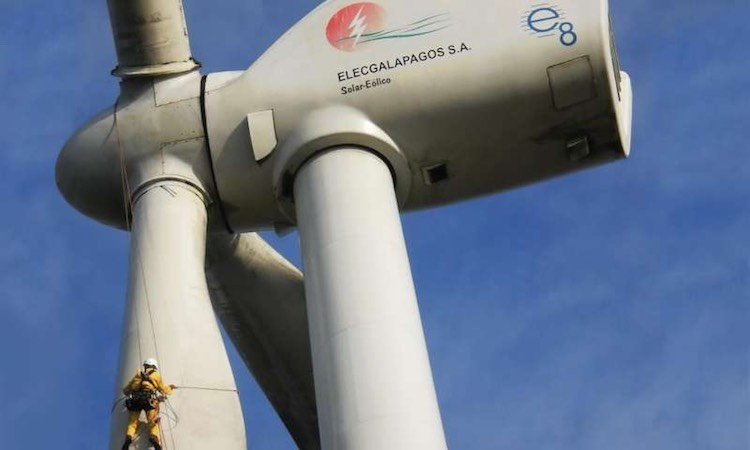
As fast as old wind turbine blades are becoming a recycling problem, there are solutions being presented to solve it.
Courtesy of EOLICSA
In Ireland, used wind turbine blades are being repurposed to build bridges, reinforce concrete, and are being proposed as potential highway noise barriers and coastal wake walls.
The first generation of wind farms are retiring their turbine blades. Cast from a fixture of plastic and fiberglass, they are essentially unrecyclable. Their predicted waste in tonnage is expected to reach 2 million by 2050.
However the fiberglass they’re made up is a valuable material used to make things strong and light, and reusing them as raw materials means less new fiberglass needs to be produced. Furthermore, as next generation blades look to increase size, strength, and lifespan, manufacturers are switching from fiberglass to carbon fiber.
The situation is perfect for innovative uses to remove a problem permanently, as next generation carbon fiber blades will be more recyclable.
Enter University College Cork in Ireland, and their plan to build a bridge out of old wind turbine blades. That can only be a good thing, as the Emerald Isle will get weighed down by 11,000 tons of decommissioned blades over the next 4 years.
“The blades are from a decommissioned Nordex N29 turbine, 14 meters long,” said Paul Leahy, lecturer in wind energy engineering to Euro News. “For this bridge, which has a span of 5m, we cut a short section from the blade. The blades are used as the main structural element of the bridge and are functional in the design.”
“However, they are also aesthetically attractive due to their gently curved shape, so we believe this will become a feature of interest on the greenway route. We are also looking at additional repurposed blade products such as outdoor furniture.”
UCC is working with schools in the States on the “Re-Wind” project—which aims to employ old blades for other uses, such as coastal wake barriers to protect soils from erosion, or to build electrical transmission towers.
Another blade recycling initiative is to use them as part of the UK’s developing high-speed rail network built by Skanska Costain Strabag.
Using the blades to reinforce concrete for various infrastructure constructions such as access roads, project developers say this should help cut carbon costs by 90%.
POWER UP the Good News—Share This Story With Friends on Social Media…
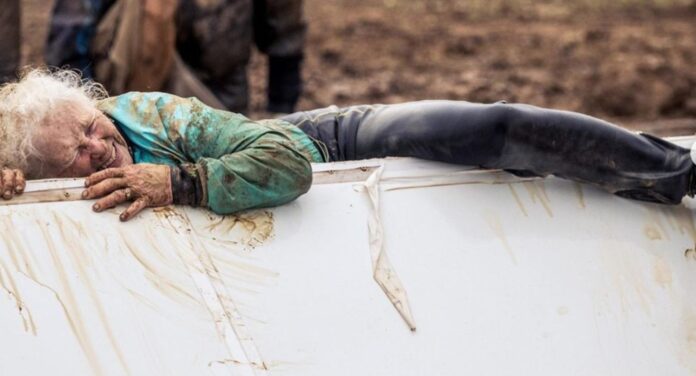
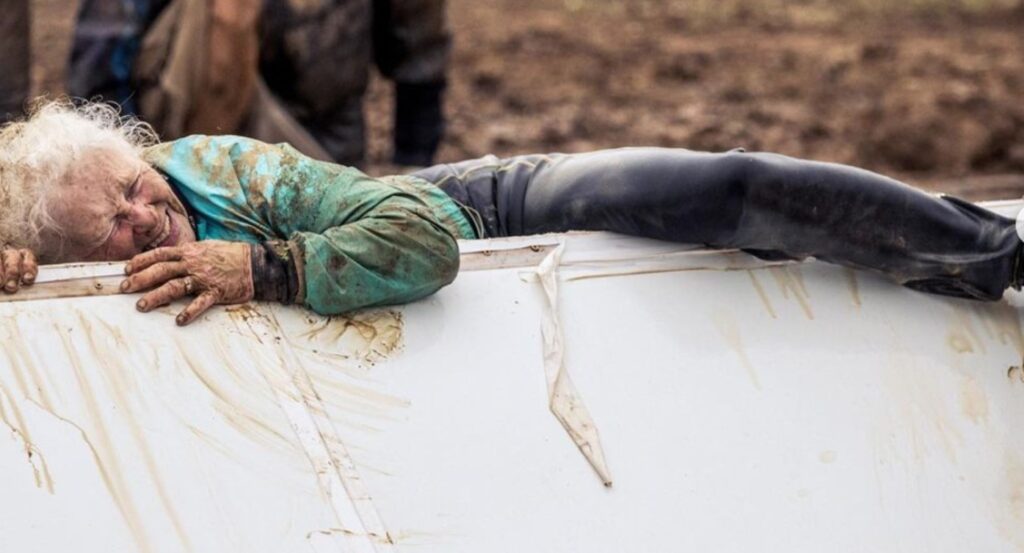
Okay, so an 81-year old widow just finished her second Tough Mudder Race. What’s your excuse?
Mildred Wilson from Sikeston. Missouri crossed the finish line of a Tough Mudder 5k obstacle course, muddy and elated earlier in March. Despite being an octagenarian, this was Wilson’s second completed Tough Mudder.
In 2019, shortly after her 80th birthday, Wilson was asked by her son if she wanted to do a race, after he himself had just finished one. The race is famous for immediately requiring participants to army crawl through pits of muddy water before tackling a several mile run interspersed with obstacles.
“I had watched him do the World’s Toughest Mudder in Vegas,” Mildred said, according to local news reports. “He asked me last fall if I would like to do one. I said yes, but, if I do it, I want to be able to really do it. Not just be out there.”
She had to get the thumbs up from her doctor first, she said, and began training at the YMCA after getting the medical all-clear. It paid off big time, as she would crush every obstacle in her path, remarking that the Missouri course was a little easier than she expected.
“Except for the wall! I always wanted to try that wall. I realized it wasn’t a piece of cake. It took a whole village to get me up,” she said, referring to a sheer wall of an obstacle called “Everest” requiring ascent by rope.
Wilson’s husband, Farrell, supported her the whole time and cheered her across the finish line in 2019 before passing away the next year. It was in his honor she crossed the line once again in 2021.
Tough Mudder’s official celebratory post included an open question to their readers: when was the last time you did something for the first time? In light of Mildred Wilson’s accomplishment, I think we could all afford an answer to that question.
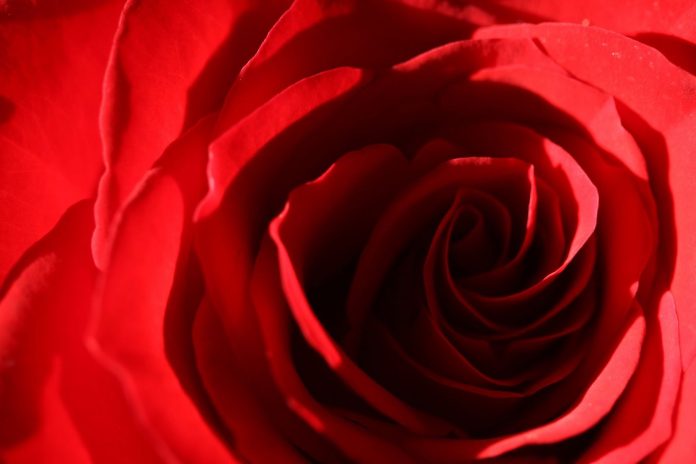
The rose may be one of the most iconic symbols of the fragility of love in popular culture, but now the flower could hold more than just symbolic value.
A new device for collecting and purifying water, developed at The University of Texas at Austin, was inspired by a rose and, while more engineered than enchanted, is a dramatic improvement on current methods.
Each flower-like structure costs less than two cents to make and can produce more than half a gallon of water per hour per square meter.
A team led by associate professor Donglei Fan developed a new approach to solar steaming for water production—a technique that uses energy from sunlight to separate salt and other impurities from water through evaporation.
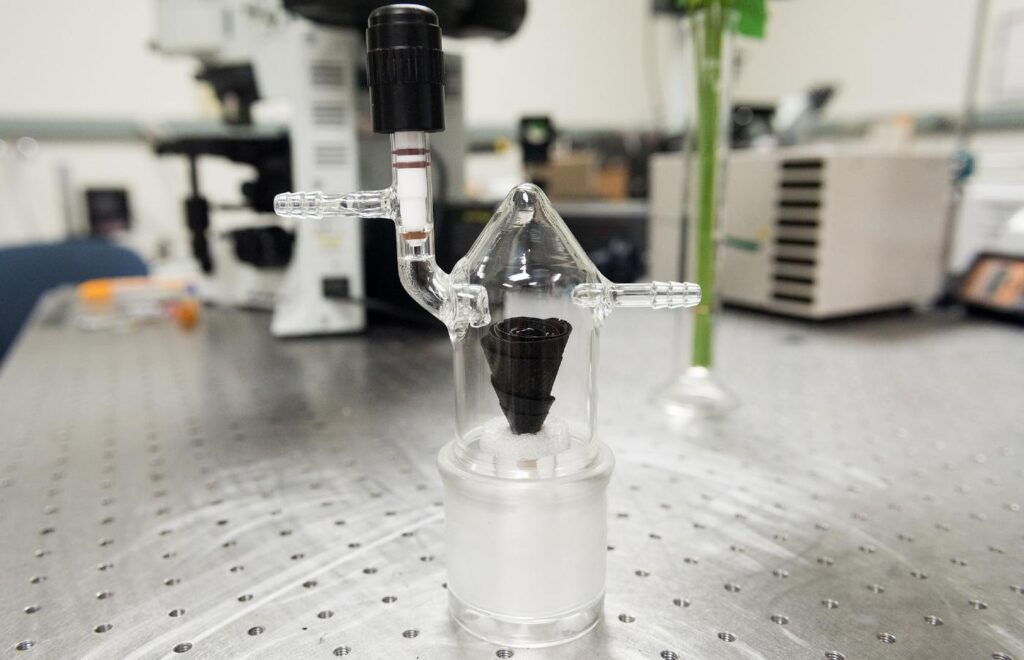
The authors of the study outline how an origami rose provided the inspiration for developing a new kind of solar-steaming system made from layered, black paper sheets shaped into petals. Attached to a stem-like tube that collects untreated water from any water source, the 3D rose shape makes it easier for the structure to collect and retain more liquid.
Current solar-steaming technologies are usually expensive, bulky and produce limited results. The team’s method uses inexpensive materials that are portable and lightweight. Oh, and it also looks just like a black-petaled rose in a glass jar.
Cockrell School of Engineering, The University of Texas at Austin
Those in the know would more accurately describe it as a portable low-pressure controlled solar-steaming-collection “unisystem.” But its resemblance to a flower is no coincidence.
“We were searching for more efficient ways to apply the solar-steaming technique for water production by using black filtered paper coated with a special type of polymer, known as polypyrrole,” Fan said.
Polypyrrole is a material known for its photothermal properties, meaning it’s particularly good at converting solar light into thermal heat.
Fan and her team experimented with a number of different ways to shape the paper to see what was best for achieving optimal water retention levels. They began by placing single, round layers of the coated paper flat on the ground under direct sunlight. The single sheets showed promise as water collectors but not in sufficient amounts.
After toying with a few other shapes, Fan was inspired by a book she read in high school. Although not about roses per se, The Black Tulip by Alexandre Dumas gave her the idea to try using a flower-like shape, and she discovered the rose to be ideal.
Its structure allowed more direct sunlight to hit the photothermic material—with more internal reflections—than other floral shapes and also provided enlarged surface area for water vapor to dissipate from the material.
The device collects water through its stem-like tube—feeding it to the flower-shaped structure on top. It can also collect rain drops coming from above.
Water finds its way to the petals where the polypyrrole material coating the flower turns the water into steam. Impurities naturally separate from water when condensed in this way.
“We designed the purification-collection unisystem to include a connection point for a low-pressure pump to help condense the water more effectively,” said Weigu Li, a Ph.D. candidate in Fan’s lab and lead author on the paper. “Once it is condensed, the glass jar is designed to be compact, sturdy and secure for storing clean water.”
The device removes any contamination from heavy metals and bacteria, and it removes salt from seawater, producing clean water that meets drinking standard requirements set by the World Health Organization.
“Our rational design and low-cost fabrication of 3D origami photothermal materials represents a first-of-its-kind portable low-pressure solar-steaming-collection system,” Li said.
“This could inspire new paradigms of solar-steaming technologies in clean water production for individuals and homes.”
BLOOM the Good News in Friends’ Feeds by Sharing This Story…
Quote of the Day: “Travel is about the gorgeous feeling of teetering in the unknown.” – Anthony Bourdain (born 65 years ago)
Photo: by Jairph
With a new inspirational quote every day, atop the perfect photo—collected and archived on our Quote of the Day page—why not bookmark GNN.org for a daily uplift?
When American artistic icon Andy Warhol made the 1968 pronouncement, “In the future, everyone will be world-famous for 15 minutes,” no-one knew how close to the truth he’d come.
While these days, the Internet regularly delivers instant gratification and overnight fame, there’s little chance Florida A&M University student Jabari Richardson was thinking about getting “likes” or retweets when he pulled his car over, opened the trunk, and passed out shoes, clothing, and other items to a homeless man standing by the side of the road.
The college senior, who was in the process of moving, decided giving his things away rather than selling them was good karma. Thankful to have more than he needed, he was simply passing it forward.
“As I was growing up, my mom always taught me there’s a lot of people that are in need. Not everyone’s blessed as I am,” Richardson told WXTL-Tallahassee. “My mom always had clothes and shoes on my back. I can definitely take that for granted. Anything can be gone in the blink of an eye.”
Unbeknownst to Richardson, his selfless act hadn’t gone unnoticed. The driver in the car behind him captured the entire event on video and posted it to TikTok with the caption: “I don’t know this young man but he deserves to go viral.”
Not only has the video garnered more than 6 million views to date, but local reporters also tracked Richardson down and the story made the evening news.
The 2021 winners of a major international environmental award have just been announced, and the list includes a Vietnamese conservationist who’s known for his vital work helping protect the pangolin—the world’s most trafficked animal.
Awarded annually to environmental heroes from each of the world’s six inhabited continental regions, the Goldman Environmental Prize honors the achievements and leadership of grassroots environmental activists from around the world, inspiring all of us to take action to protect our planet.
The Prize was founded in 1989 in San Francisco by philanthropists and civic leaders Rhoda and Richard Goldman.
In 32 years, the Prize has had an immeasurable impact on the planet—to date, it’s honored 206 winners from 92 nations, and has shined a light on many of the critical issues facing the Earth.
“When it comes to the environment, the global community of… leaders, thinkers, and philanthropists is only growing and becoming more sophisticated, more united, more powerful,” said Susie Gelman, vice president of the Goldman Environmental Foundation said in a statement.
“These Prize winners have so much to teach us about the path forward and how to maintain the balance with nature that is key to our survival. These phenomenal environmental champions remind us what can be accomplished when we fight back and refuse to accept powerlessness and environmental degradation.”
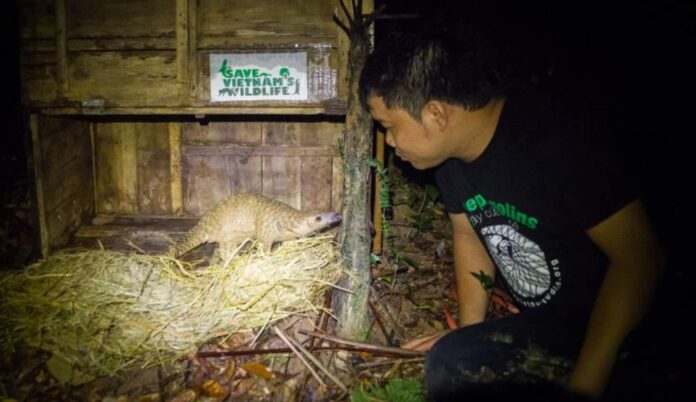
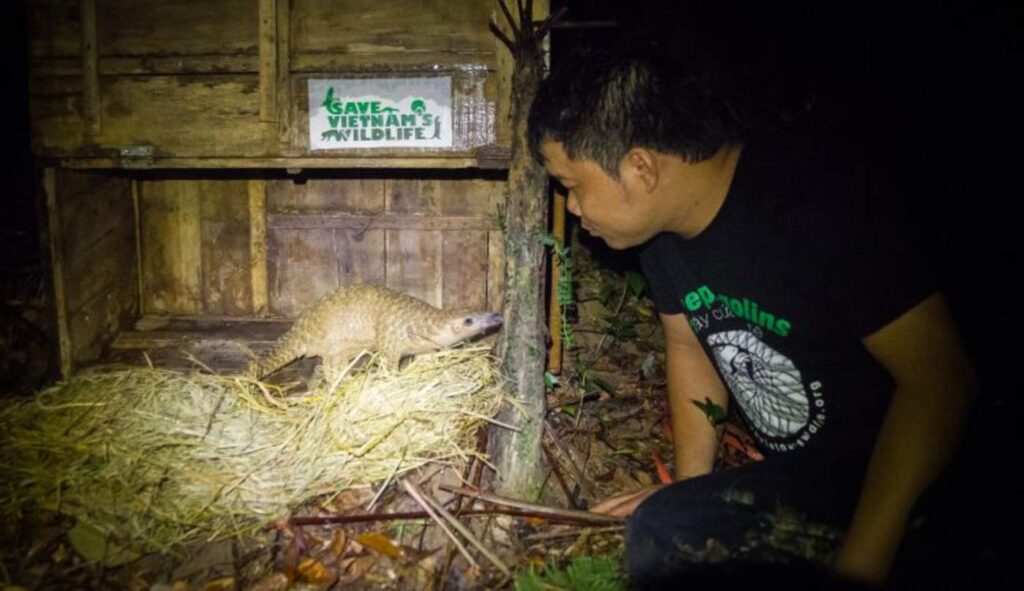
Thai Van Nguyen won the Asia award this year for his work in founding Save Vietnam’s Wildlife, which rescued 1,540 pangolins from the illegal wildlife trade between 2014 and 2020.
Nguyen also established Vietnam’s first anti-poaching unit, which, since 2018, has destroyed 9,701 animal traps, dismantled 775 illegal camps, confiscated 78 guns, and arrested 558 people for poaching—leading to a significant decline in illegal activities in Pu Mat National Park.
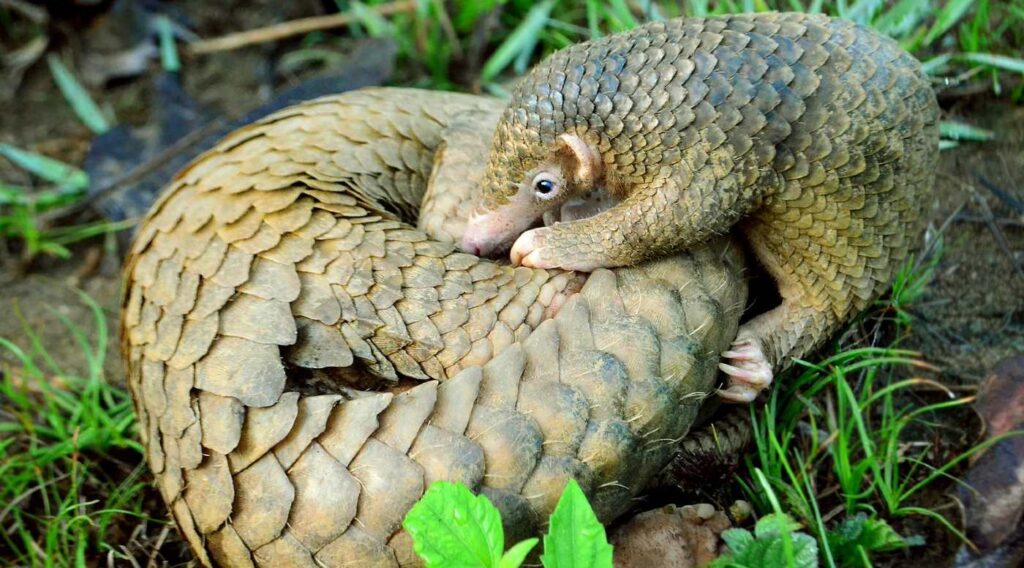
Pangolins are the world’s most heavily trafficked mammal despite an international trade ban. Heavy demand for their meat, scales, and blood threatens pangolins with extinction; all eight pangolin species are on the IUCN Red List.
The Posterchild of the Illegal Wildlife Trade
Gregg Yan, CC license
Similar in appearance to armadillos, pangolins are the world’s most heavily poached and trafficked mammal—and three out of four Asian pangolin species are critically endangered.
Because their scales are believed to cure everything from asthma to cancer, pangolins are heavily used in Chinese and Vietnamese traditional medicine. While pangolin scales are a perfect defense against predators, when stressed or threatened, pangolins curl up into a ball, making them an easy target for poachers.
Research about pangolins is challenging, as they are highly susceptible to stress and notoriously picky eaters—and rarely survive in captivity for more than a few days.
They are also difficult to observe in the wild, and little data exists about their reproductive behavior and life span. Because of these gaps, there are no clear estimates about how many pangolins are left in the wild.
In the past decade, an estimated 1 million-plus pangolins were poached worldwide, and Vietnam is a particular hotbed: in 2004, 60 tons of live pangolins were seized in Vietnam.
A Total Commitment to Pangolin Protection
According to a bio released by The Goldman Foundation, 39-year-old Van Nguyen grew up near Cuc Phuong National Park and, as a child, witnessed a mother and baby pangolin being caught and killed by neighbors in his village. Nguyen resolved to make pangolin conservation his life’s work.
In order to reverse the fate of the pangolins, Nguyen set out to stop poaching and educate the Vietnamese public on the importance of pangolin conservation. His efforts began with a sophisticated outreach and education campaign: he wrote husbandry manuals for rescued pangolins, published research in peer-reviewed journals, attended international workshops, and developed Vietnam’s first reintroduction and tracking protocols for pangolins.
Nguyen also opened the Carnivore and Pangolin Education Center, the first of its kind in Vietnam, in order to provide wildlife conservation courses to students and the general public. And he educated customs officials, border guards, and rangers on wildlife laws and how to properly care for seized pangolins.
Nguyen didn’t stop there; he established Vietnam’s first Asian Pangolin Rehabilitation Center, which focuses on rehabilitating pangolins in captivity.
To care for rescued pangolins, which often arrive in critical condition, he used grant funds to build two fully equipped veterinary clinics with hematology and ultrasound capabilities.
He’s had an 80% survival rate among pangolins with severe and septic wounds. The clinics also serve as research facilities, where his team has learned how to improve medical care for injured pangolins and identified 12 species of parasites in pangolins—and corresponding treatment plans.
SVW collaborates directly with other rescue centers and has successfully rehabilitated and released nearly 500 animals. Nguyen has expanded his rescue center to also rescue carnivores, primates, and turtles.
To better understand the poaching supply chain, Nguyen worked with poachers to take him into the forest to show him how they track and capture pangolins. He also visited markets, restaurants, and doctors of traditional medicine to better understand the demand for pangolins.
In 2018, Nguyen created Vietnam’s first-ever anti-poaching unit, which is co-managed by a local NGO and government, through which he personally trains rangers on wildlife conservation, animal identification, GPS skills, basic martial arts, and survival skills.
The unit cooperates with government rangers on missions throughout 235,000 acres of primary forest in Pu Mat National Park; on trips lasting up to six days, teams destroy illegal camps and wildlife traps, confiscate weapons, and arrest poachers.
SVW is the first organization in the world to implement monitoring of released pangolins using drone technology.
Nguyen has also looked to global strategies and worked with the management authority of the Convention on International Trade in Endangered Species (CITES) in 2016 to upgrade pangolins to Appendix I, a designation that bans international trade for animals most threatened with extinction.
Between 2014 and 2020, Nguyen’s leadership raised awareness of pangolin poaching and resulted in the rescue of 1,540 pangolins from the illegal wildlife trade.
SVW staff report an 80% decrease in illegal poaching activities since the unit’s establishment. His partnerships with government, law enforcement, scientists, veterinarians, and fellow activists have been critical to his success.
As one of the few people in the world working on pangolin conservation and rehabilitation, Nguyen is filling a crucial space for understanding and protecting this critically endangered animal.
(MEET Nguyen in the video below.)
SCALE UP the Good News in Friends’ Feeds—Share This Story…
There are more possible connections between neurons in the brain than there are stars in the galaxy, making the ole’ noggin the most complex supercomputer we know of.
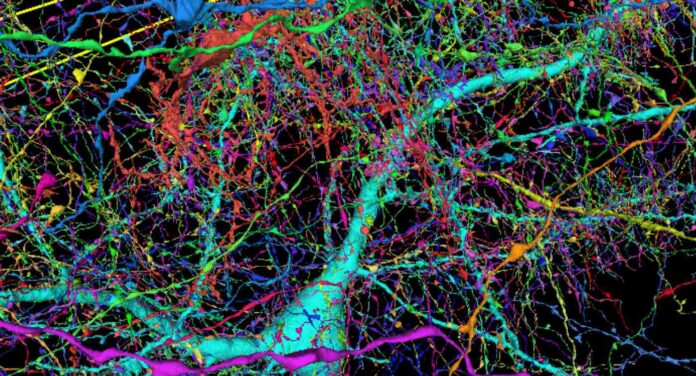
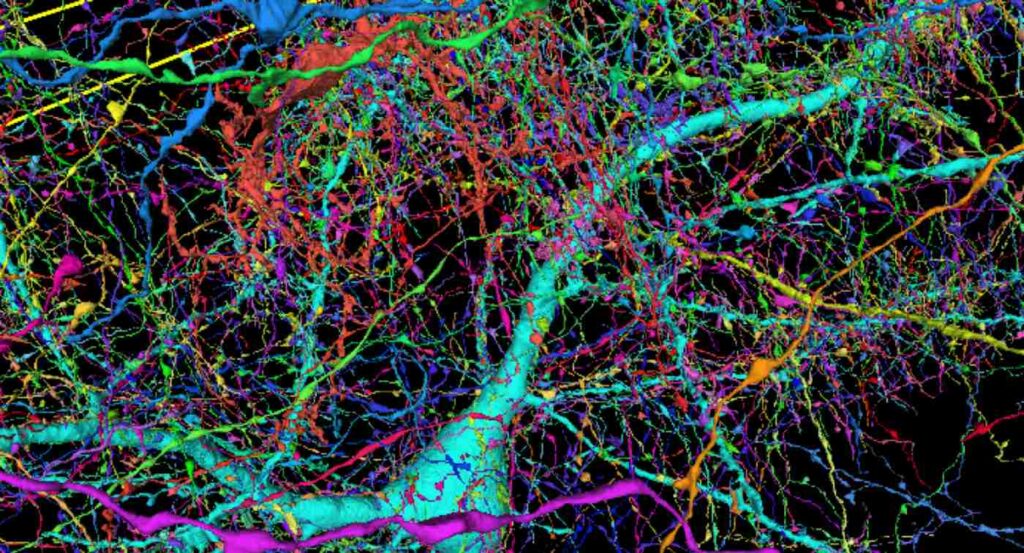
To map the connections in just one millimeter of cerebral cortex tissue required over a million gigabytes of data, and 225 million images.
Now assembled by researchers from the Lichtman Lab at Harvard and Google, the 3D image is the most detailed ever taken of our neurology. The hope is to replicate this method enough to create a puzzle of the human brain which is being called the “connectome.”
To say the connectome could take our entire lives to complete is no exaggeration. To complete the connectome of a C. elegans worm that possesses just 302 neurons required 12 terabytes of data. Google has also made a swing—along with the Howard Hughes Medical Institute, at a fruit fly connectome—which has around 100,000 neurons. It took a year and 100 terabytes to manage about half the fruit fly brain.
Here a 2D image of the C. elegans brain matter is extrapolated by machine learning and other science gubbins into a 3D map.
Rather more detailed
With between 100 and 86 billion neurons and 100 trillion synapses—electrical interchanges and signals between cells, the human brain is rather more detailed than its invertebrate neighbors’.
Nevertheless, taking a one millimeter cubed section of cerebral cortex, the researchers coated it in resin, and cut it into about 5,300 individual slices each about 30 nanometers thick in order to reduce the detail low enough to image with an electron microscope. After all that, they still needed over 200 million images before they could reassemble it into a completed 3D map.
The H01 dataset, as it’s called, measures 1.4 petabytes, more than the Pentagon gathers in a month, and contains 50,000 cells and 130 million synapses, making it the most complete picture of a part of the brain ever made.
Interesting observations were made, for example that glial cells, a brain-specialized immune cell, outnumbered neurons two to one, and are available to study in a pre-review accompanied paper on BioRxiv.
Bangladesh’s floating gardens, built to grow food during flood seasons, could offer a sustainable solution for parts of the world prone to flooding because of climate change, a new study has found.
The study suggests that floating gardens might not only help reduce food insecurity, but could also provide income for rural households in flood-prone parts of Bangladesh.
“We are focused here on adaptive change for people who are victims of climate change, but who did not cause climate change,” said Craig Jenkins, a co-author of the study and academy professor emeritus of sociology at The Ohio State University. “There’s no ambiguity about it: Bangladesh didn’t cause the carbon problem, and yet it is already experiencing the effects of climate change.”
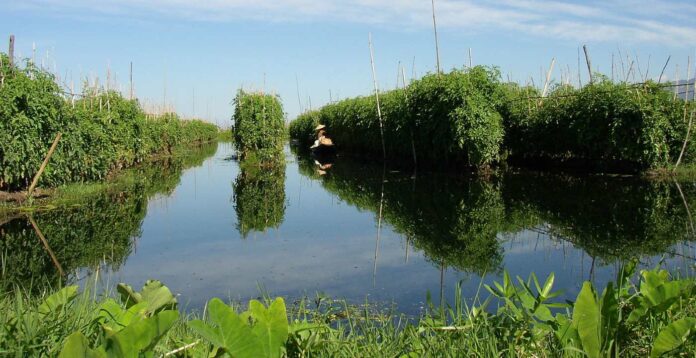
Bangladesh’s floating gardens began hundreds of years ago. The gardens are made from native plants that float in the rivers—traditionally, water hyacinths—and operate almost like rafts, rising and falling with the waters. Historically, they were used to continue growing food during rainy seasons when rivers filled with water.
The farmers—or their families—layer the plants about three feet deep, creating a version of raised-bed gardens that float in the water. Then, they plant vegetables inside those rafts. As the raft-plants decompose, they release nutrients, which help feed the vegetable plants. Those vegetable plants typically include okra, some gourds, spinach, and eggplant. Sometimes, they also include spices like turmeric and ginger.
Floating gardens are also in use in parts of Myanmar, Cambodia, and India. The United Nations Food and Agricultural Organization has named Bangladesh’s floating gardens a Globally Important Agricultural Heritage System.
But as climate change has affected the volume of water in those rivers—creating extreme highs and floods, along with extreme lows and droughts—floating gardens have become a way for rural farmers to keep producing food during unpredictable weather. Climate change increases weather extremes and the severity of flooding, and droughts as well.
The researchers—whose study was published recently in the Journal of Agriculture, Food and Environment—wanted to understand whether Bangladesh’s floating gardens could be a sustainable farming practice as climate change continues to cause floods and droughts, and to see whether the gardens bring better food security to individual households.
“They’ve got to be able to grow specific crops that can survive with minimal soil,” said Jenkins, a research scientist and former director of the Ohio State Mershon Center for International Security Studies. “And in Bangladesh, a lot of small farmers that had typically relied on rice crops are moving away from those because of the effects of climate change and better returns from alternative crops.”
For this study, the researchers interviewed farming families who use floating gardens, and found strong evidence that floating gardens provide stability, both in the amount of food available to feed rural populations and in a farming family’s income.
They found that farmers typically use hybrid seeds, which must be repurchased each year, to grow a diverse range of vegetables in the floating gardens. The gardens are also susceptible to pests, so farmers end up spending some money on both pesticides and fertilizers. But even with those expenses, they found, benefits outweighed costs.
Generally, entire families work on the gardens, the researchers found: Women, children and the elderly prepare seedlings and collect aquatic plants to build gardens. Men cultivate the gardens and protect them from raiders. Some families also farm fish in the waters around their floating gardens.
One farmer told the research team that he earns up to four times as much money from the gardens as from traditional rice paddies.
Still, the system could use improvements, the researchers found. Farmers often take out high-interest loans to cover the investment costs of building the beds and stocking them with plants.
Lower-interest loans from responsible government or non-governmental organizations could alleviate that burden, they found.
(SEE the floating gardens of Bangladesh in this United Nations video.)
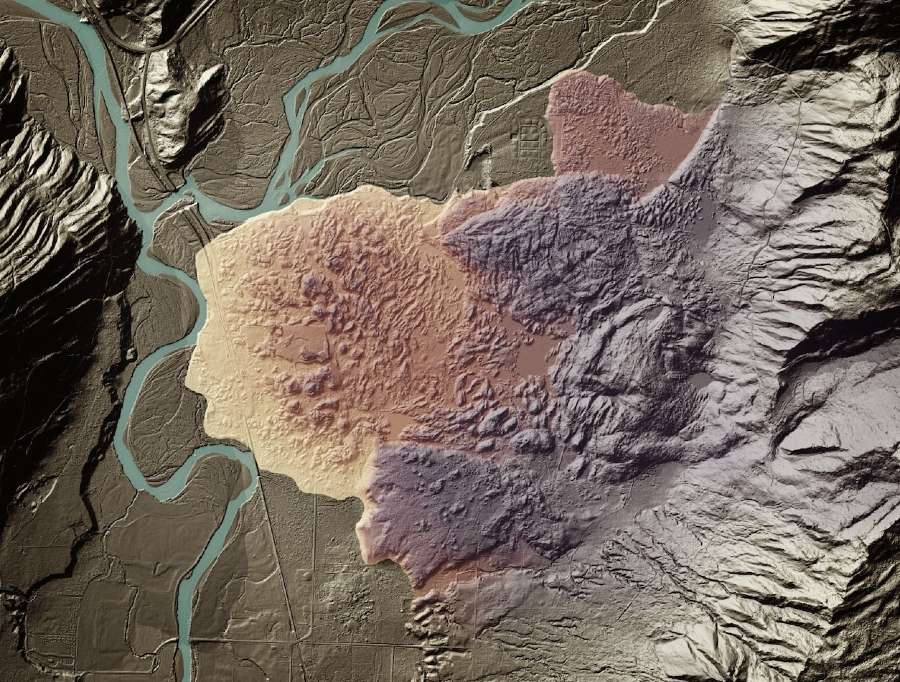
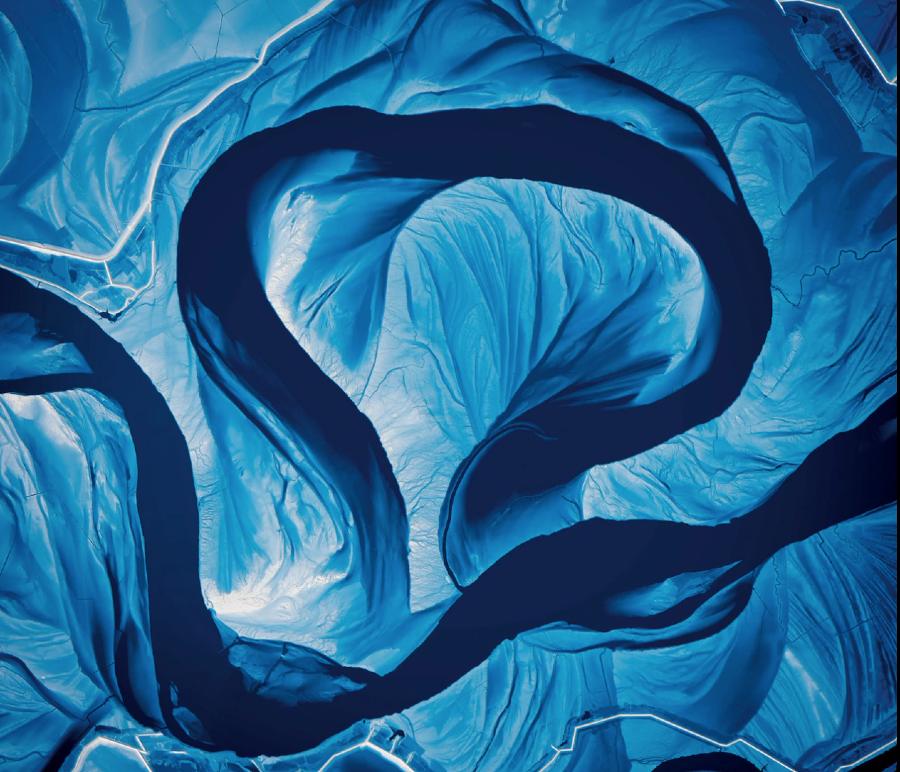
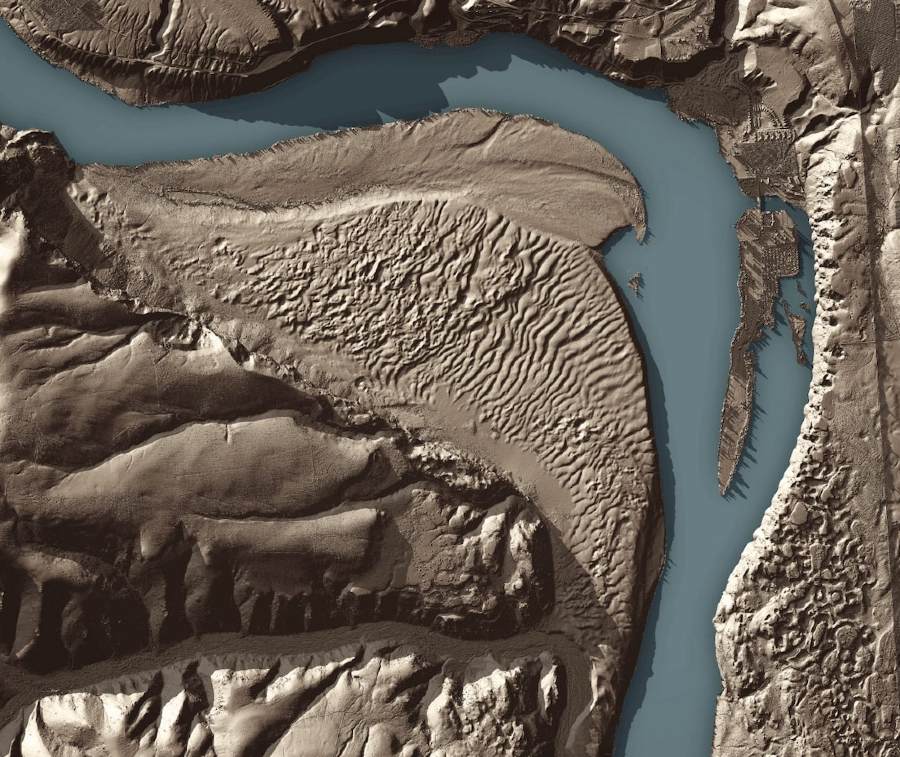
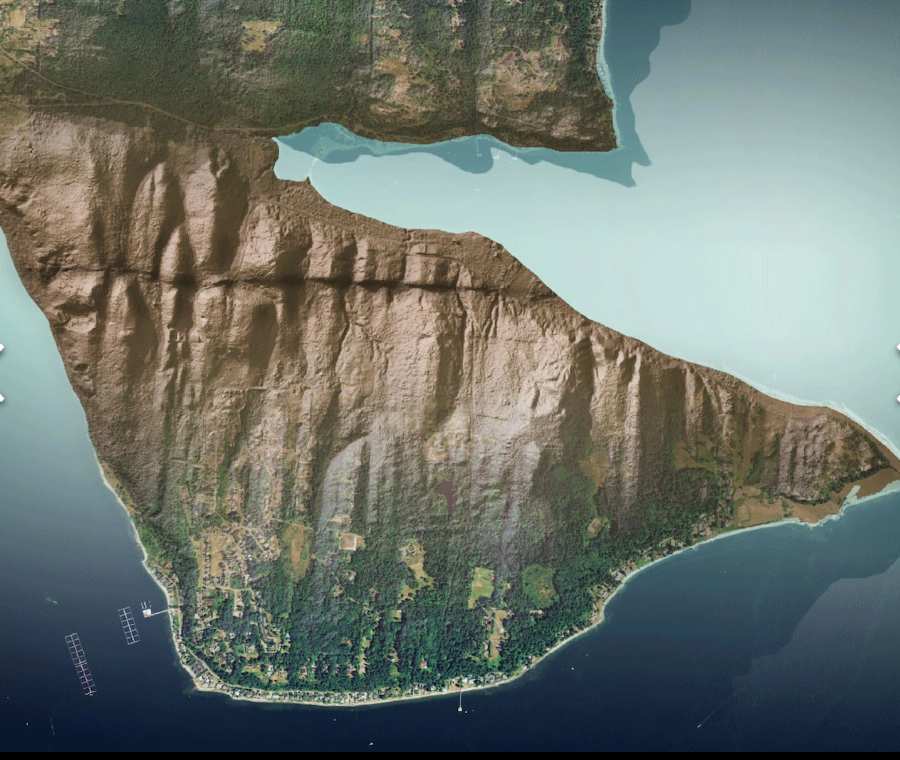
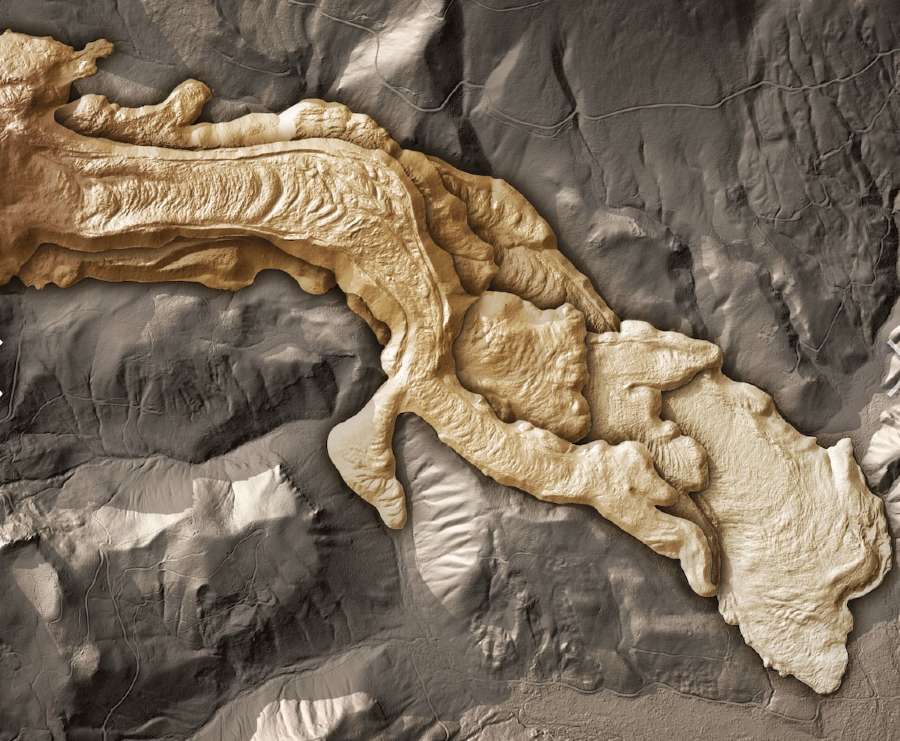
Staggering images taken from planes using forest-penetrating radar are mapping the geology of Washington state.
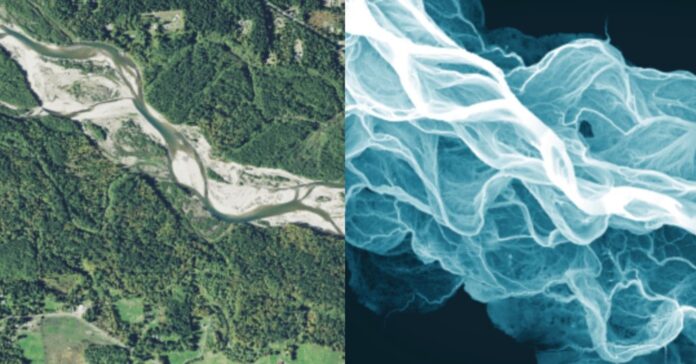
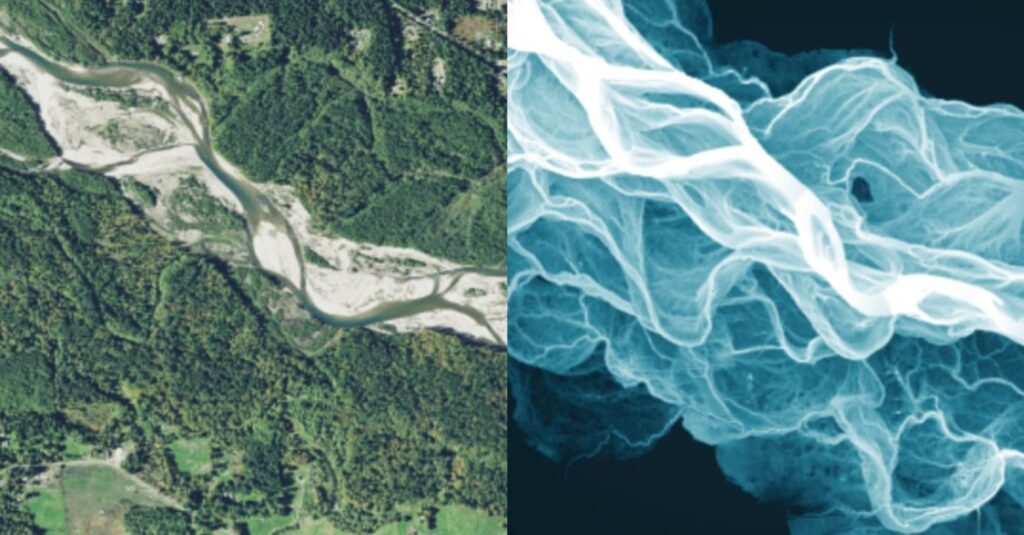
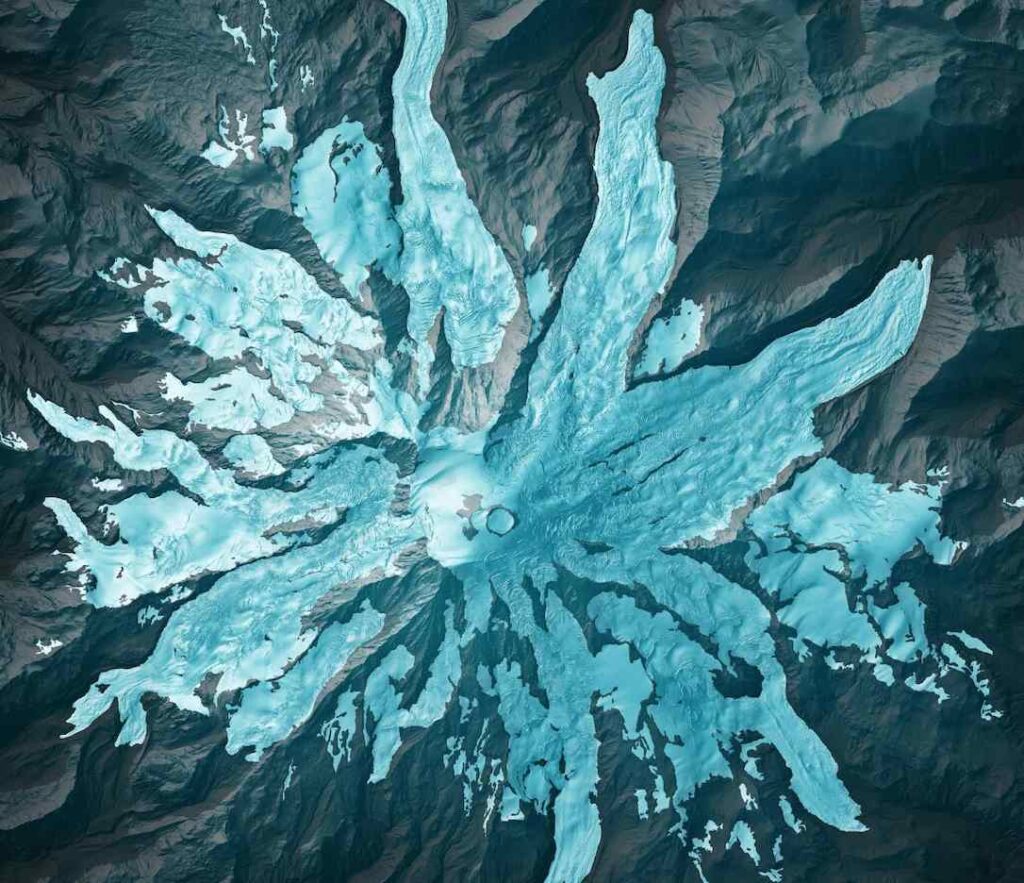
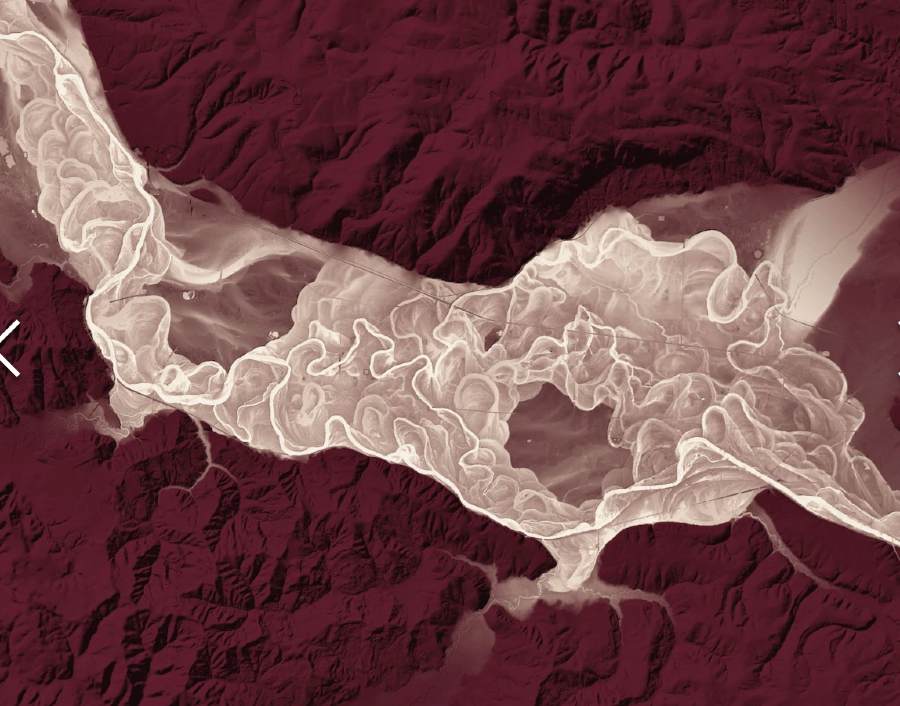
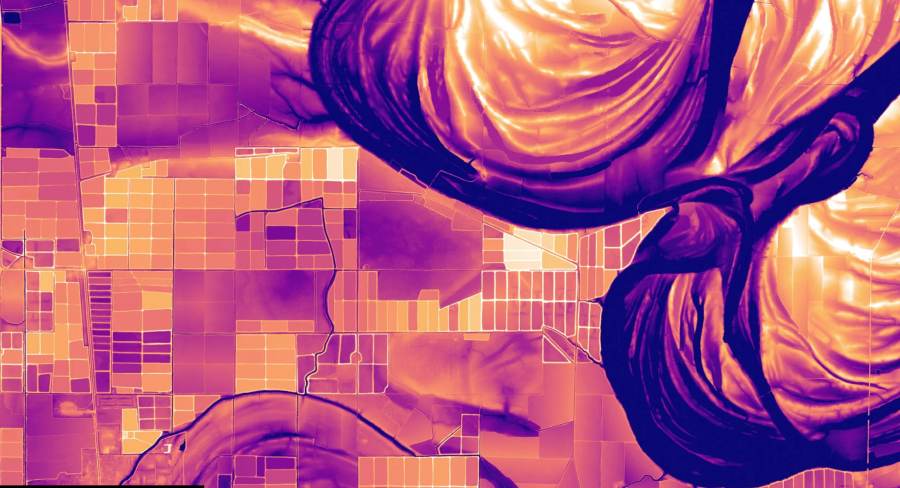
Intriguing, artsy, beautiful, and outright bizarre, “The Bare Earth” presentation on the Washington state Department of Natural Resources (DNR) website uses shading and added color to present underlying geological features like lava flows, glacial moraines, drumlins, tsunami inundation, mudslides, eruptions, fault lines, river patterns, and much, much more.
Washington Geological Survey
LIDAR, which stands for Light, Detection and Ranging, is a laser-guided mapping system that fire billions of laser pulses at an object, and like sonar or radar, gathers information about the object as the beams return.
Washington Geological Survey
The information in this case is the time it takes each pulse to arrive back.
Some of the light is reflected off the tree tops, but enough will reach the ground below to reveal the underlying geography as if the trees simply didn’t exist.
Washington Geological Survey
The light also penetrates the soil strata, meaning that while the first reading of the return pulse indicates the surface topography, the final return pulse is the bare earth below, giving unparalleled pictures of the landscape.
Washington Geological Survey
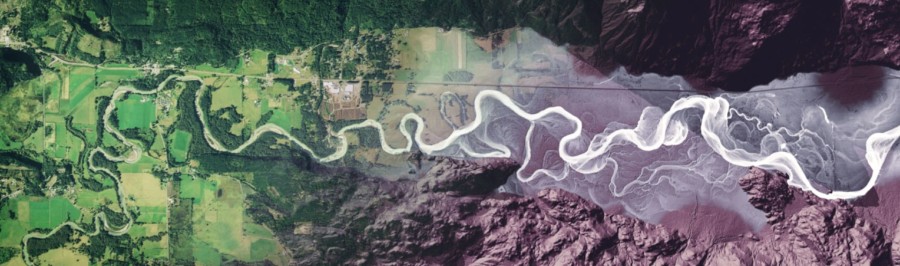
This technology was used to produce a fascinating series of images by a cartographer at the U.S. Geological Survey of the Mississippi.
Washington Geological Survey
LIDAR revealed hundreds of years of subtle changes in flow, flooding, and bending of the mighty river.
Washington Geological Survey
Following a deadly landslide in 2014 that destroyed parts of a small town about 50 miles outside of Seattle, the Washington Geological Survey realized it would behoove them to map out potential landslide sites to provide early warning for people living there.
Washington Geological Survey
As it turned out, the same method of discovery geological and climatic hazards using LIDAR can help state authorities plan for all manner of emergencies, such as volcanic eruptions, tsunamis, earthquakes, and more.
The Bare Earth presentation records all the findings LIDAR has made in a state that has a seriously varied geomorphology—the change and evolution of the surface and underlying geology over time.
Washington Geological Survey
It records the use of LIDAR to map the state’s landslides, geological curiosities, bedrock, fault lines, tsunami reach and erosion, volcanoes, glaciers, and riverways.
Washington Geological Survey
You’ll definitely want to spend a little time looking over the images.
Quote of the Day: “Why are you trying so hard to fit in, when you’re born to stand out?” – Oliver James
Photo: by Darryl W, CC license
With a new inspirational quote every day, atop the perfect photo—collected and archived on our Quote of the Day page—why not bookmark GNN.org for a daily uplift?