He may be best known for his delightful rooftop dance moves while playing a chimney sweep in Mary Poppins, but Dick Van Dyke hasn’t quietly slipped into retirement since his breakthrough 1964 role.
In fact, the 95-year-old has been caught doing all sorts of good deeds over the years.
His latest kindness? Last week, the actor showed up at Los Angeles’ Malibu Community Labor Exchange—and began handing out cash to job seekers waiting in line outside the non-profit.
Tip your hat to one of the good guys: Dick Van Dyke, 95, hands out wads of cash to people in need in Malibu https://t.co/ObsWGnXwQq via @MailOnline
Helping others has been an important part of Van Dyke’s life for decades. He’s known for spending over 20 years volunteering at LA shelter The Midnight Mission. He’s also served as a spokesperson for the Cell Therapy Foundation and the National Reye’s Syndrome Foundation.
The last time we shared the good news relating to this Hollywood legend? It was to report on Van Dyke dancing with his real-life wife, Arlene Silver, in the most joyful music video ever for bluegrass group Dustbowl Revival.
Oh, and then there was the time he treated diners at a Santa Monica Denny’s to a spontaneous performance of Chitty Chitty Bang Bang with his a cappella group Vantastix.
The secret to ageing gracefully? It seems it may just be taking a step out of Van Dyke’s shoes, by giving to others, and dancing and singing whenever we can.
For proof, just watch this video of Van Dyke dancing in a department store.
Few things are better thn 93 year old Dick Van Dyke dancing at a dept store............ pic.twitter.com/Pk5NwBebc3
For four days and three nights this past February, a dog stranded on an ice floe in the frigid waters of the Detroit River between the U.S. and Canada struggled to stay alive. Even though the situation was desperate, the dog held out for a miracle—and finally got one.
First spotted by a wildlife photographer shooting images on the Michigan bank of the river, soon enough, concerned parties on both sides of the border were struggling to find a way to save the imperiled pup, but the extreme elements were against them.
After tapping numerous resources, it seemed no one could help, but determined rescuers refused to give up. “We had to fight for him,” Patricia Trevino of the River Rouge Animal Shelter (RRAS) told WXYZ-Detroit. “It was a level of frustration I’d never felt because this was a life; it was out there in front of us. We could all see it.”
That’s when Jude Mead and his son, who own a marine construction company in Windsor, Ontario, took the helm of the lifesaving operation—literally.
Setting off in an airboat loaned to them by the BASF Corporation, the pair were able to pilot their way across the ice, finding and securing the dog with relative ease.
After having spent such a prolonged period in sub-zero temperatures—much of the time under the stressful threat of prowling coyotes—the poor pooch was in pretty rough shape.
Once ashore, he was immediately taken to Woodhaven Animal Hospital for evaluation. The diagnosis confirmed the young dog suffered frostbite, dehydration, and pancreatitis as a result of his ordeal, however, the veterinarians speculated that the dog’s badly matted fur was likely a blessing in disguise, keeping him from further harm.
“I feel like what saved him out there is the fact that he wasn’t groomed and his coat was pelted,” Woodhaven vet Dr. Lucretia Greear told The Detroit Free Press. “He had literally like a layer of insulation that protected him from the water and the ice and it protected him from freezing to death—but he’s a miracle.”
After successful treatment and recovery, the lucky pup, who’d been going by the name Alonso, was aptly renamed ‘Miracle’ and put up for adoption.
While there were many contenders for the role of new pet parent, when the man who’d plucked him from the ice stepped forward to lay his claim, the shelter staff agreed that nothing could feel more right than reuniting them.
“Today the story came full circle. Today the little Miracle dog was placed into the hands of the hero who saved his life. That’s right—this dog who defied ALL THE ODDS will now live happily ever after with the man who saved his life,” Friends of the RRAS announced.
“Miracle could not ASK for a better or more ideal family to love him! We are all so grateful for this happily ever after ending to this AMAZING story… Congrats Jude and family on the addition to your family! Happy life, Miracle!”
WOOF Your Approval of This Great Rescue Story on Social Media…
North Carolina-based writer Judy Cole has a new rom-com murder mystery debuting at Amazon: And Jilly Came Tumbling After (from Red Sky Presents).
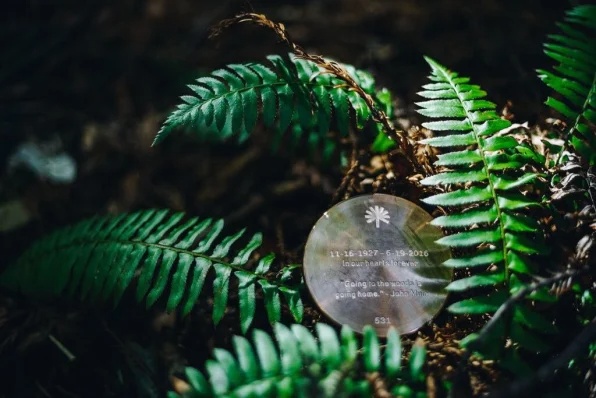
Across America, small parcels of forested land are being bought from private owners by a conservation group called Better Place Forests.
With the intention of providing the roots, trunk, and branches of a tree as the site of a loved one’s final resting place, the group is also ensuring that by law the forest will remain preserved forever.
They own and maintain “memorial forest preserves” in Connecticut, Massachusetts, California, Arizona, Minnesota, and soon Illinois. These preserves feature heritage sugar maple stands, California redwoods, quaking aspen colonies, views out across the Pacific or the Twin Lakes, and every tree is up for grabs for just a few thousand dollars.
“There’s this moment when you choose your tree, and it’s like nothing you’ve ever expected,” says Sandy Gibson, the CEO of Better Place Forests. “It’s this moment as you choose it, and you’re looking around and you realize this is what forever looks like.”
“This is where you’re going to be, and it’s a beautiful image: you’re in a beautiful place, you can hear the wind blowing through the trees, and it’s something we’ve heard from all of our customers after they choose their tree is that this feeling of peace, of knowing what the end of the journey looks like,” he adds.
Every year the funeral industry consumes 20 million feet of hardwood, 64,500 tons of steel, 1.6 million tons of concrete, and 5 million gallons of embalming chemicals.
“One of the most popular reasons to choose cremation is the idea that [people] want to take up less space, also to reduce the burden on the Earth,” says Gibson. “The environmental aspect of what we do is incredibly important to our customers.”
A healthy alternative
Fletcher Studio/Better Place Forests
As the cost of traditional casket-service-cemetery funerals continues to rise ever higher in the U.S., it’s estimated that 80% of the Baby Boomer generation will chose cremation.
“If you wanted a 10 to 20 person family plot anywhere near a major city, I’d be incredibly surprised if you could find that for less than $200,000,” says Sandy, adding that despite the shift towards cremation, Americans haven’t lost the desire for place or ritual with their families.
“Our customers are drawn to Better Place Forests because they love the idea of being in nature, and leaving a legacy of nature. For those who are very religious, for them nature is the place they felt closest to God.”
The choice of cremation and the subsequent scattering-of-ashes ceremony releases the bereaved from the constraints of the traditional funerary service which is typical planned without much time and under duress of grief.
But in a funny way, that freedom creates a significant complication for some, in that what is perceived as a very important detail in one’s life story—their funeral, has to be imagined from within a far greater realm of possibilities. This, Sandy said, can create a sort of funerary writer’s block, which Better Place Forests helps people overcome, especially those who are environmentally minded.
“Part of it is this legacy of conservation; knowing that you contributed to the protection of a beautiful forest and then it’s protected for future generations because of something you did. When you walk on these forests that’s when it makes sense; we choose properties that are incredibly beautiful, trying to find properties that are iconic to each region.”
Very North American
Fletcher Studio/Better Place Forests
“Our costs are derived from buying forests and protecting them forever,” says Sandy in response to how he manages to undercut the cost of a traditional funeral.
While legal fees soak up the majority of the cost, part of the expense also includes customizable services either indoors or in the forest. Each tree can host several ash scattering ceremonies, and the cremation techniques employed ensure the ashes are optimally and rapidly turned into nutrients, merging spirit and soil for eternity.
One might say that Americans are uniquely suited to this sort of internment, as our connection with nature, particularly with our forests, changed the world. In 1872, we became the first ever nation to create a national park, and by 1906, we had created five others.
In the 19th century, Canada and the United States attracted all manner of Europeans to join in the timber industry, and immense forests containing magnificent trees quickly became iconic images of the New World.
Fletcher Studio/Better Place Forests
There was the era of the Mountain Man, the Gold Rush, the conservation movement sparked by Field and Stream Magazine, the Audubon Society, and the Sierra Club—all cultural epochs centered around extraordinary American landscapes, while throughout the 20th century our commitment to the protection of forests may have surpassed those of any other nation.
“One of the beauties of this job is we get to go around the entire United States and see what the different forests and landscapes look like everywhere, and they are very unique, and you see why people are connected to their woods,” says Sandy.
“What’s amazing is every region has their iconic tree. In Arizona people love aspens. It’s something magical; the idea that that aspen grove could be alive 8,000 years and keep sprouting new trees over time, it’s kind of an amazing thing to think about. On the east coast it’s chestnuts.”
“There’s a new forest we’ll be announcing soon where we’ll be able to plant some giant sequoias,” he adds excitedly. “How cool is that, to get to be a part of a reforesting of regional sequoias?”
Environmentalists of all stripes, from climate warrior activists to permaculture farmers, often talk about having a better relationship with nature. Our physical relationship with nature is very one-sided, but maybe changing our attitudes towards it could start with our eternal placement, namely one borne from a desire to give back, and not to be lodged stubbornly in a concrete burial vault within a chemically treated coffin.
GIVE BACK by Sharing This Story From the Woods With Pals…
A jolt of coffee in the morning sets the world’s workers right, but a new study shows that for trees, a bit of caffeine is just as good.
Tropical forests can regrow much faster when running on the caffeine from coffee pulp, a waste product from coffee production.
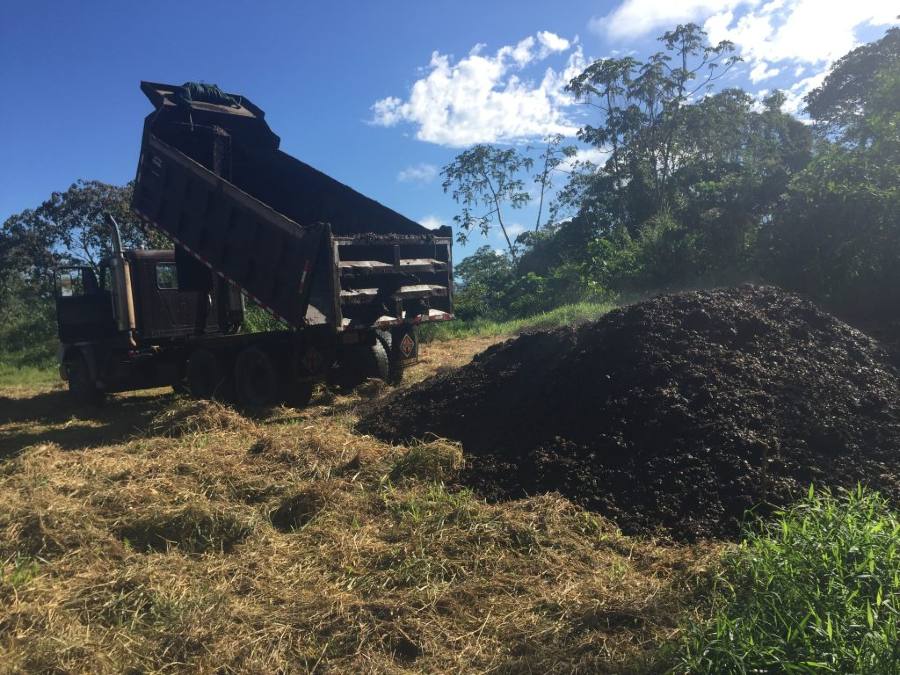
This was found in a direct case-control study of degraded tropical land in Costa Rica, where scientists from the University of Hawai’i and ETH-Zurich spread 30 dump truck loads of coffee pulp over a 35 x 40 meter plot of land.
Pulp being applied to the Costa Rica forest/Dr. Rebecca Cole
They designated an equal size plot of the same land just next to it as a control plot.
People who drink coffee that also start composting in their homes often find that coffee grounds make up the majority of their weekly biomass. But coffee grounds are naturally acidic, with a pH of less than 5, and therefore aren’t always nutritious for some houseplants or decorative flowers.
Tropical soil on the other hand, traditionally containing very poor nutrient profiles, can tolerate the coffee’s acidity, it being acidic itself, and contains a variety of plants and microorganisms that thrive in low pH environments.
“Our results show that soil carbon, nitrogen, and phosphorous were substantially elevated in the coffee pulp compared to control treatment after 2 years,” write the authors in their study led by Dr. Rebecca Cole. “Coffee pulp addition significantly altered the ground cover characteristics, eliminating pasture grasses, facilitating establishment of herbaceous plants, and increasing the percent area covered by leaf litter.”
Indeed, a report from the British Ecological Society claimed the area treated with pulp became a small forest, with 60% greater canopy coverage reaching 4 times as high than the non-treated area, which mostly remained filled with invasive grasses and weeds.
3 years after coffee pulp was applied to a forest area in Costa Rica/Dr. Rebecca Cole
It’s a significant finding, since coffee is grown mostly in tropical climates, tropical soil tolerates coffee’s acidity, tropical forests are cut down at rates faster than any others, and tropical forests sequester more carbon and contain greater biodiversity than arboreal ones.
Normally heaped into storage lots and left to decompose, coffee pulp—which consists of the husk, skin, and pulpy interior—is rich in nutrients and also represents more than half of the weight of the coffee harvest. The authors cite one study that figured there are 218,000 tones of pulp that must be managed for every one million bags of coffee sent to market.
It’s a brilliant solution—to enrich tropical lands as countries produce a cash crop. It’s cheap, it’s local, the nutrients match, it gives animals more habitat and pulls more carbon from the atmosphere, and best of all, we can keep drinking that lovely cup o’ joe.
ENERGIZE Your Friends’ News Feeds—Share This Story on Social Media…
Quote of the Day: “Don’t Let Yesterday Take Up Too Much Of Today.” – Will Rogers
Photo by: Luke Stackpoole
With a new inspirational quote every day, atop the perfect photo—collected and archived on our Quote of the Day page—why not bookmark GNN.org for a daily uplift?
Jaxson Dempsey and his sister, PA News-YouTube/John Cena, CC license
Jaxson Dempsey and his sister, PA News-YouTube/John Cena, Gage Skidmore, CC license
In moments of peril, superheroes don’t hesitate, they leap into action. And so, it seems, do little boys if their baby sister’s life depends on it.
When 8-year-old Jaxson Dempsey realized his 20-month-old sister Lelia was choking on a chicken nugget, he didn’t panic. Instead, he calmly directed his dad to pull over the car they were driving in and proceeded to dislodge the obstruction from Lelia’s airway.
Jaxson said he’d learned the lifesaving technique from watching WWE superstar John Cena perform the maneuver on an episode of the Nickelodeon show The Substitutes.
Jaxson’s father Matt has nothing but gratitude for his son, whose quick thinking staved off a potential tragedy.
“I couldn’t hear her because she was choking. She wasn’t coughing; she wasn’t panicking. She just had no air going through; she wasn’t breathing,” Dempsey told WNEP-News. “Thank God Jaxson was there because, without him, I don’t know if Lelia would be here.”
While kudos were the last thing on Jaxon’s mind for doing what came naturally when his sister needed him, they’ve been rolling in nonetheless ever since.
The first big “Well done!” came from none other than John Cena himself, who sent a personal message via video after learning of the boy’s heroics.
“I heard a story about you, and it really touched my heart,” Cena said. “A story that in a time of crisis, you were brave enough to take action… Usually, when bad things happen, one of the toughest things for all of us to do is to take action. You jumped right in, helped out the best you could. [By] doing so, you saved your sister’s life. I really want to say thank you for being you, Jaxson. Thank you for being an inspiration; thank you from all of us.”
Cena’s tribute was high praise indeed, but the accolades didn’t stop there. On March 31, Jaxson’s hometown of Hazleton, Pennsylvania fêted him with his very own parade featuring more than a dozen fire trucks, sirens blaring and lights blazing, all in honor of a pint-sized hero who turned out to be the best big brother a little sister could have.
(WATCH the PA video and meet Jaxson below.)
SHARE This Positive Story With Friends on Social Media…
North Carolina-based writer Judy Cole has a new rom-com murder mystery debuting at Amazon: And Jilly Came Tumbling After (from Red Sky Presents).
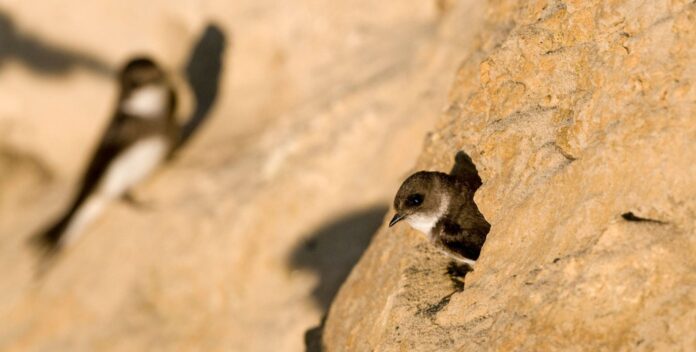
Sand martins, copyright David Tipling for Surrey Wildlife Trust
Conservationists realized they needed more than a bucket and shovel to build a 400-ton sand castle large enough to be an attractive home for sand martins to roost in England.
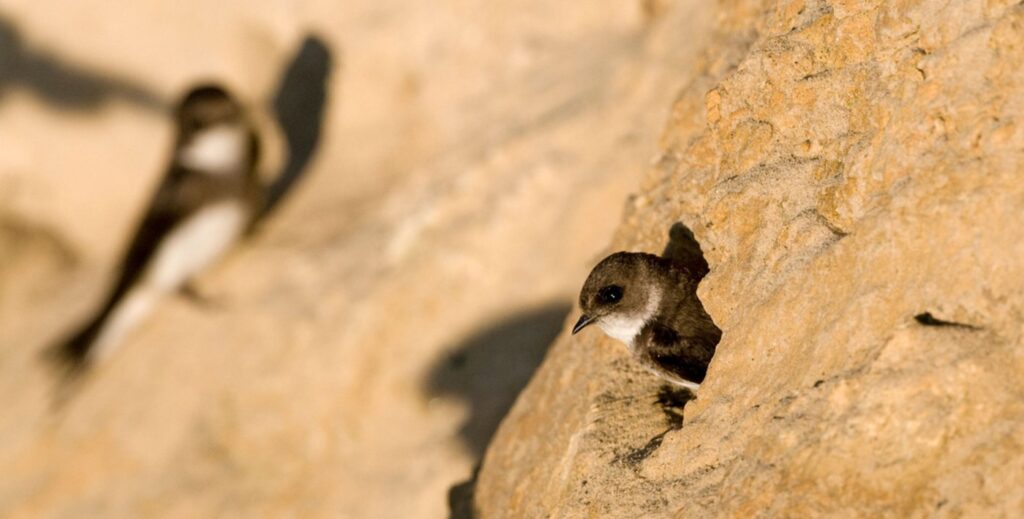
Sand martins, copyright David Tipling for Surrey Wildlife Trust
To help the tiny birds they needed big machines—and building a sandbank large enough for them to build their nests in required the help of a sand-sculpting firm.
The sand martin The smallest English members of both the martin and the swallow family—the birds were finding fewer and fewer places perfect for boring their nests, as so much development had replaced their previous nesting habitats with infrastructure.
The martins return annually from wintering grounds in sub-Saharan Africa. Burrowing into the side of high riverbanks means that sand martins are choosy homemakers—but the Surrey Wildlife Trust, acting as real estate developer, is building an enormous artificial sandbank for them in the Spynes Mere Nature Reserve.
Enlisting the help of a specialist construction and landscaping firm named ‘Sand in Your Eye’, it took weeks of filling in a mold, getting the water content right, and packing down the sand before they were able to remove the wooden supports.
Copyright Surrey Wildlife Trust
James Herd, project manager at Surrey Wildlife Trust, said in a video about the project: “Sand martin numbers have plummeted twice in the last 50 years as a result of droughts in their wintering grounds in Africa. In the bank here we’re giving them a long-term sustainable home to nest in for the future.”
“The design is similar to building a sandcastle on the beach, but rather than buckets and spades we were using nine-ton excavators and dumper trucks,” he added.
The petite passerines, which arrive in England around mid-March and depart in September, use their claws to dig nesting holes up to a meter deep into the bank. At the end of the tunnel a small chamber is created where between four and eight eggs get laid in a nest of feathers and vegetation.
Over time, layers of sand on the face of the bank will be scraped away by the Trust to remove nest parasites.
Spynes Mere Nature Reserve, copyright Surrey Wildlife Trust
The returning martins will dig new nests—and every six years or so the bank will be restored to its original size, ensuring their home remains intact for years to come.
(WATCH the Surrey Wildlife Trust video about this initiative below.)
Fly the Good Conservation News Over to Pals on Social Media…
Ashis Dhakal, Facebook/Mark Cuba, Gage Skidmore CC license
Ashis Dhakal, Facebook/Mark Cuban, Gage Skidmore CC license
Anyone who’s experienced poverty knows firsthand how hard finding a pathway out can be. For some lucky enough to have made the transition, the desire to lift up those who are still struggling can become a huge part of their lives.
When 18-year-old Ashis Dhakal arrived in Utah from a refugee camp in Nepal, he knew he’d been given a tremendous opportunity. Though he was bullied at his Salt Lake City school, the tenets of service and giving that are integral to his Hindu faith became the cornerstone of a long-term goal to pay his good fortune forward.
A few years ago, while he was bussing tables for his job at KFC, Dhakal met a homeless man for whom he felt a great deal of empathy. Understanding only too well the difference in life between “the haves” and “the have nots,” once he’d learned the man’s history, he was inspired to help.
One of the most obvious needs Dhakal observed while talking with the man was for clean, serviceable clothing. With that in mind, he launched his first clothing drive Ashis Collects Clothes, in 2019.
Dhakal’s good works won him the attention of The TODAY Show’s Hoda Kolb, who took the teen on as a mentee.
“My biggest ‘why’ in my life is that as a young child, going through poverty, I was in the same shoes as they were in right now,” he said, explaining his drive to Kolb in a recent interview. “I have a house. I have a computer now. I have a phone. But think about it: Those kids are still suffering. What I can do is better others so that, you know, they can give back to their community.”
Recognizing Dhakal’s keen entrepreneurial spirit, it seemed natural for Kolb to hook her protégé up with one of his all-time heroes, Shark Tank’s billionaire philanthropist Mark Cuban. During their online meeting, Cuban gave Dhakal a challenge: Collect 575 coats for folks in need.
While the task was initially daunting, Dhakal parlayed some of Cuban’s networking advice into a winning strategy. After partnering with the Utah outreach organization Serve Refugees, Dhakal was able to chalk up 3,000 coat donations in a matter of days (for which TODAY parent company NBC offered matching donations).
Cuban was suitably impressed, telling TODAY: “You’re setting an example, Ashis, that it’s not about connections… It’s all about how hard you’re willing to work to getting something done.”
Dhakal is certainly willing to do whatever it takes to build a better world. Wherever his entrepreneurial spirit takes him in the future, helping others is sure to drive him along the way.
(MEET Dhakal in the TODAY video below.)
INVEST in This Story—Share it With Friends on Social Media…
North Carolina-based writer Judy Cole has a new rom-com murder mystery debuting at Amazon: And Jilly Came Tumbling After (from Red Sky Presents).
California’s air pollution control standards have drastically dropped the amount of diesel particulate matter in the air, and cardiopulmonary deaths attributable to air quality.
Scientists at UC Berkeley are hailing the state’s diesel engine standards and other measures imposed over a number of years, even in the face of loosened environmental regulations in recent years.
If one has never seen the pictures of the city of Los Angeles before the Clean Air Act, they look like something out of the movie Escape from L.A. But encouraging shifts away from high-sulfur fuels, and replacements of diesel ships with electric ones, has gradually scaled the horror show back—despite the fact that still today there are more cars registered in the state of California than any other state.
“Our analysis of mobile-source DPM (diesel particulate matter) emissions suggests that many California sector-based policies have been highly effective relative to the rest of the US,” write the authors of the paper published in Science.
They found that from the period between 1990 and 2014, the amount of DPM in the California skies fell by 78%, while cardiopulmonary and cancer deaths linked to diesel pollution dropped by 82%.
The largest fall came from tractor-trailers, which is unsurprising given the fact they often run on diesel and cover many miles. Reductions were also observed in passenger and construction vehicles, as well as from the marine sector.
California’s overall consumption of diesel actually increased over this period, which suggests that mandates to move to more refined fuels and retrofitting existing vehicles with pollution filters are highly effective strategies (both are recommended for implementation in other states by the Berkeley scientists).
Moves towards electric public and private transportation, such as Governor Newsom’s executive order to ban the sale of fossil fuel vehicles beyond 2035, should clear California’s skies substantially more—and will be a momentous accomplishment from one of the country’s largest economies.
GIVE Your Friends a Breath of Fresh Air—Share the Good News…
By working with its suppliers, Tesco managed to permanently remove one billion pieces of plastic from its UK stores in 2020.
Customers at Britain’s largest grocery store chain now see much less plastic when they do their shopping, including there being no more plastic shrink wrap on multipacks of soups, corn, and other tinned items including Heinz baked beans.
Shoppers are also no longer seeing secondary lids on products like yogurts and cream. There are no small plastic bags available for packing vegetables, pastries, and loose fruit; there’s no unnecessary plastic in holiday products like crackers, and no more plastic covers on no-label and branded greetings cards from companies like Hallmark—this last move alone is already saving 44 million pieces of plastic from being used a year.
Tesco’s decision to remove a billion plastic pieces from its packaging is part of a larger strategy to tackle plastics through its ‘4Rs packaging strategy’: To remove it where it can, reduce where it can’t, reuse more, and recycle what’s left.
The strategy has seen a business-wide program of change that assesses every piece of packaging and removes all unnecessary and non-recyclable material.
Tesco Quality Director, Sarah Bradbury, said in a statement: “Our own-label and branded suppliers have had a lot to contend with in 2020, so removing a billion pieces of plastic is fantastic progress. Our work to Remove, Reduce, Reuse and Recycle will continue into 2021 —there is no place for unnecessary or non-recyclable packaging in our business.
Paula Chin, Sustainable Materials Specialist, at the World Wildlife Fund, lauded Tesco’s moves to reduce plastic pieces from its stores, saying, “Plastic pollution continues to be one of the most visible symptoms of the environmental crisis we’re currently facing.
“Businesses, governments, and households have all got an important part to play, so it’s encouraging to see Tesco delivering against their commitments to significantly reduce the amount of plastic we use.”
Last year, Tesco met with 1,500 suppliers to let them know packaging will form a key part of its decision-making process which determines what products are sold in stores—with the retailer making it clear it reserves the right to no longer stock products that use excessive packaging or hard to recycle materials.
The company reports that, since the launch of the 4Rs strategy in August 2019, and in addition to removing a billion pieces of plastic, Tesco has reduced the size of its annual packaging footprint by 3,480 tonnes.
Tesco has also made good progress improving the recyclability of its packaging. Since it asked suppliers to use a defined list of easy-to-recycle materials and formats in 2018, it has removed over 11,000 tonnes of the hardest-to-recycle materials. That’s good news indeed.
(WATCH Tesco’s video about their move to ditch plastics below.)
SHARE This Positive Trend in Plastics on Social Media…
Quote of the Day: “Many entrepreneurs make the mistake of thinking that their price is too high when, in reality, the value communicated is too low.” – Seth Godin
Photo by: Katie Harp
With a new inspirational quote every day, atop the perfect photo—collected and archived on our Quote of the Day page—why not bookmark GNN.org for a daily uplift?
The hummingbird is named after its pleasant humming sound when it hovers in front of flowers to feed. But only now has it become clear how the wing generates the hummingbird’s namesake sound when it is beating rapidly at 40 beats per second.
Researchers from Eindhoven University of Technology, Stanford University, and Sorama meticulously observed hummingbirds using 12 high-speed cameras, six pressure plates, and 2,176 microphones. The team of engineers succeeded in measuring the precise origin of the sound generated by the flapping wings of a flying animal for the first time.
They discovered that the soft and complex feathered wings of hummingbirds generate sound in a fashion similar to how the simpler wings of insect do. The new insights could help make devices like fans and drones quieter.
The hummingbird’s hum originates from the pressure difference between the topside and underside of the wings, which changes both in magnitude and orientation as the wings flap back and forth. These pressure differences over the wing are essential, because they furnish the net aerodynamic force that enables the hummingbird bird to liftoff and hover.
Unlike other species of birds, a hummingbird wing generates a strong upward aerodynamic force during both the downward and upward wing stroke, so twice per wingbeat. Whereas both pressure differences due to the lift and drag force acting on the wing contribute, it turns out that the upward lifting pressure difference is the primary source of the hum.
The difference between whining, humming, and wooshing
Professor David Lentink of Stanford University said, “This is the reason why birds and insects make different sounds. Mosquitoes whine, bees buzz, hummingbirds hum, and larger birds ‘woosh’. Most birds are relatively quiet because they generate most of the lift only once during the wingbeat at the downstroke. Hummingbirds and insects are noisier because they do so twice per wingbeat.”
To arrive at their model, the scientists examined six Anna’s hummingbirds, the most common species around Stanford.
One by one, they had the birds drink sugar water from a fake flower in a special flight chamber. Around the chamber, not visible to the bird, cameras, microphones, and pressure sensors were set up to precisely record each wingbeat while hovering in front of the flower.
During a follow-up experiment, six highly sensitive pressure plates finally managed to record the lift and drag forces generated by the wings as they moved up and down, a first.
The researchers finally managed to condense all their various results in a simple 3D acoustic model, borrowed from the world of airplanes and mathematically adapted to flapping wings. It predicts the sound that flapping wings radiate, not only the hum of the hummingbird, but also the woosh of other birds and bats, the buzzing and whining of insects, and even the noise that robots with flapping wings generate.
Making drones quieter?
Although it was not the focus of this study—published in March in the journal eLife—the knowledge gained may also help improve aircraft and drone rotors as well as laptop and vacuum cleaner fans. The new insights and tools can help make engineered devices that generate complex forces like animals do quieter.
This is exactly what Sorama aims to do: “We make sound visible in order to make appliances quieter. Noise pollution is becoming an ever-greater problem. And a decibel meter alone is not going to solve that. You need to know where the sound comes from and how it is produced, in order to be able to eliminate it. That’s what our sound cameras are for. This hummingbird wing research gives us a completely new and very accurate model as a starting point, so we can do our work even better,” concludes CEO and researcher Rick Scholte of Sorama, a spin-off of Eindhoven University of Technology.
A new recycling plant under construction in England features technologies that can break down any kind of plastic polymer into its constituent elements for recycling.
According to Forbes, wildlife filmmaker Sir David Attenborough appeared in a video alongside other naturalists and the owners of the new plant that uses superheated steam to obliterate the chemical bonds holding the monomers together.
Owned by Mura Technology, the process is known as HydroPRS, and it’s particularly special due to its ability to break down plastics normally destined for landfills or incineration. It can even remove biological material like food scraps clinging to the plastic, an aspect that can sometimes prevent plastic from being recycled—instead being used to power the boilers fueling the recycling.
What’s left are oils and chemicals ready to be re-sold to manufacturers to make into new products.
“What’s so tragic about plastic pollution is that it is so totally unnecessary,” Attenborough says in the video, released by U.K. recycling firm Mura Technology. “The plastic in our oceans should never have found its way there in the first place.”
Plastic pollution is a huge problem, and there are tons of smart technologies, many of them emerging, for recycling and biodegrading plastic.
Further still, plastic is being pulled out of rivers and the ocean with ever more intelligent designs and committed organizations. Yet the problem is set to get worse for the oceans, as more of the developing world enters the consumption-heavy prosperity and security of modern life.
Mura says the materials produced during their recycling process can be used again and again without ever becoming chemically unstable, and so it’s not surprising then that the British government is backing the project to the hilt as the plant in Teesside, England, ramps up to 1,000,000 tons of plastic recycling annually.
“The Government is committed to both clamping down on the unacceptable plastic waste that harms our environment and ensuring more materials can be reused instead of being thrown away,” said Rebecca Pow, the U.K. under-secretary of state for the Department for Environment, Food, and Rural Affairs.
“By investing in these truly ground-breaking technologies, we will help to drive these efforts even further, and I look forward to seeing them develop and deliver real results.”
(WATCH the video about Mura Technology in the video below.)
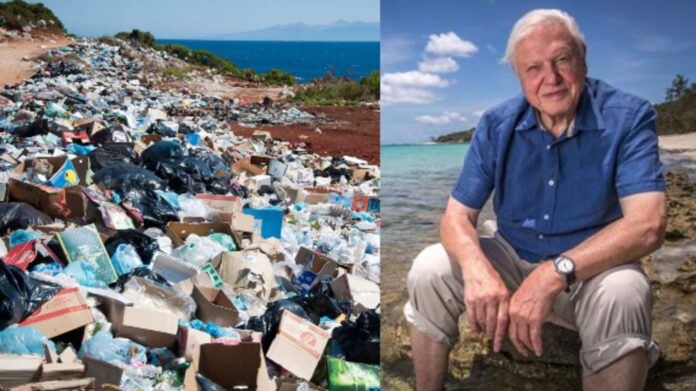
Featured image: Plastics, Antoine Giret/David Attenborough, Department of Foreign Affairs and Trade Australia
PASS the Innovation On—Share This Story With Your Pals…
Children in Nepal playing on old tires recycled into playgrounds – Anthill Creations
Pooja Rai of Anthill Creations
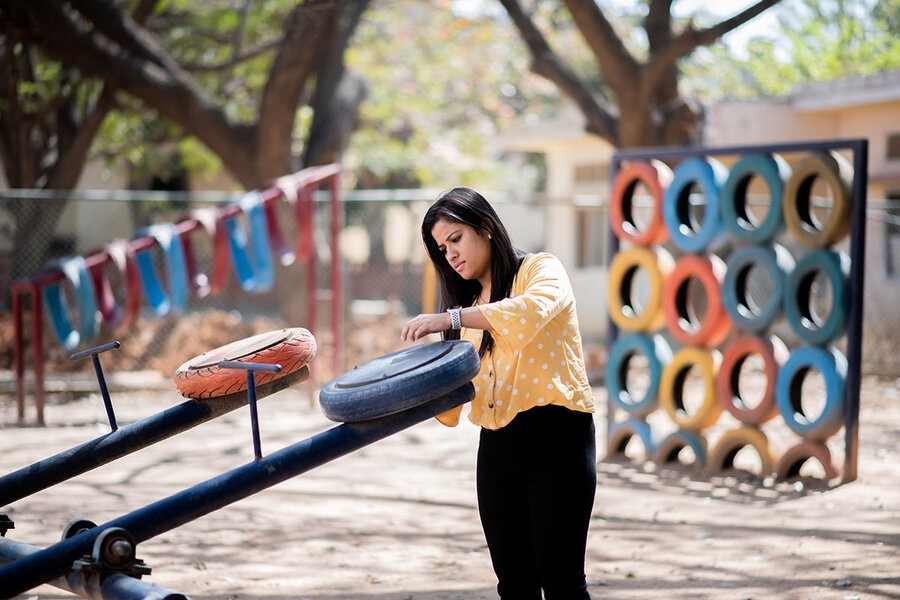
Durable, cheap, and relatively safe, one young architect is utilizing some of India’s 100 million yearly thrown-away tires to design colorful playgrounds for schools that need them.
Operating under the philosophy that play is a child’s right, Anthill Creations, a non-profit run by Pooja Rai, has so far built 283 different play spaces using almost entirely painted tires.
Located in Bengaluru, most of the play spaces Ms. Rai designs feature large tire sculptures of cars, buildings, or animals, paired with more classic elements of swings, seesaws, and jungle gyms.
All of the spaces are built with discarded tires that are collected, cleaned, and inspected for anything that might pose a threat to the kids. Next they are painted, and drilled with holes once or twice to ensure rainwater doesn’t collect inside.
“We live in a world where play, such an essential part of growing up, is now viewed as a luxury and even thought of as unnecessary,” Rai told the Christian Science Monitor.
As India is the world’s only nation that has legislated mandatory charity upon corporations, much of Rai’s work is done through donations, with a small play space costing around $800, and large ones costing up to four-times as much.
Children in Nepal playing on old tires recycled into playgrounds – Anthill Creations
The second most populous country on Earth really does go through a lot of tires, and recycling them as playground infrastructure offers the unique chance to teach kids the idea of “reduce, reuse, recycle” long before they become consumers themselves—and a perusal through images of Anthill Creations’ creations reveals all kinds of shapes familiar in bespoke recycling projects.
Constructing the play spaces, like the funding stage, is all done by volunteers—800 of whom have have so far been involved in building.
The play grounds go up not only in schools, but in public parks and even refugee camps, and they are themed to what children in the area want—whether that’s a specialty space for blind kids, nautical-themed installations for coastal communities, or even a boxing-ring instead of a jungle gym, with tires instead of punching bags.
“It has been a really gratifying and joyful experience to be part of Anthill Creations and to bring smiles and play to thousands of kids,” said Vikas Keshri, a volunteer.
“We often forget how vulnerable these growing years can be,” Rai told CSM. “The right to play should be considered critical to a child’s cognitive growth, physical, and emotional well-being—we believe that it is indeed a basic human right.”
SHARE This Inspiring Story With Friends on Social Media…
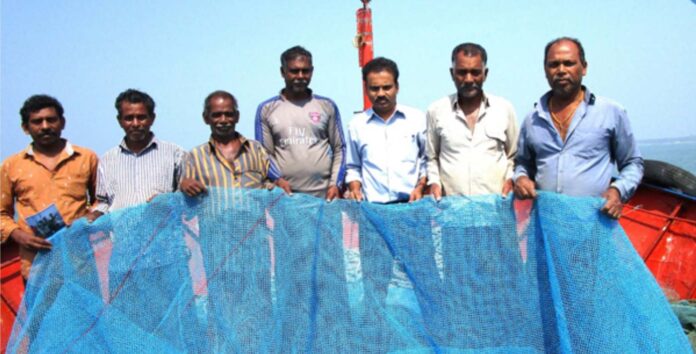
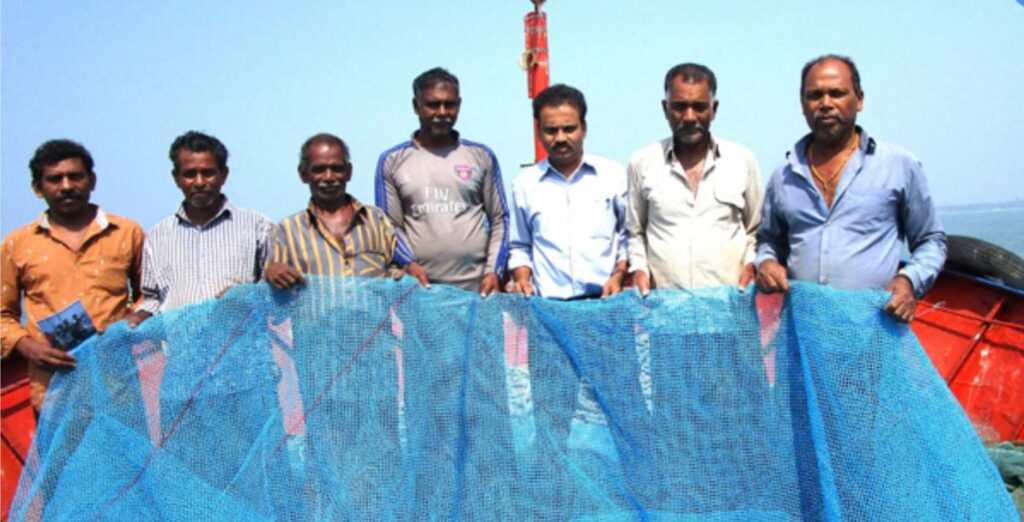
In the state of Kerala, known as the Jewel of South India, fishermen are taking it upon themselves to keep it that way and secure their livelihoods against plastic pollution.
Their workers’ association is encouraging fisherman to save all the plastic waste fished up by their nets in order to support a 2017 government clean seas initiative that’s turning plastic into roads.
A sliver of coastal land on the southwest tip of India, Kerala has a thriving fishing community. According to a report from the Hindu, the fishing industry directly employs 55,000 people working on 3,600 boats, and almost a million indirectly, while generating 1.5 billion rupees, or $14 million in revenue.
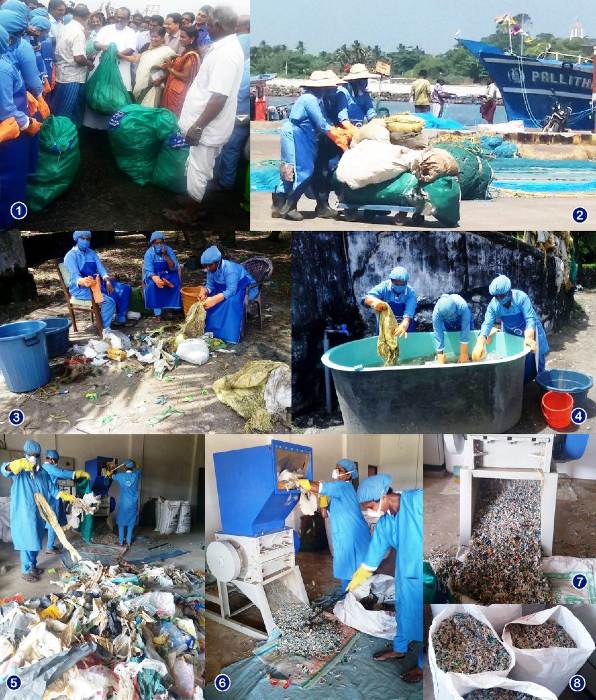
As plastic content has gradually increased in the fishing waters, the local government took notice, passing a clean seas law known as the Suchitwa Sagaram, which instructed the harbor authority to distribute nylon bags to fishing boats with the request that they save every scrap of plastic that gets caught in their nets.
Once ashore, the plastic, often far too mangled or contaminated for available recycling methods, is shredded into a kind of confetti and mixed with asphalt to make roads. The arithmetic is positive, as it requires the plastic equivalent of a million shopping bags per kilometer of road, while replacing one ton of emissions-heavy asphalt and reducing road costs by about 9%.
Clean Sea Scheme, Netfish-MPEDA
The plastic in the roads appears also to give roads resistance to the immense heat of the midday Indian sun.
An April update on the Kerala fishermen’s work from the Guardian details how the project has so far amassed 176,000 pounds (80,000 kilograms) of plastic, of which more than half has gone towards creating 84 miles (135km) of road.
“Previously, we didn’t care much about the plastic we collected in our nets,” Peter Mathias, president of the All Kerala Fishing Boat Operators’ Association, told the Guardian. “But not any more—we’re now protecting the ocean to save our livelihoods. Had we continued to be reckless, there wouldn’t have been any more fish for us to catch.”
The project, which also gives employment to those sorting the trash to sell to roadbuilding companies, is growing in scale up and down the 375 miles of coastline, with dive fisherman reportedly going to government buildings to see if they can get involved. too
Local sources also explain that attitudes are changing in the state towards plastic pollution, and there’s now a sense of pride in these efforts, such that locals try and keep littering tourists in line, and fishermen put stickers on their boats displaying their participation.
SHARE This Positive Trend With Pals on Social Media…
Quote of the Day: “Success is to be measured not so much by the position that one has reached in life as by the obstacles which he has overcome.” – Booker T. Washington (born 165 years ago)
Photo by: Levi Guzman
With a new inspirational quote every day, atop the perfect photo—collected and archived on our Quote of the Day page—why not bookmark GNN.org for a daily uplift?
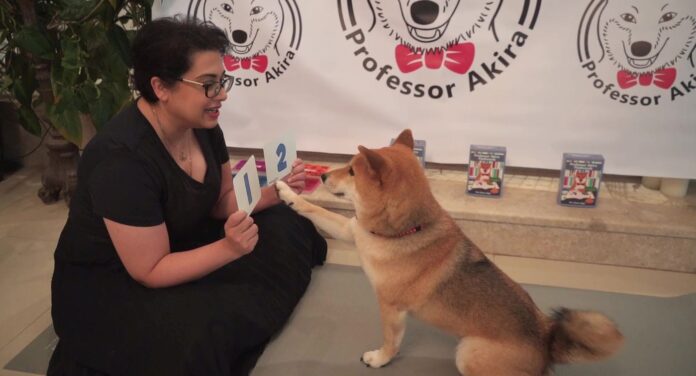
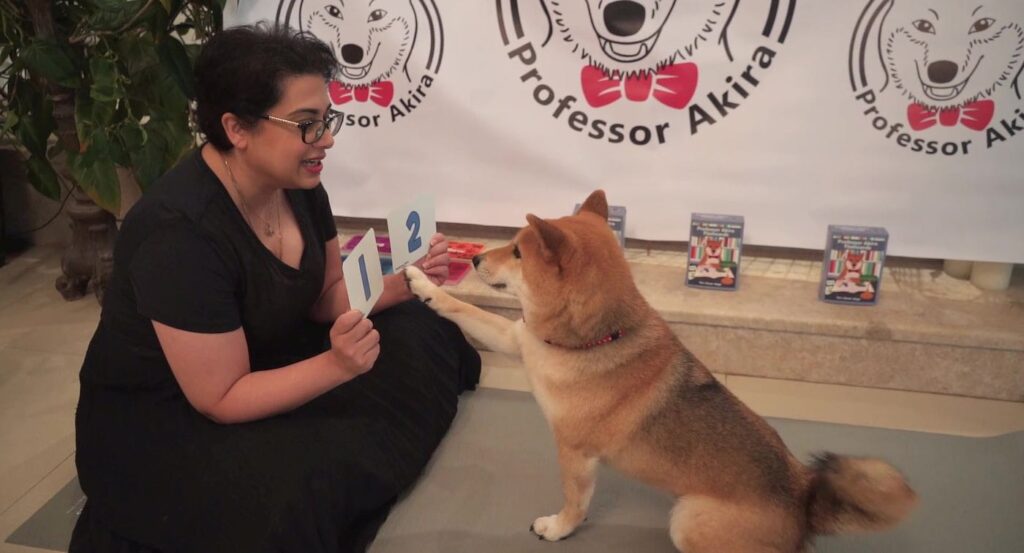
Meet the clever dog that can count to ten, answer questions and even solve addition problems—in English and Japanese.
SWNS
Monica Elkhalifa taught her six-year-old Shiba Inu new tricks when he became impossible to entertain with just long walks and toys.
Now when shown a number of different flashcards featuring colors, numbers and shapes Akira can choose the one that matches Monica’s question.
With a tap of his paw Akira—who knows more than 90 words—can also do simple addition problems by pointing to the card with the correct answer. (See the video below.)
Akira can even apparently add up the number of drawings on a card, such as three apples—and select the number card which matches—and answer yes/no questions too.
“I just thought it would be fun to teach him a few numbers—just an exercise to keep him busy. I was overjoyed when he learned the number four. After that, he quickly learned five to ten and as he mastered each stage or level, I had to develop new ideas to keep him mentally active and build on the earlier lessons.
She made her own flashcards to familiarize Akira with shapes and commands, but admits that at the start she did not know what her pet would be capable of.
Akira started by learning to tap the card on command, then Monica familiarized him with the shape of a number or image by tracing it with her finger and saying it our loud.
Next she said she taught him to count by holding a flashcard with a number on it next to a card with that number of tennis balls on it, and counting them out loud.
Even though dogs are thought to be largely color blind, Akira has also been trained to recognize different colors.
He now knows nearly 90 words, and when told a sum will point to the numbered card that is the solution, even after the cards are switched over or changed.
Akira trains five times a week in ten minute sessions, and his dog-mum said it is making him calmer and he looks forward to it. The next challenge is to master subtraction.
Monica has called her method The Professor Akira Method: Brain Training for Dogs, and pet owners can train their pets with a set of flashcards and a handful of treats. She sells them using Paypal for £20.00 on her website, ProfessorAkira.com. (We are unsure about where she ships to.)
“It is also such a great way to bond, especially during these challenging times when walks might be fewer.”
WATCH her teaching method below…
FETCH This Story for Your Friends By Sharing on Social Media…
Many people have been mastering their hobbies thanks to the isolation provided by a year of pandemic living.
Photo by Giulia Bertelli
Six in 10 Americans say they have “leveled up” in one of their hobbies since lockdown began, according to a new poll.
The survey of 2,000 adults found that 60% improved their skills in one or more of their hobbies since the start of the COVID-19 quarantines last March, and that 56% expect to be an “expert” by the time life returns to normal.
And, that includes new hobbies, too. Respondents took up an average of three brand new activities and cited improvements in active pastimes like running or yoga (35%), preparing food (34%) and making art by painting, sketching or drawing (34%).
The survey asked people to use a standardized competency proficiency scale to rank their previous and current skills related to any new hobbies.
The typical respondent said that at the start of quarantine, they would have ranked themselves as a 1—meaning they had a functional awareness or basic knowledge of the activity. Ten months later, the typical respondent now rank themselves as a 3—meaning they have intermediate skills.
So how do you know you’ve gotten better at something? Of those polled, 48% say they make fewer mistakes or can fix them more easily; 45% said they work more quickly and efficiently; and 45% said they’ve noticed mental improvements, like better memory or focus.
Conducted by OnePoll on behalf of Silhouette America, survey-takers also shared some of their proudest hobby-related accomplishments over the past year, such as knitting a blanket for the first time, mastering a new recipe, or holding a conversation in a foreign language.
“I built a new dresser from scratch for my daughter,” one respondent said. “She wanted a large dresser with some designs carved into the wood to personalize it. I felt it was an accomplishment because she gave me high approval and said it’s exactly what she wanted.”
25% of those polled even said they’ve been given a prize, award, or money for their hobby since quarantine first began — and 40% think it’s “very” or “extremely likely” that they’ll be able to make money from their hobby once quarantine is over.
“Mastering a new skill or craft feels empowering,” said Silhouette America Marketing Officer Toshiyuki Unaki. “It allows a person to take pride in what they are capable of accomplishing, which can transfer into stronger confidence in other areas of their life. When you can take on learning something new, it feels like you can take on anything.”
Now, over half (57%) of survey respondents are itching to get better at something new, and 51% are inspired to try something they’d previously found intimidating.
Overall, the average respondent has spent $165 dollars on their hobbies since nationwide shutdowns first began in March 2020.
However, 42% also bought a tool they weren’t skilled enough yet to use.
“More than ever before, I’ve realized how great it is to have a few good tools that are versatile enough to be used across my various hobbies,” said crafting expert Kelly Wayment. “Something like a digital cutting machine may seem intimidating at first, but the time spent learning how to use it pays off when I can use it for so many different crafts.”
Over half of those polled have bought new tools for their current hobby that they didn’t even know existed before—including knitting looms, pompom makers, resin molds, yarn winders, cutting machines, and more.
TOP TEN MOST IMPROVED HOBBIES Doing something active (golf, running, yoga) – 35%
Preparing food (baking, cooking) – 34%
Making art (drawing, painting, sketching) – 34%
Fiber arts (knitting, embroidery, sewing) – 28%
Playing an instrument – 28%
Speaking a language – 28%
Scrapbooking or papercraft – 23%
Model or miniature building – 21%
Photography, videography, or editing – 17%
Sculpture or pottery – 17%
Let us know what hobbies you’ve taken up this past year in the comments…
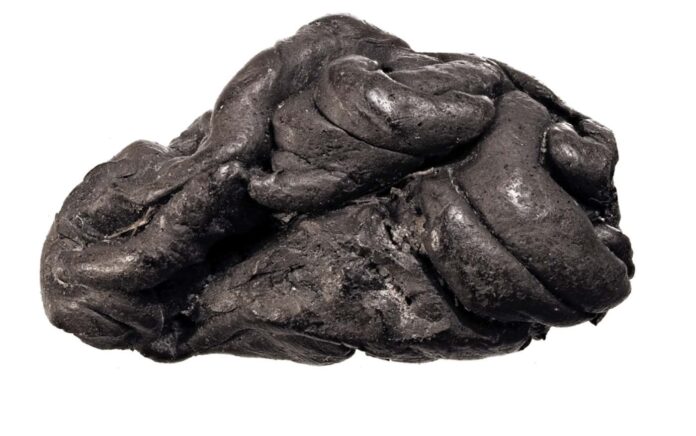
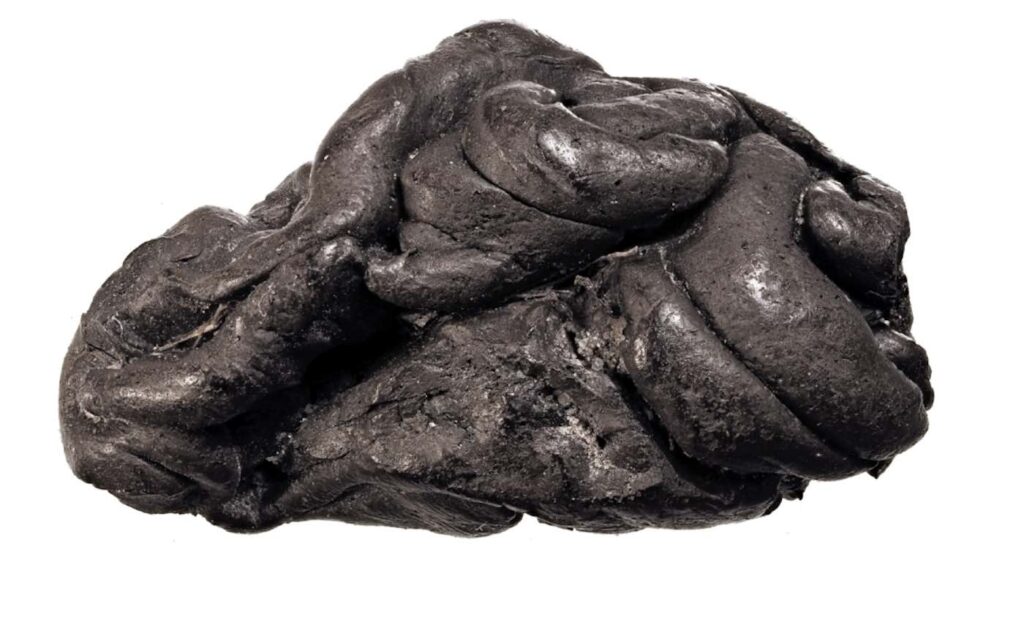
A 5,700 year-old lump of pitch from a tree provided intriguing details to archaeologists about the intimate details of a Stone Age Danish woman—and the ‘chewing gum’ sheds new light on the evolution of our species.
By Theis Jensen / University of Copenhagen
Found on an island known for its mud, the Paleolithic chewing gum has been perfectly preserved, and scientists were able to determine the individual’s skin, hair, and eye color, pathogenic profile, dental health, diet, and more, from the DNA inside.
3,700 years before the Biblical story of Jesus, a woman with dark skin, dark hair, and blue eyes lived around a place in Denmark called Syltholm, on the island of Lolland, and was chewing on a 1 centimeter long piece of birch pitch before spitting it out on the ground, as so many have done since.
There it became encased in mud for millennia until scientists managed to somehow identify, preserve, and study it.
In the pitch, researchers were able to collect her entire genome, as well as those of other species that had inhabited her mouth. She was lactose intolerant, seemed to prefer wild food to agricultural grains staples, and carried a viral infection many of us have today.
“It is amazing to have gotten a complete ancient human genome from anything other than bone,’’ says Associate Professor Hannes Schroeder from the Globe Institute, University of Copenhagen, who led the research.
“What is more, we also retrieved DNA from oral microbes and several important human pathogens, which makes this a very valuable source of ancient DNA, especially for time periods where we have no human remains,” he adds.
A window in time
This individual, named “Lola” after the name of the island on which the gum was found, had dark skin, suggesting the adaptive lighter skin of northern Europeans evolved much later on. She could have been chewing on the gum, made by rendering down birch bark, for a number of reasons.
Illustration of Lola by Tom Björklund / University of Copenhagen
As the principle Stone Age adhesive agent, resin of a variety of trees becomes more pliable the more it’s heated, and chewing it could have been a way to keep it pliable as it became cooler after heating.
There’s also the possibility that its antiseptic properties led her to chew it to relieve dental pain, or she could have simply enjoyed the monotonous gnawing that brings many of us to chew gum today.
The gum contained viral DNA of the Epstein-Barr virus, which infects 90% of humans today. The DNA of mallard duck and hazelnuts, likely the meal Lola last enjoyed, were also encased in the pitch.
“Syltholm is completely unique. Almost everything is sealed in mud, which means that the preservation of organic remains is absolutely phenomenal,” says Theis Jensen, Postdoc at the Globe Institute, who worked on the study for his PhD and also participated in the excavations at Syltholm.
“It is the biggest Stone Age site in Denmark and the archaeological finds suggest that the people who occupied the site were heavily exploiting wild resources well into the Neolithic, which is the period when farming and domesticated animals were first introduced into southern Scandinavia,” he adds.
Lola lived at a time when hunter-gatherers and agriculturalists lived in the same areas— something that wasn’t always considered probable. Her taste for mallard and hazelnut, while other Paleo-Danes were eating crops, further reinforces this theory, as does her inability to tolerate lactose, generally seen in northern Europeans after the domestication of animals.
Next time you see a piece of gum in a ditch, think of Lola—and perhaps in another five thousands years scientists will be able to parse out the characteristics of our modern time.
STICK This Fascinating Discovery on Your Social Media Pages…
When Marjy Stagmeier was 11 years old, she was the Monopoly champion of her 6th grade class in Atlanta Georgia—and she knew right then that she wanted to be landlord when she grew up—and what a compassionate landlord she became.
After graduating from Georgia State University, she started investing in old affordable apartment communities and quickly realized that many of her renter families were low-income single parents who needed services like after-school programs and playgrounds for their communities.
In response to the demand for social services, Marjy launched her own 501c3 nonprofit that provides free on-site services to families living in affordable apartments communities—and Star-C has since become a Godsend for families.
“Many children have come through the Star-C after-school program, who are now doctors, plumbers, and school-teachers, earning good wages that moved them out of poverty,” she told GNN. “Almost 100 families have elevated from renting to home ownership because we kept rents low so families can save their money.”
A chance meeting in 2017 with Bill and Melinda Gates—and Mathew Desmond, author of the Pulitzer Prize winning book Evicted—opened her eyes: Even with her rents below market, some of the tenants struggled to pay rent, so she began to build an informal resource network for families to get rental assistance.
After COVID-19 struck in March 2020, many of Marjy’s tenants were laid off from their jobs or had to manage multiple children that were suddenly at home during the day, which made the need even greater.
So, in April, Star-C launched an ambitious $50,000 GoFundMe campaign for eviction relief—and the response completely shocked Marjy—when they raised nearly $50,000.
Adding icing to the cake, the local municipal government of Cobb County found out about the Star-C Eviction Relief Fund and quickly voted to donate $1.5 million of their federal stimulus funding. Other municipalities, like Fulton County, followed, and Star-C has now raised over $9 million from governments and foundations, giving the ability to help over 3,000 families avoid eviction.
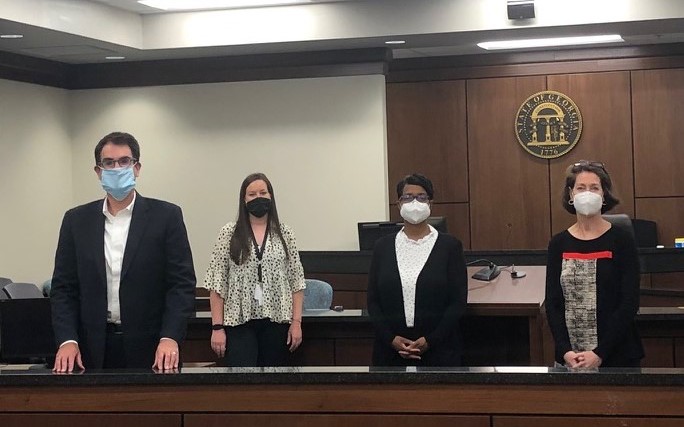
Cobb County Chief Magistrate Brendan Murphy and Fulton County Chief Magistrate Cassandra Kirk offer rental assistance and courtroom partnership to Marjy and Star-C
Marjy’s staff has spoken personally with thousands of Atlanta families through their hotline, and has, so far, partnered with over 330 landlords representing 65,000 apartment units.
“The eviction relief fund works with landlords who offer affordable rents for low-income families,” says Marjy. “Our landlords know their neediest tenants and assists them with their applications.”
Janice Abrams Cries when she finds out she’s getting financial help
The Star-C program has been a game-changer not only for tenants but landlords who have struggled as well.
“So many of our tenants and landlords are simply grateful. Our Star-C staff often receives thank you notes and calls from families who have now found work and can pay their rent.”