When the pandemic turned in-person learning virtual for the students at a Washington, D.C. high school, one chemistry teacher didn’t take long to get creative with his lessons.
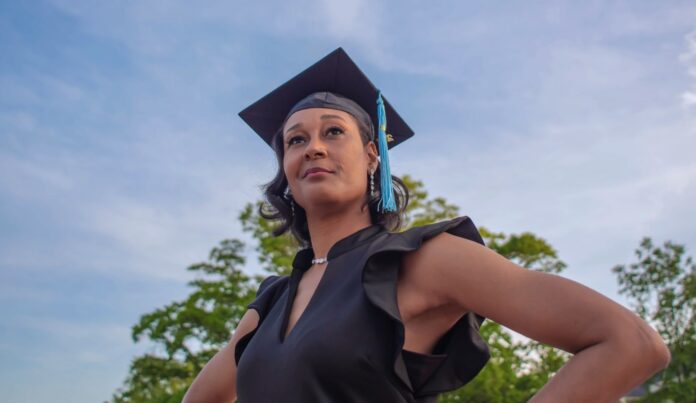
Jonte Lee
Jonte Lee’s turned his kitchen into a chemistry lab, and used his own money to buy and deliver supplies for his 35 students—then he got to teaching.
He Became known as The Kitchen Chemist and his videos have since gone viral with schoolchildren across America.
Jonte was even surprised by comedian Kevin Hart who joined one of the Zoom classes to announce the teacher had been named one of Amazon’s “Regular Heroes.”
Hart then bought the school brand new chemistry equipment and provided scholarships to the students.
Although he doesn’t think of himself as a hero, the teacher at Calvin Coolidge High said “I’m just doing me,” and he called the awards “an amazing gift”.
Find him on Instagram and get inspired by his bubbly chemistry and effervescent personality.
(WATCH the local news coverage featuring Jonte and Hart below.)
SHARE the Chemistry For Learning With Pals On Social Media…
In the birdwatching equivalent of discovering the site of the city of Troy, Asia’s longest-missing bird has been found in Indonesia.
For 170 years, the only known specimen of the black-browed babbler, found in Borneo, (thereby making it “Borneo’s black-browed babbler,”) was gathering dust at a Netherlands natural history museum.
Curious of the identity of a very much alive, small grey-brown bird flitting between the trees of South Kalimantan Province, Muhammad Suranto and Muhammad Rizky Fauzan—birdwatchers from a club called BW Galetus—managed to hold and photograph the avian for a closer look.
As the bird soared through the air, it had the appearance of a Horsfield’s babbler, but the tentative identification never sat right with the pair: a hunch that birders among readers will know all too well.
Sending the pictures of the bird to another member of their bird club ended with word of the unusual bird getting around, and some with nose to the floor, thanking God for the good fortune.
They went to another BW Galetus member, then on to a professional ornithologist, Dr. Ding Li Yong, conservationist at BirdLife International in Singapore.
“It took me a while to come to grips with this thing,” Dr. Yong told the New York Times. Once he realized the photos were legitimate, he said, “I had a tear in my eye.”
“This is a really big deal for Indonesian ornithology—as shocking as rediscovering the passenger pigeon or Carolina parakeet. But this is closer to home, a bird from the part of the world I live in.”
Everyone involved in the discovery, including BW Galetus, hopes this will increase local interest in nature and wildlife, as well as bring tourist revenue to the region, especially in the form of birdwatchers.
For Suranto and Fauzan, the discovery yielded them new jobs—as professional birding guides. Java-based birding group Birdpacker hopes to launch an expedition to study the bird once COVID-19 restrictions ease, as basically everything about this special bird is still worth exploring.
Quote of the Day: “The most common way people give up their power is by thinking they don’t have any.” – Alice Walker
Photo by: Peyton Sickles
With a new inspirational quote every day, atop the perfect photo—collected and archived on our Quote of the Day page—why not bookmark GNN.org for a daily uplift?
Legendary quarterback Tom Brady might have taken home his seventh Super Bowl ring this past February, but arguably the biggest winner of the night wasn’t even in the game.
The honor goes instead to a small, independent bookstore in Boone, North Carolina, who, with the help of The Late Night Show host Stephen Colbert and some heavyweight Hollywood talent was thrown a hail-Mary pass that might just help keep the struggling shop from having to close its doors.
Buying Super Bowl advertising time is usually a multi-million-dollar proposition, but as Colbert, a vocal proponent for boosting local economies sacked by the COVID-19 pandemic explained in his post-game special: “These big companies aren’t the ones who need our support the most right now. It’s small businesses out there who have been hurt the most in this pandemic.”
After winnowing a field of likely candidates, Colbert’s research staff chose Foggy Pine Books as the number-one draft pick to be the recipient of its “very own, very real high-octane Super Sunday ad.”
Although they already had a GoFundMe campaign up seeking support, as well as regular Instagram updates detailing the shop’s precarious situation, owner Mary Ruthless isn’t sure why or how their business was chosen.
“It was kind of like winning the lottery,” Ruthless told WBTV News. “They wanted to feature a small business that had been hit hard by COVID and do what they could to promote them. I don’t know exactly what it was that caught their eye. I’m sure part of it was our drive-thru (lovingly lampooned in the commercial).
No matter how they’d made the cut, with a mandate to sell 1,350 books a month or face defeat, it was clear without some kind of change-up, the outlook for team Foggy Pine looked pretty bleak.
“I did everything I could try to do to stay in business,” Ruthless told TODAY. “There were several weeks I didn’t take a paycheck, I had to lay people off after our PPE ran out, but we made it through the holidays… I was really pleased with that, but winter is our slowest season and I was really concerned about whether or not we were going to make it through the season.”
With a compelling voiceover from honey-and-gravel-voiced actor Sam Elliott and Oscar-winner Tom Hanks providing a priceless deadpan endorsement as well as a jaunty closing jingle, the action-adventure-paced sky-diving spot may go down as one of the funniest and most charming commercials in television history.
Ruthless reports when the store opened for business the Monday after the Super Bowl ad aired, there were 500 book orders waiting, and business, while it’s settled down a bit after the initial bump, remains brisk.
“Three weeks ago we were wondering how we were going to make it through winter and now I’m having to hire a couple of extra people to process all the extra orders,” a grateful Ruthless told WBTV.
Like Sam Elliott said: “There’s a special breed that hungers for adventure and escape into the unknown. When you’re ready for that next chapter, there’s only one place to go… Foggy Pine Books in Boone, North Carolina.”
A hot, rocky “super Earth,” near one of the oldest stars in the galaxy has taken a team of planet-hunting scientists by surprise.
Rendering, W.M.Keck ObservatoryAdam Makarenko
The planet is about 50 percent larger than Earth but requires less than half a day to orbit its star.
“For every day you’re on Earth, this planet orbits its star twice,” said UC Riverside planetary astrophysicist and team member Stephen Kane.
Part of the reason for the short orbit is the planet’s proximity to its star, which also creates incredible heat. Its estimated average surface temperature is over 2,000 degrees Kelvin—much too toasty to host life as we know it today, though it may once have been possible.
In addition, Kane said that although the planet has roughly three times the mass of Earth, the team calculated its density to be the same as our planet.
“This is surprising because you’d expect the density to be higher,” Kane said. “This is consistent with the notion that the planet is extremely old.”
The older a planet is, the less dense it’s likely to be because not as many heavy elements were available when it formed, explained Kane. Heavy elements are produced by fusion reactions in stars as they age. Eventually stars explode, dispersing these elements from which new stars and planets will form.
Discovery of planet TOI-561b, and additional observations the team made about its composition, have been accepted for publication in the Astronomical Journal.
“TOI-561b is one of the oldest rocky planets yet discovered,” said University of Hawaii postdoctoral fellow and team lead Lauren Weiss. “Its existence shows that the universe has been forming rocky planets almost since its inception 14 billion years ago.”
Named for NASA’s Transiting Exoplanet Survey Satellite, TESS Object of Interest (TOI) 561 belongs to a rare population of stars called the galactic thick disk. Stars in this region are chemically distinct, with fewer heavy elements such as iron or magnesium that are associated with planet building.
The TESS Mission team used the University of California’s access to the W.M. Keck Observatory in Hawaii—home to some of the most scientifically productive telescopes on Earth—to confirm the presence of planet TOI-561b. The observatory’s equipment also helped the team calculate the planet’s mass, density, and radius.
Astronomers are continually trying to understand the relationship between the mass and radius of the planets they find. This information yields insight about the interior structure of planets that with today’s technology are too far away to visit and sample.
“Information about a planet’s interior gives us a sense of whether the surface of the planet is habitable by life as we know it,” Kane said. “Though this particular planet is unlikely to be inhabited today, it may be a harbinger of a many rocky worlds yet to be discovered around our galaxy’s oldest stars.”
Whether or not you like your peanut butter creamy or crunchy may actually say more about you than you think, according to a new survey.
The poll examined the peanut butter and snacking preferences of 2,000 Americans—evenly split by their preference of crunchy vs. creamy—and found enjoying a crunchy peanut butter may make you have a cheerier outlook on life.
Sixty-three percent of those who prefer crunchy peanut butter describe themselves as optimists, compared to 56% of those who prefer creamy.
Other personality traits for creamy fans included being more of an early bird and more introverted—whereas their crunchy counterparts were more likely to be night owls and extroverts.
Conducted by OnePoll on behalf of Jif, the survey found that a third of all respondents described themselves as “extremely” passionate about their peanut butter preference.
Americans are so passionate, in fact, that rather than asking your date what they do for a living or where they’ll see themselves in five years—you may want to ask about their peanut butter preference. The results showed that nearly half of all respondents said it would be a deal-breaker to find out their date is on the opposite side of the creamy vs. crunchy debate.
Sixty-three percent of all respondents even said they will pass on the peanut butter altogether if it’s not the kind they prefer.
When asked to reflect on their childhoods, the results showed creamy fans were teased more over their peanut butter preference than their crunchy counterparts growing up (47% vs. 28%).
Surprisingly, those who prefer creamy were more likely to be judged for their preference than those who prefer crunchy—at 50% compared to 32%.
And 68% of creamy peanut butter fans said they’ve felt pressure to pick crunchy to fit in—compared to just 50% of crunchy fans.
Both groups do have some common ground, however, through their love of animals. When asked about their preference to dogs or cats—a third of both parties shared that they love both species equally.
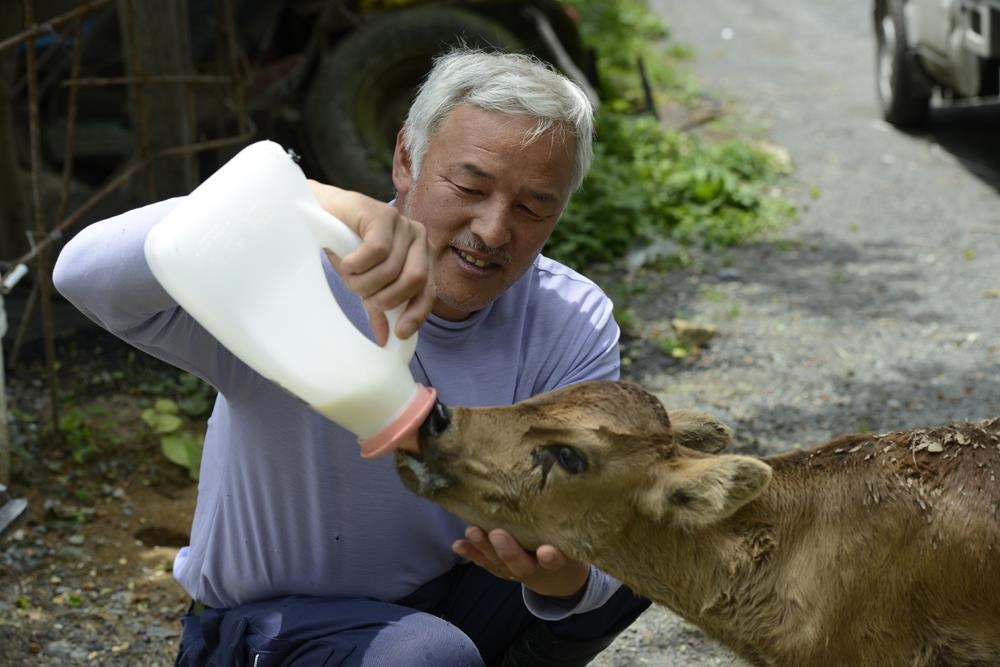
Yet, it seems only 159,998 residents heeded the warning. The other two—Naoto Matsumura and Sakae Kato—remained. Their love of animals cracked through their innate sense of self-preservation and they decided to give up everything rather than consigning other beings to starvation.
Living within the 12.5-mile exclusion zone around the damaged reactor, the two men, unrelated to one another, both live alone while taking care of dozens of stray animals that were left behind when the evacuation order was given.
Reports from Reuters and DW state that 57-year-old Kato currently has 41 cats who live with him in his home in the mountains—along with a stray dog he adopted named Pochi. Kato says he will stay with his cats and ensure they are comfortable all through their lives.
Kato’s generosity isn’t restricted to his domesticated animals. He has taken to feeding local wild boars, considered pests by the government.
Naoto Matsumura left the city at first, but returned shortly after to retrieve his own animals. Once he arrived, the now 55-year-old realized that everyone else’s pets and livestock were still there, so he began taking care of a broad community of animals including pigs, cats, dogs, ponies, ostriches, and cows.
When he first evacuated, some of his family outside of the exclusion zone told him he couldn’t stay with them due to the risk of contamination. The refugee camps outside the area were quickly filling up, and Matsumura felt like everything out there was too much of a hassle.
GNN reported in 2015 that he went back inside the exclusion zone and realized local dogs had not eaten in several days. After it became clear no-one was coming back to the neighborhood, he went around unchaining dogs from trees, letting cows out of their barns, and feeding anything in need, earning him the moniker the ‘Guardian of Fukushima’s Animals’.
According to scientists from JAXA, the Japanese national space agency, Matsumura is also the “champion” on another list—he is the most irradiated man in the country. However, they have advised him it will likely be 30-40 years before radiation begins to wreck his biology, a timeline that would leave him “likely dead by then,” anyway.
Until that day, he funds the feeding of animals through local donations and had kept people up to date with news on his blog–posted by using solar power—though he lives without steady electricity or running water.
Everything both Kato and Matsumura are doing is technically illegal, and police have ordered them both to leave the area. Yet they seemingly couldn’t be less bothered by the government’s demands, and both plan to stay there with their animals, come what may.
(WATCH a local news report… )
These Heroes Deserve Recognition—Share Their Story on Social Media…
Herpetologists at the Manchester Museum have successfully bred a critically-endangered harlequin toad for the first time ever.
Brain Gratewick, CC 2.0 license
The scientists successfully recreated the habitat in which harlequin tadpoles grow up following years of meticulous work.
The breeding program will ensure that at least one of these charismatic amphibians—the veragoa stubfoot toad, has a failsafe mechanism for its survival should something happen to it in its rainforest home of Central America.
The genus atelopus, colloquially known as the harlequin toads, almost all range from endangered to critically endangered according to the IUCN Red List, and are found in the rainforests of South and Central America.
The breeding program in Manchester is the only one of its kind, as the toads are rare and difficult to study. Herpetologists studied the conditions in which atelopus varius lay their eggs, which turned out to be turbulent streams filled with boulders and stones, of a certain temperature and moisture level in the air, and bathed in a certain spectrum of light that allows for the growth of a tropical algae which the tadpoles eat when they’re young.
“The university is the only institution outside Panama to house these frogs. It’s a huge responsibility the team do not take lightly,” Andrew Gray, curator of herpetology at the Manchester Museum told the Guardian. “So we’re over the moon we’ve achieved the first captive breeding of this remarkable species. Our success heralds the next chapter for more innovative amphibian conservation work.”
The beautiful toad, with its shiny black skin and undulating golden bands, is just one of 68 species under the atelopus genus.
The field work started in 2018 in and around Santa Fe National Park, with collaboration with Panama Wildlife Conservation (PWC) which for its part is trying to save the veragoa stubfoot toad by hosting workshops for school kids in rural areas.
They believe that if the next generation understands the value inherent in the harlequin toads, the better chance they will work for its protection when they grow up and inherit the society.
Manchester Museum is trying to raise money to continue the breeding project through various methods, including the Sponsor a Frog program, (even though it’s a toad) which has some pretty cool perks, including a personal behind-the-scenes tour of the museum’s vivarium where you can see and learn all about how the toads are kept, what they need to survive, and more.
HOP This Story Over to Your Friends on Social Media…
Quote of the Day: “What is Spring like? It is the sun shining on the rain and the rain falling on the sunshine.” – Frances Hodgson Burnett
Photo by: Sergey Shmidt
With a new inspirational quote every day, atop the perfect photo—collected and archived on our Quote of the Day page—why not bookmark GNN.org for a daily uplift?
On March 9 and 10, stargazers will get to see an impressive sight in the morning sky, as Mercury, Jupiter, and Saturn appear in near-perfect alignment—and a sliver of the moon frames these planets towards the southeast horizon.
With this Quadruple Formation, all four celestial objects will be easy enough to see with the naked eye, but as always when it comes to gazing up at the night sky, binoculars or a telescope will help you spot extra details—such as Jupiter’s largest moons, and maybe even the rings of Saturn.
Rings of Saturn, NASA/JPL-Caltech
Jupiter will appear as the brightest of the three planets, while Mercury will be quite faint.
If Mercury appears as a tiny quarter moon through your telescope? That’s because only a small portion of the planet will appear illuminated to us on Earth. Our moon, right now, is also a waning crescent.
Wishing you the clearest mid-week skies, and that you enjoy the special show.
SHARE The News With Starry-Eyed Pals on Social Media…
What’s more addictive than squishing bubble wrap and hearing that satisfying “pop-pop-pop” sound? For one New York-based painter, the answer is using it to create some truly amazing art.
There are many famous schools of art: the Impressionists, the Surrealists, and the Cubists, to name a few. But while Bradley Hart’s work most closely mirrors the Pointillists—he’s even re-created George Seurat’s famous painting “A Sunday on the Grande Jatte” using his unique technique—Hart might most appropriately be termed an “Injectionist.”
Hart’s latest creation is an homage to rap legend Notorious B.I.G. “I load thousands of syringes with paint in preparation to begin the injection,” he said in an interview with ABC’s Localish program, “I’ve done portraits of the likes of Marilyn Monroe, Kurt Cobain Michael Jackson, David Bowie, John Lennon.”
Invented in 1957, bubble wrap was originally intended to be marketed as textured wallpaper. What turned out to be a hard fail from the decorator point of view turned out to be a boon to the shipping industry—and to Bradley Hart.
“Researching the history of bubble wrap and realizing that it was meant to be wallpaper brought me around to this great idea,” Hart told Art Insider. “What is a painting—short of the cultural significance and historical value it may obtain over time? It’s ostensibly a wall covering.”
To date, Hart has completed just over a hundred injection paintings. The painstaking process involves filling row after row of tiny bubble wrap cells with different hues of acrylic paint to create an image. He estimates it takes four or five days to preload the 1,800 to 2,500 syringes his paintings require from a palette containing 116 colors.
Each project produces two separate paintings—the pixelated picture in front, and an impressionist image rendered by the drippings from the back—and takes between three weeks to a month to complete.
When he started out, Hart was only able to inject a few cells at a time before having to step back to review his progress. He’s since invented a computer algorithm that gives him a working bird’s eye view. While it makes the process faster, it’s still time-consuming.
And time is a precious commodity to Hart. Back in 2003 when he was diagnosed with Multiple Sclerosis, at the age of 31, his future seemed less than a pretty picture. Hart admits he felt as if his life was over.
Part of his treatment regimen involved self-injections. Initially, he balked at the idea of sticking himself with needles. He credits his artistic muse with eventually showing him the irony of his reluctance.
“I realized, ‘Oh my God, how perverse is this? You wouldn’t inject yourself for a decade, but you’re sitting here with thousands of syringes in front of you, injecting paint into bubble wrap!’” he told CBS News correspondent Lee Cowan on Sunday Morning.
Hart’s philosophy is simple. “Every drop of everything is potentially art,” he told Localish. “I’ve been very lucky and very thankful for the luck that I’ve been afforded. The art world has kind of enveloped me and help lift me up… It’s been really a big blessing.”
During the COVID-19 crisis, Hart has come to see bubble wrap not just as a medium, but also as a metaphor.
To quote Poet John Donne, “No man is an island entire of itself; every man is a piece of the continent, a part of the main.” It can be a difficult sentiment to hold for people trying to cope with pandemic-induced isolation. Not so for Bradley Hart.
“I joke to people that I live in a bubble,” told Sunday Morning. “We choose who we let into our circle. We’ve all been forced now to create micro-bubbles. But guess what? All these little micro-bubbles come together, they make a beautiful painting.”
And that is what we call a paint-by-injection masterpiece.
(WATCH the ABC Localish video about these artworks below.)
Help Your Pals’ Social Feeds ‘Pop’—Share This Story on Social Media…
Okere Mom-Kok was destroyed during the Ugandan Civil War in the 1980s, but is now being rebuilt into a sustainable community that’s home to 4,000 people.
Okere City is based around sustainable principles like renewable energy and the sustainable harvesting of natural resources.
The village has a clinic, church, school, a nightclub that doubles as a community center, markets, bars, and a bank. Electricity generated through solar energy is available to everyone, and clean water—thanks to modern borehole methods—keeps the all-too-normal cholera outbreaks in the region at bay.
An expert in international development and graduate of the London School of Economics, Ojok Okello started the project with a $54,000 investment from his own pocket. The village of Okere Mom-Kok was where he had some extended family, and it was during a visit that he decided to put what he learned in university to action.
“I don’t want this project to be at the mercy of some white people,” Okello told The Guardian, explaining how he had seen many NGO-funded projects on the continent fail by not involving the very communities they were helping.
While the Okere City project might conjure images of an equitable utopia, there’s a lot of business and banking knowledge that Mr. Okello utilized to ensure the community could survive and grow.
All businesses in the town pay for themselves—for example, the school allows pupils to pay up to half their tuition in sugar, beans, firewood, or other commodities, while the clinic has flexible installment-billing policies. An Okere City investment club runs a sort of credit union by taking members’ dues and offering them as loans to those in the community who need them—often to develop local resources.
“I looked at [the shea tree] and realized that we have this important natural resource and we were not harnessing it,” Okello told The Guardian. “And I thought about [Marvel Cinema’s] Wakanda and Black Panther, they had vibranium, this shea tree could be our vibranium.”
Max Kane was diagnosed with Crohn’s Disease after years of eating the standard American diet high in salt, fat, and sugar. While it’s not clear whether his poor diet brought about this autoimmune disease, what is clear was things changed when he began working with his dietitian.
Kane’s health flourished, he gained 50 lbs. of lean-muscle mass, and the catalyst was a new eating program consisting solely of foods grown and made on farms in his area.
Along with his diet and health, Kane’s attitude changed as well, and he took up the torch as a proud member of the farm-to-table, small farm movement by creating FarmMatch.com—the simplest tool desirable for those looking to support small farmers in their area, and to increase the quality of the contents of their fridge.
FarmMatch.com couldn’t be simpler to use. Just enter your zip code, choose from the list of farms, fill up your basket with their products, and then choose whether you want to pick it up, or receive it at your door.
Best of all, because many of these small farms provide foot to restaurants and other city locations, those living in the hearts of large cities can get farm-fresh produce and meat without needing drive an hour outside of town for the produce.
“There’s just tens of thousands of small farms that are making deliveries into the city already, and they have these drop locations, or pickup location food distribution models where they go to all these different neighborhoods around the city and you meet them at the pickup location and get your food,” explains Kane in a podcast interview.
While FarmMatch is as simple a tool as you like, Kaane hopes to build an application where locals buying from the platform can upload their orders to a community database. If there are people in low-income areas that maybe don’t have means of getting to a pickup location, neighbors driving there will have the opportunity to lend a hand.
This, Kane says, not only builds community relationships—it keeps the cost of products low, since the small farmers don’t have to expedite each and every home delivery.
“In a effective, tangible way it [FarmMatch] really addresses the fragileness of our food system,” says Kane, noting the bare supermarket shelves that typified the early months of COVID-19 lockdowns.
For those who just read a four-page feature article somewhere on “adaptive multi-paddock rotational grazing strategies” for livestock, or on permaculture and agroforestry, but then realized they had no access to any of this superior quality food, there may be a farm waiting for you, and your dollar, closer than you expect.
More than 40,000 small farmers are already coordinating with Kane to make their product available to people in their area, which as of December 2020 had facilitated 600,000 orders.
(WATCH the great FarmMatch explainer video below.)
SHARE This Handy Resource With Your Friends on Social Media…
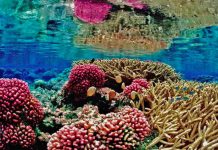
After the most destructive cyclone in Fijian history smashed into the island four years ago, it was feared the rich coral reefs surrounding the island would never recover.
Reefs across the Namena Reserve and Vatu-i-Ra Conservation Park were devastated by Cyclone Winston in 2016—which hurtled over ocean and land with 170 mph (280 kph) winds—but a recent dive expedition by the Wildlife Conservation Society (WCS) revealed there’s nothing to fear, and the corals are reproducing at an exceptional rate.
WCS Fiji-chapter expedition leader Dr. Sangeeta Mangubhai said in a statement: “We saw large areas of reef covered by branching corals all roughly the same size and likely to be around four years in age. These new corals are covering surfaces and are providing new habitat for fish.”
Along with brightly colored corals, the area was teeming with tropical fish and other sea life. This is crucial to parts of the Fijian population which depend on the bounty of the sea and the reefs for income and food security.
WCS Melanesia Director, Dr. Stacy Jupiter, said: “At a period in history where every day we are seeing bad news in the papers and on television, this is a good news story. Our Fiji reefs are showing that they are stronger than Winston.”
Together, Namena and Vatu-i-Ra protected areas cover around 120 square miles, (200 square kilometers) spread across varied marine habitats such as small islets, shallow sands, deep water passages, and more.
It is the largest area to be managed by local communities in the country, who have established rotational catch strategies in their traditional fisheries called “Tabu,” where citizens who require seafood to sell and eat do so in a regenerative way that keeps their traditions alive.
The total ecosystem expands past 27,000 square kilometers, and the reefs are a vital part of ensuring marine visitors to the islands—like the humpback whale—will have a warm welcome when they come in the spring to calve.
GROW the Good News—Share This Hopeful Story With Pals…
With a new inspirational quote every day, atop the perfect photo—collected and archived on our Quote of the Day page—why not bookmark GNN.org for a daily uplift?
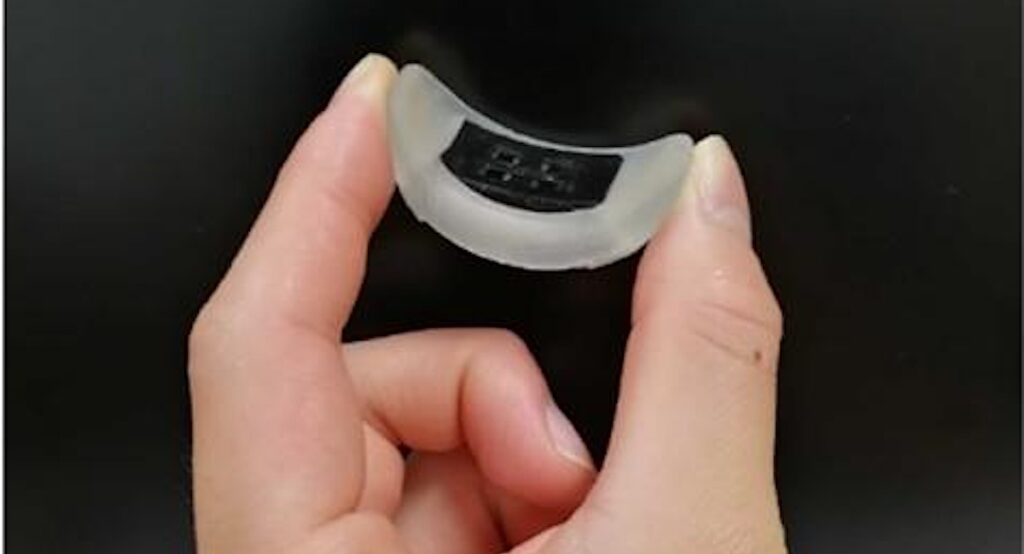
Researchers in Japan have developed the first wearable devices to precisely monitor jaundice, a yellowing of the skin caused by elevated bilirubin levels in the blood that can cause severe medical conditions in newborns.
Yokohama National University
Neonatal jaundice is one of the leading causes of death and brain damage in infants in low- and middle-income countries—but it can be easily treated by irradiating the infant with blue light which breaks down bilirubin so it can be excreted through urine.
The treatment itself, however, can disrupt bonding time, cause dehydration and increase the risks of allergic diseases.
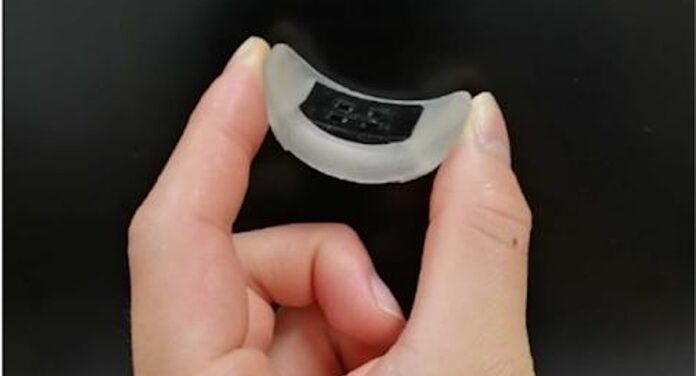
To address the tricky balance of administering the precise amount of blue light needed to counteract the exact levels of bilirubin, researchers have developed the first wearable sensor for newborns that is capable of continuously measuring bilirubin. In addition to bilirubin detection, the device can simultaneously detect pulse rate and blood oxygen saturation in real time.
“We have developed the world’s first wearable multi-vital device for newborns that can simultaneously measure neonatal jaundice, blood oxygen saturation and pulse rate,” Hiroki Ota said, noting that jaundice occurs in 60 to 80% of all newborns. “The real-time monitoring of jaundice is critical for neonatal care. Continuous measurements of bilirubin levels may contribute to the improvement of quality of phototherapy and patient outcome.”
Led by Hiroki Ota, associate professor of mechanical engineering in Yokohama National University’s Graduate School of System Integration, and Shuichi Ito, professor of department of Pediatrics in Yokohama City University’s Graduate School of Medicine, the team published their results on March 3 in Science Advances.
Currently, medical professionals use handheld meters to measure bilirubin levels, but there is not a device that can simultaneously measure jaundice and vitals in real time.
“In this study, we succeeded in miniaturizing the device to a size that can be worn on the forehead of a newborn baby,” Ota said. “By adding the function of a pulse oximeter to the device, multiple vitals can easily be detected.”
Held to the baby’s forehead by a silicone interface, the device has a lens capable of efficiently transmitting lights to neonatal skin via battery-powered light-emitting diodes, commonly known as LEDs.
“At the present stage, coin cell batteries are used, and the overall shape is very thick,” Ota said. “In the future, it will be necessary to further reduce the thickness and weight by using thin-film batteries and organic materials.”
The researchers tested the device on 50 babies, and they found that the device is not currently accurate enough to be the sole measurement used.
But Ota’s team will reduce the thickness and increase the flexibility of the device, as well as improve the silicone interface to facilitate better skin contact.
In the future, the researchers plan to develop a combined treatment approach that pairs a wearable bilirubinometer with a phototherapy device to optimize the amount and duration of light therapy based on continuous measurements of bilirubin levels.
Many swimming pools in Germany don’t have enough trained lifeguards—and in many places, this skilled labor shortage is leading to closures. The solution could be a floating underwater rescue robot.
According to one German life-saving association, nearly 420 people drowned in Germany in 2019, with the majority losing their lives in fresh water lakes, but also in swimming pools.
Now, a team of researchers from the Institute for Advanced Systems Technology of Fraunhofer Institute for Optronics, System Technologies, and Image Exploitation (IOSB) is aiming to improve the situation with an aquatic robot that uses AI, the only one of its kind worldwide.
The scientists have used their years of expertise in the area of underwater robotics to develop the autonomous device that will assist lifeguards and rescue swimmers in emergencies.
“There are typical postures that you can use to recognize when someone is in danger,” says computer scientist Helge Renkewitz, who led the team in close collaboration with the water rescue service, Wasserrettungsdienstes Halle e.V.
Surveillance cameras mounted on the swimming pool’s ceiling register the movement patterns and position of the drowning person in the pool, and send the coordinates to the robot. It is safely stored away from prying eyes in a docking station on the swimming pool floor, which opens in an emergency.
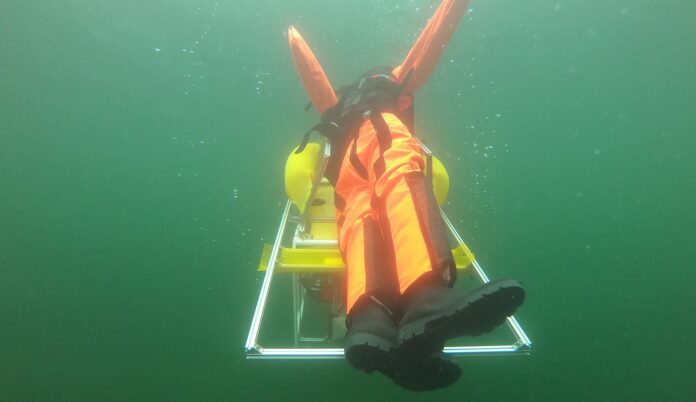
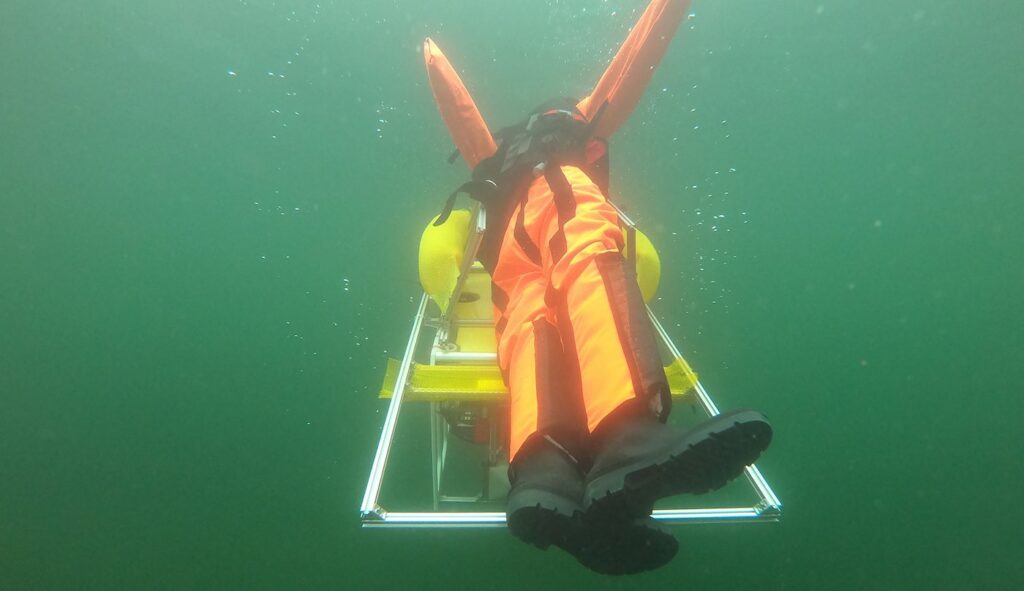
Once the vehicle has reached its destination, it locates the endangered person and carries them to the surface. A mechanism for fixing the rescuee in place prevents lifeless bodies from sliding down as they surface. This mechanism can also be mounted on other underwater vehicles.
In lakes, drones and zeppelin systems take on the task of the surveillance cameras. “These drones and advertising balloons can easily be fitted with cameras,” says Renkewitz. Because the visibility is restricted, the underwater vehicle must be equipped with acoustic sensors instead of optical ones. Sound wave echoes can be used to determine people’s positions and orientation so precisely that the robot can autonomously head for the target person and pick them up.
This has been proven to work in practice through the very impressive open-water testing that researchers conducted at the Hufeisensee lake in Halle (Saale).
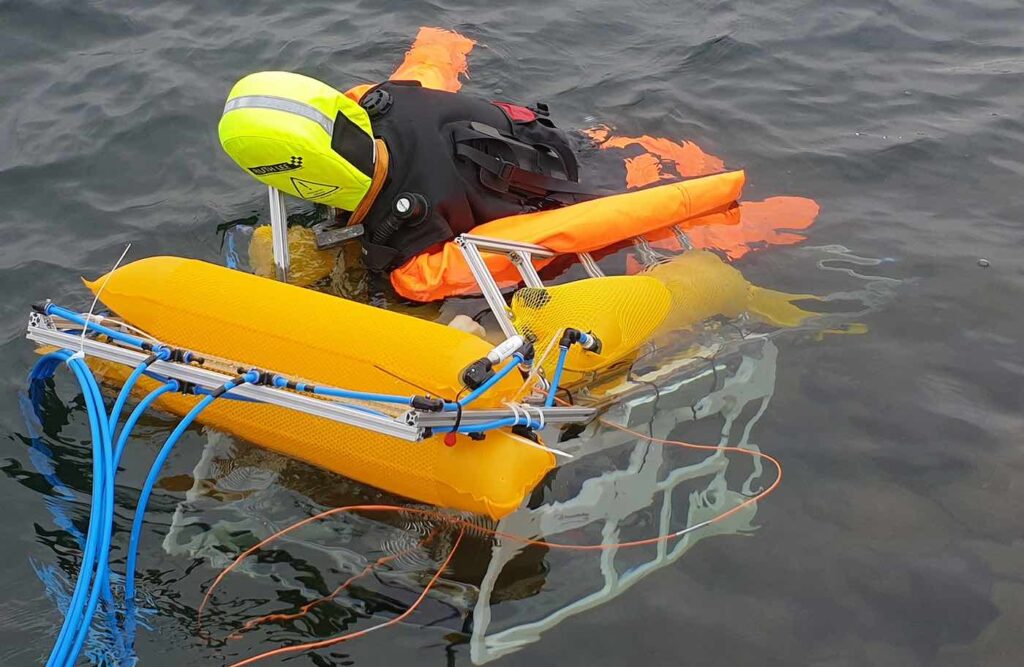
An 80-kilogram dummy was deposited at a depth of three meters. The robot then picked it up, secured it in place, brought it to the surface within a second, and carried it via the shortest route – a distance of 40 meters – to shore, where the rescue team was already waiting.
When the robot is informed of an emergency, a signal alerts the team immediately. “The full rescue operation lasted just over two minutes. Casualties must be resuscitated within five minutes to avoid long-term damages of the brain. We were able to stay within this critical time frame without any problems,” says Renkewitz.
Equipped with batteries, motor, cameras, and optical and navigational sensors, the current system is 90 centimeters long, 50 centimeters high, and 50 centimeters wide. The objective of Renkewitz’s team is to further reduce the size of the rescue system and build different versions for use in swimming pools and lakes. They aim to make it smaller, lighter, and more cost-effective than the current prototype, which is based on a pre-existing underwater vehicle.
Instead, the future robot will have the streamlined design of a manta ray.
Funded by the German Federal Ministry for Economic Affairs and Energy, a patent has already been filed for the aquatic robot. In modified versions, it can take on further tasks – such as offshore and dam wall inspections or being used to monitor the health of fish in fish farms.
The underwater vehicles have a very broad range of applications, such as detecting and verifying archaeological artifacts at the bottom of lakes—where fewer victims will end up, thanks to the new robot.
A pioneering California oncologist is doubling the success rates for cancer treatment—and one mom was so thrilled with her outcome that she reached out to a stranger recommending the clinic, and now the new friends are forever bonded as stalwart survivors of terminal diagnoses.
When Maria Lewis first felt a lump, her heart sank because she had lost many family members to cancer. She was diagnosed with triple negative breast cancer—meaning it did not have any of the receptors that are commonly found in breast cancer—and was given 3-6 months to live with little hope of any treatment working.
After being told to prepare for the worst, the 50-year-old with four children living at home traveled to Los Angeles after searching online for some help.
She went to see Dr. Robert Nagourney, who uses the emerging technique of ‘functional profiling’ to test which drugs will work in any patient using samples of the actual tumors or fluid.
Basically, this involves killing a patient’s tumor in the lab first, based on which FDA-approved drugs and drug combinations work best, then providing those to the patient—using personalized medicine based not on genomics but on cell biology.
Nagourney had become disenchanted with the trial and error approach he witnessed during fellowships at Georgetown and elsewhere, and decided that there must be a better way. Today, his approach is catching on around the world, given his patients’ success.
By the time Maria arrived in his clinic, she was at stage 4—with a large 6 cm tumor on her breast, a tumor on her kidney, and lymph node involvement.
Maria Lewis at the Institute and home
One week after going home to Utah, Dr. Nagourney finished his testing and she returned to receive chemotherapy based on the results in the lab that targeted just the right drugs. Three weeks after that chemo session, she could no longer feel her tumor. Three weeks after that, the tumor was gone.
After Maria recovered, she heard about Shellie Chrum in St. Louis (a friend of her neighbor’s) who was dealing with a similar dire diagnosis: widely metastatic breast cancer that had spread to her lungs and bones, including the spinal column. She immediately called Shellie.
New best friends
“Although we have never met in person, we have spoken on the phone for many hours,” Maria told GNN. “Having had a life threatening cancer diagnosis myself, and having been blessed with the results that I have had, I want to shout it from the rooftops so that everyone can hear and learn from my experience with Dr. Nagourney’s functional profiling test.”
Shellie took the advice of her new friend and went to California last summer so Nagourney could remove fluid from the 43-year-old, which provided ample cells for his EVA/PCD analysis (Ex-Vivo Analysis of Programmed Cell Death).
After he determined she was HER2–positive (for human epidermal growth factor 2) Nagourney knew that she would be a good candidate for the common drug combo Trastuzumab (Herceptin) and Pertuzumab (Perjeta), but how to address the disease involving lung and bone left the doctor puzzling.
He discovered a highly favorable interaction between Vinorelbine and Trastuzumab, and added a low dose Everolimus—which resulted in a four-drug combo that “no other breast cancer patient had ever received.”
After just two cycles of the drugs, given on the first and eighth day of a three-week cycle, the scan results compared with late-June were “stunning… and consistent with a complete or near-complete response to therapy”.
(Click below to continue the story and find out how much it costs…)
In yet another loss for ExxonMobil in a historic and long-running environmental enforcement case, a U.S. District Court judge has imposed a $14.25 million penalty to punish the company for violating the federal laws—the largest yet imposed in a Clean Air Act citizen enforcement suit.
Exxon has been fighting this case for 11 years now, but last July, a three-judge panel had rejected most of the arguments Exxon had made in its appeal of the original $19.95 million penalty in this case.
The appellate court sent the case back to Judge David Hittner to make additional findings as to how many of the thousands of proven Clean Air Act violations were of a type or magnitude that was “capable of causing” the kinds of harms suffered by those who live near the sprawling refinery and chemical plant complex in Baytown, Texas.
Exxon’s 3,400-acre facility sits about 25 miles east of downtown Houston, and tens of thousands of people live within three miles of the complex.
In his new opinion, Judge Hittner found that the environmental groups had proven at trial that over 3,651 days (8 years) thousands of instances of illegal flaring and unauthorized releases of pollutants causing smoke, chemical odors, ground-level ozone, and respiratory problems were “fairly traceable” to the injuries plaintiffs suffered.
“We are extremely pleased that Judge Hittner has, once again, assessed a civil penalty against Exxon that is larger than any penalty ever imposed in a Clean Air Act citizen enforcement suit,” said National Environmental Law Center senior attorney Josh Kratka, who was part of the legal team representing Environment Texas and Sierra Club.
In support of his penalty assessment, Judge Hittner pointed to the fact that Exxon had committed more than one violation every single day for a period of eight years.
This case follows successful cases the same groups brought against Shell Oil Company for violations at its Deer Park refinery, Chevron Phillips for violations at its Cedar Bayou plant, and Pasadena Refining Systems, Inc. for violations at the Pasadena refinery.
“Exxon’s Baytown refinery-chemical complex is the largest polluter on the Houston Ship Channel impacting the air quality of hundreds of thousands of citizens,” stated Neil Carman, clean air program director, Sierra Club’s Lone Star Chapter. “Exxon Baytown still needs to clean up its act and do more to create cleaner air in the Houston area,” he added.
Quote of the Day: “Loving yourself does not mean being self-absorbed, or disregarding others. It means welcoming yourself as the most honored guest in your own heart, worthy of respect, a lovable companion.” – Margo Anand
Photo by: Aziz Acharki
With a new inspirational quote every day, atop the perfect photo—collected and archived on our Quote of the Day page—why not bookmark GNN.org for a daily uplift?