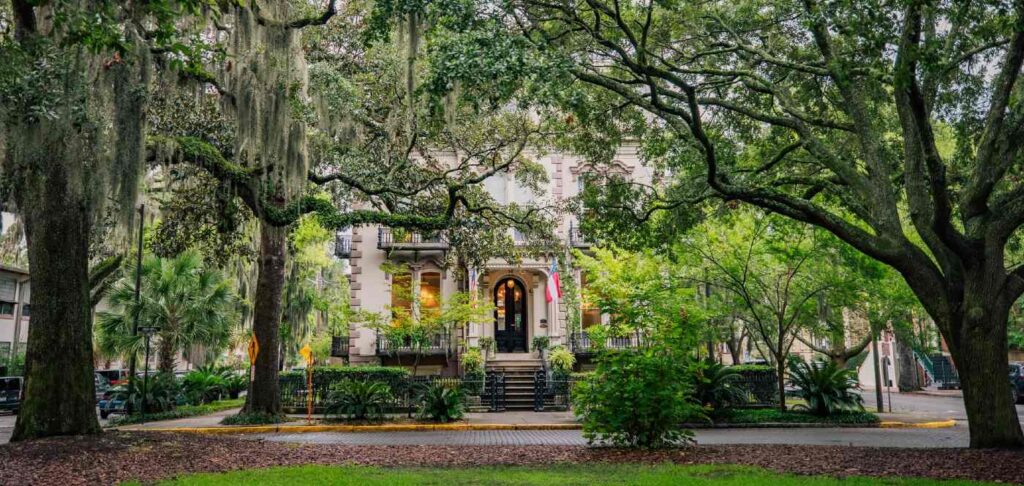
Quote of the Day: “Excellence does not require perfection.” – Henry James
Photo: Adam Hoffman
With a new inspirational quote every day, atop the perfect photo—collected and archived on our Quote of the Day page—why not bookmark GNN.org for a daily uplift?
Chelsea Timmons decided to make it her last delivery because the roads in Austin, Texas were getting slicker. When she ended up getting stuck in the customer’s driveway, there turned out to be a big silver lining.
Not wanting to walk up the driveway, the H-E-B grocery employee tried to make it up the steep slope with her car, but slid helplessly into the garden.
Though the couple tried to help move her car, efforts failed—and AAA road service was already inundated with calls.
That’s when Nina Richardson and Doug Condon decided, with the weather getting worse and safety concerns growing, she needed to settle in at their house.
“It’s just what you do when stuff shows up,” Nina told ABC News.
“We have daughters and we hope if they were ever in a situation like this that there would be someone who would open their house and help them,” added Doug.
Over dinner they learned that Chelsea would like to open a bakery some day—and she soon volunteered to bake them a delicious gluten-free coconut cake.
Chelsea Timmons
She slept in the spare room for five days, became friends with the dog, and realized how lucky she was overall.
“I found out my apartment lost water, lost power, so being ‘stuck here’ actually turned out to be a better situation. Most of my family lost electricity for several days.”
Wearable electronic sensors, such as those within Fitbit watches and pedometers that detect biological signals, could be replaced in the future by… mushrooms.
Oyster mushrooms by Rachel Horton
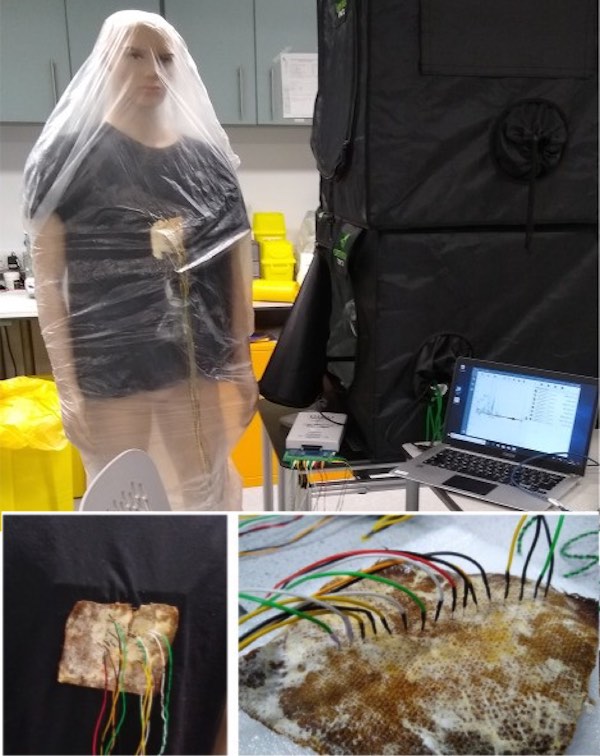
No that’s not a typo. In a proof-of-concept study, mycelium were able to perceive several external stimuli like light, temperature, and moisture, but also certain chemicals in the environment, and even electrical signals.
Oyster mushroom mycelium, the fibrous mainframe tissues of fungi that colonize under the soil and from which mushrooms sprout, were able to perceive electrical signals in such a way as to replicate that part for sensors and processors, which are readable by a computer.
In other (fantastical) words, the mushroom’s perceptions of the environment would become the data that gives you the beats-per-minute count on your heart rate monitor.
In nature, mycelium organizes itself into geometric structures in and throughout the soil. While fungal mycelium don’t have many reasons for detecting electrical signals in nature that we know of, reprogramming oyster mushroom mycelium genes to form different geometric structures that would optimize the detection power of electrical signals is the ticket to ride that makes Prof. Andrew Adamtzky believe it’s worth investigating.
“We have shown that it is possible to discern a nature of stimuli from the fungi electrical responses,” Adamatzky, who famously utilized slime molds to solve mazes and optimize city roadway planning in Tokyo and France, wrote in his new research paper.
The patches referred to were hemp fabric colonized with mycelium and then hooked up to computer sensors.
Spraying different chemicals onto the patch, as well as exposing it to different stimuli mentioned above, were what gave Adamatzky the surety of voice.
It’s not anything that’s going to seize control of the markets anytime soon, but it’s another fascinating application of mycelium, which GNN has reported can be used to make building bricks, coffins, canoes, and to great effect on nuclear waste cleanup.
SPROUT Some Food For Thought on Your Friends’ Through Social Media…
Green tea has been consumed in China for 4,000 years—and one of its compounds may hold the key to staving off cancer, according to compelling new research.
Alisher Sharip
It switches on a gene called p53, which is proven to block the development of tumors.
Known as the “Guardian of the Genome” for its ability to repair DNA damage and destroy cancerous cells, p53 is classified as a tumor suppressor—and if a person inherits only one functional copy of the p53 gene from their parents, they are predisposed to the disease.
A new study published this month in Nature Communications shows that an antioxidant found in the traditional Chinese drink may increase levels of p53 and improve its efficiency, say scientists at the Rensselaer Polytechnic Institute in Troy, New York.
Studying the direct interaction between p53 and the green tea compound, epigallocatechin gallate (EGCG), offers hope that a new drug might be created to mimic it.
A state of the art scanning technique called nuclear magnetic resonance spectroscopy showed EGCG protects the cell structure’s ‘N-terminal domain’ from degradation.
EGCG is a natural antioxidant, which means it helps to undo the near constant damage caused by oxygen metabolism. Found in abundance in green tea, EGCG is also packaged by many companies as an herbal supplement.
Wang’s team identified the specific mechanism–the beneficial interaction between EGCG and p53– for the first time. “When EGCG binds with p53, the protein is not being degraded…so the level of p53 will increase with the direct interaction.”
“That means there is more p53 for anti-cancer function.”
When operating at full capacity, p53 activates DNA repair mechanisms and prevents the cells with damaged DNA from dividing. If DNA damage is irreparable, p53 induces the cell to destroy itself by undergoing apoptosis, or programmed cell death.
Since it is commonly switched off in human cancers, reactivating the protein could potentially provide a powerful way of treating the disease in the future.
The findings also shed fresh light on the benefits of green tea, which has been shown to reduce the risk of dementia and heart attacks. One study of over 100,000 older Chinese people found those who drank at least three cups of green tea a week were 25 percent less likely to die over the next seven years.
“By developing an understanding of the molecular-level mechanisms that control key biochemical interactions linked to devastating illnesses such as cancer and Alzheimer’s disease, Chunyu’s research is laying the groundwork for new and successful therapies,” said Curt Breneman, dean of the Rensselaer School of Science.
SHARE a Cuppa Good News With Your Tea Drinking Friends on Social Media…
March is Reading Month, and this inspiring blog post was submitted to GNN by one of our own readers. If you have an interesting story of kindness or positivity, be sure and send it to us for review.
According to the National Federation of the Blind, fewer than 10 percent of the 1.3 million people who are legally blind in the U.S. are Braille readers—but one woman has made an incredible difference in their lives.
35 years ago, our son, Jared, was born blind. Fortunately, I learned about her life-changing organization when Jared’s teacher of the visually-impaired introduced us to Seedlings Braille Books for Children.
It was founded by Debra Bonde, and although she did not plan to start a nonprofit back in 1984, she ended up helping blind children all over the world.
A shy woman, she just wanted to find a volunteer job she could do without having to talk to anyone. So, she signed up for a braille transcription class in hopes of translating books into braille in the basement of her Detroit home.
Debra began transcribing popular children’s books, like Oh, The Thinks You Can Think!, printing them on a braille printer her father had made, and selling them for just the cost of the paper.
Word spread among parents and teachers of blind children, and demand grew for more of her books. Friends helped her to form a nonprofit so she could start getting grants and donations to help with production costs. She named it Seedlings Braille Books for Children because she believes that if you give a child a book, the love for reading will grow. That first year, she printed 221 books.
From its humble beginnings 37 years ago, Seedlings has produced and distributed more than 600,000 books across the world. They give half of their books away for free. The other half are sold for an average price of only $10 each, about half the cost of producing them. (They also sell charms, shirts, and gifts with Braille on them through their website.)
As a mother, I appreciated that Seedlings provided “typical” experiences for Jared in school. Seedlings supplied braille books to the libraries of the schools Jared attended so he could check-out books just like his sighted classmates. Since books from Seedlings were affordable, it was possible to have a home library. In addition to purchasing books, Jared would often receive free ones from Seedlings through one of their many giveaway programs.
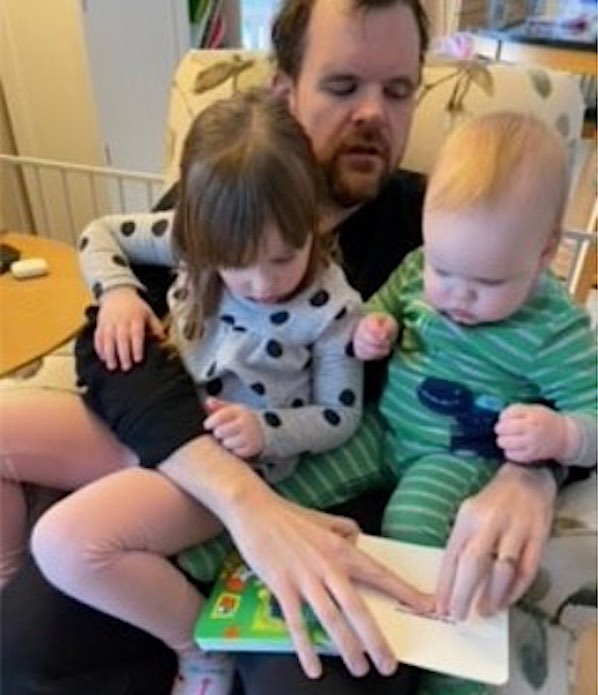
Today, Jared is a software engineer, who is married with two children, ages 1 and 3.
“Without knowing how to read and write—skills impossible to learn by just listening to speech—I would have never been able to graduate from Michigan State University with a telecommunications degree.”
“Without the childhood literacy skills Seedlings provided to me, I would not have a job in the modern workforce with the amount of reading and writing most employment requires.”
Today, he uses Seedling books to read to his sighted children.
“With the birth of my daughter, Harper, and my son, Logan, Seedlings has now come full circle in my life, he told GNN. “I read to them Seedlings’ picture books, which have both print and braille in them.”
Since 2012, Jared has served on the Board of Directors for Seedlings’—making an impactful difference in the lives of children, the way Seedlings did for his.
WATCH these great folks in action…
SHARE This Terrific Nonprofit With Your Friends on Social Media…
Quote of the Day: “The great opportunity is where you are. Don’t despise your own place and hour. Every place is the center of the world.” – John Burroughs, naturalist
Photo: Nathan Dumlao
With a new inspirational quote every day, atop the perfect photo—collected and archived on our Quote of the Day page—why not bookmark GNN.org for a daily uplift?
The Virginia-based disaster relief and humanitarian aid group Mercy Chefs reached a magnificent milestone this month, serving its 10 millionth meal.
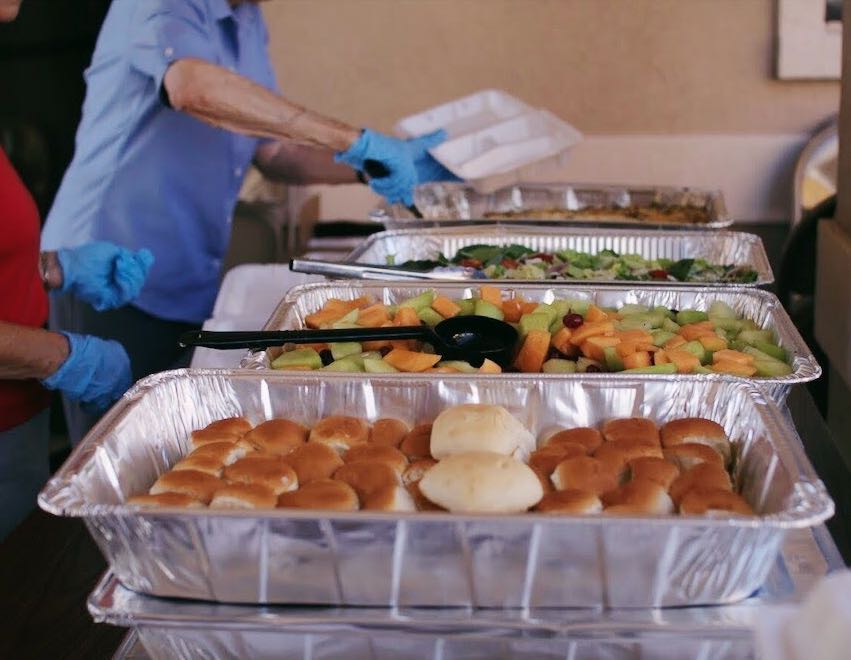
Mercy Chef volunteers deliver food
The nonprofit, founded in the aftermath of Hurricane Katrina, has served professionally prepared, restaurant-quality meals to victims and first responders in the wake of emergencies in 27 states and 10 countries, responding to more than 134 disasters.
Since the COVID-19 pandemic began in March, the nonprofit has dished out 7 million meals with the help of 10,000 community volunteers.
They recently deployed to Dallas, Texas, where a severe cold weather event left millions without electricity, water, or food—and began serving meals yesterday.
“When our friends at Gateway Church called to ask for our help, we immediately said ‘yes,’” said the group on their website.
“We’ve now transported our commercial-grade resources, including industrial power generators and water filtration systems, to serve the residents of the Dallas/Fort Worth area as they recover from this vicious winter storm.”
Founder Gary LeBlanc was spurred to action by what he witnessed while volunteering in his hometown of New Orleans following Hurricane Katrina. “The devastation was so intense and widespread. I saw first-hand the incredible difference a hot meal could make.”
But with 35 years in the hospitality industry he was disturbed by the quality of food being served.
“I became inspired to the point of distraction by the idea of serving high-quality food in a disaster zone. Little did I know how far that distraction would lead… and Mercy Chefs now has three mobile kitchens and two refrigerated trailers.”
“To hit this milestone–10 million meals–is simply remarkable,” said LeBlanc. “This past year has been devastating for so many people, and we feel blessed to have been able to play a small role in bringing people comfort through food. We could not have gotten here without our incredible staff, volunteers, and donors answering the call to serve others.”
The group uses coronavirus response distribution locations it has set up around the country, where Mercy Chefs works with food distributors and volunteers to supplement the USDA Farmers to Families Food Box Program with more meals.
Mercy Chefs
Mercy Chefs also has served free food to hospital workers in recent months who are on the front lines of the pandemic throughout Hampton Roads, Virginia, and Panama City, Florida.
In addition to COVID-19 relief, Mercy Chefs deployed to places in 2020 following natural disasters, including Hurricanes Hanna and Laura, the derecho in Iowa, and the recent tornado in Alabama. Mercy Chefs repeatedly has returned to Panama City to serve those still affected by Hurricane Michael.
To support and learn more about Gary and his Mercy Chefs, visit www.mercychefs.com.
SHARE The Mercy Chefs With Friends Hungry for Good News on Social Media…
FREE WILL ASTROLOGY – Week beginning February 19, 2021
Copyright by Rob Brezsny, FreeWillAstrology.com
PISCES (Feb. 19-March 20):
Ancient Greek playwright Euripides was popular and influential—and remains so to this day, 2,400 years later. But there’s a curiously boring aspect in five of his plays, Andromache, Alcestis, Helen, Medea, and The Bacchae. They all have the same exact ending: six lines, spoken by a chorus, that basically say the gods are unpredictable. Was Euripides lazy? Trying too hard to drive home the point? Or were the endings added later by an editor? Scholars disagree. The main reason I’m bringing this to your attention is to encourage you to avoid similar behavior. I think it’s very important that the stories you’re living right now have different endings than all the stories of your past.
ARIES (March 21-April 19):
Atheists like to confront religious people with accusations like this: “If God is so good, why does he allow suffering in the world?” Their simplistic, childish idea of God as some sort of moral policeman is ignorant of the lush range of rumination about the Divine as offered down through the ages by poets, novelists, philosophers, and theologians. For example, poet Stéphane Mallarmé wrote, “Spirit cares for nothing except universal musicality.” He suggested that the Supreme Intelligence is an artist making music and telling stories. And as you know, music and stories include all human adventures, not just the happy stuff. I bring these thoughts to your attention, Aries, because the coming weeks will be a favorable time to honor and celebrate the marvelously rich stories of your own life—and to feel gratitude for the full range of experience with which they have blessed you. PS: Now is also a favorable phase to rethink and reconfigure your answers to the Big Questions.
TAURUS (April 20-May 20):
Blogger Rachel C. Lewis confides, “I love being horribly straightforward. I love sending reckless text messages and telling people I love them and telling people they are absolutely magical humans and I cannot believe they really exist. I love saying, ‘Kiss me harder,’ and ‘You’re a good person,’ and, ‘You brighten my day.'” What would your unique version of Lewis’s forthrightness be like, Taurus? What brazen praise would you offer? What declarations of affection and care would you unleash? What naked confessions might you reveal? The coming days will be a favorable time to explore these possibilities.
GEMINI (May 21-June 20):
It’s a good time to become more of who you are by engaging with more of what you are not. Get in the mood for this heroic exercise by studying the following rant by Gemini poet Adam Zagajewski (who writes in Polish), translated by Gemini poet Clare Cavanaugh: “Read for yourselves, read for the sake of your inspiration, for the sweet turmoil in your lovely head. But also read against yourselves, read for questioning and impotence, for despair and erudition, read the dry, sardonic remarks of cynical philosophers. Read those whose darkness or malice or madness or greatness you can’t yet understand, because only in this way will you grow, outlive yourself, and become what you are.”
CANCER (June 21-July 22):
You’re on the verge of breakthroughs. You’re ready to explore frontiers, at least in your imagination. You’re brave enough to go further and try harder than you’ve been able to before. With that in mind, here’s a highly apropos idea from Cancerian novelist Tom Robbins. He writes, “If you take any activity, any art, any discipline, any skill, take it and push it as far as it will go, push it beyond where it has ever been before, push it to the wildest edge of edges, then you force it into the realm of magic.” (I might use the word “coax” or “nudge” instead of “force” in Robbins’ statement.)
LEO (July 23-Aug. 22):
In her story Homelanding, Margaret Atwood writes, “Take me to your trees. Take me to your breakfasts, your sunsets, your bad dreams, your shoes. Take me to your fingers.” I’d love you to express requests like that. It’s a favorable time for you to delve deeper into the mysteries of people you care about. You will generate healing and blessings by cultivating reverent curiosity and smart empathy and crafty intimacy. Find out more about your best allies.
VIRGO (Aug. 23-Sept. 22):
You’re about to reach the end of your phase of correction and adjustment. To mark this momentous transition, and to honor your ever-increasing ability to negotiate with your demons, I offer you the following inspirational proclamation by poet Jeannette Napolitano: “I don’t want to look back in five years’ time and think, ‘We could have been magnificent, but I was afraid.’ In five years, I want to tell of how fear tried to cheat me out of the best thing in life, and I didn’t let it.”
LIBRA (Sept. 23-Oct. 22):
It’s not a good time for you to be obsessed with vague abstractions, fear-based fantasies, and imaginary possibilities. But it is a favorable phase to rise up in behalf of intimate, practical changes. At least for now, I also want to advise you not to be angry and militant about big, complicated issues that you have little power to affect. On the other hand, I encourage you to get inspired and aggressive about injustices you can truly help fix and erroneous approaches you can correct and close-at-hand dilemmas for which you can summon constructive solutions.
SCORPIO (Oct. 23-Nov. 21):
“The most beautiful things are those that madness prompts and reason writes,” declared author André Gide. As a writer myself, I will testify to the truth of that formulation. But what about those of you who aren’t poets and novelists and essayists? Here’s how I would alter Gide’s statement to fit you: “The most beautiful things are those that rapture prompts and reason refines.” Or maybe this: “The most beautiful things are those that experimentation finds and reason uses.” Or how about this one: “The most beautiful things are those that wildness generates and reason enhances.” Any and all of those dynamics will be treasures for you in the coming weeks.
SAGITTARIUS (Nov. 22-Dec. 21):
The poet Nayyirah Waheed has some advice I want you to hear. She writes, “Be easy. Take your time. You are coming home to yourself.” I will add that from my astrological perspective, the coming weeks will indeed be a time for you to relax more deeply into yourself—to welcome yourself fully into your unique destiny; to forgive yourself for what you imagine are your flaws; to not wish you were someone else pursuing a different path; to be at peace and in harmony with the exact life you have.
CAPRICORN (Dec. 22-Jan. 19):
“The chief object of education is not to learn things but to unlearn things,” wrote author G. K. Chesterton. He was exaggerating for dramatic effect when he said that, as he often did. The more nuanced truth is that one of the central aims of education is to learn things, and another very worthy aim is to unlearn things. I believe you are currently in a phase when you should put an emphasis on unlearning things that are irrelevant and meaningless and obstructive. This will be excellent preparation for your next phase, which will be learning a lot of useful and vitalizing new things.
AQUARIUS (Jan. 20-Feb. 18): Sergei Rachmaninoff (1873–1943) ultimately became one of the 20th century’s most renowned composers. But his career had a rough start. Symphony No. 1, his first major work, was panned by critics, sending him into a four-year depression. Eventually he recovered. His next major composition, Piano Concerto No. 2, was well-received. I don’t anticipate that your rookie offerings or new work will get the kind of terrible reviews that Rachmaninoff’s did. But at least initially, there may be no great reviews, and possibly even indifference. Keep the faith, my dear. Don’t falter in carrying out your vision of the future. The rewards will come in due time.
WANT MORE? Listen to Rob’s EXPANDED AUDIO HOROSCOPES, 4-5 minute meditations on the current state of your destiny — or subscribe to his unique daily text message service at: RealAstrology.com
The largest incentive prize in history was announced this month to inspire innovators to develop and scale carbon removal solutions that combat climate change.
XPRIZE Elon Musk
The nonprofit XPRIZE, which sponsors design competitions to solve humanity’s greatest challenges, will award $100,000,000 for the top 3 carbon removal innovations.
The contest, funded by Elon Musk is looking for the best solutions that can pull carbon dioxide directly from the atmosphere or oceans and lock it away permanently in an environmentally benign way. To win the competition, teams must demonstrate a rigorous, validated scale model of their solution at a level of carbon removal of 1 ton of CO2 per day, and further must demonstrate to a team of judges the ability of their solution to economically scale to gigaton levels.
The objective of this XPRIZE is to “collectively achieve the 10 gigaton per year carbon removal target by 2050, to help fight climate change and restore the Earth’s carbon balance.”
“We want to make a truly meaningful impact. Carbon negativity, not neutrality. The ultimate goal is scalable carbon extraction that is measured based on the ‘fully considered cost per ton’ which includes the environmental impact,” said Elon Musk, founder and CEO of Tesla and SpaceX. “This is not a theoretical competition; we want teams that will build real systems that can make a measurable impact and scale to a gigaton level. Whatever it takes. Time is of the essence
Peter Diamandis, the Founder and Executive Chairman of XPRIZE said, “We want to see them built, tested, and validated. We hope this XPRIZE will activate the public and private sectors to get involved in the same way that the $10M Ansari XPRIZE brought about the commercial spaceflight industry.”
“For humanity to reach the Paris Agreement’s goal of limiting the Earth’s temperature rise to no more than 1.5˚(C) of pre-industrial levels, or even 2˚(C), we need bold, radical tech innovation and scale up that goes beyond limiting CO2 emissions, but actually removes CO2 already in the air and oceans. If humanity continues on a business-as-usual path, the global average temperature could increase 6˚(C) by the year 2100.”
The full competition guidelines will be announced on April 22nd, 2021, which is also Earth Day. On that same day team registration will begin and the competition will last for 4 years through Earth Day 2025.
The $100 million in prize purses will be distributed in the following manner, under these guidelines:
The 15 top teams selected will receive $1 million each, and $80M awards will be distributed as follows: Grand prize Winner (1st Place) wins $50 million, 2nd Place takes home $20 million, and 3rd Place gets $10M.
A total of twenty-five $200,000 student scholarships will also be distributed to student teams competing.
Teams can submit entries across natural, engineer and hybrid solutions. Judges in the competition will evaluate the teams based upon four basic criteria:
A working carbon removal prototype that can be rigorously validated capable of removing at least 1 ton per day.
The team’s ability to demonstrate to the judges that their solution can economically scale to the gigaton level.
The main metric for this competition is fully considered cost per ton, inclusive of whatever considerations are necessary for environmental benefit, permanence, any value-added products; and
The final criteria is the length of time that the removed carbon is locked up for. A minimum goal of 100 years is desired.
“Our Earth’s changing climate is a fundamental threat to humanity. But it’s not too late if we take action NOW,” said Anousheh Ansari, CEO of XPRIZE. “By partnering with Elon and the Musk Foundation, the XPRIZE Carbon Removal competition is inviting the teams to make history and become our climate heroes by reshaping our future.
The group calls it a great fit for carbon removal because there are so many ways to pull CO2 out of the air and our oceans. “We expect to see approaches like engineered direct air capture, mineralization and enhanced weathering, natural solutions based on plants, trees, or ocean-focused solutions. We want as many viable scalable demonstrations now so we can all help the best solutions get to deployment as soon as possible.”
SHARE The Hopeful News With Elon Lovers on Social Media…
From snake attacks to jumping into oncoming traffic, one in three dog-owners have put themselves in harm’s way to save their four-legged friend, a new survey found.
Anna Shvets
In a new poll, Americans say they’ve pulled off some daring rescues—climbing scaffolding at construction sites and diving into frozen pools—to save their dogs.
One dog owner reported getting in between their hound and another angry canine, while another took an electric shock from exposed wiring before their pup got too close.
In advance of National Love Your Pet Day on February 20, a study of 2,000 American dog-owners examined all the ways respondents show their love for their pooch and found that 72% said they would gladly put themselves in harm’s way to save their dog.
It’s no surprise since nearly four in five (78%) consider them a full-fledged member of the family.
For some it could be the most important relationship in the household. Of those respondents married or in a relationship (79%) over half (53%) admitted to kissing their doggie more than their partner.
The survey commissioned by JustFoodForDogs and conducted by OnePoll revealed that three in five adults surveyed (61%) concluded they prefer their dog to some people they know.
Forty-seven percent said they knew the names of the dogs in their neighborhood but not their owners.
All this quality time with Fido had some respondents saying they have been accused of spoiling their dog (70%), but they don’t care.
65 percent think of spoiling their pooch as a form of self-care—and 63% reported they are better about scheduling their dog’s vet appointments than their own doctor visits.
Results also explored the little ways respondents show their affection for their dog. Half of the group let their dog sleep in bed with them and have no problem with them lounging on the couch. One in three (34%) even let their four-legged friend follow them into the bathroom while using the toilet or showering.
A third of respondents (34%) said they’ve cooked a Thanksgiving meal just for fido—and don’t want to leave them out of the other major holidays either.
Liam-Beach, Instagram
Forty-seven percent have dressed up their pup for Halloween and included their dog in the holiday photoshoot (also 47%). A quarter of these dogs have their own Christmas stocking, too.
One in four (28%) bought their dog a Valentine’s Day gift to show their love and 37% have thrown them a birthday party.
Over half have cooked meals specifically for their dog and seven in ten want their pooch to eat just as well if not better than they do.
“The survey results reflect what we see every day: people view their pets as members of their family,” said Shawn Buckley, Founder of JustFoodForDogs. “Our pets bring us so much joy, and while they ask for little in return, we only want the best for them and cooking a nutritionally-balanced meal from fresh whole food demonstrates just that.”
TOP ACTS OF LOVE FOR A DOG
Let them sleep in bed with owner 49%
Get up on the couch 46%
Make them their own dinner with human food 46%
Let them sit on owner’s lap 44%
Let them into the bathroom while owner uses toilet or showers 34%
Purchased custom decorations that look like their dog 31%
Made Christmas/holiday cards that feature the dog 28%
Let them take up more room on the bed/couch than owner 26%
Share water with the dog 13%
TOP METHODS TO CELEBRATE WITH A DOG
Dressed up dog in a Halloween costume 47%
Included dog in holiday photoshoots 47%
Thrown their dog a birthday party 37%
Made dog a Thanksgiving dinner 34%
Bought their dog a Valentine’s day gift 28%
Dog has their own Christmas stocking 27%
SHARE With Your Own Story of Love on Social Media for Love Your Pets Day…
Quote of the Day: “At some point in life the world’s beauty becomes enough. You don’t need to photograph, paint, or even remember it. It is enough.” – Toni Morrison
Photo: Dannii Coughlan
With a new inspirational quote every day, atop the perfect photo—collected and archived on our Quote of the Day page—why not bookmark GNN.org for a daily uplift?
In 1943, Royal Navy Bill Caldwell wrote a postcard to his uncle Fred, enclosed it in an envelope with a picture, and instructed the Royal Mail to “post early in the day.”
Family of Bill Caldwell
77 years and 7 months later, and that same postcard has finally arrived at the Liverpool doorstep of his family home to the shock and delight of his children.
The Royal Mail admitted they hadn’t the faintest idea of why it took so long for delivery, but posited that perhaps it had been found and reposted by someone.
Having joined on to train with the HMS Raleigh stationed at Torpoint, Cornwall, Caldwell’s first message back from the military was simple, and typical of a man who his children remember as someone who didn’t ever send letters or postcards.
“Well I am in blue at last. I did not think it would be like this—you don’t get much time for yourself, do you?
“But I like it alright.
“I will write a letter to you all when I get half a chance so will you hold on a bit? I have 19 weeks here yet.
“Give my love to everyone. Love, Bill.”
The most surreal thing
Family of Bill Caldwell
Caldwell would go on to man a minesweeper during the D-Day landings, travel all over the Pacific, visit Japan, and carry prisoners of war back to Australia. His naval career concluded with four medals.
“It was the most surreal thing on a Friday night to suddenly read a postcard that dad had written 77 years ago when he was training to be a sailor in the Navy,” his daughter Joanna Creamer told the BBC.
None of his six children live in the family home, but a distant relative, the stepson of their cousin Dan—Caldwell’s nephew, does. It was this stepson who alerted Dan, who sent a picture of the postcard to one of the children, Jane, who shared it in a family WhatsApp group.
Family of Bill Caldwell
Another of Caldwell’s daughters, 58-year-old Elizabeth, said, according to Yahoo!, “It’s a crazy story and it’s hard to believe. My mum wrote letters and postcards but Dad never wrote. To actually see his handwriting was beautiful.”
“He had such an impact on us and our kids he was such a great role model,” Elizabeth added. “Mum wrote on his gravestone ‘A Liverpool gentleman’ and that’s what he was. He would give anyone the time of day and that’s why it’s so magical to get this glimpse of him.”
If you’re an artist who’s always dreamed of getting your Gaugin on with an immersive island getaway where you can fully indulge yourself in all things nature, you just might be in luck.
Located a few miles east of Michigan’s Keweenaw Peninsula in Lake Superior, Rabbit Island may not be Tahiti, but it does boast 91 forested acres of practically pristine paradise and the call for its annual artist’s residency program is now open.
Three lucky applicants will score three-week residencies scheduled to take place sometime from mid-June to mid-September of this year.
If that’s not inspiration enough, the Rabbit Island Foundation is also offering a $3,200 stipend to sweeten the pot. (Past recipients have used the funds to facilitate research, cover travel expenses, purchase supplies, and procure materials.)
Per their website, the Rabbit Island Residency, launched in 2010 “is a platform to investigate, expand, and challenge creative practices in a remote environment. By living and working on Rabbit Island residents engage directly with the landscape and respond to notions of conservation, ecology, sustainability, and resilience.”
Rabbit Island is comprised of a native ecosystem that’s never been developed or subdivided—and is held in trust so that it never will be. Bald eagles share the tree-filled landscape with indigenous reptiles, nesting birds, salamanders, salmon, and native lake trout.
While it’s a glorious untamed environment, it’s likely not suited to anyone who can’t do without creature comforts, doesn’t have previous camping experience, or can’t cope with the whims of changing weather. (Intermittent wind and rain are normal; water temperature ranges from 48° to 68° F; air temperature ranges from 40° to 90° F.)
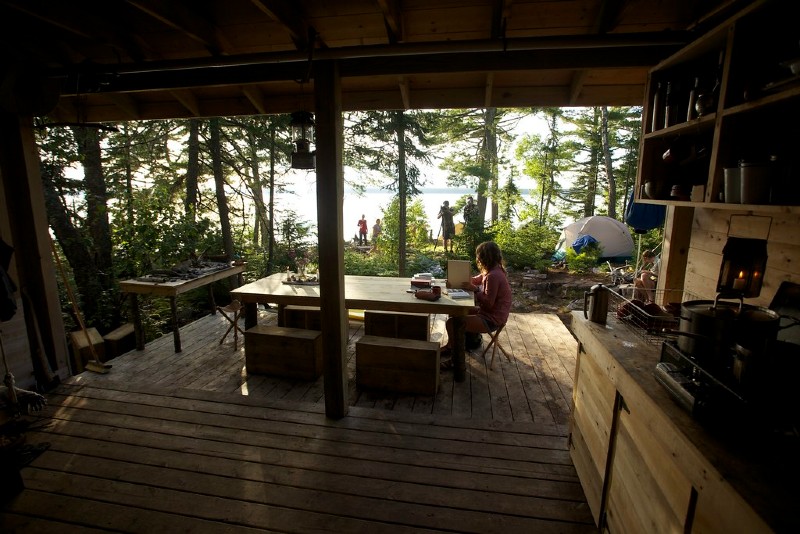
Resident accommodations come in the form of two multi-purpose three-sided shelters as well as tents and camping gear. The only fully enclosed space is a wood-fired sauna.
Wifi/cell phone service? Check. Kitchen and library? Check. Open-air studios with tools and equipment? Check. Indoor plumbing? Can you say, “outhouse?”
To commemorate and promote the residency, the Rabbit Island Foundation annually creates a publication featuring the work and research of each resident and also promotes extensively via its social media channels and online archive.
Not a Post-Impressionist? No worries. The call is open to “visual artists of all disciplines, as well as writers, poets, architects, designers, musicians, filmmakers, composers, and choreographers.” In addition to individual applications, small collaborative groups are also encouraged to apply.
In the midst of a mind-bogglingly severe cold snap, heroic efforts are being made in Texas by warm-blooded animals to save thousands of their cold-blooded neighbors who lack the ability to fend off the freezing temperatures.
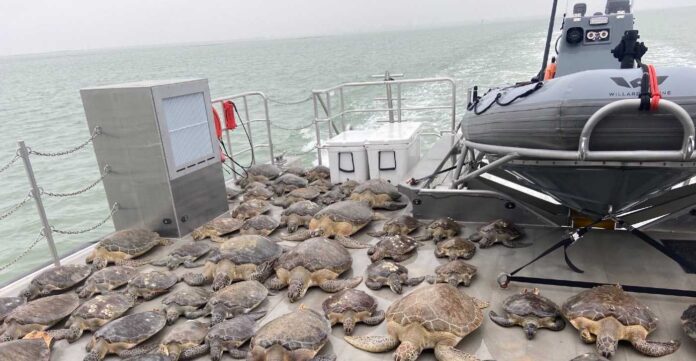
Volunteers at Sea Turtle Inc. rehabilitation center and among the local community on South Padre Island in the Gulf have so far rescued more than 4,900 sea turtles from death by “cold stunning”—an event that causes the turtles to fall into comatose if the water drops below 50° Fahrenheit.
My mom is retired, & she spends her winters volunteering at a sea turtle rescue center in south Texas. The cold snap is stunning the local turtles & they’re doing a lot of rescues. She sent me this photo today of the back of her Subaru. It’s *literally* turtles all the way down. pic.twitter.com/xaDRNjLDoQ
The normally balmy lagoon off the south tip of Texas is a place where sea turtles live year-round, a rarity for the migratory species, but the area lost power earlier in the week.
Volunteers’ efforts had by Tuesday already managed to scoop up 1,700 turtles, lining them up in rows on tarps in a nearby convention center that was donated for an emergency space. The community tried to help the turtles out of their comatose state by warming them in kiddy pools. By the end of the day there were 3,500 turtles in the makeshift I’T’CU.
Meanwhile in the Gulf, Texas game wardens used patrol boats to fish out hundreds more that had lost the ability to move their flippers in the cold water. According to an update by Wendy Knight, executive director of Sea Turtle Inc, another thousand cold-stunned turtles had been brought in, including one that was 150 years old and weighed 400 pounds.
Texas Game Wardens assigned to Cameron county rescued 141 sea turtles from the frigid waters of the Brownsville Ship Channel and surrounding bays. The sea turtles were transported via the PV Murchison, operated by Sgt. Game Warden Duke and B/M Bowers-Vest. pic.twitter.com/LqFBrElTog
“The love and support of people who just want to help things that can’t help themselves is overwhelming,” Knight told NPR.
“It is a huge, huge community effort,” Gina McLellan, a 71-year-old retired professor and volunteer, told The Washington Post. “We very often don’t even think about the [cold’s] impact on animals, because we’re so worried about our own electricity and water. With this kind of event, it’s a classic display of humanity toward animals.”
SpaceX to the rescue
SpaceX’s Boca Chica launch facility came Tuesday night and delivered a massive commercial generator to Sea Turtle Inc, which they used to power the heating of their enormous tanks and the equipment in their hospital.
“This kind of reach out from our community sponsors at SpaceX, there are no words to explain the gratitude we have,” Knight said on a Facebook video update. “They came to us in our darkest hour of need, and got us a generator that was complex to find, and even more complex to wire into our system.”
SpaceX employees actually rescued nearly another thousand turtles all on their own.
After the power came back, Knight discovered that the storm had damaged or ruined all 10 of the heaters and coolers used for the large community tanks, and so Sea Turtle Inc. has started a fundraiser so that they can make repairs or afford replacements. They’ve currently raised 25% of their target goal.
We have surpassed more than 4,900 cold-stun sea turtles in the largest recorded cold-stun event in history. These endangered sea turtles are our number #1 priority your support and encouragement has been overwhelming. Donate here to support our efforts: https://t.co/9ajzm5oTTvpic.twitter.com/dEqu4Q8xtS
Yesterday, Knight gave another video update in which she described Thursday as “a calm quiet day” at the makeshift hospital for the cold-stunned turtles.
She noted that they had lived through the largest cold-stunning event in recorded history, and it would have been “Armageddon” if not for the enormous influx of volunteer time, money, and other resources. Cheers to everyone who got involved with this herculean effort to help the sea turtles.
HATCH These Rescues By Sharing Them With Your Friends On Social Media…
Cotswold villagers have been busy creating colorful nighttime window displays to cheer up the neighbors’ who are on their daily walks during lockdown.
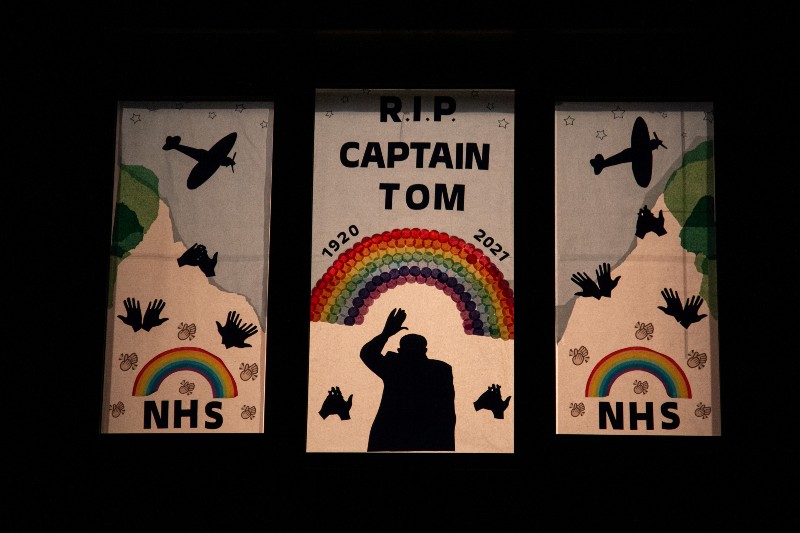
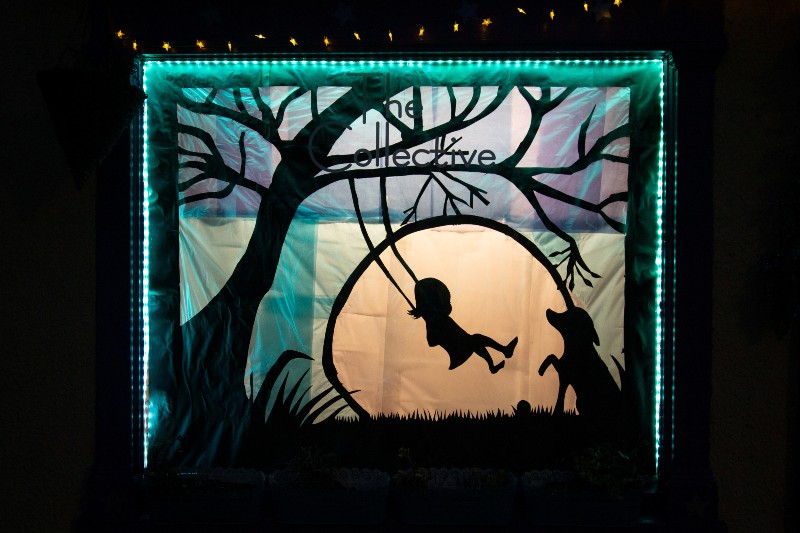
Around 500 windows in the picturesque English town of Wotton-under-Edge have been transformed, with residents decorating their windows in bright, ornate, and often touching designs.
It all started when hundreds of families signed up for the Wotton Window Wanderland event. This year’s theme? Celebrating community. The aim? Raising people’s spirits during the pandemic.
Organized by Martin Clarke, this is thought to currently be the country’s biggest outdoor art show.
People hope their parade of ‘painted’ windows will inspire other places around the world to put on their own Covid-safe, community-friendly art galleries.
We’ve curated photographs of some of our favorite artworks below—and you can see all of the designs on the event’s Instagram page.
If you’d like to learn how to make similar window displays, you could look up Japanese paper lightbox art online (there are tutorials on Pinterest). Get ready to be inspired.
A Philly art teacher has set a new world record—creating the largest single drawing by an individual at 6,509 square feet.
Crayola
At the Crayola IDEAworks exhibition, Dyymond Whipper-Young has made her piece 400 square feet larger than the work of previous world record holder—Italian artist FRA!—who completed a drawing in 2020 that was 6,100 square feet in size.
The IDEAworks exhibition is being held at the Franklin Institute in Philadelphia, and tests visitors’ creativity by using Crayola products to sketch, draw, and doodle the answers to questions like how to regenerate a coral reef and how to build a sustainable town.
“I really believe that creativity is in all of us, and with this exhibition, the drawing, the purpose is to inspire people to find their own creative pulse,” said Whipper-Young, who took an impreessive 63 hours, spread over five days, to complete the piece. “I’m… super grateful to be able to showcase my own art as well.”
(WATCH the video below to see how Whipper-Young made her *giant* mark.)
Quote of the Day: “With realization of one’s own potential and self-confidence in one’s ability, one can build a better world.” – Dalai Lama
Photo: Oliver Sjöström
With a new inspirational quote every day, atop the perfect photo—collected and archived on our Quote of the Day page—why not bookmark GNN.org for a daily uplift?
Are you feeling you need a change of scenery, or perhaps you have a desire to move to a less-expensive town? If you’re budget-conscious, more and more cities in America will actually pay you to move there.
Some of these programs require you to buy a house or get a state driver’s license, but others require almost no hoops being jumped through at all.
After the coronavirus pandemic struck cities across the country, many realized that perhaps they don’t need to pay $4,000 every month for a NYC apartment or California townhome if they’re going to be working from home.
Most of the following programs are trying to attract workers who have left their offices and set up desks in their own homes, knowing that the shift may be permanent.
Tulsa Remote is a unique recruitment initiative aimed at attracting talented individuals to the Art deco city. With a $10,000 grant to inspire you to move, the initiative asks that you live in their city for one year, confident you’ll want to stay longer at the end.
The ideal candidate for Tulsa Remote is a digital nomad or remote worker with the flexibility to work anywhere—who is looking for a real community to call home. Along with receiving $10,000, distributed over the course of a year, the program is offering you space in a co-working center, help finding housing, and regular community-building opportunities.
Read more in the FAQs and apply if you’d like to move to where the wind goes sweeping down the plains.
2. Ozarks, Arkansas
Sharon Mollerus/Flickr—CC license
“One of the best costs of living, plentiful outdoor lifestyle perks, nationally ranked arts, culture, and cuisine scenes, and per capita income that’s 14% higher than the national average.”
That’s what the Northwest Arkansas Council website boasts, saying the region offers “a unique opportunity to create balance for those eager to move from congested and expensive larger cities and suburbs.”
The counties of Benton and Washington will offer people working remote, full-time jobs— especially top-talent entrepreneurs and those in STEM fields—$10,000 and either a street or mountain bike to take advantage of the well-established biking infrastructure in Ozarks—or an annual membership to one of their “world-class” arts and cultural institutions.
Applications can be done through their website, and you must be able to move into the state within six months.
3. Savannah, Georgia
Sunira Moses
Savannah is a beautiful place, and they are looking to incentivize remote tech workers to move to the Chatham County area—provided they have three-years of verifiable work experience, and that they secure at minimum a one-year lease or purchase property.
Moving expenses will be covered with $2,000 after 30 days of residency, and the position can be remote or in-office. Applications can be done here.
P.S. The city’s cost of living is relatively low—beating out other regional metropolises like Nashville and Atlanta.
4. Topeka, Kansas
Gary Todd
The Choose Topeka Initiative will help workers looking to move to Topeka—who have arrangements to work inside the city—with $10,000 in moving expenses for those looking to rent, and $15,000 for those looking to buy a home.
The incentives kick in after a year of residency. Remote workers will need a job outside the county, and will receive only $5,000 in assistance to rent, and $10,000 to buy a home.
“Choose Topeka was created with the intention of investing in employees to live and work in Topeka & Shawnee County, so that we may foster an ‘intentional community,’ one of community support builders,” said Barbara Stapleton, VP of Business Retention & Talent Initiatives at GO Topeka.
5. Hamilton, Ohio
Amy Bolinder, CC license
The Talent Attraction Program of Hamilton, Ohio is offering “reverse scholarships” to recent college grads in the STEM fields that will help pay off student loan debt with $300 per month payments—up to $10,000 total.
They must demonstrate employment in the city or county, and plans to move there—with any moves out of the city or county forfeiting future payments.
6. Newton, Iowa
USDA
Newton, Iowa is offering a slightly different kind of incentive. Looking to improve the quality of the available housing inventory, The Newton Housing Initiative is offering cash to people looking to build a new home.
“The Newton Housing Initiative, approved by City Council in 2014, provided incentives to home builders, real estate developers, property owners, and homebuyers…” writes the initiative website.
For homes valued at $180,000 or more, applicants to the grant program receive a $10,000 cash incentive and the Get to Know Newton Welcome Package worth $2,500. Homes valued at anything less than $180,000 will garner $5,000 for the owners.
7. Alaska
Zetong Li
One of the most beautiful places on Earth, the state of Alaska won’t pay you to move there necessarily, but there is a state-fund financed by mineral extraction sales which pays a dividend to workers who choose to remain in the state.
According to Fox Business, the “exact amount of the payment varies from year to year. This year the payment is $992. Last year it was $1,606. The highest dividend to date was $2,072 in 2015.”
“In order to be eligible for the dividend, one must be a state resident for the entire prior calendar year, intend to remain an Alaska resident indefinitely, and not have been sentenced on a felony conviction in the year prior, among other requirements,” writes Fox.
SHARE This Story With Friends Who Might be Looking For a Fresh Start in Life…
In a country with both housing shortages and world-leading coffee production, a small construction company has, quite brilliantly, found a way to leverage one in order to fix the other.
Woodpecker WPC
Coffee husks, a papery material surrounding the prized beans, are being turned into resilient, light, and versatile building materials that can make the panels of a house for as little as $4,500.
The Bogota-based Woodpecker, which tried to develop a material from rice fiber, palm fronds, sawdust, and even recycled plastic, eventually settled on coffee husk for its availability, fire resistance, and insect/waterproofing. Another benefit? Utilizing coffee husks would stop them ending up in landfills where they would add to the methane emissions of the country.
Woodpecker WPC
“We saw that there was a huge necessity for a lightweight construction system for housing and classrooms in rural and isolated places where traditional construction systems cannot go—like bricks, cement, and concrete,” said CEO Alejandro Franco.
The prefabricated “casa kits” have to be able to be loaded and transported on small boats, helicopters, or even on the back of a donkey, and for the most part they can.
Woodpecker WPC
Each kit consists of lightweight steel frames that, like LEGO, can click together with minimal tool use, and coffee husk boards that can be attached to the steel frames without need for nails and screws.
Woodpecker has been in this game for 10 years, and recently built their 2,500th house.
When category 5 Hurricane Iota hit the Colombian island of Providence in November, destroying more than a thousand homes, the company donated two complete houses that the army received and assembled, which as Franco told Adele Peters at Fast Company, was a real boon to a community.
“The system worked perfectly considering that there was no energy supply, the soil was muddy, the airport damaged, no food, etc.—all the problems that you can imagine,” he said. “We think our houses are an excellent solution for the housing crisis there.”
SHARE the Java-Related News With Pals on Social Media…
NASA/JPL-Caltech, illustration of the rover landing
NASA/JPL-Caltech, illustration of the rover landing
In a huge moment for space exploration, the American space agency will today attempt to land a new rover on the surface of Mars.
The six-wheeled robot, named Perseverance, will be the first NASA mission since the 1970s to search directly for signs of ancient life on the Red Planet.
Powered by plutonium, this is the most sophisticated rover the space agency has ever built.
NASA/JPL-Caltech
The rover’s aimed for landing point? An ancient river delta in dusty, boulder-strewn Jezero Crater—where the rocks could bear signs of microbes from what was, 3.5 billion years ago, a deep lake.
If all goes to plan, Perseverance is scheduled to land at 3:55 pm EST—or at least, that’s when NASA will find out if its rover has touched down.
Radio signals take around 11 minutes and 22 seconds to travel between Mars and Earth, so there’ll be a slight lag before NASA officially knows the success of its landing.
The live stream can be watched on NASA’s official YouTube channel, beginning at 2:15 pm EST (11:15 am PST). That means it’s just about time to settle in, settle down, and get ready for one hugely exciting touchdown.
SHARE The Far-Out Moment With Friends on Social Media…