














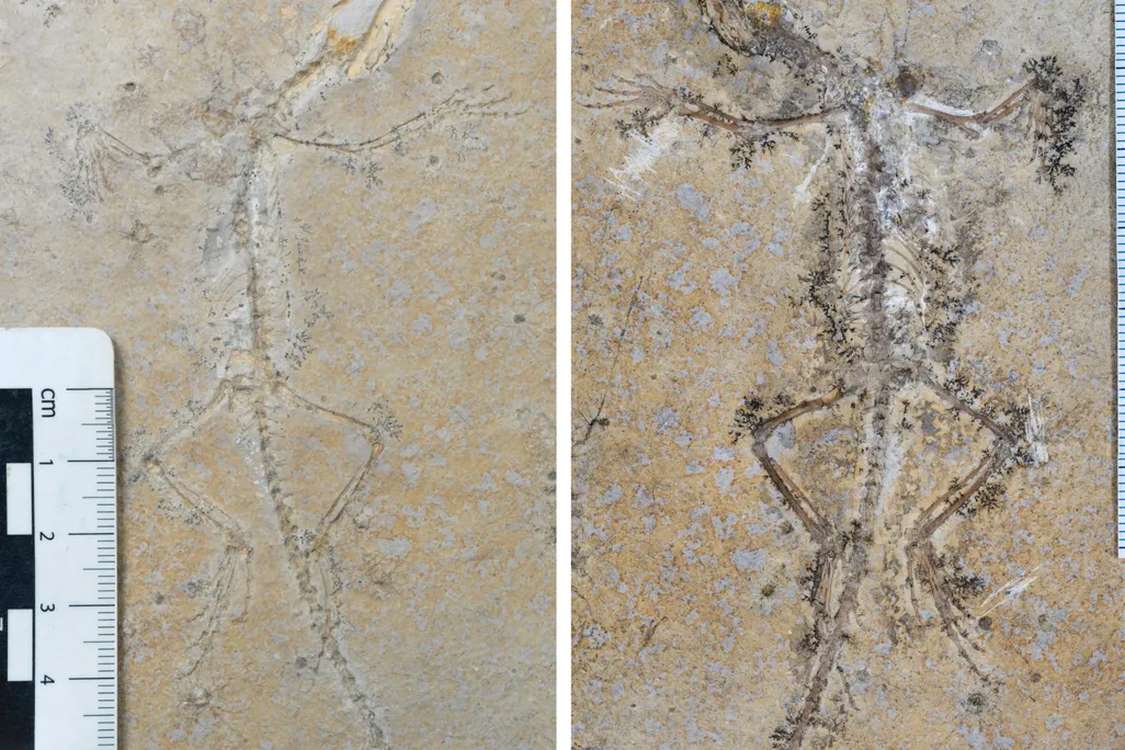
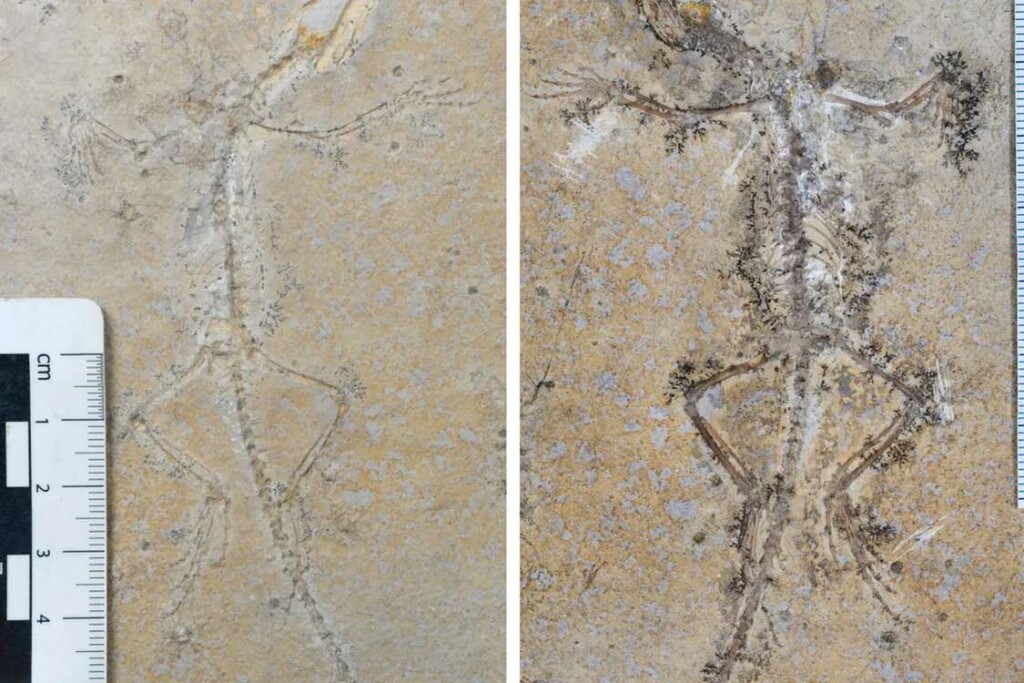
The story of how Sphenodraco scandentis came to be known is one for the ages: involving lies and deceit, and the well-trained eye of a brilliant paleontology student.
Ph.D. student Victor Beccari couldn’t shake the feeling he had seen the fossil before: it was a slab of rock containing the impression of a Jurassic-period reptile housed at the London Natural History Museum.
It was during the same visit that he realized where—at the Senckenberg Nat. History Museum in Frankfurt.
Beccari followed his instincts and confirmed that each museum contained a half of the whole: one had the fossil, and the other the imprint it made on the prehistoric sediment.
“It seems that someone in the 1930s decided to double their profit by selling both halves separately,” Beccari says in a museum statement. “As they didn’t tell either buyer that there was another half, the connection between the two fossils had been lost until now.”
“These kinds of fossils are normally preserved flat, so when they’re split open you often get the skeleton in one half and the impression of the skeleton in the other.”
When the two halves were reunited, something more was revealed other than intergenerational deception and buyer’s remorse—neither museum had identified it correctly.
Previously labeled Homoeosaurus maximiliani, it’s actually a new species of ancient lizard that dwelt among the trees. Sphenodraco scandentis, as the specimen has been renamed, is the earliest known member of the order Rhynchocephalia to have lived in trees.
These ancient lizard-like reptiles are actually not true lizards, but a third major reptile order alongside snakes and lizards. There is a living member of this order today, called the tuatara, that lives in New Zealand.
Beccari’s subsequent work on S. scandentis shows that it had a short body, long limbs, and long forefingers, similar to draco gliding lizards today. It strongly suggests an arboreal lifestyle, and would be the oldest rhynchocephalian known to live in the trees.
One of the key places on Earth for studying rhynchocephalians is an area of German rocks known as the Solnhofen Limestone. During the Late Jurassic, this region would have been a chain of islands across a subtropical sea, and it just so happens that it was where the Senckenberg Museum’s specimen came from.
Although the fossils are well-preserved, they’ve not all been studied in detail. Many of the historic descriptions of rhynchocephalians are somewhat vague, focusing on characteristics that are fairly broad across a variety of animals.
MORE ANCIENT REPTILES: Fascinating Species of 200 Million-Year-old Flying Reptile Discovered in Britain
“I think we’re really underestimating the diversity of these animals,” Beccari said. “In a lot of cases, fossils coming from the same place that look somewhat similar get lumped together. So, everything with longer limbs was called Homoeosaurus and everything with shorter limbs was Kallimodon.”
“The closer you look at how these animals have been studied in the past, the more you appreciate that the species aren’t that well-defined. We know that modern islands can have hundreds of species of reptiles, so there’s no reason that ancient islands didn’t too.”
“I’m going back over existing fossils to look for signs that other currently accepted species might cover multiple rhynchocephalians. There are also still a number of undescribed specimens that may also represent new species as well.”
ALSO CHECK OUT: Exquisite New Fossil Shows Scientists How Much More Ferocious Australia’s Crocs Once Were
“It goes to show just how important museum collections are to understanding ancient diversity. Even though many of these fossils were discovered almost two centuries ago, there’s still a lot they can teach us.”
GNN recently reported on other instances like this: a new tyrannosaurid that had sat in a museum drawer for 50 years, and a small, riverside dinosaur that had been poorly described for 150 years.
SHARE The Story Of This Young Man’s Brilliant Discovery With Your Friends…