










A major arts and heritage conservation project in China has born unexpected fruit thousands of miles away in New York City.
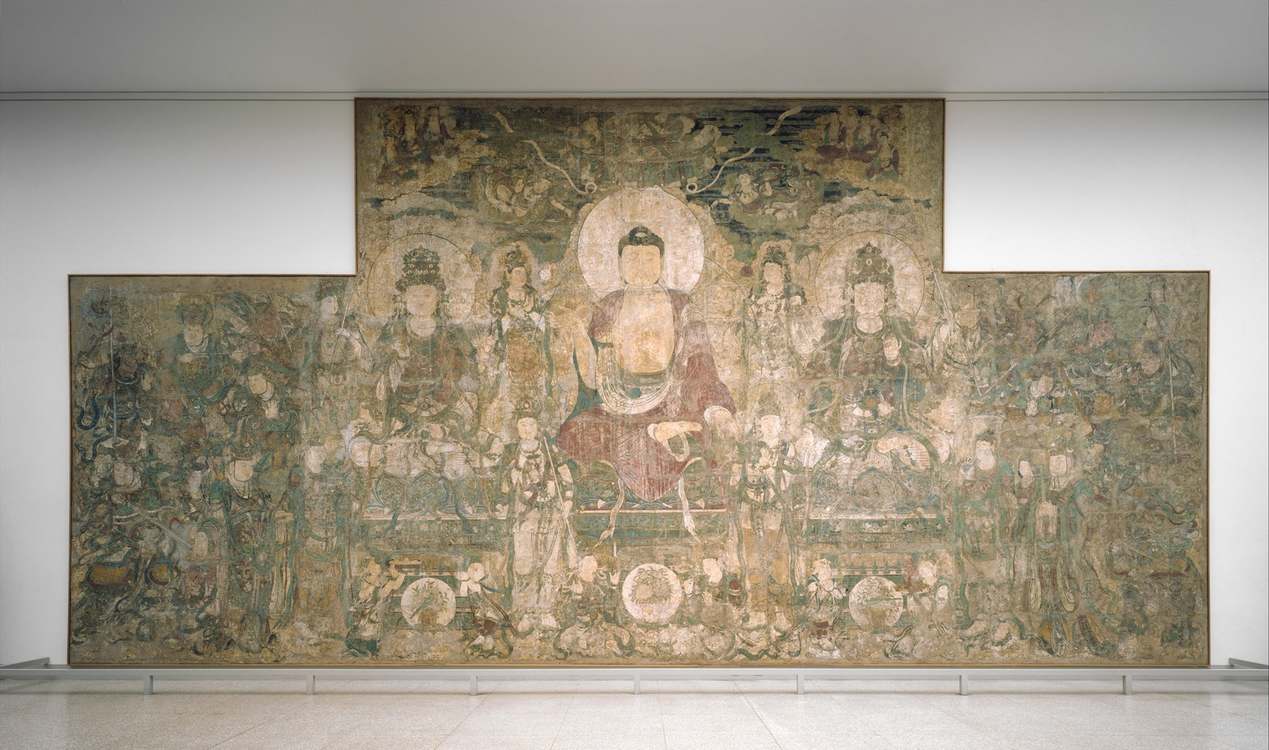
In the Chinese arts and antiquities gallery of the Metropolitan Museum of Art, a 50-foot-long mural devours the attention of an entire room with its arrangement of Buddha and his attendants.
The Medicine Buddha mural had long attracted the wonder of Zhang Jian, director of the “Meticulous Painting Institute” at the Chinese National Academy of Arts, which since 2013 has poured billions of Chinese RMB into restoring, conserving, and repatriating Chinese artifacts around the country and the world.
Describing it as wielding an “awe-inspiring energy,” Zhang learned that the mural was originally located in the ancient Guangsheng Temple in central China. Standing in its halls years later, staring at the vacant space where the massive mural had originally hung, Zhang was struck with an idea.
Over the next 3 years, he led a team of special artists and conservationists to the Met to meticulously—excruciatingly—copy the mural for a life-sized replica that captures every single crack, faded contour, and conservationist correction it had faced in its 700 years on the Earth.
This project was made possible with the unerring support of the Met itself, a collaboration which marks arguably the highest ever undertaken between Chinese and American cultural institutes.
Now in October, the Met is to co-host an international symposium in Beijing about Chinese murals, marking the first time the New York museum has jointly held a major academic conference in China with a national research body.
Jason Sun, the Met’s curator of Chinese art, told the South China Morning Post that the results achieved by Zhang’s team—including the realization that conservators had incorrectly arranged the mural segments so that Lord Buddha’s head was 2 centimeters off kilter—as having “profound historical and practical significance.”
Painted around 700 years ago during the Mongol-administered Yuan Dynasty, on clay tiles mixed with rice straw, the mural depicts the Medicine Buddha seated with his chief attendants surrounded by numerous figures.
Yet its presence in the Met isn’t the result of it being a plundered relic. Mainland China was mostly free from Western colonial occupation when the impoverished monks from Guangsheng Temple chopped the mural up into sections and sold it to fix the collapsing roof of their temple.
Among the keystones of Buddha’s teachings is the unavoidable truth that all things are impermanent, so if they were good students of the Great Sage, those impoverished monks would not have hesitated to part with the relic, that traded hands across the West until it arrived at the Met via donation from Arthur Sackler in 1965.
The China National Arts Fund, a state-endowed philanthropic fund established in 2013 under the National Academy of Arts, was as recently as 2025 tasked specifically with the preservation of ancient murals and other works. So far, 40 ancient murals from caves and temples across Western China have been painstakingly examined and copied, but if they are held overseas, the Fund has the directive to pay for their study, and potentially, their recreation.
Yet Zhang had a different sort of intention for that recreation: one that the Met administrators enthusiastically supported. In 2024, SCMP reports that the Fund had formalized a research partnership with the Met, whereby the famous museum granted their colleagues in East Asia full authorization for prolonged detailed study of the work, and the sharing of ultra-high-resolution digital images.
CHINESE MURALS IN THE NEWS: Stunning Tang Dynasty Mural Unearthed in China Portrays a ‘Westerner’ with Blonde Hair
“The Met staff actively coordinated with visitors for us,” said Meng Ying, an artist on Zhang’s team which visited the Met 3 times over the following years. “Though our lifts and lighting equipment occasionally blocked sightlines, visitors were remarkably understanding.”
As Meng said, studying portions of the work required specialized hydraulic lifts and expansive light fixtures, conditions which he described as being “unprecedented” in the history of the Met. This went on for days at a time, while the team poured their attention onto the smallest details to reproduce exactly what it was that the Guangsheng Temple was missing.
This included using clay-rich mud and rice straw to make the tiles, which they sourced from as close to the temple as possible. It involved extensive studying into the mineral pigments—considering what would have been available to the medieval painters, and how such materials could have changed over 700 years.
“Lighting, digital cameras ,and printing all change how a color looks. We had to tweak our paints over and over again on site,” said Han Maoyuan, another artist on the team.
MORE COLLABORATION LIKE THIS: Since 1968 French Teachers Have Come to Louisiana Classrooms to Preserve French Language Through Immersion
Yet further, the team layered their mud tiles to create a base-layer painting and a second to replicate the scars left by time and intervention.
As mentioned earlier, the team’s exhaustive examination of the mural revealed that its original mounters in the Met’s galleries had misunderstood Chinese brushwork, and misaligned the Buddha’s head by 2 centimeters. Met staff told SCMP that after the disbelief wore off, they couldn’t walk through the room without noticing that the Buddha’s head was crooked.
The finished mural produced by Zhang and his team made its public debut at the China National Arts and Crafts Museum in Beijing, where on September 24th, in honor of President Xi Jinping’s visit to the US, an exhibition was held featuring the fruits of the National Art Fund’s preservation and reproduction efforts.
FROM THE MET: Rare Chinese ‘Magic Mirror’ That Projects Hidden Image Rediscovered After Decades in Museum Storage
Zhang said it would allow this ancient mural to re-enter contemporary cultural life, yet with all the context that great works of art carry with them as the centuries load up on their shoulders.
Other murals from Guangsheng, as it turns out, are located in American Museums—in Cincinnati and Missouri—both have which have already contacted Zhang for the purpose of examining the alignments and conditions of the works.
SHARE This Inspiring Institutional Collaboration For The Sake Of Art And History…