











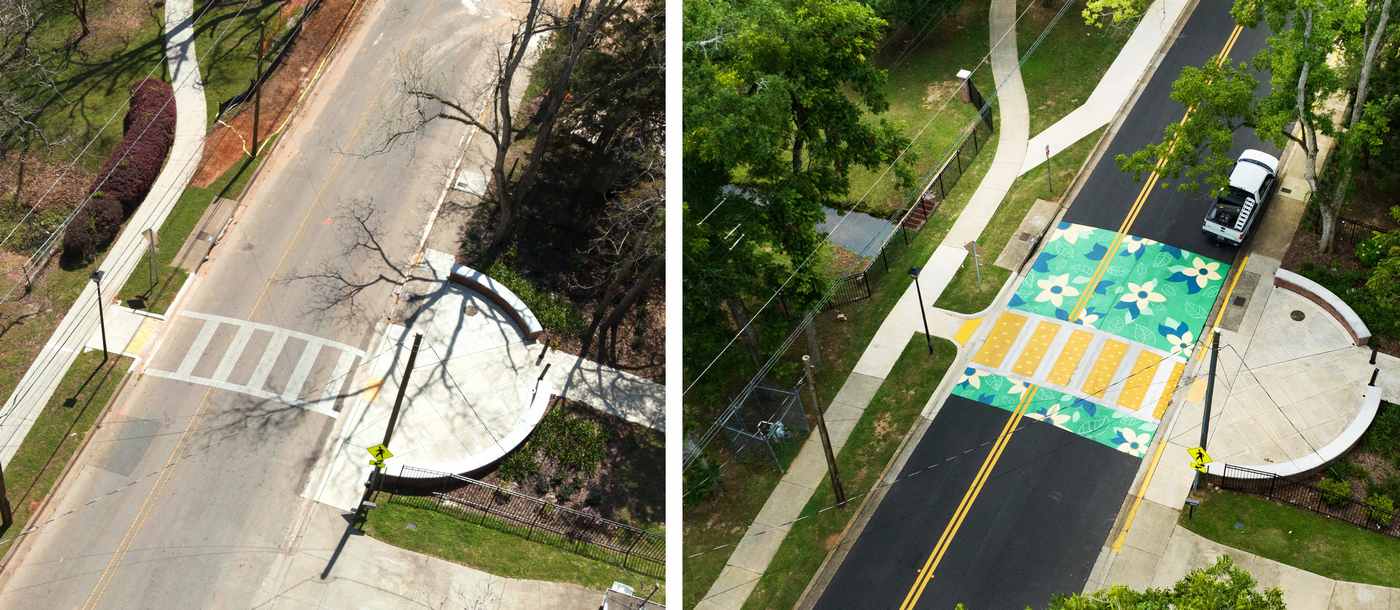
Studies examining US road intersections seem to suggest that colorful pavement art paired with other safety improvements make people safer drivers.
For example, colorful crosswalks or bike lanes saw 32% fewer car collisions and 52% fewer crashes involving pedestrians and bicyclists.
Just as interesting, one of the studies found that drivers were more likely to yield at some of these artistic intersections—35% more likely at one such site in the nation’s capital, and 300% more often at one stop sign in Cincinnati.
Researchers caution that the structuring of their studies can’t reveal how much of the improvements in safety came from the artworks themselves versus the accompanying road changes.
The first analysis, released November 17th by Bloomberg Philanthropies and conducted by engineering firm TYLin, was a repeat of a previous 2022 study but at double the scale.
It found that annual crashes at the average US intersection fell from 1.23 to 0.84, while crashes resulting in injury dropped 29%, when asphalt artworks were present.
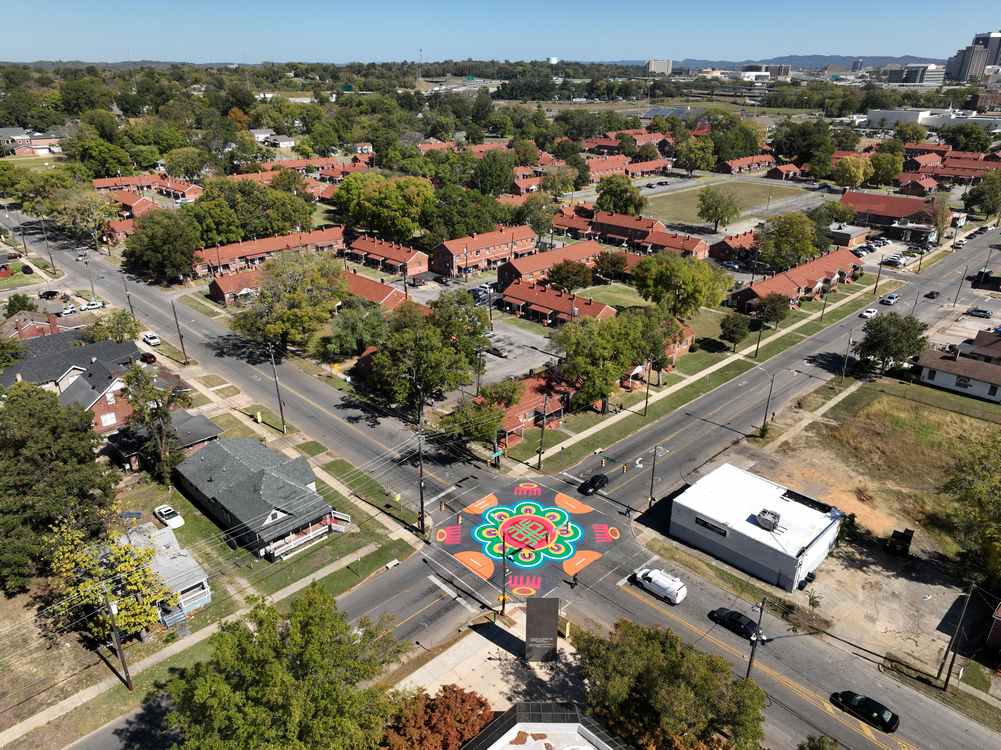
The artworks are almost never installed alone, and this is a key aspect of the research. Most projects combine painted curb extensions, flexible posts, and upgraded crosswalk markings to shorten pedestrian crossings, improve sightlines, and slow turning vehicles. Unlike conventional reconstruction, these can be built or added in months, and they allow cities to test designs before committing to permanent changes.
“It’s not trying to isolate the effect of the art from the larger installation,” Eric Hanns, senior associate and safe mobility lead at TYLin, told Engineering News-Record. “That’s just how these treatments are commonly deployed.”
Since launching in 2019, the Asphalt Art Initiative has supported 100 projects in 97 cities across 20 countries.
“Street art does more than alter a roadway’s aesthetic—empirical evidence demonstrates its power to reshape public interaction,” noted Janette Sadik-Khan, Transportation Principal at Bloomberg Associates.
“Extending our Asphalt Art Initiative throughout North, Central, and South American municipalities offers additional neighborhoods the opportunity to convert artistic vision and colorful paint into dynamic, secure thoroughfares.”
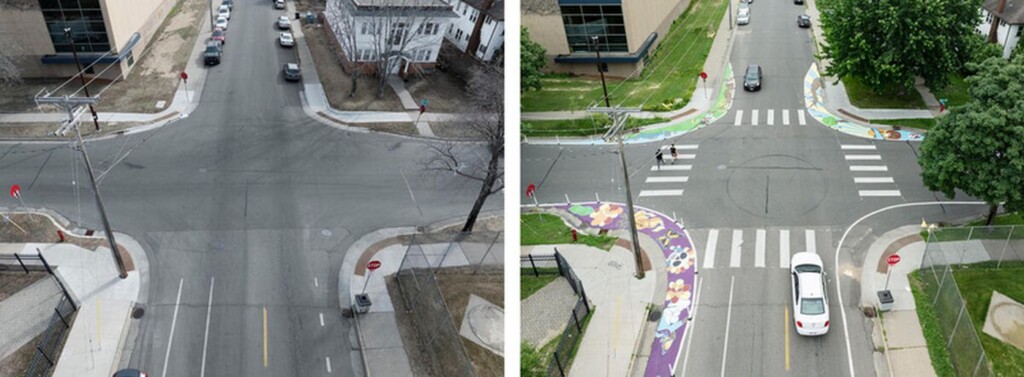
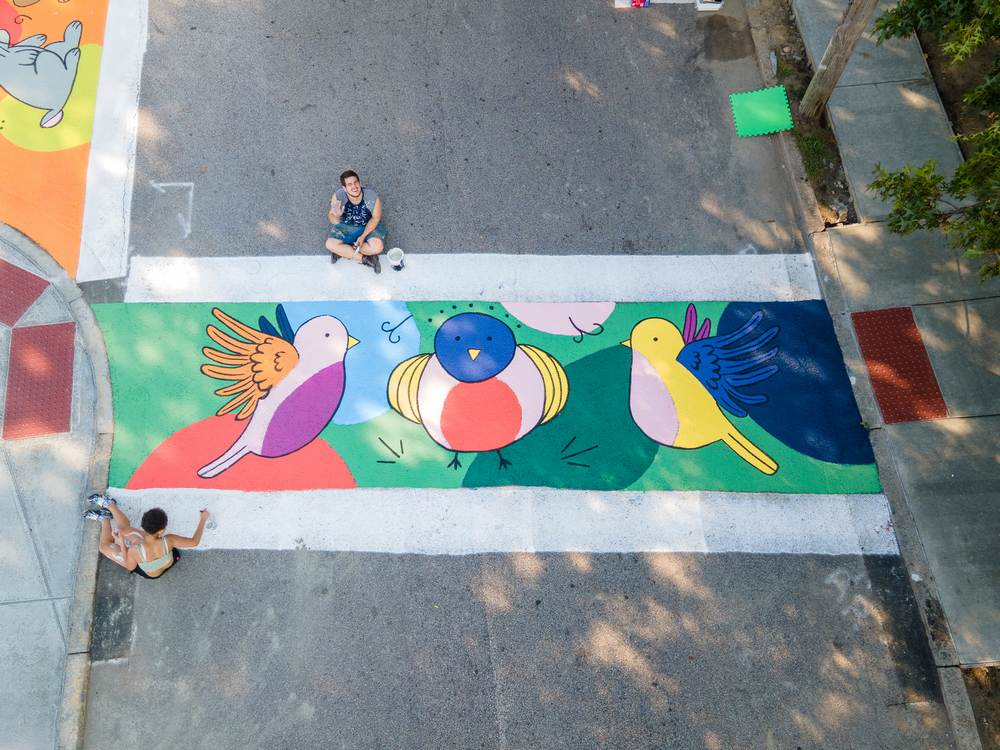
Bloomberg Philanthropies opened its 2026–2027 funding round for cities across North, Central and South America, and the Caribbean, awarding up to $100,000 to each of 10 selected cities interested in participating in the Asphalt Art Initiative.
As Hanns at TYLin points out, curb extensions and other safety improvements accompany most of these asphalt art projects, and already have well-documented safety benefits.
By jutting into the street at corners, they shorten crossing distances and improve driver-pedestrian sightlines. High-visibility crosswalk markings alone have established crash-reduction benefits. The colorful artwork may add a psychological nudge, encouraging drivers to slow down and pay attention.
RECLAIMING THE STREETS: New York City is Putting ‘The Park’ Back in Park Avenue – And Adding a Protected Bike Lane (LOOK)
To wit, a separate study conducted in Washington, DC, found 84% of approaching drivers yielded at mural-art curb extensions, compared with 62% at temporary extensions without murals and 49% at intersections without any extensions. A January 2026 University of North Carolina study also found drivers yielded more often at painted crossings.
These separate, successful replications of the TYlin study are important, as the latter lacked untreated comparison intersections and did not adjust for changing traffic volumes, meaning the before-and-after differences may not prove causation. The findings are statistically significant, and they show that the overall package works, but not necessarily that paint alone saves lives or prevents collisions.
That distinction matters for transportation agencies weighing investments. As Bloomberg Philanthropies has argued since its first safety report, cities can deliver measurable results for pennies on the dollar compared with full reconstruction. And the quick-build nature of these projects lets communities see what works before making permanent commitments.
ALSO CHECK OUT: Tokyo Tackles Trash Troubles with New Generation of Robotic Street Waste Bins
Though not conducted scientifically, Bloomberg Philanthropies reported on findings from municipalities participating in the Asphalt Art Initiative in the US, like Cincinnati and Durham, NC.
In the former, there was a 300% increase in motorists stopping completely at a stop sign, while in the latter, the percentage of people who felt unsafe crossing fell from 85% to 6%.
SHARE This Brilliant Way To Make Streets Safer Around The World…