













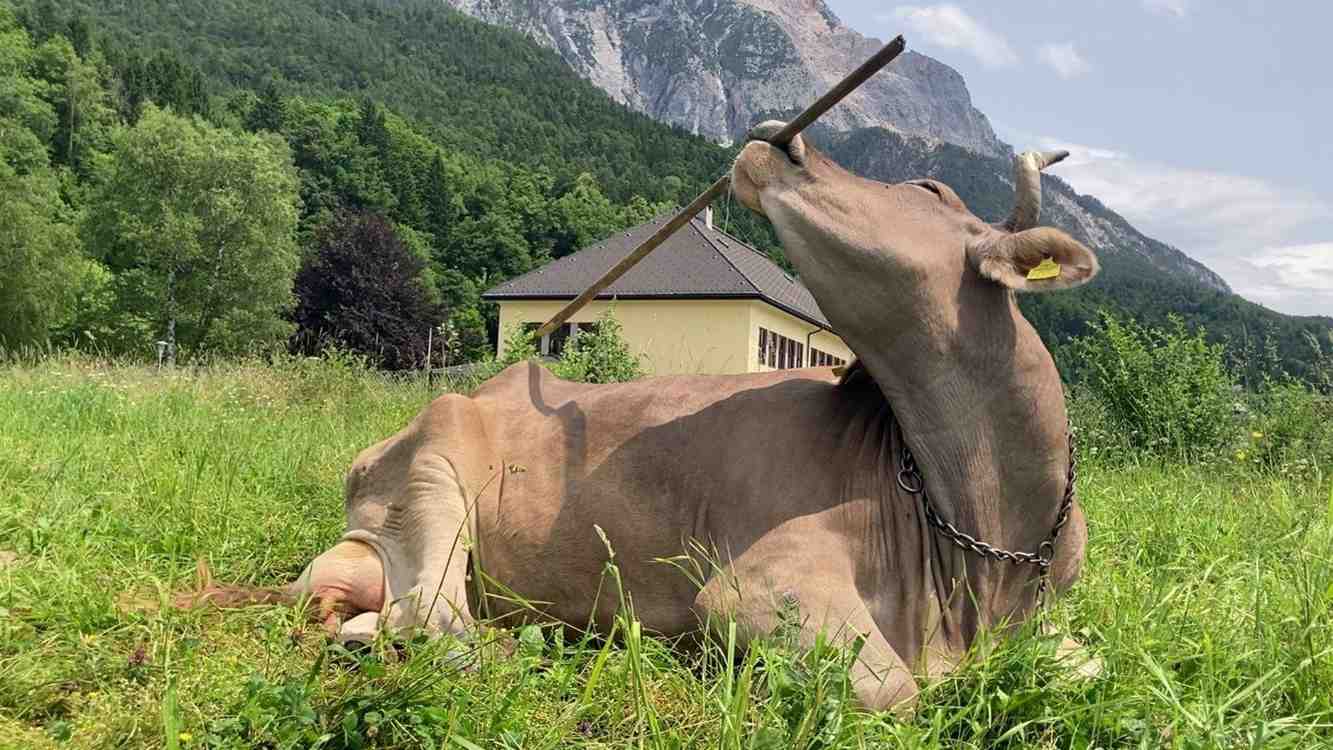
A clever cow called Veronika is the first ever to be recorded using tools—a brush or stick to scratch her back.
The old Swiss Brown cow has astonished scientists in Austria with her broom, which she uses as a multi-purpose tool, an “extraordinarily” rare ability that outside of humans has only previously been documented convincingly in chimpanzees.
Veronika is not farmed for meat or milk but has been kept as a companion by organic farmer and baker Witgar Wiegele, who regards her as part of the family. He noticed over a decade ago that Veronika would occasionally pick up sticks and use them to scratch herself.
The behavior first came to scientific attention when it was recorded on video and shared with cognitive biologist Professor Alice Auersperg.
Dr. Auersperg has now conducted a study, published in the journal Current Biology, which is the first to describe tool-use in a cow.
“The findings highlight how assumptions about livestock intelligence may reflect gaps in observation rather than genuine cognitive limits.”
“When I saw the footage, it was immediately clear that this was not accidental. This was a meaningful example of tool use in a species that is rarely considered from a cognitive perspective,” she said.
Auersperg and her colleague Dr. Antonio Osuna-Mascaró went to meet Veronika and conduct systematic 70 tests. In a series of controlled trials, they presented a deck brush on the ground in a random orientation.
The researchers recorded which end Veronika selected and which body region she targeted. Across repeated sessions, they found that her choices were “consistent and functionally appropriate” for the body regions she targeted.

“Veronika uses each part of the broom in a different way,” said Dr. Osuna-Mascaró, “and she applies different techniques depending on the function of the tool and the body region.”
The researchers found that Veronika usually prefers the bristled end of a deck brush when scratching broad, firm areas such as her back. But when targeting softer and more sensitive regions of her lower body, she switches to the smooth stick end.
Further still, Veronika also adjusts how she handles the tool, and will change her method of use, not just the end of the brush, depending on her aim. Upper-body scratching involves wide, forceful movements, while her lower-body scratching is slower, more careful, and highly controlled, with occasionally precise whacks.
Tool-use is defined as the manipulation of an external object to achieve a goal through mechanical means. The Austrian research team found that Veronika’s behavior meets the definition and goes a step further, describing it as flexible, multi-purpose tool use, meaning that different features of the same object are used to achieve distinct functional outcomes.
“Because she is using the tool on her own body, this represents an egocentric form of tool use, which is generally considered less complex than tool use directed at external objects,” said Dr. Osuna-Mascaró, getting into the nitty-gritty. “At the same time, she faces clear physical constraints, as she must manipulate tools with her mouth.”
“What is striking is how she compensates for these limitations, anticipating the outcome of her actions and adjusting her grip and movements accordingly.”
SACRED COWS: Farmers Invite Jazz Band to Play Moosic for Cows in Bid to Boost Milk Production – WATCH
He said the findings represent the first documented case of tool use in cattle and the first evidence of flexible, multi-purpose tool use in the species, something that expands the taxonomic range of animals known to possess this capacity.
The researchers note that Veronika’s life circumstances may have played an important role in the emergence of her behavior. Most cows do not reach her age, do not live in open and complex environments, and are rarely given the opportunity to interact with a variety of manipulable objects.
Her long lifespan, daily contact with humans, and access to a rich physical landscape likely created favorable conditions for “exploratory and innovative” behavior, according to the researchers.
MORE ANIMAL VIDEOS: 2 Bears Figure out How to Make a ‘See-Saw’ in Playful Moment Caught on Video (WATCH)
The research team is now interested in understanding which environmental and social conditions allow such behaviors to emerge in livestock species, and how many similar cases may have gone unnoticed simply because no one was looking for them.
“Because we suspect this ability may be more widespread than currently documented, we invite readers who have observed cows or bulls using sticks or other handheld objects for purposeful actions to contact us,” said the authors.
WATCH the story below, well narrated by Dr. Osuna-Mascaró…
SHARE This Incredible Animal, And The Discovery She’s Given Us…