












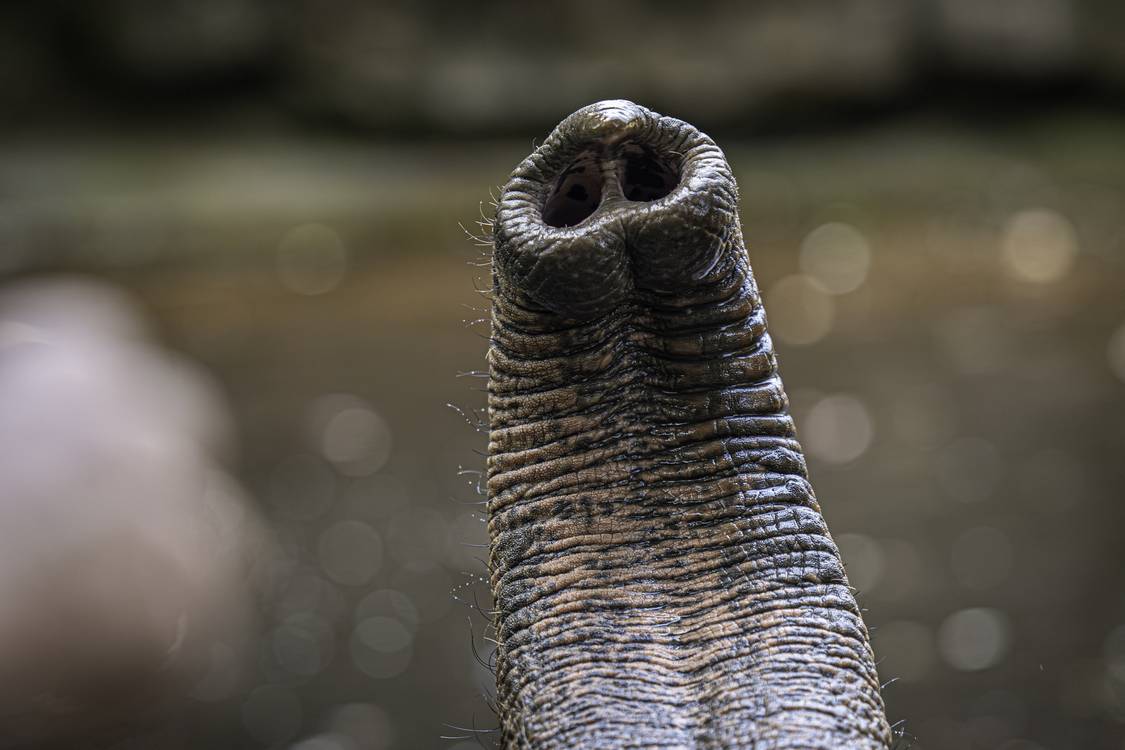
The whiskers on an elephant’s trunk are key to its “amazing” sense of touch, reveals new research.
The 1,000 hairs that cover the trunk have unusual properties that highlight where contact happens along each whisker allowing the largest land animal to grab something as small as a peanut, say scientists.
The whiskers of elephants and domestic cats have stiff bases that transition to soft rubber-like tips, different from the uniformly stiff whiskers of rats and mice and referred to as a functional gradient.
The German research team believe that the unusual stiffness gradient helps elephants know precisely where contact occurs along each of their 1,000 trunk whiskers so they can perform feats such as picking up a tortilla chip without breaking it or precisely grabbing a peanut.
Now the researchers are looking to invent new robotic sensing technologies inspired by the functional gradients they discovered in elephant and cat whiskers.
“The stiffness gradient provides a map to allow elephants to detect where contact occurs along each whisker,” said Dr. Andrew Schulz, the study team leader. “This property helps them know how close or how far their trunk is from an object… all baked into the geometry, porosity, and stiffness of the whisker.”
“Engineers call this natural phenomenon embodied intelligence. It’s pretty amazing.”
Dr. Schulz and his colleagues examined elephant trunk whiskers to understand how they are shaped, how porous they are, and how soft they are.
Micro-CT scanning allowed the researchers to measure the 3D shape of several whiskers and showed that elephant whiskers are thick and blade-like, with a flattened cross-section, a hollow base, and several long internal channels that resemble the structure of sheep horns and horse hooves, but not rat whiskers, which was their hypothesis.
The researchers explained that the porous architecture reduces the whisker’s mass and provides impact resistance, allowing elephants to eat hundreds of kilos of food every day without worrying about damage to their whiskers, which never grow back.
The discovery that elephant trunk whiskers bear a stiffness gradient initially stumped the team as they were not sure how it would affect touch sensing.
To try to figure out why, Dr. Schulz worked with colleagues at the Max Planck Institute for Intelligent Systems (MPI-IS) in Stuttgart to 3D print a scaled-up whisker with a stiff, dark base and a soft, transparent tip.
SECRETS BEYOND ANIMAL ABILITIES: Hi-Tech Whiskers Give Working Robots More Ability to Move Safely and Read Environment
Having this physical “whisker wand” prototype helped the research team develop their intuition for what an elephant trunk feels through its whiskers.
Dr. Schulz left the wand with his mentor Professor Katherine Kuchenbecker after a meeting, and she carried the wand in her hand as she walked through the halls of the Institute, gently hitting the columns and railings.
“I noticed that tapping the railing with different parts of the whisker wand felt distinct – soft and gentle at the tip, and sharp and strong at the base,” said Professor Kuchenbecker. “I didn’t need to look to know where the contact was happening; I could just feel it.”
ALSO CHECK OUT: Hummingbird Chicks Observed for the First Time Pretending to be Caterpillars to Avoid Being Eaten
To test their hypothesis from the 3D-printed whisker wand, the research team developed a computational modelling toolkit to assess how the whisker responds to contact.
The simulations showed that the transition from a stiff base to a soft tip does indeed make it easier to feel where something is touching along the whisker, allowing the elephant to react appropriately and carefully manipulate even delicate objects, such as tortilla chips.
ELEPHANT STORIES: Houston Elephants Do Yoga 7-days a Week to Stay Flexible and Healthy
The discovery has excited the research team who are working to apply the insights from nature to applications in robotics and intelligent systems.
“Bio-inspired sensors that have an artificial elephant-like stiffness gradient could give precise information with little computational cost purely by intelligent material design,” said Dr. Schulz.
SHARE This Unique Insight Into Elephant Trunks.