












From a spartan office on a university campus, law professor Wang Canfa has gained fame for the legal battles he was waged for thousands of victims of polluters across China. “I feel I have the legal knowledge and should provide help for the underprivileged as best I can…”
Company Will be Largest Solar Generator in State
"By year’s end, Deltec will be using 100 percent renewable energy at its factory. That will make Deltec not only Asheville’s largest maker of manufactured homes but also North Carolina’s largest private generator of solar power." (Citizen-Times) Thanks to Linnea for the link.
Charitable Gift-Giving Growing in Popularity

Socially responsible gifts are growing popular in Canada, where people have everything they need and family members turn to charities to buy what are sometimes called ‘gifts that give twice’. These include gifts that lay eggs, produce milk and provide shade and grow fruit in developing countries, particularly for families in need. GNN-i reported on a charity that is perfect for holiday giving – the Heifer Project.
(Full story of Candian Giving: CBC)
Ex-Baseball Pitcher Becomes the New Gratitude Guru

After baseball pitcher Mike Robbins left behind professional baseball — and his self-pity — after an injury, he embarked on a new path of self-discovery where appreciation and gratitude became his new pitch, and life coaching, his new game.
His first book, “Focus on the Good Stuff: The Power of Appreciation” reached No. 4 on Amazon.com
(READ the review from the Mercury News)
Thanks to Jerry C. for submitting the link!
African School Succeeds Against the Odds

“With 1,531 students, six classrooms, no running water and no light bulbs, this Malawi school has one of the best academic records by far, in a country that is now overhauling education — along with several other African states — in an effort to meet the United Nations goal of having every child enrolled in primary school by 2015.”
(ABC News)
Led Zeppelin Takes to the Stage Tonight
Rock legends Led Zeppelin took the stage at their long-awaited reunion concert tonight with a blistering display of their greatest hits.The three surviving members of the iconic group — Robert Plant, Jimmy Page and John Paul Jones — were joined on stage by their late drummer John Bonham’s son Jason for the tribute show in honor of the late Ahmet Ertegun, the founder of Atlantic Records who launched Led Zeppelin in the US. (Profits from the show will support his education fund, granting college scholarships in Turkey, the UK and the U.S.)
Reminder: Tele-Seminar Tonight: How to Pay Off Your Mortgage Quicker and Save Tons of Interest
Editor’s Blog- Tonight is the LIVE VIDEO webinar and Great Mentors tele-seminar which was designed to help better explain the new mortgage program that I called the "Best Good News Story of 2007." If you are a U.S. homeowner with a mortgage, and you earn more money than you spend each month, meet us at 9:00PM EST, to join our MUST-HEAR seminar about the new program. You can read the GNN feature story here and get all the details about signing up for the tele-seminar on our Great Mentors page. I hope that by learning about this program we may save you money and get you out from under your mortgage payments years sooner, without re-financing. It’s the real deal and very good news for MANY working class, responsible, US homeowners. See you there!
AquaMaker Creates Water From Thin Air

"In Israel, where water is scarce, a new device allows people to generate water from air." Aquamaker, a Houston based company created the water generator now for sale that converts humidity in the air to purified water. (Jerusalem Post) Thanks, Andrews, for the link.
IBM Donates Supercomputer to Spur Growth in Africa
Because building scientific and technical capability within Africa is one of the fundamental keys to growing its economy, IBM announced that it will donate a $2 million Blue Gene supercomputer to African institutions that are focused on social, economic, and environmental issues. (CNN Money) Link from Andrew N.
Rookie Cop Braves Raging Flames To Rescue Rooming House Residents
"A Toronto area police officer is being called a hero after racing into a burning rooming house and saving all those inside." (CityNews with video) Thanks to Andrew N. for the link.
Marine Gets Thanksgiving Meal in a Box From Mom
My son, along with his Marine unit in Iraq were out on Thanksgiving day and missed the whole dinner that was prepared for the holiday. Bummed because the mess hall had closed before they’d returned, they were told to go back to their bunks and eat military rations — not a happy alternative.
My kiddo got to his bunk and noticed the mail had been delivered while they were gone. Instead of opening his rations, he got to open the care package I’d sent that was filled with his favorite food. He was so excited.
Oddly, I was worried about that specific box, thinking it was a cheeky thing to send. I had included a canned turkey, cranberry sauce, and some individual pecan and apple pies I’d found in walmart, along with a tuna packet with crackers, jelly, pudding, fruit cocktail, eating utensils and hot cocoa with a camp thingy to warm up hot water (or soup) and instant coffee irish cream.
He said he really appreciated the thoughts that went into it, and it was the best thing he had eaten in days!
So even the weird box worked out well with what they go through. Thank you post office for getting him that box when he most certainly needed something good to happen! My hope for Christmas is that his unit has a chance to get their Christmas dinner.
– A proud Marine mom
Stranger Pulls Driver From Blazing Truck After Others Had Given Up
A Sacramento man said other motorists had stopped and were circled around the truck, which he described as a fireball. "They looked like they had tried to get him out, but they couldn’t do any more," he said. "The whole thing was on fire, and the others couldn’t get close to it anymore…. I just couldn’t let him burn to death." (SacBee.com) Thanks to Andrew N. for the link!
Winner of Moscow Millions Donates Prize Money to Orphans
Tony G. of Melbourne is keeping the gold bracelet, and the title of “Russia’s National Poker Champion”, but his cash winnings of $205,000 he has already donated to Russian orphanages. Thanks to Andrew N. for the link.
Brad Donates Millions for Eco-Housing Project in New Orleans

Brad Pitt unveiled the next phase of his mission to help the people of New Orleans rebuild their homes in the devastated ninth ward, backed by a personal $5 million donation. His “Make It Right” fundraising effort is collecting $150,000 from celebrities, including Jimmy Buffett, and from business leaders for the construction of 150 eco-friendly and flood-proof homes to replace those destroyed in the Hurricane Katrina disaster.
“The families of New Orleans need the help of families across America this holiday season,” said Pitt. “We are asking Americans this holiday season to go to our website, MakeItRight, and send a contribution that will help us rebuild homes for these families — and rebuild their lives.”
Pitt was joined by the architects, who unveiled their groundbreaking designs for the community. In addition to high-quality, sustainable design, the project incorporates the spirit and culture of the Lower 9th Ward and encourages it to flourish.
Today’s launch was marked by the unveiling of 150 bright pink structures the size of real houses erected throughout the project site. The pink houses, which will remain for five weeks, serve as a stand in for the vibrant community that will be built.
Pitt also unveiled innovative features of the donation website. Users are able to “walk” through houses and select which items in the house they will support with their contributions. The site also allows users to provide parts of a house on behalf of their friends and families.
Following the announcements, Pitt hosted a party for Lower 9th residents. The party included appearances by Jerry Lee Lewis, Ivan Neville, and Fats Domino.
Earlier this year, Pitt and Steve Bing announced at the Clinton Global Initiative that they each would match $5 million in contributions to the houses, for a total of $10 million in matching funds, and challenged others to join them in rebuilding New Orleans.
Pitt became a part-time resident of New Orleans after Hurricane Katrina. After seeing the devastation first hand and meeting with the hardest-hit residents, he began the Make It Right project to catalyze the rebuilding of New Orleans starting with the Lower 9th Ward.
The 150-home community will address the dire need for single-family housing in the Lower 9th Ward and further spark rebuilding efforts in one of the richest cultural communities in America. Make It Right’s mission is built upon catalyzing redevelopment of the Lower 9th Ward by building a neighborhood of safe and healthy homes that incorporates modern, high-quality design and ensuring a green, affordable, sustainable, and replicable community to serve as a model for further rebuilding. The process has including the Lower 9th Ward community as an integral part of the process; and a finance plan that ensures that residents who wish to return to the Lower 9th Ward can do so without further financial hardship.
Thanks to Andrew N. for the heads-up.
Photo: Dick Thomas Johnson
Food Stamps Now Buys Fresh Fruit and Whole Grains
"A popular program that provides food assistance to low-income women and their children received its first overhaul in more than 30 years Thursday with the addition of fruits, vegetables and whole grains to the list of grocery items covered by the U.S. government." (Reuters) Thanks to Lynn J. for submitting the link!
Climate Change Conference Hails Australia Kyoto Signing

More than 10,000 scientists, bureaucrats and politicians from 186 countries gathered this week on the Indonesian island of Bali for what is perhaps the world’s largest-ever conference on climate change. Monday’s session opened with delegates giving Australia a standing ovation for announcing they will ratify the Kyoto accord.
Scientists Hope Polymers Will Give Oil Spills the Slip

“U.S. scientists have designed a process to create a material capable of strongly repelling oils, one they said could have applications in hazardous waste cleanup.” (CBC)
Australian Golfer Plays 650 Holes for Charity
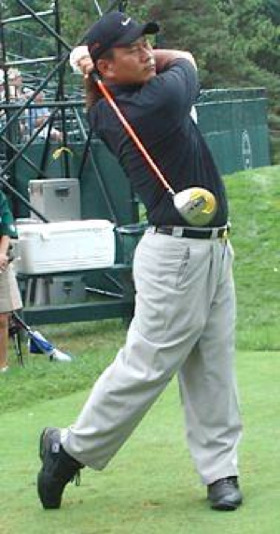
After playing 650 holes of golf over 40 hours, Adam Engel didn’t expect his marathon charity round to end with a bang: a chip-in birdie from about 45 yards.
Engel said he was inspired to take on the challenge to raise money for the Leukemia Foundation after his best friend, Shane Burn, was stricken with the disease.
(READ the AP story in Golf.com)
File photo of golfer, KJ-Choi
Indonesian Grandmother Spreads Green Ways in Smoggy Jakarta
A 77-year-old grandmother who has been teaching green ways for almost 30 years to 218 neighborhood families: Homes are shaded by potted plants, bins encourage waste separation and residents recycle their garbage.
Afghan Widows Returned to Society With Carpentry Skills
“An Afgan widow will not be welcomed by either her own or her husband’s family,” said Fatima, a widow who has established a carpentry school in Kabul to teach other widows the craft. With their new education, the women can earn bread for their families through their own hands. (Read more here)