Quote of the Day: “Sometimes I think about retiring but not stopping work. Just ‘re-tiring’ – put on some new tires and go on to do something else.” – Jeff Bridges (turns 72 today)
Photo: DENIS MAROSAN
With a new inspirational quote every day, atop the perfect photo—collected and archived on our Quotes page—why not bookmark GNN.org for a daily uplift?
Ever the one to go big or go home, Chinese officials have briefed reporters on a new massive greening campaign that will create Belgium-sized forests every year for the next five years.
Additionally, the country’s national park and forest system will be expanded, new green corridors will be created to reconnect fragmented populations of wildlife, and greater crackdowns on the illegal trafficking of wildlife and wildlife products will be enforced.
Li Chunliang, vice-chairman of the State Forestry and Grasslands Commission, announced the addition to the recent five-year plan at a press briefing, stating that, “By 2035, the quality and stability of national forest, grassland, wetland and desert ecosystems will have been comprehensively upgraded.”
14,000 square-miles (35,000 square kilometers) of new forest will go up every year, particularly in drought-prone regions of the North and West.
The nation has also detailed that the strategy will be based around “natural reforestation,” from which one might guess it will have learned from the mistakes of the “Green Great Wall” which attempted to stop desertification near the Gobi Desert, but which was largely a failure due to monocrop planting, with billions of planted trees dying from moisture or from beetle infestations.
Amazingly, five of these Belgium forests will increase total forest coverage in the country by less than 2%, but in a culture like China, which for decades has existed in the paradox of matching traditions like Buddhism, folk medicine, and a deep reverence for national animals with breakneck economic development and conquering of the natural world, every little bit counts.
Forests planted in the north could expand the habitat of the Siberian tiger, a staple of painting and one of the five animal styles in Kung Fu, while forests planted in the west could be a hope for survival of the Gobi bear, the most endangered species of bear on Earth. That’s good news all-round.
One of the big knocks against solar panels is how much land they take up compared to how much power they generate. But what if there were a readymade source of open land nearby to cities and towns that was guaranteed not to be used for anything else?
As it turns out, landfills are becoming prime real estate for solar farms, and one nonprofit believes the U.S. could increase the nation’s solar energy capacity by 63 gigawatts, or approximately 60%, simply by building solar farms on landfills.
Solar firms are building these landfill solar farms all over the country, and while they present a bigger engineering and economic challenge then building one on flat ground, the appeal of refurbishing capped landfills and brownfields from their barren state into a new service for the community is deeply appealing.
For example, Nexamp’s Solar Star Urbana Landfill community solar farm occupies nearly 40 acres on a capped landfill, meaning one that isn’t accepting solid waste and which has been “capped” with concrete or other material to block rain from seeping through to the decomposing waste below.
It features nearly 14,000 solar panels and generates 5.2 megawatts of clean energy for low and middle income residents, who receive discounts on their energy bill if they sign up to take on the solar energy.
IKON Environmental Energy is building a 70 megawatt solar farm in Houston Texas called the Sunnyside Energy Project that will power 12,000 homes, atop a 240-acre capped, methane-leaking landfill that will also host community features like an electric vehicle charging point, bio-digester to turn certain waste sources into green energy and fertilizer, and a community garden.
Annapolis Maryland has one too—55,000 panels on an 80-acre landfill, generating power for 2,500 people.
It isn’t the easiest thing to build a solar farm on a landfill. For one thing, the traditional method of securing the panels on concrete struts buried in the ground is out of the question, as it would break the cap on the landfill. This also currently puts a landfill solar panel out of the reach of current technologies that allow the movement of the panels to follow along the sun.
However there are also aspects which are easier, for example there are usually underserved communities that live nearby landfills, and the local cheap power access (solar is usually either subsidized or rewarded) can help save them money.
Furthermore, there’s no risk of facing high land prices, or a bidding war from someone else who may want to use a pristine stretch of meadow for something else.
There are more than 10,000 closed or capped landfills around the country, and perhaps as many as 4,000 of them could be turned into solar farms immediately.
A rising star among the UK’s passionate “detectorist” community has found a buried hoard of 65 objects, many of which are bronze axes.
It’s being called a once-in-a-lifetime find, one which had to be handled by archeologists, and which is now undergoing the British government’s Treasure Review to determine if the nation will purchase the artifacts.
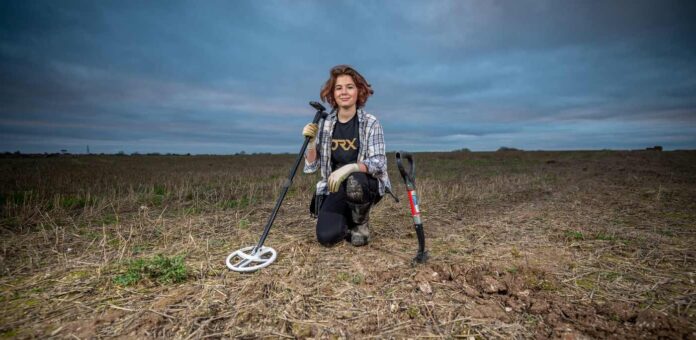
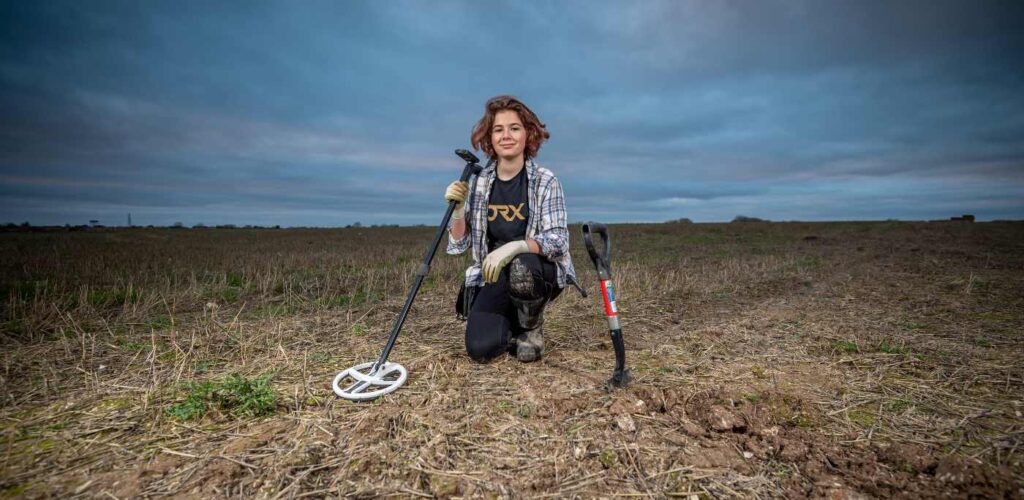
Milly Hardwick from Suffolk was out detecting in a field with her dad Colin, when the 13-year-old made the find.
“It was my third time out and I didn’t quite know what I was doing,” Milly told the BBC. “I got a signal and yelled at my dad and when he started digging he went ‘this could be an axe’, and he was joking around about it.”
It’s thought the axes and other objects, 65 in total, date from around 1,300 BCE. After finding the first 20, the father-daughter team had to cover the site back up until archeologists could come the next day.
She took the day off of school to go with her father and give the find to the local coroner to be sent off for review.
SWNS
Milly says if she receives any money from the hoard she will split it with the landowner, typical of the sometimes millions of pounds in payments detectorists can receive for important finds like the recently-deemed-treasure hoard of gold coins from the Anglo-Saxon period.
Milly, who is now so taken with detecting she wants to be an archeologist, is on a bit of a hot streak, and the axe hoard has made her somewhat of a celebrity among British detectorists. She was featured on the cover of Searcher magazine, and her mom Claire says she gets noticed when she’s out with her metal detector.
“There’s been times when people have gone ‘Oh no, she’s here, we might as well go home now,’ and there’s been a couple of digs they’ve been on since she found the hoard and when she’s got out the van people have given her a round of applause,” Claire told ITV News. “It’s massive, massive, some people detect for forty, fifty years and don’t find anything like that.”
Smithsonian reports the British Bronze Age started around 4,300 years ago, when ancient Britons began melting tin and copper together to make bronze.
“Because it’s happening to us it’s lovely anyway, but it’s also nice that it’s happy news rather than some of the depressing news we’ve had lately,” Claire tells the BBC.
Quote of the Day: “Spend so much time improving yourself that you have no time left to criticize others. Be too big for worry and too noble for anger.” – Norman Vincent Peale
Photo: Priscilla Du Preez
With a new inspirational quote every day, atop the perfect photo—collected and archived on our Quotes page—why not bookmark GNN.org for a daily uplift?
An enthusiastic backyard bird watcher named Stuart Dahlquist spent years leaving out food for a family of crows—but he never expected to be given anything in return for the snacks.
That’s why he was all the more shocked when he was surprised with a gift from the corvids.
The 56-year-old Seattle homeowner first became acquainted with the bird family after he rescued two chicks that had fallen out of their nest in his front yard six years ago.
Dahlquist told The Dodo that he had always delighted in listening to the baby birds chirp to their parents during feeding time—so when he went outside and found the tiny crows on the ground, he knew he had to help.
Despite the squawks of alarm from the adults, Dahlquist managed to scoop up the chicks and put them back in the nest. He even left out food and water at the base of the tree in case they fell a second time.
He then began regularly throwing bird food into his front yard—and the crows apparently took notice.
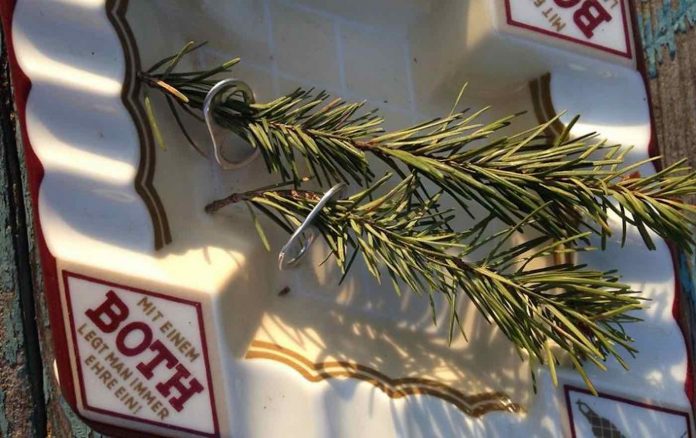
We've been feeding a small family of four crows (mated pair and their two year old kids) for several years. Last week two days in a row they left these gifts, pull tabs threaded onto pine twigs. This isn't only generous, it's creative, it's art. My mind is blown. pic.twitter.com/tT5ORZ3AHL
One day when Dahlquist was preparing for his daily feeding ritual, he was surprised to find a fir sprig that had been decorated with a soda can tab. Not only that, it was left in the exact spot where he fed the crows.
“I noticed it straight away because I’m kind of sensitive about trash going where it belongs,” he told The Dodo, “but the pull tab being threaded onto the sprig of fir wasn’t normal and I hung onto it.”
The next day, he was offered a second soda tab-decorated branch courtesy of the crows—and he says was stunned by the discovery.
“This isn’t only generous, it’s creative, it’s art,” Dahlquist wrote on social media. “My mind is blown.”
Since his Twitter photo of the greenery gifts were shared several thousand times, Jennifer Campbell-Smith, a behavioral ecologist who earned her PhD studying crows at Binghamton University, told the Audubon Society: “I am very skeptical of random internet sources, but knowing these birds and how intelligent they are, I wouldn’t be shocked.
“It’s still an amazing example of the way crows are really watching us and are mindful of us,” she added.
Regardless of the corvids’ intent, Dahlquist says he has maintained a close relationship with the bird family since the incident. Additionally, he told Audubon that he planned on getting a tattoo of the gift as reminder of his sweet inter-species friendship.
“They’ll follow along when I take my walks, landing on the wires along the way,” Dahlquist told The Dodo. “The adult male … is very amiable and will fly sometimes within a few feet, swooping by to say, ‘Here I am!’”
(If you want to learn more about the cleverness of crows, be sure and watch the jaw-dropping TEDx Talk below)
Fly This Story Over To Your Friends By Sharing It To Social Media…
A Christmas fanatic turned her office cube into an incredible life-size gingerbread house to amuse her colleagues.
47-year-old Monika Orrey had only worked at her new job for two months when they announced a workspace decorating competition.
The financial services manager threw herself into the contest, spending eight hours turning her cube into a festive gingerbread wonderland.
She constructed the sides and roof of the house by herself with duct tape and cardboard that she covered in brown craft paper.
The mum-of-one visited the office on a Sunday to construct her masterpiece as a surprise for her colleagues the following Monday.
Monika from Oakley, California, said, “I consider myself very festive, or as my daughter would say, I am ‘extra’!
“I do indeed have far too many decorations at home according to my family but I know they love it.
“When the cubicle decorating contest was announced, I started stockpiling cardboard right away.
SWNS
“I was at first concerned my new colleagues might think I was odd but soon remember that I am happiest when I am authentically me so I pushed right past any concerns and got to planning.
“I wanted to do something big and incorporate my well-known sweet tooth, and what better than a giant gingerbread house?
“With the cardboard I had collected and the decorations I had on hand, the biggest cost was tape.
“I was able to collect bowls from the dollar store, paint pinwheels on them, attach the bowl to a white cardboard tube and cover in cellophane for extra large ‘lollipops’.
“I bought some candy stickers and found more candy images online that I printed out for more decorations.”
If there’s plenty of sky, but little sun; plenty of wind, but little land, where can the Faroe Islands look for renewable energy?
The answer is obvious, owing to their Viking origins: Sea Dragons.
The Sea Dragon is a unique form of kinetic energy generated by the movement of the tides. 40 meters below the surface, they are underwater kites or gliders that have a 16-foot wingspan and swim in a figure of eight position along with the tide, generating enough energy to power 50-70 homes.
Home to just 50,000 people, the Faroe Islands is a self-governing Danish archipelago that lies between Iceland and Shetland—and one would think it would be an easy enough place to reach a zero-emissions target.
But with North Atlantic weather and not much land to build wind turbines, hydro-electric power gives over 40% of the island’s energy supplies.
Minesto
Built by Minesto, a spin off from the parent company of airplane and (former) car manufacturer Saab, the “tidal kites,” as they’re called, operate by using the lift force of the tide rather like an airplane uses the force of air passing over its wings to fly.
With an onboard control system and rudders, the kite is autonomously steered in a pre-determined pattern that pushes it through the sea while anchored to the seafloor by a tether. By doing so, the turbine experiences a water flow several times higher than the actual stream speed.
Minesto
The turbine diffuses power to the generator which sends electricity via power cable in the tether up to a station on land.
Operating in unison with the marine environment in totally predictable ways, the tidal kites are extremely low in environmental impact, and most importantly for the tiny island chain, use up no land other than for the receiving power station.
“The new kites will have a 12-metre wingspan, and can each generate 1.2 megawatts of power [a megawatt is 1,000 kilowatts],” Martin Edlund, CEO of Minesto, told the BBC. “We believe an array of these Dragon-class kites will produce enough electricity to power half of the households in the Faroes.”
Returning to winter from an unusually windless summer in which the Faroes had to import much more diesel than their installation of wind turbines would have made them expect, the tide’s regularity is literally the stuff of legend; so much so that Minesto believe their dragons could provide 600 gigawatts low-impact, low-cost, renewable energy around the world if scaled up.
A Londoner has received the world’s-first 3D printed digital eye as a prosthetic.
Promising to cut the time it takes to develop a prosthesis by half, it’s also more realistic than other alternatives.
Steve Verze is a 47-year-old engineer from Hackney who had needed a prosthetic eye since he was 20. Last week he finally had it fitted.
“When I leave my home I often take a second glance in the mirror, and I’ve not liked what I’ve seen,” Verze said in a press release. “This new eye looks fantastic and, being based on 3D digital printing technology, it’s only going to be better and better.”
Normal prosthetic eyes involve hand-painting an iris onto a disc that is then inserted into the eye socket. However since the eyes are the windows to one’s soul, the light reflecting off the disc rather than penetrating to the full depth like a natural iris will give it away.
Also, along with needing just three weeks to prepare compared to a normal six, 3D printed eyes are much less invasive.
To make a traditional prosthetic eye a physical mold must be taken of the eye socket, but the 3D printer needs only a digital scan which is not only cleaner and faster, but more accurate.
Verze’s functional eye was also scanned to ensure the details between the two would be the same.
Clinical lead Professor Mandeep Sagoo of Moorsfields Eye Hospital where the procedure took place said: “We hope the forthcoming clinical trial will provide us with robust evidence about the value of this new technology, showing what a difference it makes for patients.”
3D printing has been something of a revolution for the world of prosthetics, with the clever machines being used particularly often to cheaply and quickly restore limbs of animals like turtles, dogs, and ducks, and even a toucan.
GIVE Others an Eye of the Good News—Share This Story…
Quote of the Day: “America’s greatest contribution is its concept of democracy and freedom… freedom of action, freedom of speech, and freedom of thought.” – Benazir Bhutto (first woman to head a Muslim country)
Who Ms. Bhutto became the Prime Minister of Pakistan 30 years ago today, on December 2, 1988.
Photo: The top of the U.S. Capitol
With a new inspirational quote every day, atop the perfect photo—collected and archived on our Quotes page—why not bookmark GNN.org for a daily uplift?
The Galapagos Islands features some of the most beautiful creatures on the planet. Scuba divers visit from all over the world to view the greatest show on Earth, a smorgasbord of marine animals from hammerhead sharks to the giant eagle rays.
Seen from below
Capable hunters of small fish and crustaceans, spotted eagle rays have evolved an ability to detect the electrical impulses of their prey through thousands of nerve cells located in their wings and around their heads.
They can also sense minute changes in water temperature and pressure.
Commonly seen alone, these rays are unique in appearance with their spotted back and flat snouts similar to a duck’s bill.
Their whip tails are longer than those of other rays, and they have 2-6 venomous, barbed stingers containing powerful venom that is capable of inflicting serious, even fatal wounds on large predators. (Look for them at the base of the tail in the video.)
Graceful but dangerous
With such defenses, they are avoided by most animals except large sharks—yet humans accidentally can run into them. They freely leap out of the water at times, and, at least twice have landed in boats with dire consequences for at least one woman.
The scuba diver in this video was hanging onto a rock in the strong current off Darwin Island when an eagle ray appeared and swam near him, almost within arm’s reach. It fought the current, making slow progress creating a prolonged and memorable experience for the lucky diver. WATCH below…
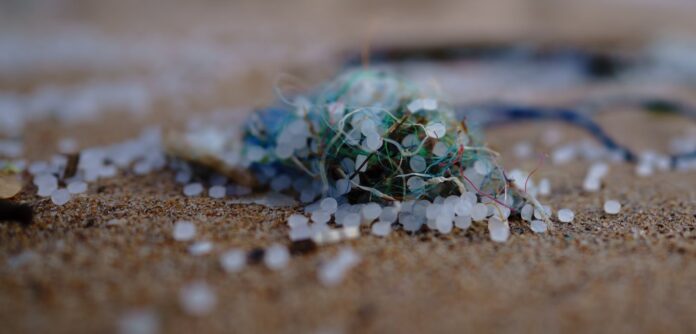
Filtering microplastics from polluted water using acoustic waves is the new solution to cleaning up our oceans, according to new research.
Microplastics are released into the environment as cosmetics, clothing, industrial processes, and plastic products like packaging, break down naturally.
The plastic pollutants then make their way into rivers and oceans, endangering marine life.
Filtering and removing these particles from water is a difficult and timely task, but using acoustic waves may provide a solution to this impenetrable task.
Dr Dhany Arifianto from the Institut Teknologi Sepuluh Nopember in Surabaya, Indonesia, created a filtration prototype using acoustic waves and presented his method and its data at the Meeting of the 181st Acoustical Society of America in Seattle, designed to showcase the latest research about the science of sound.
Dr Arifianto and his team used two speakers to create the acoustic waves and the force produced was able to separate the microplastics from the water by creating pressure on a tube of inflowing water.
As the tube split into three channels, the microplastic particles are pressed towards the center as the clean water flows towards the two outer channels on either side.
The prototyped device cleaned a staggering 150 litres of polluted water per hour and was tested filtering three different microplastics.
Each plastic was filtered with different efficiency, but all were above 56 percent efficient in pure water and a further 59 percent efficient in seawater.
The team measured different variables against their efficiency and found that acoustic frequency, speaker-to-pipe distance, and water density all affected the amount of force generated.
A varsity football team in California is impressing the state’s athletic world, as the limited 23-player roster has gone undefeated 12-0 though all 23 players and their coach are deaf.
They don’t play in a hard of hearing league, they are beating hearing teams, sometimes by huge margins, all the while using American Sign Language to communicate on the field.
The Cubs varsity team from Riverside California have no pedigree of success. They’ve lost every single game for the previous seven seasons. Now their incredible transformation, which has landed the school in the championship game for the first time in its history, has drawn an endless stream of well-wishes and messages, including from NFL franchises.
Like all the most successful teams in any sport, the players explain they are taking their incredible season “one game at a time, one practice at a time,” ABC, speaking to the players using an ASL translator, reports.
“Now we’re just destroying every game. We’re showing the world we can play. We’re not losing anymore,” Wide Receiver Jory Valencia said.
“We can do anything. Deaf people can do anything, we’re not this stereotype that’s out there,” said running back Enos Zornoza. “We’re breaking news that we can do it right. And not just our school here but other schools for the deaf can do it as well.”
The Cinderella story was not to have the most storybook of endings, as the Cubs fell short in the final against Faith Baptist, who had made the final 18 times in the last 37 years.
“It feels overwhelming,” Cubs head coach Keith Adams told NBC LA. “It’s been nonstop, getting messages, you know, congratulations and well-wishes. My email is blowing up. I’ve had some NFL head coaches—the Tennessee Titans have sent me congratulations. It’s just been amazing.”
(WATCH the CBS video for this story below… EDITOR’S NOTE: Viewers outside the US can view this video on the CBS website, here.)
The simple of act of staring at a deep-red or near infrared light source for about three minutes was found to be enough to improve color vision in those suffering from failing eyesight.
The potential treatment allows the mitochondria in the human retina to produce more ATP, the principal energy currency of all cells, and offers a chance of keeping good color vision long into our golden years.
Just a single short trial run in 24 people was enough to improve their color vision for multiple days up to a week, and was most effective when performed in the morning. This is because the wavelength of light that was found to be effective is only present in our Earth sky at that time of day, and it’s also the time when the retinal-mitochondria produce the most ATP.
Making cells more energy-efficient can help with many different issues, says Glen Jeffery at University College London, who led the research focused on the retina—a patch of light-sensitive tissues at the back of the eye that have more mitochondrial density than any other cell. Inside, the retina turns light into pictures with two pieces of equipment, rods and cones.
Rods are very sensitive cells responsible for perceiving black and white, while cones are built for richly-lit environments and are responsible for the perception of color. Tests were made after the short light exposure by asking trialists to identify colored letters of a similar color to the background paper.
Their results have doctors, but also businesses, very excited at a potential at-home treatment for reduced sensitivity to color in old age.
“We demonstrate that we can significantly improve cone mediated color contrast thresholds for a week using a single 3 minute light exposure by an average of 17% and in some older subjects by > 20%,” the authors write in their corresponding paper, published in Nature journal.
“This simple and highly economic intervention applied at the population level will significantly impact on the quality of life in the elderly and likely result in reduced social costs that arise from problems associated with reduced vision.”
New Scientist reports that other researchers believe the treatment could be applied to a much wider spectrum of ailments, as boosting the productivity of mitochondria is a relevant treatment for all kinds of age-related problems.
Mitochondria “turn on all the systems in the cell that make the cell work better,” says Janice Eells, who is currently advising a firm called LumiThera that’s attempting to bring light therapy products known as “photobiomodulators” to market.
Light therapy of different colors has been curiously shown to have benefits in other ways. Dr. Mohab Ibrahim at Tucson University Medical Center is using green light exposure in dark rooms to treat migraines. And flashing lights set to 40 hertz have been shown to clear away tau protein “plaque” that cause Alzheimer’s Disease by mimicking the brain wave oscillations of deep, slow-wave sleep.
GIVE an Eyeful of This Hopeful Research to Friends; Share This Piece…
Quote of the Day: “I didn’t belong as a kid, and that always bothered me. If only I’d known that one day my differentness would be an asset.” – Bette Midler (born 76 years ago)
Photo: by Omid Armin
With a new inspirational quote every day, atop the perfect photo—collected and archived on our Quotes page—why not bookmark GNN.org for a daily uplift?
This article is written by Guananí Gómez-Van Cortright and has been reprinted with permission from Mongabay.
Kali the Destroyer, CC license
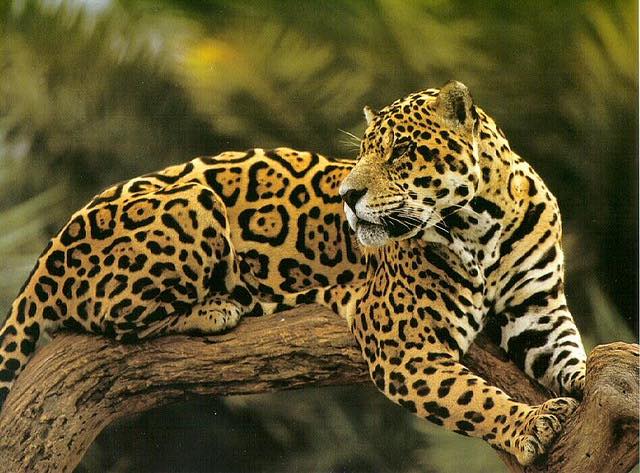
The jaguar population in Mexico increased by about 800 animals from 2010 to 2018, according to the first two censuses of the elusive carnivores ever conducted in the country. The news confirms that Mexico’s national strategy to protect jaguars is working, researchers reported recently in the journal PLOS One.
“It was incredible to see jaguars in so many places where there weren’t any before,” said ecologist Gerardo Ceballos of the Universidad Nacional Autónoma de México, founder of Mexico’s National Alliance for Jaguar Conservation and lead author of the paper.
The jaguar (Panthera onca), listed by the IUCN as Near Threatened, ranges from northern Mexico through Central America, the Amazon Basin, and into northern Argentina. Ecologists had never properly counted jaguars in Mexico before, making it difficult to design a conservation program in the iconic cat’s northernmost ranges. The alliance created by Ceballos and his colleagues used the results of the first Mexican jaguar census in 2010 to create a national strategy endorsed by government policy and scientists alike.
“This is very important,” said jaguar researcher Ronaldo Gonçalves Morato, head of the National Predator Center at the Instituto Chico Mendes de Conservação da Biodiversidade in Brazil, who was not involved in the study. “They are connecting science with conservation plans. It can be a good model for researchers—not only working with jaguars, but all the other big cats or other species that are critically endangered.”
Ceballos and a team of 20 ecologists spanning the country gathered data from photo capture traps to determine where jaguars lived and how many roamed in each of the country’s protected conservation regions. Then, they created a plan to tackle the most critical issues affecting Mexico’s jaguars: preserving wildlife corridors and sanctuaries; advocating for helpful laws and public policy; and avoiding or resolving conflicts with livestock owners.
For example, the government paid people living near protected areas to not deforest sanctuaries, compensated them for cattle losses from jaguar predation, and provided electric fences to prevent jaguars from killing livestock. The on-the-ground efforts paid off.
“Local people have been critical,” Ceballos told Mongabay. “When they have the funding and incentives to protect the forest, they become the most important ally.”
Ceballos expected jaguar populations to stay the same or decrease between 2010 and 2018. Instead, estimated numbers rose by 20%, from roughly 4,000 to 4,800 animals. Mexico’s Yucatan Peninsula hosts about 2,000 jaguars, with others spread throughout coastal and inland habitats across the nation. Brazil hosts the largest continuous jaguar habitat today, with an estimated population of more than 10,000 individuals
Moving forward, the National Alliance for Jaguar Conservation will focus on key threats, especially conflicts with humans and habitat loss.
Morato notes that other wildlife and ecosystems will benefit from these efforts.
“The jaguar is an umbrella species,” Morato told Mongabay. “They need a large amount of area, so if we need to protect a viable population of jaguars with at least 50 individuals, we are going to have many other species protected [within that area].”
In 2022, the Mexican government and the National Alliance for Jaguar Conservation plan to expand the Calakmul Biosphere Reserve in the southern Yucatan Peninsula from 723,185 hectares to more than 1.3 million hectares of land, making Calakmul the largest protected tropical forest north of the Orinoco River—all motivated by jaguar conservation.
“It’s very unusual that scientists can do all these things: research, outreach, conservation, and public policy,” said Ceballos. “And in Mexico we have been able to do that.”
(WATCH a jaguar and her cub in Mexico captured on camera.)
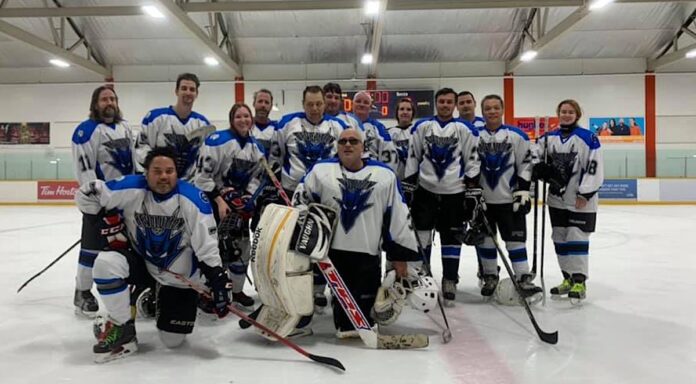
For recreation league athletes, there’s nothing worse than when one of your teammates drops out at the last minute. When a rec league ice hockey team in Edmonton needed a goaltender, they got a save from an unlikely hero.
Nelson Rego is 100% blind: and by filling in as goalie for an acquaintance’s team, he became the first ever blind player to play in a sighted team in the province’s history.
Rego plays blind ice hockey for the Edmonton “SeeHawks” and met another goaltender, John Hunter, inquiring online about gear modifications and a chest protector. Later Hunter got injured, and trying to help his team find a goalie for a league game, he reached out on the Edmonton Goalies Facebook page.
“This is low level stuff so beginners to pro welcome!!! DM me if you’re interested and we’ll get you set up,” wrote Hunter.
“Nelson calls me, and he kind of starts out with, ‘Hey, how’s the chest protector going?” Hunter later told Edmonton news about the remarkable story. “By the way, I’m not sure if this is a good idea or not but I saw your post for a goalie sub for your league game tonight. What do you think about me playing?’”
According to the players, they didn’t tell the referee until the puck drop that their goalie was blind—information with which he didn’t really what to do. In an interview with CTV Edmonton, Rego, who has also driven motorcycles and racecars since going blind, explains he keeps himself centered in the goal by measuring the distance between the posts with his stick and his glove.
After he uses sound to key into where the puck is and if it’s being challenged, all the while following audio instructions from his loving wife Emelinda, in the stands relaying the action.
The game was by no means a washout, and even though Rego’s team lost 9-8, he hung in there and earned the respect and admiration of the team.
“They made no accommodations for me,” Rego said. “It was just like being one of the guys on the team and that whole comradery thing that you get with a team that’s the thing that I really love the most.”
Hunter would later post on Facebook that “These are the nights where legends are born.”
“Good for him, he’s something; bragging rights,” said one spectator.
This remarkable night, “a childhood dream” as he would call it on Facebook, is just one step in his hockey career, as Rego also plays in the International Blind Ice Hockey Federation, and is sponsored by the Edmonton equipment outfitter Hockey Shop of Horrors.
“I’d say just go for it,” Rego says. “If it’s something you want to do, just do it. It’s amazing watching hockey, but it’s even better playing it.”
(WATCH the video for this story below.)
MELT Those Cold Feeds With Good News—Share This Story…
Ranchers in Australia are gradually allowing the “back end” of their animals to take care of their own back end when it comes to electricity costs by converting pig and cow excrement into fuel for biogas power plants.
“Piggeries” as they’re called in Australia, don’t have a reputation for clean or for green, but are now greener than vegetables as far as climate change is concerned, after concerted effort and investment from industry organizations and individual ranchers have turned pork into the second-lowest GHG producing agricultural source in the country.
Jock Charles operates Berrybank Piggery, and it was 27 years ago he started investing into waste-to-energy systems on his property where he rears 20,000 pigs at any given time. Traditionally, waste from pigs is collected and dumped into “effluent ponds,” where it’s treated with anaerobic bacteria to break it down.
Now Charles, who built a bio-digester, simply pumps it into a machine that operates in parallel to a pig’s stomach. There, bacteria breaks waste down into harmless manure, producing methane in the process. This methane is converted by a turbine into heat, which generates 90% of Berrybank’s electricity needs.
“We are producing about the same as we use, but during the day when we’re running the feed mill and a few other things, we are pulling some power in from the grid, and then in the evening, we export power,” Charles told ABC Australia.
Charles said it reduced energy costs by 90%, but that it also makes the piggery a much more pleasant place to work, as it provides a quicker disposal option for the 80,000 liters of liquid waste per day.
“Seventy per cent of odor from piggeries comes out of lagoons or ponds [that are used to store manure], so if you can eliminate the ponds, which we’ve been able to do, then you’re only dealing with 30 per cent [of the smell].”
A good neighbor
Biogas energy is transforming the Australian pork industry, with a study from the Grattin Institute showing that now only 2% of all ag-related emissions come from pork, which is less even than vegetable production. Furthermore, Australian Pork Limited, an industry research firm, says that 80% of all farm emissions can be reduced by using biogas, and that 16% of all piggeries in the country are now operating bio-digesters for manure management and for green energy generation.
But it’s not just piggeries that are benefiting from this manure-powered movement, and Mr. Charles actually helped a nearby dairy farm at Bungaree install their own bio-digester for the same reasons.
Mark Trigg runs a robotic dairy farm there, which produces tens of thousands of liters of manure which the bio-digester turns into enough electricity to cover half of the dairy’s demand.
Furthermore, Trigg and his parent company, Gekko Systems, which runs a gold mine of all things, are able to take the solids leftover from the process and turn them into fertilizer. Charles has been making fertilizer for years, and his bio-digester at Berrybank produces 20 different varieties currently sold on the market.
Gekko Systems, whose owner Sandy Gray loves farming and “ended up in mining by mistake,” believes the technology could be used on mining operations in remote locations. He’s looking at creating a shipping-container-sized model of the bio-digester and biogas engine for that purpose.
“We’ve got interest from a mining company in human waste, they’ve got communities they’ve got to deal with in remote areas,” he told ABC Australia.
It goes back to that old chestnut about one man’s trash, except in this case it’s one man’s waste is another man’s want.
NO Need to Waste the Good News—Share This Piece With Friends…
An innocent man who served 43 years in prison for a triple murder he did not commit was finally released from a Missouri penitentiary.
Missouri law states that only DNA evidence can lead to someone wrongfully imprisoned receiving $50 per day of post-conviction confinement. Kevin Strickland was not freed that way. So, to help him on his way, a GoFundMe campaign was launched—and it has raised $1.65 million from caring strangers.
Strickland was sent to prison in 1979, but has maintained his innocence for four decades. He was charged for the murder of three people, and an eyewitness, Cynthia Douglas, was pressured by police to pick Strickland out of a lineup, after he was arrested merely on a hunch.
He said he was watching television at the time, and no physical evidence ever linked him to the crime scene.
Ms. Douglas would later approach the Missouri Innocents Project with the desire to recant her testimony, but died before she was able to. Her children stated it was her will to see Strickland be freed, which prompted a re-examination of his case leading to his release.
Among the fundraiser’s contributors were moving messages of support.
Douglas Newel donated $25, saying, “Realizing how many people have contributed to this cause and reading through some of the messages has made my heart feel at least a little bit better. I hope it does the same for Kevin.”
“Look forward,” wrote William Elliot alongside his $100 donation. “Don’t allow yourself to be a prisoner of the past. You are now in charge of your life. Live boldly!”
‘Blackstone’s Ratio,’ written in 1760, says “the law holds that it is better that ten guilty persons escape than that one innocent suffer.”
U.S. Founding Father Benjamin Franklin took that principle further, turning 10 into 100—and in that spirit the fundraiser has seen 29,000 people step in to do their part, hoping to make up for the flaws in their society.