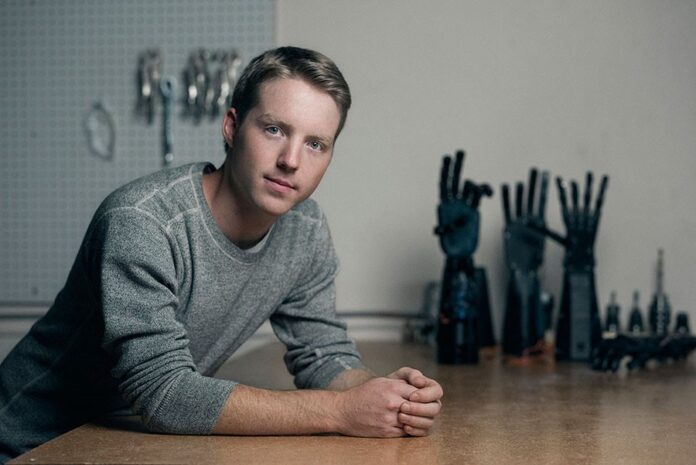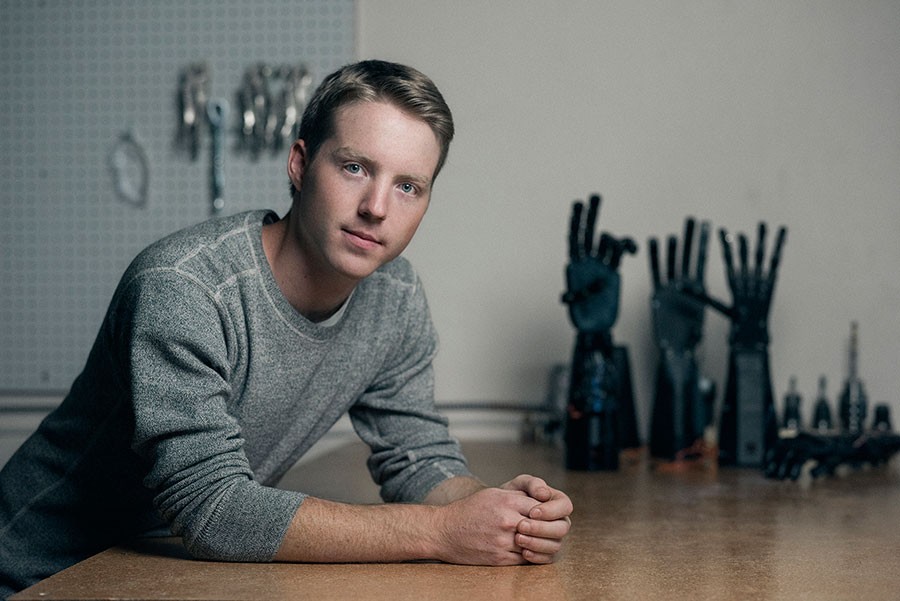











It didn’t take long for this San Francisco 12-year-old to invent his own solution for the problem of avoiding germs in public during the pandemic, which hit the city hard in early April.
Mizan Rupan-Tompkins saw his parents fumbling with their sleeves whenever they wanted to open a door, so he designed a hook-like tool and perfected the prototype on his 3D printer.
Called the Safe Touch Pro, it also has the ability to punch numbers on keypads, for whenever you are at the ATM, cash register, or gas stations.
“I really made it for my parents and now it’s helping everyone,” Mizan told KTVU News in San Francisco.
He’s not the first to dream up such a device, but he did his market research, and provided an upgrade: he makes his tool from plant-based plastic that is germ resistant.
“I wanted to make sure it was good for the environment—and the virus can’t survive on it,” he explained.
He was already an inventor of sorts, having built a computer and his own Alexa from scratch, along with an age-guessing robot that “can guess age, gender and emotions in seconds”.
He is now selling hundreds of the Safe Touch Pro on his website, with dozens of new orders daily at $14.99 each.
Home-schooled for the past 3 years, with an eye toward a career in aviation, aeronautical design, or technology, this inventive boy is bound to reach the sky.
(Watch the local coverage below…) –Photo via Facebook
SHARE the Prevention Tool With Your Friends on Social Media…
Need more positive stories and updates coming out of the COVID-19 challenge? For more uplifting coverage, click here.
The U.S. National Highway Traffic Safety Administration today released preliminary estimates for the 2019 data on highway crashes, which showed a continued decline in traffic fatalities. The federal agency previously reported declines in traffic deaths during 2018 and 2017, and these latest estimates continue the downward trend.
“Safety is our top priority so this report that traffic fatalities appear to have decreased again for the third year is great news,” said U.S. Transportation Secretary Elaine L. Chao.
Fatalities decreased in most major traffic safety categories:
Overall, this represents an estimated decrease of about 440 deaths, down 1.2% over the reported 36,560 fatalities in 2018—even though traffic miles rose almost 1%.
If these estimates are reflected in the final data, the fatality rate per 100-million-miles-traveled would be the second lowest since NHTSA started recording fatal crash data.
This new data also shows that nine out of 10 regions across the country have experienced the downturn in deaths in 2019.
Last year, the Department established an intermodal truck and bus working group that focuses on increasing safety and reducing truck and bus-related crashes.
And, NHTSA has accelerated its efforts to continue the decline of traffic fatalities. In February, NHTSA released $562 million in grants for highway safety programs to the Offices of Highway Safety in all 50 states, the District of Columbia, U.S. territories, and the U.S. Department of the Interior’s Bureau of Indian Affairs. The grants were issued to help state and local law enforcement agencies enhance their traffic safety efforts to combat risky driving behaviors.
(Source: U.S. Department of Transportation) – Photo by Xan Griffin
Two-thirds of Americans have had an “eco wake-up call” since the start of the COVID-19 pandemic, according to a new survey.
A poll of 2,000 Americans revealed 64% have had a moment since the pandemic started wherein they realized they needed to be more eco-friendly.
This might be a result of paying closer attention to their lifestyles—70% said being home more due to COVID-19 made them more aware of their eco-unfriendly behaviors. These eco wake-up calls included becoming more aware of wasting food (44%), using paper products more sparingly (43%) and being more careful about where they buy meat (38%).
While these behaviors might have been influenced by the pandemic, however, they aren’t going away when COVID-19 does.
Commissioned by Avocado Green Mattress and conducted by OnePoll, the survey found 81% of respondents plan to keep their newfound eco-friendly habits.
The top way they’re doing this is by continuing to recycle more often (55%), followed by continuing to reduce the amount of paper products they use (44%).
Furthermore, 42% of those surveyed plan to work from home one day per week, instead of commuting, in order to reduce their carbon footprint. In fact, another survey found that working from home has so many benefits, that 48% of workers would even take a pay cut to continue indefinitely.
More than that, respondents also plan to continue composting more often (37%) and take public transportation more frequently (35%).
Those aren’t the only habits respondents are picking up right now: One-third (32%) plan to continue wearing a face mask even after receiving the “all-clear” from the CDC.
“We’re living in unprecedented times,” said Mark Abrials, co-founder and Chief Marketing Officer of Avocado Green Mattress. “Now, more than ever, we’ve been presented with an opportunity to reflect on and reassess our current way of living as a society, and help make strides towards adopting more thoughtful, sustainable habits.”
COVID-19 hasn’t just changed our habits, but the survey found it’s also affected the way we think about the world.
Results revealed 79% of respondents have been thinking more about the connectedness of people and the planet as a result of COVID-19.
“Through this crisis, it has become undeniably apparent how connected our own health is to the health of our planet,” said Abrials. “We truly are all in this together, on a global scale, and even the smallest actions add up to create meaningful change.”
ECO-FRIENDLY CHANGES RESPONDENTS HAVE MADE SINCE COVID-19 STARTED
1. Reduced the amount of food they’re wasting 44%
2. Used paper products more sparingly 43%
3. Been more careful of where they buy meat 38%
4. Shopped more sustainably 36%
5. Recycled more often 36%
6. Reduced my water usage 35%
7. Video chatting instead of traveling to see friends and family 29%
8. Reduced my commute 28%
9. Used time to read books instead of solely streaming shows 25%
10. Started using a community garden—or their own garden 19%
Need more positive stories and updates coming out of the COVID-19 challenge? For more uplifting coverage, click here.
Plant Some Positivity Amongst Your Friends By Sharing The Inspiring Survey To Social Media…
Quote of the Day: “Age and glasses of wine should never be counted.” – Italian proverb
Photo: by cottonbro, public domain, cropped
With a new inspirational quote every day, atop the perfect photo—collected and archived on our Quote of the Day page—why not bookmark GNN.org for a daily uplift?
With greenhouse gas emissions set to decline a record-breaking 8% this year, a happy accident of the novel coronavirus pandemic has been its positive impact on cities.
The World Health Organization says walking and cycling are considered the safest means of transport to reduce exposure to COVID-19. So cities around the world have been building new cycling paths and scaling up their car-free street initiatives.
Now, it looks like many of these environmentally-friendly changes will be permanent
Bogotá, Colombia had a head start when the virus began to spread in the city in mid-March. The city had an existing tradition, called la Ciclovía, where it closed its main roads to cars every Sunday. Mayor Claudia López decided to scale the program up, and according to one report, “within days, Bogotá opened nearly 47 miles of new temporary bike routes, adding to 340 miles of paved protected paths, and converted almost 17 miles of automobile lanes to bike routes overnight.”
For years, Paris has been a leader in the car-free streets movement. Now the capital city is building 650 kilometers (about 400 miles) of new “corona cycleways.” Mayor Ann Hidalgo has said many of these will be made permanent as part of the city’s larger mobility plan. Among other initiatives, the city has accelerated construction of dedicated cycle highways in response to the pandemic, according to the BBC.
In Italy, the city of Milan has announced that over 20 miles of newly installed cycling infrastructure will be kept in place after the quarantine has been lifted. Former New York City Transportation Commissioner Janette Saik-Kahn, who is working with the Italian city on the transition, told the British news outlet, “The pandemic challenges us, but it also offers a once-in-a-lifetime chance to change course and repair the damage from a century of car-focused streets.”
The city of Budapest, Hungary has also constructed temporary cycle lanes. Though they are currently due to last until September, the city has signaled a preference to leave them in place. “We are constantly monitoring the use of the temporary bike lanes, and we are hoping that a good many of them could remain in place,” the mayor’s chief of staff Samu Balogh added. “In the long term, we are working towards implementing traffic-calming measures and new bike lanes so we can create a more inviting environment for cycling and walking.”
In France, it’s not just Paris that is focusing on two wheels. The country’s Minister of Ecological Transition also announced a $22 million plan to support cyclists nationwide. Under the plan, all French citizens will be entitled to 50 euros ($55) in free bicycle repairs, paid for by the government. The program will also fund plans by cities to build more permanent bike racks, bike lanes, and cycling classes.
These initiatives, and many more eco-silver linings, have given hope to those who have seen the pandemic as an opportunity to make lasting changes to the way humans relate to the natural environment.
“We must act decisively to protect our planet from both the coronavirus and the existential threat of climate disruption,” UN Secretary General António Guterres said on Earth Day. “We need to turn the recovery into a real opportunity to do things right for the future,” noting that—like the coronavirus—climate change knows no national borders.
Cycle This Exciting News Over To Your Friends By Sharing It To Social Media…
Need more positive stories and updates coming out of the COVID-19 challenge? For more uplifting coverage, click here.
Nursing home holds a mock wedding to pass the time. – Valerie Martin
When the COVID-19 shadow loomed large over France, the staff of a nursing home for seniors near Lyon, go to the website to get more information about this place, they have resolved that they would not allow their residents to become statistics—so they did what no one else was doing.
Valerie Martin runs the home in Corbas, where she cares for 106 people. When she heard what the coronavirus was doing to elderly people across Europe, she resolved that drastic action was needed to protect her residents.
“I said, ‘No. Not mine. My residents still have so much to live for,’” Martin told AP.
She decided to completely close the building, and invited staff members and nurses to join her in lockdown for what she thought would be a three-week quarantine. Fortunately Valerie wasn’t alone in her heroics, as 29 of her employees volunteered to stay, bringing pillows and sleeping bags to spend nights with mattresses on the floor.
It turned into a marathon of 47 days and nights, but 12 staff members remained the entire time. Their determination paid off, and on Monday May 4th, amid hugs of celebration and singing, coronavirus tests came back negative for all 106 residents.
Nurse with residents in front of the daily tally board – All photos, Valerie Martin
“We succeeded,” Martin said. “Every day, every hour, was a win.”
The caregivers who called themselves the “happily confined” left in a parade of cars honking horns on their way back to reunions with pets, partners, and children.
A Holiday Camp
“It was tough,” caregiver Vanessa Robert told AP. But there were also moments of “total joy, getting together in the evenings, fooling around, tossing water bombs at each other.”
They even planned a pretend wedding, as depicted in the photo below.
Nursing home holds a mock wedding to pass the time. – Valerie Martin
Because staff and residents of Vilanova were all locked in together—separated from another part of the facility where outside staff members would bring in food and supplies—there was no need to confine seniors to their lonely rooms.
After the start of France’s lockdown on March 17th, Martin saw that many residents were falling into depression during their first days in isolation, while the staff gave the home a deep cleaning.
“In two days, we already saw people who started no longer wanting to eat, people who didn’t want to get up, people who said, ‘Why are you washing me? It’s pointless,’” she told the AP.
However, once there were again communal games and meals, everyone stayed in good spirits for the whole 47 days.
When the national average of new cases fell dramatically and the doors at Vilanova were unlocked, Valerie Martin, who finally went home to her likely-distraught cat, was hailed a hero in newspapers around the world for her efforts. But it wasn’t a huge sacrifice in the end.
With a population of 1.2 billion people, any news of renewable energy success in India is a cause for celebration. One would undoubtedly expect to see decreasing carbon emissions due to widespread travel reductions due to COVID-19 prevention measures, but a further analysis shows us that coronavirus doesn’t get to take all the credit, and the unholy trinity of oil, coal and gas seems to be on the downward slide.
In a report from carbonbrief.org, daily statistics on energy consumption and power plant activities demonstrate that India’s total year–over–year emissions has, for the first time in 4 decades, fallen.
The country’s CO2 emissions fell by 15% in March, and 30% in April, in what could primarily be attributed to COVID-19 measures. However for 12 months, the rate at which Indians were demanding more power slowed drastically, and it was the March shutdowns that capped the new growth of power generation from oil, coal and gas below zero for the first 12-month period in 30 years (falling 1%).
Moreover, in March, when coal-fired power generation fell by 15% it was married with a 6.7% increase in use of renewable energy. These were also joined by a year-by-year fall in total coal deliveries, both imported and domestic—the first of such demand drops in 20 years.
This was despite the fact that more coal was mined in India this fiscal year than last year, indicating that the slowdown is not due to limited supply but a milder demand for coal as an energy source.
Production for other fossil fuel energy sources is also falling, with fiscal year 2019-20 seeing a drop in crude oil production of 5.9% and natural gas of 5.2%.
Twilight of Indian Coal?
Good News Network has reported extensively already this year about such market forces pushing coal use, and in some cases oil use, to the point of complete and total unprofitability—not just in countries like Sweden, but in the U.S. India, and China.
Coal is becoming less and less profitable in India, and a recent energy contract auction—used by public sector planners to encourage private energy development, investment, and production—secured 2,000 megawatts per hour of solar energy at a price of $34 per hour. In contrast, oil over the same time period, when the contract was awarded, was costing $45 per hour.
According to a report from Carbon Tracker entitled “How to Waste Half a Trillion Dollars” economists warn that half a trillion in coal-plant investments around the world are at risk of becoming so unprofitable in the future as to totally impair the repayment of any investment dollars, as it is already 50% more expensive to operate an Indian coal-fired power plant than renewable sources. This number will rise to 100% by 2030.
India recently began setting records for cleaner air, and now it seems the country is leaping on the opportunity to keep it going.
This is just one of many inspiring stories and updates that are coming out of the COVID-19 news coverage this week. For more uplifting coverage on the outbreaks, click here.
Multiply The Good News By Sharing It With Your Friends On Social Media…
South Africa has seen a 75% drop in violent crime during the coronavirus pandemic. Now, rival gang members in Cape Town are teaming up to collect and distribute food and essential goods to those in need.
“What we’re seeing happen here is literally a miracle,” Andie Steele-Smith, a pastor who works with gang members in the community, told BBC News.
Before the pandemic, South Africa had some of the highest violent crime rates on the continent. But now, new circumstances have created changes that are leading to a silver lining.
The government has imposed some of the toughest quarantine rules in the world, including banning alcohol and cigarette sales. The economy has taken a beating—and the gang members were feeling the effects as much as anybody else.
“I got a phone call from two gang leaders, both saying ‘Andie, I’ve never asked you for anything but we are starving’,” the Australian-born pastor told BBC News. “And I just thought if these guys are starving—they are at the top of the food-chain—the rest of the community is going to be in serious, serious strife.”
Andie hatched a plan that would not only meet the needs of the community in the moment, but also show these young people a new sense of purpose in the world. He asked members who would normally be trying to kill each other to work together toward a common goal: providing food and vital supplies, such as soap, to those in need.
Preston Jacobs, a member of the “Americans” gang, told the BBC it “feels nice” to be doing something positive for the community. “Now I see there are nice people also, and people want to love what we’re doing now.”
Andie Steele-Smith
Sansi Hassan of the “Clever Kids” gang expressed hope that the truce would become permanent, saying: “If it can stay like this, then there will be no gang fight,” he said. “And every gang will agree with us.”
Andie, a former banker who moved from Sydney to South Africa to become a pastor five years ago, expressed pride in what these young men are doing. “I’m proud of you guys. Literally, if I died today and went to heaven I would die a happy man.”
(WATCH the BBC video below)
Need more positive stories and updates coming out of the COVID-19 challenge? For more uplifting coverage, click here.
MULTIPLY the GOOD, By Sharing It With Your Friends On Social Media…
Quote of the Day: “Opportunities to find deeper powers within ourselves come when life seems most challenging.” – Joseph Campbell
Photo: by Warren Wong, public domain, cropped
With a new inspirational quote every day, atop the perfect photo—collected and archived on our Quote of the Day page—why not bookmark GNN.org for a daily uplift?
Young Arlo playing with his neighbor Leo through their perspex window. SWNS.
SWNS
These young BFFs who live next door from each other in England can finally play together again from quarantine after one of their crafty moms turned a section of their garden fence into a perspex window.
Since the novel coronavirus forced their families into self-isolation, 3-year-old Arlo and 2-year-old Arabella Devonport had been missing their pal Leo Adlington, who lives next door to their home in Wakefield, Yorkshire.
As a means of uniting the kids while still respecting social distancing guidelines, the siblings’ mom, 27-year-old Amy Vickers, came up with the idea of cutting a hole out of their shared backyard fence and installing a transparent window.
“Arlo and Arabella have been finding it hard not seeing anyone during lockdown,” said Vickers. “It got to the point where they were climbing on top of the rabbit cage that we have next to the fence so they could see over it into the neighbor’s garden—which is clearly dangerous.
“Instead of them climbing up, we decided to make them a little window so they would be able to stand there and see their friend next door.”
After Leo’s mum agreed, they set to work.
Arlo and Arabella. SWNS.
“We measured the fence and then ordered a perspex panel on eBay, cut into the fence panel with a circular saw, and drilled some holes in each corner so we could screw some screws into it to hold it in place,” says Vickers.
“We also bought wipe board markers so they now draw pictures on it and we’ve been teaching them to play naughts and crosses on it as well.
“The kids are at the window all day every day when we are at home so I guess they love it!” the mom concluded.
This is just one of many inspiring stories and updates that are coming out of the COVID-19 news coverage this week. For more uplifting coverage on the outbreaks, click here.
Arlo and Leo. SWNS.
Multiply The Positivity By Sharing This Sweet Story With Your Friends On Social Media…
Gemini Solar Project — Photo by Quinbrook Infrastructures
The US government has just approved the construction of what will be the largest solar project in the nation and the 8th largest in the world.
This week, the Department of the Interior (DOI) and the Bureau of Land Management (BLM) announced the approval of a proposal to construct and operate a 690-MW photovoltaic solar electric generating facility in Nevada about 30 miles northeast of Las Vegas.
US Secretary of the Interior David L. Bernhardt signed the Record of Decision (ROD) for Solar Partners XI, LLC to construct the estimated $1 billion Gemini Solar Project expected to generate enough electricity to power 260,000 homes in the Las Vegas area and potential energy markets in Southern California.
The on-site construction workforce is anticipated to average 500 to 700 construction workers, with a peak of up to 900 workers at any given time, supporting up to an additional 1,100 jobs in the local community and injecting an estimated $712.5 million into the economy in wages and total output during construction.
The project is expected to be constructed in two phases. The first phase of power could come on-line in 2021 with final completion as early as 2022. Federal revenues are expected to be more than $3 million annually to the US Treasury.
The project is also expected to generate renewable electricity that would annually offset greenhouse emissions of about 83,000 cars (384,000 metric tons of carbon dioxide equivalent). Although the ROD included several operational stipulations to reduce the facility’s impacts on native vegetation and wildlife, such as the desert tortoise, extensive long-term monitoring will be required in order to examine additional adaptation methods that could be used to reduce potential environmental impacts.
“Despite the challenges of the coronavirus, we’re pleased to see that Nevada will soon be home to one of the biggest solar projects in the world,” said Abigail Ross Hopper, President and CEO of the Solar Energy Industries Association. “The solar industry is resilient and a project like this one will bring jobs and private investment to the state when we need it most.”
The Gemini facilities are set to be built and managed by Australia’s Quinbrook Infrastructure Partners and California-based Arevia Power across up to 7,100 acres of land.
“We are very pleased to have reached a satisfying and final seal of approval from the Department of the Interior and the Bureau of Land Management so that we can now take Gemini forward with confidence,” said David Scaysbrook, Co-Founder and Managing Partner of Quinbrook. “This final decision officially clears the pathway for Quinbrook, and our development partners at Arevia, to accelerate completion of detailed project designs and procurement plans for one of the world’s largest renewables projects ever undertaken.
“Gemini offers the opportunity to showcase, at an unprecedented scale, what we believe to be one of the most promising technological advances in coupling battery storage to utility scale solar power to produce low cost renewable energy over the long term,” he added. “Gemini will benefit all Nevadans by supporting jobs, stimulating the local economy and capturing the state’s abundant solar resources to deliver low-cost, renewable power to NV Energy customers.”
Gemini Solar and Battery Storage site in Nevada — Photo by Quinbrook Infrastructures
Power Up With Positivity By Sharing The Exciting News With Your Friends On Social Media…

This little critter may only be 8 months old, but that hasn’t stopped him from raising thousands of dollars for charity.
Over the course of just two and a half weeks, Bandit the pet ferret managed to complete a full marathon by taking the challenge in his tiny stride and completing several miles per day alongside his owners.
Jim and Arabella Wood took Bandit out for a walk with their kids each day to raise money for The London Children’s Book Project and the At The Bus art charity.
Both organizations are putting together bundles of books and creative resources that will be handed out to thousands of young people in the Oxfordshire area.
SWNS
“Children in disadvantaged areas are being badly hit [by the pandemic] as they can’t go to school and haven’t got the devices to learn online,” said Jim. “We need to get these bundles to kids who wouldn’t otherwise be able to access books.
Their effort began on what should have been the day of the London Marathon as part of the “2.6 Challenge” for UK citizens to run 2.6 miles for charities—but when Bandit showed no signs of tiring, the family decided to go for the full 26.2 miles.
Since the furry athlete completed his mission earlier this week near The Ridings in Oxford, England, his Just Giving crowdfunding campaign managed to raise roughly £2,200 ($2,700), which is expected to help distribute more than 12,000 books to low-income homes.
Photo by the Wood family
“The little guy is making a great effort for an animal that doesn’t do straight lines,” said Jim. “He seems to love it and is getting a lot of attention—from a distance—from other people out getting their exercise. You can see people trying to work out what he is.
“It’s good to be doing something to help which also makes people smile,” he added. “Our concern is that Bandit will think this is ‘the new normal’ and we will have to carry on doing this every day.”
Multiply The Good News By Sharing This Story With Your Friends On Social Media…
As more and more Americans file for unemployment amidst the novel coronavirus shutdowns, the Headspace meditation and mindfulness service is offering up its services to those who may need it most.
This initiative is part of the company’s newly-created “Headspace Promise” campaign to care for the mental health of communities at risk of suffering from increased stress and anxiety, particularly since the COVID-19 crisis began. In addition to offering free subscriptions for US, UK, and French healthcare providers on the frontlines of the pandemic, the company is also offering up their free services to K-12 educators in the United States, Canada, Australia, and UK.
Headspace has also announced partnerships with New York Governor Andrew Cuomo and Michigan Governor Gretchen Whitmer to provide free Headspace content to residents.
“While meditation and mindfulness can’t change our circumstances in life, it can help us change our perspective on those circumstances. And, now more than ever, that’s an incredibly powerful skill to learn,” said Headspace CEO and co-founder Rich Pierson. “As a company dedicated to improving the health and happiness of the world, we take our responsibility to help support people’s mental health very seriously. It’s our promise today and for whatever tomorrow brings.”
Americans who are unemployed can visit the company’s website in order to register for their free Headspace Plus subscription and unlock access to more than 1,200 hours of meditation and mindfulness content including sleep, kids, and mindful movement exercises. In addition to the content in its existing library, Headspace will also be launching six new meditations under a featured collection called “Living through unemployment.”
Available May 18th, this collection will include meditations such as: “Adapting to sudden change,” “Sadness and loss,” “Recovering confidence,” and “Finding purpose.”
“Job loss can have a substantial negative impact on people’s self-efficacy as well as their sense of control, which are two important anchors of mental health,” said Headspace Chief Science Officer Dr. Megan Jones Bell. “As a company committed to advancing the field of mindfulness and meditation through clinically-validated research, we know that Headspace meditations have been shown to have favorable outcomes of interventions on key measures like reduced stress, reduced irritability, decreased aggression, and increased resilience. These are really powerful markers in demonstrating how we can support the mental health of those experiencing job loss.”
This is just one of many inspiring stories and updates that are coming out of the COVID-19 news coverage this week. For more uplifting coverage on the outbreaks, click here.
Representative file photo by Michiexile, CC
Give Your Friends The Gift Of Mindfulness—And Good News—By Sharing This To Social Media…
More than 400 California college graduates were left overwhelmed with joy and surprise earlier this week after they were told that anonymous donors had paid off their student debt.
The unidentified benefactors paid off the debt by donating more than $8 million to Students Rising Above (SRA), a San Francisco-based nonprofit organization that helps send low-income, first-generation college students through college and provide them with personal guidance, mentoring, internships, and career guidance.
Despite how 100% of SRA students are from low-to-moderate incomes and 62% are living below the federal poverty line, however, the average SRA grad finishes school with $8,000 in debt.
“With student loans increasingly becoming a financial burden, SRA is grateful for the opportunity to facilitate relief to our hardworking alumni who have become highly productive members of the workforce nationwide,” said SRA CEO Elizabeth Devaney, who informed the grads of their relieved debts in a Zoom call this week.
Kimberly Armstrong, who owed $300,000 in law school debts, is just one of the SRA students who has now been freed from the financial burden thanks to the generous donation. She told KPIX: “It’s a shock; it’s amazing; it’s a relief, though … Literally, it’s a weight lifted.”
Dr. Zachary Tabb, who owed $160,000 in medical school debt, agreed with the sentiment.
“It’s life changing. I’ve had debt … really my entire adult life. And so it’s just something that—everywhere you go—it follows you,” he told reporters. “It’s really a generational impact. To completely un-burden myself and all of them … has a real multiplicative effect … not only on [my fellow SRA scholars’] lives, but on the contributions they can make to society.”
(WATCH the heartwarming coverage below — or our international viewers can watch the video on the CBS News website)
Be Sure And Share This Inspiring Story Of Kindness With Your Friends On Social Media…
Quote of the Day: “To get up each morning with the resolve to be happy is to set our own conditions to the events of each day.” – Ralph Waldo Emerson
Photo: by Saksham Gangwar, public domain, cropped
With a new inspirational quote every day, atop the perfect photo—collected and archived on our Quote of the Day page—why not bookmark GNN.org for a daily uplift?
It’s been 14 years since the final performance—but now 160 former Disneyland Paris cast members living all over the world have dusted off their dancing shoes in quarantine to present, one more time, The Wonderful World of Disney Parade.
Three weeks ago, Mat Davies was sitting at home, having exhausted Netflix and Disney Plus, looking for the next thing to pass away the time.
Feeling nostalgic, Mat told GNN, he started reminiscing about old times working at Disneyland Paris, and looking through old photos.
“Seeing photos of me dancing in the parade with so many great people, I decided to set up a Facebook group to see if there would be any interest in creating a lockdown version of ‘The Wonderful World of Disney Parade’ which ran at Disneyland Paris from 1998 to 2007.”
After initially contacting about 80 people, there seemed to be some interest and the group began to grow in membership. Today, the group has over 1,200 members, all of them former Disneyland-Paris parade performers reliving happy memories, sharing stories and photos, and reconnecting with old friends.
Photos submitted by Mat Davies
“Some of them haven’t seen or spoken to each other in almost 20 years!”
One member said, “This was the group that none of us knew we needed.”
Over 160 videos were sent in to Mat for him to expertly compile them into a single spectacular virtual parade.
They all knew the choreography of the same dance because the parade song, Dancin’ A Catchy Rhythm, was played throughout the park on loudspeakers, so no matter which parade float you were accompanying—Mary Poppins, Micky Mouse, or Aladdin—all the chimney sweeps, sailors, and genies were on the same beat.
See a clip of the original parade, and continue reading below…
One of the new videos was sent in by dancer David Mitchell from his home in Brighton, England. You can see him near the beginning (and later on) waltzing elegantly with a female partner who looks like she, too, had performed the moves hundreds of times. Had they met at Disneyland?
Yes, Alice and David originally met as cast members at the theme park in 2006, but he left soon afterward. Coincidentally, both ended up back at Disneyland Paris four years later, where they fell in love while working together again in the parade department.
“We got married in 2015,” Mitchell told GNN. “We now have 2 handsome boys—and it’s all thanks to Disney.”
“We were really lucky, as Alice and I got to perform together again in this video for the first time since 2013, which brought back lots of amazing memories.”
“This group is a big family who had lost touch and, thanks to Mat, he has brought us all together. Literally people are now chatting everyday to each other. It is so lovely to see and I feel so honored to be part of this special family.”
WATCH the truly heartwarming video below—and don’t forget to share…
Masks, gowns, and other personal protective equipment (PPE) are essential for protecting healthcare workers—however, the textiles and materials used in such items can absorb and carry viruses and bacteria, inadvertently spreading the disease the wearer sought to contain.
When the coronavirus spread amongst healthcare professionals and left PPE in short supply, finding a way to provide better protection while allowing for the safe reuse of these items became paramount.
Thankfully, researchers from the LAMP Lab at the University of Pittsburgh Swanson School of Engineering may have a solution. The lab has created a textile coating that can not only repel liquids like blood and saliva but can also prevent viruses from adhering to the surface. The work was recently published in the journal ACS Applied Materials and Interfaces.
“Recently there’s been focus on blood-repellent surfaces, and we were interested in achieving this with mechanical durability,” said Anthony Galante, PhD student in industrial engineering at Pitt and lead author of the paper. “We want to push the boundary on what is possible with these types of surfaces, and especially given the current pandemic, we knew it’d be important to test against viruses.”
What makes the coating unique is its ability to withstand ultrasonic washing, scrubbing and scraping. With other similar coatings currently in use, washing or rubbing the surface of the textile will reduce or eliminate its repellent abilities.
“The durability is very important because there are other surface treatments out there, but they’re limited to disposable textiles. You can only use a gown or mask once before disposing of it,” said Paul Leu, co-author and associate professor of industrial engineering, who leads the LAMP Lab. “Given the PPE shortage, there is a need for coatings that can be applied to reusable medical textiles that can be properly washed and sanitized.”
Galante put the new coating to the test, running it through tens of ultrasonic washes, applying thousands of rotations with a scrubbing pad (not unlike what might be used to scour pots and pans), and even scraping it with a sharp razor blade. After each test, the coating remained just as effective.
The treatment consists of polytetrafluoroethylene (PTFE) nanoparticles in a solvent thermally sintered to polypropylene microfibers. PTFE is stable and nontoxic at temperatures lower than 260 °C (500 °F).
The researchers worked with the Charles T. Campbell Microbiology Laboratory’s Research Director Eric Romanowski and Director of Basic Research Robert Shanks, in the Department of Ophthalmology at Pitt, to test the coating against a strain of adenovirus.
“As this fabric was already shown to repel blood, protein and bacteria, the logical next step was to determine whether it repels viruses. We chose human adenovirus types 4 and 7, as these are causes of acute respiratory disease as well as conjunctivitis (pink eye),” said Romanowski. “It was hoped that the fabric would repel these viruses similar to how it repels proteins, which these viruses essentially are: proteins with nucleic acid inside. As it turned out, the adenoviruses were repelled in a similar way as proteins.”
The coating may have broad applications in healthcare: everything from hospital gowns to waiting room chairs could benefit from the ability to repel viruses, particularly ones as easily spread as adenoviruses.
“Adenovirus can be inadvertently picked up in hospital waiting rooms and from contaminated surfaces in general. It is rapidly spread in schools and homes and has an enormous impact on quality of life—keeping kids out of school and parents out of work,” said Shanks. “This coating on waiting room furniture, for example, could be a major step towards reducing this problem.”
The next step for the researchers will be to test the effectiveness against betacoronaviruses, like the one that causes COVID-19.
“If the treated fabric would repel betacornonaviruses, and in particular SARS-CoV-2, this could have a huge impact for healthcare workers and even the general public if PPE, scrubs, or even clothing could be made from protein, blood-, bacteria-, and virus-repelling fabrics,” said Romanowski.
At the moment, the coating is applied using drop casting, a method that saturates the material with a solution from a syringe and applies a heat treatment to increase stability. But the researchers believe the process can use a spraying or dipping method to accommodate larger pieces of material, like gowns, and can eventually be scaled up for production.
While many people have been left twiddling their thumbs for the duration of the novel coronavirus shutdowns, this 11-year-old athlete took advantage of his free time spent in quarantine to make skateboarding history.
This week, Gui Khury became the first skateboarder to ever land a 1080-degree turn on a vertical ramp.
For perspective, the Brazilian youngster had not even been born when 22-year-old Tony Hawk completed the first 900-degree turn back in 1990. Gui completed his first 900-degree turn at just 8 years old.
Now two decades after Hawk’s accomplishment, Gui says he was able to complete the jaw-dropping 1080-degree feat by using his time off from school amidst the pandemic to train. Upon expertly landing the triple-turn earlier this week, Gui says he could hardly comprehend his achievement.
“I was like, oh my God, what did I just do?” Gui Khury told Reuters. “I was just like OK, I landed it. Now I am going to celebrate.”
Gui later told reporters that he celebrated by sharing a bowl of macaroni and cheese with his family.
(WATCH the amazing video below)
Be Sure And Share This Gnarly Story With Your Friends On Social Media…
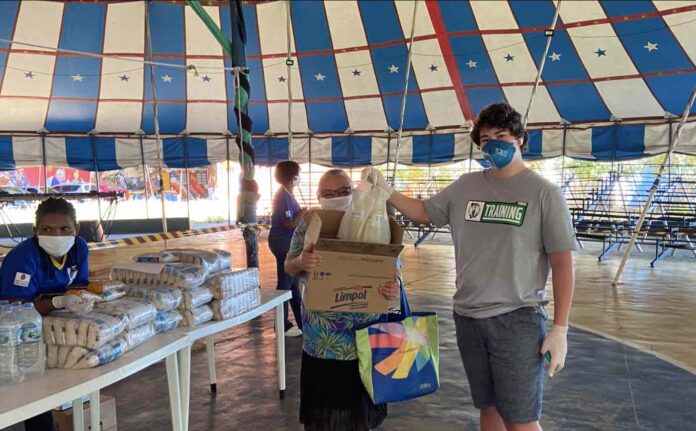
This week’s star-studded “Rise Up New York!” virtual telethon hosted by comedic icon Tina Fey helped to raise more than $115 million for New Yorkers whose lives have been dramatically impacted by COVID-19—and the actress could hardly contain her emotions over the outpouring of support.
Robin Hood, New York’s largest poverty-fighting organization, and iHeartMedia joined together this week to air the citywide “virtual telethon” to raise funds for Robin Hood’s relief and recovery efforts to help fellow New Yorkers rebuild their lives in the wake of the COVID-19 economic shutdown.
One hundred percent of donations raised are being deployed directly to the front line organizations providing food, shelter, cash assistance, health and mental health, legal services, education, and other supportive resources.
Figureheads from across New York’s most beloved entertainment industries all participated in the telethon that was broadcasted across different radio and television channels, as well as several Time Square billboards. The special opened with Robert de Niro reminding COVID-19 that NYC has recently been attacked several other times, and that the virus “can take its best shot, but it cannot break our spirit.”
David Chang and other figures of the New York City restaurant industry talked about its importance both as a cultural and economic sector for the city. Several musical performances were broadcast from artists like Mariah Carrie, Billy Joel, and Sting.
Broadway stars joined Barbara Streisand in lamenting the closure of NYC theaters, and reminded New Yorkers of their iconic productions’ places in the history of the city.
Sports stars like Michael Strahan and Eli Manning announced a contest whereby donators can win a game of touch football with the New York Giants.
New York City faith leaders Rev. Dr.Terry Troia, and Queens’ Swami Durga Das were also highlighted for their charitable work with helping homeless and disadvantaged communities.
The benefit closed with Governor Andrew Cuomo surprising viewers by introducing a special performance of “Miami 2017” by Billy Joel, which took over 13 of Times Square’s iconic digital billboards. At the same time, the Empire State Building debuted a choreographed lighting spectacle that will repeat at 9PM EST every night throughout this week.
This is just one of many inspiring stories and updates that are coming out of the COVID-19 news coverage this week. For more uplifting coverage on the outbreaks, click here.
(WATCH the tear-jerking video announcement below)
Multiply The Good News By Sharing It With Your Friends On Social Media…
Pedestrians all over the world are being encouraged to loosen up on their daily strolls through their neighborhoods by showing off their best silly walks reminiscent of the iconic Monty Python sketch from 1970.
Homeowners from Michigan to Ontario have been erecting signs in their front yards asking passerby to strut their goofy stuff similarly to the original “Ministry for Silly Walks” comedic sketch.
This is not the first time that Monty Python fans have implemented their own real-world silly walk directives; back in 2014, a town in Norway published a now-viral montage of local pedestrians busting a move in front of their own public silly crosswalk sign.
Now amidst the novel coronavirus outbreaks, people like Liz Koto in Detroit have been encouraging people to find joy in these turbulent times by showing off their best silly walks.
Since putting up the “jurisdiction of silly walk” signs in her yard several weeks ago, she has launched an Instagram page dedicated to sharing the dozens of amusing walks that have been captured by her doorbell camera.
Cynda Fleming told CTV News that her own silly walks sign in Leaside, Toronto has resulted in a similar source of endless entertainment, which she says is “better than Netflix”.
“I just wanted to do this to bring some positivity into this crazy situation we’re in right now and it just, I think, gives permission for people to be positive and silly,” she told the news outlet.
This is just one of many inspiring stories and updates that are coming out of the COVID-19 news coverage this week. For more uplifting coverage on the outbreaks, click here.
(WATCH the CTV interview below)
Be Sure And Share This Amusing Story Of Fun With Your Friends On Social Media…