












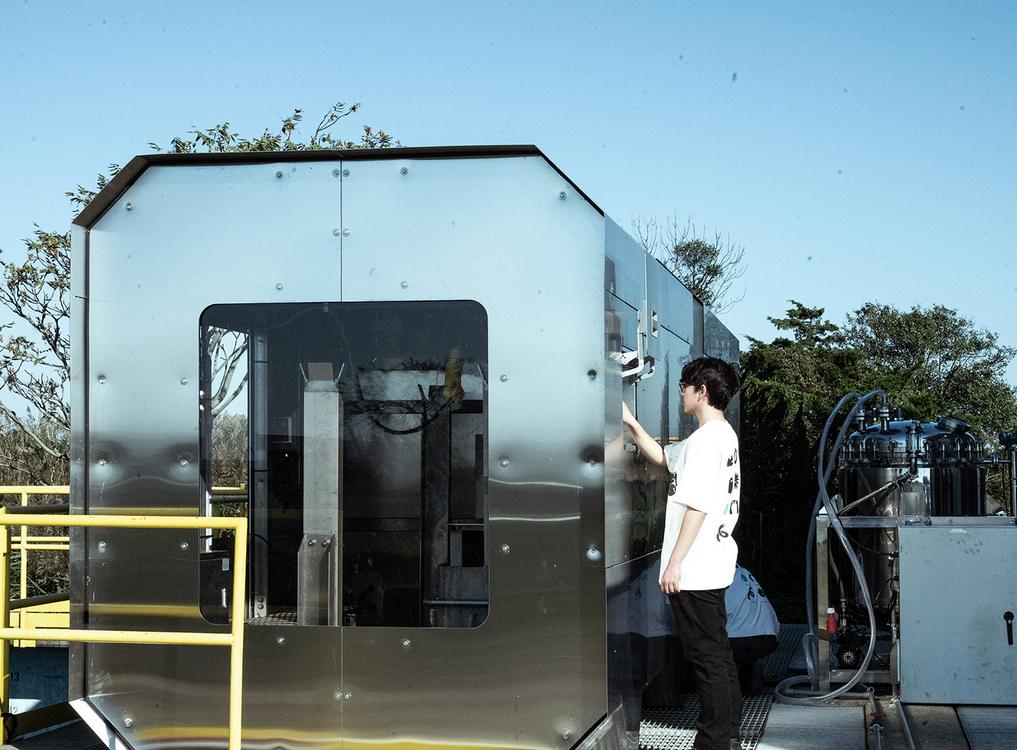
Princeton alumni have designed what’s called a first-in-the-world device to filter microplastics out of wastewater at scale, and it’s already been deployed in Atlantic City.
The large implant mimics hydrophobic plants found in nature, which completely shed water on contact but also attract microplastic particles.
With the water moved on and the particles thusly removed, they can then be easily collected and sent to a recycling facility for processing.
The Atlantic County Utilities Authority (ACUA) in New Jersey have said that it’s crucial for public safety that microplastics be removed from water through existing processing streams. Though no federal regulation exists mandating that utilities remove these contaminants, the ACUA isn’t waiting around for one to be passed.
Microplastics can easily accumulate in wastewater through washing machines, heavy rains, and littering. Most existing treatment facilities across the country will be streamlined for human sewage, solid matter, heavy metals, and other well-understood contaminants, but microplastics present a challenge for these systems.
“We’re discharging to the ocean. So, if we’re not removing the plastic that’s in our wastewater, we’re putting it back into the environment,” said Matt DeNafo, president of the ACUA. “It’s getting into the fish that we’re eating, even the water that we’re bathing. So, it really becomes an issue for human health.”
The ACUA has brought onboard PolyGone Technologies, a startup founded by 2 Princeton University graduates Nathanial Banks and Yidian Liu, as part of a 2-year pilot program to see if their large filtration system can clean up this source of pollution in the city of 40,000.
“I think this really marks a new era for treatment innovation, where we’re able to build very large, scalable systems that use a very small amount of material and very low energy to treat very challenging contaminants,” said Banks, co-founder and CEO of PolyGone Systems. “And, having the first system in the world for that in Atlantic County, it’s quite unusual.”
Laboratory tests showed that a prototype could remove 98% of microplastic particles from wastewater, and the pilot program will focus on replicating this efficiency at the commercial scale.
MORE MICROPLASTIC SOLUTIONS: 3 Teens Win Global Earth Prize for Inventing Tamarind Powder That Easily Removes Microplastics
Interestingly, WHYY reports that Banks and Liu are architecture students, and the latter admitted that the most enjoyable part of the whole process was designing the large device.
In 10 to 15 years time, society may be look back and see microplastics as the greatest environmental crisis of modern times. The mass deforestation of the industrial age can be reversed as trees are given a chance to regrow. As debilitating as the pollution of the coal-fired revolution was to both human and environmental health, its effects were comparatively limited to the vicinity of the coal mine and the coal power plant.
Microplastics, in contrast have been found anywhere researchers have cared to look for them—from the bottom of the Mariana Trench, to the summit of Everest, and inside every human organ from the brain to the placenta—in quantities surpassing a gram, or even more.
ALSO CHECK OUT: Teen Discovers Coconut Fungi Can Filter Plastic and Sunscreen From Sea—And Wins Science Fair
Encouragingly, the majority of humanity isn’t waiting around for someone else to solve the problem, and GNN has reported on numerous inventions, innovations, and successes in the field of microplastic filtering and removal.
For Liu and Banks, they’re also interested in scaling down their technology for residential uses, while eco-conscious California is also the home to one of their commercial scale implants.
SHARE When These Young Entrepreneurs Met A Responsible Utility On The Jersey Shore…