Quote of the Day: “Life consists not in holding good cards but in playing those you hold well.” – Josh Billings
Photo: Alessandro Bogliari
With a new inspirational quote every day, atop the perfect photo—collected and archived on our Quotes page—why not bookmark GNN.org for a daily uplift?
Mitla Church - Marco Vigato and the ARX Project - released
Mitla Church – Marco Vigato and the ARX Project – released
Is there anything in science more exciting than when an ancient legend is confirmed by modern research?
Archaeologists in Mexico were able to experience this exact triumph when they found evidence that a mythical underground city lies undisturbed beneath the altar of a church—exactly where a Spanish legend stated it would.
In the time of Babylon, there emerged from Mexico’s Oaxaca Valley a culture known as the Zapotec which could create monumental stone architecture, sophisticated crafts and artwork, as well as a written and spoken language that predated Mayan, Mixtec, and Aztec. They were among Mesoamerica’s first great civilizations, and existed longer than perhaps any other, from 700 BCE to the time of Spanish conquests when they were part of the Aztec Empire.
Legend has it that the Zapotec built a great labyrinthine city called “Lyobaa,” or “place of rest,” centered around a large cavity found in the earth which they believed was the gateway to the underworld.
Later, venturing Spanish missionaries were so repulsed and frightened to explore more than a few yards into the tunnel network that they “ordered [the] infernal gate to be thoroughly closed with masonry,” wrote a Dominican chronicler named Francisco Burgoa.
Now, a collaboration between the Mexican National Institute of History and Anthropology (INAH), the National Autonomous University of Mexico (UNAM), and the Association for Archaeological Research and Exploration called the “ARX Project Lyobaa” has discovered a “vast underground labyrinth” underneath the 15th-century Church of San Pablo, all but confirming the Zapotec legend.
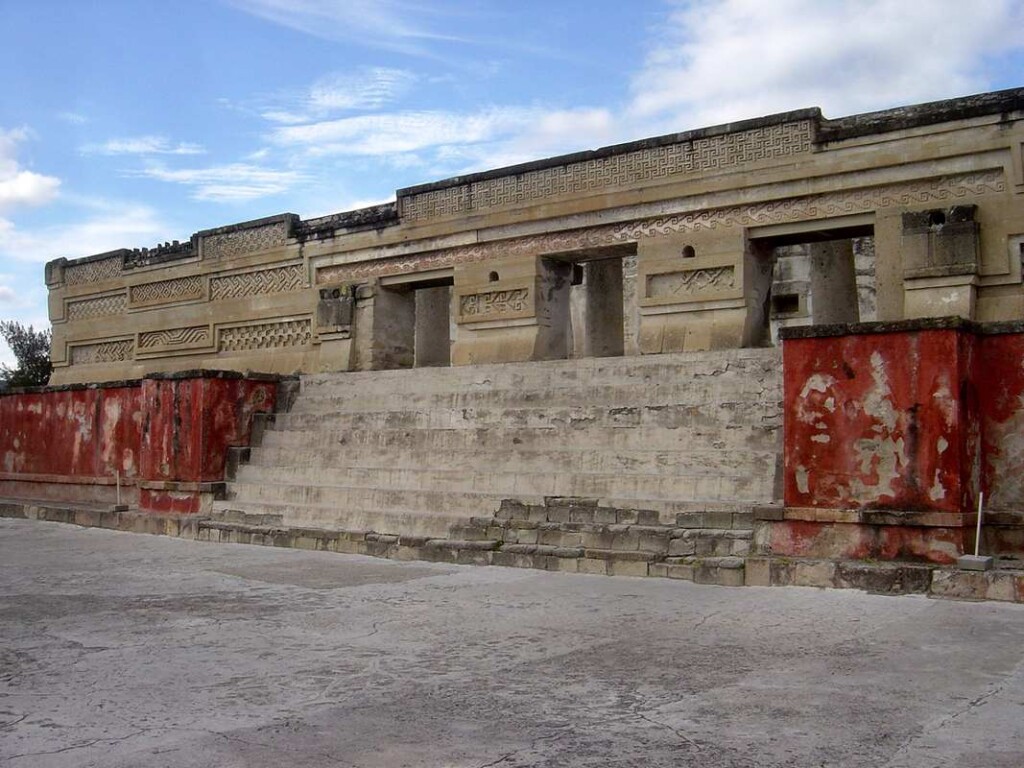
The collaboration began at the archaeological site of the Zapotec city called Mitla, where murals, mosaics, and a monument stone palace are still seen above ground today.
The researchers created a 3D model of Mitla’s subterranean passageways using a combination of three geophysical scanning technologies—ground penetrating radar, electrical resistivity tomography, and seismic noise tomography—all of which left the archaeological site above undisturbed.
The model shows a very large hollow void underneath the precise location of the altar inside the church that was built on the Mitla site. Additionally, the void appears to be connected with another significant geophysical anomaly located immediately to the north of the church.
“Burgoa’s account speaks of a vast subterranean temple consisting of four interconnected chambers, containing the tombs of the high priests and the kings of Teozapotlán,” reads a press release on the truly epic discovery.
Palace in Mitla, Mexico, with original paint on the walls – CC 2.0. Bobak
“From the last subterranean chamber, a stone door led into a deep cavern extending thirty leagues below ground. This cavern was intersected by other passages like streets, its roof supported by pillars.”
The electrical tomography confirmed the existence of two passageways between 18 and 26 feet below the ground. They enter the void from the east. Their scanning also revealed what could be the barricaded entranceway Burgoa spoke of.
The size and scope of the passageways surprised the researchers, who conclude that more work is needed before we can truly comprehend what has been found.
“Additionally, the study has revealed evidence of an earlier construction stage of the Palace of the Columns, Mitla’s most important and best-preserved ancient monument, as well as several other geophysical anomalies that may be interpreted as tombs or buried archaeological structures,” the press release reads. “These findings will help rewrite the history of the origins of Mitla and its development as an ancient site.”
Further studies of this kind are already scheduled for this September, meaning that the true scope of the mythical Lyobaa could be illuminated before the year is out.
CELEBRATE This Incredible Story Of The Past Coming Alive On Social Media…
Moved by a desire to help people deal with grief and angst caused by COVID-19, Brexit, and the climate crisis, artist Annie Nicholson wanted to create a space where the public can shake out grief and unravel their climate angst.
Nicholson is collaborating with The Loss Project, K67 Berlin, and Street Soundsystem to realize this ambitious public art project.
The kiosk is a refurbished K67 kiosk, a modernist design gem associated with ad hoc post-Soviet spaces, chip stalls, newspaper stands, student cafes, and shelters, which evokes a legacy of European unity and collaboration.
As well as DJ sets, there’ll be meditation and yoga workshops, dance classes, and “grief raves” where clubbers can request tracks that remind them of absent or lost loved ones. It will be located in London’s Canary Wharf before eventually touring Europe and the UK.
Nicholson got the idea in the debilitating aftermath of the deaths of her mother, sister, sister’s partner in a helicopter crash, and her father of cancer a few years later year.
During times of grief or anxiety, it can be difficult to find joy. Dancefloors bring people together in powerful ways, and allow people to process complex feelings in a physical way.
“The dance floor has been a space of silence and safety as I have navigated the many great losses and painful grief in my life throughout the past decade, and having successfully installed public realm projects around grief and mental health over the past two years, we have noticed a distinct change in how people wish to connect and come together. There is an overwhelming need to shake out your grief physically right now,” said Nicholson.
She further points out that dance is used in funerary rituals around the world, but particularly among indigenous nations, such as in Māori, Yoruba, and Jamaican cultures, Unsurprisingly however, this expression is not common in grieving periods on the British Isles.
“Improvised dance – where you just move to show how you feel – improves divergent thinking and the ability to solve problems,” Nicholson told the Guardian. “But we generally don’t consider ordinary dancers who aren’t particularly good to be valuable even though the dancefloor can be a site of solidarity, repair and even healing.”
SHARE This Wild And Crazy Idea With Your Friends Experiencing Loss…
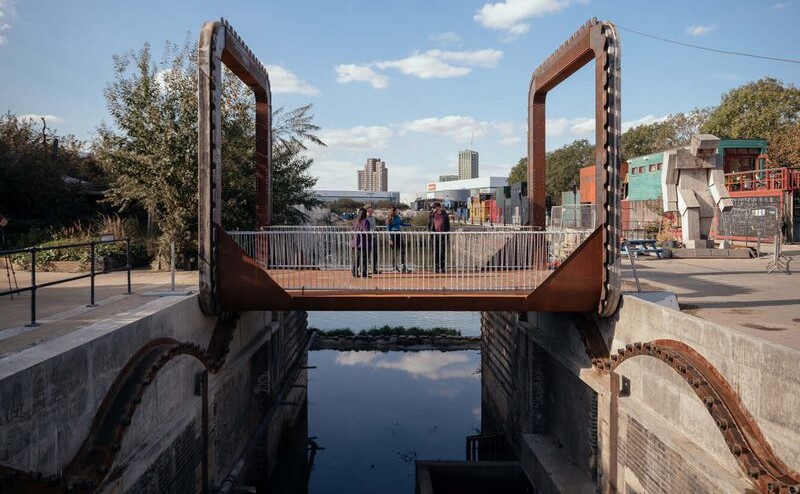
Cody Dock Rolling Bridge by Thomas Randall-Page. Copyright Jim Stephenson 2022
Cody Dock Rolling Bridge by Thomas Randall-Page. Copyright Jim Stephenson 2022
The crown jewel in a recent revitalization project of a London industrial area is a “rolling bridge” made of squares powered by a hand crank.
The bizarre spectacle of two large squares gradually inverting the deck of the pedestrian footpath to allow boats to pass underneath a canal lends the new Cody Docks community in London a touch of Victorian-era chic tinged with steampunk madness.
Architect Thomas Randall-Page freely admits it’s not possible to justify everything about the square rolling bridge. It could have been cheaper, it could have been powered by hydraulics or electricity, or it could have been a much simpler design.
But its childish fun, its imaginative function nestled perfectly within its surroundings leaves Randall-Page believing it to be exactly what Cody Docks needs as it transitions from an old 19th-century industrial wharf where the Thames meets the tidal River Lea to a creative community.
Reopening the dock to the Lea’s waters required the removal of a dam and the introduction of a footbridge over a canal where barges would pass into a refurbished mooring.
“To move it from one position to another takes about 20 minutes,” says Randall-Page calmly. “It was important to have that manual aspect, partly because it’s a very low-energy solution in terms of you’re not relying on external power solutions, and partly because there’s a way in which that simplifies things; there’s a whole lot less that can go wrong.”
“If something does begin to go wrong you notice it, you literally feel it getting harder to move. So it’s kind of a haptic check-in process,” he said in a micro-doc about his bridge.
For someone wondering how the square portals of the bridge roll, it’s because they’re mounted on rails built into the sides of the canal wall which undulate up and down like hills on the horizon. This symmetry allows the whole bridge structure to smoothly roll through 180 degrees to a fully inverted position facilitating the movement of boats from the river to the dock.
Randall-Page said his design was inspired by a visit to a friend’s boat. At times, he had to help his friend pass through canal locks, and the architect took an immediate liking to the low-tech yet smart and hands-on Victorian design of the lock mechanism.
“There’s something very nice about being able to look at the thing even if it’s stationary, and kind of be able to read something about how it works,” he said. Everything’s on show, the winches are on show, the tracks are on show, and if you’ve got your head screwed on you can follow the logic of how this thing works.”
WATCH the mini-doc below…
SHARE This Truly Unique Project With Your Friends…
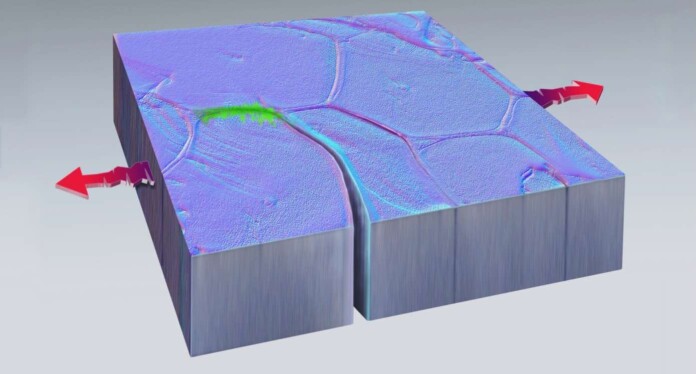
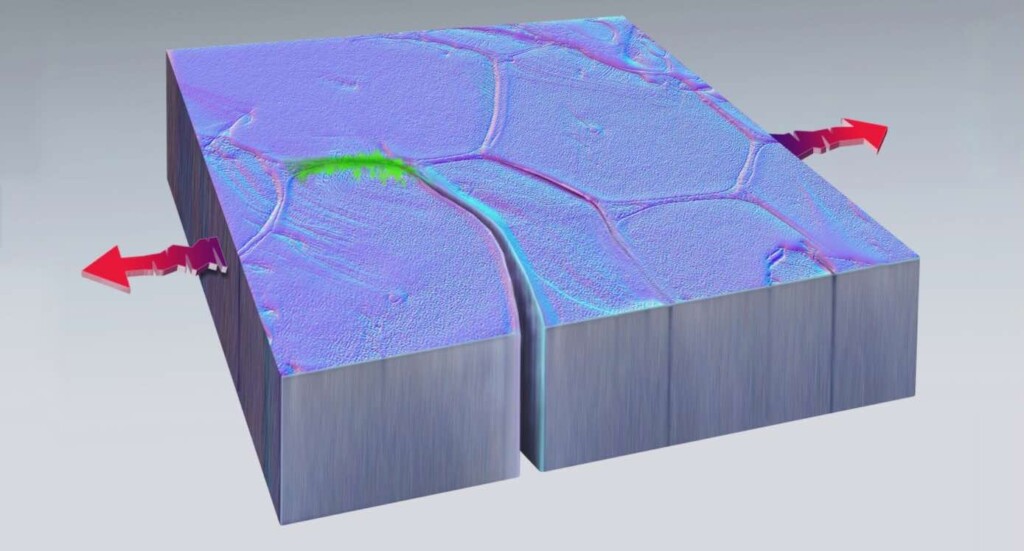
Illustration of nanoscale self-healing (in green) – Sandia National Laboratories / Dan Thompson
Illustration of nanoscale self-healing (in green) – Sandia National Laboratories / Dan Thompson
Scientists for the first time have witnessed pieces of metal crack, then fuse back together without any human intervention, overturning fundamental scientific theories in the process.
If the newly discovered phenomenon can be harnessed, it could usher in an engineering revolution—one in which self-healing engines, bridges, and airplanes could reverse damage caused by wear and tear, making them safer and longer-lasting.
The research team from Sandia National Laboratories and Texas A&M University described their findings today in the journal Nature.
“This was absolutely stunning to watch first-hand,” said Sandia materials scientist Brad Boyce.
“What we have confirmed is that metals have their own intrinsic, natural ability to heal themselves, at least in the case of fatigue damage at the nanoscale,” he told the Laboratory’s press.
Repeated stress or motion causes microscopic cracks to form in machines’ metal components. Over time, these cracks grow and spread until the whole device breaks, or in the scientific lingo, it fails.
The fissure Boyce and his team saw disappear was one of these tiny but consequential fractures—measured in nanometers.
“From solder joints in our electronic devices to our vehicle’s engines to the bridges that we drive over, these structures often fail unpredictably due to cyclic loading that leads to crack initiation and eventual fracture,” Boyce said. “When they do fail, we have to contend with replacement costs, lost time and, in some cases, even injuries or loss of life. The economic impact of these failures is measured in hundreds of billions of dollars every year for the U.S.”
Self-healing, as much as it sounds like something from science-fiction, is actually thousands of years old. The Romans realized that making concrete with certain ingredients like lime clasts allowed it to heal itself over time.
More recently, engineers at the University of Illinois have found how to make self-healing lithium-ion batteries out of a polymer-based electrolyte that doesn’t form harmful lithium dendrites that can cause shorting and explosions.
Khalid Hattar, now an associate professor at the University of Tennessee, Knoxville, and Chris Barr, who now works for the Department of Energy’s Office of Nuclear Energy, were running the experiment at Sandia when the discovery was made. They only meant to evaluate how cracks formed and spread through a nanoscale piece of platinum using a specialized electron microscope technique they had developed to repeatedly pull on the ends of the metal 200 times per second.
Surprisingly, about 40 minutes into the experiment, the damage reversed course. One end of the crack fused back together as if it was retracing its steps, leaving no trace of the former injury. Over time, the crack regrew along a different direction.
A lot remains unknown about the self-healing process, including whether it will become a practical tool in a manufacturing setting.
“The extent to which these findings are generalizable will likely become a subject of extensive research,” Boyce said. “We show this happening in nanocrystalline metals in vacuum. But we don’t know if this can also be induced in conventional metals in air.”
Yet for all the unknowns, the discovery remains a leap forward at the frontier of materials science.
SHARE This Remarkable Surprise Discovery With Your Friends…
With a new inspirational quote every day, atop the perfect photo—collected and archived on our Quotes page—why not bookmark GNN.org for a daily uplift?
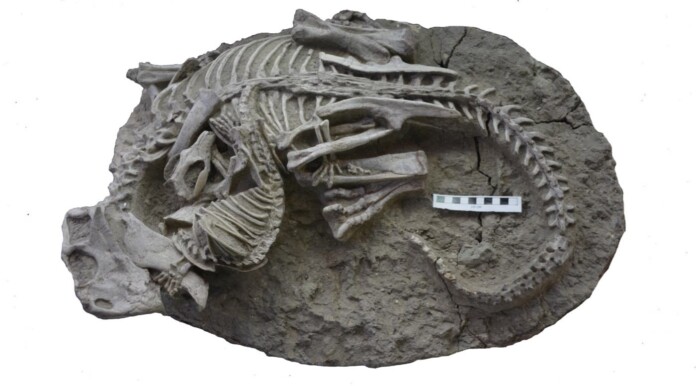
Entangled skeletons of Psittacosaurus and Repenomamus preserved in fossil - SWNS
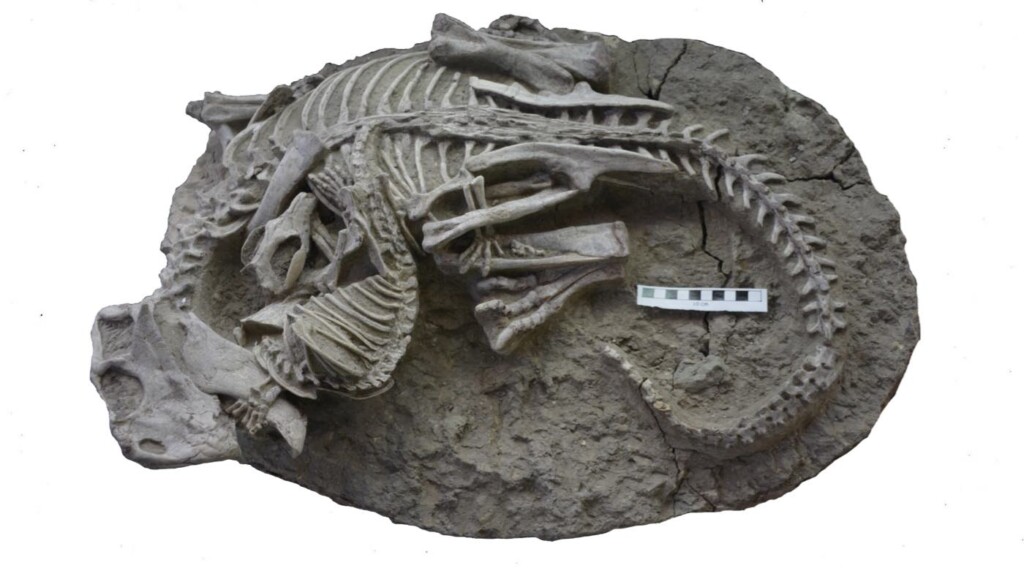
Entangled skeletons of Psittacosaurus and Repenomamus preserved in fossil – SWNS
An extraordinary fossil of a dinosaur being attacked and eaten by a mammal has been unearthed by paleontologists.
It features the entangled skeletons of a beaked and horned herbivore and the smaller, meat-eating Repenomamus at a prehistoric animal graveyard in China’s Liaoning Province dubbed ‘Dinosaur Pompeii,’ for the number of pristine fossils uncovered there.
The amazing scene was frozen in time when a mudslide entombed them both and contains some of the first evidence to show actual predatory behavior by a mammal on a dinosaur.
“The two animals are locked in mortal combat—intimately intertwined,” said co-author of the English language paper of its discovery, Dr. Jordan Mallon from Ottawa’s Museum of Nature. “The weight of the evidence suggests that an active attack was underway.”
Close examination shows the dinosaur is lying prone with its hindlimbs folded on either side of its body. Psittacosaurus was about the size of a large dog.
The weasel-like Repenomamus, the largest mammal of the Cretaceous, coils to the right and sits atop—gripping the jaw of its prey while biting into some of the ribs. Its back foot is holding onto Psittacosaurus‘ hind leg.
The international team ruled out scavenging as the bones of the dinosaur bear no tooth marks. It’s also unlikely the two would have become so entangled. Furthermore, Repenomamus was known to have preyed on Psittacosaurus because of fossilized baby bones of the herbivorous dino found in the mammal’s stomach.
The elevated position of Repenomamus also suggests it was the aggressor.
Lone wolves are known to hunt larger animals, including caribou and domestic sheep, in the modern world, and the Mustelids, like stoats, weasels, and martins, routinely prey on much larger rabbits and other mammals.
There were also small mammals, lizards, and amphibians buried suddenly en masse by mudslides and debris following volcanic eruptions nearby.
Dr. Mallon said in his paper that he is sure the fossil beds at Lu Jia Tun will continue to yield new evidence of interactions among species otherwise unknown to the fossil record.
SHARE This Stunning And Exciting New Fossil With Your Friends…
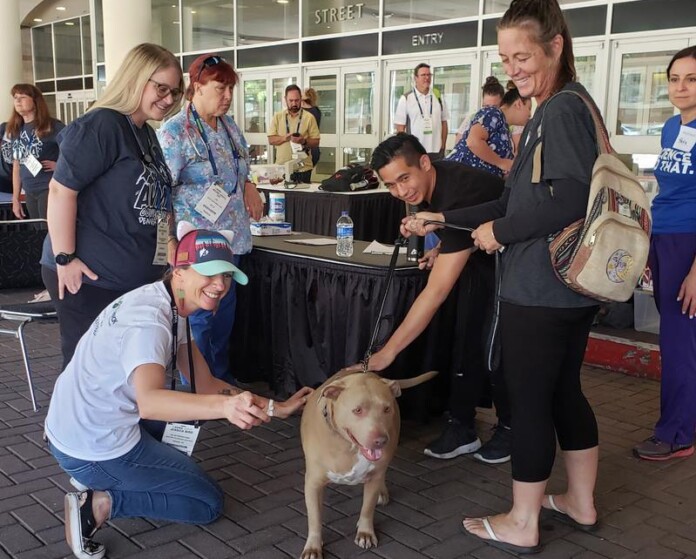
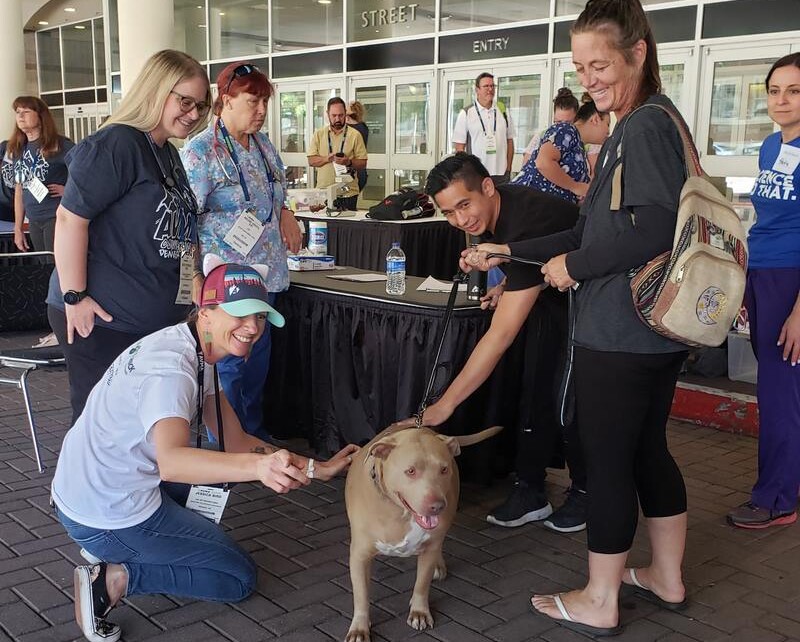
This year’s annual convention for the American Veterinary Medical Association has been turned into a medical care drive for the companion animals of the homeless in the Denver area.
In partnership with the Street Dog Coalition and a number of corporate sponsors, the event held over last weekend allowed anyone to bring in an animal to receive a free health check, vaccinations, and essential supplies to take home with them.
Social isolation is as deadly to human beings as smoking 15 cigarettes a day, and a companion animal can almost entirely alleviate those maleffects.
For people experiencing homelessness, that emotional support can be even more important.
“I think there’s a big judgment and stigma out there about, ‘gosh you need to be able to afford everything or you shouldn’t have a pet,’ and I really struggle with that,” says Dr. Ashley Ackley, one of the volunteer veterinarians who offered up their time during the convention.
Each pet owner was given a referral for spaying, neutering, or follow-up vaccinations depending on what was required within the Denver area.
“People experiencing homelessness have incredibly strong bonds with their pets who provide companionship, purpose, and unconditional love. By providing free compassionate care to both ends of the leash, we hope to help preserve, protect, and strengthen those bonds,” said Katrina Weschler, Executive Director of The Street Dog Coalition.
WATCH the story below from NBC 9 news…
SHARE These Inspiring Vets Volunteering Their Time To Help These Animals…
From the Pacific Ocean comes a harrowing and inspiring tale of survival, as sailor Timothy Shaddock, 51, and his dog were rescued after 3 months adrift at sea.
Now being treated by the ship’s doctor onboard a tuna trawler that rescued him, Australian news reports that he has sustained no major or serious injuries.
“I’m just needing rest and good food because I have been alone at sea a long time,” Shaddock said after being rescued. “Otherwise I’m in very good health.”
Nevertheless, his appearance was one of a man on the ragged edge, with a diminshed physique, and hair grown out in such a way that the ship doctor compared him to Tom Hanks’ character in Castaway.
Shaddock departed from Sydney in May in a catamaran en route to French Polynesia, but bad weather knocked out all his electronics, and he was soon lost in the great blue nothing.
Shaddock kept himself protected from sunburn by hiding under a canopy, and the heroic, persevering sailor managed to catch enough fish with the gear he had onboard for him and his dog Bella to survive over 2 months of isolation.
Rainwater kept them alive while they hoped for rescue, which came in July in the form of the tuna trawler’s helicopter. He’s being brought back to Mexico where he will receive proper medical attention.
WATCH the story below from Channel 9 News, Australia…
SHARE This Unbelieveable True Story With Your Friends…
Madison Stevens - taken from Beluga Cam via Polar Bears International
Madison Stevens – taken from Beluga Cam via Polar Bears International
Perhaps you’ve watched nest cam footage from organizations like the Fish and Wildlife Service that monitors bird nests, and if you’re a fan of that then you’ll surely leap like a humpback at the chance to watch Polar Bears International’s “Beluga Cams.”
During the ice-free months of summertime, about two-thirds of the world’s beluga whales—about 57,000 animals, migrate to the waters around Churchill Valley and Hudson Bay in Canada.
From the deck of their Beluga Boat, PBI scientists maintain underwater microphones that allow you to listen in on the constant whistling, chattering, and singing of these incredible creatures.
The cameras were set up over the last weekend, which PBI has designated as Arctic Sea Ice Day, (July 15th) to raise awareness about polar bears, and sea ice loss.
“Arctic sea ice regulates our planet’s climate, and is essential for polar bears and humans alike,” says Krista Wright, executive director of Polar Bears International, adding, “On Arctic Sea Ice Day, we bring the Arctic to people around the world through outreach like the beloved Beluga Whale Live Cam.”
“As we expand our operations across the Arctic, we believe it’s more important than ever to work together to slow global warming and preserve Arctic sea ice along with the creatures that depend on it.”
The Beluga Cams are also the focus of a big citizen science project. PBI asked viewers to collect individual screenshots from the livestream footage and register them to gather data on the individual animals below the waves. In total more than 22,000 photographs have been taken by Beluga Cam viewers.
CHECK out the Beluga Cam below…
SHARE This Very Different Sound Of Nature To Narrate Your Day…
Quote of the Day: “I had to live in the desert before I could understand the full value of grass in a green ditch.” – Ella Maillart
Photo: Ries Bosch
With a new inspirational quote every day, atop the perfect photo—collected and archived on our Quotes page—why not bookmark GNN.org for a daily uplift?
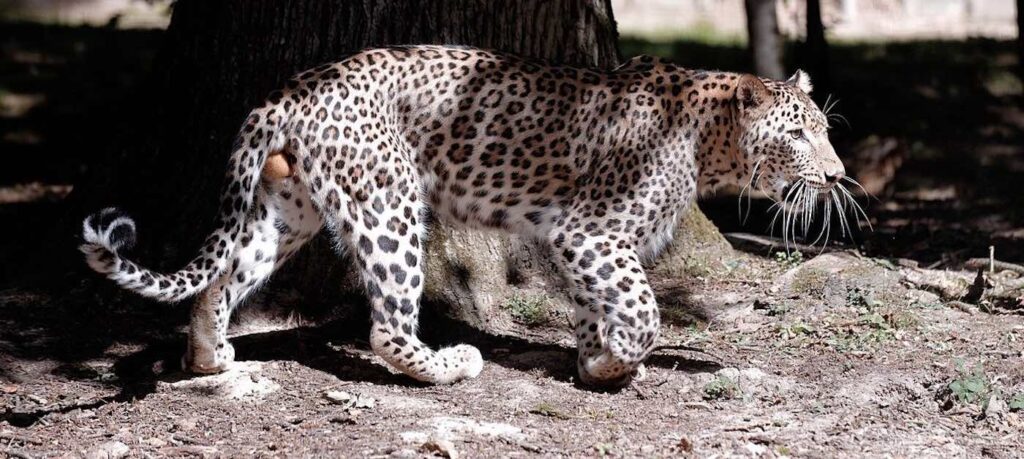
A Persian leopard, part of the Asian leopard species. Benoit Boudeville, CC license
Last Friday, it was believed a young farmer had been caught in the act of leopard poaching in India—a crime that’s easy to believe based on the amount of animal-human contact in rural areas of the country.
In reality, the film of the 25-year-old man driving his motorbike with a leopard hog-tied over the rear wheel came out as evidence of him actually saving the leopard’s life.
The man, Venugopal aka Muttu, from the Hassan District of the Indian state of Karnataka, found the juvenile leopard lying unconscious in the corner of his field. After observing the feline for some time, Mr. Muttu concluded it was not well, and “summoning up his courage” he decided to intervene.
Face to face with the big cat he realized it was too exhausted to move, so he brought it back to the village on his motorbike. Seeing their neighbor with the cat, the villagers immediately called the forest service who got to Muttu, learned of the situation, and sped the leopard off to veterinary care.
“The leopard is around nine-month-old and must have strayed into the village seeking food which led to dehydration,” said Ashish Reddy, an official from the Hassan DCF. “Our staff members have given him advice on what needs to be done about noticing wild creatures in the area.”
When asked about the way Muttu tied the leopard to his bike, Reddy said the state was not intending to press charges as the leopard is in stable condition and there was no criminal intent behind Muttu’s actions.
Human-animal conflict, particularly involving charismatic animals like elephants, tigers, and leopards, is always a major challenge for Indian communities and states to try and manage, wanting to protect both people and property, and the animals that share the rural territory.
The story is a heartening reminder that some rural folks are not only willing to make room for wild predators, but give them a helping paw as well.
WATCH live video of the rescue…
BREAK The Bad News Cycle With This Great Compassion For Wildlife…
Open to skateboarders, BMXers, scooter riders, and rollerbladers, an abandoned Sainsbury’s in the UK has become a community skatepark.
The Pitt Street skatepark in Portsmouth, about 75 miles southwest of London, is located in the city center, and is seen as a way to help “unlock long-term regeneration opportunities.”
“As a child, skateboarding was my outlet and I want to give others the opportunity to use it in a positive way,” said Founder and skater at Pitt Street, Jacob Skinner, who said he was inspired to support the project after skateboarding helped him as a youngster.
“We are really passionate about changing the view of skateboarding in the community, it’s also so important to remember that you are never too old to skate.”
“We want to bring the community together through this venue and encourage people of all ages to get involved.”
In an effort to be inclusive for the whole community, sessions such as the “silver surfers” and “teeny boppers” will allow those of all ages to get stuck in.
Local councilor Steve Pitt, no relation to the street, said he was happy to see the empty building transformed.
“Pitt Street Skatepark gives a real opportunity for people to come together and explore a new passion,” said Pitt.
“We know this area has huge potential to help transform the city centre and using empty spaces like this is a great way to start to unlock new community facilities and business opportunities while we develop long-term regeneration plans.”
Watch “A TOUR” of the skatepark…
b
SHARE This Skate-Forward Story With Any Skaters You Know…
Shayden Walker rings the doorbell asking for friends - courtesy of Brennan Ray
Shayden Walker rings the doorbell asking for friends – courtesy of Brennan Ray
Get ready to fall in love with the sincerity of this 11-year-old Texan boy who went to a neighbor’s house asking if they knew any kids in the area because he really needed some new friends.
The heartbreaking-then-heartwarming interaction between Shayden Walker and his neighbor Brennan Ray was caught via a doorbell security camera, and trigged a viral storm of offers for friendship on social media.
“Um, I just wanted to see if you knew any kids around like 11 or 12, maybe,” the boy can be heard saying in the video. “I need some friends, like really bad.”
Ray suggests some kids in their area of Amarillo Texas, but Shayden replies that he doesn’t see them anymore “because they’re bullies.”
Ray then says that if Shayden wanted to he could play with his daughter, but she was only 2 years old, to which the young man replies “Oh great! I love 2-year-olds, to be honest, they’re like the most cutest things I’ve ever known.”
Ray was struck by Shayden’s honesty and demeanor and took to TikTok to try and solve his conundrum.
“You never know what people are going through until you get a chance to talk to them. This young man is well-mannered, kind, and brave. So TikTok can we help Shayden make some friends?” Ray captioned the video which garnered an absolutely staggering 69 million views.
MORE FRIENDSHIP RALLIES:
“I figured I could post it and some local people would see it and help me connect to them,” he told USA Today.
Shayden has been diagnosed with several mental disorders, and his mom said he’s always had trouble maintaining friends, but after the TikTok video he now has friends in China, the UK, Hawaii, and Australia.
At first, admits mom Kimberly, she thought the video would lead to more ridicule.
“When that didn’t happen, the relief that washed over me and the pure joy that people actually were showing compassion, that was huge,” she said.
Brennan Ray and Shayden Walker hug it out – courtesy of Brennan Ray
Shayden also spoke with USA Today, and said he felt drawn to visit the Rays because their dog ran into his yard one day, and when the Rays come over to get him they seemed like nice people.
Ray and his wife thought they could use all the publicity to help Shayden, so they started a GoFundMe which raised $37,000 for whatever he wants—a clause stipulated in the fundraiser. The families are extremely close after the ordeal, and Shayden does in fact play with their daughter despite all his new friends.
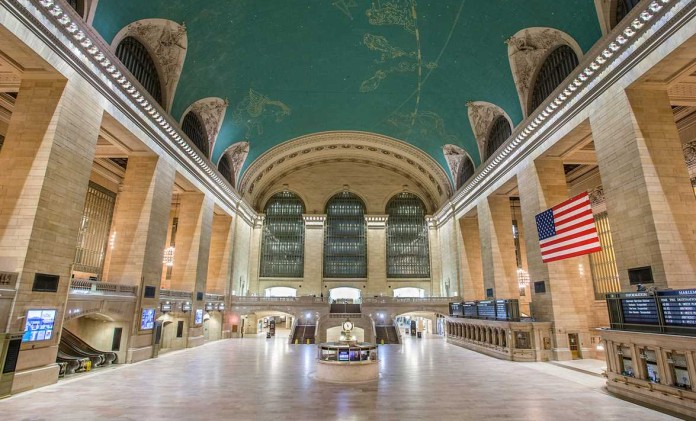
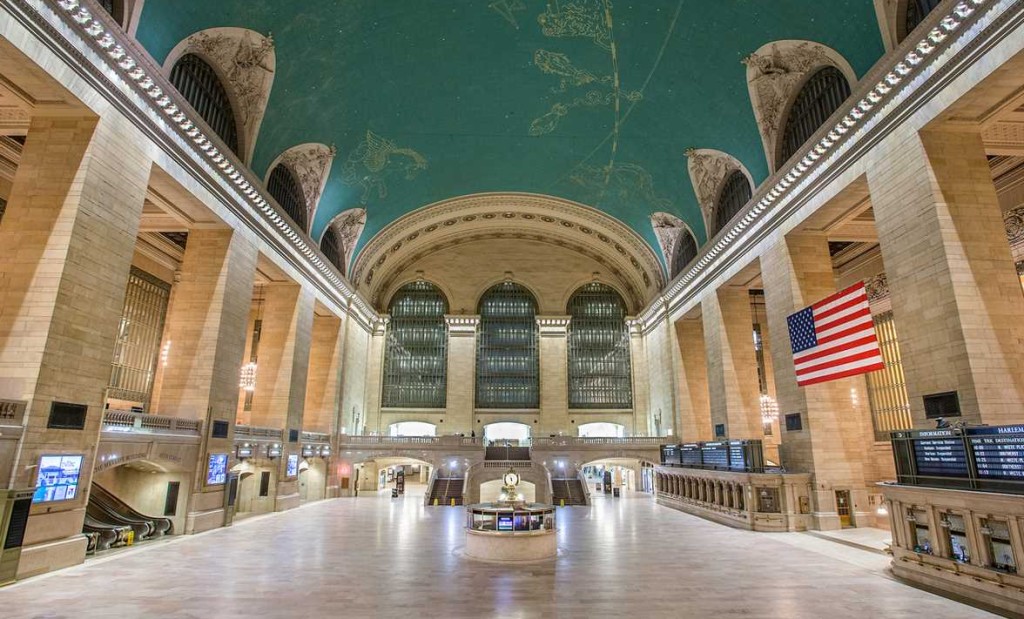
Grand Central Terminal CC 3.0. Metropolitan Transportation Authority
Grand Central Terminal CC 3.0. Metropolitan Transportation Authority
When a Philly man with autism boarded the wrong train and ended up lost in the mammoth network under New York City’s Grand Central Maddison, his family had to cut their day plans short to travel to the Big Apple for an emergency pick-up.
But before they hit the road, three NYC transit officers who had gotten the call came to the rescue, locating the man and coming up with a rather Daoist solution to the problem—just put him back on the train.
Officers Azad Miah, Rochester Joseph, and Sergeant Craig Siegelbaum located the man named Tyree, who was happy to hear they were there to help him.
“The family was going to come to New York to pick him up originally and someone came up with the idea to get him on an Amtrak train and have the family meet him there, Siegelbaum told ABC 7 news in a touching reunion with Tyree and his family over Zoom.
One of the key tenants of Daoism is the life principle of being like water, originally interpreted to mean “do as little as needed to move forward.”
In making their mini-rescue, the officers went with the flow of the situation, escorted the man to the correct train, let the conductor know what was happening, and let it carry him back to his family.
“I’m grateful that they were even able to coordinate something like this because I’ve heard of countless times where it didn’t end like this,” Tyree’s uncle, Kevin Watson, said.
Tyree thanked the officers for helping him over Zoom.
WATCH the Zoom call below…
SHARE This Nice Story OF Friendly Officers With Your Friends…
Quote of the Day: “I have never been hurt by what I have not said.” – Calvin Coolidge, US President
Photo: Etty Fidele
With a new inspirational quote every day, atop the perfect photo—collected and archived on our Quotes page—why not bookmark GNN.org for a daily uplift?
Architects and designers of eras past had to adapt to the planet’s challenges long before electricity, air conditioning, and heating were invented, and as modern humans try and find a way to reduce carbon emissions, the ancients have much to teach us.
In China, more and more modern buildings are being planned around antique design features known as “skywells”—and they’re doing so not only because the design significantly cools a building’s interiors, but because it reduces carbon emissions by cutting down on the need for air conditioning.
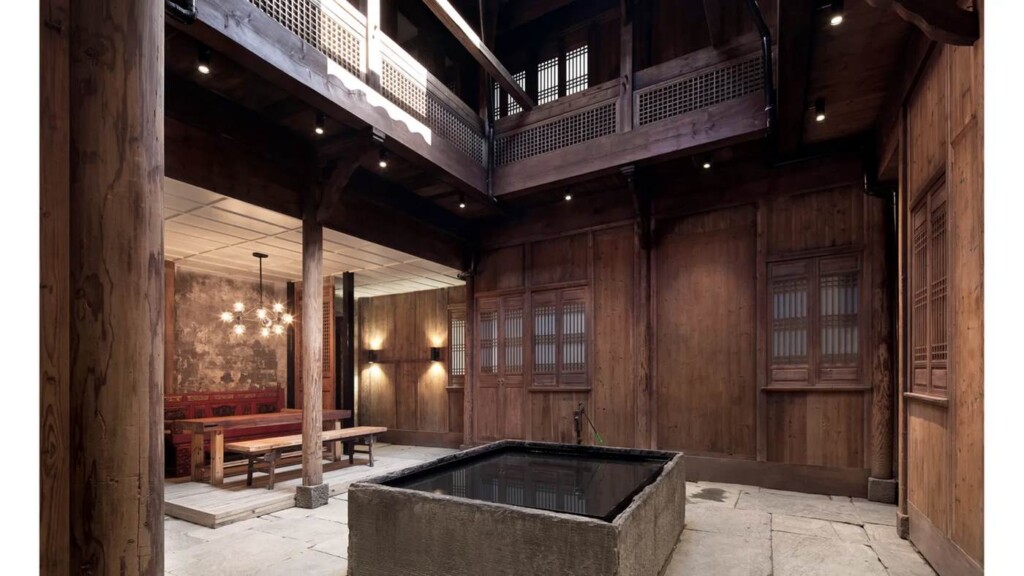
Used in the country’s humid south at least since the Ming Dynasty of the 14th century, a skywell is basically a square or rectangular courtyard in the middle of the floor plan on which one side is a stone wall. Overhead hang the classic dou gong, or beam and bracket eaves. This shades the ground and funnels rainwater into a central basin.
When the wind blows across the roof of a skywell house, it’s often colder, and therefore heavier, than the still air indoors. It’s funneled down, especially by the wall, into the interior which then pushes the warmer still air higher and out of the opening.
Even if the wind isn’t blowing though, openings such as skylights, chimneys, or smokestacks tend to create circulation. As warm air rises up through the skywell, it pulls air from the other rooms into it.
Traditional Chinese designs will have a basin of water replenished by the rain sitting in the middle of the skywell. As the water evaporates it cools the surrounding air, before rising and creating the circulation mentioned earlier.
People living in hot environments the world over have used these principles to cool their homes for millennia, as it can reduce interior temperatures by 9.5°F (4.3°C).
In Persia for example, “wind towers” act like chimneys of cold air that brought desert wind down into a house or even a subterranean cold chamber which created a constant movement of cold air in, hot air out; a design that has been replicated in Andalusia, Spain.
Recently, the BBC reports great interest in the revival of traditional Chinese architectural principles, and the skywell is one that is receiving a lot of attention because of its ability to cut down on air conditioning use in accordance with a recent government initiative for greener buildings.
– credit Wuyuan Sky Hotel
Furthermore, there is a real aesthetic beauty to the skywell that when combined with its pleasant climate creates the perfect place for meals, reading, or spending time with family. It’s a buffer zone where one can get the benefits of being outdoors while not suffering from the heat, sunburn, or bugs.
However it’s a principle that isn’t limited to family homes. The National Heavy Vehicle Engineering Technology Research Centre in the eastern Chinese city of Jinan has an 18-story tower block with a massive skywell in the middle of it. The bathrooms, conference rooms, and elevators are all located on the interior walls facing the skywell, allowing for better ventilation and temperature control.
SHARE These Beautiful Antique Designs With Your Friend…
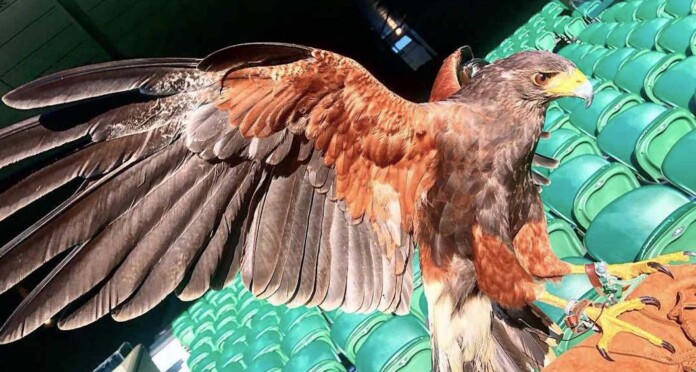
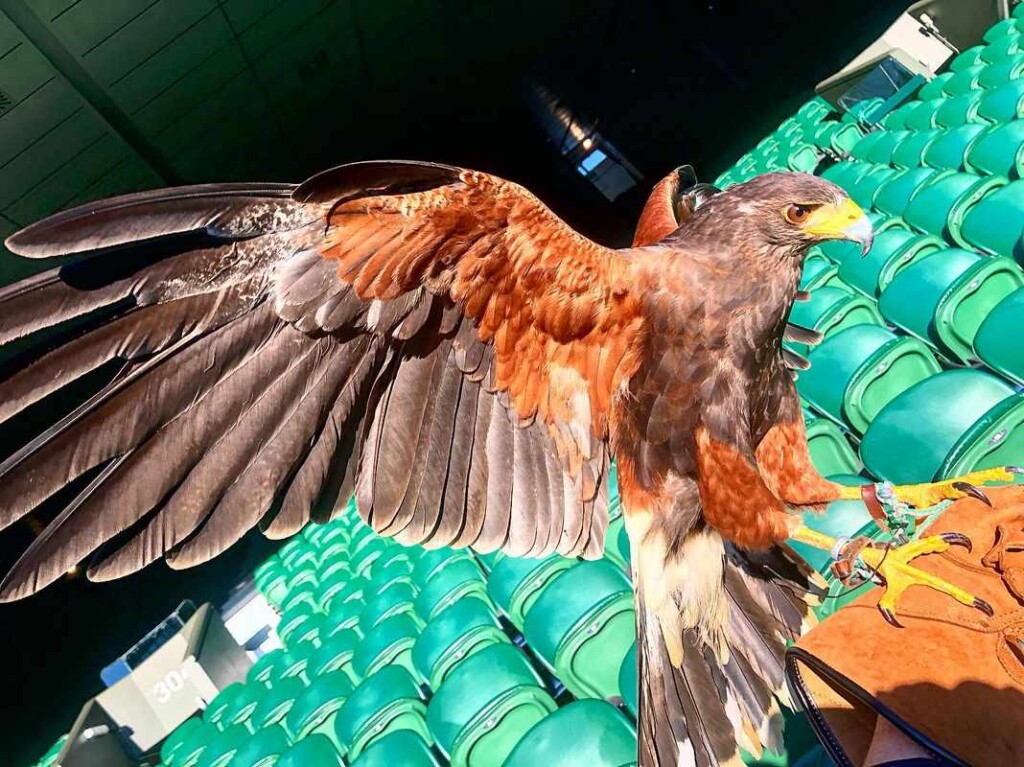
Rufus the hawk – retrieved from the bird’s Facebook
With the curtain closing on the All England Lawn Tennis Club’s annual championships at Wimbledon, it’s another successful year in the books for the real king of Centre Court—Rufus the Hawk.
For any Nigels reading this, it will likely be a case of heard it all before, but us Yankees might not know that a family of falconers has been training Harris’ Hawks for use as pigeon control officers on Wimbledon’s grass courts for 20 years.
Taking over from the previous hawk, Hamish, for 15 years Rufus has spent a few hours every morning during the 42-day-long tournament scaring away pigeons that may have entered the grass courts to roost during the night. Rufus doesn’t hurt the pigeons, but he scares them away by triggering a flight or fight response which can take days to get over.
It all began back in 1999 when Donna Davis was watching a match of the eventual champion Pete Sampras. A plague of pigeons was repeatedly disrupting the action and gave Donna the idea to call the organizers and offer her services.
Typically, Donna, or another member of the Davis family, Imogen, will begin the day on Court No.1 and carry on clearing all the courts of pigeons who fly down to munch on the grass seed. Small bells on his feet alert the Davises below where he is heading.
Rufus would have enjoyed a memorable year. Having seen some exceptional performances in his time, the Gentlemen’s Singles Final between GOAT Novak Djokovic and young-blood and world #1 Carlos Alcaraz will certainly be up there.
The Spaniard denied the best to ever do it his 8th Wimbledon title, and 24th Grand Slam of his career with a mixture of raw power and confidence in a tightly contested match. Indeed, even as late as the 9th game of the 4th set, each man had won the same number of points: 134. Djokovic had trouble with a number of Alcaraz’s brilliant slices and drop-shots, and was unable to take enough games off of Alcararz’ service, which was routinely clocked at 130 mph.
The Ladies’ Singles Final was hardly less memorable, as the Czech Republic’s Marketa Vondrousova became the first unseeded player since Billie Jean King in 1963 to make it to the final or win the tournament. She took the tile over Tunisia’s Ons Jabeur, the first Arab or North African to ever make it to a Women’s single’s final in any tournament. While not a washout, Vondrousova, who finished last season ranked 99th in the world, won back-to-back sets 6-4.
Though it’s believed Rufus enjoyed the Gentlemen’s Singles Final more, because in 2019, he was cheering for Federer.
WATCH the story below from the Wimbledon YouTube…
SHARE This Brilliant Bird With Your Friends Who Watched The Finals…
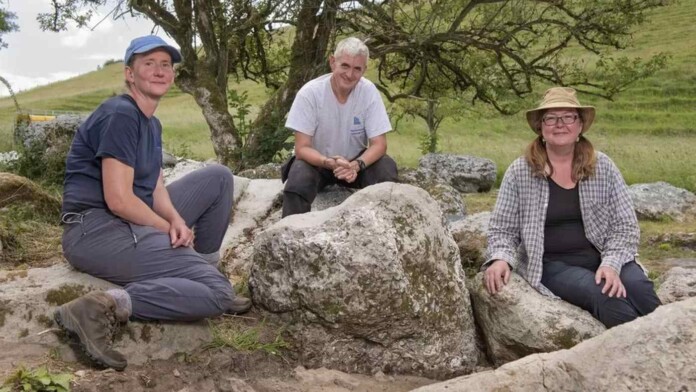
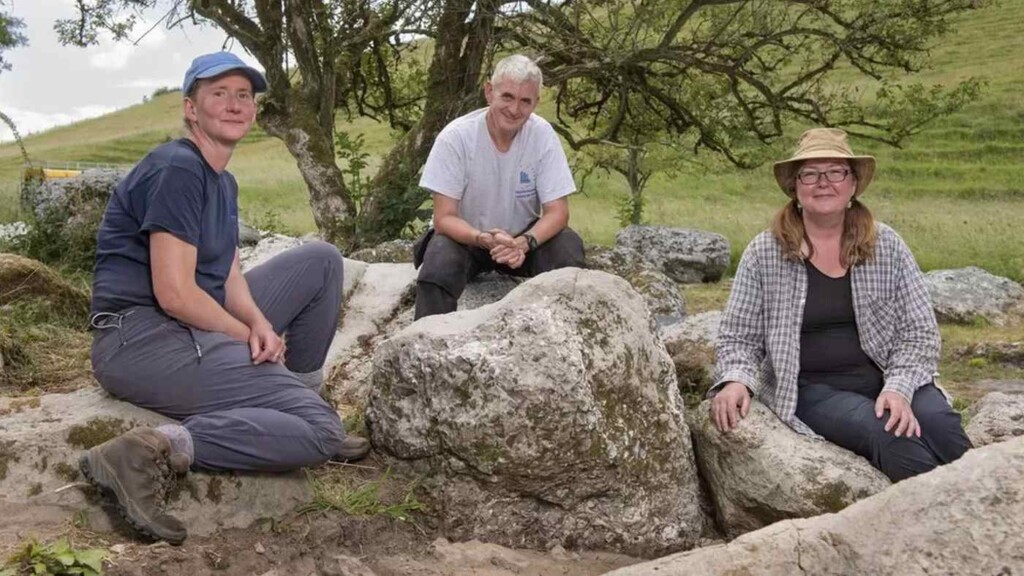
Dr Hayley Roberts (left), Jim Rylatt and Dr Anne Teather are part of the team that discovered the rock - credt Past Participate
Dr. Hayley Roberts (left), Jim Rylatt and Dr. Anne Teather are part of the team that discovered the rock – credit Past Participate
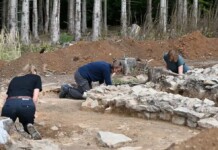
In the rolling hills and green fields of Dorset, Dorchester, archaeologists have discovered a polishing boulder, known as a polissoir, which would have been used to make hundreds of axe heads.
Identified in a designated Area of Outstanding Natural Beauty, the boulder will be left where it was found—in a spot called the Valley of the Stones—rather than being taken to a museum.
Made of sarsen stone, the same sandstone mineral composition in the megaliths at Stonehenge, the find was described as “unexpected” and excavations will now begin in the surrounding area with an eye toward finding some of the stone tools this polissoir would have allowed the prehistoric Britons to create.
“The stones would have been extremely important to Neolithic people, as without axes they could not have cleared woodland and farming would have been impossible,” he said.
Over 1,000 large sarsen boulders have been identified in England, but this is only the second one where evidence of its use as a polishing boulder has been clear.
They’re so rare that archaeologist Dr. Anne Teather described them as “hen’s teeth”. The director at Past Participate, a small organization that does archaeology alongside volunteers in communal places, wrote that she promised a bottle of fine whiskey as a reward for any volunteer who finds one.
“This incredible discovery represents the research value that community heritage projects can bring,” said Dr. Teather, who thanked Historic England, and the local landowners who helped make the discovery possible.
The Dorset countryside where the rock was discovered – credit Historic England
“Several examples of portable polissoirs have been found but there are only a handful that have been found on larger, ‘earth-fast’, stones such as ours,” Dr. Teather wrote on the organization’s blog.
“Several of these are in the Avebury area, and almost all have been moved from their original location. Some were moved in prehistory, such as those used to build West Kennet Long Barrow. Others have been spotted repurposed in farm walls!”
Stone axes played the starring role in shaping the British landscape, which was once almost entirely forested. The crafting of axes on polissoirs like this one allowed Neolithic people to harvest trees for houses, firewood, or for rollers to move large stones.
SHARE This Second-In-A-Lifetime Discovery With Your Friends…
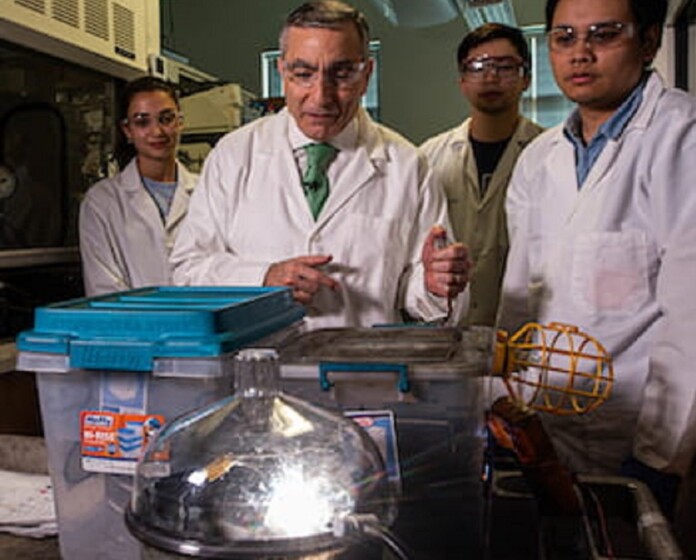
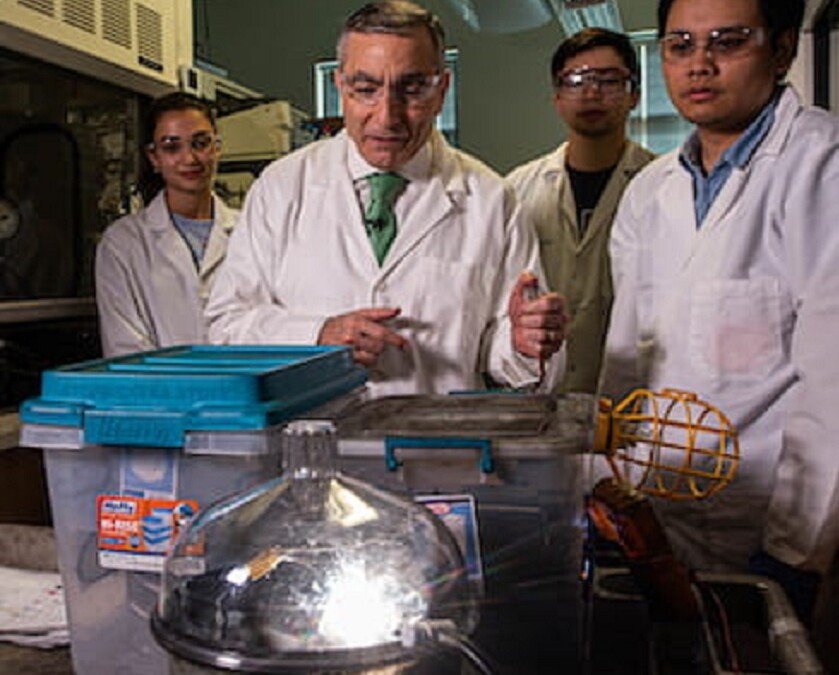
Dr. James Tour and his team make flash graphene - credit Rice University released
Dr. James Tour and his team make flash graphene – credit Rice University released
Imagine if you could turn a material that costs $100 per ton into one that costs thousands of dollars per pound—it’s the kind of story attached to the fable of the Philosopher’s Stone.
At Rice University, a group of scientists started turning coal, an energy source of little value, into graphene, a raw material with dozens of applications in electronics. Then, the scientists realized they could use any carbon source, which for their experiments included dead cockroaches, coffee grounds, and girl scout cookies.
Graphene comes from a mineral called graphite, a carbon allotype, and one of only two forms of naturally-occurring carbon. It has metal-like properties and is valuable for use as a conductor in aerospace, medicine, and electronics.
The global demand for this material is predicted to top $1 billion at an average price of $67,000 per ton.
Using a technique they created called “flash graphene” the scientists were able to create high-value graphene flakes from a variety of raw materials by hooking them up to a pair of capacitors and electrodes that delivered a 3,000° Kelvin shock.
This, according to experiment lead Dr. James Tour, a professor of materials and nanotechnology at Rice University, passes a current through the trash or coal with enough energy to break every carbon-carbon bond in the substance, before they reorganize themselves as graphene.
“You can put your finger right on the container a few seconds afterwards,” Tour said. “And keep in mind this is almost three times hotter than the chemical vapor deposition furnaces we formerly used to make graphene, but in the flash process the heat is concentrated in the carbon material and none in a surrounding reactor.”
This, Tour says, has unique advantages and allows the team to create flash graphene in bulk.
“All the excess energy comes out as light, in a very bright flash, and because there aren’t any solvents, it’s a super clean process,” he said.
Graphite mining comes with all the environmental unhappiness of any other kind of mining, and the team identify two ways in which bulk flash graphene, along with making a variety of products much cheaper, could really improve the environmental footprint of manufacturing.
The first is shown in the paper Tour et al. published in Nature on their work—that adding just 0.1% of graphene to concrete could reduce its environmental footprint by one-third.
“Essentially, we’re trapping greenhouse gases like carbon dioxide and methane that waste food would have emitted in landfills,” Tour told his university press. “We are converting those carbons into graphene and adding that graphene to concrete, thereby lowering the amount of carbon dioxide generated in concrete manufacture. It’s a win-win environmental scenario using graphene.”
Second, as he explains in the video below, existing coal mines and companies which mine coal could sell their product to flash graphene production rather than coal power plants. This would eliminate any CO2 emissions that would normally come from that coal being burned, and would likely save thousands of jobs for coal companies.
WATCH the story below…
SHARE This Ingenious Invention With Your Eco-Anxious Friends…