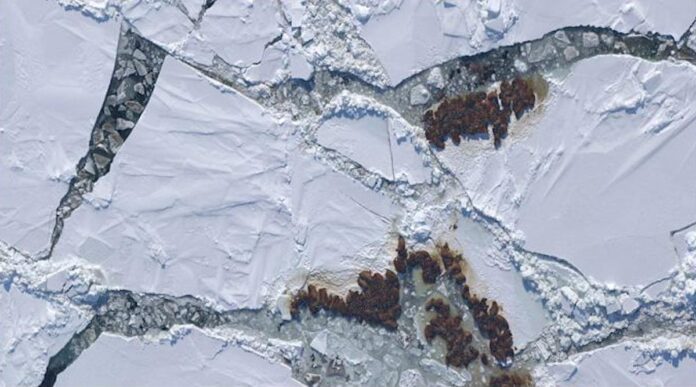
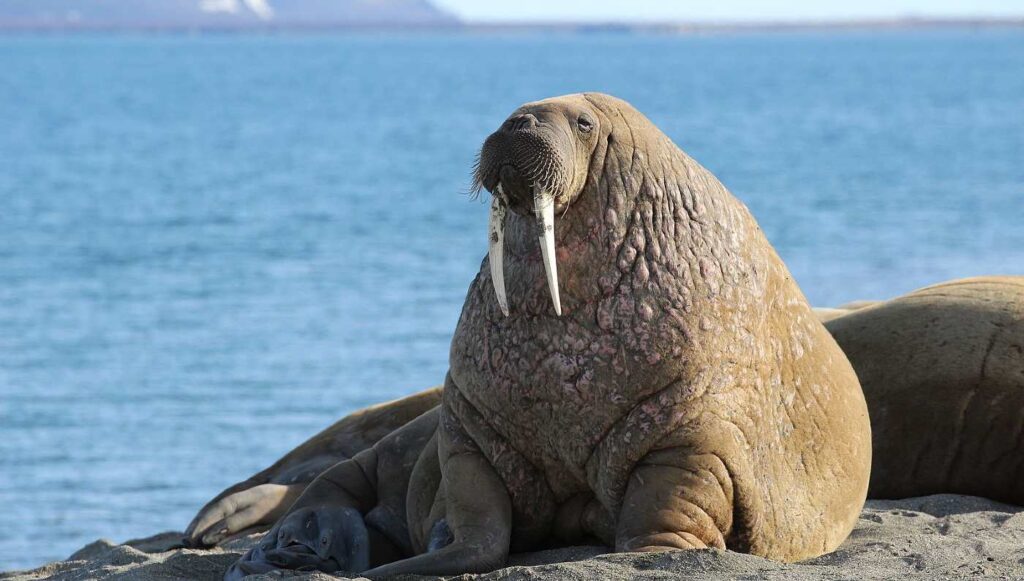
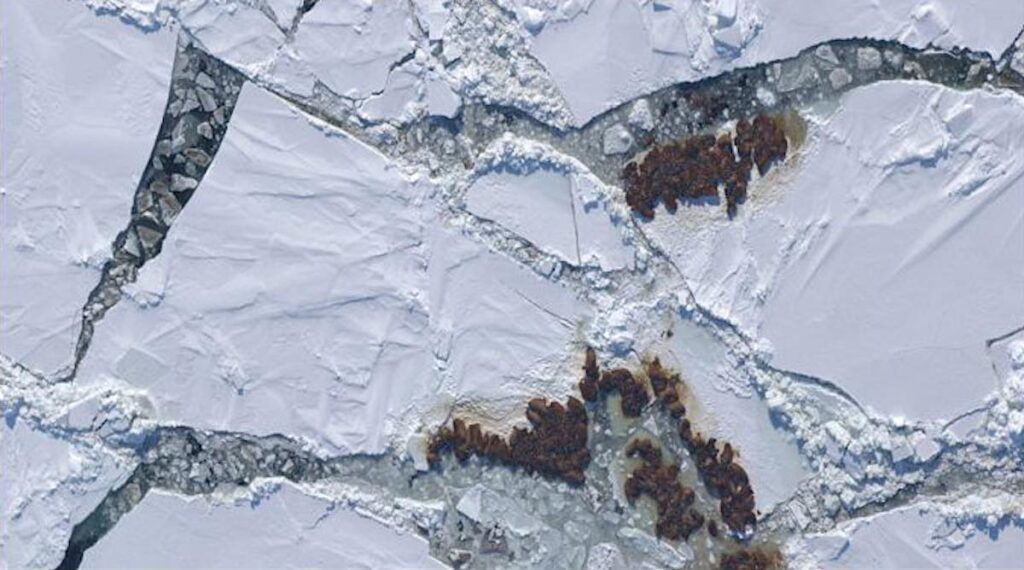
Scientists are appealing to the public to help them monitor the number of Walrus in the Arctic by looking at images—taken from space.
The real-life Where’s Wally? project will see animal-lovers scanning satellite images to help monitor Walrus populations along the Arctic coastline.
Conservationists hope that the ‘Walrus from Space’ research project will give a clearer picture of how each population is doing without disturbing the animals.
The project, led by the WWF and British Antarctic Survey, uses space satellites to capture thousands of high-resolution images of walrus congregated on more than 25,000 square kilometers (9653 square miles) of Arctic coastline—an area larger than Wales.
Anyone can take part in the walrus census using their own computer but they must undergo a short online training module before starting.
Rod Downie, chief polar adviser at WWF, said, “It’s easy to feel powerless in the face of the climate and nature emergency, but this project enables individuals to take action to understand a species threatened by the climate crisis, and to help to safeguard their future.
“What happens in the Arctic doesn’t stay there; the climate crisis is a global problem, bigger than any person, species or region.
Train travel is a lost art in the United States, a fact not lost on film director Wes Anderson, who revels in using train travel in his films.
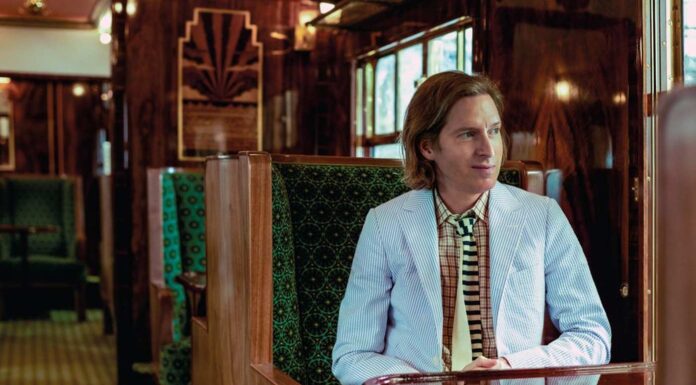
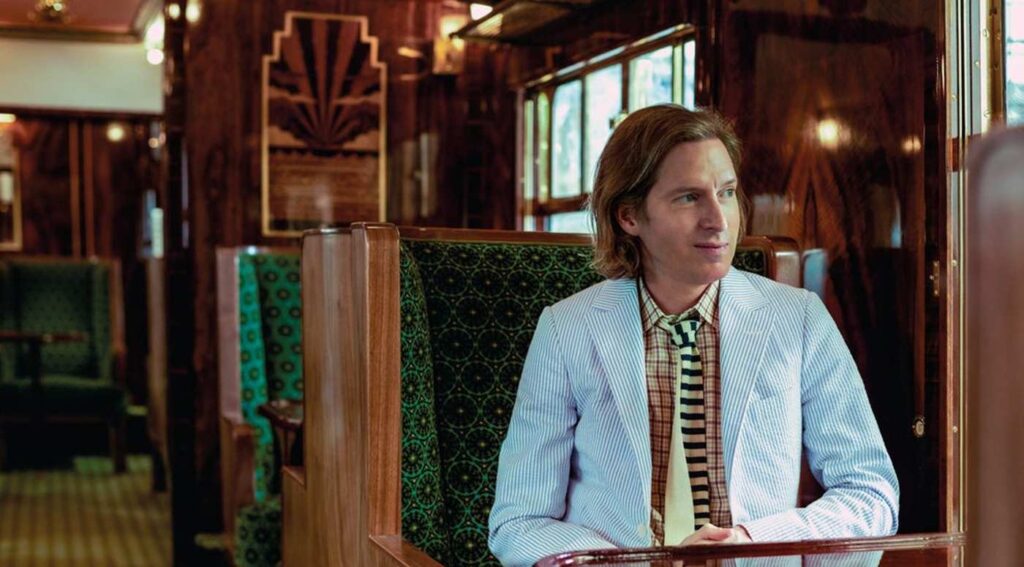
Now he’s taken his passion to a country that understands it: to England, where a company has built a Wes Anderson-inspired train carriage complete with all the rich details one expects from his movies.
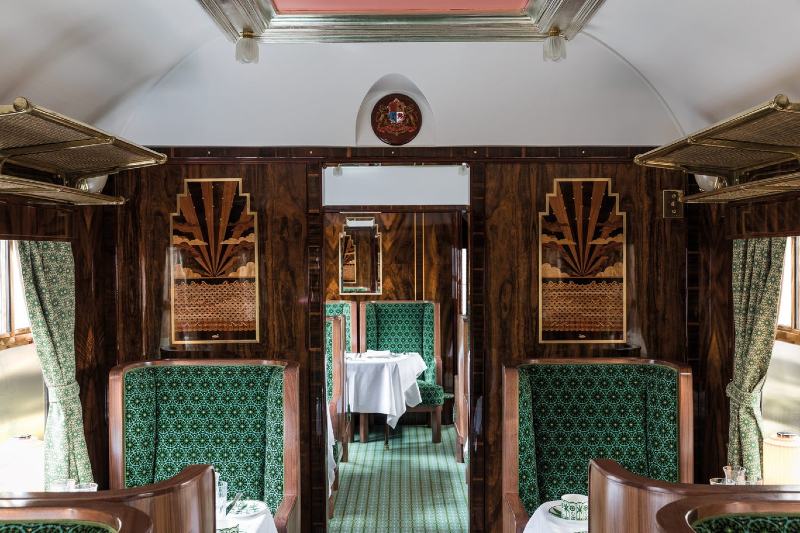
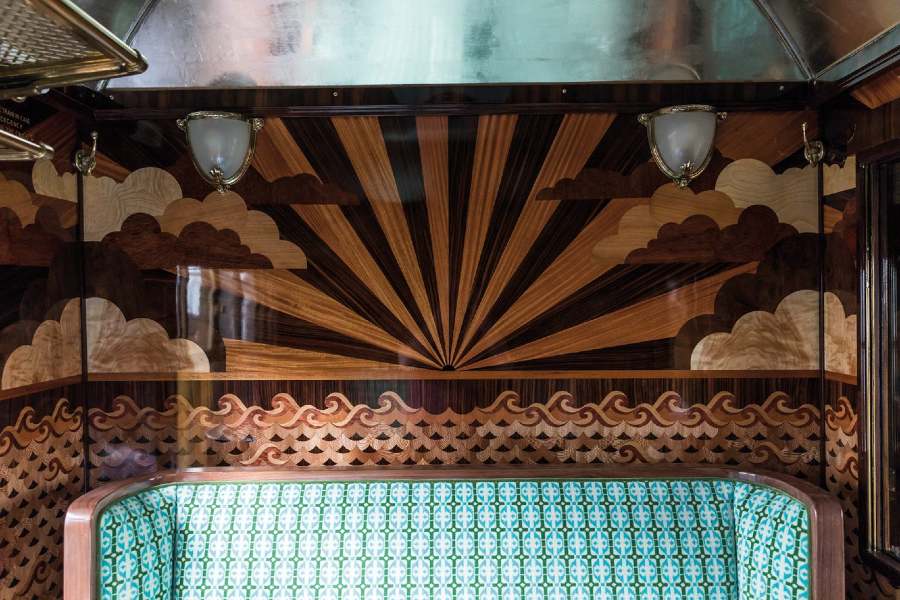
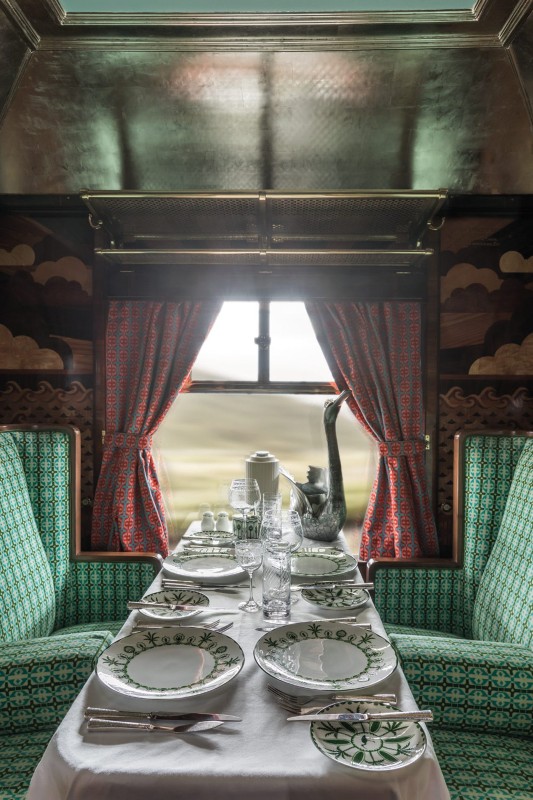
Travelers with cash to burn can book a ticket on the Cygnus train carriage—built by Belmond, it will service cities all over the UK with its pastel-pink ceiling, richly embroidered green seats, and Art Deco wooden walls and window frames inspired by the train coaches Anderson designed for his films Darjeeling Limited, and The Grand Budapest Hotel.
“I have often had the chance to invent train compartments and carriages in my movies,” Wes tells Belmond.
“So I was very eager to make something new while also participating in the process of preservation which accompanies all the classic Belmond train projects. They are keeping something special alive. An endangered species of travel which is nevertheless very suited to our time.”
The carriage is named after the mythical Greek god of balance, as well as an older luxury train carriage maintained by British Pullman trains in the middle 20th century.
It hosted royalty and dignitaries, and survived World War II bombing raids.
Belmond
Cygnus now travels this way and that across the countryside, and serves a five-course English menu that’s ever changing, complete with real crockery, cheeses, afternoon teas, and champagne—poured from a bottle made of glass into a glass made of glass, just as it would have been in the Golden Age of Travel.
Belmond
A table in the main carriage is not for a last minute getaway, as it runs $545 per person, while one of the private coupés, a small private dining room for four, will go for $2,455 per coupé.
Belmond
“Wes is an expert in rendering fantasy worlds that are a little more beautiful and satisfying than the ones we live in,” Belmond said.
With relentless details to feast upon and carefully calibrated colour palettes to pore over, his films aren’t just thrilling stories: they’re works of art.
MAKE Beautiful Design Travel Further—Share This Story…
“The Great Pacific Garbage Patch can now be cleaned,” announced Dutch entrepreneur Boyan Slat, the wonderkid inventor who’s spent a decade inventing systems for waterborne litter collection.
Recent tests on his Ocean Cleanup rig called System 002, invented to tackle the 1.8 trillion pieces of plastic pollution, were a success, leading Slat to predict that most of the oceanic garbage patches could be removed by 2040.
Intersections of ocean currents have created the massive floating islands of plastic trash—five slow-moving whirlpools that pull litter from thousands of miles away into a single radius.
The largest one sits between California and Hawaii, and 27-year-old Slat has been designing and testing his systems out there, launching from San Francisco since 2013.
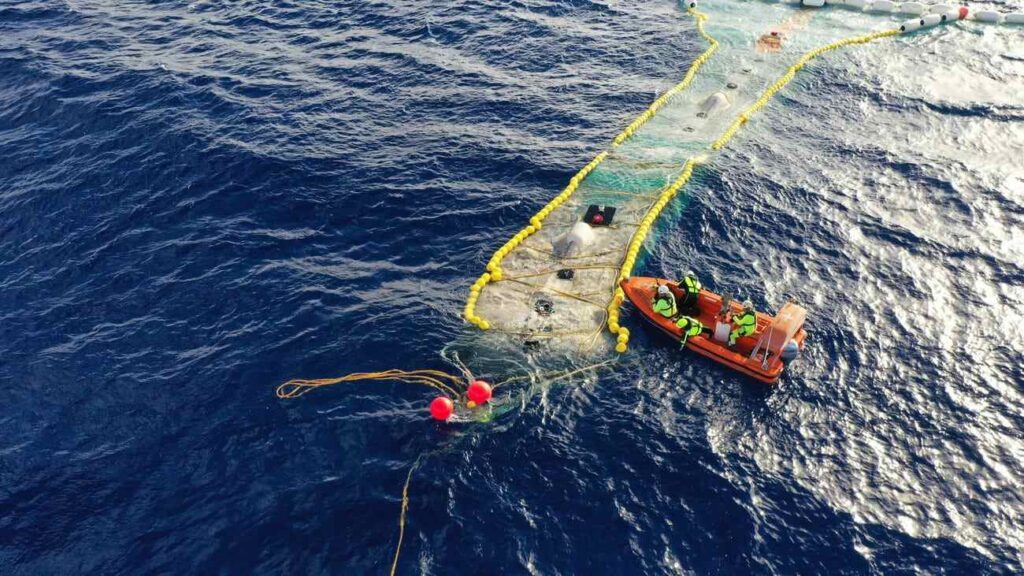
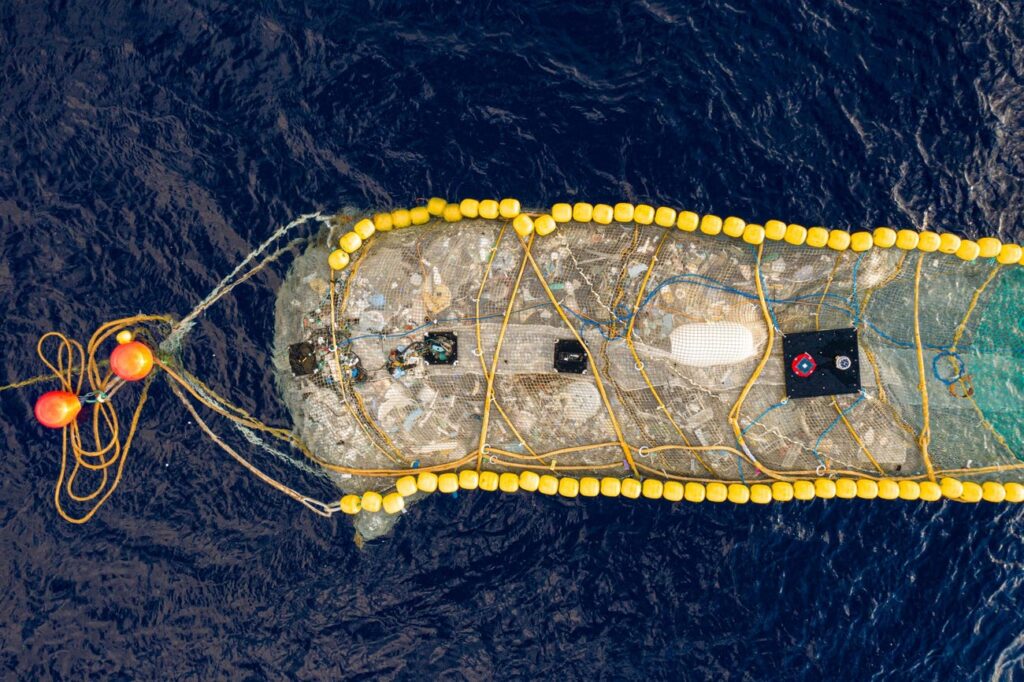
GNN has reported on his original design for the floating device, but his engineering team improved upon it. System 002, nicknamed “Jenny,” successfully netted 9,000 kilograms, or around 20,000 pounds in its first trial.
It's exactly 10 years ago that I first learned about the Great Pacific Garbage Patch.
Back then, everyone told me there was no hope of ever cleaning it up.
They were right then; no method existed to do it. Proud (and relieved!) to say that now there is. https://t.co/ek1kKnxLcO
It’s carbon-neutral, able to capture microplastics as small as 1 millimeter in diameter, and was designed to pose absolutely no threat to wildlife thanks to its wide capture area, slow motion, alerts, and camera monitors that allow operators to spy any overly-curious marine life.
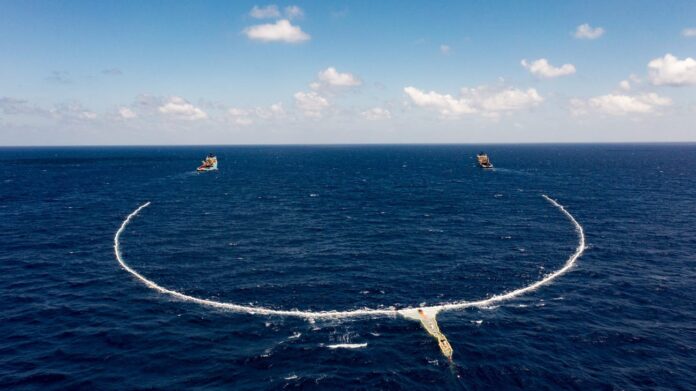
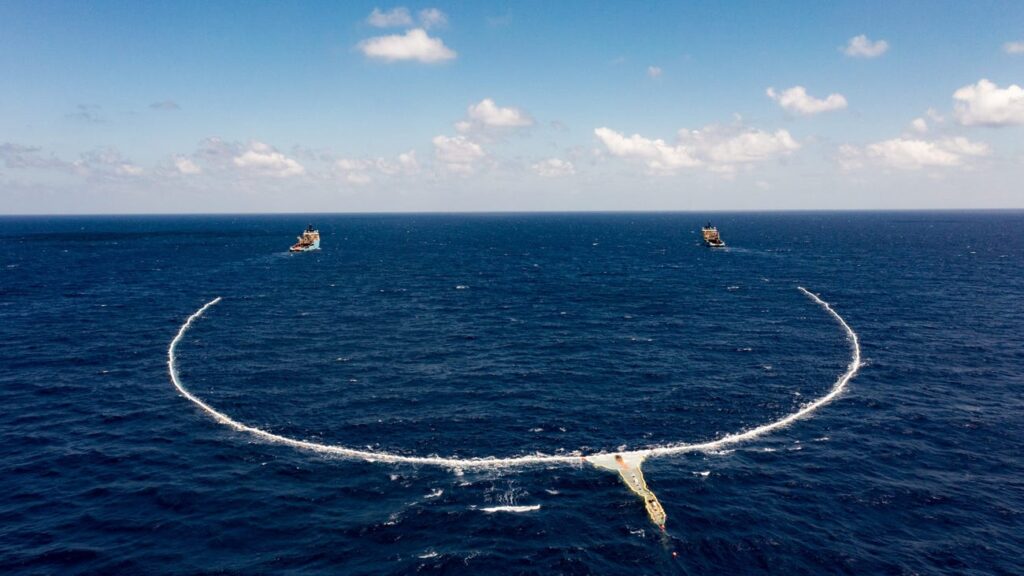
Jenny consists of two boats dragging a very long net in a U-shape behind them.
The Ocean Cleanup
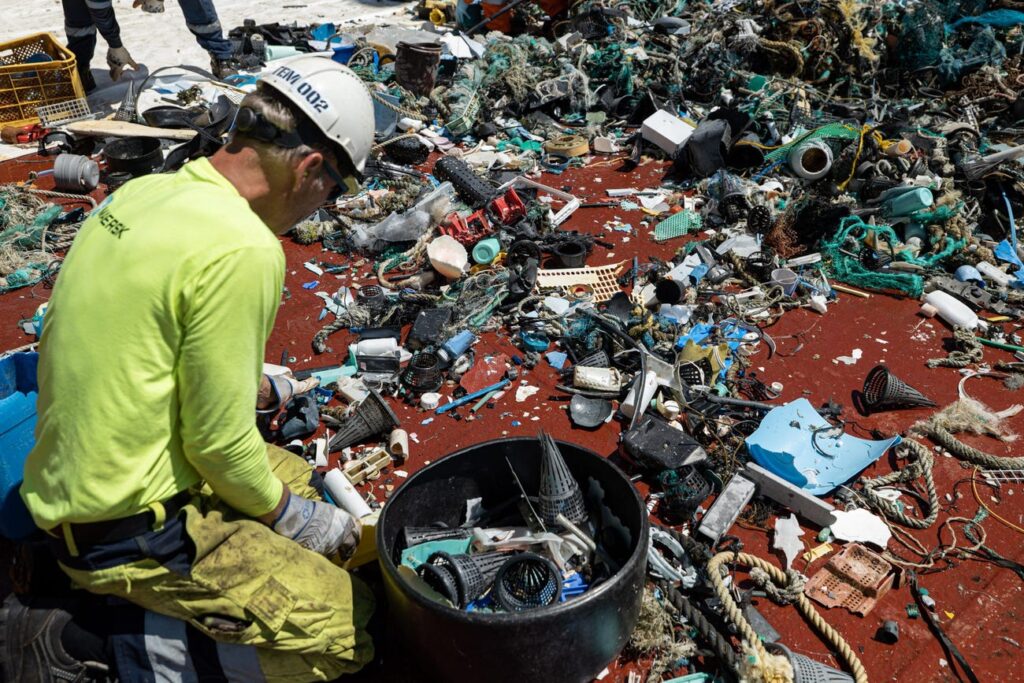
They use computational modeling to predict where and at what speed the movements in the water will be shifting the plastic. They then fill up their net, pull it on board, and bring it ashore for recycling.
The team are also turning some of the trash they collect into designer sunglasses—and earnings from the stylish shades will go toward helping support the nonprofit so they can continue cleaning up the ocean. The new glasses are the first product to be created from the recovered ocean debris—but they say it will not be the last.
The Ocean Cleanup
A timeline of hope
Slat estimates ten Jennies could clean half the garbage patch in five years, and if 10 Jennies were deployed to the five major ocean gyres, then 90% of all floating plastic could be removed by 2040.
This is what 9000kg of ocean plastic looks like inside the retention zone and on deck.
It’s no longer in the ocean, and next week, we’ll bring it to shore so it can’t pose a threat to the environment ever again. pic.twitter.com/Syl5uypND6
There are obvious challenges, like the fact that millions of pieces of plastic flow into the oceans every year, and that investors may believe river cleanup is easier, cheaper, and doesn’t require the use of fossil fuels to power the boats.
And that’s why Slat’s nonprofit has also launched a number of ‘interceptor’ barges to clean up polluting rivers, intercepting plastic before it reaches the ocean.
The Ocean Cleanup
Nevertheless—this is a huge breakthrough in the cleanup of ocean plastics, and one worth celebrating.
SCOOP Up the Innovative News and Share It Far and Wide…
Quote of the Day: “Life is not a process of discovery, but a process of creation. You are not discovering yourself, but creating yourself anew.” – Neale Donald Walsch
Photo: by Onkarphoto
With a new inspirational quote every day, atop the perfect photo—collected and archived on our Quotes page—why not bookmark GNN.org for a daily uplift?
Tybee_Island_Beach3 cc license wikimedia commons Melissa P from Douglasville, GA, USA
Melissa P, CC license
Like with spouses, some people lay their eyes on a stretch of beach and are never the same again.
Fortunately for the dunes along the shoreline of Tybee Island, Georgia, they caught the eye of a rich banker with a green heart of gold, who is paying a king’s ransom to create a storm-resistant living beach where animals and beachgoers can coexist.
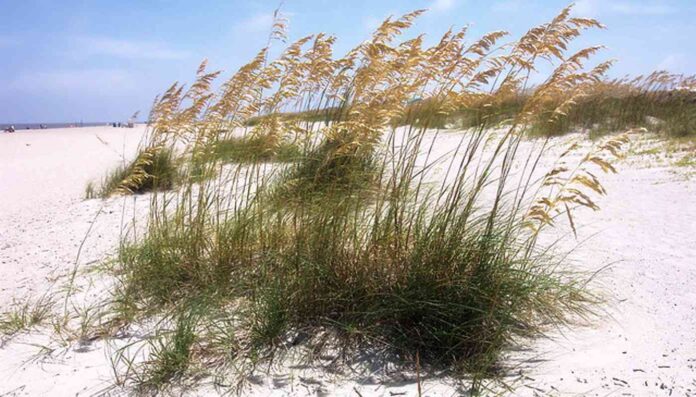
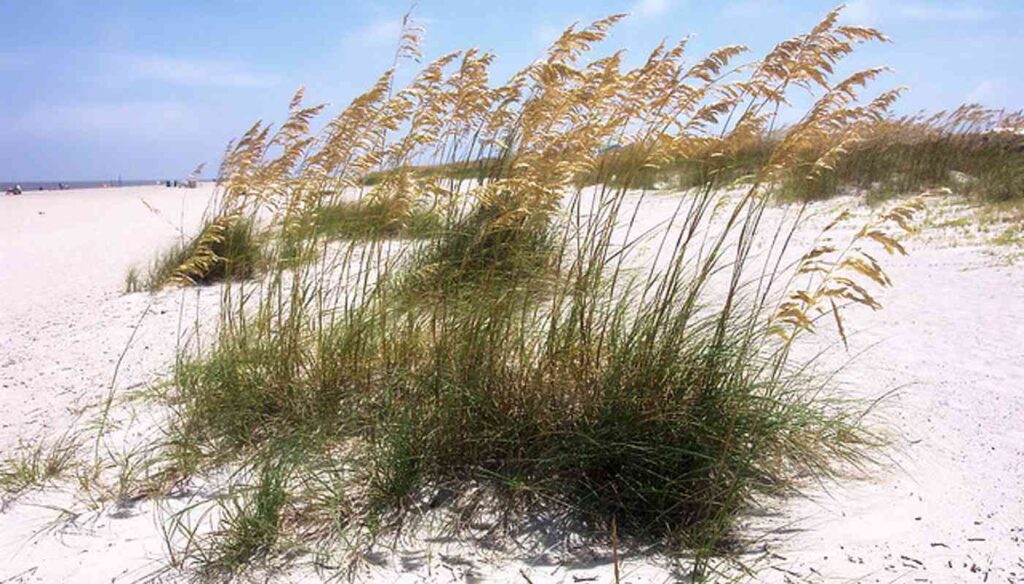
Sea oats sway in the breeze, while ghost crabs skitter around the dunes and kestrels hunt on the winds above. They are set among small overwalks, wind fences, dunes built up over time around coastal vegetation, which all serve to create a natural ecosystem that is also, according Alan Robertson, the best chance his small island has of surviving storms and sea-level rise.
“If you didn’t know it was not nature, well, you wouldn’t know [it was built by bulldozer],” Mr. Robertson, a former international banker who spent $15 million of his own money to restore an eight-acre beach on Tybee, told Christian Science Monitor.
Involving nearly 50,000 cubic yards of sand, the rebuild was costly but necessary, as scientists hypothesize that climate change will cause stronger storm surges, which has already raised sea levels around the Earth by around one foot.
Robertson’s restoration, which kindly included two parking lots offshore, is so successful, the National Oceanic and Atmospheric Administration asked him to write a book of best practices for beach restoration, while some experts have said he’s 6-7 years “ahead of this country.”
Out of beach reach
While many coastal communities in the U.S. turn to dykes, seawalls, floodgates, flood channels, and more to stop storms surges, these have the often deleterious effect of diminishing beaches, which themselves act as excellent storm protectors. Many beaches around the world however require regular “nourishment” in the form of thousands of tons of dredged sand which tends to erode twice as fast.
This is a consequence of the encroachment of civilization onto the beach ecosystem, leaving it a strip of manicured sand, but removing the dunes and other aspects behind.
Beach restoration is often at the center of discussion about whether to try and reinforce the coast against storms and rising oceans, or whether to simply stop building expensive infrastructure on what may become prone to regular flooding over the next 20-40 years.
However some scientists believe that if beaches are returned to their natural state, the worst of these effects will be avoided.
“The beach is a wonderful, free natural defense against the forces of the ocean. Beaches absorb the power of the ocean waves reducing them to a gentle swash that laps on the shoreline,” Orrin Pilkey, a professor of earth and ocean sciences at Duke University, told the Guardian.
Robertson describes himself as having entered “the Matrix,” after retiring to Tybee Island and buying a house, before immediately joining the local beach task force.
“Now I can’t look at this [sand] without seeing all the processes at work,” he says.
CONSERVE the Good News—Share This Story With Your Friends…
If a place that truly floated your boat was about to be torn down, you could try to move heaven and earth to save it—or, you could just move the house.
And that’s just what one determined couple did—but they didn’t take an overland route, they went by sea.
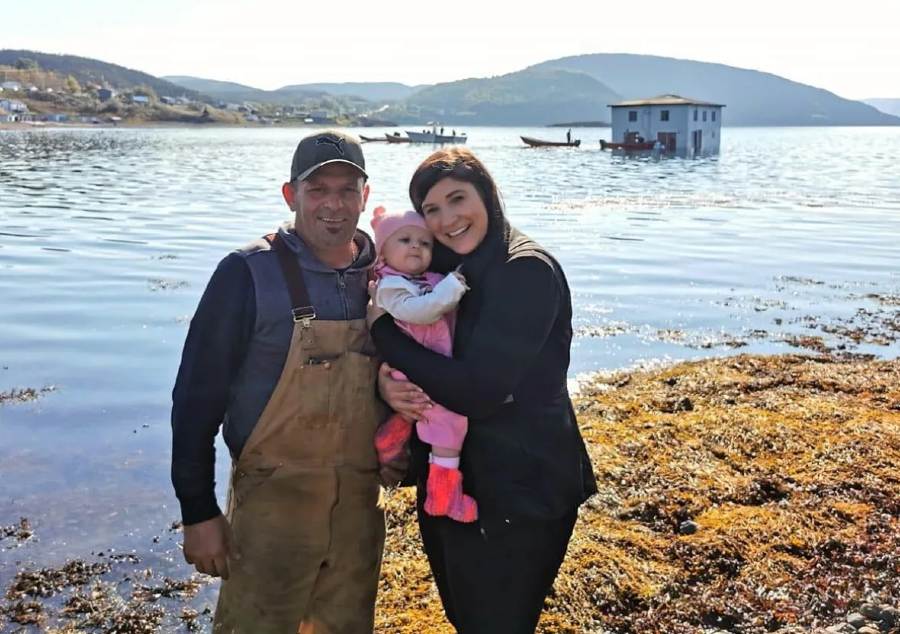
Daniele Penney fell in love with a two-story “biscuit box” house on the shores of Newfoundland’s Bay of Islands and longed to someday make it hers.
“It was the little green house on the point that I loved… I talked about it to my friends, my family. Everybody knew that my heart always belonged to this house,” Penney told CBC.
When Penney learned the home had been sold this past June and was slated for the wrecker’s ball, she and her boyfriend Kirk Lovell came up with an alternative solution. Rather than demolition, the couple asked the new owners if they’d allow them to relocate the structure to a different location and were given the go-ahead.
The logistics of moving the house overland weren’t in their favor, however, in Newfoundland, transporting various buildings across the local waterways had plenty of historical precedents.
During a government-sponsored resettlement period in the 1960s through the ’70s, seeing a home being hauled over the water was a fairly common sight along the coasts of Newfoundland and Labrador, but the practice goes back even further than that.
“My mother was born in a house that was transported from Cape Breton across the Canso straight to Mulgrave on the Nova Scotia mainland back in the 1910s,” CBC reader Murray Brown noted in a comment. “That house is still standing to this day.”
Prior to the move, the house was stripped to its studs, and holes were drilled in the flooring to allow any water that got inside to quickly drain.
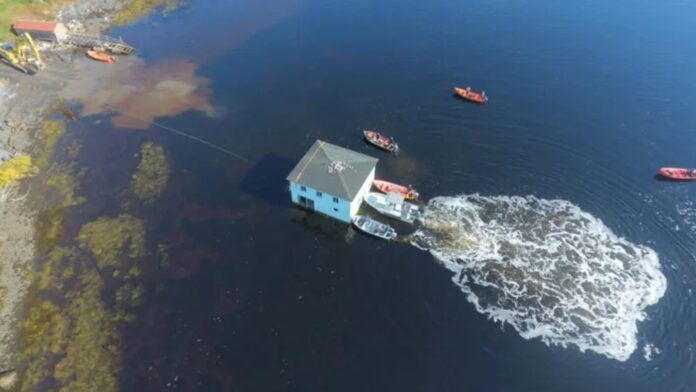
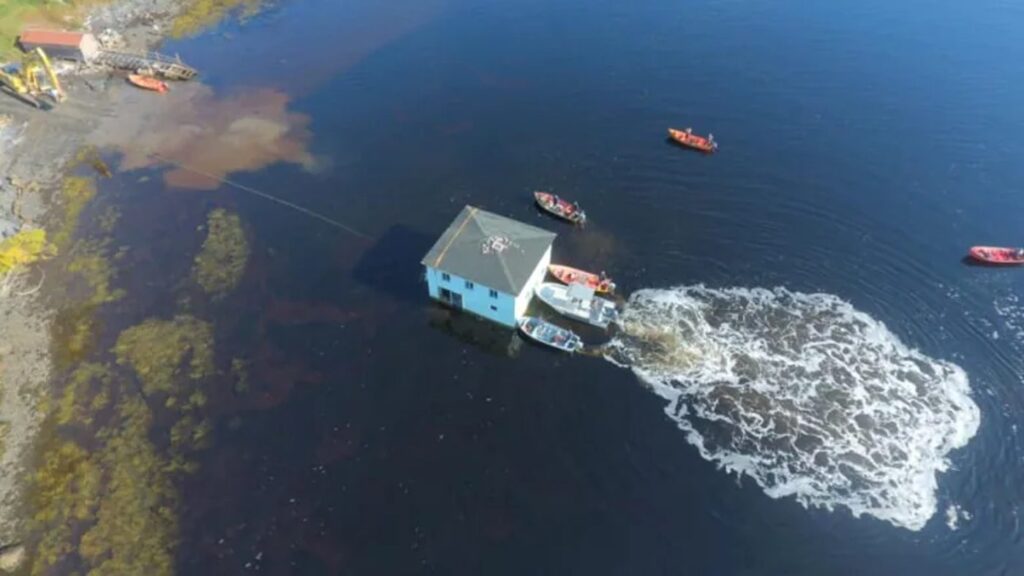
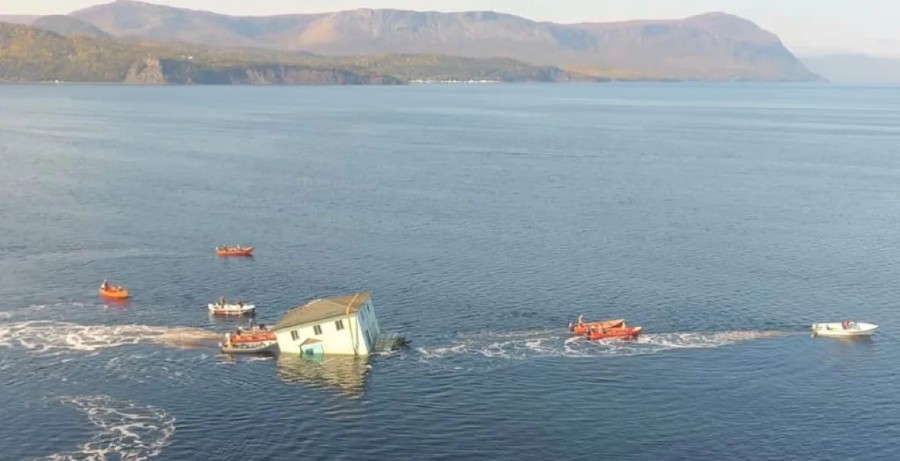
Next, it was lashed to a frame and placed on a series of floatation devices, including barrels and old tires, and launched into the water for the move to its final destination in the town of McIvers, about one kilometer away.
Guided by a small convoy of dories, the shore-to-shore journey took eight hours. For one heart-stopping moment, the house listed, one of its corners sinking precariously into the bay at the same time Lovell’s boat lost power.
Keith Goodyear
But just as it looked as if the beloved green biscuit box houseboat might go the way of the Titanic, a fleet of neighboring fisherfolk with small boats swooped in to help right the precious cargo.
“All of a sudden, there [were] dories coming from everywhere,” a grateful Penney told CBC. “The community definitely stepped up to help us get this house over.”
As friends and neighbors gathered to monitor the flotilla’s progress and cheer things on, “Operation House Float” became a true Newfoundland affair.
“Went to watch this unfold yesterday when we heard. I thought she was a goner for a few minutes. You should see it in its final resting place. Absolutely beautiful. Amazing that people did this often years ago,” CBC reader Haley Jesso proclaimed.
“You followed your dreams and I could not be happier for you,” added Lori Patrick. “I love that the extra dories saw your predicament and came to lend a hand. True Newfoundlanders!”
Although the house did take on a great deal of water during its voyage, the drainage holes seem to have done their job. Penney, Lovell, and their 6-month-old daughter, Harper—who are currently living in a trailer during the drying out and renovations—hope to be able to make the home their own once everything’s back in ship shape.
Daniele Penney
So while we’ve heard it said that hope floats, it’s nice to know that when it comes to saving the house of your dreams, home floats too.
(WATCH the video to see the boat being pulled below.)
Invaders, pirates, warriors—the history books taught us Vikings were brutal predators who travelled by sea from Scandinavia to pillage and raid their way across Europe and beyond.
Hans Splinter, CC license
Now cutting-edge DNA sequencing of more than 400 Viking skeletons from archaeological sites scattered across Europe and Greenland will rewrite the history books as it has shown:
Skeletons from famous Viking burial sites in Scotland were actually local people who could have taken on Viking identities and were buried as Vikings; many Vikings actually had brown hair not blonde hair; the genetic legacy in the UK has left the population with up to six per cent Viking DNA, and Viking identity was not limited to people with Scandinavian genetic ancestry—the study shows the genetic history of Scandinavia was influenced by foreign genes from Asia and Southern Europe before the Viking Age.
The six-year research project debunks the modern image of Vikings.
Co-first author Dr Daniel Lawson, from the University of Bristol, said, “The Vikings have an image of being fierce raiders, and they certainly were. What was more surprising is how well they assimilated other peoples.”
“Scottish and Irish people have integrated into Viking society well enough for individuals with no Scandinavian ancestry to receive a full Viking burial, in Norway and Britain. We studied two Orkney skeletons from Viking graves with Viking swords who share ancestry with present-day Irish and Scottish people, who could be the earliest Pictish genomes ever studied.”
Work from the School of Mathematics at the University of Bristol specialized in separating out very similar ancestries.
“People in Scandinavia during the Viking age were relatively similar, but we developed advanced methods to separate their ancestries. This showed that Norwegians predominantly went to Ireland and Iceland, whilst Danes came to England,” said Dr Lawson, Senior Lecturer in Data Science.
“But Viking were often diverse, with ancestry from all over Scandinavia and the British Isles found in the same raiding party. The Vikings coming to Britain and Ireland were part of a wider migration spanning several centuries.”
A history lesson
The word Viking comes from the Scandinavian term ‘vikingr’ meaning ‘pirate’.
The Viking Age generally refers to the period from A.D. 800, a few years after the earliest recorded raid, until the 1050s, a few years before the Norman Conquest of England in 1066.
The Vikings changed the political and genetic course of Europe and beyond: Cnut the Great became the King of England, Leif Eriksson is believed to have been the first European to reach North America, 500 years before Christopher Columbus, and Olaf Tryggvason is credited with taking Christianity to Norway. Many expeditions involved raiding monasteries and cities along the coastal settlements of Europe but the goal of trading goods like fur, tusks, and seal fat were often the more pragmatic aim.
Lead author Professor Eske Willerslev, a Fellow of St John’s College at the University of Cambridge and director of the University of Copenhagen’s Lundbeck Foundation GeoGenetics Centre, said: “We didn’t know genetically what they actually looked like until now. We found genetic differences between different Viking populations within Scandinavia which shows Viking groups in the region were far more isolated than previously believed. Our research even debunks the modern image of Vikings with blonde hair as many had brown hair and were influenced by genetic influx from the outside of Scandinavia.”
DNA testing
The team of international academics sequenced the whole genomes of 442 mostly Viking Age men, women, children, and babies from their teeth and petrous bones found in Viking cemeteries. They analyzed the DNA from the remains from a boat burial in Estonia and discovered four Viking brothers died the same day. The scientists have also revealed male skeletons from a Viking burial site in Orkney, Scotland, were not actually genetically Vikings despite being buried with swords and other Viking memorabilia.
There wasn’t a word for Scandinavia during the Viking Age—that came later. But the research study shows that the Vikings from what is now Norway traveled to Ireland, Scotland, Iceland, and Greenland. The Vikings from what is now Denmark traveled to England. And Vikings from what is now Sweden went to the Baltic countries on their all-male ‘raiding parties’.
DNA from the Viking remains were shotgun sequenced from sites in Greenland, Ukraine, The United Kingdom, Scandinavia, Poland, and Russia.
The team’s analysis also found genetically Pictish people ‘became’ Vikings without genetically mixing with Scandinavians. The Picts were Celtic-speaking people who lived in what is today eastern and northern Scotland during the Late British Iron Age and Early Medieval periods.
The Viking Age altered the political, cultural, and demographic map of Europe in ways that are still evident today in place names, surnames, and modern genetics.
Professor Søren Sindbæk, an archaeologist from Moesgaard Museum in Denmark who collaborated on the ground-breaking paper, explained: “Scandinavian diasporas established trade and settlement stretching from the American continent to the Asian steppe. They exported ideas, technologies, language, beliefs, and practices and developed new socio-political structures. Importantly our results show that ‘Viking’ identity was not limited to people with Scandinavian genetic ancestry.”
Assistant Professor Fernando Racimo, also a lead author based at the GeoGenetics Centre in the University of Copenhagen, stressed how valuable the dataset is for the study of the complex traits and natural selection in the past.
He explained, “This is the first time we can take a detailed look at the evolution of variants under natural selection in the last 2,000 years of European history. The Viking genomes allow us to disentangle how selection unfolded before, during and after the Viking movements across Europe, affecting genes associated with important traits like immunity, pigmentation and metabolism. We can also begin to infer the physical appearance of ancient Vikings and compare them to Scandinavians today.”
The genetic legacy of the Viking Age lives on today with six per cent of people of the UK population predicted to have Viking DNA in their genes compared to 10 per cent in Sweden.
Professor Willerslev concluded of the research, published in Nature, “The results change the perception of who a Viking actually was. The history books will need to be updated.”
LET Fascinating Stories Like This One Evolve in Those News Feeds—Click Share…
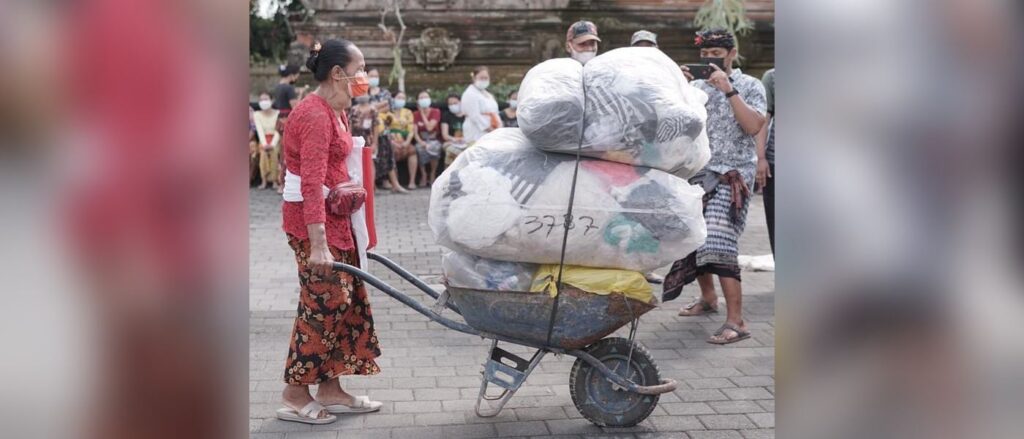
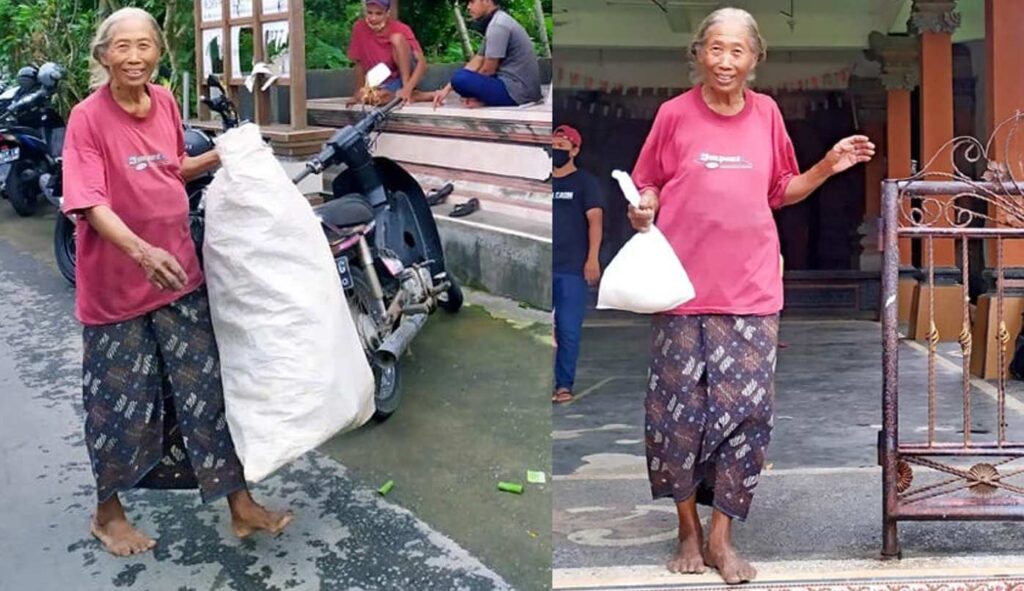
As the pandemic ground the tourism industry on Bali to a halt, a man sought to do the same to the problem of plastic pollution, by offering rice in exchange for plastic garbage.
The reaction was immediate, and compounding, with over 500 tons of plastic collected by over 200 villages on the Indonesian island, for which the organizers have given out over 550 tons of rice.
Bali’s beaches are so beautiful, it’s created an economy that derives 50% of GDP from tourism alone. But when COVID-19 grounded airlines around the world, and Bali’s principal supply of vacationers, Australia, went into severe lockdown, workers in the tourism industry had to go back to their rural villages—and plastic pollution skyrocketed.
A local restauranteur wanted to do something to help, and so started a barter system to help “cleanse the soul of nature” and relieve the economic hardship of his neighbors. In May 2020, he hosted the first Plastic Exchange in his own childhood village.
“I thought to myself, if it works in my village, it will work in other places as well,” Made Janur Yasa, Plastic Exchange’s founder, told CNN. “I realized this thing was getting bigger than I had ever imagined.”
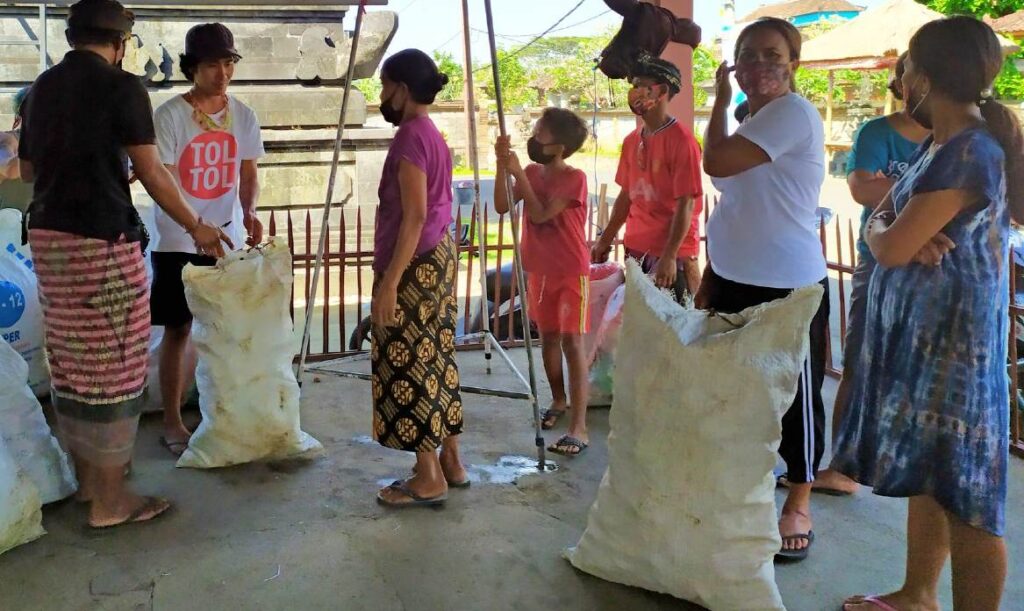
Local neighborhood groups called Banjars began organizing plastic collections once a month in the forests, towns, and on the beaches, before bringing it to Yasa for their main staple food.
Bali Tribune reports that in a single two-hour period in August of this year, a Plastic Exchange in the village of Saba collected turned in two tons of plastic, and that Yasa’s project was beginning to change the attitudes of islanders.
“Now, people think that plastic waste must be sorted and collected, then exchanged. There are even my people who collect plastic on the streets every day,” explained the director of the Saba Banjar, Kadek Merta Anggara.
The most commonly turned-in plastic is single-use carrier bags—shocking when one considers the success of Bye-Bye Plastic Bag, another plastic collection movement on Bali that focused exclusively on single-use bags, but plastic bottles and wrappers are also very common.
“People in Bali live in nature,” Yasa said. “Traditionally, we believe nature has a soul. People do care about the environment. But the plastic pollution in Bali is because of lack of education and practice.”
Yasa works with a small company that will send all the plastic he collects to the much larger island of Java, where it can be recycled, as no such infrastructure exists on Bali.
The sale of that raw material allows for the buying of rice from growers on Bali, supporting the local economy.
According to Yasa, picking up and recycling plastic is no longer tedious or pointless, he says it’s become “sexy,” and “the cool thing to do.” Long may it be so.
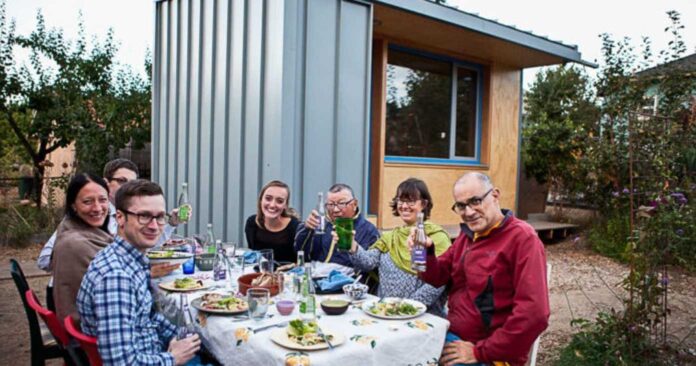
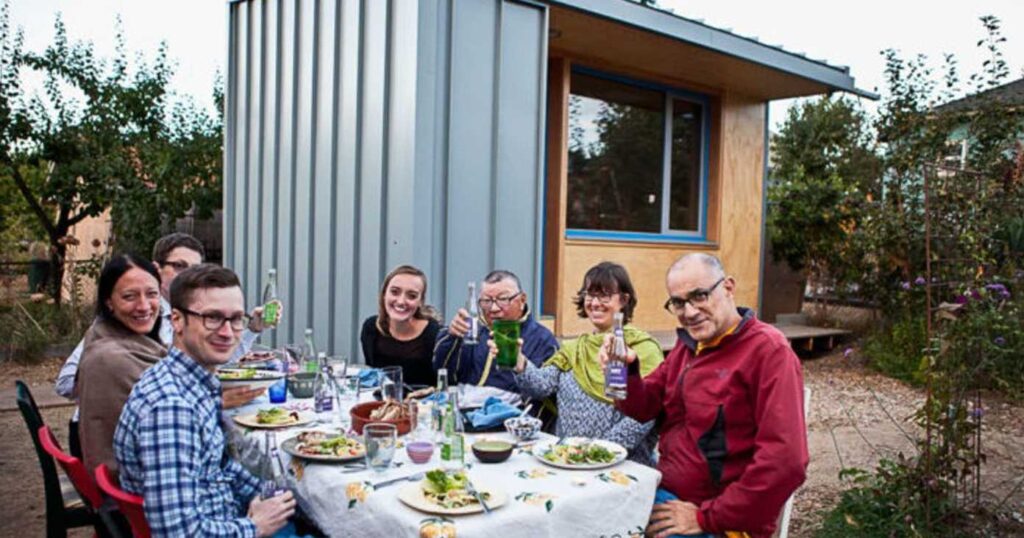
A pair of non-profits are housing homeless people in tiny sustainable homes in the backyards of charitable volunteers who decide to host them.
The Seattle-born partnership hopes to replicate the “cultural shift” brought about by Airbnb to tackle the homelessness epidemic in the Pacific Northwest, as well as introduce concepts of sustainable housing to thousands of charitable residents who have offered their yards.
After befriending a homeless resident outside of his architecture studio, Rex Hohlbein transitioned his career towards helping others by starting the BLOCK Project—its name playing on the words for neighborhood, and for the shape of the tiny houses he would pioneer.
Seattle has the dual problems of expensive real estate and the third-largest homeless community in the country, which led Hohlbein to reason that kindly neighbors could have a much better impact than waiting for a big-budgeted government program.
He founded BLOCK, along with Facing Homelessness. The latter would find backyards in which the former could build small, low-emission housing, and the government stepped in to make the process as legally expedient as possible.
Zoning laws already allowed for “accessory dwelling units” to be present on existing properties, and to ensure there’s no impact on property tax for those volunteering their backyards, the non-profits sign five-year leases for the tiny houses.
“Airbnb, the idea of a complete stranger staying in your house while you’re sleeping—that’s crazy,” Hohlbein told Fast Company. “I’m old enough to know the time before Airbnb, and that thought was just ludicrous. And now nobody thinks about it. So we believe that the same kind of cultural shift will happen with the Block Project.”
Won’t you be my neighbor?
The Block Project
Facing Homelessness evaluates possible volunteers’ yards to see if they fit, and they check out volunteers themselves. Then they play matchmaker and pair the house, the unhoused, and the property owners together—providing support to help the unhoused individual achieve specific goals, whether that’s job training or sobriety.
Their first match was a slam dunk. The first tiny home owner was 74 when he first moved in, and has become such a close part of the property owners’ life, it’s likely he will remain there until the end of his days.
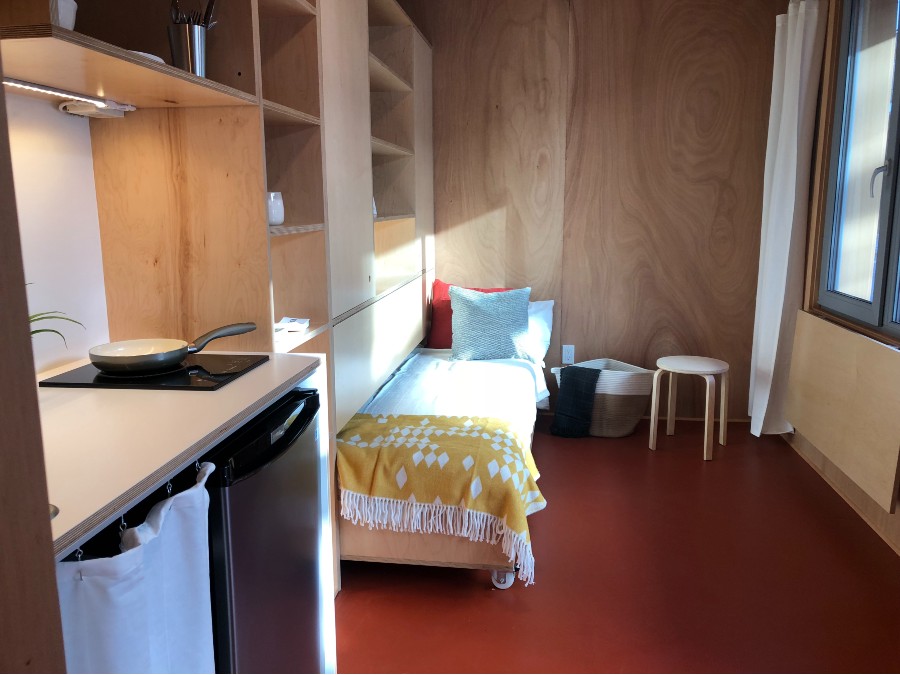
The 125-square feet houses from BLOCK Project were originally gummed up by contractors’ schedules and volunteers’ abilities. Now they are modular, and the panels are pre-fabricated, allowing for both the manufacturing and the assembly to be much quicker. They also introduce smart systems like rain-water catching and solar panels, and come with a little bit of furniture, a hot plate, and a bed.
“It was important that we didn’t just provide a home that was meeting shelter needs, but that it would be this advanced home,” Hohlbein said. “In fact, it would be the most forward home on the block.”
So far thousands of Seattle residents have registered their properties under the BLOCK Project, and fundraisers ensure everyone gets a “Welcome to the Neighborhood” gift bag with pots, pans, shampoo, towels, bed linens, and more.
(WATCH the video for this story below.)
HOUSE the Good News on Those Social Feeds—Share This Story…
Seeking to raise money for restaurant workers stuck at home during COVID, two bartending brothers decided to make like Bilbo Baggins and walk 3,200 miles across America to raise money.
Having just arrived on the sands of the Pacific Ocean, Aiden and Louis Ardine have now completed their five-month walkabout which started on the Asbury Park boardwalk in New Jersey.
They hoped to raise $30,000 for some charities that were helping restaurant workers waiting for restrictions to end, but ended up making $70,000—which they distributed to the COCO Fund and the Restaurant Workers’ Community Foundation.
Verizon heard about the endeavor and launched a donation drive in support of the Ardines, who passed through 11 states over the course of 162 days, 12,000 feet in various elevation changes, and about 80 degrees in temperature variation before the job was done.
“This would not have been possible without the help of a huge community of people, whether people were donating or helping us navigate our way across the United States.” Aiden Ardine told App. “This was definitely an adventure founded in a very hopeful notion about America, and it confirmed our suspicion that people are inherently good and want to help their neighbors.”
Typical of cross-country trips in this nation, their voyage was characterized by stunning scenery, long roads, and helpful strangers: like a man who passed them in the searing heat of summertime Iowa, before doubling back and giving them a cold Gatorade; or a Nevada campground manager who left them stay for free.
In Utah they had what the naturalist John Muir would have described as an “interview” with a black bear, when rounding a corner in the trail, they found themselves within a few feet of it.
When they reached San Francisco, their supporters were waiting for them on the beach. Afterwards they flew home along with their mom who had been there to meet them. After their adventurous sojourn, we can only imagine she was feeling proud of her sons indeed.
Quote of the Day: “Everything you want is on the other side of fear.” – Jack Canfield
Photo: by Arto Marttinen
With a new inspirational quote every day, atop the perfect photo—collected and archived on our Quotes page—why not bookmark GNN.org for a daily uplift?
Napa Valley vintners are increasingly turning towards winged-laborers for their pest control, and away from super toxic pesticides that poison everything, including their wine.
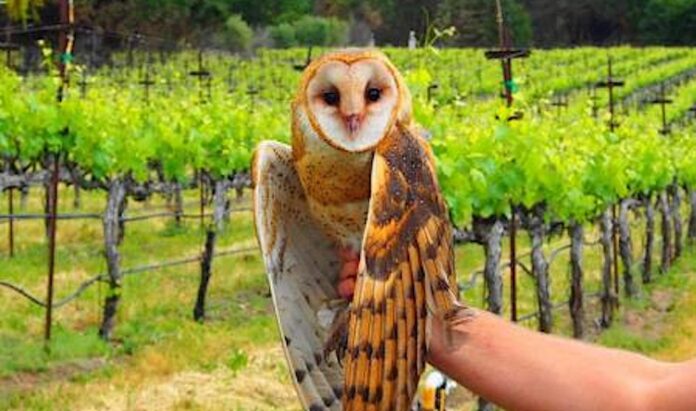
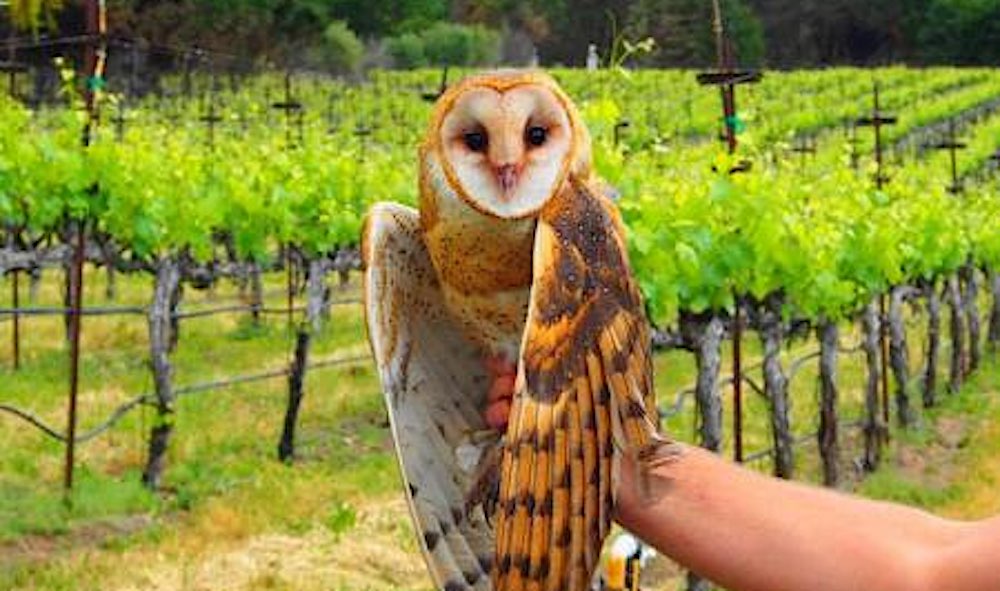
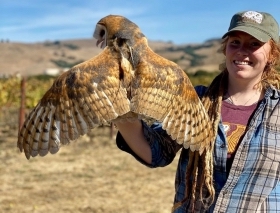
Barn owls in particular, but also hawks and other birds of prey, known as raptors, are being welcomed onto vineyards across California for their skill in rat-catching, vole-estation, and gopher-gobbling—and scientists studying the impact of these strategies are finding encouraging results.
For years, vintners in California were proud of the certain je ne sais quoi, inherent in their wines which made Napa a world class destination for growing grapes.
But, they were using super-toxic “rodent-icides,” a type of poison used to kill the mice and voles that munch on vines. The poison had become an industry standard in the state up until the 1980s when raptors, trapping, and other more holistic methods became more popular.
According to the nonprofit Napa Green, a trend toward chemical-free farming statewide is reflected in the threefold increase of organic winegrape acreage since 2005, with the number of organic acres doubling in just the last decade.
One of the world’s most efficient pest controllers is the barn owl, which is found on 6 of our 7 continents and is capable of eating 3,400 rodents each year.
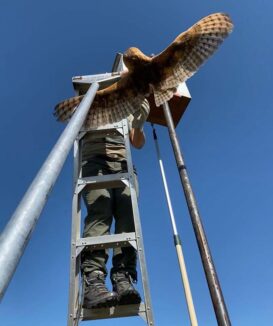
Matt Johnson is a wildlife professor at Humboldt State who began a program years ago to study raptor pest control in vineyards and research the results. A survey by graduate student Brooks Estes found that four-fifths of the 75 California grape growers purposely invite owls onto their property by constructing nest boxes.
Allison Huysman, Humboldt Stat
“We’re working mainly in Napa Valley, where there are over 300 barn owl nest boxes,” Johnson wrote on his department’s webpage.
“You can literally put a barn owl nest box in the exact location where you think you have a problem with the small mammals, and voilà! The owls will start using that area,” John C. Robinson, a local ornithologist, told Bay Nature Magazine.
Courtesy of Humboldt State
Johnson and his graduate students have found that barn owls like their boxes to sit at least 9 feet off the ground, face away from the sun, adjacent to grassy fields, and preferably far from forested acres.
Humbolt State grad student Jaime Carlino, by Matt Johnson
Early surveys suggest that it’s possible more vintners are using barn owls and even traps, than pesticides, but how much pesticide use was avoided in favor of the owls is not known.
All the incentives are there, however, because using owls is much less expensive than trapping: 26 cents per rodent versus $8.11. It’s also helping a beautiful group of species to thrive.
Ventura County uses birds, including hawks, falcons, and owls, instead of rodenticides, across nearly one hundred dikes and dams, as the rodents’ burrowing can damage the structures. Ventura County Watershed Protection Department reports a cost savings of $216,000 per channel mile compared with traps.
The owls not only help winemakers lower their costs, they make the vineyards greener and keep ecosystems healthier—a dignified result that reflects the majesty of the famous valley.
FLY This to Friends Who Love Wine And Owls —Share on Social media…
These two adorable cockapoos look a bit different now than when they were adopted by different families almost a year ago, but it was a ‘Puppy Love’ moment recently when they ran into each other on a walk.
David Kidd was out walking his one-year-old pup Monty when he spotted another dog that looked similar.
When Monty crossed paths with Rosie, they began hugging, as though being reunited, so their owners started chatting.
They realized then, that they were from the same litter.
Susan, Rosie’s mom lives in the next village, so this was a rare moment.
“My husband Lee and I took Rosie for a walk one day… It was so lovely, they both just jumped up and hugged each other, it was amazing,” Susan Killip told Bored Panda.
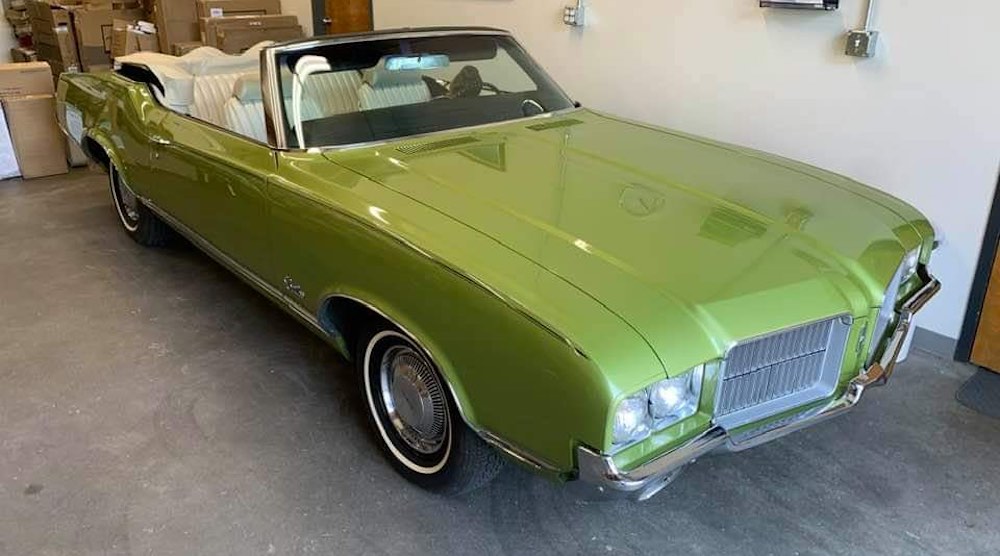
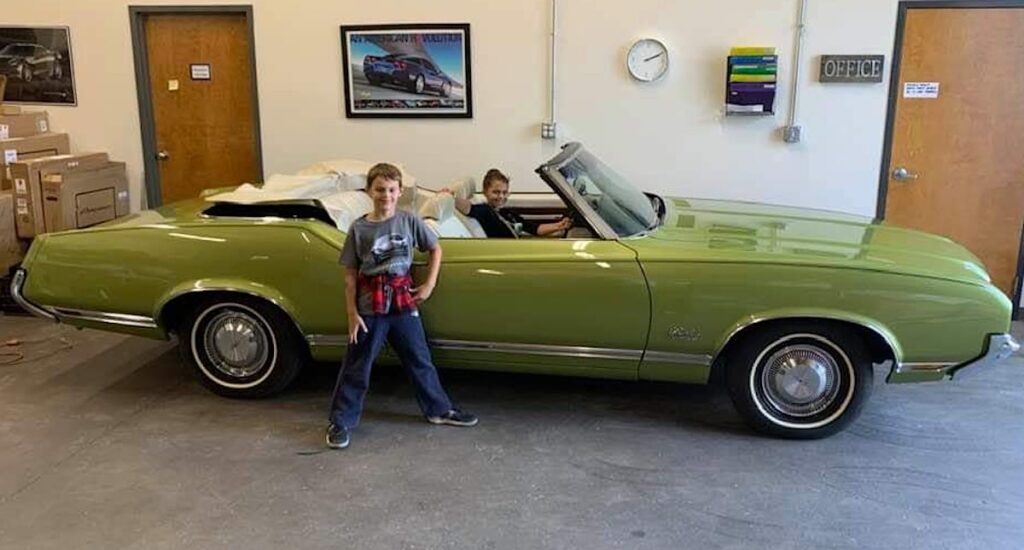
September 26 was a very sentimental day for John Berry, as he finally experienced the realization of a 40–year dream—one that he honestly thought might never happen.
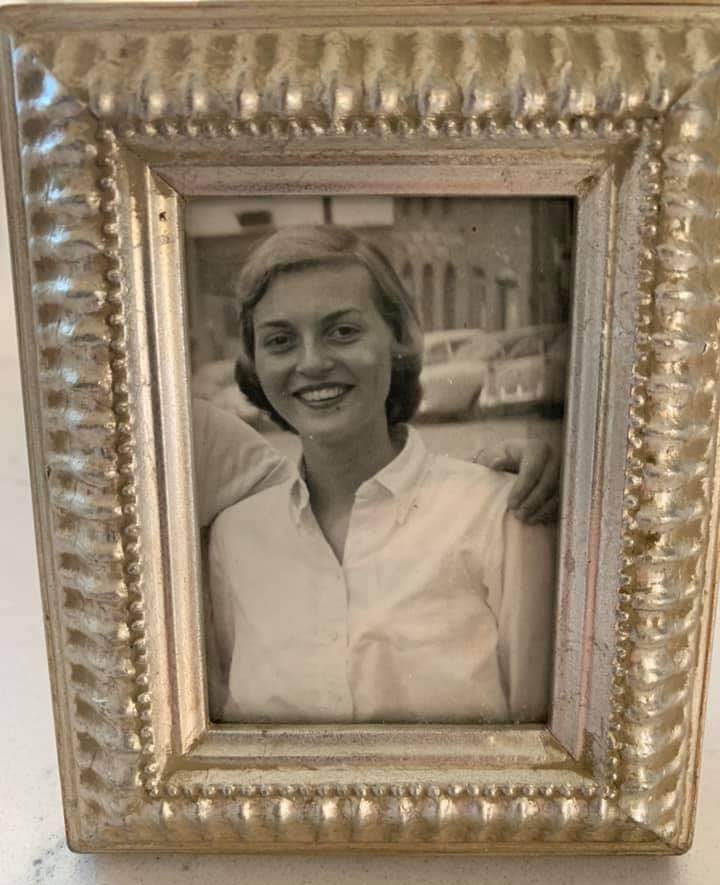
His sweet mother, Janis, passed away unexpectedly when he was 15 years old, and his dad eventually sold her car.
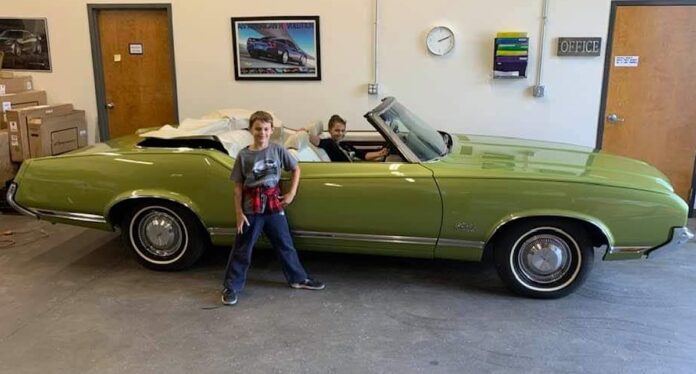
It was a 1971 Oldsmobile Cutlass Supreme convertible and was purchased by a GM auto executive in the early 80’s.
John never had the chance to own any of his mom’s personal belongings after she passed, but for decades he continued to hunt for that car.
Once he did find it, he stayed in touch with the second owner.
“Each time John contacted him, he was never interested in selling the car,” said Shannon Berry, John’s wife. “Thankfully, he was a ‘car guy’ and collector of classic Buick, Chevrolet and Oldsmobile cars.” So, they knew he was taking good care of the green convertible.
Out of the blue, he wrote to John in September, saying he’d had a ‘change of heart’ and was ready to pass ownership to him, knowing it would mean a lot to an original family member.
“To say he is thrilled, overjoyed and unbelievably emotional is an understatement,” Shannon told GNN.
The car is all-original, and has only 42,000 miles on the odometer. And, once it had arrived in Union, Kentucky, John even found some of his mom’s belongings still in the glove box—her sunglasses, maps of trips she’d taken, some earrings, an unused postage stamp from 1971, and a comb.
“It has been a real journey down memory lane, detailing and driving the car,” John says.
“So many memories are stirred riding in the same car that my late mother drove around in, with my siblings and I as small children.”
(WATCH the local news coverage below…)
IF YOU HAVE an interesting story of kindness or positivity to share with GNN, be sure and send it to us for review.
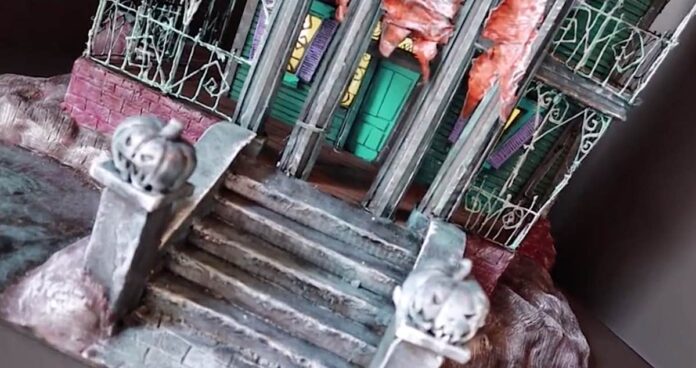
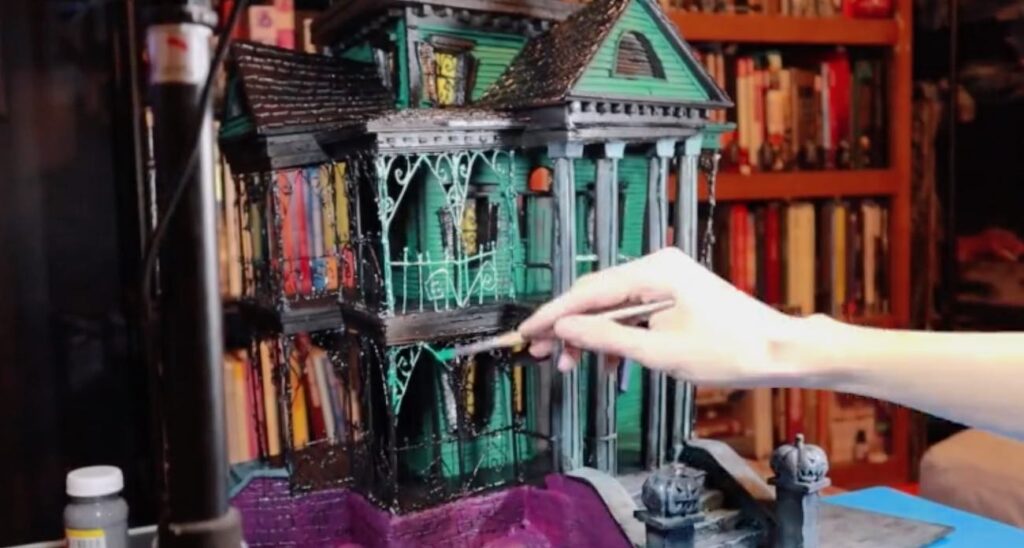
An industrial designer in Mexico recorded a time lapse video showing how he used shipping boxes, corrugated cardboard, and art supplies, to build a spooky model for Halloween.
“I like to build things, and I started making videos of it to keep me entertained—and inside—while in the pandemic,” said Carlos, from his home in Villa de Cos, Mexico.
“In the video I’m using an Amazon Box, corrugated cardboard, clay and some trash to make a Haunted Mansion.”
Quote of the Day: “Faith is the substance of things hoped for, the evidence of things not seen.” – King James Bible (Hebrews 11)
Photo: by Alex Radelich
With a new inspirational quote every day, atop the perfect photo—collected and archived on our Quotes page—why not bookmark GNN.org for a daily uplift?
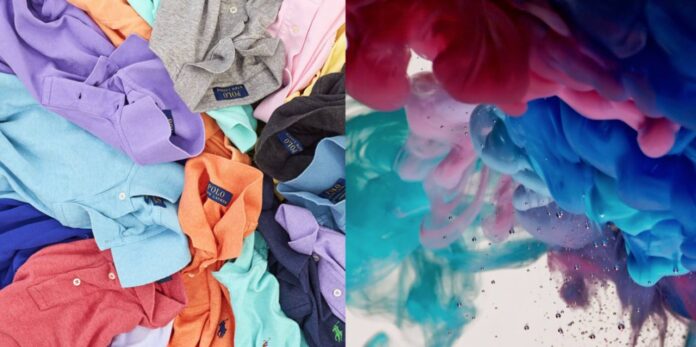
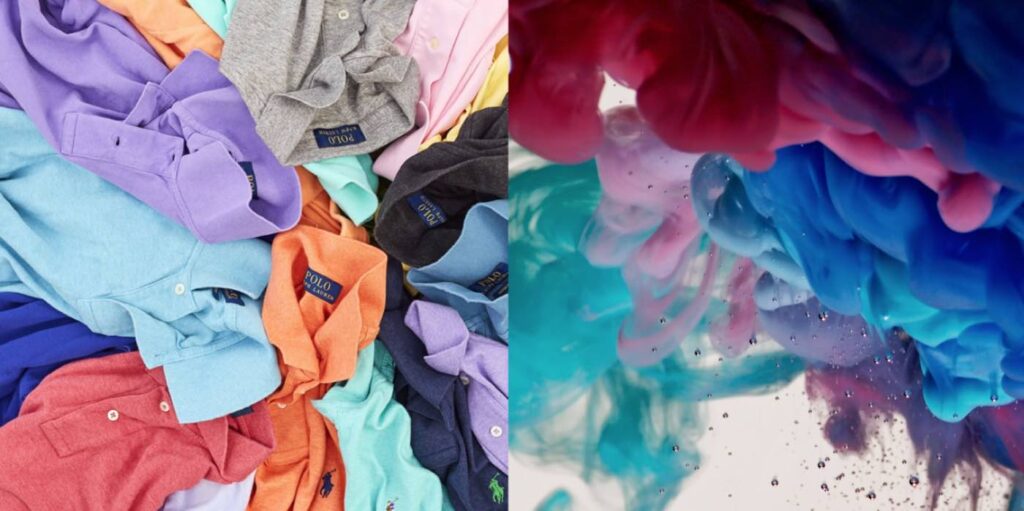
Every year, trillions of liters of water are used for fabric dyeing alone, generating around 20% of the world’s wastewater. Untreated, it is incredibly polluting, so requires rigorous, lengthy, and costly treatment to make the water reusable.
Ralph Lauren
Recently Ralph Lauren brought together four leading innovators, including Dow, to develop a way to significantly reduce the amount of water, chemicals, and energy needed to color cotton, by enabling up to 90% fewer processing chemicals, 50% less water, 50% less dye and 40% less energy without sacrificing color or quality.
The Color on Demand system uses a set of technologies that will enable the recycling and reuse of all the water from the dyeing process, to establish the “world’s first scalable zero wastewater” cotton dyeing system.
In addition to significant water savings, Color on Demand dramatically reduces the amount of chemicals, dyes, time, and energy used in the cotton dyeing process. Most importantly, the system utilizes the current dyeing equipment already in factories.
“If we want to protect our planet for the next generation, we have to create scalable solutions that have never been considered before. This requires deep and sometimes unexpected collaboration and a willingness to break down the barriers of exclusivity,” said Halide Alagöz, Chief Product & Sustainability Officer at Ralph Lauren.
According to a company statement, “To implement its groundbreaking approach, Ralph Lauren brought together four innovators in their respective fields, including Dow, a leader in materials science; Jeanologia, a leader in sustainable solutions for garment and fabric finishing, with high expertise in garment dyeing and close loop water treatment systems; Huntsman Textile Effects, a global chemicals company specializing in textile dyes and chemicals; and Corob, a global technology leader in dispensing and mixing solutions, to reimagine each stage of the coloring process and join this shared mission to create a more sustainable and efficient system for cotton dyeing.”
As part of the first phase of Color on Demand, Ralph Lauren has optimized the use of ECOFAST Pure Sustainable Textile Treatment, which is a pre-treatment solution.
And, they worked with World Wildlife Fund to accelerate change of the fashion industry’s outdated practices, and at a scale that matters.
An Open Source manual for change
This month, the companies have jointly released a detailed open-source manual to create an even more meaningful positive environmental impact.
The co-developed, step-by-step manual details how to use ECOFAST Pure, a cationic cotton treatment developed by Dow, that utilizes already existing dyeing equipment.
“We are proud to share it openly with our industry, with the hope that it will help transform how we preserve and use water in our global supply chains,” said Alagöz.
Ralph Lauren began integrating Color on Demand into its supply chain earlier this year and first launched products utilizing ECOFAST Pure as part of the Company’s Team USA collection for the 2020 Olympic & Paralympic Games in Tokyo.
“As fashion supply chains look to recover from impacts of the pandemic, there is a critical window to build more sustainable practices into production processes,” said Mary Draves, Chief Sustainability Officer at Dow. “By collaborating today to scale a less resource intensive dyeing process, we can help address pressing challenges, like climate change and water resiliency, in the long-term.”
FREE WILL ASTROLOGY – Week beginning October 15, 2021
Copyright by Rob Brezsny, FreeWillAstrology.com
LIBRA (Sept. 23-Oct. 22):
“We must never be afraid to go too far, for truth lies beyond,” declared novelist Marcel Proust. I wouldn’t normally offer that counsel to you Libras. One of your strengths is your skill at maintaining healthy boundaries. You know how to set dynamic limits that are just right: neither too extreme nor too timid. But according to my analysis of the astrological potentials, the coming weeks will be one of those rare times when you’ll be wise to consider an alternative approach: that the most vigorous truths and liveliest energies may lie beyond where you usually go.
SCORPIO (Oct. 23-Nov. 21):
Author William S. Burroughs claimed his greatest strength was a “capacity to confront myself no matter how unpleasant.” But he added a caveat to his brag: Although he recognized his mistakes, he rarely made any corrections. Yikes! Dear Scorpio, I invite you to do what Burroughs couldn’t. Question yourself about how you might have gone off course, but then actually make adjustments and atonements. As you do, keep in mind these principles: 1. An apparent mistake could lead you to a key insight or revelation. 2. An obstruction to the flow may prod you to open your mind and heart to a liberating possibility. 3. A snafu might motivate you to get back to where you belong. 4. A mess could show you something important you’ve been missing.
SAGITTARIUS (Nov. 22-Dec. 21):
In her novel We Have Always Lived in the Castle, Sagittarian author Shirley Jackson wrote, “Today my winged horse is coming, and I am carrying you off to the moon, and on the moon we will eat rose petals.” I wonder what you would do if you received a message like that—an invitation to wander out on fanciful or mysterious adventures. I hope you’d be receptive. I hope you wouldn’t say, “There are so such things as flying horses. It’s impossible to fly to the moon and eat rose petals.” Even if you don’t typically entertain such whimsical notions, the time is favorable to do so now. I bet you will be pleased with the unexpected grace they bring your way.
CAPRICORN (Dec. 22-Jan. 19):
Capricorn author Susan Sontag wrote about people who weren’t receptive to her intensity and intelligence. She said she always had “a feeling of being ‘too much’ for them—a creature from another planet—and I would try to scale myself down to size, so I could be apprehendable and lovable by them.” I understand the inclination to engage in such self-diminishment. We all want to be appreciated and understood. But I urge you to refrain from taming and toning yourself down too much in the coming weeks. Don’t do what Sontag did. In my astrological opinion, it’s time for you to be an extra vivid version of yourself.
AQUARIUS (Jan. 20-Feb. 18):
Judging from current cosmic rhythms, I’m inclined to say that it may be wise for you to dose yourself with intoxicants. JUST KIDDING! I lied. Here’s the truth: I would love for you to experience extra rapture, mystic illumination, transcendent sex, and yes, even intoxication in the coming weeks. My analysis of the astrological omens suggests these delights are more likely and desirable than usual. However, the best way to arouse them is by communing with your favorite non-drug and non-alcohol inebriants. The benefits will last longer and incur no psychological cost.
PISCES (Feb. 19-March 20):
“The truth is,” writes cartoonist Bill Watterson, “most of us discover where we are headed when we arrive.” I sense this will describe your life during the next six weeks. Your long, strange journey won’t come to an end, of course. But a key chapter in that long, strange journey will climax. You will be mostly finished with lessons you have been studying for many moons. The winding road you have been following will end up someplace in particular. And sometime soon, I suspect you’ll spy a foreshadowing flash of this denouement.
ARIES (March 21-April 19):
According to my understanding of the upcoming weeks, life will present you with unusual opportunities. I suspect you will find it reasonable and righteous to shed, dismantle, and rebel against the past. Redefining your history will be a fun and worthy project. Here are other related activities I recommend for you: 1. Forget and renounce a long-running fear that has never come true. 2. Throw away a reminder of an old experience that makes you feel bad. 3. Freshen your mood and attitude by moving around the furniture and decor in your home. 4. Write a note of atonement to a person you hurt once upon a time. 5. Give yourself a new nickname that inspires you to emancipate yourself from a pattern or habit you want to leave behind.
TAURUS (April 20-May 20):
Taurus poet Donte Collins Ancient Chinese philosopher Lao Tzu told us that water is in one sense soft and passive, but is in another sense superb at eroding jams and obstacles that are hard and firm. There’s a magic in the way its apparent weakness overcomes what seems strong and unassailable. You are one of the zodiac’s top wielders of water’s superpower, Cancerian. And in the coming weeks, it will work for you with even more amazing grace than usual. Take full advantage of your sensitivity, your emotional intelligence, and your empathy. wrote, “A lover doesn’t discourage your growth. A lover says, ‘I see who you are today, and I cannot wait to see who you become tomorrow.'” I hope you have people like that in your life, Taurus—lovers, friends, allies, and relatives. If there is a scarcity of such beloved companions in your life, the next eight weeks will be an excellent time to round up new ones. And if you are connected with people who delight in your progress and evolution, deepen your connection with them.
GEMINI (May 21-June 20):
Gemini author Lisa Cron advises her fellow writers, “Avoid exclamation points! Really!! Because they’re distracting!! Almost as much as CAPITALIZING THINGS!!!” I’ll expand her counsel to apply not just to writers, but to all of you Geminis. In my astrological opinion, you’re likely to find success in the coming weeks if you’re understated, modest, and unmelodramatic. Make it your goal to create smooth, suave, savvy solutions. Be cagey and cool and crafty.
CANCER (June 21-July 22):
Ancient Chinese philosopher Lao Tzu told us that water is in one sense soft and passive, but is in another sense superb at eroding jams and obstacles that are hard and firm. There’s a magic in the way its apparent weakness overcomes what seems strong and unassailable. You are one of the zodiac’s top wielders of water’s superpower, Cancerian. And in the coming weeks, it will work for you with even more amazing grace than usual. Take full advantage of your sensitivity, your emotional intelligence, and your empathy.
LEO (July 23-Aug. 22):
Leo author James Baldwin told us, “You read something which you thought only happened to you, and you discover that it happened 100 years ago to [Russian novelist] Fyodor Dostoyevsky. This is a great liberation for the suffering, struggling person, who always thinks that he is alone.” In that spirit, Leo, and in accordance with astrological omens, I urge you to track down people who have had pivotal experiences similar to yours, either in the distant or recent past. These days, you need the consoling companionship they can provide. Their influence could be key to liberating you from at least some of your pain.
VIRGO (Aug. 23-Sept. 22):
Poet Octavio Paz described two kinds of distraction. One is “the distraction of the person who is always outside himself, lost in the trivial, senseless, turmoil of everyday life.” The other is “the distraction of the person who withdraws from the world in order to shut himself up in the secret and ever-changing land of his fantasy.” In my astrological opinion, you Virgos should specialize in the latter during the coming weeks. It’s time to reinvigorate your relationship with your deep inner sources. Go in search of the reverent joy that comes from communing with your tantalizing mysteries. Explore the riddles at the core of your destiny.
WANT MORE? Listen to Rob’s EXPANDED AUDIO HOROSCOPES, 4-5 minute meditations on the current state of your destiny — or subscribe to his unique daily text message service at: RealAstrology.com
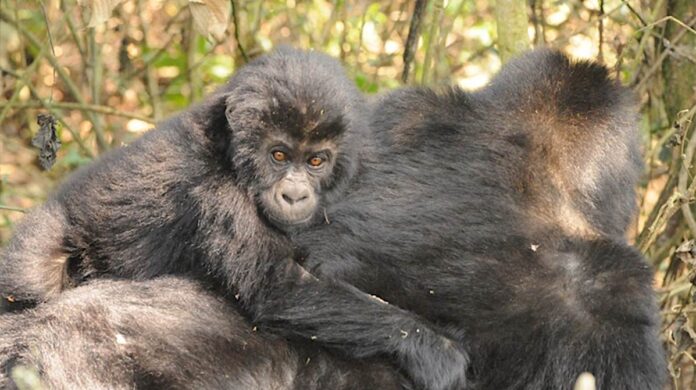
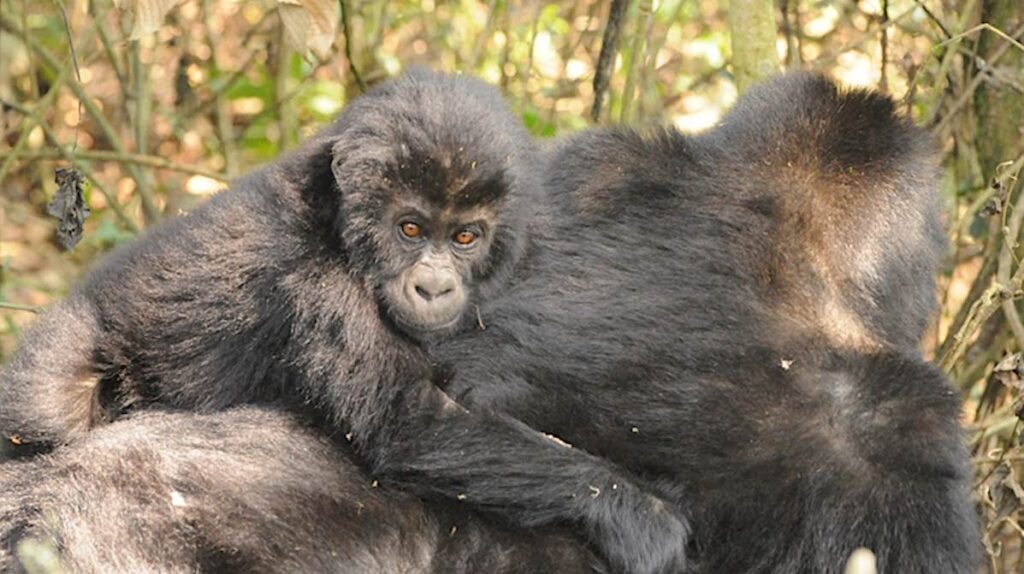
A new study estimated the global population of Grauer’s gorillas—the world’s largest gorilla subspecies–and it reported good news for rangers, nonprofits, and caretakers who have been saving this Critically Endangered animal.
Photo credit: Andrew Plumptre, WCS study author
From a previous global estimate of 3,800 individuals, the number has almost doubled to 6,800 individuals.
This revised estimate comes from recent field surveys conducted in one of this animal’s largest remaining strongholds, an area that was previously inaccessible for surveys in eastern Democratic Republic of Congo.
Led by the Wildlife Conservation Society (WCS), results were published in the American Journal of Primatology.
A previous peer-reviewed paper led by WCS in 2016 showed a decline of almost 80 percent in the population of these gorillas since the last range-wide survey carried out in the mid-1990s. However, due to insecurity in the region, the 2016 estimate did not include data from all areas of the Grauer’s gorilla range.
The 2021 population estimate includes new field surveys in the Oku forests and suggest declines were not as great as previously feared. The findings also provide hope for the conservation of Grauer’s gorilla, as populations in the highland sectors of the Kahuzi-Biega National Park have also remained relatively stable over the past 20 years..
“It is a tribute to the courage and dedication of the Congolese biologists who took part,” said the study’s lead author Dr. Andrew Plumptre, Key Biodiversity Area Secretariat hosted by Birdlife International, who conducted the research with WCS.
Additionally, there is good news for chimpanzee populations, which have also held steady over the past twenty years.
“We show that gorillas and chimpanzees are avoiding areas where people are extracting minerals, an occupation that contributes to the insecurity in the region,” said Plumptre.
Grauer’s gorillas (Gorilla beringei graueri) are a subspecies of eastern gorilla found only in the eastern Democratic Republic of Congo and can weigh over 450 pounds (204 kilograms).
The authors say that the results of the study underscore the importance of good forest protection in the region. In 2018, three local community forest concessions comprising a total area of 1,465 square kilometers (565 square miles) were created and attributed to community management in Oku.
Additionally, WCS is working with these communities, the Government’s Nature Conservation Agency, ICCN, and the local NGO Reserve des Gorilles de Punia (RGPu), to create an additional Wildlife Reserve in the Oku forests to secure up to 3,000 square kilometers (1,158 square miles) of forest for gorillas and other flora and fauna in this area.
More than 80 percent of the world’s supply of coltan—used in many electronic devices—is found in the DRC, including much of the Grauer’s gorilla’s prior habitat. The focus of conservation efforts must now be on supporting local community management of the Oku forests to protect gorillas and their habitats.
HANG This Great News From the Trees on Social Media…
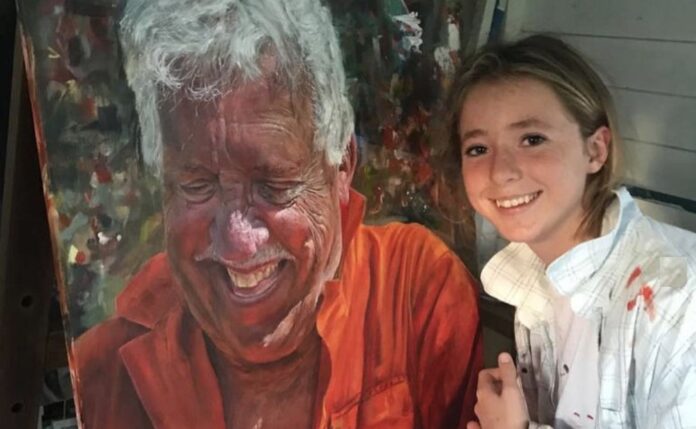
A 14-year-old in Wales took up painting during lockdown, and is now selling her canvases for thousands of dollars.
Makenzy Beard from the city of Swansea, has garnered international attention for her portraits of human faces cloaked in jubilant smiling visages after her first piece went viral on social media—a portrait of John Tucker, the farmer next door.
“I had some free time on my hands and my mum used to love to paint so we had paints and canvasses and brushes. I thought ‘why not give it a try’ and it escalated from there,” she told the BBC.
For Tucker, it was simply the case that a local lass asked one day to take a photograph of him while he was bringing hay nets down from his truck.
Now he says that all his family thinks it looks exactly like him.
Beard entered the portrait into a competition, and it won a place at the Young Artists’ Summer Show in the Royal Academy of Arts.
Fast forward to October, when Blackwater Gallery in Cardiff exhibited some of her other works and reported they had sold several to international buyers from the U.S., UK, and Middle East—one of whom offered her £10,000.
Makenzy’s most recent portrait is of her grandfather, Bernard Davies, and is one of the 6 currently hanging in Blackwater. It’s not for sale, however, as Beard plans to keep it for sentimental reasons. It’s not hard to see why—Mr. Davies is depicted with the most heart-warming and grandfatherly smile one could ever imagine.
Her collection, which can be seen on Instagram, consists of workmen and children, mostly the old and the young, in expressions of joy or indifference. They are interspersed with pictures of her other great love—field hockey for Wales.






















 An industrial designer in Mexico recorded a time lapse video showing how he used shipping boxes, corrugated cardboard, and art supplies, to build a spooky model for Halloween.