











All News - Page 594 of 1733 - Good News Network
Home Blog Page 594

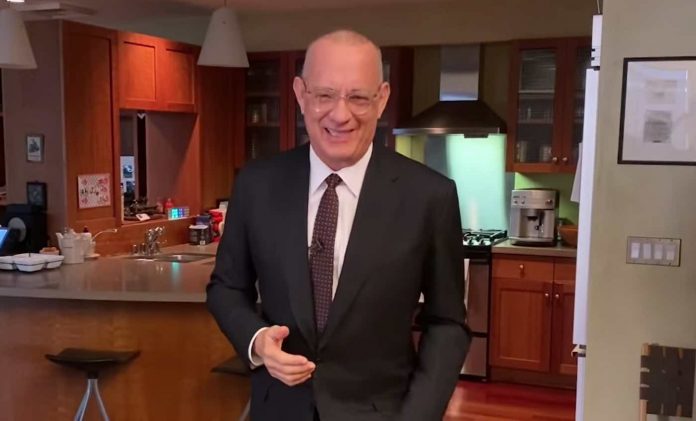
Watch Tom Hanks Kick Off First Ever SNL Episode Filmed From Home With Sweet Intro About His Recovery

For the first time in 45 years of broadcasting, the beloved actors and comedians from the Saturday Night Live television show filmed an entire episode from the comfort of their quarantined homes.

It has been a month since the show stopped airing new episodes as a means of respecting social distancing amidst the COVID-19 outbreaks. Earlier this week, however, the cast finally rejoined audience members by contributing all of the episode’s sketches and clips from home.

The SNL cast members were not the only ones rejoining the public sphere; Tom Hanks—who has hosted a number of episodes in the past—kicked off the historic episode with a monologue discussing his brief hospitalization and recovery from the novel coronavirus in Australia.

LOOK: Jimmy Fallon Asks Twitter to Change Movie Titles Into Quarantine Editions and the List is Hilarious

“Ever since being diagnosed, I have been more like America’s dad than ever before,” Hanks said, “since no one wants to be around me very long and I make people uncomfortable.”

Furthermore, the cast was joined by previous comedic guest stars such as Larry David and Alec Baldwin, as well as Fred Armisen, Bill Hader, John Mulaney, Adam Sandler, Tina Fey, and Amy Poehler for a solemn musical memorial tribute to the show’s longtime musical director Hal Willner.

MORE: Watch These Self-Isolating Seniors Stave Off Boredom by Playing Life-Sized ‘Hungry, Hungry Hippos’

Regardless of the turbulent circumstances surrounding the show’s release, Hanks reassured viewers that the show was made with the intention of bringing some much-needed joy, laughter, and unity to the internet.

“Is it going to look a little different than what you’re used to?” he asked the camera. “Yes. Will it be weird to see sketches without big sets and costumes? Sure. But will it make you laugh? Eh—it’s SNL. There’ll be some good stuff, maybe one or two stinkers. You know the drill.”

To view the entire episode, check out the full playlist of sketches and segments on the SNL YouTube channel—or just get a taster by watching the Tom Hanks monologue below.

Multiply The Laughter By Sharing This With Your Friends On Social Media…
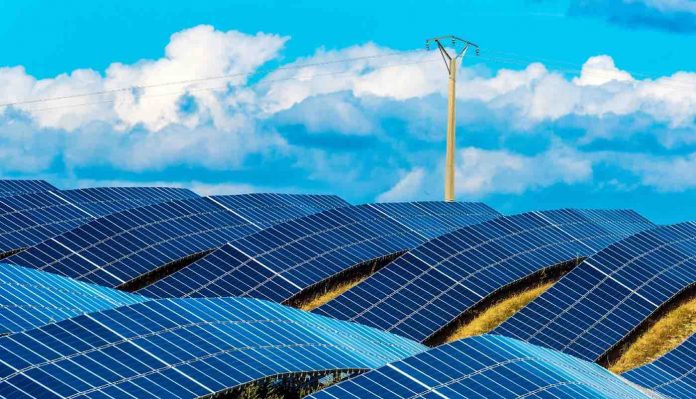
Exciting New Data Says Renewables Accounted for Almost Three Quarters of New Energy Capacity in 2019

In an exciting reported victory for sustainability, new renewable power accounted for a whopping 72% of all global power expansion in 2019.

According to new data released last week by the International Renewable Energy Agency (IRENA), the renewable energy sector added 176 gigawatts (GW) of generating capacity globally in 2019, although this was notably lower than the (revised) 179 GW added in 2018.

However, IRENA’s annual Renewable Capacity Statistics 2020 shows that renewables expanded by 7.6% last year with Asia dominating growth and accounting for 54% of total additions. While expansion of renewables slowed last year, total renewable power growth outpaced fossil fuel growth by a factor of 2.6, continuing the dominance of renewables in power expansion first established in 2012. Solar and wind contributed 90% of total renewable capacity added in 2019.

RELATED: Newly-Developed Enzyme That Breaks Down Plastic Bottles in Hours is On Track to Change the Recycling Game

“Renewable energy is a cost-effective source of new power that insulates power markets and consumers from volatility, supports economic stability and stimulates sustainable growth,” said IRENA Director-General Francesco La Camera. “With renewable additions providing the majority of new capacity last year, it is clear that many countries and regions recognize the degree to which the energy transition can deliver positive outcomes.

“While the trajectory is positive, more is required to put global energy on a path with sustainable development and climate mitigation—both of which offer significant economic benefits,” continued Mr. La Camera. “At this challenging time, we are reminded of the importance of building resilience into our economies. In what must be the decade of action, enabling policies are needed to increase investments and accelerate renewables adoption.”

CHECK OUT: Bill Gates Has Just Invested in a Company That Grows Palm Oil in a Lab to Save the Rainforests

Renewables accounted for at least 70% of total capacity expansion in almost all regions in 2019, other than in Africa and the Middle East, where they represented 52% and 26% of net additions respectively.

The additions took the renewable share of all global power capacity to 34.7%, up from 33.3% at the end of 2018. Non-renewable capacity expansion globally followed long-term trends in 2019, with net growth in Asia, the Middle East and Africa, and net decommissioning in Europe and North America.

MORE: Impelled by Reactor Meltdown, Fukushima Japan Vows to Achieve 100% Renewable Energy Use in 20 Years

Solar added 98 GW in 2019, 60% of which was in Asia. Wind energy expanded by close to 60 GW led by growth in China (26 GW) and the United States (9 GW). The two technologies now generate 623 GW and 586 GW respectively—close to half of global renewable capacity. Hydropower, bioenergy, geothermal and marine energy displayed modest year on year expansion of 12 GW, 6 GW, 700 MW, and 500 MW respectively.

Asia was responsible for over half of new installations despite expanding at a slightly slower pace than in 2018. Growth in Europe and North America increased year on year. Africa added 2 GW of renewable capacity in 2019, half of the 4 GW it installed in 2018.

Want to learn more? Read the “Highlights of the key findings” or the full IRENA report.

Reprinted from the International Renewable Energy Agency (IRENA)

Power Up With Positivity By Sharing The Good News With Your Friends On Social Media…
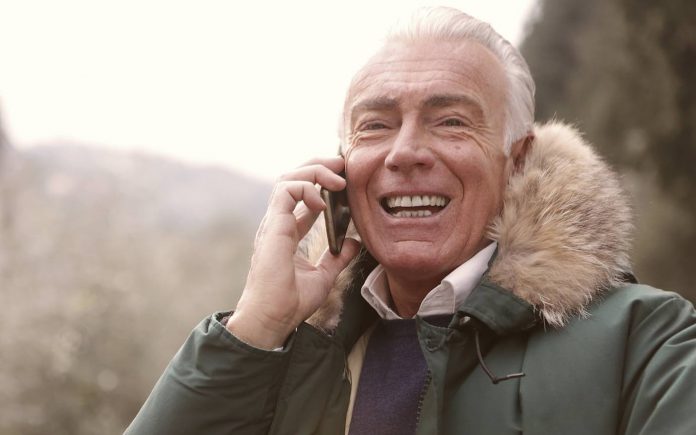
17-Year-Old ‘Angel’ Cashier Picks Up $173 Grocery Bill for Senior Shopper Who Found Himself Short on Cash

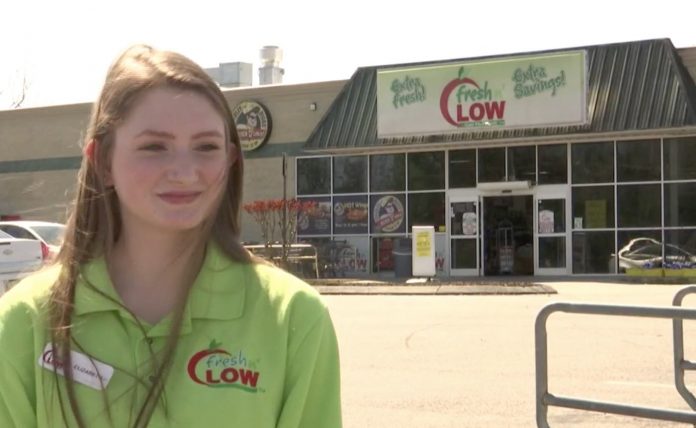
This 17-year-old grocery store cashier is being hailed for going above and beyond the call of duty to help a senior shopper named Layne McKeel.

McKeel hasn’t been able to get out of his house very much since the start of the novel coronavirus outbreaks. He had just picked up his disability payment last week when he decided to go get some food and supplies from the Fresh n’ Low supermarket in Georgetown, Tennessee.

The young grocery store employee named Elizabeth Taylor had just finished ringing up McKeel at checkout when he was distressed to find himself $33 short of his final $173 bill.

RELATED: Teens Launch Hotline for Isolated Seniors to Listen to Pre-Recorded Jokes, Stories, and Messages of Hope

After explaining his dilemma to Elizabeth, McKeel was about to put some of his items back on the shelf—but before he could, she simply insisted on paying for all of his groceries instead.

“It was all essential stuff so I was just like… you know… and he was like ‘what do I owe you?’ And I was like no, it’s fine, I’ll take care of it, it’s okay,” Elizabeth recalled to WRCB.

When asked about what inspired her to show such kindness towards a stranger, Elizabeth simply shrugged and said: “We’ve seen a lot of older people, and they’re all trying to buy groceries and a lot of places have ran out of stuff, and so the older people are kind of taking the downfall for that. I just try to give back when I can.”

MORE: Tyler Perry Picks Up the Tab for All Groceries Purchased During Senior Shopping Hour at 73 Supermarkets

McKeel, on the other hand, was extremely touched by the gesture, calling her an “angel” and “the light of day”.

This is just one of many positive stories and updates that are coming out of the COVID-19 news coverage this week. For more uplifting coverage on the outbreaks, click here.

(WATCH the news coverage below)

Be Sure And Share This Sweet Story Of Kindness With Your Friends On Social Media…
“It is good to love many things, for therein lies the true strength, and whosoever loves much performs much, and can accomplish much, and what is done in love is well done.” – Vincent van Gogh

By Carles Rabada

Quote of the Day: “It is good to love many things, for therein lies the true strength, and whosoever loves much performs much, and can accomplish much, and what is done in love is well done.” – Vincent van Gogh

Photo: by Carles Rabada – public domain, cropped

With a new inspirational quote every day, atop the perfect photo—collected and archived on our Quote of the Day page—why not bookmark GNN.org for a daily uplift?

Teens Launch Hotline for Isolated Seniors to Listen to Pre-Recorded Jokes, Stories, and Messages of Hope

As a means of entertaining lonely adults during the novel coronavirus outbreaks, a team of Canadian high schoolers created a hotline that plays pre-recorded messages of positivity.

The Joy4All project was launched by students from the Ever Active Schools recreational leadership program run by the Calgary Board of Education.

The youngsters say they created the free hotline as a means of comforting quarantined seniors across North America. However, people of all ages are encouraged to dial 1-877-JOY-4ALL in order to enjoy the regularly updated selection of jokes, stories, guided mediations, and educational messages.

LOOK: Family Cheers Up Neighborhood By Spending 6 Hours Coloring Each Brick of Their House With Rainbow Chalk

Since the hotline launched earlier this week, the youngsters will now be updating the pre-recorded content until June; although if social restrictions continue throughout the summer, then the teens hope to continue adding to the phone selections until adults are free from self-isolation.

“A lot of folks who are in isolation are really missing their families right now,” Ever Active Schools teacher Jamie Anderson told CBC. “So we’re just trying to fill in some of the gaps and bring them a little bit of joy and levity during these difficult times.”

Youngsters are also encouraged to submit their own messages and recordings through the Joy4All website.

MORE: New Jersey Teens Take Matters into Their Own Hands to Help First Responders and Small Businesses Amidst COVID-19 Crisis

“Children and youth can submit their own written messages, content, and even recordings!” reads the website. “We encourage kindness, creativity, and diverse messages of joy, especially for our Indigenous elders in isolation as well as seniors who are newcomers, immigrants, and refugees.”

This is just one of many positive stories and updates that are coming out of the COVID-19 news coverage this week. For more uplifting coverage on the outbreaks, click here.

Multiply The Good By Sharing This Sweet Story Of Kindness With Your Friends On Social Media…
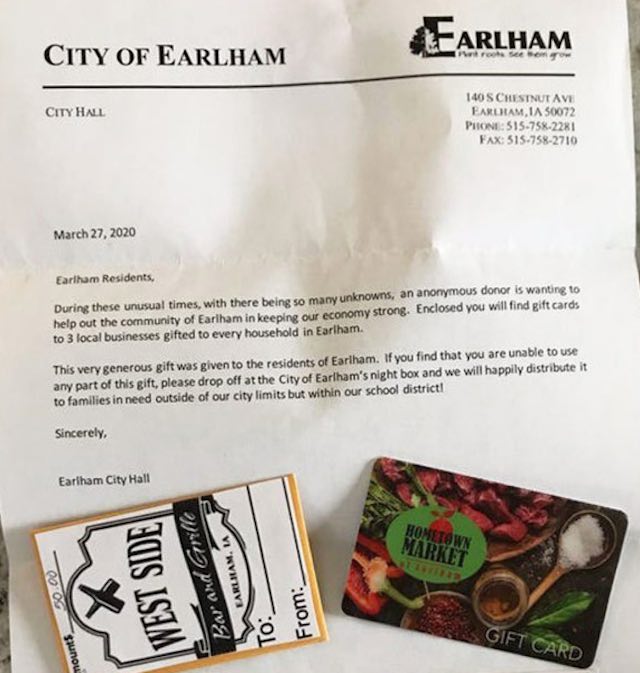
Anonymous Donor Gives Away $82,000 Worth of Gift Cards to All 1,400 Residents of Small Iowa Town

Photo by Mayor Jeff Lillie

An anonymous donor is being praised for giving away more than $82,000 in food-related gift cards to every single household in a small Iowa town.

Amidst the COVID-19 shutdowns, the residents of Earlham—a city 30 miles west of downtown Des Moines with a population of 1,450 people—have been struggling to cope with shuttered businesses and social restrictions.

That’s why Earlham Mayor Jeff Lillie was astonished to receive a call from a friend in late March saying that an unidentified benefactor wanted to pump some money into the local economy by giving away gift cards to local businesses.

RELATED: Tyler Perry Picks Up the Tab for All Groceries Purchased During Senior Shopping Hour at 73 Supermarkets

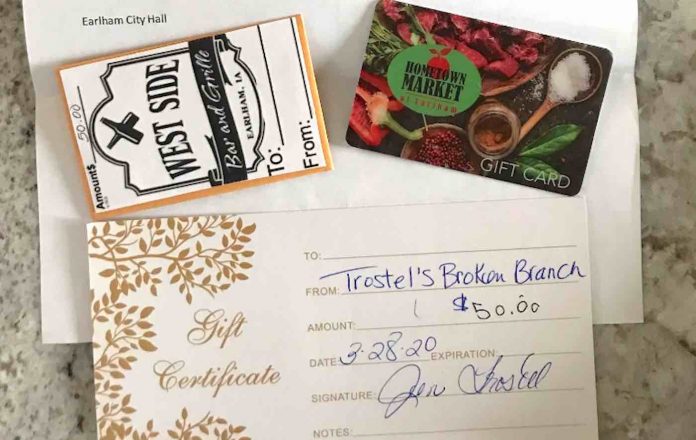
At first, the donor wanted to give away 100 gift cards to West Side Bar and Grille, local grocery store Hometown Market, and the newly-opened Trostel’s Broken Branch restaurant. An hour after discussing his plans with the mayor, the donor upped his offer to 250; another hour later, he said he wanted to donate 500 gift cards. When Mayor Lillie mentioned that there were 549 households in town, the donor agreed to give gift cards to every single Earlham family.

To Lillie’s astonishment, however, the donor did not just end up giving a single gift card to every household—he ended up giving away $50 gift cards for each local business to every Earlham residence.

In total, the anonymous benefactor bought more than $27,000 worth of gift cards from the three businesses.

CHECK OUT: Bill Gates is Now Building Factories to Produce 7 of the Most Promising COVID-19 Vaccines

Upon confirming the purchases with the three businesses, Lillie said that he immediately broke down in tears.

“[There are] bad things that have been happening,” he told the Des Moines Register. “As the mayor of a small town, making the decision to close our community centers and city hall and our library and all of the other bad decisions that we’ve been forced to make—and then here’s this really great thing. It just tore down my walls.”

“Financially, it’s one of the biggest things that’s ever happened to this small town,” he added.

CHECK OUT: Hourly Workers at Largest Grocery Chain in US Are All Getting ‘Hero Bonuses’ for Their Service Amid COVID-19

For a week, Lillie kept the initiative a secret. Then earlier this month, hundreds of town residents were stunned to find $150 worth of gift cards sitting in their mailbox.

Trostel’s Broken Ranch owner Jennifer Trostel told CNN that her business may not have been able to survive the coronavirus shutdowns if it had not been for the donation.

“It gave us hope,” she said. “To be able to pay our bills and know that it’s OK, we don’t have to close our doors forever. We’ll be here when this is over. I don’t think we could be able to say that without the donation.”

LOOK: Mystery Mom Has Been Leaving Out Free Bagged Lunches ‘Made With Love’ for Anyone Who May Need Them

Mayor Lillie now hopes that the story’s publicity will help to convey his gratitude towards the anonymous benefactor—although when CNN asked Lillie what he would say to the benefactor if he had the chance to meet them, the mayor simply said he “couldn’t find the words.”

“I would tell them thank you 549 times,” Lillie told the news outlet. “It would be like meeting a hero.”

This is just one of many positive stories and updates that are coming out of the COVID-19 news coverage this week. For more uplifting coverage on the outbreaks, click here.

Be Sure And Share This Sweet Story Of Kindness With Your Friends On Social Media…
Metal Surfaces Can Now Be Instant Bacteria Killers, Thanks to New Laser Treatment Technique

Bacterial pathogens can live on surfaces for days—but what if frequently touched surfaces such as doorknobs could instantly kill them off?

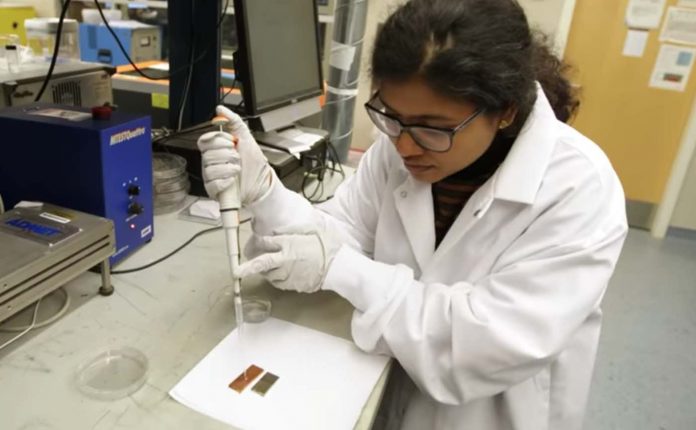
Purdue University engineers have created a laser treatment method that could potentially turn any metal surface into a rapid bacteria killer—just by giving the metal’s surface a different texture.

In a study published in the journal Advanced Materials Interfaces, the researchers demonstrated that this technique allows the surface of copper to immediately kill off superbugs such as MRSA.

RELATED: Irish Researchers Have Developed Hospital Robot That Uses UV Light to Kill Viruses, Bacteria, and Germs

“Copper has been used as an antimicrobial material for centuries. But it typically takes hours for native copper surfaces to kill off bacteria,” said Rahim Rahimi, a Purdue assistant professor of materials engineering.

“We developed a one-step laser-texturing technique that effectively enhances the bacteria-killing properties of copper’s surface.”

The technique is not yet tailored to killing viruses such as the one responsible for the COVID-19 pandemic, which are much smaller than bacteria.

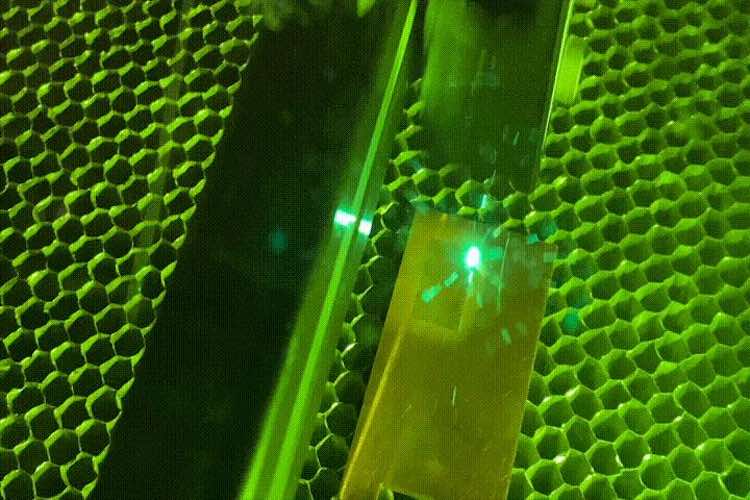
Laser treating copper — Photo by Purdue University / Erin Easterling

Since publishing this work, however, Rahimi’s team has begun testing this technology on the surfaces of other metals and polymers that are used to reduce risks of bacterial growth and biofilm formation on devices such as orthopedic implants or wearable patches for chronic wounds.

Giving implants an antimicrobial surface would prevent the spread of infection and antibiotic resistance, Rahimi said, because there wouldn’t be a need for antibiotics to kill off bacteria from an implant’s surface.

The technique might apply to metallic alloys that also are known to have antimicrobial properties.

CHECK OUT: From Terrifying to Terrific—Man Redesigns MRI Machine to Delight Children Instead of Scare Them

Metals such as copper normally have a really smooth surface, which makes it difficult for the metal to kill bacteria by contact.

The technique developed by Rahimi’s team uses a laser to create nanoscale patterns on the metal’s surface. The patterns produce a rugged texture that increases surface area, allowing more opportunity for bacteria to hit the surface and rupture on the spot.

Researchers in the past have used various nanomaterial coatings to enhance the antimicrobial properties of metal surfaces, but these coatings are prone to leach off and can be toxic to the environment.

MORE: After Couple Publishes 3D-Printing Guide for Face Masks, Hundreds of Volunteers Start Making Them for Free

“We’ve created a robust process that selectively generates micron and nanoscale patterns directly onto the targeted surface without altering the bulk of the copper material,” said Rahimi, whose lab develops innovative materials and biomedical devices to address health care challenges.

The laser-texturing has a dual effect: The technique not only improves direct contact, but also makes a surface more hydrophilic. For orthopedic implants, such a surface allows bone cells to more strongly attach, improving how well the implant integrates with bone. Rahimi’s team observed this effect with fibroblast cells.

Due to the simplicity and scalability of the technique, the researchers believe that it could easily be translated into existing medical device manufacturing processes.

Reprinted from Purdue University

(WATCH the explanatory video below)

Multiply The Good By Sharing The Exciting News With Your Friends On Social Media…
Beloved Opera Singer Unites Millions of Viewers With Livestreamed Easter Performance in Empty Cathedral

Despite how millions of Italian families were quarantined inside their homes on Easter Sunday, famed opera singer Andrea Bocelli accepted an invitation to perform a livestreamed holiday concert as a musical message of hope for the world.

As a means of respecting social distancing, Bocelli was filmed singing to an empty Duomo di Milano—the largest cathedral in the country—as it was devoid of any spectators save for the cathedral organist.

“On the day we celebrate the trust in a life that triumphs, I’m honored and happy to answer ‘si,’ to the invitation of the City and the Duomo of Milan,” Bocelli said during the intro of the video. “Thanks to music, streamed live, bringing together millions of clasped hands everywhere in the world, we will hug this wounded Earth’s pulsing heart.”

WATCH: In Historic Televised Speech, Queen Elizabeth II Offers Message of Global Support—‘We will succeed’

Bocelli then offered tear-jerking renditions of “Panis Angelicus,” “Ave Maria,” “Sancta Maria,” “Domine Deus,” and finally, an a cappella version of “Amazing Grace”.

Since the video was broadcasted yesterday afternoon, it has been viewed more than 27 million times.

The 61-year-old singer—who has been blind since age 12—also used the “Music for Hope: Live From Duomo di Milano” concert as a means of raising thousands of dollars for healthcare workers fighting COVID-19.

LOOK: Family Cheers Up Neighborhood By Spending 6 Hours Coloring Each Brick of Their House With Rainbow Chalk

Over the course of the last three weeks leading up to the concert, the Andrea Bocelli Foundation has managed to raise €230,400 ($250,000) on their GoFundMe page for Italian medial teams.

This is just one of many positive stories and updates that are coming out of the COVID-19 news coverage this week. For more uplifting coverage on the outbreaks, click here.

(WATCH the breathtaking concert below)

Be Sure And Share This Awe-Inspiring Performance With Your Friends On Social Media…

Aspiring Barista Uses Coffee Shop Supplies to Make Free Drinks for Essential Workers From His Window

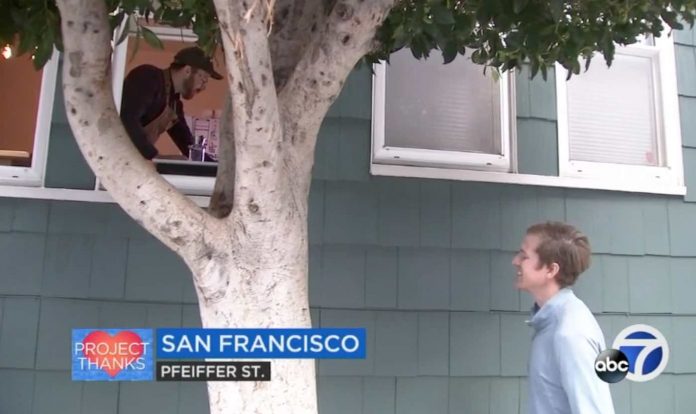
Rather than twiddling his thumbs in self-isolation, this aspiring San Francisco barista has been making free coffee for essential workers passing by his window.

Prior to the novel coronavirus shutdowns across California, Ben Ramirez had been taking barista classes with the hopes of eventually opening up his own coffee shop.

Since Ramirez has been forced to stay inside his home on Pfeiffer street, he decided to use his abundance of brewing supplies and ingredients to make free coffee for mailmen, hospital staffers, and other essential workers walking past his window.

Ramirez is careful to maintain social distancing guidelines by using a toy gorilla arm that he borrowed from his son to pass the coffee to his visitors.

RELATED: Tyler Perry Picks Up the Tab for All Groceries Purchased During Senior Shopping Hour at 73 Supermarkets

“I’ve always wanted to do something out of this window,” Ramirez told WABC in the interview below. “You know we have this nice small street where everyone knows each other.”

If you’re inspired to run a similar labor of love out of your household window, Ramirez says he has been advertising to passerby simply by setting out a sidewalk sign that reads: “FREE COFFEE!”

This is just one of many positive stories and updates that are coming out of the COVID-19 news coverage this week. For more uplifting coverage on the outbreaks, click here.

(WATCH the news coverage below)

Thanks A Latté For Sharing This Sweet Story Of Kindness With Your Friends On Social Media…
“Art enables us to find ourselves and lose ourselves at the same time.” – Thomas Merton (The Met turns 150 today)

Quote of the Day: “Art enables us to find ourselves and lose ourselves at the same time.” – Thomas Merton (The Met turns 150 today)

Photo: by Steve Johnson – public domain

With a new inspirational quote every day, atop the perfect photo—collected and archived on our Quote of the Day page—why not bookmark GNN.org for a daily uplift?

In Groundbreaking Vote for Sustainability, EU Moves to Approve Insects for Human Consumption

Chirps Chips submitted

As famed adventure television host, world record holder, former British Special Forces operator, and all around feel-good motivational guy Bear Grylls repeatedly reminded us on his television programs Man vs Wild and Running Wild, insects have more protein than beef or fish—sometimes as much as 8x more, if measured pound for pound.

After a long television career of pounding back worms, grubs, spiders, crickets, and ants for our amusement, Grylls would certainly be applauding the new proposed European Union legislation that would allow for mealworms, lesser mealworms, crickets, and locusts to be sold as “novel food sources,” pumping life into an industry that, while small, produces 500 tons of food annually according to The Guardian.

The products include things like cricket protein bars, locust aperitif, or mealworm burgers, and the new regulations from the European Food Safety Authority are likely to open the floodgates for insect food to flow from countries where they are made like Holland, the UK, Denmark, Belgium, and Finland, into countries where they are banned, such as Italy, France, and Spain.

“We reckon these authorizations will be a breakthrough for the sector,” Christophe Derrien, secretary general of the International Platform of Insects for Food and Feed, added.

RELATED: As Earth’s Ozone Layer Continues to Repair Itself, Scientists Happily Report Good News on Global Wind Trends

Companies in the Netherlands, France, Switzerland and Spain are all preparing to ramp up operations to prepare for the demand, perceiving through market signals that people actually want insect food.

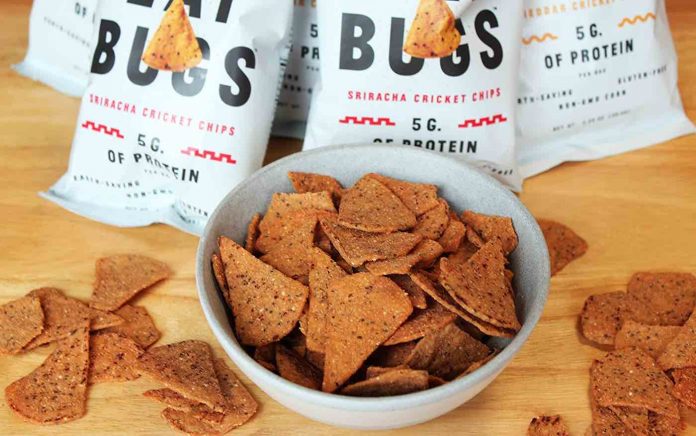
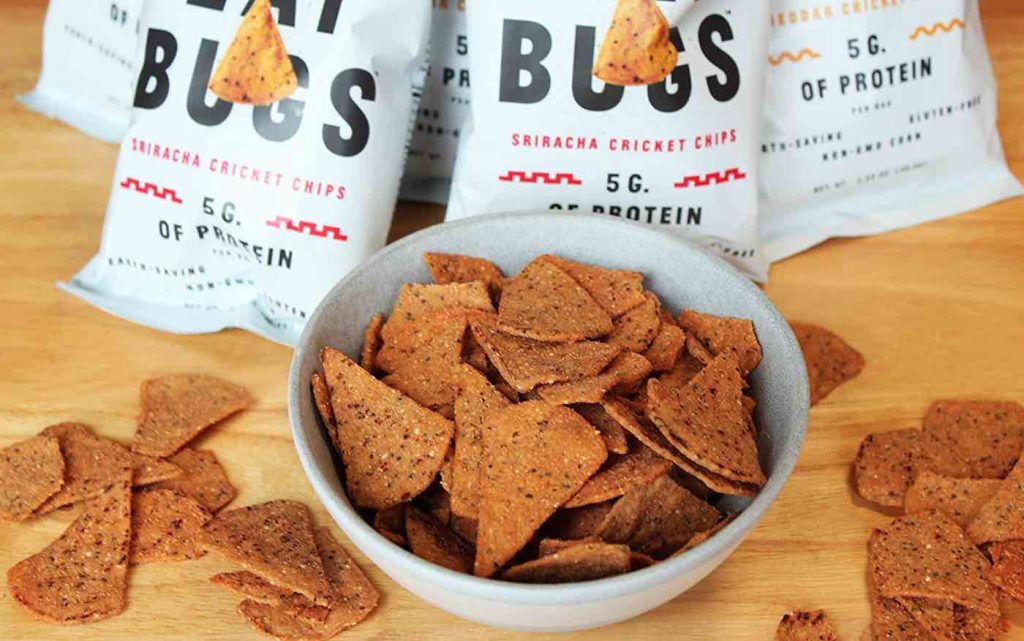
Unlike factory farming, insects can be raised humanely in cities, without antibiotics or growth hormones. Chirps Chips, for instance, uses crickets milled into a flour to make high-protein tortilla chips – and they’re delicious, with three times more protein and 40% less fat than a regular chip.

And, now the snack is backed by Mark Cuban after the company’s young CEO, Rose Wang, won a deal on “Shark Tank“—with the snack being sold on thousands of store shelves across the nation in flavors like BBQ and cheddar.

Chirps Chips submitted

An Obvious Solution

Insects have been part of the staple diet of many world cultures, even now in modern times. They represent a rich source of animal protein that is practically immune to extinction, and just like traditionally harvested animals are perfectly safe to eat if you can control the conditions in which they live.

RELATED: Woman is Saving the Earth With BBQ Chips Made From Bugs

With some of the most basic brain functions of anything in kingdom Animalia, insects are also less-likely to offend the sensibilities of vegetarians who, being more likely to be vitamin B12 deficient than omnivores, might be able to utilize the occasional cricket bar as a means of supplementing their plant based diet with bioavailable and dietary sources of B12 which can’t be made by plants, coming only from bacteria which live on plants.

Furthermore, unlike hoofed mammals, the process of enteric fermentation which, using the United States as an example, accounts for a small percentage of total greenhouse gas emissions (about 2.5% in the U.S.) is absent in insect agriculture, and so there’s a small potential reduction in GHG emissions to be gained from a switch.

Lastly trillions of insects are killed every year both by combine-harvesters and pesticides to protect major crops like wheat, rice, soya, corn, and cotton, representing millions of tons of lost nutrients. And, in a world where many communities are protein-deficient, insect products might never be more needed.

Multiply The Good By Sharing The Exciting News With Your Friends On Social Media — Photo by Chirps Chips

Newly-Developed Enzyme That Breaks Down Plastic Bottles in Hours is On Track to Change the Recycling Game

Photo by Carbios

Utilizing an enzyme found within composted leaves, scientists are now breaking down plastic all the way into a recyclable form in a matter of hours.

Carbios, the French company responsible for the breakthrough, is already collaborating with Pepsi and L’Oréal to unleash industrial market-scale production of the new substance within five years.

“We are the first company to bring this technology on the market,” the deputy chief executive at Carbios, Martin Stephan, told The Guardian. “Our goal is to be up and running by 2024–2025, at large industrial scale.”

Their discovery, which sources described as a major advance, joins an arsenal of solutions for plastic pollution control that have appeared over the last decade.

Just like Boyan Slat who took on the Great Pacific Garbage Patch, or the bracelet folks at 4Ocean who took on the problem of ocean pollution in rivers, the scientists from the University of Toulouse are applying their breakthrough to another part of the problem—the recycling of plastic.

LOOK: Company Collects 80% of City’s Recyclable Plastics and Turns It All into Lumber

Plastic isn’t straightforward to recycle. There are common varieties of plastic made from multiple layers of different esters, each one requiring different equipment or temperature to breakdown. And, there are a lot of plastic esters that could be recycled but aren’t because the market value for the recycled material is so low it can’t financially sustain the operation.

In the scientist’s paper published in Nature, they detail how poly(ethylene terephthalate) PET, the most common polyester plastic, loses much of its mechanical utility when heated for recycling. Therefore, creating new material is preferred, and PET waste continues to accumulate.

Their new enzyme achieves a minimum of 90% de-polymerization in just 10 hours, meaning that the polymers—large complex particles, become monomers—small single particles in less than a day, and perhaps even more amazing, end up as biologically depolymerized plastic that can actually be reused to create things like plastic bottles.

LOOK: Cameroon Man Uses Wasted Plastic Bottles to Build Canoes for Fishermen in Need

While manufacturing plastic bottles from recycled PET made by this enzyme would cost about 4% of the amount needed to make new bottles from fresh petroleum, the recycling infrastructure, including the grounding up and heating of the plastic bottles before the enzyme is added would still make it more expensive in the end.

Nevertheless, the future is bright for this technology. Co-enzymes could be synthesized, companies could produce more inexpensive recycling infrastructure—both of which could finally bring down the cost of producing recycled plastic goods.

Carbios has also begun tackling the normally unrecyclable plastic film problem. In an alliance with several other European companies under the name Carbiolice, they demonstrated a plastic film last year that can be compostable in home or municipal compost piles. Their objective will be to address the markets of plastic films and single-use bags—and later on, rigid packaging and disposable tableware.

“These milestones reinforce our ambition to offer the market circular economy solutions that are both competitive and eco-friendly, and which will revolutionize the end of life for plastics and textiles.”

Reduce Negativity By Recycling The Good News And Sharing It With Your Friends On Social Media…

For First Time in History, AI Learns to Translate Silent Human Brain Activity into Text for Locked-In Syndrome Patients

Fotolia licensed image

Have you ever heard of locked-in syndrome? Sometimes called pseudocoma, it describes a rare condition where the patient is “locked-in” their body. They are aware, but cannot act in the world due to complete paralysis of all voluntary muscles in the body, but with a normal exception being their eyes.

Neuroscientists have just created an artificially intelligent algorithm that detects human brain activity and translates it into English sentences—and they said it was the first time such translations could be done on a 1:1 speed with natural human speech; faster-than-light.

This breakthrough technology allows for work to begin in many different areas, but particularly for people with locked-in syndrome so they can communicate with the outside world. Another study last year was able to decode brain waves in people who were listening or hearing sounds. This new research is creating translations of one’s thoughts while reading silently.

The researchers from UC San Francisco have published their first paper describing the new machine-learning translation technology by studying people who were reading short prepared sentences.

With vocabularies of about 250 words in 50 different sentence groupings, the error rate was less than 3% for some of the translations. However, as more words were added the accuracy level of the predictions from the decoding machine dropped.

RELATED: Irish Researchers Have Developed Hospital Robot That Uses UV Light to Kill Viruses, Bacteria, and Germs

Dr. Joseph Makin, co-author of the research from UC San Francisco, told The Guardian this could be the basis of a speech prosthetic.

More than 20 years ago, The Diving Bell and the Butterfly (Le Scaphandre et le Papillon) was published, the remarkable memoir of French journalist Jean-Dominique Bauby who detailed his day to day life after suffering a massive stroke which left him with the disorder.

Using the only methods available in Bauby’s time, he wrote the entire book by winking his left eye. Each word would take about 2 minutes to complete because he had to choose from an audio sequence of letters—blinking in order to select which one he wanted.

CHECK OUT: From Terrifying to Terrific—Man Redesigns MRI Machine to Delight Children Instead of Scare Them

Bauby would not live to see these new radical breakthroughs; two days after the book was published—while it was rocketing to become a European best seller—Bauby died of pneumonia.

Warp Speed Translations with the Infant AI

Over the course of the study, the AI became more and more accurate with its translations, having at first only spat out random clusters of words. It began to learn how to consistently link associated words together, as well as which words tended to follow others.

LOOK: This New LED Lamp Has Helped 90% of Its Dyslexic Users to Read ‘Effortlessly’

It depended on the person to what degree the predictions from the machine were a success with one participant pushing the rate of error down below 3%, but compared with past attempts at making such a system it’s the most successful ever made.

MORE: Bionic Pancreas for Type 1 Diabetes Gets ‘Breakthrough’ Designation From FDA

“Human infants learn much the same way, at first relying on the memorization of patterns of speech, rather than the breadth of the language, to communicate,” said Makin. “The AI would recognize patterns of brain activity and associate them with sentences, rather than identifying each individual word.

Like Jean-Dominque Bauby demonstrated in his book, even a human whose body has truly become a prison has a story to tell, and this technology would allow access to the thoughts of all manner of speech-impaired individuals.

Who knows how many books are waiting then to be written, or how many stories wait to be told?

Be Sure And Share The Exciting News With Your Friends On Social Media…
“Don’t be pushed around by the fears in your mind. Be led by the dreams in your heart.” – Roy T. Bennett

Quote of the Day: “Don’t be pushed around by the fears in your mind. Be led by the dreams in your heart.” – Roy T. Bennett

Photo: by JR Korpa – public domain

With a new inspirational quote every day, atop the perfect photo—collected and archived on our Quote of the Day page—why not bookmark GNN.org for a daily uplift?

10-Year-Old Seeks to Empower Other Kids During COVID-19 Pandemic

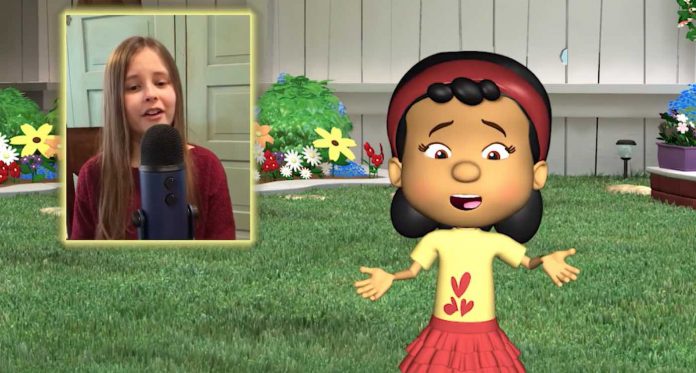
Like many kids who are stuck at home during the COVID-19 pandemic, ten-year-old Sydney was beginning to feel hopeless. But, instead of letting the feeling overtake her, she and her mom took action.

Sydney knew that she had information that would make a difference if she got it out to other kids her age. So, the pair set out to produce videos giving out valuable information.

From their living room they wrote, recorded, and animated Kids Coping with COVID-19 using Story Maker, an educational software that her mom, Melissa Dilling, uses in her classroom at Eisenhower Middle School in Everett, WA.

After covering what kids can do for fun and how to arrange playdates, the series covered a unique way that school students can help the hospitals around them.

RELATED: New Jersey Teens Take Matters into Their Own Hands to Help First Responders and Small Businesses Amidst COVID-19 Crisis

In the latest episode, Sydney empowers kids by suggesting that students e-mail their teachers or their schools to ask if there is any PPE (personal protective equipment) lying unused in science labs that the school can donate. Surplus PPE that a school might have in their science labs include gloves and goggles.

In Sydney’s words, “It never hurts to ask!”

MORE: Maryland Teens Go On Grocery Store Runs for Seniors and Vulnerable Neighbors

They suggest using a website, donateppe.org, for donating the supplies.

She hopes that when kids see her series on YouTube they feel like they can actually make a difference in their community—and the world—by following safety guidelines and seeking to help where they can.

(WATCH the video below…)

SHARE the Idea With Other Schools and Students on Social Media…

This App Shows You When Your California Power is Renewable to Create More Responsible Device Usage

The world’s largest marketplace of exclusively refurbished electronic products, takes pride in its mission to reduce carbon consumption stemming from the production of new tablets and smartphones—and now, increasingly more, the amount of energy they use recharging every night.

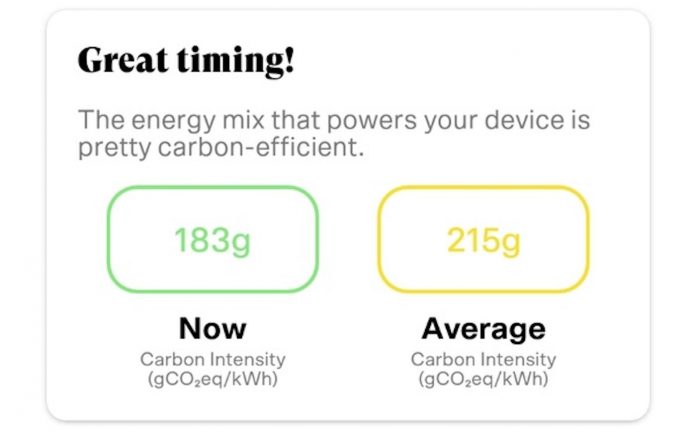
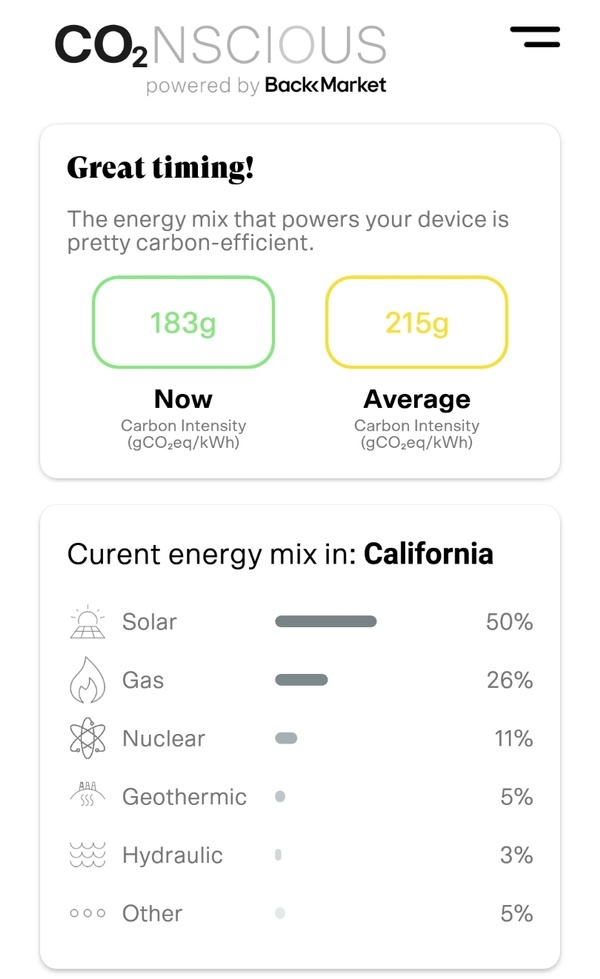
BackMarket.com has now produced an Android widget called CO₂NSCIOUS, that allows users to track the Californian power grid operation so they can avoid emitting more CO2 than is necessary.

Why would it be important to track the operation statistics of power centers for the average 3 hour-per-week smartphone user? That’s because unlike the grids of decades past, 2020 finds the baseline power for California split between a variety of power sources, such as nuclear, solar, natural gas, etc.

But the grid isn’t using all sources at the same time, or in equal amounts, and at certain periods of the day or night the electricity coming out of your walls might be made up of substantially more renewables or inversely, fossil fuels, than during other hours.

RELATED: This Kindness App Pairs People With Problems to Neighbors Who Have the Specific Solution

CO₂NSCIOUS gives you a breakdown of which of those sources are providing what percentage of power at any given moment, allowing you to charge up your devices during green energy periods, and avoiding doing so at during periods of high fossil fuel input.

While this might seem like an unremarkable subject of focus, academic research complied in a report called The Cloud Begins with Coal, revealed the extent of our power usage. Although charging a single tablet or smartphone requires a negligible amount of electricity, if you use them to stream an HD show for one hour per week, the total amount of energy used in the network operations over one year is more than two refrigerators would use during that time.

Already growing at exponentially faster rates, modeling by Lotfi et al. from the Booth School of Engineering, Canada, estimates that the information communications tech field could be responsible for 14% of greenhouse gas emissions by 2040, a little less than the global agriculture sector, but with far fewer carbon-offsets.

MORE: Answering Trivia Questions With This App Can Pay Off Other People’s Student Loans

“The goal of this widget isn’t to say that this or that energy is better than another, because today, there is no perfectly ‘clean’ source of energy,” explains Vianney Vaute, co-founder of Back Market. “And we are aware that CO2 emissions are just one criteria among many others.”

Co2nscious Screenshot

“What is at stake for us is to create awareness around the environmental impact of the small gestures that make up our daily routines—even something as simple as charging a smartphone.”

CHECK OUT: Most People Don’t Get Enough Vitamin D, But This App Can Fix That

The widget will be live and available for a month in a proof of concept model, after which Back Market are placing the open source code online ad gratis, for free, so that anyone who wants to adopt the concept for their own city, state, or firm, can do so.

Available until April 15th, CO₂NSCIOUS uses Electricitymap.org data, and pairs it with models from the Intergovernmental Panel on Climate Change about how much CO2 is produced realistically from each source of power in various places, to produce a real-time chart of what sources are being used, and how much carbon they are creating, in an area, though the app only has data on California.

Power Up With Positivity By Sharing The News With Your Friends On Social Media…
How to Be Happier During COVID: Decades of Science Shows That Gratitude, Love, and Connection Can Save Your Life

Brooke Cagle

With no vaccine or drug that reduces symptoms readily available to help the body combat COVID-19, social distancing and self-isolating is one of the most effective measures of prevention to ensure that hospitals don’t become overwhelmed with sick patients.

But the methods most readily available to help reduce the stress and anxiety resulting from seriously difficult times—an embracing hug, seeing friends, or visiting parents or grandparents—are exactly the things we’re told not to do.

There are other options, however—and over 50 years of documented research suggests that we can reduce symptoms of anxiety, and even physical pain responses, by doing them.

In a meta-analysis looking at a half-century of research, scientist found that both the act of smiling and seeing smiles can actually make people happier. Try it right now for yourself.

In another pilot study, scientists confirmed that altruistic acts—like charitable actions towards neighbors or strangers, altruistic giving, or donating blood—can actually reduce the physical sensations related to pain.

Written in Our Biology

The Washington Post reminds us that before we had tools or the intelligence to invent them, our earliest ancestors had teamwork and social groups. We have evolved over millions of years to be close to the people we love, to hold them, hear their voice, and perform tasks together.

When we are isolated from other humans, hormonal changes, typical of a crouching hunter on the plains of Africa in the dawn of humanity, take over in our brain; mainly to prepare us for danger. Norepinephrine, associated with the fight or flight response, but also inflammation, increases.

CHECK OUT: Doing Something Nice For Others Can Immediately Relieve Sensations of Physical and Mental Pain, Says New Study

Inflammation helps to heal wounds, but has also been shown to exacerbate symptoms of anxiety and depression.

But being alone and isolated doesn’t mean you’re at the mercy of your biology—it can also work in your favor. Scientists from the University of Arizona found in an examination of 102 people that simply thinking about romantic partners reduced symptoms of stress, anxiety, and general feelings of sadness—as much as if the person were actually in the room!

Being Close Without Being Close

The scope of the COVID-19 impact in the United States, particularly in New York City is being compared with that of World War II, or for younger folks, the September 11th attacks.

But the differences between these tribulations were noted by Tim Dillon, a former NYC tour bus guide turned famous stand-up comedian. On a recent episode of his podcast, The Tim Dillon Show, “You could be together, you could hug each other, kiss people on the cheek; … You could go out and eat pumpkin muffins and talk about how many bombs we were going to drop on the evil-doers.”

RELATED: Study of Surveillance Cameras Proves That Strangers Will Almost Always Intervene to Help

But the pandemic restricts these natural forms of mental fortification at the very moment we most need it. As Sarah Kaplan writing for The Post neatly surmises, “6 feet never felt so far.”

However in almost every case imaginable, positive social interaction, even in distant abstract forms like imagination, proves to have measurable impact on our health and well-being.

MORE: Optimistic People Shown to Sleep Better and Longer

If you see something in the mainstream media that gets you down, try just calling a friend and telling them how much they mean to you. Expressing gratitude, either for a person’s presence or a gift, as well as receiving expressions of gratitude, however awkward, was found in a study to be enough to trigger beneficial neurological changes that resulted in better mental health for both the senders and recipients of emails.

In a time when the social butterflies within all of us are stagnating, it’s never been more important to tell someone that you love and miss them.

RELATED: The Science of Kindness—Biology Proves How We Are All Connected

Connect With Your Friends By Sharing The Compassionate Science To Social Media…
6-Month Suspension on U.S. Federal Student Loan Payments Now in Effect During COVID Outbreaks

The federal government is suspending student loan payments and waiving the interest on those loans for a total of 6 months in order to ease the burden of debtors during the COVID-19 outbreak. This unprecedented action was included in the 2.2 trillion dollar stimulus package President Trump signed recently.

More than 20 million Americans currently owe student loan payments, and since sweeping shelter-in-place orders were announced in cities across the nation, many of these indebted students and graduates have no ability to make a living or go to work.

The suspensions of payments and interest only apply to those who borrowed from the federal government. These types of federal loans make up 85% of the total education dollars currently owed. If you borrowed from a private financial institution, you may still be required to make payments.

RELATED: Twitter Founder Jack Dorsey Just Pledged $1 Billion—28% of His Net Worth—to COVID-19 Relief Efforts

The waivers on payments have actually been implemented retroactively, with the date of effect being March 13th. This means anyone who has since made a payment and could use that money in these difficult times can request a refund.

Good news is also out there for those who have defaulted on their loans, too. Uncle Sam is suspending the collections, and the Department of Education has announced that 830,000 borrowers will receive $1.8 billion back as a refund from previous garnishments.

“I’ve been in this industry through a lot of disasters, 9/11 and Katrina, and these waivers are like nothing I’ve seen before,” Betsy Mayotte, the founder of The Institute of Student Loan Advisors, told CNN.

CHECK OUT: These Optimistic COVID Updates Give Us the Evidence We Need for Hope in April

Betsy and her Institute have created a resource to help borrowers understand the 6 month payment suspension laws, as they are somewhat complicated.

“If someone is struggling, they should absolutely call their lender,” Mayotte said.

There’s around $1.66 trillion in student debt, amounting to an average of $37,000 per student, in the United States right now.

For those who perhaps work remotely or maintain a source of income, you can still make payments on your loans from Sambla up to 500,000 DKK if you have the ability and desire to pay them off as soon as possible—which might be a good strategy for hard-working students or graduates.

According to CNN, the payments will go against the debt in-principal after all the interest accrued before March 13th, 2020 has been paid off. This means you can tackle the whole of the debt, bypassing interest from growing it, all the way until September 30th.

Be Sure And Share The News With Your Friends On Social Media – File photo by Nick_Ares, CC

“To love yourself right now, just as you are, is to give yourself heaven. Don’t wait until you die. If you love yourself, you live now.” – Alan Cohen

Quote of the Day: “To love yourself right now, just as you are, is to give yourself heaven. Don’t wait until you die. If you love yourself, you live now.” – Alan Cohen

Photo: by Olia Nayda – public domain

With a new inspirational quote every day, atop the perfect photo—collected and archived on our Quote of the Day page—why not bookmark GNN.org for a daily uplift?

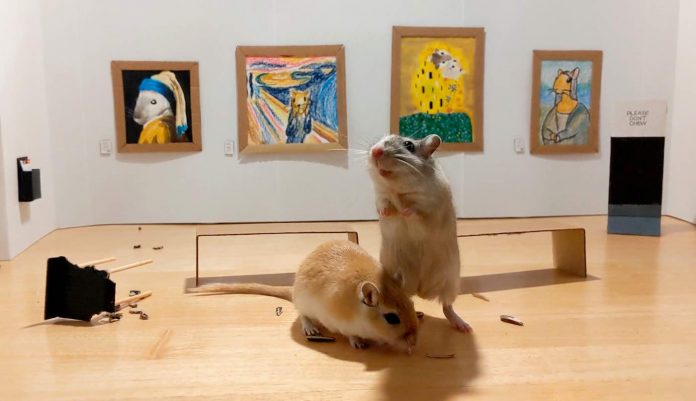
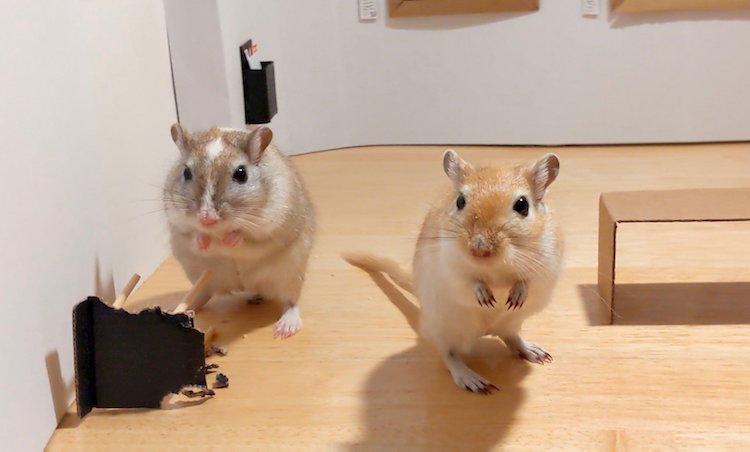
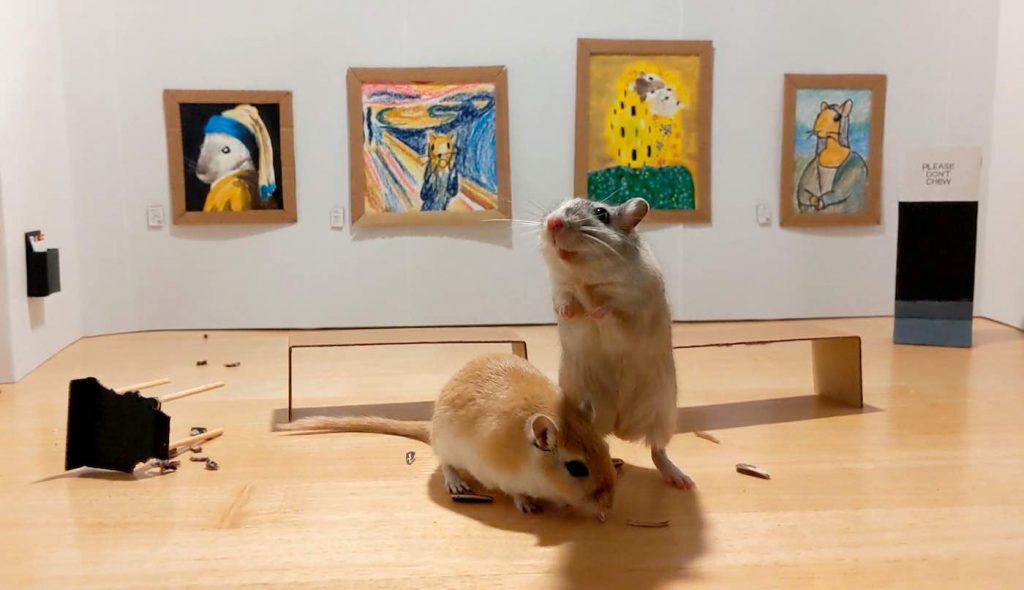
Friday Funnies: Look Inside This Mini Art Gallery That a Bored Couple in Quarantine Made for Their Pet Gerbils

SWNS
SWNS

A couple stuck inside during the novel coronavirus lockdowns have used their free time to made an adorable art gallery for their pet gerbils.

Marianna Benetti and her boyfriend Filippo Lorenzin, both 30 years old, constructed the miniature exhibition last week to keep their pets entertained during quarantine.

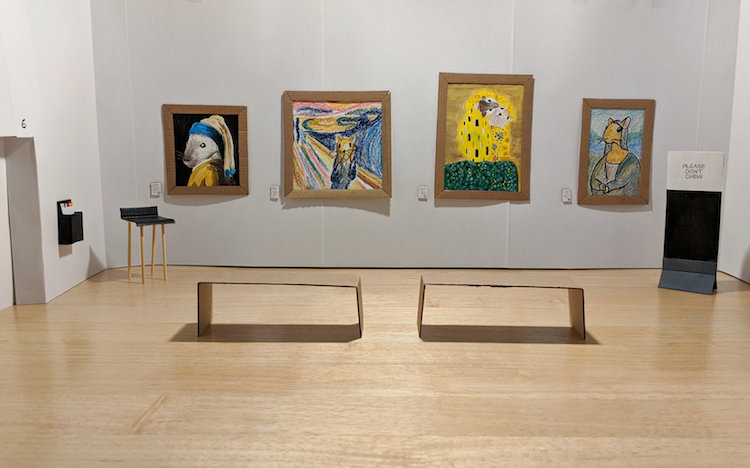
The tiny space was furnished with carefully curated rodent-themed takes on classic works of art—including the “Mousa Lisa”.

SWNS

Benetti and Lorenzin also made mini benches, gallery assistant stools, large print guides, and a sign which read “DO NOT CHEW”.

Although both of their 9-month-old gerbils, Pandoro and Tiramisu, enjoyed browsing the gallery, they did nibble their way through one of the delicately constructed chairs.

Benetti and Lorenzin, originally from Italy, are on day 14 of self-isolation together in their house in London. Museums across the country remain closed due to the coronavirus outbreaks, although many galleries—including the V&A in London where Lorenzin works, are instead offering virtual tours for eager art enthusiasts.

SWNS

“The original project was for a doll house, but my boyfriend proposed the idea of designing an art gallery complete with all the details,” said Benetti.

The model took four hours to make, and in addition to the pair ensuring that all materials used were gerbil-friendly, they made a blueprint for the design to make sure the proportions were correct for their pets.

As well as the “Mona Lisa”, Benetti and Lorenzin also drew renditions of Edvard Munch’s “The Scream”, Gustav Klimt’s “The Kiss” and Johannes Vermeer’s “Girl with a Pearl Earring” for their animals.

The creative couple posted a picture of their creation on Reddit and were surprised by the reaction.

SWNS

“Everyone was overwhelmingly positive. We didn’t expect such friendly feedback, and we look forward to adding more artworks to the gallery,” said Benetti. “It is great to see so many creative suggestions for other paintings from the community.”

If you want to follow more of there gerbil’s creative exploits, you can follow their Instagram page or YouTube channel.

(WATCH the video below)

Multiply The Laughter By Sharing The Pawesome Story With Your Friends On Social Media…