














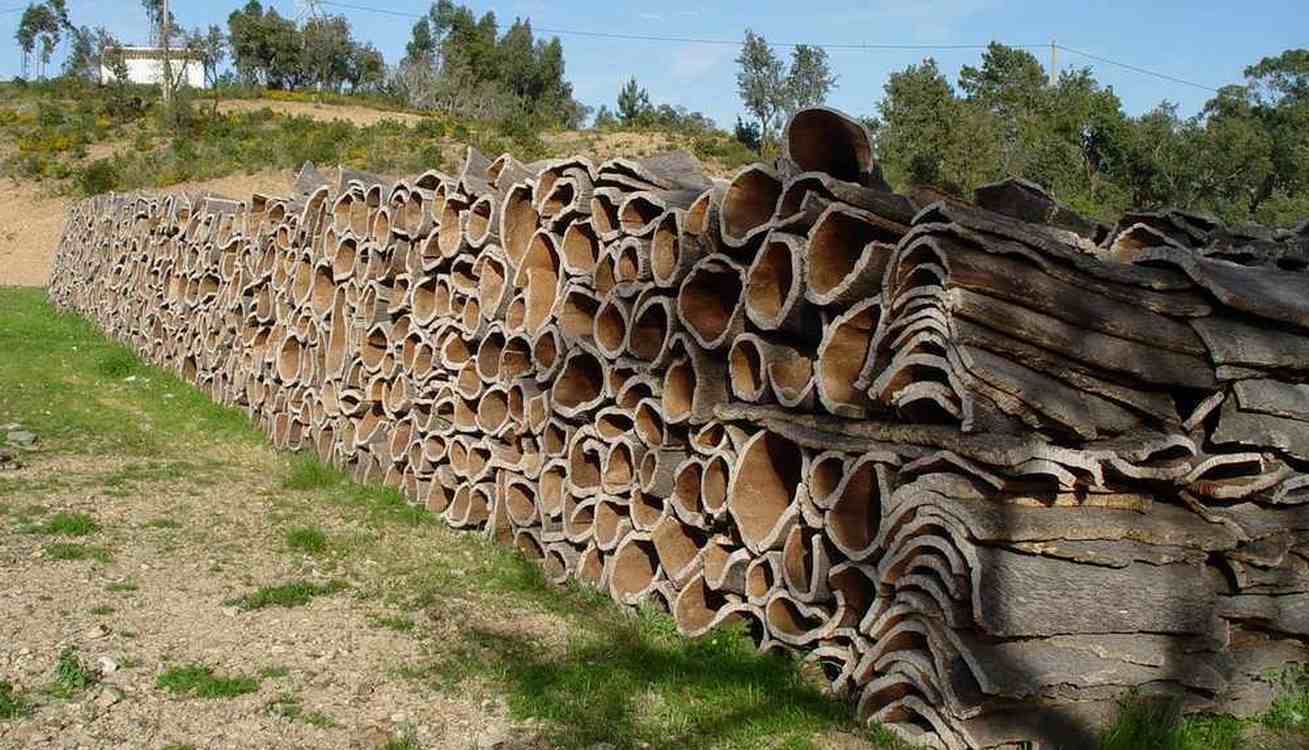
In Portugal, a 150-year-old business making corks is showing that it’s absolutely possible to teach an old dog new tricks.
Having cultivated cork oak trees since the time of the monarchy, Corticeira Amorim have popped open the potential of this humble material, transforming it into a sustainable piece of sophisticated technology that can line the deck of a cruise ship, and even insulate a space ship.
Cork oak forests are quite the unusual sight, and the plantation at Herdade Rio Frio is one of the largest planted cork oak forests of them all. Here, this twisty, gnarly species of oak grows well in the hot, dry Mediterranean climate, and they can produce the bark layer which goes into making cork for up to 200 years.
Each tree can be harvested 9 times after they reach maturity at 25 years. Operating on such long time horizons, it’s no surprise that Corticeira Amorim has deep roots—roots the leaders of this business want to protect.
Monica Pinna traveled to Corticeira Amorim’s cork factory in Portugal to report for Euronews what bubbling up in the science of making cork products.
The multinational company has 4,000 employees, and makes some €1 billion in revenue every year. The cork from its trees make its way into some 30 products, many resembling—in no way at all—the cork one pulls from their wine bottle.
Indeed, taken from their website, Corticeira Amorim’s cork goes into making river cruise ship decking, a cork-concrete solution for the Lisbon Cruise Terminal, and the thermal heat shield for the European Space Agency’s Intermediate eXperimental Vehicle (IXV) re-entry spacecraft. Aerospace applications for NASA, Boeing, and SpaceX followed the IXV’s success. Corticeira Amorim has even developed a 3D-printer-compatable material out of cork.
SURPRISING SUBSTANCES:
- Scientists ‘Cultivate’ Metal Instead of 3D Printing it–and it’s 20x Stronger
- Chemical Process Produces Critical Battery Metals from This Unloved Mineral with No Waste
- This Home Siding Made from Rice Husks Saves Thousands of Trees and Diverts Crop Waste from Landfills
“Developed to mitigate hydrocarbon spills into the oceans caused by large oil tankers, CorkSorb is currently used in numerous industries where oil leaks occur,” the company boasts regarding yet another application for this tree bark. “Cork absorbs only the crude which can be reused later in other activities.”
It’s been used throughout the applied art and design industry, and tiny cork pellets coming as a byproduct of cork production are turned by Corticeira Amorim into a new filler for artificial turf sports fields. The natural shock absorption and frictional resistance means that, if the company is to be believed, cork-turf fields see 40% fewer injuries than shredded rubber fields. Real Madrid—perhaps the most famous soccer club in the world—use Corticeira Amorim cork on their training fields.
For many of the cork oak woodworkers in the fields of Rio Frio south of Lisbon, or at the processing plant at Mozelos, not far from the city of Porto, this glitzy innovation in their ancestral craft isn’t seen. Their days carry on much as they always have, an element of protection afforded by a truly special firm, breaking barriers with a truly special material.
POP Open This Bottle Of Good News In Sustainable Industry On Social Media…