














252 years ago today, the First Continental Congress was organized in Carpenter’s Hall, Philadelphia, after the British Navy implemented a blockade of Boston Harbor and the Parliament of Great Britain passed the punitive Intolerable Acts in response to the Boston Tea Party. The result of the Congress was the drawing up of the Continental Association, a proposal for an embargo on British trade. They also drew up a Petition to the King pleading for redress of their grievances and repeal of the Intolerable Acts. READ more about this milestone marker in our history… (1774)
Endangered Salmon Return to California Rivers in Incredible Numbers: ‘Everybody’s just ecstatic’


A record 30,000 coho salmon returned to central California rivers last season—up 10x from an average of 3,000 over the last decade—and double the total of last season.
Running up the rivers which empty into the Mendocino coast, the proliferation among the fish is something that scientists studying the animals thought they’d never see in their careers.
A March news release by the National Oceanic and Atmospheric Administration (NOAA) said they took it as a sign that targeted restoration efforts on private land can help move the needle for a species that was not long ago considered somewhere near the brink.
“I am overjoyed—everybody’s just ecstatic about how many coho there are,” said NOAA Marine Habitat Resource Specialist Joe Pecharich, who has been supporting restoration projects in the region for 20 years. “We have conducted intensive sampling since 2009 in these watersheds and many of us never thought we’d see something like this in our lifetime.”
“It’s very good news for all of us—communities, tribes, NGOs, NOAA, California Department of Fish and Wildlife, and all our partners,” said Joshua Fuller, NOAA’s Coastal California Branch Supervisor.
“Recovering salmon is undeniably challenging, particularly for a species that must successfully navigate both freshwater and marine ecosystems during its lifetime. These numbers are very encouraging and demonstrate that recovery is possible when management, habitat, ocean, and hydrologic conditions are aligned.”
Life is precarious for the central California coast coho salmon, (CCCC salmon for short) the most endangered subset of the coho salmon species. In many waterways, their existence had become a mere memory.
Stretching back before the new millennium, NOAA gathered together a wide-ranging coalition of local stakeholders, some already mentioned, but which also included timber companies and the fishing-focused nonprofit Trout Unlimited, to work on over 100 small improvement projects to the Mendocino coast river systems to give the coho the best chance of reclaiming its former territory.
These have included removing or altering fish-unfriendly modifications to streams and rivers, like widening undersized road culverts, removing barriers like log jams, and returning previously-straightened waterways to their natural, meandering state.
Such amendments have been made in the North Fork Navarro, Noyo, Garcia, and Big river watersheds. Last summer, the NOAA and The Nature Conservancy constructed the largest-ever habitat restoration project in the Ten Mile watershed.
AMERICAN FISH STOCKS:
- California Creek Restoration Helps Young Salmon Grow Twice as Fast—And Doubles Their Survival Rate
- Maine Counts Over 20 Million River Herring During Annual Run, the Highest in Decades
- After 50 Years, Trout Population Is Restored to Historic Numbers in One of the Largest Lakes in US
“It’s been amazing to see how quickly coho will occupy new habitat. Just days after the excavators roll out, the fish will start to swim in,” said Peter van de Burgt, The Nature Conservancy’s North Coast Restoration project manager.
It’s not only the rapidity with which the coho seem to be returning up these various rivers and brooks that catches the eye, but the breadth. Usal Creek hadn’t seen a live coho in 10 years; the Gualala River watershed hadn’t recorded any in 2 decades. Both are now witnessing adults migrate upstream and juveniles downstream.
As to the size of the migratory population from this year, the count was conducted through spring, with early indications suggesting similarly robust numbers, such as a reported 400 coho on the North Fork Navarro River so far—far beyond normal estimates.
SWIM Up Social Media And Share This Story With Your Friends…
Neighbors Get Swept Up in Man’s Viral Journey to Clean a NYC Street Block Every Day for 100 Days

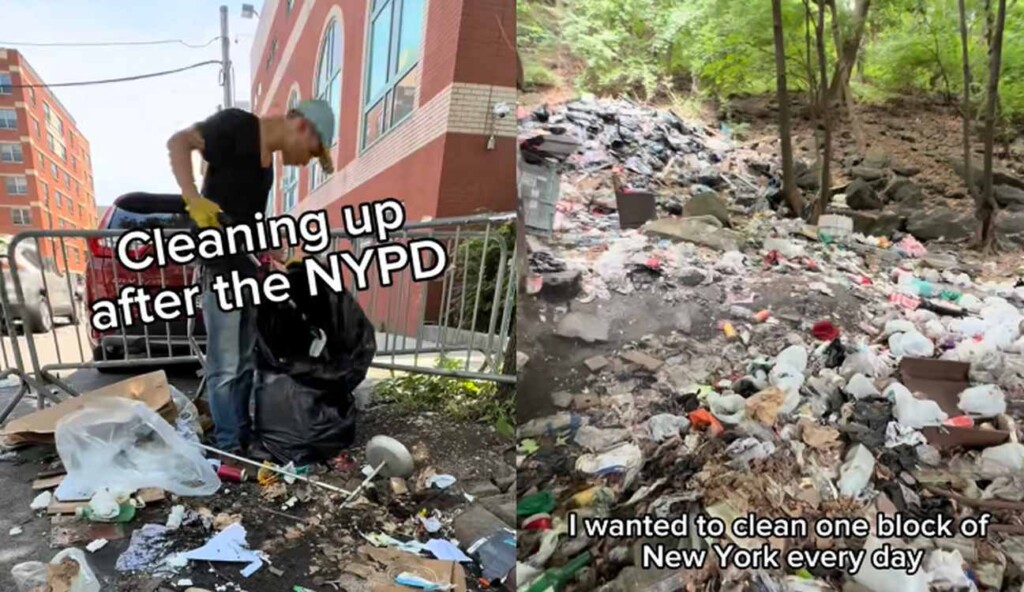
In New York City, something magical has happened along the sidewalk in Washington Heights that can best be described in a metaphor.
In the East, the lotus is not only a food source, an ornamental, and a religious symbol, it also serves as a convenient allegory—because it grows best in the dirtiest water.
So it was with David, a young New Yorker who felt “powerless” to change the circumstances on his block at 171st between Broadway and Fort Washington. Everywhere a piece of litter could be, it was. Whether wrapped around the bolts securing a fire hydrant or choking the tree plots on the sidewalk, litter was everywhere.
So David bought some bags and a grabber stick and announced on his TikTok account that he was going to clean the litter off of a single NYC block every day for 100 days.
The project, like the lotus blooming out of sludge, revealed a caring community hungry for change, just waiting for someone to show that it was possible to do something.
@trashtalk_nyc DAY 100! Thank you for all your support during this incredible and challenging time. When I started this account, I had no expectations. Thank you for giving me an opportunity to help our communities through kindness and hard work. I am so excited for this fall, as we transition to education and beautification for New York families #newyork #communitycleanup #trashtalk ♬ original sound - Your Neighbor David
“When this account went viral, I learned that litter was correlated with pride and a sense of community,” David wrote in his 100th day montage video. “I could have picked up trash my whole life, but instead I want to give people a reason not to litter.”
The reason was simple: that littering would spoil the beauty that David and an ever-proliferating number of local volunteer comrades worked to bring about along this special neighborhood in the Big Apple.
What started as a solo cleanup has grown into a broader community effort, with local businesses donating plants, lumber, and equipment to help improve neighborhood spaces. It wasn’t long before many of his neighbors were there right beside him, picking up litter, badgering city officials to make more of an effort to keep streets clean, and cultivating beds of flowers and plants where the city’s trees grow on the sidewalk.
@trashtalk_nyc Day 44 of Cleaning New York: let's clean our own blocks, but let's also call out problems where we see them. The organizations responsible for cleaning and protecting this city should lead by example. Please comment and share to grow this mission #trashtalk #communitycleanup #newyork #bronx #CapCut ♬ original sound - Your Neighbor David
For this was the ultimate culmination of David’s good work. As much as his videos went viral, so too did his idea of fencing off little flower beds under the trees, laying down soil and mulch, and planting flowers to encourage neighbors and passersby to keep the streets clean.
His new green thumbs have pulled him as far afield as the mountains upstate looking for native plants to put into the beds along the streets.
MORE VIRAL MOVEMENTS: Quirky Campaign Leaves Nice Surprises on Cars of Anyone Who Took Cabs Home from the Bar
“Litter can kill plants, but plants can also teach people not to litter,” David says. “People don’t notice a dying tree, but when flowers magically appear for the first time in decades, people notice when they die.”
He’s so far spent some $2,000 buying fence and gardening supplies to beautify the tree plots along his own block, enriched by giving hands inspired by his creative solutions to litter control.
@trashtalk_nyc Day 108 of Cleaning New York: when you build in public, you create a mirror for the community to understand itself. I have loved watching my neighbors sit on these fences and enjoy the flowers, and I'm excited to replace our stolen plants soon. Please consider contributing to my GoFundMe to support this mission #newyork #communitycleanup #trashtalk #washingtonheights #gardening ♬ original sound - Your Neighbor David
SHARE David’s Incredible Work In Washington Heights On Social Media—Keep The Viral Train Rolling…
A Terrier Rescued After Spending 2 Days Underground Lost in a Badger Warren
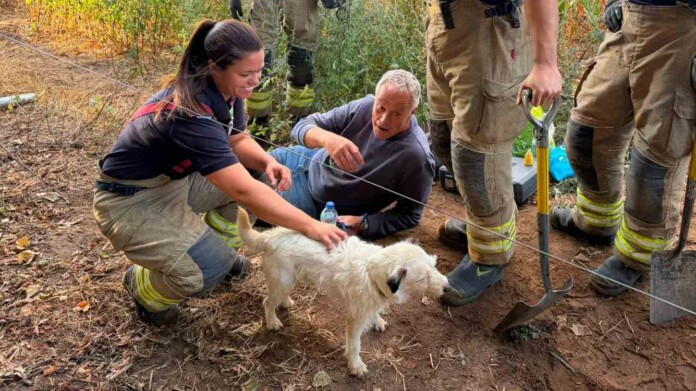
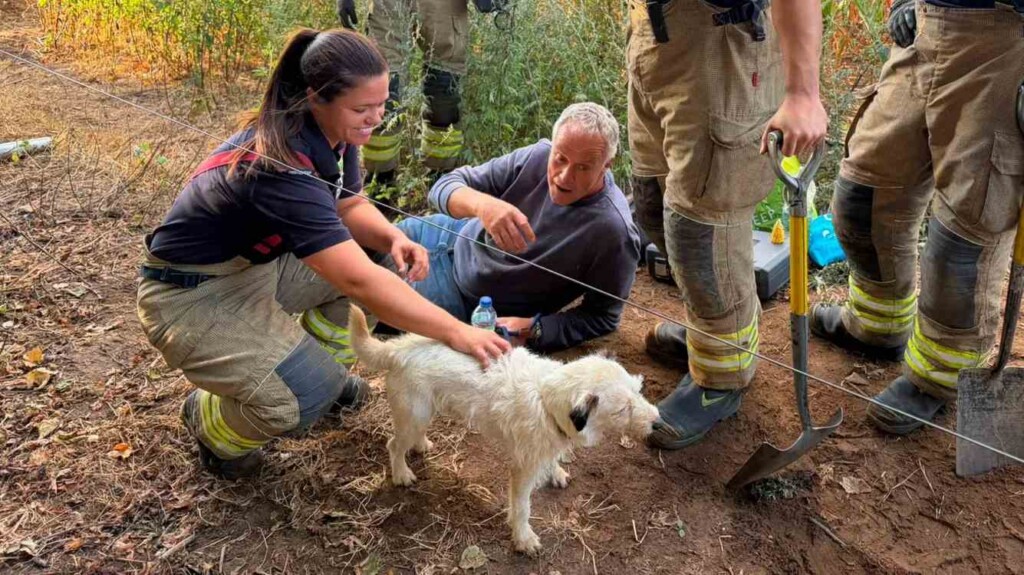
A very English story of peril and rescue comes to us now from Nottinghamshire, where a man’s terrier was stuck underground for 2 days after getting lost in a badger warren.
Cello is a 6-year-old parson Russell terrier, and he was out walking with his owner Stephen Smith, the BBC reports, when he decided, as he’d often done before, to let the curious pooch off his leash to explore a field.
This time, however, Cello became overly-interested in the network of tunnels dug by these large mustelids. Venturing within, Cello quickly got turned around, lost, and stuck, leaving Smith to call for help.
“I took him and one of his friends out for a walk and they disappeared. After a while, the other dog came back, but Cello didn’t, so I went searching for him. The other dog helped me locate where he was,” Smith told the BBC.
Volunteers from Notts Lost Dog (short for Nottinghamshire) were on the case, as were the local fire department, but they first had to obtain a license from the government-sponsored public welfare organization Natural England to dig into the badger warren.
For American readers raising an eyebrow at this last sentence, badgers are a protected species in the UK and disturbing their burrows without a permit is punishable at about half the severity of an American who hunts a bald eagle: up to 6 months in prison and a fine with no ceiling.
Notts Lost Dog’s Kim Jefcott said she was anxious that a permit might not be secured in time.
“It was very worrying because we didn’t know whether it was an active badger [warren],” she told the BBC. “Lots of things go through your mind. Badgers are very protective and can be aggressive if they feel threatened, so we were concerned for Cello’s safety.”
TRAPPED UNDERGROUND: Lacking Ninja Training, Trapped Turtle is Rescued from City Sewer by Police and Firefighters
The permit was issued just in time for the rescue team, along with assistance from Natural England, to locate Cello using a camera and dig a shaft 2 feet down into the network of tunnels to extract him.
Jefcott said he was clearly stressed, and his eyes were sore from getting dirt in them, and from staring into the dark.
DOG RESCUES: 18 Rescue Workers Toil for 6 Hours to Save Dog Trapped Underground (Watch Her Joyful Release)
It wasn’t long after breathing the free air again that Cello perked up, and showed the rescue team what a well-behaved and “lovely, friendly little dog” he is.
Smith added that after eating and drinking—and sleeping 24 hours straight—Cello is back to his normal self again. He still enjoys walks in the fields off his leash, but will hopefully have learned from his ordeal to steer well clear of the smell of badgers.
SHARE The Story Of Cello’s Close Call With Your Friends On Social Media…
After 30 Years of Estranged Trains, Sweden and Finland Re-Connect Their Railway Lines


Early on a Monday morning in early August, a train rumbled across a thawed out Arctic landscape in Finland before screeching to a halt at its final destination at a border crossing with Sweden.
It may sound ordinary for rail-loving European societies, but it was actually the first time these neighbors had the option to travel across the border by train in 30 years.
Now they can thanks to a twice-daily service from the Finnish town of Oulu to the Swedish town of Haparanda, an investment that’s aimed at improving tourism and business conditions for these remoter regions of the two semi-Arctic nations.
The agreement to connect the railway line was made between the Finnish Transport and Communications Agency and the Finnish railway company VR, as well as its subsidiary, VR Sweden, which operates in the northern counties of that country.
“By linking Swedish and Finnish train services, we are creating new opportunities for people to travel, work, study and visit one another across the border. At the same time, we are strengthening conditions for business and tourism throughout the region,” said Joakim Berg CEO of one of VR’s suppliers, called Norrtåg, which operates in the north.
He spoke with the outlet SwediJärnväger to mark the occasion, while the paper added that much of the Finnish network has been electrified, allowing the trains to run from the capital of Helsinki all the way to Haparanda without diesel.
Though either country uses a different rail track gauge, a divided railroad bridge will allow trains to arrive and depart Haparanda on each format. At Haparanda, passengers can embark on a series of regional trains to destinations such as the university town of Luleå to the south, or Gällivare, camp town for the world’s most efficient copper mine run by Boliden Mining, around 160 miles to the north.
RAILWAY NEWS: Japanese Engineers Help Modernize India’s Massive Railway, Launching Her First Bullet Train
“When the new timetable period begins in December, the connections will improve even further,” Hannukainen at VR told the Arctic outlet High North News.
“The Finnish government and the municipalities in the region made the decision to launch and fund the service only last winter, by which time the Swedish timetables had already been finalized. We are working closely with Norrtåg, and as early as this autumn, passengers will have more transfer options available.”
Send This Great Story About Northern Railways Down The Line To Your Friends On Social Media…
“One day an army of gray-haired women may quietly take over the Earth.” – Gloria Steinem (1934-2026)

Quote of the Day: “One day an army of gray-haired women may quietly take over the Earth!” – Gloria Steinem (1934-2026)
Photo by: Bradley Andrews
With a new inspirational quote every day, atop the perfect photo—collected and archived on our Quotes page—why not bookmark GNN.org for a daily uplift?

Good News in History, September 4

Happy 64th Birthday to the Japanese Nobel laureate, Sinya Yamanaka, whose pioneering work in the science of stem cells led him to identify the “Yamanaka Factors”— 4 different genetic transcription factors that he used to turn any adult human cell into a stem cell. He shared the prize jointly with Sir John Gordon of England, and his discovery was described as world-changing. READ a bit more about his work… (1962)
Indian Home Stays Cool Without A/C Through Clever Clay Architecture


Every summer it seems there’s a part of the world experiencing record temperatures, so perhaps it’s time for architects to design buildings designed to resist heat as easily as possible.
GNN has reported, mostly in Asia, about firms that specialize in designing auto-cooling homes that leverage the laws of thermodynamics just as our ancestors did, and with terracotta roofs, perforated walls, and high ceilings, one Indian design team is doing just that.
Elemental Architects built a new family home for sisters Renu Krishnadas and Rekha Utham, located in sweltering Kerala. Having both established and enjoyed several decades of successful careers, they wanted to return to their 1.5 acres of family land set an hour outside the city of Kannur amid rice paddies.
When Elemental proposed a house without AC, the women were skeptical.
“I was the first person to say that summers in Kerala are very hot,” remembered Krishnadas. “I stayed for 21 days, and I never once switched on an AC. I did not feel the need for an AC at all. Even today, fans are good enough.”
Literally, the cool thing about the house which Elemental lead architect Amrutha Kishor built for them is that it acts like a fan all by itself.
View this post on Instagram
The first step was identifying the direction of the natural airflow. Coming from the north, the house was built along a north-south axis to ensure the breeze could pass through the entirety of the living areas. Low-lying open brick walls or clay lattices called jali allow for air to pass through the northern face of the house and circulate air in the home.
As it heats up from activity or the Sun’s rays, it rises into high, angled ceilings which channel it out through a series of windows. These windows allow light in without the heat from the Sun as might occur with normal, eye level windows.
The openings in the jali and between the bricks not only let in air, but take advantage of a natural law: that air and water necessarily speed up when moving from a wide open space into a narrow space. In this way, the 2 building features, unlike normal windows, act like little pumps to accelerate air passing through them, cooling them down for the same reason that air exhaled to blow out a candle is cool while normal breathing is warm.
On top of this, the interior dividing walls are made with perforated clay blocks, which not only allow air to literally pass through them, but moisture as well.
Unique to India, and all the more to Kerala, the skeleton of the house is constructed of a local mineral called laterite, which Kishor described to the Better India as having “very low thermal transmission.”
CLEVER ARCHITECTURE: New York Building Proves Ice Is Nice for Staying Cool Without Power-Hungry A/C Units
“Exposed laterite was common back in the day, but now it’s not very common in buildings. We’ve tried to maintain that.”
In addition to absorbing and releasing heat more slowly than other materials, laterite can also absorb moisture; helpful in a state where humidity can often hang around 80%.
The last summer-stopping design is found in the pitched roofs, which are constructed with 2 layers of local clay tiles with a gap in between them to slow heat transmission from direct sunlight.
MORE STORIES LIKE THIS: Terracotta Is a 3,000-Year-Old Solution to Fighting Extreme Heat
All together, the house is like living, breathing, mammalian organism that through respiration can cool itself, and those dwelling within, even during the hottest summers.
Elemental have designed dozens of structures utilizing these principles, and maybe it’s time they become a little mainstream.
SHARE This Brilliant Way To Stay Cool Indoors With Architects You Know…
Survey Finds Blackbirds to Have the Most Beautiful Songs in the Avian World–Science Explains Why

The next time you hear a blackbird singing in the dead of night, know that you’re listening to the most pleasant song in the world.
What the bird lacks in dressage it makes up for in repertoire, a new survey and study from the University of Tübingen found in which researchers set out to discover the key ingredients that make birdsong pleasant.
The blackbird topped the ‘pleasantness’ table with an average score of 4.52 out of 5, beating the willow warbler to first position (4.45) . The blackcap filled out the top 3.
“You don’t have to be a ‘bird person’ to find bird sounds beautiful,” said study author Dr. Nadine Kalb from Tübingen U. “Being able to recognize birds by their appearance or song did not affect how people rated calls.”
By asking people to listen to birdsongs and rate them for pleasantness, then cross-referencing the results with information about the calls’ acoustic characteristics, Kalb and co-authors identified key aspects that make some birdsongs seem more pleasant than others.
Participants rated the perceived pleasantness of 123 different bird songs on a scale from 1 (not very pleasant) to 5 (very pleasant). Calls which are varied, higher-pitched, and not too loud are considered most pleasant.
The research team suspected that some acoustic characteristics, such as a high amplitude—perceived as a loud noise—would be associated with a lower pleasantness rating.
But they also suspected some personal characteristics, such as individuals’ knowledge about birds, would influence pleasantness ratings, and so participants were also asked questions which measured their birding skills and their perception of birds.
“I’m very interested in human-bird relationships,” said senior study author Dr. Christoph Randler, also from the University of Tübingen.
“Bird sounds are often considered one of the most enjoyable aspects of spending time in nature, and previous research has shown that they can contribute to psychological restoration and well-being. However, not all bird sounds are perceived equally positively.”
For example, the barn owl finished rock bottom with an average pleasantness score of just 1.32.
A narrower bandwidth, which captures the range of frequencies a song used, and greater complexity, the number and variety of elements in the song, were perceived as more pleasant, as were birdsongs at a higher frequency or with a relatively low amplitude. The songs that scored highest also avoided a key frequency range where human hearing is highly sensitive.
“We might be wired to prefer more variable sounds with moderate amplitudes and frequencies because they signal a safe, healthy, and restorative environment where we can relax,” said Dr. Kalb.
MORE BIRDSONG BITES: South American Songbird Hailed as Most Expert Musician of the Animal Kingdom (LISTEN)
To follow up the research, they want to carry out larger studies with broader samples including more men, different cultures, and more experienced birdwatchers.
“I would love to investigate how bird sounds influence people in real-world environments,” Dr. Randler said. “That would help us better understand the role that healthy ecosystems play in supporting both biodiversity and human well-being.”
Top 20 Most Pleasant (Old World) Bird Songs
1. Common Blackbird (4.52 average pleasantness score)
2. Willow Warbler (4.45)
3. Blackcap (4.43)
4. Mistle Thrush (4.33)
5. Garden Warbler (4.30)
6. Dunnock (4.30)
7. Chaffinch (4.29)
8. Common Nightingale (4.26)
9. Common Linnet (4.26)
10. European Goldfinch (4.26)
11. European Pied Flycatcher (4.25)
12. Eurasian Wren (4.24)
13. Skylark (4.23)
14. Eurasian Golden Oriole (4.17)
15. Common Cuckoo (4.13)
16. Tree Pipit (4.08)
17. Common Redstart (4.08)
18. European Greenfinch (4.08)
19. Eurasian Treecreeper (4.05)
20. European Robin (4.04)
3 Million Oysters Eaten by New Yorkers Are Rebuilding the City’s Reefs
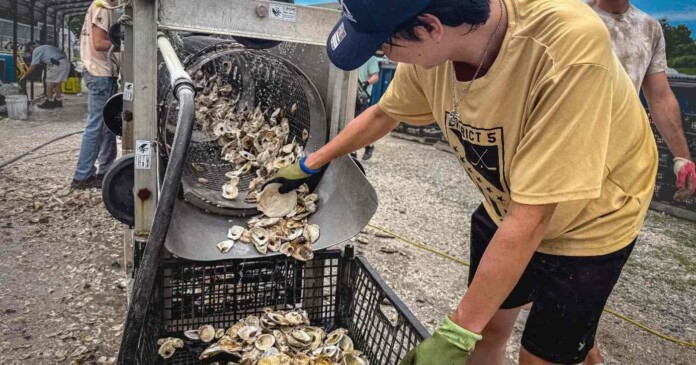
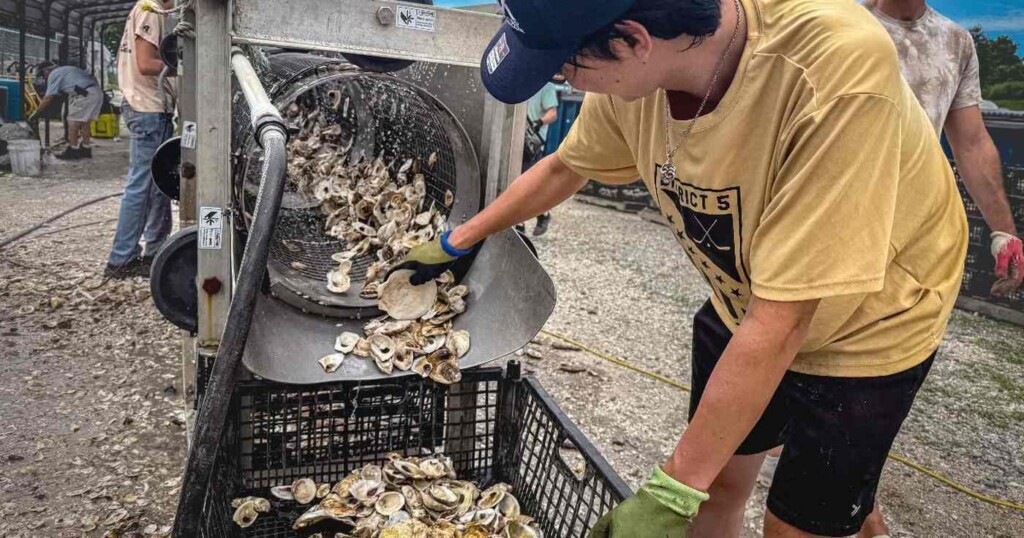
On Governor’s Island in New York City, a nonprofit is turning wasted oyster shells into new oyster reefs that filter pollutants from the harbor, absorb wave energy, and supply the city’s restaurant industry.
Called the Billion Oyster Project, the objective is to restore some 100 acres of lost, historic oyster reefs using the waste streams from dozens of partner restaurants.
To date, the project has achieved 20% of the eponymous aim, the project has nevertheless seen incredible results. Staff estimate the 200 million live oysters they’ve raised on 3.2 million pounds of discarded shells have filtered tens of trillions of gallons harbor water across 19 acres of restored reefs.
“Oysters are what we call a keystone species, meaning if the oysters are thriving in an environment all other biodiversity is thriving in that environment,” Bela Altman, Volunteer Coordinator for the Billion Oyster Project, told Reuters.
The project runs a hatchery on the southern part of Governor’s Island. Here, some 75 NYC restaurants divert oyster shells from municipal landfills to a very special dump.
“We take the oyster shells from restaurants and bring them to our shell pile,” Agata Poniatowski, education outreach coordinator for the project, told ABC News. Over time, the shells cure. “Once there’s no bacteria and no invasive species, no disease, we bring them to our hatchery.”
There, oyster larvae are released to populate the old shells, acclimatize to New York water, feed and mature. 10 million baby oysters can be raised at once, before being trucked by the bag out into the harbor and dumped into the reef sites to begin their new lives.
It’s been a long road to get to this point of efficiency and scale. ABC reports that the Billion Oyster Project was launched in 2008, with the 10-figure end point predicted to come by 2035.
DOING GOOD WITH OYSTERS:
- Over 200 Volunteers Lead Largest-Ever Oyster Reef Restoration Off England’s Portsmouth
- Everglades Farm Is Reviving Florida’s Oyster Industry, Making the Tables of Michelin-Starred Restaurants
- Shells to Sweaters: Sustainable ‘Sea Wool’ Earns Millions for Taiwan Business Spinning Oyster Shells into Yarn
1 billion oysters would make a major difference to the city. Not only would it bring down the cost of oysters to the delight of restaurant goers, 100 new reefs would refresh the entire water volume of New York Harbor every 3 days.
In a world where climate change could amplify storm intensity, oyster reefs would help disperse the energy of incoming waves, reducing the risk of severe flooding.
WATCH the story below from Reuters…
SHARE This Great Story On The Half Shell With Your Friends…
Common Supplement Rivals Antibiotics for Severe Gum Disease When Taken with Low-Dose Aspirin

A combination of omega-3 and low-dose aspirin performed about as well as antibiotics in a yearlong study of people with severe gum disease, or periodontitis.
It raises the possibility of an alternative treatment for some patients at a time when multiple pathogens are developing resistance to antibiotics.
The clinical study run by the São Paulo Research Foundation included 109 people with advanced periodontitis who were followed for one year.
Periodontitis is a chronic inflammatory disease that develops when bacteria accumulate below the gumline and damage the tissues that hold teeth in place. In advanced cases, the disease can destroy supporting bone, loosen teeth, and eventually cause tooth loss.
“Patients with severe disease have very deep [voids,] which act as reservoirs for bacteria associated with the disease. It’s a very challenging condition to treat,” says dental surgeon Nídia Cristina Castro dos Santos, the first author of the study and a professor and researcher at the Albert Einstein Israelite Hospital, Guarulhos University (UNG), in Brazil.
The participants were randomly divided into four groups. Everyone received a standard treatment for periodontitis called scaling. The procedure removes bacterial deposits and other material from below the gums. What differed among the groups was the additional treatment they received.
Participants in the control group were given placebo versions of the antibiotics, omega-3, and acetylsalicylic acid, or generic aspirin, packaged in capsules that looked like the active treatments.
A second group received the antibiotics metronidazole and amoxicillin. This combination has some of the strongest scientific evidence supporting its use in severe periodontitis. Patients took the antibiotics 3 times per day for 14 days.
A third group received 3 grams of omega-3 each day along with a daily dose of aspirin for 6 months. Researchers assessed the participants again after three, six, and twelve months.
After one year, about 58% of patients treated with antibiotics had reached the clinical target established by the researchers. That goal was defined as having no more than 4 remaining deep periodontal pockets.
The omega-3 and aspirin group achieved a nearly identical result, with 57.7% of participants reaching the same target.
The difference compared with standard treatment alone was substantial. Among patients who received scaling plus placebo, only 23.1% met the clinical goal, while a fourth group using antibiotics together with omega-3 and aspirin didn’t see any additional benefit over either strategy alone.
“The use of antibiotics isn’t considered the gold standard of treatment. Although metronidazole and amoxicillin yield good results in the most severe cases, their use should be evaluated on a case-by-case basis due to risks related to bacterial resistance and possible adverse effects,” says Castro dos Santos.

In an earlier study supported by the foundation, researchers found that omega-3 supplementation reduced inflammation and bone loss associated with periodontal disease in rats. The effect was particularly noticeable when supplementation was combined with physical exercise.
According to Castro, omega-3 works differently from conventional anti-inflammatory medications. Rather than simply blocking particular inflammatory pathways, omega-3 can contribute to the production of molecules that help the body naturally bring inflammation to an end and promote tissue repair.
Low-dose aspirin was included because it can enhance the production of these inflammation-resolving molecules. Researchers therefore suspected that combining omega-3 with aspirin might help the body gain better control over the persistent inflammation associated with periodontitis.
“We imagined that the combination of antibiotics and omega-3 would be most effective in controlling periodontitis in these patients. We also believed that the results for the group that used omega-3 with aspirin would be slightly lower than those for the antibiotic group. The result was surprising because the two therapies performed very similarly, paving the way for it to become a treatment option for these patients,” says Castro.
The researchers were also struck by how long the apparent benefits lasted, as participants in the non-antibiotics group continued to show results similar to those seen at the end of treatment even 6 months after supplementation had stopped.
According to Castro, the persistence of the effect raises the possibility that changing the way the body responds to inflammation could produce longer-lasting benefits. Researchers are still investigating exactly how this might happen.
For dental surgeon Magda Feres, the lead author of the study and a full professor at the Harvard School of Dental Medicine and the Graduate Program in Dentistry at UNG, the results suggest that targeting the inflammatory response could provide another option for certain patients.
ALSO CHECK OUT: Antiviral Chewing Gum Cuts Risk of Certain Head and Neck Cancers to Almost Zero in New Study
“The combination of omega-3 and low-dose aspirin achieved clinical benefits comparable to those of the metronidazole and amoxicillin protocol, opening up a real alternative for those who can’t take antibiotics, especially patients with allergies or intolerance to these medications,” she says.
The potential to treat some cases without antibiotics is particularly relevant because antibiotic resistance is considered one of the major threats to global public health.
“Demonstrating that it’s possible to treat severe periodontitis by modulating the body’s own response is new and relevant information that helps preserve antibiotics for when they are truly indispensable,” says Feres.
DENTISTRY ADVANCES: New Gel Regrows Dental Enamel–Which Humans Cannot Do–and Could Revolutionize Tooth Care
Despite the promising results, the researchers stress that omega-3 and aspirin should not yet be viewed as a routine replacement for antibiotics in severe periodontitis. Researchers are also conducting microbiological analyses to understand what happens to bacteria inside periodontal pockets during treatment.
Preliminary findings suggest that the therapies may reduce bacterial species associated with periodontal disease while increasing microorganisms linked to healthier gums.
“It’s an important step forward, but not the end of the story. Therefore, the message is one of cautious optimism: we have a promising, scientifically plausible alternative to antibiotics in select cases. Routine replacement will require more evidence,” she concludes.
SHARE This Probiotic Way To Potentially Treat Gum Disease…
“Space is the breath of art.” – Frank Lloyd Wright

Quote of the Day: “Space is the breath of art.” – Frank Lloyd Wright
Photo by: fuzheado via CC BY-SA 2.0
With a new inspirational quote every day, atop the perfect photo—collected and archived on our Quotes page—why not bookmark GNN.org for a daily uplift?

Good News in History, September 3

Happy Birthday to Shaun White, the three-time Olympic gold medalist in half-pipe snowboarding, who turns 40 today. He was a champion skateboarder in his teens after undergoing two open-heart surgeries as an infant. He became first person to compete in and win both the Summer and Winter X Games in two different sports–including historic wins four years in a row and tallying more X-Games gold medals than anyone. READ more about White… (1986)
Belligerents in 6-year Military Standoff Agree to Swap Rifles for Ballots


A civil war, military standoff, and a state experiencing double-government are all hopefully set to end after Libya’s rival factions agreed to hold elections.
The breakthrough occurred in a signing ceremony Sunday at the United Nations Support Mission to Libya in Tripoli, and follows a period of tireless negotiations by the UN lasting over 2 years.
Following a NATO-backed insurrection which toppled the government in 2011, rival political and rebel factions succumbed to a civil war that lasted from 2014 to 2020. In 2021, negotiations on national elections collapsed, leaving the country split between the UN-recognized government in Tripoli, and the forces of the army under General Khalifa Haftar in the eastern city of Tobruk.
Though Tripoli maintained international recognition, the state of its own political and military structure was precariously balanced between a coalition of parties and factions who weren’t always on the same side.
Mercifully, the guns have been silent for the last 6 years, leading to the Sunday’s breakthrough which saw a date set for future elections in 2 years’ time, during which contentious issues involving electoral law, the eligibility of candidates, and the national elections body are to be resolved.
“Today’s signing represents an important step in overcoming the political and institutional impasse that has delayed Libya’s electoral process,” UN Special Rep. for the Secretary General, Hanna Tetteh said in her remarks at the signing ceremony. “The agreement demonstrates what can be achieved when Libyans constructively engage in dialogue and seek practical and implementable solutions to outstanding issues.”
MORE DIPLOMACY SUCCESSES: Nobel-Worthy Prime Minister Attempts to End Century of Ethnic Hatred for Armenians
A potential elections framework suddenly seemed possible after the UN held a series of discussions that involved two representatives of Libya’s 4 existing political institutions: the Government of National Unity (UN recognized), the Libyan National Army (General Haftar’s side), the High Council of State, and the House of Representatives.
Shibani Abu Hamoud, head of the army’s general command, said this forum would work with the UN’s mission “to develop a framework within one month of the signing of the agreement to follow up on all matters related to its implementation.”
NORTH AFRICA NEWS: Timbuktu’s Medieval Manuscripts Return Home After a Decade Away Safe from Insurgents
The agreement signed on Sunday includes a provision that if Libya’s House of Reps. and the High Council of State fail to achieve a breakthrough in this one-moth period, the parties will move forward towards the elections with “a constitutional document,” the New Arab reported, with support from the UN Security Council.
All major Libyan political players have called for elections repeatedly over the last 6 years, and economic re-development and internal security in the country has rapidly improved.
SHARE This Huge Change For Peace And Democracy In A Troubled Nation…
Stray Cat Nursed Back to Health by Train Staff, Climbs the Ranks to Become Stationmaster


Japan is nothing if not a servant to tradition; even if the tradition is a little strange.
Admittedly a little less strange than the annual Kanamara Matsuri festival in Kawasaki (parental guidance suggested) the custom of railway lines promoting cats to the rank of stationmaster certainly raises eyebrows, but also spirits, it must be said.
In the port town of Choshi, near Tokyo, employees of a struggling railway company found either a stray or abandoned cat last October skulking around the station, thin, sick, and eyes frozen shut.
With plenty of space at the station, the tabby was nursed back to health by the platform staff before signing up as an ‘apprentice’ in January. Then, in July, Nakano-san achieved the rank of stationmaster, and was awarded with a neat cap and medallion for her collar.
Her CV includes such crucial skills as “pushing computer mouses off the desks” and “sleeping on paperwork.”
She now figures prominently in Choshi Electric Railway Co. public relations content as a mascot, and her July debut saw the rail hub of Nakanocho Station swarmed with reporters to catch a glimpse of the new boss.
In all seriousness though, being too close to Tokyo to stand out but too far away to comfortably visit, Choshi Railway felt that more needed to be done to draw interest in the city’s numerous historic temples, lighthouses, and characteristic waterfront area.
MORE FROM JAPAN:
- Organizations Rally to Reunite Lost Pets with Owners Following Earthquake in Japan
- How Japanese Fish Printing Grew from Documenting Day’s Catch to Acclaimed Artform
To that end, the 4-legged stationmaster seemed a good idea. They had good reason to believe it was too. In January, at Wakayama Electric Railway Co.’s Kishi Station in the city of Kinokawa, officials welcomed their third stationmaster cat.
In 2007, the station announced Japan’s first-ever cat stationmaster: Tama. After Tama passed away in 2015, she was succeeded by Nitama (literally, “looks like Tama”) who also passed away in last November. Now, Kishi Station is run by Yontama (literally, “Fourth Tama,” after the ‘third Tama’ was adopted back into private house life).
CAT JOBS: Meet the Oxford Library Cat Who’s Purr-fectly Content Being the Unofficial College Mascot
The publicity from Tama’s original 2007 appointment led to an increase in passengers by 17% for that month as compared to same period from the previous year. A study estimated that the publicity surrounding Tama has contributed 1.1 billion yen to the local economy, and she was widely credited with saving Nishi Station from closing.
Yontama previously served as stationmaster at Idakiso Station in Wakayama City, and vowed to “follow in Nitama’s ‘pawprints’.”
SHARE This Cute And Curious Tradition From Japan On Social Media…
Original Picasso Stolen 8 Years Ago Found Hanging in Vacant Apartment by Milwaukee Landlord


Whether it’s cleaning out an attic or a Wisconsin apartment, in one landlord’s case, finding an original Pablo Picasso work might seem like an unbelievable stroke of luck.
GNN knows slightly better—every year pieces by the most famous Spanish artist seem to turn up all over the place.
Milwaukee landlord Timothy Dertz was cleaning out after a tenant had left, and found a striking depiction of a man behind a door in the farthest room.
“A very odd placement for such a piece of art,” he thought at the time, according to local news.
Dertz brought it to an antique dealer to see if there was any indication it might be valuable: the Picasso signature in green crayon seemed to be a good place to start.
The two men then dug deeper and found an identical piece by Picasso; an etching made by the artist in 1949 called Torero. Moreover, the piece was reported stolen from a Milwaukee art gallery in 2018 where it was valued at between $35,000 and $50,000.
Anxious he would somehow become associated with the unsolved criminal act, Dertz wasted no time in bringing it to the police station and recounting all he had learned. In August, Milwaukee police contacted Mr. Bill DeLind, owner of the art gallery where the piece was allegedly stolen. He confirmed it was the real deal.
PICASSO GETS AROUND: Painting Found in Italian Villa Basement Turns Out to Be Original Picasso
“I never expected to see it again,” DeLind tells the Washington Post. “The fact that it would turn up 8 years later in perfect condition is just jaw-dropping.”
At the time, the gallery had put out a reward worth $5,000 for information leading to the etching’s return, increasing it in increments periodically until, with their insurance having compensated them for the loss, they gave up hope of finding Torero.
MORE STORIES LIKE THIS: Stolen 18th-Century Painting of St. Francis Returned to a Mexican Church
Yet if the art world is anything, it’s archival. Indeed, Smithsonian Magazine quoted the founder of the FBI’s Art Crimes Unit as saying that the bureau always advises victims of art theft to sit tight, as stolen pieces often show up through gallery and auction house due diligence processes.
Even antique dealers like the one contacted by Dertz can only properly appraise works of art if they know what they are. Knowing what they are inevitably involves learning where they came from, and that often sees paintings reunited with rightful owners, as GNN has reported—about Picasso works no less.
SHARE This Lost And Found Story Among Milwaukee’s Art World…
Last-Minute Flood Warning Saved Over 900 Nepal Students, School Principal Said


More than 900 students and 16 faculty members escaped before the tragic flood on the border with China and Nepal destroyed a school.
They are alive today because of a truly last-minute warning by the school’s accountant, who like Paul Revere, ran through the building shouting “the flood is coming, the flood is coming!”
His warning, while the student body sat unawares in their classrooms, is the reason that the 900 members are alive today.
On the fateful day when a collapsing glacier mouth caused a flash flood that destroyed several towns and claimed hundreds of lives, the headmaster of the Tribhuvan Trishuli Secondary School in the town of Bidur was told by the school accountant that the destructive force was surging toward them.
Several teachers had received frantic calls from family and friends, but the accountant first got wind of the oncoming disaster when a friend from the very first town hit called to raise the alarm.
Indeed the story features 2 heroes, for at the speed the water was traveling, the accountant’s friend’s warning meant the school had 14 minutes to evacuate before, as it would come to happen, the waters utterly flattened it.
MORE STORIES LIKE THIS: Solitary Rescuer Leads 165 Children to Safety During Recent Texas Flooding–Hailed as a Hero
Headmaster Rajendra Dawadi became the organizing force in a panicked escape, calling bus drivers bringing yet more students to the school to turn around and seek higher ground. Parents, teachers, and locals piled students into cars, buses, and motorbikes to send them across a bridge to higher ground as the school was built on something of a peninsula along the Trishuli River.
According to Reuters, it was after the final bus crossed the most recently built bridge that the waters arrived, erasing the school as the students might erase a spelling error.
SHARE This Incredibly Fortunate Escape That Saved 900 Children…
“Life is a lot like jazz… It’s best when you improvise.” – George Gershwin

Quote of the Day: “Life is a lot like jazz… It’s best when you improvise.” – George Gershwin
Photo by: Pierre Goiffon
With a new inspirational quote every day, atop the perfect photo—collected and archived on our Quotes page—why not bookmark GNN.org for a daily uplift?

Good News in History September 2

Happy 62nd Birthday to Keanu Reeves, the actor who might be called one of the nicest guys in show business. The Canadian started his career with humor and light-hearted films like Bill and Ted’s Excellent Adventure, before moving onto becoming an action star with his protagonist role as Neo in The Matrix trilogy, Point Break, and the John Wick movies. In addition to his career as an actor and musician, Reeves is the co-writer and creator of the BRZRKR comic book franchise. GNN reported on its release. READ more about this charismatic star… (1964)
Pokémon Fans Rally to Help Child After He Was Scammed Out of His Most Valuable Card


A heartwarming story of a community putting values above value comes from the convention floor of Pokémon XP.
At the August 29th event in San Francisco, venture capitalist Eric Bahn shared that his son was scammed while trading Pokémon cards with an adult.
“Lost his most valuable cards in a fraudulent trade by some guy in a booth,” Bahn wrote on X. “Very tough lesson for him. Sucks to see an adult take advantage of a child.”
A series of personality card collectors quickly replied to the comment offering to help, if possible, make the boy’s collection whole again.
The first was a YouTuber by the channel name “Deep Pocket Monster,” a play on words with the Japanese translation of Pokémon [pocket monsters].
In an earlier reply, Bahn revealed that his son had lost a “PSA 9 Rayquaza VMAX #218 from Evolving Skies” an exceptionally valuable card the lad had spent a long time trading up to.
It was a valuable one, took him many years of trading to work up towards pic.twitter.com/pBqTc8G3S8
— Eric Bahn 💛 (@ericbahn) August 30, 2026
Deep Pocket Monster, who Bahn’s son had met just hours before he was scammed, replied that he would “reach out via DM,” saying he’d love to help out.
Sonoroman, whose profile lists him as Pokémon’s “Premier Event Manager for Latin America and Oceania,” saw this reply and left one of his own, saying that if he can locate the card in his vast collection, he’d be happy to hand it over. Alternatively, the gentleman card collector said he’d have a surprise for Bahn’s son if the pair decided to return to the convention.
On a happier note, thank you @DeepPocketMnstr for being so kind and generous to my son and friend today. My son got scammed right after meeting you in this pic, but despite that he said interacting with you made his day. Thank you for that. pic.twitter.com/jzOEMXRjI3
— Eric Bahn 💛 (@ericbahn) August 30, 2026
Sonoroman wasn’t the only one in the thread who offered to make the boy’s collection whole again if they had this rare Rayquaza card—a US Army veteran made the same offer. Bahn thanked everyone who had reached out, supported the family, or offered gifts, saying it helped his son learn a second lesson—that there are far more good people in the world than bad people.
It’s unclear if the card was ever indeed replaced, but as inflation has driven up asset prices considerably over the last 20 years, and as the first launch of Pokémon Trading Cards back in 1997 drifts further and further into history, many cards are attracting hair-raising valuations.
Some of these offers to replace the card may have represented 4 or even 5-figure sums.
The story was first reported by Dextero, which writes on gaming and collectibles.
SHARE This Swarm Of Good Souls Doing What They Can To Help One Of Their Own…