














A statue of an ancient Persian king might seem like an unlikely addition to the city of Atlanta. To the people who spent years bringing him here, there’s no more fitting place in America.
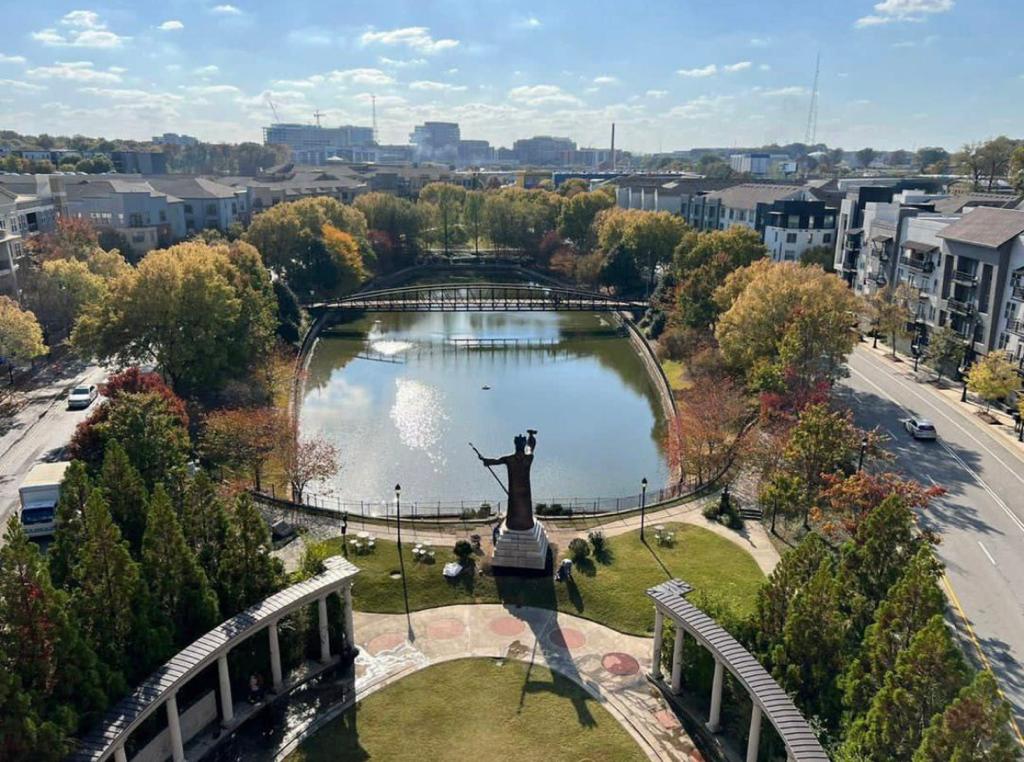
This week, crews installed a 29-foot bronze statue of Cyrus the Great at Pardis Park. It’s now one of the largest Iranian monuments anywhere outside of Iran. The bronze figure alone weighs about 8,000 pounds, and that does not even include its limestone base, which is shaped like his tomb.
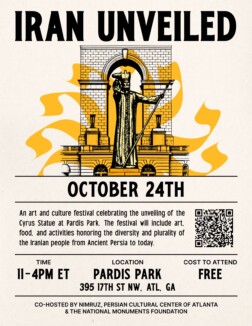
This Saturday, it will be formally dedicated during Iran Unveiled, a free, family-friendly festival celebrating Persian culture.
Why Atlanta
Cyrus founded the Persian Empire roughly 2,500 years ago, but he’s remembered less for conquest and more for tolerance. The Cyrus Cylinder, a clay artifact now in the British Museum, is often called one of the earliest declarations of human rights.
It reflects a policy of religious freedom and respect for the dignity of every people under his regime. Cyrus also freed the Jewish people held captive in Babylon and let them return home to rebuild their temple.
That legacy is exactly why Rostam Zafari, co-founder of the nonprofit Nimruz and the driving force behind the statue, wanted it in the city of Dr. Martin Luther King Jr.
“It’s so fitting in the home of Martin Luther King,” Zafari told Atlanta’s 11 Alive this week. “This is a message for freedom and peace and coexistence between people, and justice as well.”
The setting reinforces the message. Pardis Park, which Zafari led the effort to create, already honors champions of human rights from around the world, including Cuban poet José Martí and Hungary’s freedom fighters. Cyrus stands on a replica of his own tomb in Iran. Even the park’s name fits: Pardis means “paradise” in Persian, and the word traces back to the walled gardens of ancient Persian kings.
There’s an American connection, too. Thomas Jefferson owned two copies of the Cyropaedia, an ancient account of Cyrus’s life and leadership, and pushed his grandchildren to study it. Zafari sees the statue as a reminder of ideals the two countries share.
“We have to go back to our roots as people and the ideals that both of our nations were founded on,” he said.
Why Now
The statue, sculpted by Atlanta artist Stan Mullins, took several years and more than 40 people to complete. Funding was a constant struggle, and an earlier version of the statue suffered complications before the final bronze was cast. Zafari says he took a big personal risk to see it through.
“I believed it was something that would outlast me and my family,” he said.
With Cyrus finally standing, organizers decided the moment deserved a party. The statue of Cyrus will be unveiled at a festival aptly named Iran Unveiled. “We wanted to celebrate this,” Zafari said. “It’s a big deal.”
It was also personal, with Zafari dedicated the project to his grandparents. “They taught me what it means to be a human being and to be an Iranian,” he said, calling the statue a gift to Atlanta, to his grandparents’ hometown in Iran, and to them.
And for many Iranian Americans, it arrives at a moment when the US is at war with Iran. Zafari hopes the statue offers a different picture: Iran as its people actually are, not as it’s often portrayed in the news.
READ ABOUT ANOTHER UNEXPECTED COLLABORATION:
“I want [Americans] to know that [Iranians are] very similar to American people,” he said. “In freedom, in plurality, in music, in joy. That is what it means to be Iranian.”
That’s also the mission of Nimruz, which Zafari co-founded with his cousin, Sepanta Mohseni, to bring together Iranians of every background, faith and point of view to celebrate Iranian culture and share it with their neighbors.
Share This Story With Your Community Today…