Animals that have never been domesticated, such as kangaroos, can intentionally communicate with humans, says a new study.
Nick Dunn
Challenging the idea that such behavior is restricted to domesticated animals like dogs, horses, and goats, the research was done by the University of Roehampton and the University of Sydney.
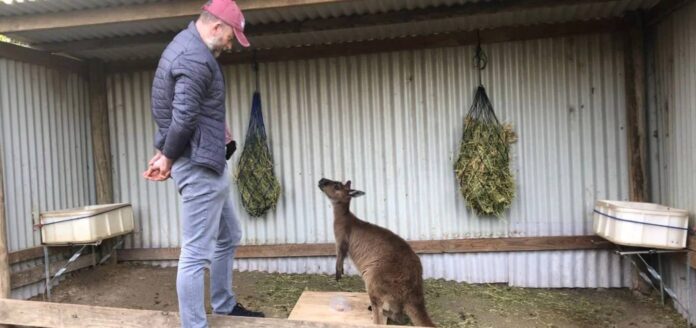
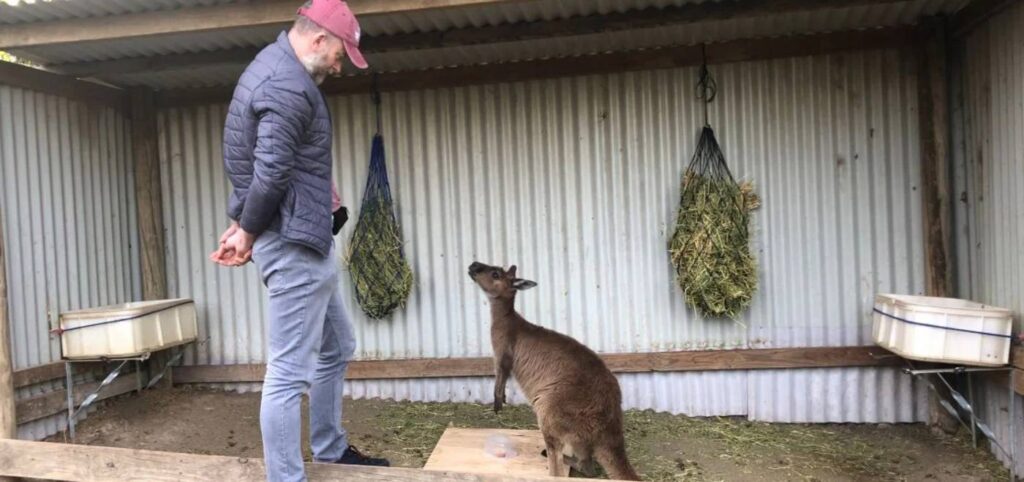
Involving kangaroos—marsupials that were never domesticated—at three locations across Australia, the findings revealed that these animals gazed at a human when trying to access food which had been put in a closed box.
The kangaroos used these long looks to communicate with the person instead of attempting to open the box themselves—a behavior that is usually expected for domesticated animals.
10 out of 11 kangaroos tested actively looked at the person who had put the food in a box to get it (this type of experiment is known as “the unsolvable problem task”).
Nine of the 11 kangaroos additionally showed gaze alternations between the box and the person present, which is seen as a heightened form of communication.
The science of communication
Dr. Alexandra Green, University of Sydney
The research builds on previous work in the field which has looked at the communication of domesticated animals, such as dogs and goats, and whether intentional communication in animals is a result of domestication.
Lead author Dr Alan McElligott, University of Roehampton (now based at City University of Hong Kong), previously led a study which found goats can understand human cues, including pointing, to gather information about their environment.
Like dogs and goats, kangaroos are social animals, and Dr McElligott’s new research suggests they may be able to adapt their usual social behaviors for interacting with humans.
Dr Alan McElligott said in a statement: “Through this study, we were able to see that communication between animals can be learnt and that the behavior of gazing at humans to access food is not related to domestication. Indeed, kangaroos showed a very similar pattern of behavior we have seen in dogs, horses and even goats when put to the same test.
“Our research shows that the potential for referential intentional communication towards humans by animals has been underestimated, which signals an exciting development in this area. Kangaroos are the first marsupials to be studied in this manner and the positive results should lead to more cognitive research beyond the usual domestic species.”
Dr Alexandra Green, School of Life and Environmental Sciences at the University of Sydney, said of the study, published in Biology Letters: “Kangaroos are iconic Australian endemic fauna, adored by many worldwide but also considered as a pest. We hope that this research draws attention to the cognitive abilities of kangaroos and helps foster more positive attitudes towards them.”
HOP, JUMP, and SKIP the Fascinating Research Over to Your Buddies…
And as any devoted Antique’s Roadshow armchair appraiser can tell you, few things rhyme better with “Ka-ching!” than Ming—Ming Dynasty, that is.
Sotheby’s
That’s why when one eagle-eyed thrifter spotted a promising-looking piece of porcelain amidst the other tchotchkes at a Connecticut yard sale, he didn’t even haggle over the price. Soon enough, it was, “Sold to the gentleman for $35!”
Even so, the unnamed buyer was likely bowled over when he learned that the delicate blue-and-white dish—measuring just a bit over six inches in length and decorated with lotus, peony, chrysanthemum, and pomegranate blossoms—was one of a mere half dozen such Ming pieces to have survived into the 21st century.
Sotheby’s confirmed the exquisite 15th-century treasure likely originated during the reign of the Yongle (which rhymes with Mongol, which starts with a capital “M,” and that stands for Money!) Emperor, circa 1403–1424.
“The Yongle Emperor really promoted the artistic importance of porcelain,” Angela McAteer, head of Sotheby’s Chinese art department, told CNN. “He elevated it from being a utilitarian bowl, for example, into a true work of art.”
With an estimated value of between $300,000 to $500,000, the lovely lotus bowl is to be auctioned off during Sotheby’s “Highlights From Important Chinese Art” sale on March 17. “In every respect,” notes the catalog listing, “this delicate bowl is a quintessential Yongle product, made for the court, showing the striking combination of superb material and painting.”
Adding to its a mystique, from what McAteer told CNN, “[The bowl had an] incredibly smooth porcelain body” and a “really unctuous silky glaze [which] was never replicated in future reigns or dynasties.”
Should the fetching vessel go for the half-million figure when it goes under Sotheby’s figurative hammer, even taking into account the auction house’s cut, an up-to 1,428,471% price hike is a pretty nifty return on anyone’s $35 dollar investment.
From rare wood, to dried intestines, to horse hair dusted with crystalized pine sap, human beings will make instruments out of practically everything.
But who would ever imagine that, acoustically speaking, an entire orchestra of equipment could be formed out of ice?
As it turns out, ice instruments have a very good, and very unique sound to them, one that Tim Linhart, an American ice sculptor-turned-instrument maker describes as having the “purity and clarity of the heavenly realm.”
“There’s so much potential in ice as an acoustic material,” says Linhart in a YouTube mini-doc from Great Big Story. Linhart has learned, through trial and error, how to carve a complete orchestra from nothing other than frozen water, including violin, viola, cello, double bass, mandolin, guitar, banjo, xylophone, drums, and marimba.
“I decided [for] one of my sculptures I’d like to build a giant violin,” explains Linhart. “And I had a friend who was building guitars and he just asked the question, ‘yeah I wonder how that one’s going to sound?'”
“And that question has swallowed much of the rest of my life,” said Linhart.
Linhart, who also carves ice concert halls—a cross between a giant igloo and a tiny amphitheater, founded Ice Music, a touring ice concert performance group based out of Sweden and Italy.
A sample of their music on SoundCloud features a rendition of the Minor Swing by Django Reinhardt, wherein the difference in sound between ice and wood instruments can be heard perfectly.
Linhart is certainly a pioneer, having built 19 ice orchestras and 11 igloo concert halls. But he is not alone in this most extreme form of music.
In 2000, the world’s first ice-music concert took place under a frozen waterfall in Lillehammer, Norway. The composer and conductor, Terje Isungset, is still one of the world’s premier ice-music producers.
Having conducted hundreds of concerts worldwide, Isungset performed at the 2017 Nobel Prize Gala dinner, which featured renowned traditional Swedish vocalist Lena Willemark, and which began with a 10-second blast from an carved-ice horn.
“When I first started playing on clear ice, I found its pure sound surprisingly warm and gentle compared to the sound of crushed ice beneath your feet, which is a very cold sound,” Isungset told National Geographic.
Insungset also started the annual Ice Music Festival, held every year in Norway for those willing to withstand the freezing temperatures needed to ensure the instruments keep their shape throughout the concert.
Problems like hot hands and lips warming the instruments mean that the strings section gradually alters their pitch throughout the concert, but a colder environment can help prevent these material issues.
They present other challenges, however, as musicians’ normally-nimble fingers slow down from the numbing cold, and horn players’ lips stick to their instruments like the kids in a Christmas Story.
While the pandemic has prevented any ice concerts from happening recently, the Ice Music Festival is on track for a 2022 return, and after Milan was awarded the 2026 Winter Olympic games, Linhart immediately began drafting proposals for an ice concert as part of the opening ceremony.
(WATCH the igloo orchestra in action below.)
Featured image: Bjørn Furuseth for @IceMusicFestivalNorway/Instagram
SHARE the Icy Sounds With Your Friends Who’d Love to Hear It…
Quote of the Day: “Spring… thaws the frozen fears, mends the wounded heart that Winter has broken.” – Aarno Davidson
Photo by: Ed van duijn
With a new inspirational quote every day, atop the perfect photo—collected and archived on our Quote of the Day page—why not bookmark GNN.org for a daily uplift?
While countless brilliant men and women don’t have college diplomas, their achievements often speak for themselves. Still, having access to higher education can be an integral stepping stone on the path to success.
It’s a double-whammy when marginalized students who’ve traditionally faced financial barriers to obtaining degrees find themselves drowning in debt by the time they graduate.
Few know the challenges of this particular obstacle course better than Calvin Tyler, who abandoned his own collegiate dreams six decades ago when tuition became too steep.
In 1961, Tyler enrolled as a student of business administration at Morgan State College (now Morgan State University) in Baltimore. When his funds dried up in 1963, a year shy of graduation, he took a job as a UPS driver.
Tyler’s lack of a college diploma might have been considered a setback by some, but it didn’t deter this driver with a true drive from steadily rising in the ranks. By the time he retired in 1998, Tyler was Senior Vice President of U.S. Operations and was seated on the UPS board of directors.
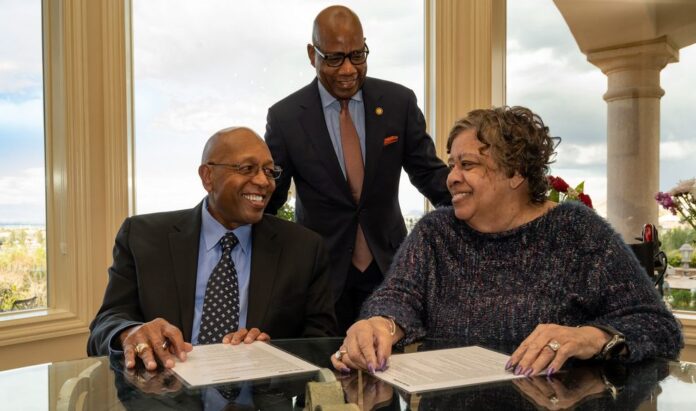
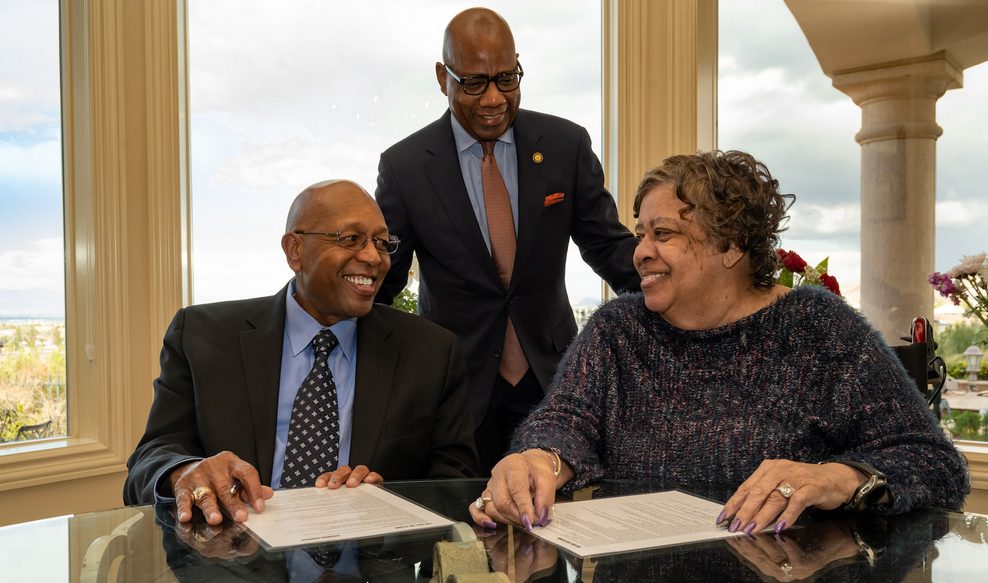
Tyler’s hard work and grit paid off, but he knew that in the business world, his story was the exception rather than the rule. So, in 2002, he and his wife established the Calvin and Tina Tyler Endowed Scholarship Fund at the historically Black university he once attended.
Morgan State University
By granting full-tuition scholarships to select Baltimore students in need, they hoped to elevate them to a place where they’d be able to gain a first foothold on the corporate ladder. How far they climbed would be up to them.
In 2016, the Tylers raised the bar, endowing the fund with $5 million. Earlier this year, they broke their own record, pledging $20 million in scholarship endowments.
Tyler says he and his wife were compelled by the impact the COVID-19 crisis has had on students already struggling to do what they could to help close the financial gap.
“This is why we are increasing our commitment,” he explained. “We want to have more full-tuition scholarships offered to young people so that they can graduate from college and enter the next stage of their life debt-free.”
Morgan State President David Wilson addressed the couple’s magnanimous ongoing support in a statement that said in part: “Through their historic giving, the doors of higher education will most certainly be kept open for generations of aspiring leaders whose financial shortfalls may have kept them from realizing their academic dreams…
Morgan State University
“The Tylers’ generosity over the years, culminating with this transformative commitment, is a remarkable example of altruism with great purpose.”
Calvin Tyler might not have a college diploma to hang on his wall, but he’s earned an advanced degree in paying it forward many times over—and that’s one course of study all of us can learn from.
SHARE This Inspiring Story With Pals on Social Media…
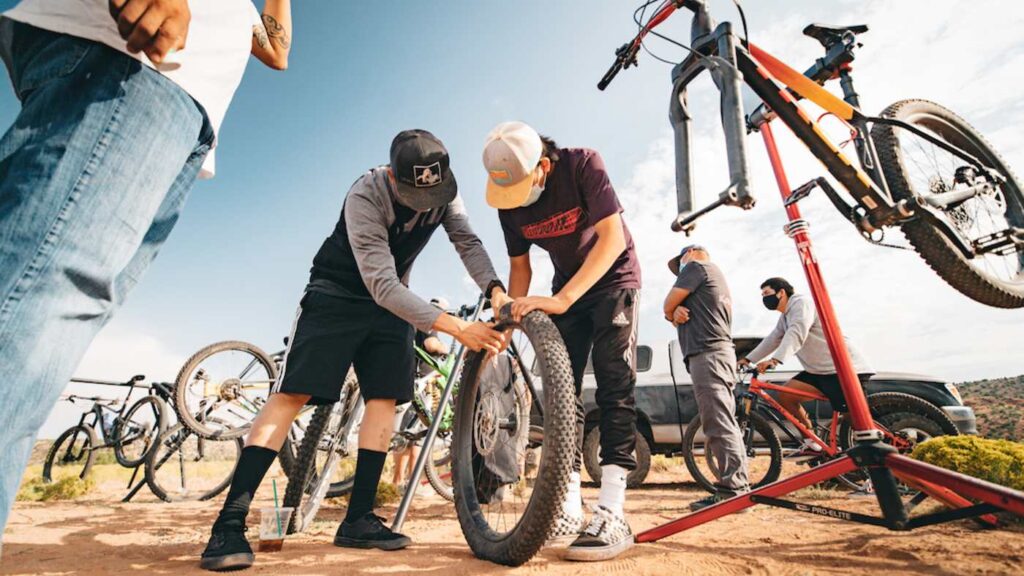
AJ Murphy teaches Wyatt James about tubeless tires, by Shaun Price
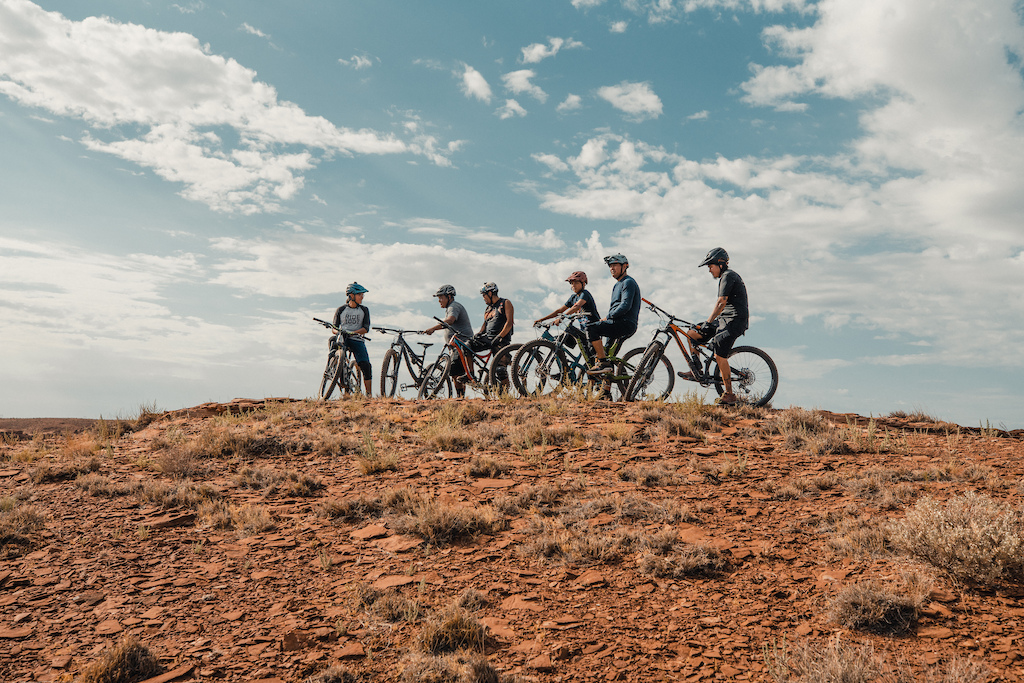
For many living on the 29,500 square miles of Navajo land in New Mexico, riding a bicycle is a way of life, yet there isn’t a single bicycle repair shop in the area. That’s why a group of bike-enthusiasts are bringing a repair shop to the desert.
AJ Murphy teaches Wyatt James about tubeless tires, by Shaun Price
Instead of residents having to travel to towns as far as Gallup to get their bikes repaired, Silver Stallion is coming directly to them—and not charging a dime.
Silver Stallion Bicycle & Coffee Works is traveling across Diné lands to do free bike repair for the Navajo Nation as a form of COVID-19 relief—and they got a grant in 2020 to help cover expenses from the New Mexico Economic Development Department.
In addition to the grant from the state, the Southwest Indian Foundation donated a delivery truck and the Catena foundation awarded the Stallion with a grant to cover the truck’s operating costs.
Late this summer, Stans-Pivot Pro Team mechanic, Myron Billy, traveled to Gallup in New Mexico to outfit the Stallion’s freshly donated truck as a mobile bike shop.
From September to November, Billy and the crew from the Stallion held thirteen repair events, repairing 425 bikes in seven different communities across the Navajo Nation.
Events were hosted by community members at Navajo Nation chapter houses and community schools.
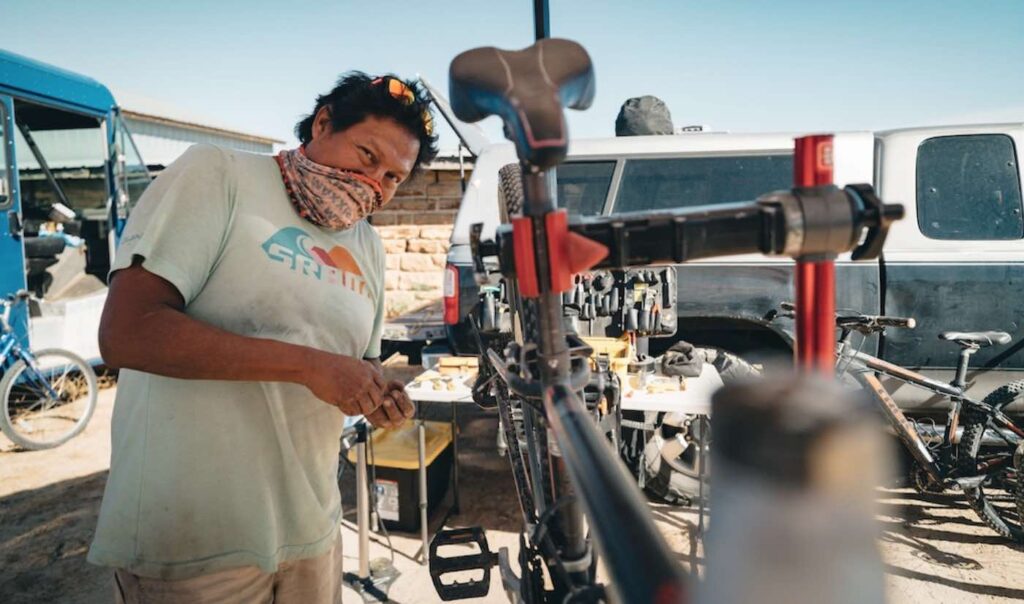
Myron Billy, by Shaun Price
The Silver Stallion’s mobile repair center was a grassroots movement that was led by Diné mechanics and various riders like Billy. His experience working on the World Cup mountain bike circuit was critical to the operation’s success in getting so many bikes rideable and he served as an invaluable mentor for the other mechanics.
The Silver Stallion used donated parts from companies like Stans No Tubes and the Clif Bar Pro Team—along with salvaged parts off old bikes to do many of their repairs.
The crew were experts at freeing-up seized freehubs, outfitting bikes with new cables and housing, and sliming tubes for the abundant local goatheads—a type of seed that causes punctures.
The effort was so successful—and the need so great—that they had to cut off the intake of bikes early at almost every event.
This Spring, the Silver Stallion hopes to continue free bike repair, operating with the belief that cycling is one of the best ways for kids and communities to recreate and find joy during the pandemic.
The Stallion saw plenty of evidence about how essential the service of bike repair is across Diné lands—but also begun fundraising for five kids’ mountain bike teams for expanding the cycling lifestyle.
To support both efforts you can donate to the Silver Stallion Pledgeling fundraiser here. The Silver Stallion is also accepting in-kind donations for bikes and parts for their Devo kids teams. Visit theirwebsite for more information, and to learn a little more about their awesome initiatives.
Reaching zero net emissions of carbon dioxide from energy and industry by 2050 can be accomplished by rebuilding U.S. energy infrastructure to run primarily on renewable energy, at a net cost of about $1 per person per day, says a new study.
Researchers at the Department of Energy’s Lawrence Berkeley National Laboratory, the University of San Francisco (USF), and Evolved Energy Research created a detailed model of the entire U.S. energy and industrial system to produce the first detailed, peer-reviewed study of how to achieve carbon-neutrality by 2050.
According to the Intergovernmental Panel on Climate Change (IPCC), the world must reach zero net CO2 emissions by mid-century in order to limit global warming to 1.5 degrees Celsius and avoid the most dangerous impacts of climate change.
The researchers developed multiple feasible technology pathways that differ widely in remaining fossil fuel use, land use, consumer adoption, nuclear energy, and bio-based fuels use but share a key set of strategies.
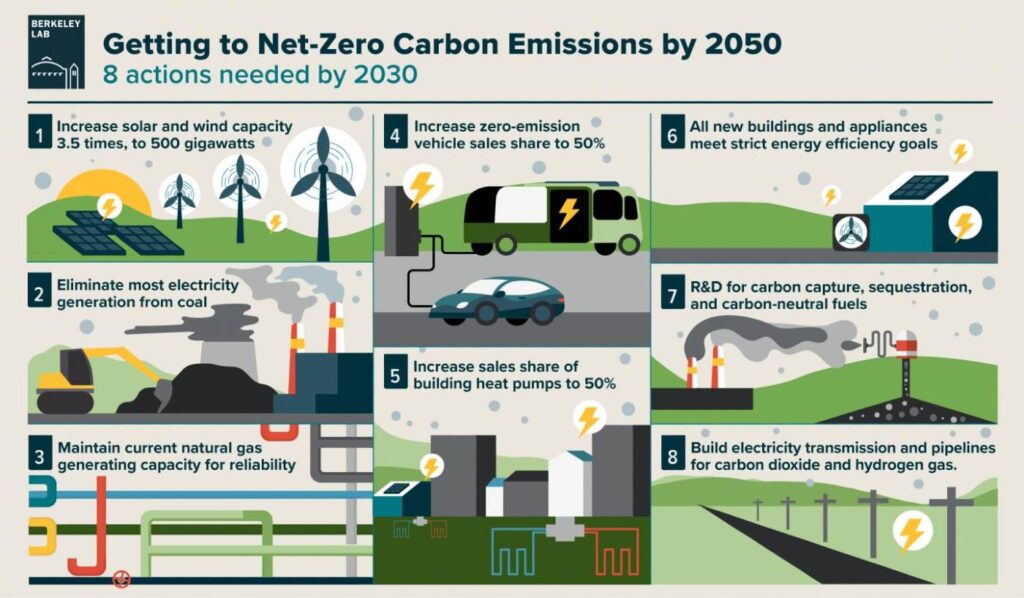
“By methodically increasing energy efficiency, switching to electric technologies, utilizing clean electricity (especially wind and solar power), and deploying a small amount of carbon capture technology, the United States can reach zero emissions,” the authors write in Carbon Neutral Pathways for the United States, published recently in the scientific journal AGU Advances.
Net zero means achieving a balance between the greenhouse gas emissions put into the atmosphere and those taken out.
Transforming the infrastructure
Jenny Nuss, Berkeley Lab
“The decarbonization of the U.S. energy system is fundamentally an infrastructure transformation,” said Berkeley Lab senior scientist Margaret Torn, one of the study’s lead authors. “It means that by 2050 we need to build many gigawatts of wind and solar power plants, new transmission lines, a fleet of electric cars and light trucks, millions of heat pumps to replace conventional furnaces and water heaters, and more energy-efficient buildings – while continuing to research and innovate new technologies.”
In this transition, very little infrastructure would need “early retirement,” or replacement before the end of its economic life. “No one is asking consumers to switch out their brand-new car for an electric vehicle,” Torn said. “The point is that efficient, low-carbon technologies need to be used when it comes time to replace the current equipment.”
The pathways studied have net costs ranging from 0.2% to 1.2% of GDP, with higher costs resulting from certain tradeoffs, such as limiting the amount of land given to solar and wind farms. In the lowest-cost pathways, about 90% of electricity generation comes from wind and solar. One scenario showed that the U.S. can meet all its energy needs with 100% renewable energy (solar, wind, and bioenergy), but it would cost more and require greater land use.
“We were pleasantly surprised that the cost of the transformation is lower now than in similar studies we did five years ago, even though this achieves much more ambitious carbon reduction,” said Torn. “The main reason is that the cost of wind and solar power and batteries for electric vehicles have declined faster than expected.”
The scenarios were generated using new energy models complete with details of both energy consumption and production—such as the entire U.S. building stock, vehicle fleet, power plants, and more—for 16 geographic regions in the U.S. Costs were calculated using projections for fossil fuel and renewable energy prices from DOE Annual Energy Outlook and the NREL Annual Technology Baseline report.
The cost figures would be lower still if they included the economic and climate benefits of decarbonizing our energy systems. For example, less reliance on oil will mean less money spent on oil and less economic uncertainty due to oil price fluctuations. Climate benefits include the avoided impacts of climate change, such as extreme droughts and hurricanes, avoided air and water pollution from fossil fuel combustion, and improved public health.
The economic costs of the scenarios are almost exclusively capital costs from building new infrastructure. But Torn points out there is an economic upside to that spending: “All that infrastructure build equates to jobs, and potentially jobs in the U.S., as opposed to sending money overseas to buy oil from other countries. There’s no question that there will need to be a well-thought-out economic transition strategy for fossil fuel-based industries and communities, but there’s also no question that there are a lot of jobs in building a low-carbon economy.”
The next 10 years
An important finding of this study is that the actions required in the next 10 years are similar regardless of long-term differences between pathways. In the near term, we need to increase generation and transmission of renewable energy, make sure all new infrastructure, such as cars and buildings, are low carbon, and maintain current natural gas capacity for now for reliability.
“This is a very important finding. We don’t need to have a big battle now over questions like the near-term construction of nuclear power plants, because new nuclear is not required in the next ten years to be on a net-zero emissions path. Instead we should make policy to drive the steps that we know are required now, while accelerating R&D and further developing our options for the choices we must make starting in the 2030s,” said study lead author Jim Williams, associate professor of Energy Systems Management at USF and a Berkeley Lab affiliate scientist.
The net negative case
Another important achievement of this study is that it’s the first published work to give a detailed roadmap of how the U.S. energy and industrial system can become a source of negative CO2 emissions by mid-century, meaning more carbon dioxide is taken out of the atmosphere than added.
According to the study, with higher levels of carbon capture, biofuels, and electric fuels, the U.S. energy and industrial system could be “net negative” to the tune of 500 million metric tons of CO2 removed from the atmosphere each year. (This would require more electricity generation, land use, and interstate transmission to achieve.)
The authors calculated the cost of this net negative pathway to be 0.6% of GDP – only slightly higher than the main carbon-neutral pathway cost of 0.4% of GDP. “This is affordable to society just on energy grounds alone,” Williams said.
When combined with increasing CO2 uptake by the land, mainly by changing agricultural and forest management practices, the researchers calculated that the net negative emissions scenario would put the U.S. on track with a global trajectory to reduce atmospheric CO2 concentrations to 350 parts per million (ppm) at some distance in the future.
The 350 ppm endpoint of this global trajectory has been described by many scientists as what would be needed to stabilize the climate at levels similar to pre-industrial times.
One of the most important stops on the ride to independence is the freedom to economically plan one’s own affairs and retain ownership of acquired property.
World Bank Collection, CC license
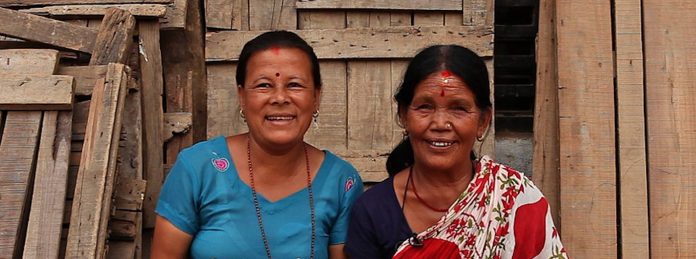
The Himalayan state of Uttarakhand has finally given married women co-ownership of their husbands’ ancestral property. It’s the first Indian state to do so, though local politicians hope it won’t be the last.
Ancestral property normally takes form as farms, which have traditionally been passed down along patriarchal lines. But as a state migration crisis has taken place—where men in particular have left in search of work elsewhere—and women have been left alone on family farms, the government thought it was only natural that women should be given co-ownership of the land.
“We talk about equal partnerships and this ordinance will provide equal partnership to women. This will have a major impact and will go a long way in the overall development of the state,” Chief Minister Trivendra Singh Rawa has said, explaining, “It was unfair that despite performing all the agri works, the women could not take decisions or apply for loans as the land was in the name of their husbands.”
Divorced women, provided they have no children with their first husband, will also have a claim to co-ownership of their father’s farm, and if a divorced husband reaches bankruptcy, his ex-wife will be able to file for co-ownership.
In 2015 Uttarakhand was the second-fastest growing state by GDP, and agriculture remains its economic engine. High in the mountains, bordering Tibet to the North, Uttarakhand is also referred to as Devabhumi, which means “Land of the Gods,” due to the numerous temples and shrines in the region.
AMPLIFY The Positive Trend By Spreading the Good News on Social Media…
Shannon Lee, The Conservation Fund Parks with Purpose Program
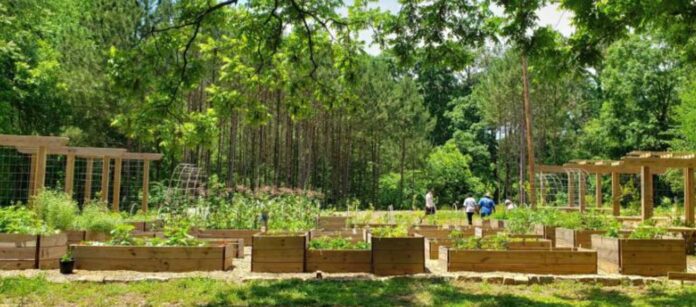
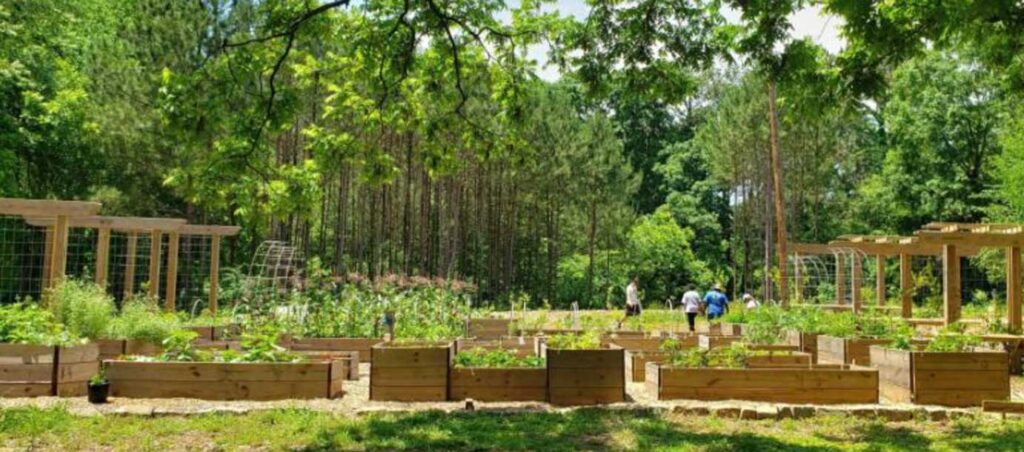
There’s a seven-acre farm in Atlanta where residents can walk into a forest, take a deep breath, and begin pulling crops right off the land for dinner.
Shannon Lee, The Conservation Fund Parks with Purpose Program
A one-time pecan farm, the Food Forest at Browns Mill project contains 2,500 edible and medicinal plants available to anyone in need.
It’s one of a growing number of free-food forests cropping up in cities around the country, as citizens and organizations both public and private attempt to grapple with problems of hunger and food deserts.
In Atlanta, this problem is acute, with the USDA’s Food Access Research Atlas estimating that at least one in every four Atlantans, or around 125,000 people, live in areas defined as food deserts based on their geographical distance from grocery stores.
Having created the nation’s largest free-food forest, The Conservation Fund, with the assistance of the city of Atlanta and the U.S. Forest Service, is ensuring this former pecan-farm continues its tradition of feeding the community.
Located in Browns Mill, only 10 minutes from Atlanta airport, the nearest grocery store for the 2,100 residents in that area a 30-minute bus ride away.
“Access to green space and healthy foods is very important. And that’s a part of our mission,” Michael McCord, a local arborist, told CNN.
The scheme is utilizing practices known collectively as permaculture, and specifically as “agroforestry”—a term that describes marrying the forest and the field in a way that benefits both, as well as the global and local climate. GNN has reported extensively on agroforestry in the US, and in the UK.
Already filled with large, mature pecan trees and blackberry brambles, the conversion process was enough to create some space underneath the trees with which to grow row and cover crops, and clear non-use bushes for replacement by other crops.
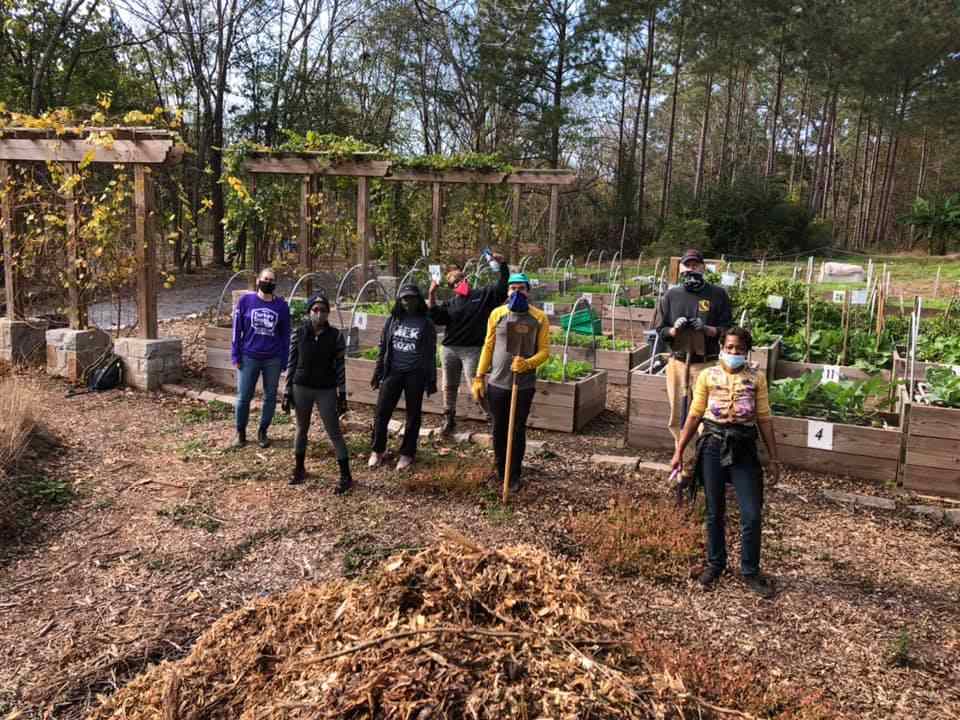
Community, corporate, and non-profit partners involved in the project have committed over 1,000 volunteers.
“It’s really a park for everyone,” Atlanta city councilwoman Carla Smith told CNN. “Every time I go there’s a community there who respects and appreciates the fresh healthy foods. There’s a mentality there that people know to only take what they need.”
Reports of people taking more than they need are rare, and food that’s left over will be harvested by full-time volunteers and distributed among the community.
According to the Conservation Fund, gardening and cooking classes are being held to help teach community members about healthy food, and the project includes community garden beds which the most enterprising of visitors can utilize.
Their project map reveals the scope of the project, with mycelium cultivation for edible mushrooms, boardwalks, and an apiary for honey production.
It’s a project carrying the most robust of democratic sympathies; stretching all the way back in likeness to the Athenian Agora—or public square—where members of the community would make intentional efforts to create a flourishing society through specialization and mutual exchange.
Quote of the Day: “Doubt kills more dreams than failure ever will.” – Suzy Kassem
Photo by: Jonas Geschke
With a new inspirational quote every day, atop the perfect photo—collected and archived on our Quote of the Day page—why not bookmark GNN.org for a daily uplift?
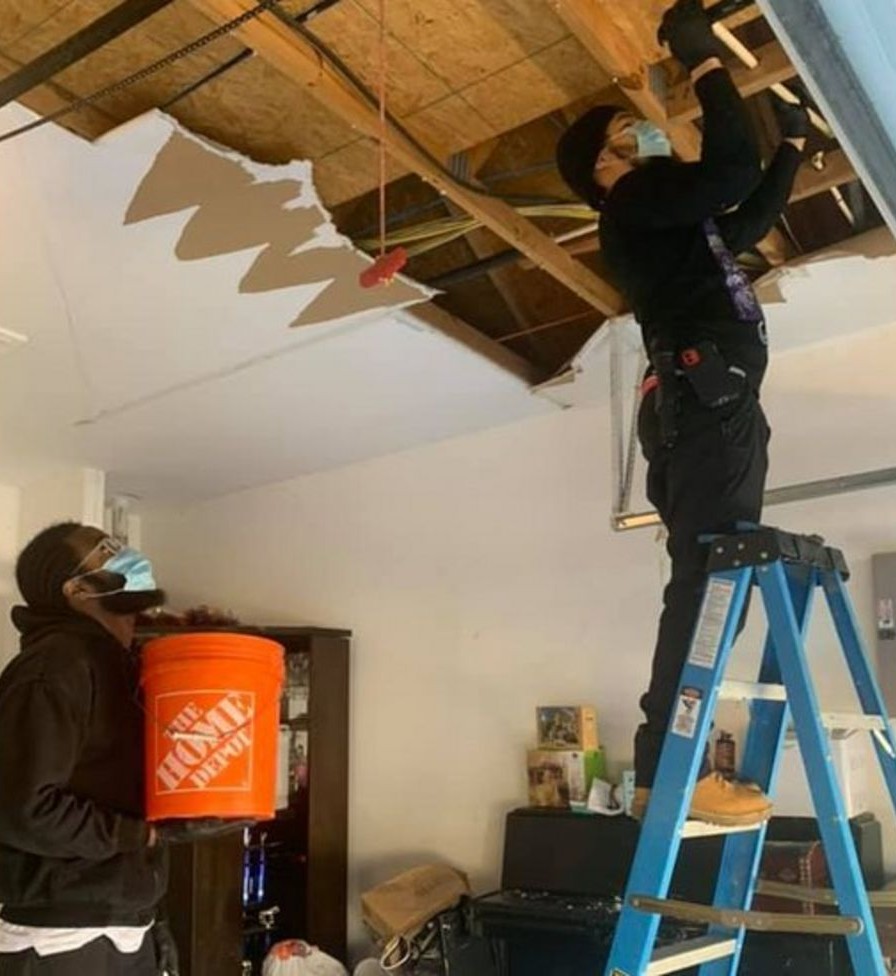
When a crippling ice storm hit Texas, leaving a bonanza of burst waterlines, homeowners found themselves scrambling to find help. With local supplies and plumbers exhausted by demand, crucial repairs seemed out of reach—until an unlikely hero rode to the rescue.
Andrew Mitchell
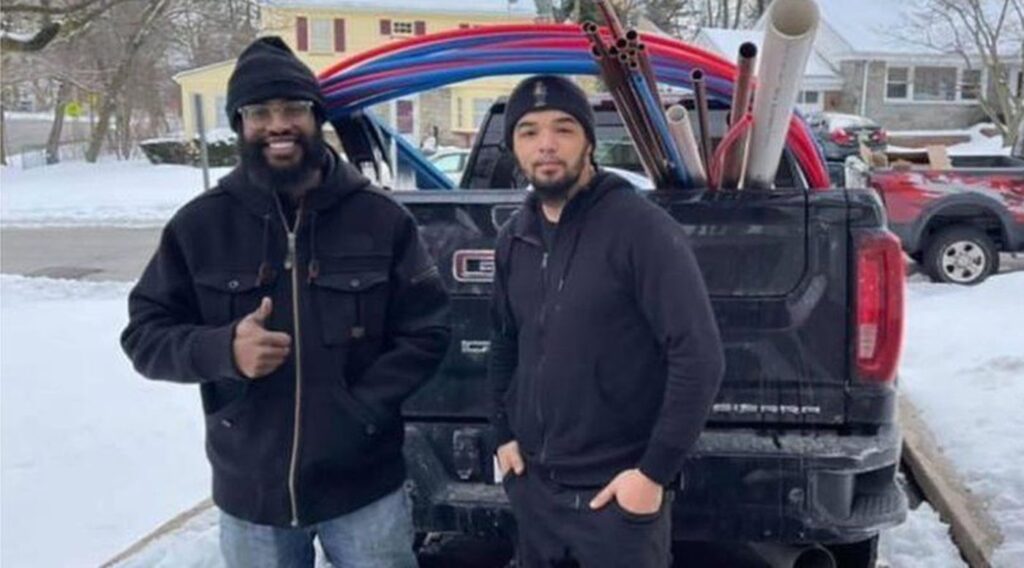
After loading up his truck with about $2,000 of materials, New Jersey plumber Andrew Mitchell, along with his wife, Kisha Pinnock, the couple’s 2-year-old son, Blake, and his newly apprenticed brother-in-law, Isiah Pinnock, made the 22-hour trek from Morristown to Houston—and got to work putting things right.
“A lot of the people we’ve helped were telling us they either can’t get a plumber on the phone or—if they do get one on the phone—the wait to be serviced is three to four weeks out, so they can’t have water during that entire time,” Kisha told the BBC.
Mitchell’s first stop was his sister-in-law’s home in Humble. Throughout the storm, Kisha and Andrew had been keeping tabs on her sister in Texas and learned from her situation just how dire circumstances in the Lone Star State truly were.
Facebook posts from harried local plumbers pleading for help cemented the couple’s resolve to take action. “This is your time,” Kisha told Andrew in a conversation she recounted in an interview with the CBS News program Uplift. “Everybody has their time to shine. You have the skills; you have the credentials…You should just go.”
After tackling his sister-in-law’s plumbing woes, word of Mitchell’s efforts soon spread. With days starting at 7 a.m. and often not ending until after 2 a.m. the following morning, Mitchell and Isiah were servicing on average between 6 to 10 houses per day.
One recipient of their good work was 71-year-old Barbara Benson. After a week without water resulting from a burst pipe, she was at her wit’s end.
Andrew Mitchell
She’d contacted more than a dozen plumbers and was told it would be weeks before an appointment could be scheduled. To make matters worse, Benson said some plumbers quoted as much as $2,000 just to show up for an estimate.
Far from price gouging, Mitchell routinely charged clients only what they could afford. “I always ask a customer what do they think is fair, what do they have to spare,” Mitchell told NJ.com. “I never try to take advantage of somebody.”
Satisfied customer Benson couldn’t have been more pleased with the outcome of Mitchell’s house-call. “For a woman living by herself, you can get scammed easily and I was just pleasantly surprised,” she told NJ.com. “It was like somebody’s watching out for me.”
While Mitchell and his family originally planned to stay until the plumbing supplies run out, since the need remains so great, they’re considering restocking materials and spending at least a little more time in Texas.
“A lot of times when you see devastation it could be across the world; it could be across the country; it could be in your own town,” Kisha told Uplift. “You really feel like your heart is breaking with them and you can’t do anything but in this instance, we really could. I really knew if we could only help one family, we did make a difference.”
Doing what you love and being of service to others has proven to be an immense inspiration.“It’s really a blessing to be a blessing to other people and Andrew truly enjoys the work,” Kisha told the BBC. “Plumbing is his passion.”
(WATCH the CBS video about the New Jersey team below.)
EDITOR’S NOTE: Viewers outside the US can view this video on the CBS website, here.
Fix Your Friends Up With the Good News—Share This Story With Them…
Hundreds of turtles are now returning to their home in the Gulf of Mexico after suffering a terrible ordeal during the recent winter storm in Texas.
When the now famous and freakish cold front devastated Texas’ power grid, a local sea turtle rescue shelter, Sea Turtle Inc, lost power and wasn’t able to keep the water at the normally balmy temperatures needed to ensure the turtles’ health.
That would have been the first concern, but then, as GNN reported, literally thousands of sea turtles around South Padre Island and in the Gulf were being “cold-stunned,” a term that describes a comatose state brought on by falling water temperatures sapping the life from the cold-blooded animals.
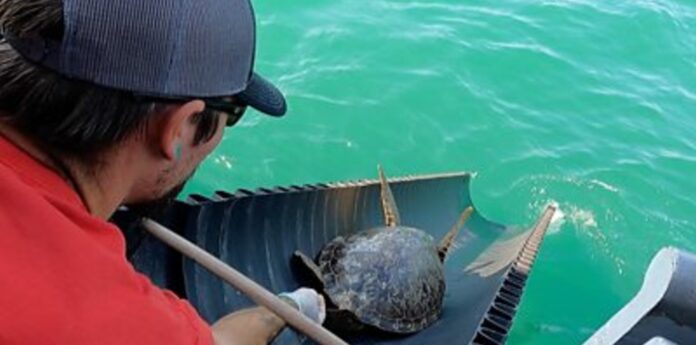
Volunteer rescue efforts from staff, community members, beachgoers, wardens, and even nearby SpaceX rocket engineers wound up bringing more than 5,000 turtles to makeshift hospitals managed by Sea Turtle Inc. staff.
The infirm reptilians overflowed their property, and a rescue center was set up in a nearby convention center—with turtles lined up nose-to-tail on sheets of tarpaulin, waiting for their turn in warm water kiddie pools, the only method of recovery available when the power was out.
The “overwhelming support” of community volunteers prevented a sea turtle “Armageddon,” and two days ago Sea Turtle Inc. reported that 2,200 of the rescued turtles were returned to the sea.
“We still have lots of work to do but we are rejuvenated with passion,” Sea Turtle Inc. staff wrote, “having seen our first released turtles swim away.”
Another video published by the BBC showed rehabilitators cheer as they sent their first turtle speeding down a slide into the ocean now that record low temperatures have ceased.
(WATCH the amazing BBC video below.)
SHARE This Good News Update With Your Warm-Blooded Friends…
When a video surfaces of the Fijian national rugby team singing a rousing song from the balconies of their hotel rooms, you know it’s going to be good.
At the end of a mandatory 14-day quarantine in Australia, the players and coaches sang a traditional song to thank the hotel staff for their presumably kind and attentive service over the two weeks.
The team had traveled to join a rugby competition in New South Wales, but their performance could make one think the athletes were in town as a professional choir.
The curved shape of the hotel’s walls provided helpful acoustics and stunning optics. And the show clearly delighted the other guests—who watched from the other balconies and from the courtyard below. Naturally, the video of the Fijians singing has since gone viral.
What do you do while stuck at home in the age of COVID-19? When you’re a soccer-mad Canadian, you get creative and start trading maple syrup for football scarves from around the world, of course.
Daniel Robertson
19-year-old Daniel Robertson lives in Whitby, Ontario with his family. To pass the time during what’s been, well, a quiet year, he’s been trading syrup for scarves through a light-hearted Reddit thread he created.
Robertson hasn’t had to worry about no-one responding to his unique exchange idea. Since making his first post, he’s received an impressive 113 scarves from 59 countries—from Latvia, Japan, and Singapore, from Nigeria and Belarus and Senegal.
For Daniel, receiving post from across the globe has been a delight. In fact, the surprise gifts have made him feel a little like he’s traveling, while staying safely in one place.
And he’s not done yet. To make his collection complete, he’d love to receive 80 to 90 more scarves—one for all the 193 countries currently recognized by the U.N.
(WATCH Daniel’s fun story in the video below.)
SHARE The Joy—Send This Story to Pals on Social Media…
When computer nerds are placed in command of one of humanity’s most ambitious scientific undertakings, you know there’s going to be some fun involved.
NASA/JPL-Caltech
NASA’s Jet Propulsion Laboratory (JPL)—home of mission control for the Mars rovers Perseverance and Curiosity—takes advantage of the brilliance of their staff, and the fact that tens of millions of people tune in to watch their handiwork of landing craft on Mars, to sprinkle their missions with hidden puzzles and messages that need decoding.
If only the IRS were so playful!
In the video NASA recently released of Perseverance deploying its parachute, Director and Mission Lead Allen Chen announced that hidden within the strange white and orange shapes of the parachute canopy’s underside was a hidden message in binary code.
“So we invite you all to give it a shot and show your work,” Chen said, with “you all” in this instance referring to the entire internet user base.
Unsurprisingly, it took just six hours for people to decode the message hidden in the parachute, matching the variations in color to binary code, before translating that into English letters and numbers.
“Dare Mighty Things,” read the parachute, the motto of NASA’s JPL, with the outermost ring of the parachute containing the GPS coordinates for their facility in California.
“Oh internet, is there anything you can’t do?” wrote Chief Engineer for Perseverance Adam Steltzner in a tweet.
Taken from a Teddy Roosevelt speech in which he noted that “far better is it to dare mighty things, to win glorious triumphs, even though checkered by failure,” the motto perfectly captures the spirit of the JPL, which undertakes many of NASA’s most ambitious projects.
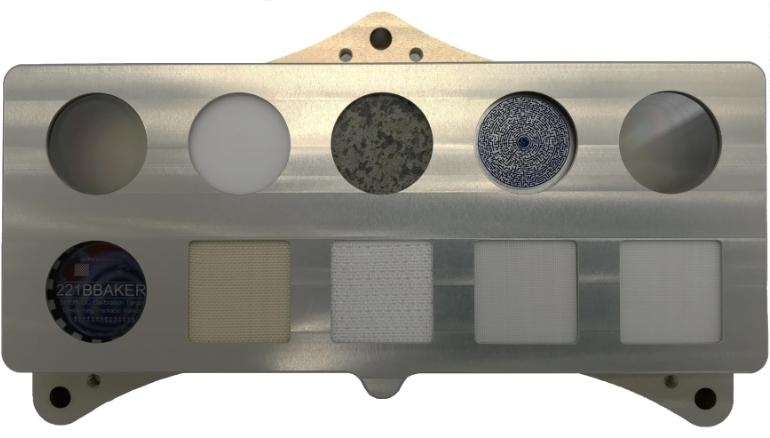
Another jape on the current Mars mission has Sherlock Holmes’ fictional address—221B Baker Street—plastered along one of the lenses of the rover’s principal camera, known as the “Scanning Habitable Environments with Raman & Luminescence for Organics & Chemicals.” Can you see why?
NASA/JPL-Caltech
Curiosity, the previous Mars rover, had the Morse code spelling of the JPL embedded into its wheels, effectively putting a librarian’s stamp on every square foot of Martian dust the rover passed over during its long stay on the Red Planet.
(WATCH the video of Perseverance make its big Mars touchdown below.)
HELP Your Friends Join in on the Fun—Share This Story With Them…
Quote of the Day: “Never place a period where God has placed a comma.” – Gracie Allen
Photo by: Suzanne D. Williams
With a new inspirational quote every day, atop the perfect photo—collected and archived on our Quote of the Day page—why not bookmark GNN.org for a daily uplift?
Usually, when dogs are actually “smiling,” meaning expressing happiness, it is when they have their ears in the relaxed state for the breed, and a big wide open mouth—tongues a-flailing.
So, although we are giving our thumbs-up for the best pooch smiles today, we are really reflecting our humanness onto the animals—and enjoying it immensely.
Dogs normally are signaling that they accept being the lowly beta in the pack by pulling the corners of their mouths upwards—the same signal we call a smile.
Even so, not all dogs have the talent for making a ‘smile’, but these pups are pros—especially when asked the right question.
Loni had a visit at the doggy dentist where she had to get one of her teeth pulled.
Watch how she shows off her dental work for the camera. Priceless!
“Did you get a tooth pulled? Let me see…”
This Golden Retriever puppy shows off his baby teeth, and the added music makes this is a cuteness overload.
When mom asks Bill the Labrador to smile, he is all too happy to oblige.
This smile might be the most adorable, of all…
But dogs aren’t the only animals that can produce a giddy-faced ‘smile’ on cue. Check out this sea lion. A zookeeper from Dubai in the United Arab Emirates plays a game with one of the animals in his care.
“When I smile at the camera she imitates me and makes the same face.”
Be Sure to Produce a Smile on Your Friends’ Faces—SHARE This on Social Media…
3D printers may one day become a permanent fixture of operating rooms, now that Australian scientists showed they could print bone-like structures containing living cells.
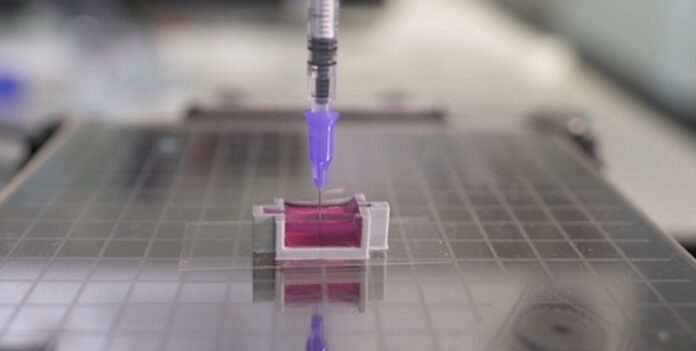
Scientists have worked out how to print bone-like structures using a 3D-printer and a gelatinous ‘bath’ containing living cells. Photo: UNSW
Scientists from UNSW Sydney have developed a ceramic-based ink that may allow surgeons in the future to 3D-print bone parts complete with living cells that could be used to repair damaged bone tissue.
Using a 3D-printer that deploys a special ink made up of calcium phosphate, the scientists developed a new technique, known as ceramic omnidirectional bioprinting in cell-suspensions (COBICS), enabling them to print bone-like structures that harden in a matter of minutes when placed in water.
While the idea of 3D-printing bone-mimicking structures is not new, this is the first time such material can be created at room temperature – complete with living cells – and without harsh chemicals or radiation, says Dr Iman Roohani from UNSW’s School of Chemistry.
“This is a unique technology that can produce structures that closely mimic bone tissue,” he said, pointing to repairs of bone defects caused by accidents or cancer.
Associate Professor Kristopher Kilian who co-developed the breakthrough technology with Dr Roohani says the fact that living cells can be part of the 3D-printed structure, together with its portability, make it a big advance on current state-of-the-art technology.
Up until now, he says, making a piece of bone-like material to repair bone tissue of a patient involves first going into a laboratory to fabricate the structures using high-temperature furnaces and toxic chemicals.
“This produces a dry material that is then brought into a clinical setting or in a laboratory, where they wash it profusely and then add living cells to it,” Professor Kilian says.
“The cool thing about our technique is you can just extrude it directly into a place where there are cells, like a cavity in a patient’s bone. We can go directly into the bone where there are cells, blood vessels and fat, and print a bone-like structure that already contains living cells, right in that area.”
“There are currently no technologies that can do that directly.”
In a research paper published recently in Advanced Functional Materials, the authors describe how they developed the special ink in a microgel matrix with living cells.
“The ink takes advantage of a setting mechanism through the local nanocrystallization of its components in aqueous environments, converting the inorganic ink to mechanically interlocked bone apatite nanocrystals,” Dr Roohani says.
“In other words, it forms a structure that is chemically similar to bone-building blocks. The ink is formulated in such a way that the conversion is quick, non-toxic in a biological environment and it only initiates when ink is exposed to the body fluids, providing an ample working time for the end-user, for example, surgeons.”
He says when the ink is combined with a collagenous substance containing living cells, it enables in-situ fabrication of bone-like tissues which may be suitable for bone tissue engineering applications, disease modeling, drug screening, and in-situ reconstruction of bone and osteochondral defects.
Already there has been keen interest from surgeons and medical technology manufacturers. A/Prof. Kilian thinks while it’s early days, this new bone-printing process could open up a whole new way of treating and repairing bone tissue.
“This advance really paves the way for numerous opportunities that we believe could prove transformational – from using the ink to create bone in the lab for disease modelling, as a bioactive material for dental restoration, to direct bone reconstruction in a patient,” says A/Prof. Kilian.
“I imagine a day where a patient needing a bone graft can walk into a clinic where the anatomical structure of their bone is imaged, translated to a 3D printer, and directly printed into the cavity with their own cells.
“This has the potential to radically change current practice, reducing patient suffering and ultimately saving lives.”
Next up the duo will be performing in vivo tests in animal models to see if the living cells in the bone-like constructs continue to grow after being implanted in existing bone tissue.
Dreams take us to an alternative reality while we’re fast asleep. So, you might not expect that a person in the midst of a vivid dream would be able to perceive incoming questions and provide answers to them. But a new study led by Northwestern University researchers shows that, in fact, they can—and they developed an app for those who’d like to try it at home.
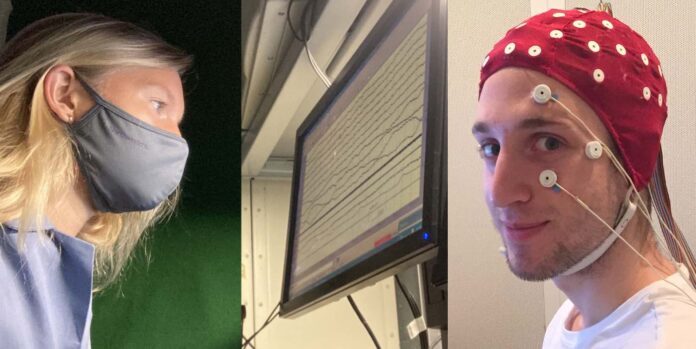
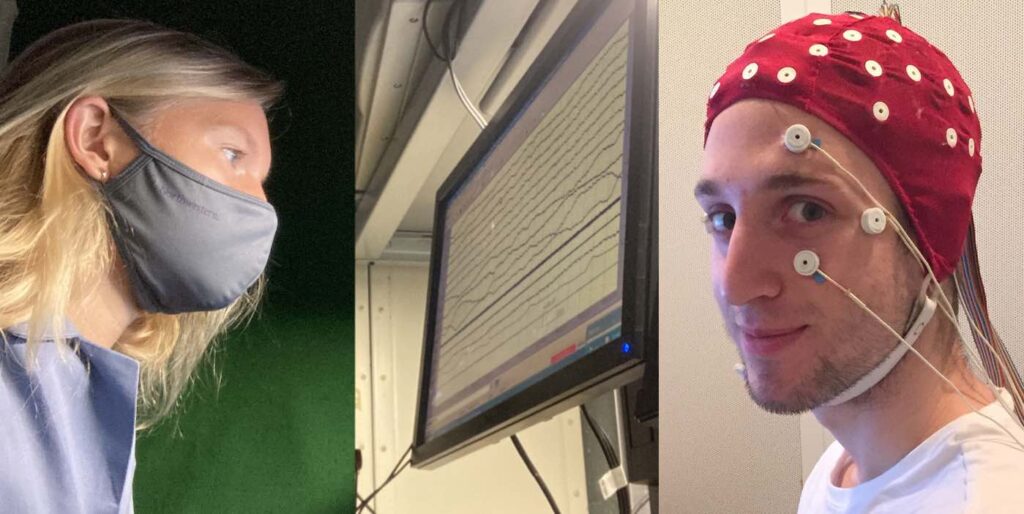
Konkoly watches monitor – Northwestern University
With partners at three universities around the world, they confirmed that real-time dialogue with a dreaming person is possible—and that dreamers were able to solve simple math problems and answer yes-or-no questions.
The researchers studied 36 volunteers who aimed to have a lucid dream, wherein a person is aware that they’re dreaming.
Using polysomnographic data, they could confirm that study participants had reached the REM stage of sleep—the rapid eye movement phase in which lucid dreaming can occur.
“We found that individuals in REM sleep can interact with an experimenter and engage in real-time communication,” said senior author Ken Paller, professor of psychology and director of the Cognitive Neuroscience Program at Northwestern. “We also showed that dreamers are capable of comprehending questions, engaging in working-memory operations, and producing answers.
“Most people might predict that this would not be possible — that people would either wake up when asked a question or fail to answer, and certainly not comprehend a question without misconstruing it.”
While dreams are a common experience, scientists still haven’t adequately explained them. Relying on a person’s recounting of dreams is also fraught with distortions and forgotten details. So Paller and colleagues decided to attempt communication with people during lucid dreams.
The researchers realized that finding a means to communicate could open the door in future investigations to learn more about dreams, memory, and how memory storage depends on sleep, the researchers say.
They also used a rotten egg smell to associate with cigarette smoking, which caused the dreamer less inclined to smoke the following week.
The paper is unique in that it includes four independently conducted experiments using different approaches to achieve a similar goal. Studies were conducted at Sorbonne University in France; Osnabrück University in Germany; and Radboud University Medical Center in the Netherlands.
“We put the results together because we felt that the combination of results from four different labs using different approaches most convincingly attests to the reality of this phenomenon of two-way communication,” said Karen Konkoly, a Ph.D. student in psychology at Northwestern and main author of the paper published this month in the journal Current Biology.
“In this way, we see that different means can be used to communicate.”
One of the individuals who readily succeeded with two-way communication had narcolepsy and frequent lucid dreams. Among the others, some had lots of experience in lucid dreaming and others did not. Overall, the researchers found that it was possible for people, while dreaming, to follow instructions, do simple math, answer yes-or-no questions, or tell the difference between different sensory stimuli.
They could respond using eye movements or by contracting facial muscles. The researchers refer to these successful conversations as “interactive dreaming,” and they chose questions with known answers so that they could assess whether participants’ answers were correct.
Konkoly says that future studies of dreaming could use these same methods to assess cognitive abilities during dreams versus while awake. They also could help verify the accuracy of post-awakening dream reports. Outside of the laboratory, the methods could be used to help people in various ways, such as solving problems during sleep or offering nightmare sufferers novel ways to cope. Follow-up experiments run by members of the four research teams aim to learn more about connections between sleep and memory processing, and about how dreams may shed light on this memory processing.
Students in Paller’s lab group have developed a smartphone app for Android devices that aims to make it easier for people to achieve lucidity during their dreams. Information on the lucid app, and the link to download it, is available on Paller’s cognitive neuroscience lab site, here.
SHARE Your Thoughts About Lucid Dreaming While Posting the Suggestion on Social Media…
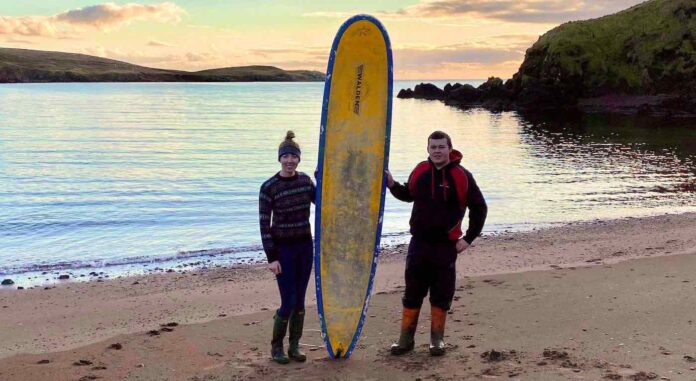
Stephanie Riise and Jake Anderson on Shetland Islands - SWNS
After a couple stumbled across a strange sight while walking the beach, the blue and yellow surfboard became like a message in a bottle—and they had to know its origins.
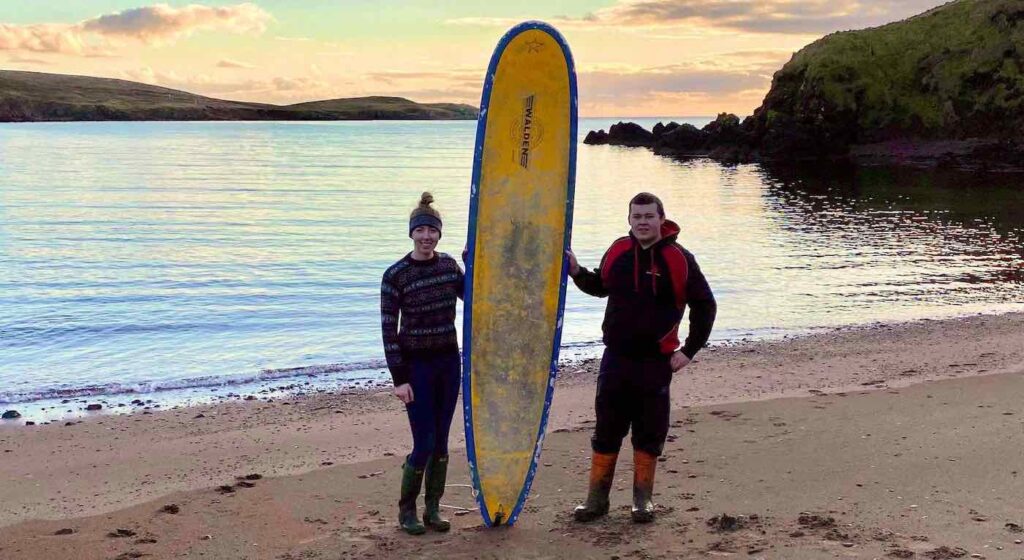
Stephanie Riise and Jake Anderson on Shetland Islands – SWNS
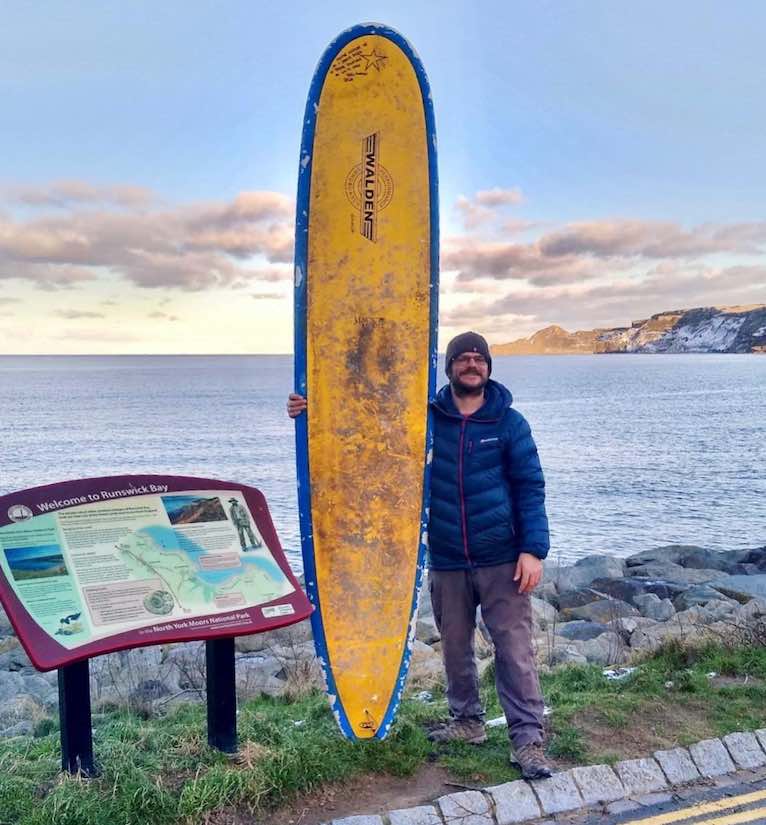
It all started when Lee Brogan had been “wiped out” by a massive wave while surfing off the Yorkshire coast in England last year and watched in agony as his surfboard disappeared into the ocean.
He had given up hope of ever being reunited with his 10-year-old board but luckily a young couple found it—some 400 miles away.
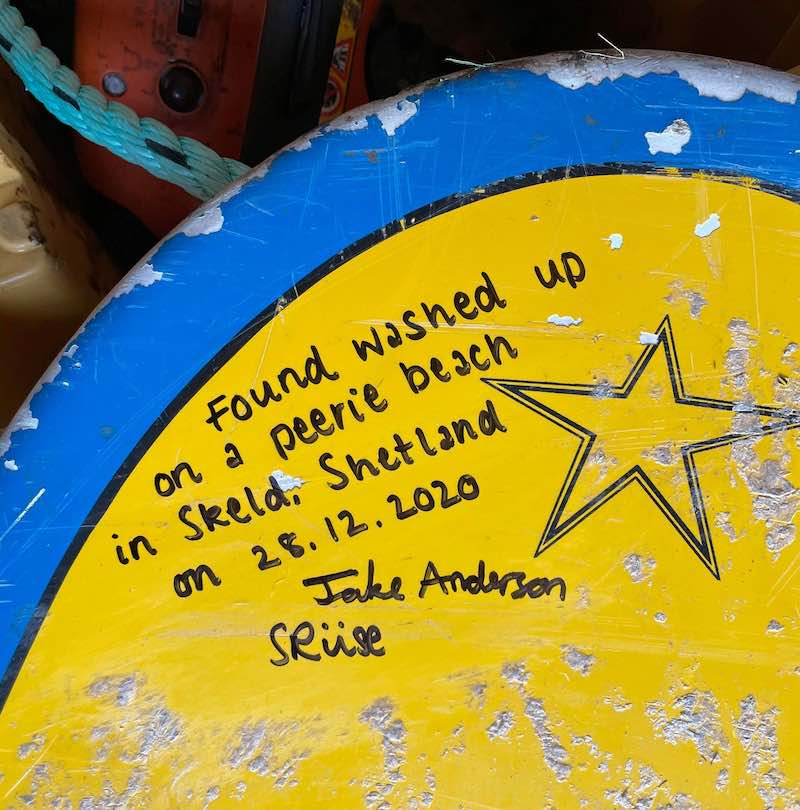
Stephanie Riise, 22, and Jake Anderson, 23, were hiking on the Shetland Islands off the coast of Scotland when they spotted the nine-foot board and decided to investigate further.
The Walden board, which costs between £800 and £1,200, was marooned off shore on some gravel but was completely intact.
“Our interest was piqued at that point and we were just wondering where it had come from, how far it had travelled, who lost it, what story was behind it,” said Stephanie, from Shetland.
The inquisitive pair took to Facebook on the day of the discovery to see if anyone could trace the owner as they wanted to know the story behind the board. She posted about her find on the Shetland Seashore Discoveries Facebook page and the community quickly put on their detective hats.
Just a day later, they were put in touch with Lee who couldn’t believe they had found his beloved board which had been lost in the waves in Runswick Bay in Scarborough, England.
“We were so surprised by how quickly it all came about, we didn’t think we’d ever find the owner in all honesty. We were so pleased he had gotten in touch.”
She said they quizzed Lee to make sure he was indeed the owner, but after he provided photo evidence and explained how he’d fallen off the board, they were convinced.
Lee Brogan reunited – SWNS
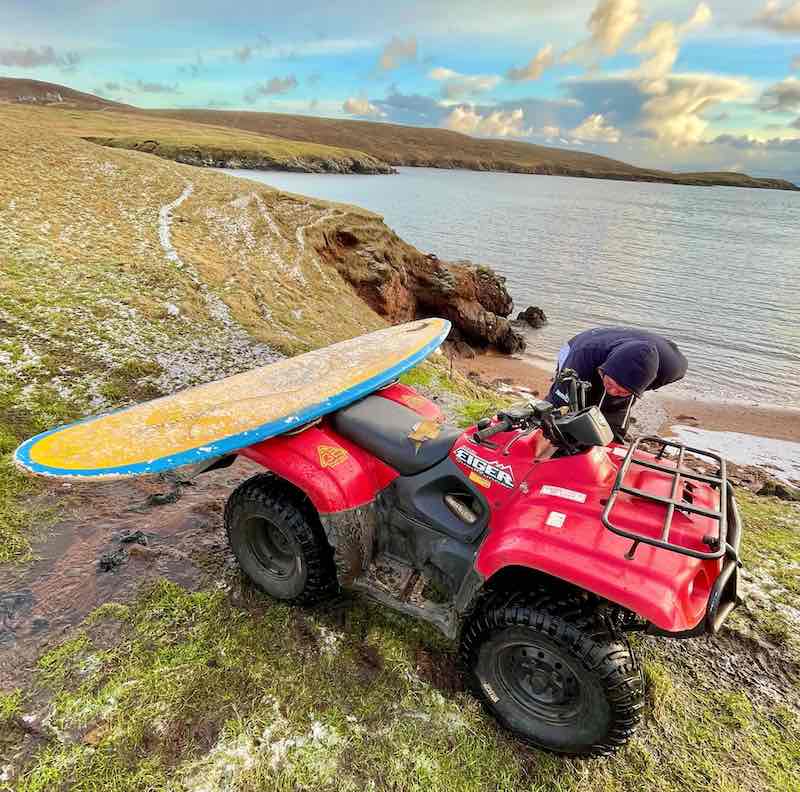
The kind couple not only solved the mystery, they got a friend to deliver the board to his home in a van and said they were just tickled to have been able to help. And, they signed the board with a message—not needing any bottle to preserve the 400-mile synchronicity of fellowship.
SWNS
“Knowing (now) where it had come from, it’s even more impressive that it was completely intact.”