










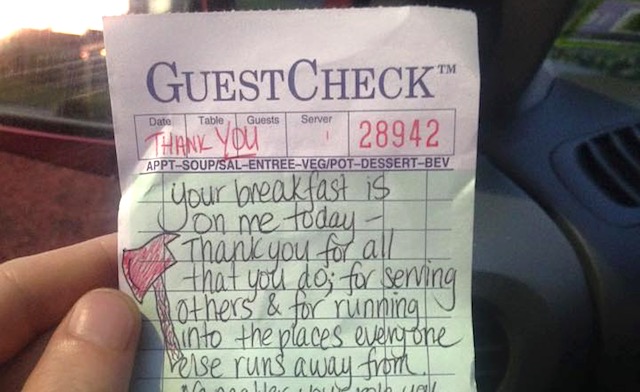
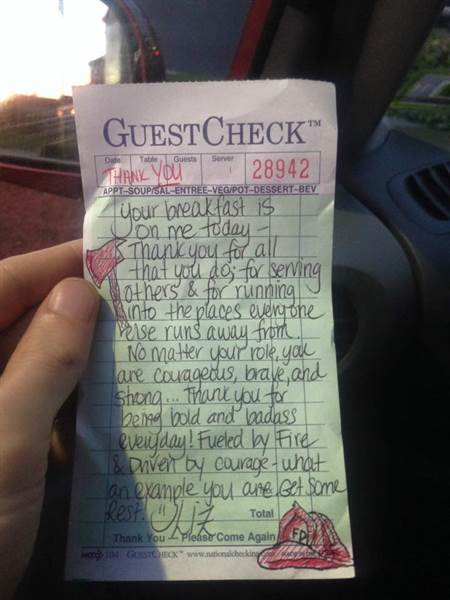
I believe most parents of kids with cancer would agree that there are an infinite number of stresses in this life of childhood cancer. Yet there were so many strangers that came into our lives who seemed to understand what we were going through.
Having lost our jobs, living on the generosity of others is scary. We didn’t live in the city so anytime our vehicle made an odd noise or we knew it needed repairs, I felt sick. The first time we took our van in to get fixed after her diagnosis, I chewed on my finger nails knowing how little money we had, yet having a way to get her to the hospital was paramount. I knew we could always call an ambulance, but true to how deep my worry went, “What if for whatever reason the ambulance couldn’t get to her? It was and is our job to protect her.”
So there I stood in front of the counter waiting to hear the total “damage” – I knew it would be over a thousand dollars.
But Dave handed me the keys and when I asked how much it was, he said not to worry about it– they looked after it.
Doing this once was truly shocking, but Dave and Chris from Ballymote Auto did it time and time again.
When hearing that a customer was getting rid of their van, which still had some miles left in it, they told this customer about us and before we knew it, we could breath again for awhile.
Submitted family photo
They continued to help us until we finally moved closer to hospital. We could never repay all they have done for us and if there is ever a time in our lives when we are in a position to impact their lives, the way they did ours, we will.
They helped us in a very difficult financial time, but they also reminded me just how much people care – that even if you cannot always count on those you call family, there are strangers that become friends, not out of obligation, but because they want to.
Ballymote Auto in Ballymote, Ontario, Thank you! From the bottom of our hearts!
“The James Gang” is officially patrolling the jungle gym at a Mankato, Minnesota elementary school, protecting one “special needs” boy from any more bullying.
When a group of James Willmert’s fifth-grade classmates saw that he was being teased at recess last fall, they made a pact to have his back, all year long.
Their teacher believes the school’s anti-bullying curriculum factored into the boys’ actions and resulted in kindness that has gone far beyond the classroom.
The boy, adopted from an orphanage in Colombia, now plays sports with his five new friends after school – an activity he’s never enjoyed before.
They even pitched in money to buy him a Playstation gaming system.
“He used to not want to go out for recess or anything, it would be like a struggle,” James’ mom told KARE-11 News. “And now he can barely eat his lunch to get outside to play with those guys.”
(WATCH the video above or READ the story from KARE-TV – *NOTE* the page auto-plays, so adjust your speakers)
File photo on homepage by Gonzalo Díaz Fornaro, CC
Kala the sun bear is so elated to be back in the forest, it’s unbearable!
Initially sold as an exotic pet as part of the illegal wildlife trade, Kala was rescued by the Bornean Sun Bear Conservation Center, who took her in earlier this year.
Now, the center is “teaching” her to be a wild bear again, and it looks like she is adapting pretty well. In fact, each lesson looks like a blissful experience.
Kala is sharpening the sun bear skills she’ll need to return to the wild, like how to climb trees.
She’s also learning to use her long, powerful claws to strip tree bark and look for termites — a favorite treat for sun bears.
All Photos via Facebook/Bornean Sun Bear Conservation Centre
“Kala is everything a cub should be – playful, inquisitive and sweet-natured,” the Center posted on the Bornean Sun Bear Conservation Center website. “Sometimes, she does not want to leave the forest.”
The center’s goal is to teach Kala everything she’ll need to live in the wild so that in a couple of years she will never have to leave the forest again.
Relax! You don’t have to hire a masseuse to reap the benefits of aromatherapy.
If you can get your hands on a bottle of lavender or cardamom extract, you’re well on your way to improving your mood, your health, and your immune system, according to a series of scientific studies.
These essential oils, derived from plants, can be used at home to create a relaxing aural experience while simultaneously treating a variety of ailments.
It’s a method that goes way back: a smattering of ancient civilizations, from the Egyptians to the Romans and the Chinese, have all used them for healing purposes.
Here’s how the science breaks down:
Scent receptors in your nose send messages to the amygdala and hippocampus (parts of the brain) that affect emotions and memories. The theory is that scent can influence these areas, and that some oils, like lavender, can soothe in the way that medications do when stimulating cells in certain parts of the brain.
Beware, though: many lotions, candles, and the like labeled as aromatherapy aren’t the real deal. For aromatherapy at its most pure, stick with the essential oils. You can the oil in a myriad of ways:
Just sniff it.
Dab it on a handkerchief to slide in your pillowcase.
Rub it on your skin in a circular motion, either on your temples, above the eyes, on the wrists, or on the neck.
Drop a few drops in the bathtub.
Inhale over a bowl of steaming water infused with a few drops.
Inhale this one, straight up. It’s said to be great for alleviating stress and good for your skin. It’s also widely used to treat urinary tract infections.
This one is kind of a grab bag. The flowery oil is used to boost libido, treat depression after childbirth, treat addiction issues and respiratory issues, and alleviate tension. Note: pregnant women should avoid this one.
This is the mac daddy of medicinal oils. Bergamot is believed to stimulate the liver and spleen to help with digestion, soothes skin ailments like eczema and psoriasis, and is also used treat depression and anxiety. Note: Stay out of the sun with this one on, or it will burn.
If you need a boost, this is the oil for you. Just a couple of whiffs could help you become more alert and energized. It’s also a mood booster, and is known to help calm irritated skin (and mood) and help folks breathe easier.
You’ve most likely come across this in cold remedies and cough drops, and for good reason. Distilled from the leaves and twigs of Eucalyptus trees, this extract decongests and has antiseptic and anti inflammatory properties. Rub this one in when you’ve got a headache, fever, or stuffy nose. Lavenderhas almost identical properties, if you prefer a less intense scent.
(Photo credits: (top to bottom) Bart Speelman, whirledkid, Tara Aveilhe, tdlucas5000, Joshua-Mayer, Juan Carlos Martins, Jean-Jacques Boujot, Pam Link – all via CC)
Wait ’til your friends get a whiff of this…. Share below
Have you heard the one about the guy who walks into a bar — and comes out with a new kidney?
It happened almost that quickly for Don Thomas, a regular customer at the Hooters restaurant in Roswell, Georgia. He was talking to a new waitress, Marianna Villareal, when he happened to mention he’d lost both his kidneys to cancer.
Villareal, 22, recently lost her grandmother to kidney disease, and even though she didn’t know the 72-year-old outside of work, she didn’t hesitate to offer him one of her kidneys.
She says she wasn’t able to do anything for her grandmother, but knew the transplant would be worth it if Thomas got to live a longer, happier life because of it.
(WATCH the WXIA News video below)
Photo by Mariana Tolentino, Twitter – Story Tip from Carilyn
Ex-convict David Potchen walked into a local small-town bank in Indiana and told the teller to give him all their money.
He walked out with $1,600 and sat down to wait for the police.
Potchen, who said he’d tried his best to earn a living after getting out of prison, wanted to go back to the place where he actually worked and earned money and didn’t have to sleep in the woods.
When Indiana Judge Clarence Murray heard the evidence, he offered Potchen an alternative to prison. Instead of sentencing the man to 13 years, Murray asked aloud in his courtroom if anyone could give him a job.
A local reporter wrote a story about it, and “the owner of a nearby trucking company decided it was time to show a little faith,” reports NBC News. “David Potchen is now a full-time welder, and a good one, too.”
Apparently he is about as happy and loyal as a worker could be.
(WATCH the NBC video, or READ the story from NBC News -NOTE* auto playing video, adjust your speakers)
With this “Big Bang” comes the creation of a new generation of scientists.
The cast and creative minds behind their hit TV show have announced “The Big Bang Theory Scholarship Endowment,” which has been funded with $4 million so far, to help students majoring in science and math at the University of California Los Angeles (UCLA).
“We have all been given a gift with ‘The Big Bang Theory,’” Chuck Lorre, the show’s co-creator and executive producer, said in a statement. “This is our opportunity to give back.”
Lorre, is funding most of the endowment along with gifts from about 50 other people — including several of the show’s stars. It’s the first time the cast and crew of a television series has endowed a scholarship at UCLA.
Even though the show is set at Caltech in Pasadena, California, the show has ties to UCLA. Actress Mayim Bailik earned her doctorate in neuroscience there and the show’s science consultant, David Saltzberg, is a UCLA physics and astronomy professor.
Remember the teen who unveiled an ambitious plan to clean up the plastic floating in the world’s oceans? Well, his invention is set to be deployed in 2016.
After completing a $2 million crowdfunding campaign last September, he is ready to launch the project off the coast of Tsushima Island, between the East China Sea and Sea of Japan.
The system of solar-powered floating booms and processing platforms were dreamed up by Boyan Slat when he was a 19-year-old first-year Aerospace Engineering student at TU Delft University in the Netherlands.
The 6,500 foot boom will be the longest floating structure ever put to sea and will spend at least two years collecting plastic trash floating in the Korea Strait.
People on the island are also looking into the possibility of using the plastic waste recovered by the system as an alternative fuel source.
A study published in the Proceedings of the National Academy of Sciences last year estimated there are 5.25 trillion pieces of plastic in the world’s oceans. Slat believes his system can collect almost half of this 77,000 tons of plastic within just 10 years.
His organization, The Ocean Cleanup, plans to deploy increasingly larger booms culminating in a 62 mile-long system that will tackle the Great Pacific Garbage Patch between Hawaii and California.
SHARE the Good Green News… (Photo from The Ocean Cleanup)

Fifty years after he charmed audiences with his goofy dance steps playing a chimney sweeper in “Mary Poppins,” Dick Van Dyke shows he still has the moves in a new music video.
The sprightly 89-year-old appears with his real-life wife, Arlene Silver, showing off his high-stepping moves in order to entice her to dance.
The music video is part of a new bluegrass album by Dustbowl Revival, which will be released July 21.
Thanks to the spontaneous actions of a US soldier, Lava Barwari was able to live her entire life, happily, in Atlanta, Georgia.
If it weren’t for Greg Peppin, her life would have been drastically different.
In 1996, the child’s mother, a Kurdish woman on Saddam Hussein “kill list”, had been offered asylum in the United States, but found her daughter missing from the list when she arrived at the border.
That’s when Lt. Colonel Peppin stepped in and claimed her as his own so she could get into the country.
Peppin’s plan worked.
Now 18, Lava Barwari was graduating from her high school and in honor of the occasion, she set out to track down the soldier who brought her here–and found him.
All three treasured the reunion. Awaz Barwari, mother of the girl said, “You saved the day for us.”
As California and other western areas of the United States grapple with an extreme drought, a revolution has taken place in Israel over the last six years.
A major national effort to desalinate Mediterranean seawater and to recycle wastewater has provided the country with enough water for all its needs, even during severe droughts. More than 50 percent of the water for Israeli households, agriculture and industry is now artificially produced.
The ability to regret something is a great skill to have for any animal, survival-wise. When you’re reliving and kicking yourself for something in the past–and feeling sad, guilty, ashamed, or other unpleasant emotion–your mind is trying to do you a favor. It’s trying to make something very clear: you shouldn’t let it happen again if you want things to be better in the future.
You probably realized this point pretty quickly, but that doesn’t necessarily mean your mind is done harping on about it. Much like an ill-advised social media posting, once it’s there, it’s there, and your mind might seem like it’ll never let you live it down. Unfortunately, as regret piles up, it can have a long-term effect on your confidence and self-esteem that, ironically, impairs your ability to act decisively in your best interests in the future. I have included three ways to steer yourself toward a regret-free life below.
The Mechanics of Regret
If you want to reduce the amount of regret your mind produces, it’s helpful, first, to be aware of a few underlying factors that are at work. One is that your mind abhors loose ends of any kind, and it will nag you to tie them up. This is apparent whenever you’re called away in the middle of something, and your mind returns over and over to your unfinished business.
Another is that short-term regrets tend to concern something you’ve done, while the ones that haunt you over the long term are more likely to concern things you haven’t done. Like the previous point, this phenomenon has been repeatedly demonstrated in experiments.
Image by Sal Falko (CC)
The third is that the single largest cause of inaction is fear. It’s not only a natural response to known threats. Your mind also tends to play it safe when you have incomplete information, filling in the blanks on its own, and often making assumptions that amplify risk and justify inaction.
This, in turn, can begin a snowball effect whereby you put your head in the sand, taking in less and less information and creating more and more blanks. It’s not unlike the child who, fearing the monster under her bed, pulls the blanket up over her eyes, letting her imagination run even wilder. You end up making increasingly uninformed decisions—the kinds of decisions you’re more likely to regret.
With these factors in mind, here are three ways you can get out of your own way and let your mind steer you naturally toward a more regret-free life, and even help the process along.
1. Stay in Fact-Finding Mode
If your mind is filling in blanks with too many fear-multiplying assumptions, then you need to minimize the number of blanks. Knowledge is fear’s worst enemy: just ask a parent who has banished their child’s under-bed monster simply by turning the lights on and taking a quick look.
Nurturing a sense of curiosity and openness to input keeps your information stores topped off and helps you establish a more productive response to uncertainty: relaxing into it and surveying the facts and the blanks just as they are. You’ll be less likely to retreat to your inner world of doubt and paralyzing assumptions, and better able to plan the smartest course of action.
2. Aim for the Abstract
Photo by Sun Star
Research shows that when you’re doing something for the purpose of acquiring rewards like money, belongings, and fame, you’re less likely to resume that activity once you pause. In turn, that makes failure—and regret—more likely. On the other hand, when you’re pursuing more abstract goals, like qualities, traits, or feelings you’d like to have, your urge to get back to work is stronger. (It so happens that people pursuing those kinds of goals also tend to be happier.)
Therefore, make your long-term goals more intangible (“I want to enjoy close connections with others”) than concrete (“I want to be married and have two children within five years”). Yes, it can be helpful to have concrete short-term milestones because these provide reference points for you to chart and enjoy your progress. But aiming for the abstract will keep you more persistent and happier in the long run.
3. Select an Action and Take It
Bear in mind that your best bet in general is: when in doubt, act. For one thing, if you always make the best decision possible at the time, using the best information you have available—and you’ll have good information if you stay in fact-finding mode—regret won’t get a foothold.
Plus, taking action is a win-win for you in the long run. If you’re successful, great. But even if you get it wrong, remember that things you do wrong won’t bother you as long as failing to take action will. In other words, it’s better to regret something you did for a little while than to regret something that you didn’t do forever.
Jim Hjort, LCSW, is founder of the Right Life Project, where he helps people overcome roadblocks to self-actualization as a licensed psychotherapist, Right Life Coach, and mindfulness meditation instructor. The Right Life Project helps you understand the ways you can work with the different dimensions of your life (psychological, social, physical, and vocational) to be happier and more fulfilled, and to reach your full potential. You can follow Jim on Facebook, Twitter, Pinterest, and Instagram.
Ellen and Bob Wallace have built a strong marriage over 41 yrs. Not only have they raised children together, they have worked side by side seven days a week to build a business. “She runs half the company; she is my best friend, she is my everything.”
Two weeks ago, they found out her uterine cancer has spread.
“It was just my worst day,” said Bob, who was hoping the chemotherapy and radiation begun in February would have helped.
On top of that, there was a telephone call from the fraud department of Capital One bank. Wallace had just paid the bills for Arizona Sun, the natural skin care products company he founded with Ellen 33 years ago.
Wallace contacted the Good News Network to share an extraordinary experience he had with the bank’s customer service representative, who identified herself as Chine Cmv797:
“When I returned to the office, I called the fraud department and talked to a wonderful lady. During the course of the conversation, she said I sounded sad, so I told her about my wife’s cancer, saying it had been a horrible day. Chine (Shi-nay) expressed her thoughts and prayers, and said that a close relative of hers had passed on from cancer as well. She was so moving and caring in my hour of need. She told me she would call the accounts and make sure they knew that everything was fine.”
The following Tuesday, Bob arrived home and there on the kitchen counter was a beautiful bouquet of white roses, babies breath, and green ferns in a glass vase with a note attached. He remarked to his wife, “The white roses are very pretty! Who are they from?”
Ellen said “They are not for me, they’re for you.”
He couldn’t imagine who would send him flowers. So, he walked back in the kitchen to look for a card.
Mr. Wallace, I have confidence that the positive energy and strength you and your wife hold will guide you through this difficult time.
– Chine Cmv797, Capital One
“That someone in corporate America on the other side of the country took the time in my hour of sadness to send flowers with such a compassionate note… We were both crying,” Bob told Good News Network. “As large as Capital One is, I don’t know if she got permission or if she took it out of her own pocket, which is why I took the time to write the founder and CEO, Richard Fairbank.
He told Capital One they should be very proud that they have such an outstanding and exemplary human being in their employment.
You can write an encouraging message for Ellen or Bob in a comment, below…
Storms inundated a no-kill shelter in Texas last week with 12 inches of water flooding the animal kennels. In need of immediate foster homes for 162 dogs and cats, Austin Pets Alive posted a plea for help on Facebook.
“Some of the kennels at Town Lake Animal Center are flooding! We NEED FOSTERS NOW! Stop by TLAC if you can safely get here and give a pup a dry place for the night.”
Before long, the plea was shared 13,000 times and Austin animal lovers responded, lining up to help. By the end of the day, the group was “overwhelmed by the support.”
Facebook Photo – Austin Pets Alive
“Before midnight we had 211 foster applications completed,” Faith Wright of APA told a local news station. “There was a line in our parking lot, waiting to get in and take a dog home.”
Facebook Photo – Austin Pets Alive
“Those who couldn’t take in an animal for a night or two found other ways to help,” reports People magazine. “Within two days, volunteers had washed all the laundry, cleaned clogged drains and mopped up water, which allowed the largest public-run, no-kill animal shelter in the country to reopen and take in 67 more dogs from another shelter.”
At least one dog found a new forever home after Kim Griffin took him home for the night and the Jack Russell terrier stole her heart. She is now adopting him for good.
Renewable energy companies have formed a coalition to re-power the country after its massive earthquake.
After the natural disaster on April 25, Gham Power, a solar company that’s been operating in Nepal for five years, sprung into action to deploy solar power systems that could power lights and mobile charging stations for relief workers and the displaced.
The government is doing something about those annoying automated robo calls that arrive day and night at your home or on your mobile phone.
The head of the Federal Communications Commission circulated a proposal Wednesday designed to close loopholes, reaffirm current anti-robocall rules, and encourage wireless and wireline carriers to do more to fight against unwanted telemarketing calls and spam text messages to consumers.
“We are giving the green light for robocall-blocking technology,” FCC Chairman Tom Wheeler wrote on the federal commission’s website. “Telephone companies can — and in fact should — offer consumers robocall-blocking tools.”
Incredible video footage has captured the moment up to 100 bystanders in London lifted a double-decker bus to save the life of a unicyclist trapped underneath its wheels.
Witnesses described people leaving their tables in restaurants and running out to help in the Walthamstow area of the city.
Students and police officers hope to “end the pain” by literally standing together for a campaign to show “good cops and good kids.”
After a student and the school’s officer came up with the idea, a line of mostly African American high school students and mostly white cops assembled to stand arm in arm across a Brunswick, Ohio football field– a visual statement meant to improve race and community relations across the country.
They’re posting the picture to social media using the hashtag – #endthepain.
(WATCH the WEWS-TV video above) Photos from WEWS video