













A mother recorded a video of her twins while they were completely engrossed in pulling rubber bands that are hanging from drawer handles.
Silliness ensues and the video become a contageous giggle-fest.
Watch the video below, from Facebook…


A mother recorded a video of her twins while they were completely engrossed in pulling rubber bands that are hanging from drawer handles.
Silliness ensues and the video become a contageous giggle-fest.
Watch the video below, from Facebook…

The 2013 Boston Marathon champion, Lelisa Desisa of Ethiopia, gave his championship medal to the City of Boston Sunday on behalf of all the runners and to honor the victims of the bombing that day in April.
Lelisa’s return to Boston marked yet another admirable gesture witnessed by the city in the weeks following the marathon.
Desisa presented his medal to Mayor Thomas M. Menino in a public ceremony on the Boston Common.

For a breathtaking 23 minutes, famed tightrope artist Nik Wallenda walked on a two-inch steel cable 1500 feet above the ground to cross the Grand Canyon without a net or tether.
With winds expected to be 30 mph over the gorge, it was the accumulated dust on the cable that caused some concern, along with the “unpredictable” movement.
“It was a dream come true,” Wallenda said of the crossing. “This is what my family has done for 200 years, so it’s part of my legacy.”

Germany’s largest solar company is launching a battery set that will allow households to store surplus daytime solar energy for use in the evening, cutting energy bills.
SMA Solar says its combined inverter battery, which will go on sale later this year, will give a four-person household up to three hours of extra energy during the evening.

After being gifted a life-changing sum of $703,000 following a school bus bullying incident seen around the world, former bus monitor Karen Klein says she really hasn’t changed all that much.
No new carpet or furniture for the home she’s lived in for 46 years. No fancy car in the driveway.
Klein’s anti-bullying foundation has recently partnered with the Moscow Ballet to raise awareness of cyberbullying as the dance company tours the U.S. and Canada.
(READ the AP story from TODAY)
Related Story: Bullied Bus Driver Donates Funds to Fight Bullying

Community-minded Aussies are baling out farmers in Northwest Queensland who are faced with the choice of slaughtering their animals in the midst of massive draught and food shortages. Cash, fuel and bales of hay are on their way: The farmers now only need to ask.
A joint venture between Aussie Helpers and The Give Back Campaign launched last week has taken off, with about $1.5 million in cash and supplies being donated already through the Buy a Bale campaign.
“The need is critical as Queensland suffers under a massive combination of no export of their cattle, drought, no wet season and bush fires which burnt their feed,” according to Brian Egan, head of Aussie Helpers.
Donations can be made by visiting www.buyabale.com.au
(READ the story and hear an interview at ABC.au)
Photo borrowed from 2012 Related Story: Trucker Convoy Brings Donated Hay to Oregon Ranches Devastated by Fires– credit: Stephanie Falck

Because artwork isn’t available to those who can not get to galleries, a pair of artists from Madison, Wisconsin have launched “Little Galleries” to bring mini installations in small structures along the street.
The public art space by Rachel Bruya and Jeremy Wineberg is a structure about six feet tall, with an 18-inch-high glass box on the top that’s big enough to display prints, small paintings or sculptures.

Janette Camba, a temporary worker and familiar barista at Tim Hortons, for more than three years, is now back in her home country of the Philippines, recovering from a life-saving kidney transplant, paid for by almost $30,000 in donations raised in North Vancouver.
Her boss launched a desperate last-ditch fundraising effort to save her life after a fatal kidney disease was revealed.
(READ the story in the Vancouver Sun)

Over the past 25 years Partners In Health (PIH) has been working to bring the benefits of modern medical science to poor residents who need it most in mountainous Central Haiti. But here’s the problem: The electric power there is intermittent at best, with random outages for three or more hours every day.
By turning to renewable solar energy to solve these problems the new teaching hospital in Mirebalais, 30 miles north of Port-au-Prince, has landed itself in the forefront of health care innovation around the world. Stretched across the roof of the 200,000-square-foot University Hospital is a vast array of 1,800 solar panels — making it the largest solar-powered hospital in the world that produces more than 100 percent of its required energy every day, an impressive feat for a hospital in the middle of Haiti.
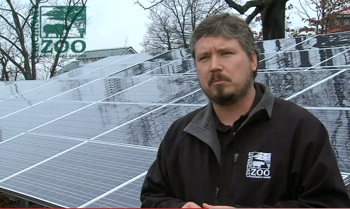
Over the years, as Rick Murphy helped expand his family’s auto business in Edina, Minn., outside Minneapolis, he wanted to install solar panels to cut the electricity bills, but the upfront cost was too high.
Then a developer, Blue Horizon Energy, made a proposal: Grandview Tire and Auto, using a new loan program, could borrow the $34,000 to install the system and pay it back over 10 years, but instead of making traditional loan payments, they would be made through his property taxes.

The chemical secrets of a concrete Roman breakwater that has spent the last 2,000 years submerged in the Mediterranean Sea have been uncovered by an international team of researchers led by a professor of civil and environmental engineering at the University of California, Berkeley.
Analysis of the samples pinpointed why the best Roman concrete was superior to most modern concrete in durability, why its manufacture was less environmentally damaging – and how these improvements could be adopted in the modern world.
“It’s not that modern concrete isn’t good – it’s so good we use 19 billion tons of it a year,” says Paulo Monteiro of the U.S. Department of Energy’s Lawrence Berkeley National Laboratory. “The problem is that manufacturing Portland cement accounts for seven percent of the carbon dioxide that industry puts into the air.”
Cutting greenhouse gas emissions is one powerful incentive for finding a better way to provide the concrete the world needs; another is the need for stronger, longer-lasting buildings, bridges, and other structures.
“In the middle 20th century, concrete structures were designed to last 50 years, and a lot of them are on borrowed time,” Monteiro says. “Now we design buildings to last 100 to 120 years.” Yet Roman harbor installations have survived 2,000 years of chemical attack and wave action underwater.
 The Romans made concrete by mixing lime and volcanic rock. For underwater structures, lime and volcanic ash were mixed to form mortar, and this mortar and volcanic tuff were packed into wooden forms. The seawater instantly triggered a hot chemical reaction. The lime was hydrated – incorporating water molecules into its structure – and reacted with the ash to cement the whole mixture together.
Descriptions of volcanic ash have survived from ancient times. First Vitruvius, an engineer for the Emperor Augustus, and later Pliny the Elder recorded that the best maritime concrete was made with ash from volcanic regions of the Gulf of Naples (Pliny died in the eruption of Mt. Vesuvius that buried Pompeii), especially from sites near today’s seaside town of Pozzuoli. Ash with similar mineral characteristics, called pozzolan, is found in many parts of the world.
Using experimental facilities from UC Berkeley, Saudi Arabia and Germany, they found that Roman concrete from Pozzuoli differs from the modern kind in several essential ways. One is the kind of glue that binds the concrete’s components together, with the Roman mineral mix producing an exceptionally stable binder. The results revealed a mineral mix with potential applications for high-performance concretes, including the encapsulation of hazardous wastes.
“For us, pozzolan is important for its practical applications,” says Monteiro. “It could replace 40 percent of the world’s demand for Portland cement. And there are sources of pozzolan all over the world. Saudi Arabia has mountains of it.”
Stronger, longer-lasting modern concrete, made with less fuel and less release of carbon into the atmosphere, may be the legacy of a deeper understanding of how the Romans made their incomparable concrete.
(Learn more: Lawrence Berkeley National Lab)
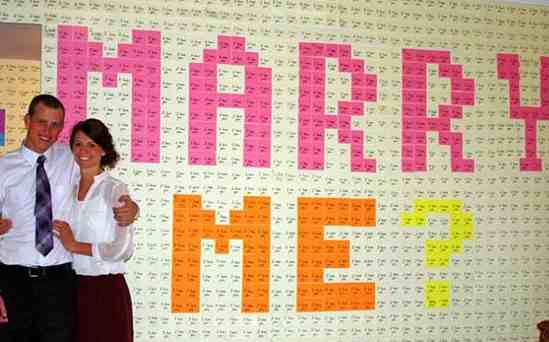
A Littleton, Colorado man popped the question asking for his girlfriend’s hand in marriage using 8000 Post-it Notes arranged to ask, “Marry Me?”
Not only that, it took him several months to write “I love you” on each individual sticky note.
His surprised bride-to-be said yes.

While waving to the crowd in St. Peter’s Square at the Vatican Wednesday, Pope Francis invited a teen with Down Syndrome to climb aboard his open top Popemobile.
The Catholic church leader gestured for him to sit down in the white captain’s chair and even gave the swivel seat a spin while hundreds watched and clapped.
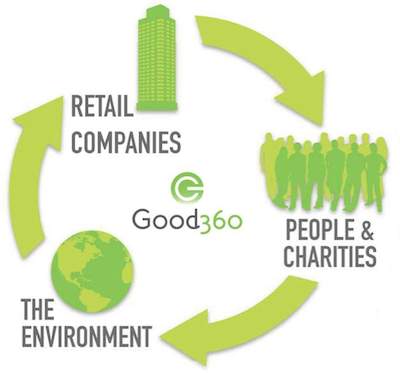
Over the past 30 years, the charity Good 360 has redistributed over $7 billion dollars worth of products to the poor. The online marketplace makes it easy and profitable for corporations to donate unused surplus to charities, rather than storing it or shipping it to a landfill.
Now, Good 360 is coming to Australia, aiming to help companies there convert their excess goods into good deeds. The expansion was spearheaded by a woman whose good friend and her special needs daughter.
Good360, formerly known as Gifts In Kind International, formed in 1983 in response to 3M’s need to donate $12 million worth of new office equipment – perfectly usable copiers that would have been disposed of had 3M had not considered the charitable alternative.
(WATCH the video from ABC.au)
Crime in Scotland has fallen to the lowest level since 1974 with homicide and other violence plummeting by more than 20 percent. Even robbery and theft rates dropped despite the recession. – Scotsman

Have you read the book “Lean In” by Facebook executive Sheryl Sandberg yet? In professional women’s circles, it’s all the rage. It has sparked conversations about whether women can truly ‘have it all’, and whether they even want to. But it misses a key point related to positive psychology – it’s focused on success rather than happiness. What about our innate simple desire to be happy? Carin Rockind explores this in her essay, “Lean In to Happiness Instead”.
_______________
I am consistently amazed by how many successful, professional women with VP titles and six-figure salaries flock to my Happiness Workshops because they are starving for just one taste of joy. Yes, accomplishment is an ingredient of happiness, but so are healthy relationships, an abundance of positive emotions and greater life purpose. Too many women today are racing so furiously to do everything that we have no time to just be. Sure, our smiles are perky and our handshakes firm, but underneath it all, we aren’t happy. We’re panicked that we can’t get it all done, worrying that we’re constantly disappointing someone, angry that we are passed up for the promotion and sad that we have no time to relax. We’re trying to balance six plates on five perfectly manicured fingers, and it isn’t working.
While common Western wisdom believes that success leads to happiness, hundreds of research studies show that the opposite is true. Happy people are more successful in every possible measure. Happy people are physically healthier, have better relationships and are more productive at work. Customers like working with happy staff; employees prefer a happy boss. You get the idea.
As is, most people hate their jobs. According to Gallup, approximately 70% of all employees dislike their jobs, leading to $300 billion in lost profitability annually. For women, though, the added stress of unequal power and status, role prioritization between executive/lover/mother, plus our genuine concern for others escalates our unhappiness.
 We are too important to the workplace to allow this to continue. It’s time to end this madness. Let’s claim our happiness and demand it at home and in the workplace. We still make most of the home and purchasing decisions, so we need to take a stand. As the old adage says, “If momma ain’t happy, ain’t nobody happy.”
But happiness doesn’t mean another gift certificate for a mani/pedi. It means creating opportunities for the distinct challenges that women face. It means honoring the powerful nature of creative feminine energy. It means not only supporting a woman’s biological right to have a baby, but also leveraging her nurturing instinct in general. How many companies know that most women are motivated intrinsically by collective, social action? Those who do could be at a huge advantage.
Ladies, here is our responsibility. We need to believe that we deserve happiness above all else. We need to own it and claim it. We need to love our full selves and bring that confidence to work and life. Rather than follow conformist rules about who you should be or what you ought to do, know that your voice matters, that your essence is electric and speak up with pride. Know that you offer strengths that no one else does. Use them. Forget balance and work for integration, getting very clear on what YOU need to be happy. Do you need 30 minutes once a week by yourself to exhale the stress? Do you need one night a month to be with girlfriends so that you can recharge your batteries and feel sexy? Does having time to paint or read or garden feed your soul? Then claim it. People treat your time as you allow them to, so if you don’t protect your need happiness time, why should others? Know what matters and put a stake in the ground. Believe that you are worthy of happiness. And know that in claiming your happiness, it will lead to greater success.
 So should we lean in? Maybe. But how about companies also extend out? Know what motivates women – and every employee for that matter. Humans are happiest when they are appreciated for who they are. We thrive when working our strengths, not trying to fix weaknesses or fit into norms. Ask for our opinions, solicit our ideas, lean into us and learn. Empower us to be us and we’ll all win.
__________________________
Empowerment coach and transformative speaker, Carin Rockind elevates women to be rockstars in life. Working with individuals and companies, she combines her expertise in Positive Psychology with experience as a trauma survivor and former Fortune 500 exec to support professional women to being truly happy and wildly successful. Find more information on www.carinrockind.com, Facebook or Twitter.

Collecting a hole-in-one on Father’s Day is about as good as it gets for a golfing dad, unless his son gets one, too, right afterward.
That’s exactly what happened when 57-yard-old Lonnie Whitener and his 13-year-old son, according to the Houston Chronicle.
When Whitener drove his ball into the hole in one shot he was ecstatic, of course, but it wasn’t anything compared to what he soon would be feeling soon.

New York City unveiled the first of 25 free solar charging stations for mobile phones on Tuesday, installed in response to Superstorm Sandy, which wiped out power and forced residents to walk miles to charge their phones.
The Street Charge stations promise to be the solution in both sunny and cloudy weather for New Yorkers facing the dead battery dilemma.

A retiring Massachusetts principal was tricked into going on the school’s roof in order to receive a very memorable going-away present. Students, parents and staff stretched across the parking lot below surprising the 36-year veteran educator with a loving flash mob of thanks.
Bearing signs and dressed in neon colors, the crowd of teens and adults from Hingham Middle School performed a choreographed dance to “Don’t Stop Believing”.
The display brought Roger Boddie to tears, saying, “Unbelievable,” and “Incredible”.
(READ the story in the Boston Globe)

Now you can share your status as an organ donor on Facebook. The simple switch prompted more than 13,000 people to register for organ donation in a single day last year. Researchers think social media might be the key to solving the nation’s organ shortage problem.
Researchers from Johns Hopkins University said that single day recorded more than 21 times the average of daily sign-ups, according to a study released Tuesday.