From World Resources Institute – Energy.gov (FOTW)
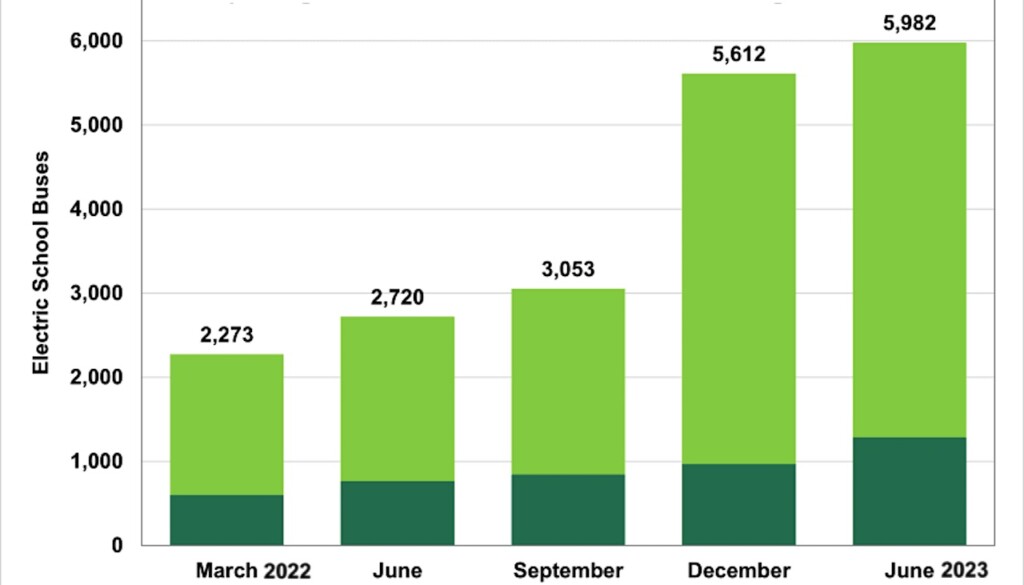
According to the World Resources Institute, the number of electric school buses operating or delivered in the United States more than doubled—from 598 in 2022 to 1,285 through June 2023—all driven to serve school children while providing cleaner air in 40 states.
Looking into the near future, the number of electric school buses that were already funded or on-order nearly tripled, and were spread across districts located in 49 states.
The emissions-free buses are found in 914 U.S. school districts and private fleet operators, according to the evidence-based nonprofit’s report published in September, 2023: State of Electric School Bus Adoption in the US.
California leads all states, with over 2,000 committed electric buses across the sprawling territory. This is more than five times as many EV buses as the next leading state, Maryland, with 391 commitments.
New Jersey has the second largest increase with 107 new buses, while West Virginia has the third largest increase with 42 new commitments. The updated data shows electric school bus commitments are now more evenly distributed across all regions of the country.
The Top 5 School Districts by Number of Electric School Buses are:
Montgomery County Public Schools (Maryland)
Los Angeles Unified School District
New York City Public Schools
Twin Rivers Unified School District (California)
Troy Community Consolidated School District (Illinois)
“We estimate approximately 69,000 students across the country are currently served by electric school buses that are delivered or in operation,” said the report authors, Lydia Freehafer, Leah Lazer, and Brian Zepka.
Zero pollution from tailpipes while buses are idling or driving means the students, staff, and community will be exposed to significantly less harmful air particulates that contribute to asthma and lung disease. The environment also benefits from reduced greenhouse gas emissions.
The federal government’s Clean School Bus Program, administered by the Environmental Protection Agency, is one of the biggest funders of these vehicles, having awarded 2,339 electric school buses—with more on the way.
EDUCATE OTHERS By Sharing This Green News on Social Media…
FREE WILL ASTROLOGY – Week of December 30, 2023
Copyright by Rob Brezsny, FreeWillAstrology.com
CAPRICORN (Dec. 22-Jan. 19):
Capricorn-born Lebron James is one of the greatest players in basketball history. Even more interesting from my perspective is that he is an exuberant activist and philanthropist. His list of magnificent contributions is too long to detail here. Here are a few examples: his bountiful support for charities like After-School All-Stars, Boys & Girls Clubs of America, the Children’s Defense Fund, and his own Family Foundation. I suggest you make Lebron one of your role models in 2024. It will be a time when you can have more potent and far-reaching effects than ever before through the power of your compassion, generosity, and beneficence.
AQUARIUS (Jan. 20-Feb. 18):
I propose we make the shark your soul creature in 2024. Not because some shark species are apex predators at the top of the food chain. Rather, I propose you embrace the shark as an inspirational role model because it is a stalwart, steadfast champion with spectacular endurance. Its lineage goes back 400 million years. Sharks were on Earth before there were dinosaurs, mammals, and grass. Saturn’s rings didn’t exist yet when the first sharks swam in the oceans. Here are the adjectives I expect you to specialize in during the coming months: resolute, staunch, indomitable, sturdy, resilient.
PISCES (Feb. 19-March 20):
In the 19th century, many scientists believed in the bogus theory of eugenics, which proposed that we could upgrade the genetic quality of the human race through selective breeding. Here’s a further example of experts’ ignorance: Until the 1800s, most scientists dismissed the notion that stones fell from the sky, even though meteorites had been seen by countless people since ancient times. Scientists also rejected the idea that large reptiles once roamed the Earth, at least until the 19th century, when it became clear that dinosaurs had existed and had become extinct. The moral of the story is that even the smartest among us can be addicted to delusional beliefs and theories. I hope this inspires you to engage in a purge of your own outmoded dogmas in 2024. A beginner’s mind can be your superpower! Discover a slew of new ways to think and see.
ARIES (March 21-April 19):
Among couples who share their finances, 39 percent lie to their partners about money. If you have been among that 39 percent, please don’t be in 2024. In fact, I hope you will be as candid as possible about most matters with every key ally in your life. It will be a time when the more honest and forthcoming you are, the more resources you will have at your disposal. Your commitment to telling the truth as kindly but completely as possible will earn you interesting rewards.
TAURUS (April 20-May 20):
According to tradition in ancient Israel, a Jubilee year happened every half-century. It was a “trumpet blast of liberty,” in the words of the Old Testament book Leviticus. During this grace period, enslaved people were supposed to be freed. Debts were forgiven, taxes canceled, and prisoners released. People were encouraged to work less and engage in more revelry. I boldly proclaim that 2024 should be a Jubilee Year for you Bulls. To launch the fun, make a list of the alleviations and emancipations you will claim in the months ahead.
GEMINI (May 21-June 20):
This is essential wisdom about how to conduct vibrant relationships: “Make peace with their devils, and you will do the same with yours.” I invite you to make liberal use of it in 2024. Why? Because I suspect you will come to deeply appreciate how all your worthwhile bonds inevitably require you to engage with each other’s wounds, shadows, and unripeness. To say it another way, healthy alliances require you to deal respectfully and compassionately with each other’s darkness. The disagreements and misunderstandings the two of you face are not flaws that discolor perfect intimacy. They are often rich opportunities to enrich togetherness.
CANCER (June 21-July 22):
Cancerian author Franz Kafka wrote over 500 letters to his love interest Felice Bauer. Her outpouring of affection wasn’t as voluminous, but was still very warm. At one point, Kafka wryly communicated to her, “Please suggest a remedy to stop me trembling with joy like a lunatic when I receive and read your letters.” He added, “You have given me a gift such as I never even dreamt of finding in this life.” I will be outrageous here and predict that 2024 will bring you, too, a gift such as you never dreamt of finding in this life. It may or may not involve romantic love, but it will feel like an ultimate blessing.
LEO (July 23-Aug. 22):
Renowned inventor Nikola Tesla (1856–1943) felt an extraordinary closeness with sparrows, finches, pigeons, and other wild birds. He loved feeding them, conversing with them, and inviting them into his home through open windows. He even fell in love with a special pigeon he called White Dove. He said, “I loved her as a man loves a woman, and she loved me. As long as I had her, there was a purpose to my life.” I bring this to your attention because I suspect 2024 will be an excellent time to upgrade your relationship with birds, Leo. Your power to employ and enjoy the metaphorical power of flight will be at a maximum.
VIRGO (Aug. 23-Sept. 22):
“All the world’s a stage,” wrote Shakespeare. He was comparing life to a theatrical drama, suggesting we are all performers attached to playing roles. In response, a band called the Kingpins released the song “All the World’s a Cage.” The lyrics include these lines: “You promised that the world was mine / You chained me to the borderline / Now I’m just sitting here doing time / All the world’s a cage.” These thoughts are the prelude to my advice for you. I believe that in 2024, you are poised to live your life in a world that is neither like a stage nor a cage. You will have unusually ample freedom from expectations, artificial constraints, and the inertia of the past. It will be an excellent time to break free from outdated self-images and your habitual persona.
LIBRA (Sept. 23-Oct. 22):
At age 10, an American girl named Becky Schroeder launched her career as an inventor. Two years later, she got her first of many patents for a product that enables people to read and write in the dark. I propose we make her one of your role models for 2024. No matter how old you are, I suspect you will be doing precocious things. You will understand life like a person at least ten years older than you. You will master abilities that a casual observer might think you learned improbably fast. You may even have seemingly supernatural conversations with the Future You.
SCORPIO (Oct. 23-Nov. 21):
Here are excellent questions for you to meditate on throughout 2024. 1. Who and what do you love? Who and what makes you spill over with adoration, caring, and longing? 2. How often do you feel deep waves of love? Would you like to feel more of them? If so, how could you? 3. What are the most practical and beautiful ways you express love for whom and what you love? Would you like to enhance the ways you express love, and if so, how? 4. Is there anything you can or should do to intensify your love for yourself?
SAGITTARIUS (Nov. 22-Dec. 21):
Like the rest of the planet, Scotland used to be a wild land. It had vast swaths of virgin forests and undomesticated animals. Then humans came. They cut the trees, dug up charcoal, and brought agriculture. Many native species died, and most forests disappeared. In recent years, though, a rewilding movement has arisen. Now Scotland is on the way to restoring the ancient health of the land. Native flora and fauna are returning. In accordance with astrological omens, I propose that you launch your own personal rewilding project in 2024. What would that look like? How might you accomplish it?
WANT MORE? Listen to Rob’s EXPANDED AUDIO HOROSCOPES, 4-5 minute meditations on the current state of your destiny — or subscribe to his unique daily text message service at: RealAstrology.com
Quote of the Day: “Kindness in words creates confidence… Kindness in giving creates love.” – Lao Tzu
Photo by: Narges Pms
With a new inspirational quote every day, atop the perfect photo—collected and archived on our Quotes page—why not bookmark GNN.org for a daily uplift?
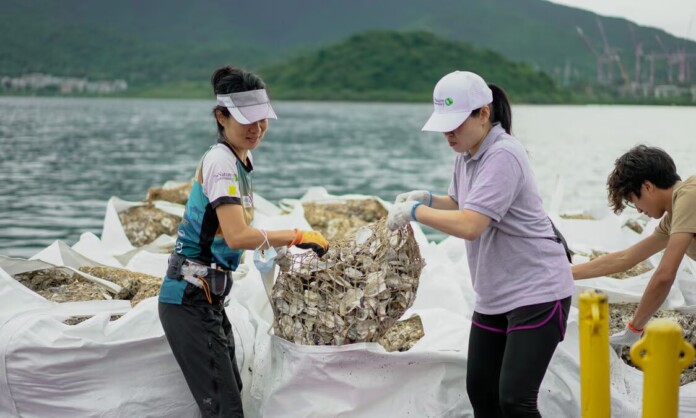
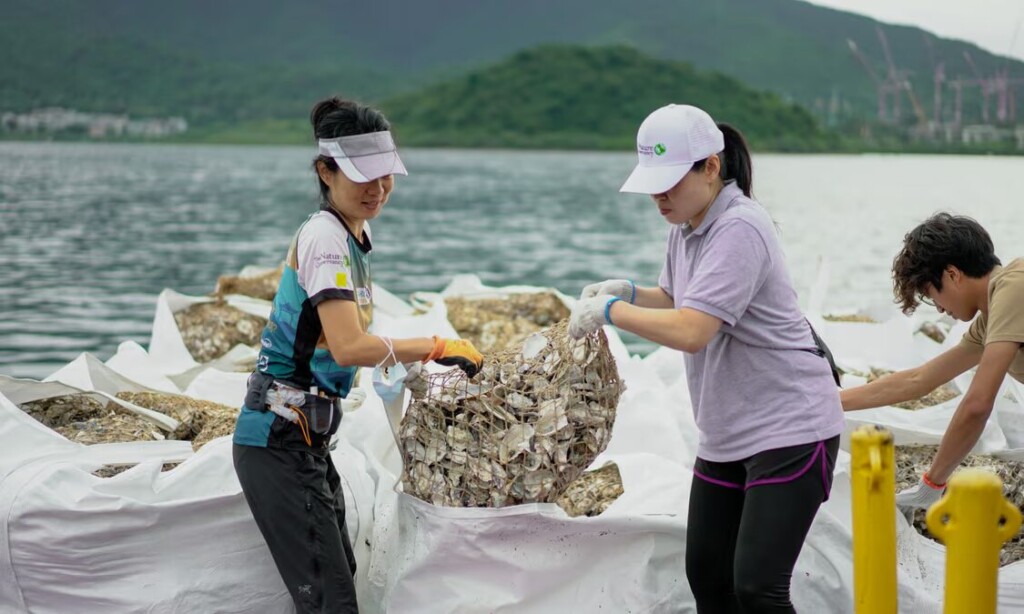
Decontaminated shells being unloaded to become part of a series of restored oyster reefs. Photograph Miko/The Nature Conservancy
Decontaminated shells being unloaded to become part of a series of restored oyster reefs. Photograph Miko/The Nature Conservancy
For everything that Hong Kong is and has become, a quiet constant among the rattle of construction and the sprawl of concrete, steel, and glass has been the humble oyster.
Now, after decades of degradation of the oyster reefs, restaurants and municipal waste services are ensuring that consumed oysters have their shells returned to the reefs, ensuring they rebuild and thrive in the deep Hong Kong water.
The Hong Kong oyster, Magallana hongkongensis filters more water of impurities than any other species. If properly cared for, each of the tens of thousands of oysters that make up the reefs can clean 200 liters per day.
The Nature Conservancy, one of America’s largest conservation NGOs, runs a chapter in Hong Kong that organizes oyster shell collection from the city’s many restaurants. Every Thursday their vehicles comb the city for sacks of used oyster shells before dumping them at a special enclosure at a landfill to ensure all residual flesh and bacteria are dried out in the sun.
1 year from that point, they are dumped into the waters over reefs identified as having the potential to be regenerated, according to the Guardian’s Sofia Quaglia reporting on the effort.
The Nature Conservancy is collecting nearly 1 metric ton of shells from 12 hotels, supermarkets, and a variety of smaller restaurants. Around 80 tonnes have been recycled since the project began in 2020.
The shells help regrow the reefs by increasing the mass of material for oyster larvae to glom on to. It also provides homes for sea sponges and other foundational marine life that provide food, shelter, and co-dependent relationships with other creatures higher up the marine food web.
The City University of Hong Kong and the Swire Institute of Marine Science are both studying the efforts of the Nature Conservancy and their local oyster farming partners to quantity how much, if at all, oyster populations can be restored by this recycling method.
They have been used in 4 projects so far, including on the eastern side of the island and around the airport island.
WATCH the story below from The Nature Conservancy…
SHARE The Rebuilding Of These Reefs One Half-Dozen On Ice At A Time…
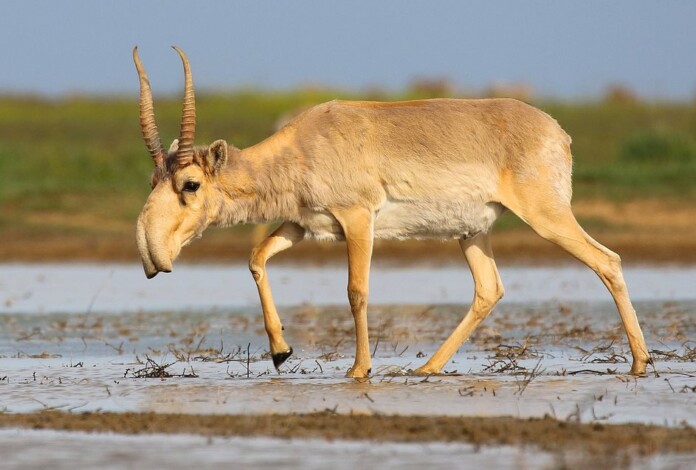
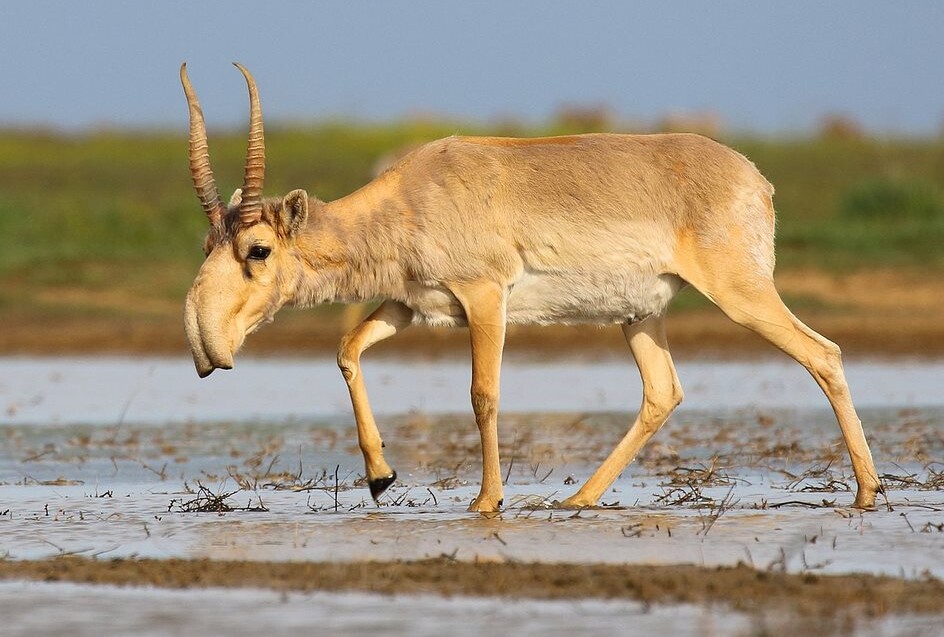
Saiga antelope at the Stepnoi Sanctuary in Russia. CC 4.0. Andrey Giljov
Saiga antelope at the Stepnoi Sanctuary in Russia. CC 4.0. Andrey Giljov
Decades of hard work on the part of national and international conservation partners have reaped rich rewards for the saiga, one of the world’s most charismatic and, until recently, most endangered antelopes.
The IUCN Red List status of this timeless talisman of the Central Asian steppes has been changed from Critically Endangered to Near Threatened.
The dramatic downlisting reflects a remarkable rebound in saiga numbers, particularly its Kazakhstan stronghold, where populations have bounced back from a perilously low 48,000 individuals in 2005 to a new high of over 1.9 million.
It’s hard not to romanticize the Central Asian steppes with all their great history of intercultural exchange and travel. But leering at all the passing Turkic tribes, Mongol hordes, peaceful nomads, and Marco Polo would have been the saiga antelope.
The most characteristic feature of this animal are without a doubt the pair of bloated downward-facing nostrils, and the gorgeous, ringed horns sported only by the males. Large nostrils are typical of sprinters or cold weather environments, but it’s possible they are also a display tool for potential mates.
Described by Fauna and Flora International as a “genuine collaborative effort” involving state governments, research institutes, and conservation NGOs, the return of the saiga has featured many “false dawns.” Of particular impediment to their recovery has been frequent outbreaks of zoological diseases.
While the stronghold of the saiga is in Kazakhstan—the largest member of the Central Asian “stans” there are populations as far away as Russia and China, with the latter protecting it with the same stringency as giant pandas, rhinos, tigers, slow lorises, a variety of Critically Endangered monkeys, elephants, and Przewalski’s horse.
“Saiga have been roaming in the Eurasian steppe territories for thousands of years, way before our current generation was born,” said Samat Toigonbaev, Fauna & Flora Project Manager, Kazakhstan.
“When staying in the steppe, I can sense that invisible feeling of pride the local people have towards saiga. Witnessing them running through the steppe in vast numbers again has been one of my brightest life experiences. And it is our utmost duty to conserve it that way.”
The Kazakh government has consistently legislated to protect the saiga; as recently as 2021 designated two new protected areas on their behalf totaling over 1.5 million acres.
“As one of the most successful recoveries of a terrestrial mammal ever recorded, this… illustrates how conservation can be effective if all parties collaborate with a strong mission and appropriate resourcing”, says Vera Voronova, Executive Director of ACBK, a Kazakh national civil society organization that was part of the conservation efforts.
SHARE This Major Milestone For These Central Asian Icons With Your Friends…
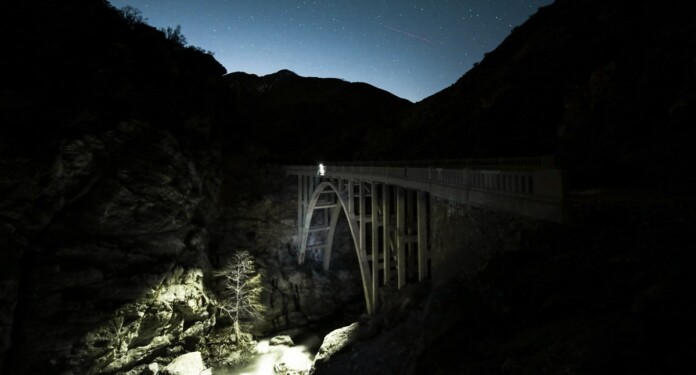
An Army veteran in Virginia jumped 50 feet off a bridge into winter-cold water to save a suicidal teen.
Instincts clued in Juan Serrano on the motives of a young guy on the side of the Appomattox Bridge of I-95 who was pacing and seemed to need help. Serrano had been returning home from a visit to church he hadn’t been particularly interested in—waking up tired that morning.
Pulling over, he asked the young fellow if he needed a ride, but as soon as Serrano began to approach him, he jumped into the fast-flowing, freezing water below.
“I thought alright we got to get him out of the water because it could’ve been my kid,” Serrano told WTVR. “Next thing I knew I was just jumping into the water, trying to get him out.”
It was pitch-black that night, and against all odds, Serrano managed to reach the boy, either before or after the river carried them a mile downstream, eventually landing them at the gates of a water treatment facility where Serrano used his belt and the boy’s backpack in some combination to get him out of the water.
“Hero is a big word, I was just a guy with my wife, passing by and God put us there for a reason,” Serrano said, dismissing the moniker.
He told the CBS affiliate that he’s telling the story now—not to draw attention to his daring actions—but to raise awareness of mental health needs in communities near and far.
WATCH the story below from WTVR…
SHARE This BRAVERY With An Important Message on Social Media…
Artistic rendering of the possible view from LHS 3154b towards its low mass host star - CC 4.0. ND SA
Artistic rendering of the possible view from LHS 3154b towards its low mass host star – CC 4.0. ND SA
Far out in the galaxy, astronomers at Penn State have found a planet that is just a little bit smaller than its host star, a surprising finding set to potentially change the established ideas of planet formation.
Science news is filled with headlines of discoveries that clash with established theories known only to the scientists researching them, and not to the general public. But the idea of a planet being almost as large as the star it orbits is intuitively very strange to anyone with even a vague understanding of system dynamics.
The exoplanet is twice the mass of any known body that orbits its star in less than ten days, and weighs in at about one three-hundredth the mass of its star, which may not sound like much, but just compare it to Mercury, the closest planet to the Sun which is 93 million times smaller, and you have some understanding of the magnitude of the discovery.
“This discovery really drives home the point of just how little we know about the universe,” said Suvrath Mahadevan, Professor of Astronomy and Astrophysics at Penn State and co-author on the paper describing the discovery. “We wouldn’t expect a planet this heavy around such a low-mass star to exist.”
Mahadevan and his colleagues were using the 10-meter Hobby-Eberly Telescope at McDonald Observatory in Texas to survey low-mass stars and managed to identify LHS 3154, an M-type star, which is called a ‘cold dwarf’ and is the least-massive and least-hot kind of luminescent star.
Very quickly they used the transiting method to determine there was a planet passing between the view of the telescope and the star every 3.7 days, and the apparent wobble it was causing in the position of the star indicated that it was a massive object.
With the help of NASA’s Transiting Exoplanet Survey Satellite (TESS) and ESA’s Gaia satellite, the team established the mass of the transiting body as 0.35% the mass of the star, and about the size of Neptune, which when controlled for with the two most accepted theories of planet formation, threw a spanner in the works of both.
An artistic rendering of the mass comparison of LHS 3154 system and our own Earth and Sun. Credit: Penn State / Penn State. CC 4.0. ND SA
“The planet-forming disk around the low-mass star LHS 3154 is not expected to have enough solid mass to make this planet,” Mahadevan said. “But it’s out there, so now we need to reexamine our understanding of how planets and stars form.”
The two existing theories of planet formation are core accretion and gravitational instability.
Core accretions states that when stars complete their formation, a large disk of gas and dust is leftover which coalesces into planets, but the size of LHS 3154 is simply not enough to produce a planet as large as this one in any of the scenarios the team ran.
The team also considered the possibility the planet was created outside the star system and arrived there afterwards, but if this was the case, the planet would have to have an elliptical orbit, which it doesn’t.
“We were really struggling—like, we said, ‘OK, how can we actually form this type of planet?’” Guðmundur Stefánsson, an astrophysicist at Princeton University, and the paper’s first author, told Astronomy.
The mass of dust in the protoplanetary disk would have to be 10 times what the star is believed to have been capable of producing to create such a large planet.
SHARE This Astronomical Headscratcher With Your Friends…
Quote of the Day: “The great thing about getting older is that you don’t lose all the other ages you’ve been.” – Madeleine L’Engle
Photo by: Aziz Acharki
With a new inspirational quote every day, atop the perfect photo—collected and archived on our Quotes page—why not bookmark GNN.org for a daily uplift?
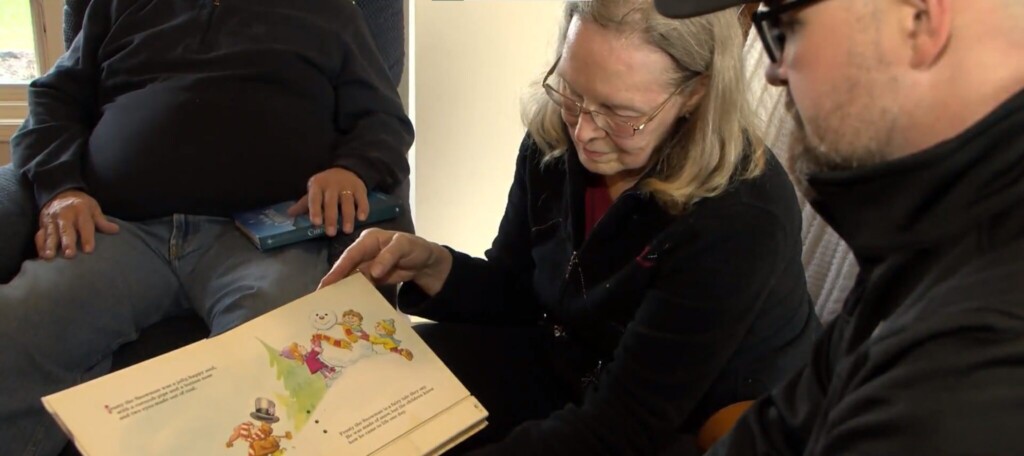
An electrician with a passion for preservation restored an ancient piece of home electronics, allowing a woman to hear her departed mother’s voice on Christmas.
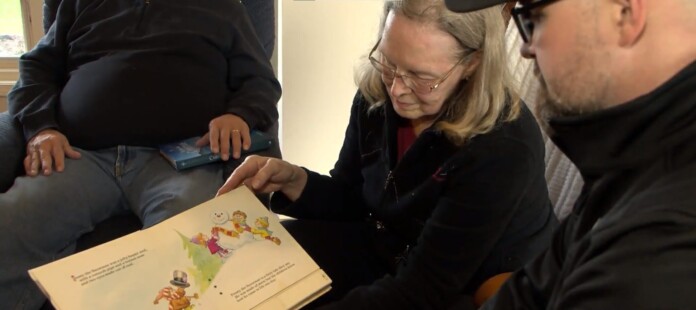
The old animated version of Frosty the Snowman can pull many people back to their childhood; doubly so for Linda Swartz, who had an old book with an electronic recording of her mother reading it to her when she was young.
Corrosion had long since rendered the circuitry unusable, but Linda kept it around for sentiment. Years went by, and as all mothers do, hers passed away in 2020.
Enter Lars Robins, an electrician who came by to fix something in Linda’s house. In the course of his work he came across the Frosty the Snowman book.
“I was really shocked because I didn’t think it was going to work,” Swartz told WCIA news. “For a second there it looked like it wasn’t going to, but it did. I couldn’t be happier.
Robins says his passion for preserving old things began when he worked as a teacher before his job as an electrician. Teachers are constantly creating and watching their kids create sentimental things, and understand how much old books and toys can mean even to adults.
“Helping people is the heart of what we do, so being able to help somebody in that kind of specific way, those opportunities don’t come around too often but when they do you kind of jump on them,” Robins added.
Linda put it down as a Christmas blessing.
WATCH the story below from WCIA…
SHARE This Sentimental Story With Your Friends Post-Christmas…
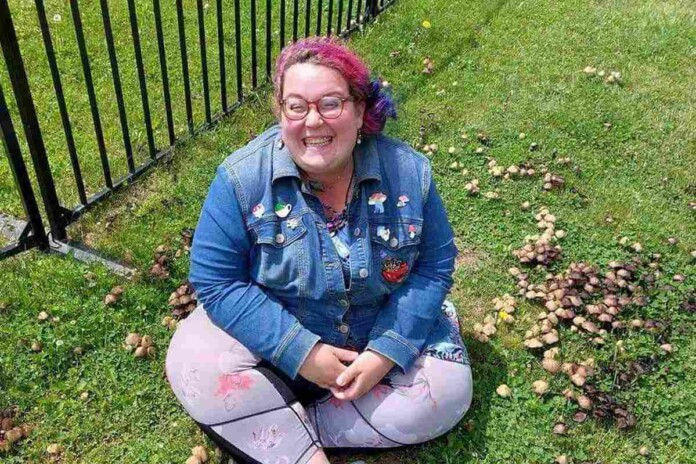
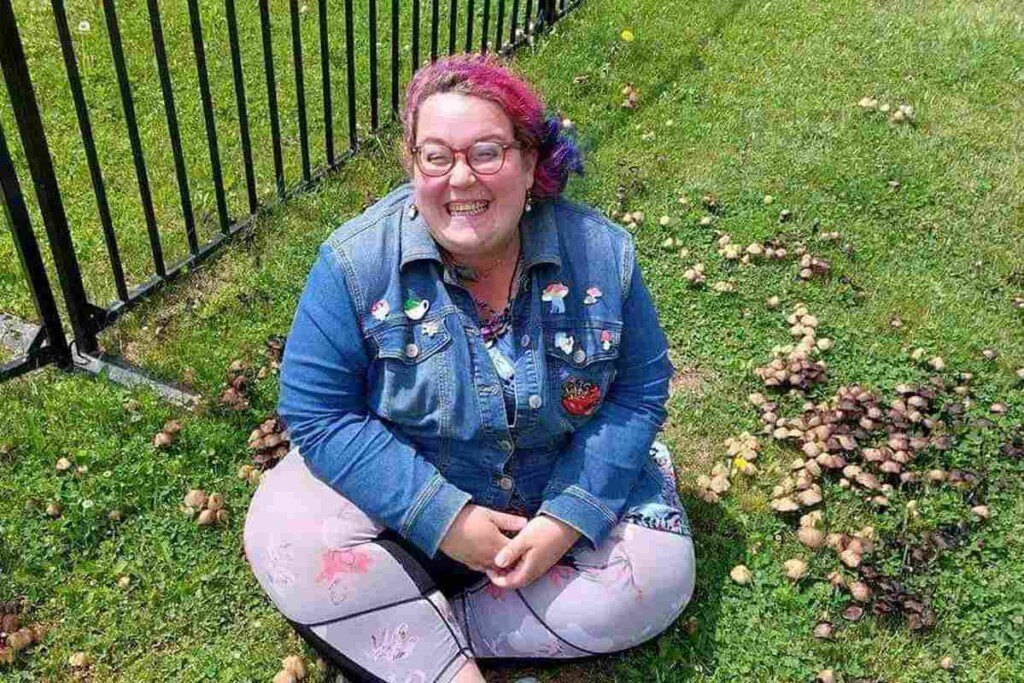
For 6 years, Jessika Gauvin used alcohol and drugs as a way to escape life and ignore past trauma.
But in April 2018, Jessika wandered into her local woods, in Moncton, New Brunswick and found being around nature gave her a “new perspective” on life.
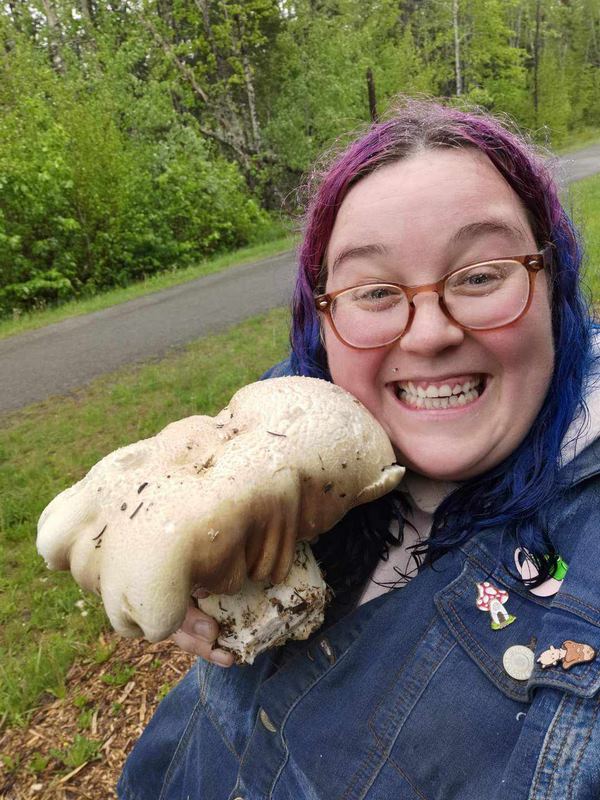
The Canadian is now five years sober and dedicates her time to finding natural ways to reduce stress and trauma through mushrooms and other wild edibles.
The full-time forager even uses blended-down black trumpet mushroom as a spice for all of her dishes due to its high levels of nutrients like protein and potassium, as well as a unique kind of fiber called beta-glucan.
Part of her full-time occupation is teaching other adults and children how to pick mushrooms safely.
“Mushrooms saved my life,” says Jessika simply. “I used to spend every paycheck on getting wasted. Now I’m debt-free and have discovered what mother nature can offer. I now use fungi to treat my trauma.”
Jessika began drinking at an early age with friends, but the dependence grew as she started a family.
In March 2012, her first son Noah, now 11, was born at Moncton Hospital, with a second son Jasper being born in the same hospital just one year later.
She suffered from post-natal depression that led to 6 years serious of substance abuse when she regularly felt “incredibly tired and lonely” trying to raise both children, and turned to drugs and alcohol to relieve stress.
As the children grew up, Jessika noticed her dependency on alcohol left her sad and anxious “every hour of every day.”
After finally becoming sick of her own behavior, Jessika took herself to Moncton forest for guidance and dug her bare feet into the soil to connect with nature. On that day, she recalls, she decided to tackle her problems head-on with nature as a guide.
It’s not a new idea; the Japanese have been ‘forest bathing’ for many years as a way to reduce anxiety, and ‘nature prescriptions’ have become a very common recommendation from physicians seeing depressed individuals.
She educated herself on fungi like Reishi mushrooms—which contain a high concentration of naturally sedative compounds that she says helped induce calmness.
Jessika reborn as a mushroom forager – SWNS
“Reishi mushrooms are incredibly beneficial to those with anxiety,” said Jessika, and in fact, they are often sold as a nootropic, or neuro-cognitive enhancing nutriceutical.
“My anxiety drastically reduced and it was all free. I was saving so much money every month,” she remembers.
Jessika soon fell ”completely in love” with mushrooms and spent day and night educating herself on how to safely pick and identify them. She now spends three hours in the woods every day and offers multiple classes on folklore medicine, herbal remedies, and mushroom identification.
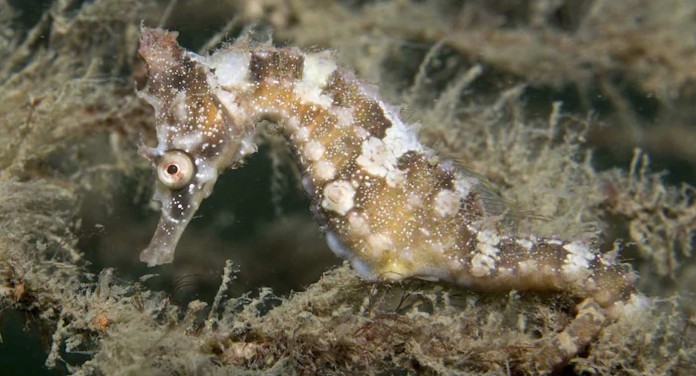
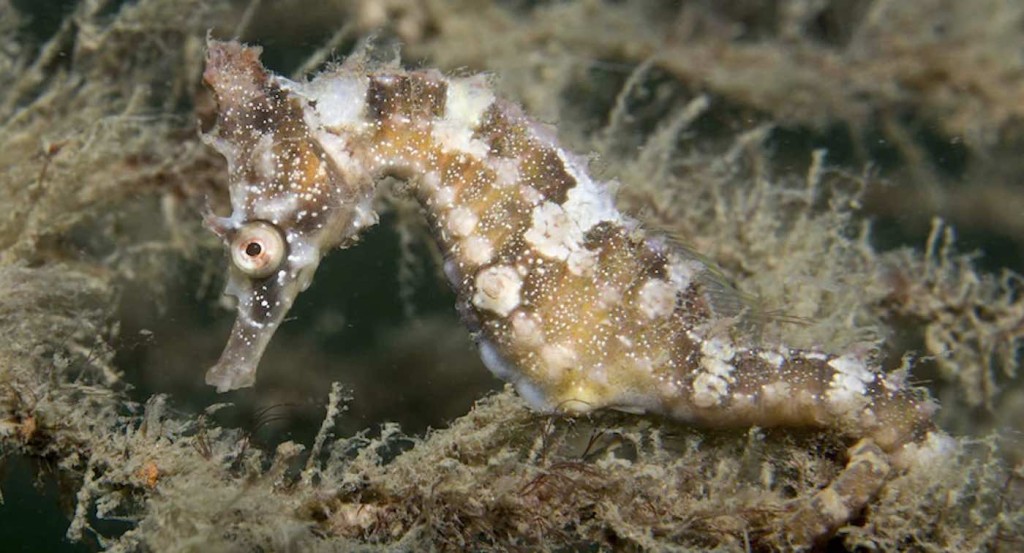
White's seahorse released in Australia - Supplied- by Dr. .David Harasti
White’s seahorse released in Australia – Supplied to ABC News by Dr. David Harasti.
Australia continues to rehabilitate its populations of White’s seahorse, an “Australian icon” and the only such creature on the nation’s endangered list.
In May, GNN reported that hundreds of White’s seahorses were released into the waters north of Newcastle into specially-made “hotels” as part of the largest release of captive-bred seahorses in history.
Now, as part of another reintroduction, a tide pool north of Sydney Harbor in a place called Clontarf will become the latest release site for these tiny sea creatures.
The seahorses were bred at Sea Life Aquarium in Sydney, and the Aquarium’s curator Laura Simmons says the release is just one of several already done and several more planned for 2024.
Also known as the New Holland seahorse, these small animals display a number of very interesting characteristics, including ovoviviparous reproduction whereby the female creates the eggs and uses an ovipositor to place them in the male’s brood pouch where they are fertilized and carried until birth.
Simmons said this release at Clontarf is the sixth release this year, following up on previous successes at Chowder Bay in Sydney Harbour, Botany Bay, and Little Manly Beach totaling over 400 individual seahorses.
Swimmers at Clontarf may be able to see the seahorses clinging to the habitat net in the tidal pool, but are encouraged not to disturb the animals.
SHARE This Story Of A Tiny National Icon Below The Sea On Social Media…
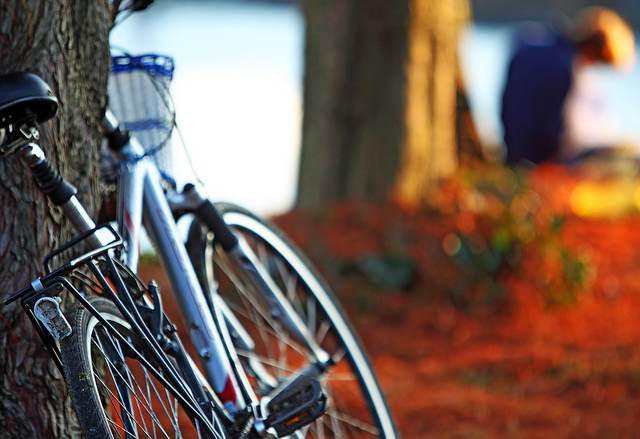
In Iceland’s capital of Reykjavik, a local man known as the “bike whisperer” works to recover stolen bikes, but he never gets angry or calls the police on the thieves.
In fact, the police call him when someone comes to report a missing bike. In a country with only a single high-security penitentiary, Bjartmar Leósson is a shining example of criminal rehab over criminal justice.
For the self-confessed “bike nerd” it all started when his bike was stolen years ago and came to believe it and other thefts like it were centered around a Reykjavik homeless shelter. He would see police cars driving past what were obviously stolen bikes out front and doing nothing.
“I was very angry, they were angry. But then I started to think: OK, it doesn’t matter, I can scream until I’m blue in the face, nothing’s going to change,” Mr. Leósson told The Guardian. “So I decided to try to level with them and just talk to them.”
From that point, the one-time thieves at the shelter became accomplices in a city-wide bike theft bust, with the unhoused helping to track down stolen bikes and recovering them for people reporting their bike stolen on Leósson’s Facebook group, Bicycle stuff etc lost, found or stolen, which has over 14,000 members.
Reykjavik is no Amsterdam, and only single-digit percentages of trips are made on bikes by the city’s 140,000 residents. But a drop in bike theft from 569 to 404 over 2 years, and a government program to create off-thoroughfare cycling routes is seeing that number rise.
“Bjartmar Leósson is doing a great job finding and collecting bikes that have been stolen,” said the Reykjavík police chief, Guðmundur Pétur Guðmundsson. “Police often guide victims of theft to various sales groups and his [Facebook] group just to increase the likelihood to find the bike a gain.”
In Leósson’s experience, bike thefts are primarily driven by addiction; people stealing them to try and afford to pay for drugs. According to the Guardian, he has helped some of these folks find pathways to recovery.
SHARE This Unlikely Hero Activity With Your Friends On Social Media…
Quote of the Day: “God gave us memory so that we might have roses in December.” – James M. Barrie
Photo by: Jamie Street
With a new inspirational quote every day, atop the perfect photo—collected and archived on our Quotes page—why not bookmark GNN.org for a daily uplift?
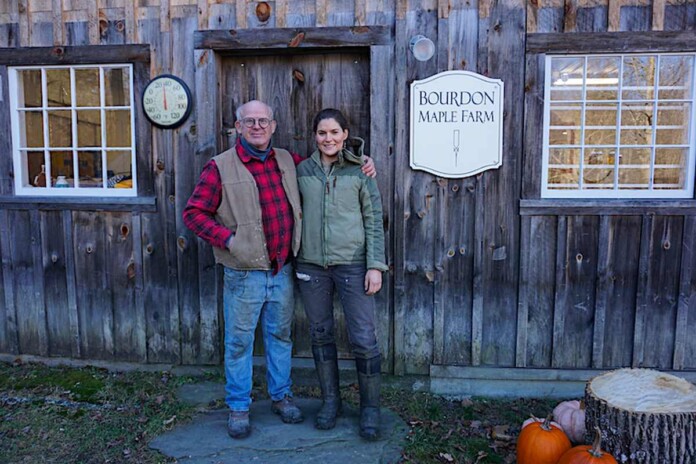
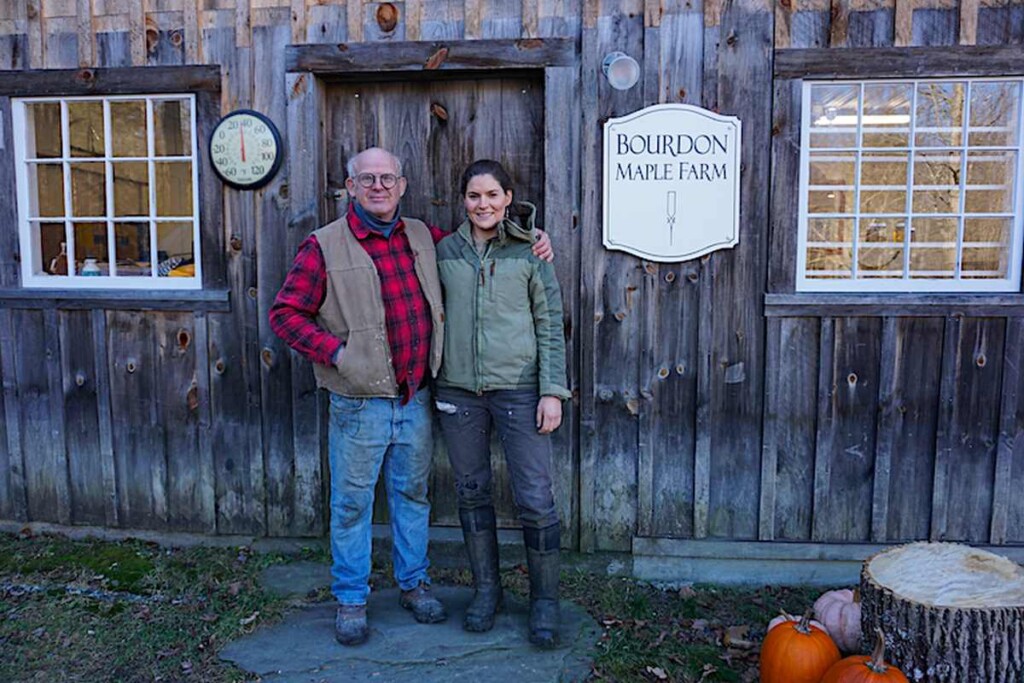
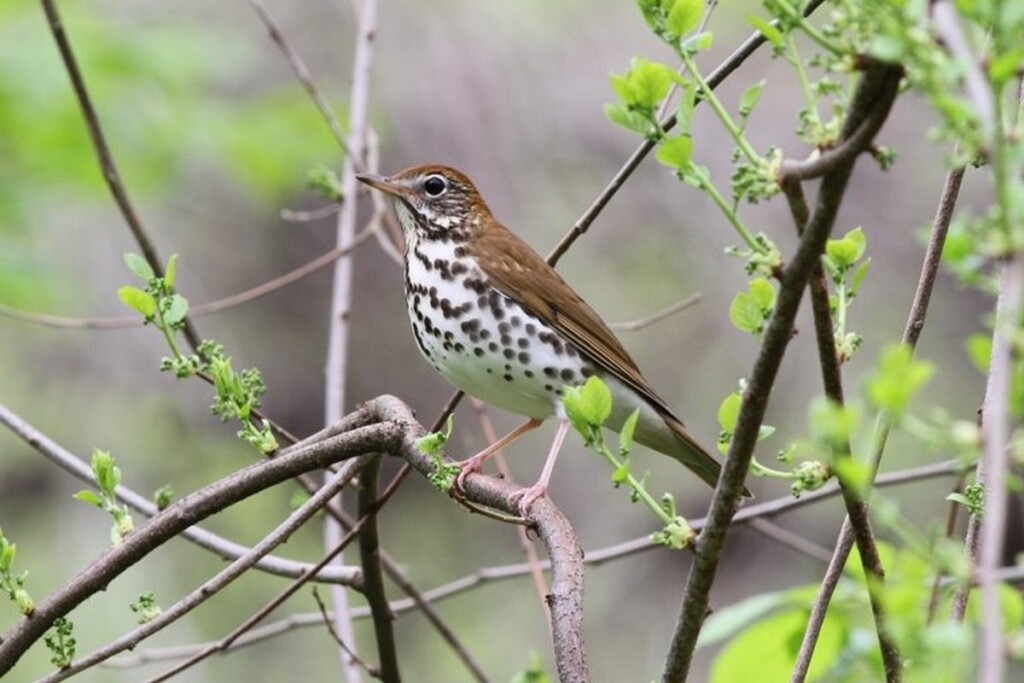
As the sun rises, the ethereal song of a wood thrush echoes through Bourdon Maple Farm’s 55-hectare (135-acre) forest in Woodstock. A bright scarlet tanager wings about the canopy as hungry yellow-bellied sapsuckers drill into tree bark.
At the height of maple sugaring season, birds provide a comforting soundtrack for the farm’s head of operations, sales, and marketing, Meg Emmons.
“A lot of times, the birds are my only company out here in the woods,” she said, smiling at a nearby black-capped chickadee. But the forest’s most vocal residents are also some of its most vulnerable.
Forest birds thrive in diverse habitats that consist of young, middle-aged, and old-growth trees. Most trees in New England, however, are uniformly middle-aged after regrowth following widespread clearing for agriculture in the 1800s. Modern development pressure continues to convert woodlands into residential areas, parking lots, and other unforested landscapes, further reducing the amount of habitat available.
As a result, many forest bird populations have plummeted. Wood thrush populations, for instance, more than halved in 50 years due to forest loss that increased nest exposure to predators and parasites. Vermont’s Wildlife Action Plan identifies it as a high-priority “species of greatest conservation need.”
Wood thrush. Image courtesy of Michael Parr / American Bird Conservancy.
Recent technological advances have resulted in an explosion of the maple syrup industry over the past 15 years in the United States and Canada. But with the growth of production comes the temptation to favor sugar maple (Acer saccharum) trees at the expense of other tree species in the “sugarbush,” as a stand of tapped sugar maples is called.
Some maple producers operate with an “I tend to the trees I tap” mentality, prioritizing maples and minimizing competition among maple trees and other vegetation. But removing too many non-maple trees puts the health of the entire forest, and hence the sugar maples themselves, at risk. In extreme cases, producers remove all non-maples growing beneath the forest canopy.
The eponymous owner of Bourdon Maple Farm, Don Bourdon, once met a producer who regularly cleared his woods with a lawn mower, cutting any species seemingly getting in the way of his maples’ success. But when maples surpass 90% of the sugarbush composition, producers have effectively created a monoculture, experts say.
Calling a sugarbush a monoculture may sound strange, as the term is usually reserved for industrial agriculture, such as giant fields of corn, soy or wheat that now occupy what used to be diversified forests or prairies. By comparison, monocultures in the maple industry are less common and less harmful — sugarbushes tend to keep the forest intact, which is far better than clearing it to plant annual crops — but growing trees in a monoculture still limits the forest’s ability to support wildlife and withstand ecological disturbances.
Encouraging a diversity of species in tended fields or forests is a major tenet of agroecology, which treats agriculture more like a functioning ecosystem than a food factory. Encompassing an array of techniques from organic farming to integrated pest management and agroforestry, agroecology is also a top climate solution since it sequesters carbon from the atmosphere, as the Intergovernmental Panel on Climate Change stated in 2022.
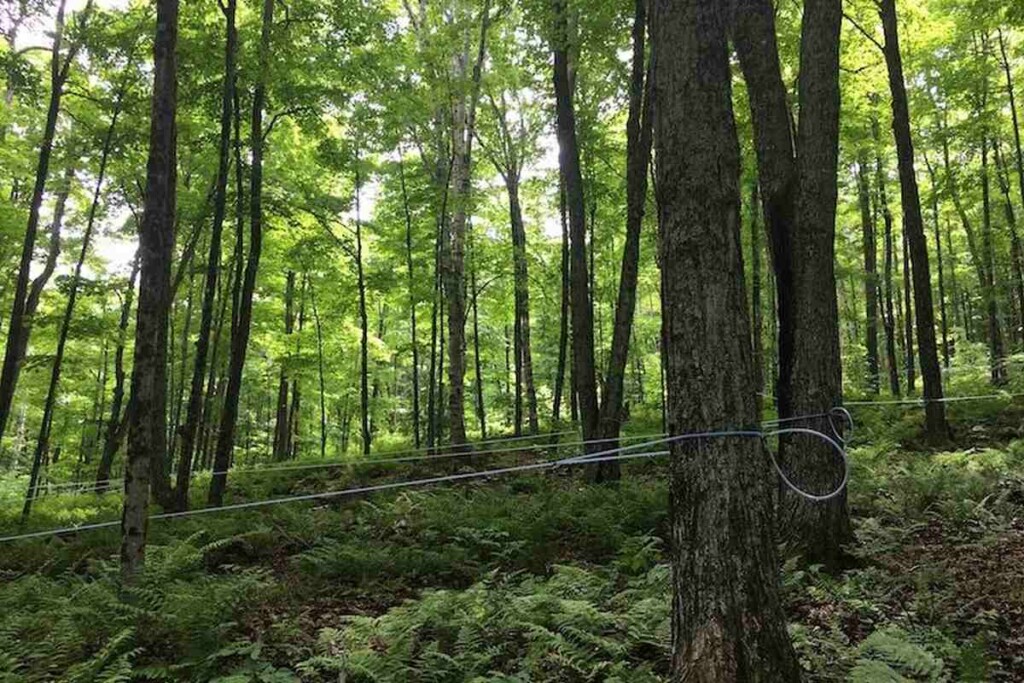
Bourdon Maple Farm’s flora exhibits a diversity of levels, from the forest floor to its mid-story and canopy. Image courtesy of Meg Emmons/Bourdon Maple Farm.
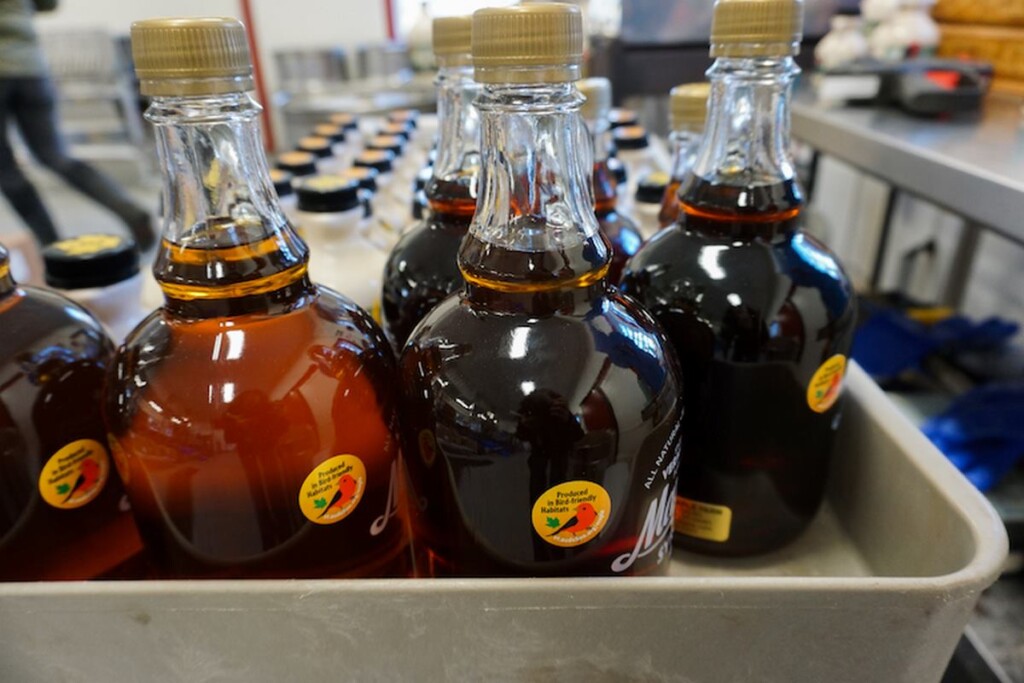
Along with a decline in crop or tree diversity, the diversity and abundance of birds decrease when, as in the case of maple monocultures, sugar maple trees exceed 75% of a forest. So, the conservation nonprofit Audubon Vermont focused on developing a solution and worked with the Vermont Maple Sugar Makers’ Association and the Vermont Department of Forests, Parks and Recreation to launch the Bird-Friendly Maple Project in 2014. The program celebrates producers who safeguard and enhance forest bird habitats and provides a label that customers can look for when buying syrup.
For a maple producer to earn the bird-friendly label, they must commit to a management plan that ensures a future sugarbush composition of no more than 75% sugar maples. In addition to enriching tree species diversity, bird-friendly producers must improve the structural complexity of their sugarbush with management objectives that aim to have vegetation covering at least 25% of the forest’s understory (the zone comprising the first 5 feet above the forest floor, where flowers, ferns, and shrubs are likely to grow) and its midstory (trees and shrubs standing between 5 and 30 feet in height). Eventually, participating farms’ sugarbushes should look like a wall of green in summer, with vegetation providing optimal nesting and foraging opportunities from the ground to the forest canopy.
“A messy forest is a little harder to work in. As a sugar maker, it can be difficult to walk out and tap your trees if you’re working through brambles and snags — but it’s good for the wildlife,” said Aaron Wightman, lifelong maple producer and co-director of the Cornell Maple Program, where researchers also explore additional sugarbush diversification efforts such as growing nutrient-rich forest products like berries and nuts under the forest canopy, and the harvesting of alternative tree syrups. “Retaining at least 25% non-maple species and creating structural diversity in a sugarbush are powerful strategies for bolstering the populations of birds and other forest species,” Wightman told Mongabay.
With diversity comes resilience. In addition to better supporting wildlife, a bird-friendly forest is less susceptible to threats including pests, disease and extreme weather events, owing to a diverse community of trees and because birds are voracious predators that eat many bugs that may damage trees or spread tree diseases.
Audubon Vermont conservation biologist Steve Hagenbuch compares diversifying a sugarbush to navigating the stock market. “If you put all of your funds in one account, and something bad happens to that account, you’re in trouble. But if you diversify your portfolio and you have it spread out, then you can handle something negative hitting one part of your investment,” he said.
In August, Audubon Vermont, along with the Vermont Center for Ecostudies and the University of Vermont (UVM), wrapped up a study launched in 2020 to quantify how forest bird communities respond to different habitat characteristics in actively managed sugarbushes. The data will be used to update and refine the Bird-Friendly Maple Project’s sugarbush management guidelines.
Preliminary results gathered in 2020 and 2021 from field surveys of breeding birds, foliage- and litter-dwelling arthropods, and vegetation across 14 active sugarbushes in Vermont—nine of which were enrolled in the Bird-Friendly Maple Project—suggest that the program’s current management guidelines need little modification. Cultivating diverse vegetation and structure in a sugarbush allows the landscape to better meet the needs of a wider range of forest birds, supporting bird diversity and abundance. For example, increases in low woody vegetation and sapling richness were linked to a significant increase in the abundance of three species that prefer to nest in saplings and shrubs: mourning warblers (Geothlypis philadelphia), chestnut-sided warblers (Setophaga pensylvanica) and black-throated blue warblers (Setophaga caerulescens).
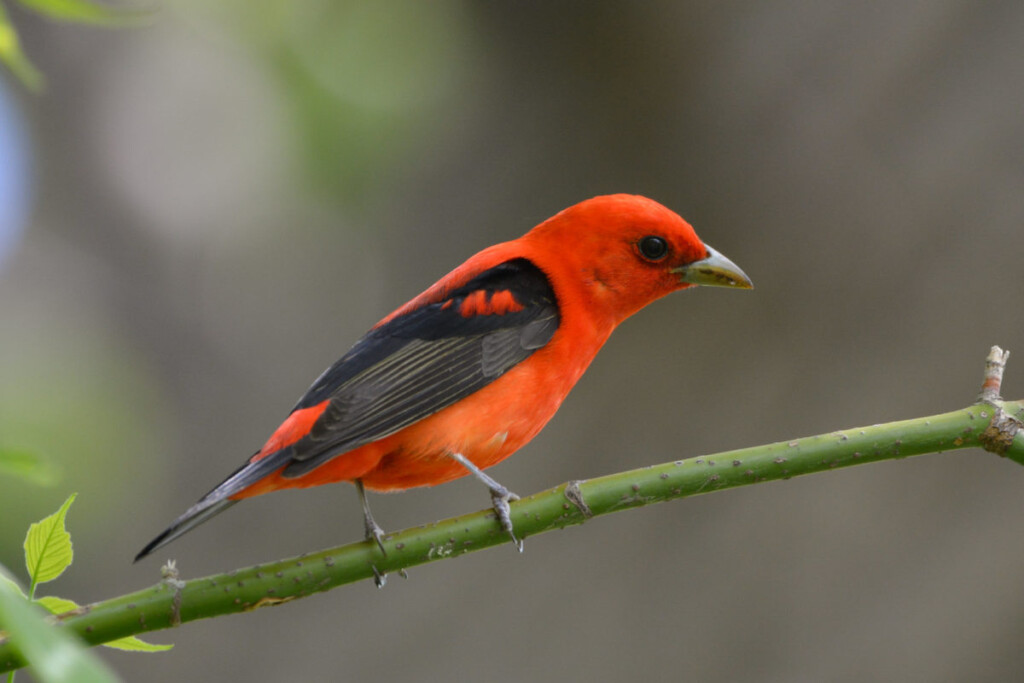
Scarlet tanager. Photo by Jen Goellnitz via Flickr (CC BY-NC 2.0)
Leaf litter depth proved to be one of a few especially important habitat features that benefit all forest birds. Many bird species rely on this rich carpet of organic material, whether for searching out insects and seeds, snagging twigs and leaves to build nests or camouflaging themselves among the debris to avoid nearby predators. Nonnative earthworms, however, can deplete this valuable leaf litter layer. Audubon Vermont will likely incorporate additional requirements into their bird-friendly management guidelines based on the study’s findings, such as paying attention to the presence and distribution of earthworms in the sugarbush.
UVM researchers gathered additional field data in 2022 and 2023 and continue to build upon the study’s evaluation of bird-friendly management practices. Liza Morse, a UVM Ph.D. candidate whose dissertation investigates the link between maple sugaring and sugarbush biodiversity and resilience, assisted with all four years of data collection and plans to interview participating sugar makers about their specific management approaches.
“Current bird-friendly targets are based on best practices for forest management in general, but the hope is that we can drill down on the drivers of change in a sugarbush and what they mean for birds,” Morse said. “Programs like the Bird-Friendly Maple Project are only going to improve as they are evaluated by research and continue to self-reflect.”
Bourdon Maple Farm’s Meg Emmons first reached out to Hagenbuch in late 2021 when she noticed the Bird-Friendly Maple Project logo on other producers’ websites. After conducting a thorough analysis of their 10,000-tap operation the following spring, Hagenbuch concluded that to be recognized by the program, they simply needed to add a bird-friendly focus to the forest management plan they had already been following for four decades.
Their forest is a work in progress — sugar maples still account for about 90% of the larger trees in the sugarbush — but their commitment to diversification earned their bird-friendly title. After all, maple producers work in “forest time,” meaning it takes years, even decades, to achieve change.
Emmons and Bourdon support birds and the rest of their forest ecosystem by thinning sugar maple density in their woods, fighting invasive plants like honeysuckle to encourage growth of native species, and leaving dead trees on the ground or standing upright for hole-nesting birds like woodpeckers to use. Between May and mid-July, they avoid thinning trees and other practices that could disturb birds during their nesting season.
While walking through the sugarbush, Emmons spotted a long, thick tree branch that had fallen on some tapping equipment. “We’ll leave that for the birds,” she said as she tossed it aside.
Bottles of Bourdon Maple Farm syrup bearing the bird friendly logo. Image by Nina Foster for Mongabay.
Mr. Bourdon is just one of 90 Vermont maple producers who enthusiastically joined the Bird-Friendly Maple Project, which is now being replicated in New York, Massachusetts, and Maine. Across all participating sugarbushes, there are now approximately 7,284 hectares (18,000 acres) of forest managed with birds in mind, thanks to the program.
And birds aren’t the only winners. Bird-friendly producers can brand their products with the program’s label showcasing the scarlet tanager (Piranga olivacea), a species that’s one of the effort’s big beneficiaries. This attractive logo is a visual recognition of their sustainable maple operations and attracts new customers and business opportunities.
For Bourdon and Emmons, the label presents an exciting opportunity to keep up with the resurgence of interest in local, sustainable food products and to educate their customers about conservation efforts in maple production. On sugarbush tours, they distribute a maple bingo game with a prompt that encourages kids (and adults) to look and listen for birds. Emmons has met birders who are thrilled to learn that maple syrup producers like them are playing an active role in supporting wild bird populations.
“People really value it,” said Emmons. “They’re supporting environmentally friendly products and causes through socially conscious shopping.”
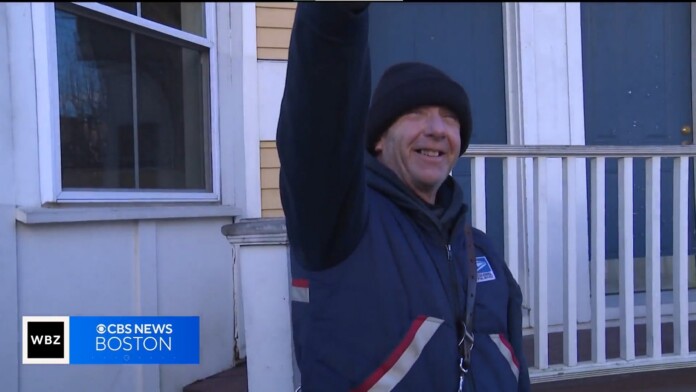
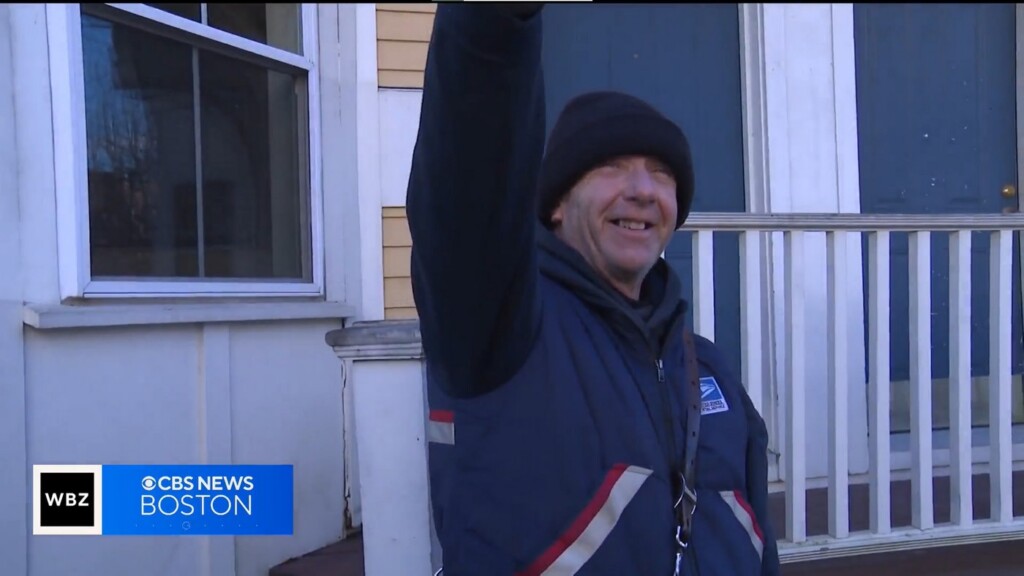
A Massachusetts mail carrier recently swapped delivering the Globe for saving lives after following his instincts at the sight of a meandering child.
The postal worker of eight years said he was in the right place at the right time after a child managed to somehow get out of a daycare facility in Salem, Massachusetts.
Police say the three-year-old was wandering around sidewalks for about a half-hour before David Moulton saw him, realized something was wrong, and called 911.
“I just scooped him up before he got into the street over there,” Mr. Moulton told CBS News, indicating to reporters the busy thoroughfare of Congress Street. “He’s got no shoes and no jacket on, it’s like, this isn’t right. I’m wearing four layers of clothing you know.”
“He ran past me this way first in the park. At first, I didn’t think anything of it, I thought he was playing with kids or something like that, and then all of a sudden, he zipped by me again, I thought ‘he’s heading to a busy street,'” said Moulton.
Salem Community Child Care runs a very busy operation, and neighbors who now routinely call Moulton a hero while he delivers the mail, also told CBS the facility is always busy.
As for Moulton, like all heroes without capes, he doesn’t take much note of the new title, and instead calmly considers that God works in mysterious ways.
WATCH The story below from CBS News… For those outside US, watch HERE…
SHARE This Mass Story Of Mass Heroism With Your Mass Friends…
An Alabama Uber driver should be on track for a stellar 2024 after doing “something good” and returning $8,000 cash a hopeful teenager had left in his vehicle.
Esbon Kamau has been an Uber driver for 4 years on and off, and the father of five really connected with a young client Alex Tisdale.
“He told me how his dad is proud of him and how he’s also very proud of him. And he said something which makes me feel very good,” Kamau said.
His dad had given Alex $8,000 cash to buy a new motorcycle, the teen explained over the course of a 15-minute ride to John Hawkins Parkway in Hoover, Alabama.
Dropping off Alex, Kamau was heading to retrieve another rider when he noticed a red, Christmas-themed bag in the back of the car, which he realized was filled with “quite a lot of money,” but reported it missing through the Uber app immediately.
Meanwhile, a young Mr. Tisdale was frantically retracing his steps. Eventually, he also reported the cash missing, at which point the Uber app connected the two once again, and Kamau headed back over to Alex’s position.
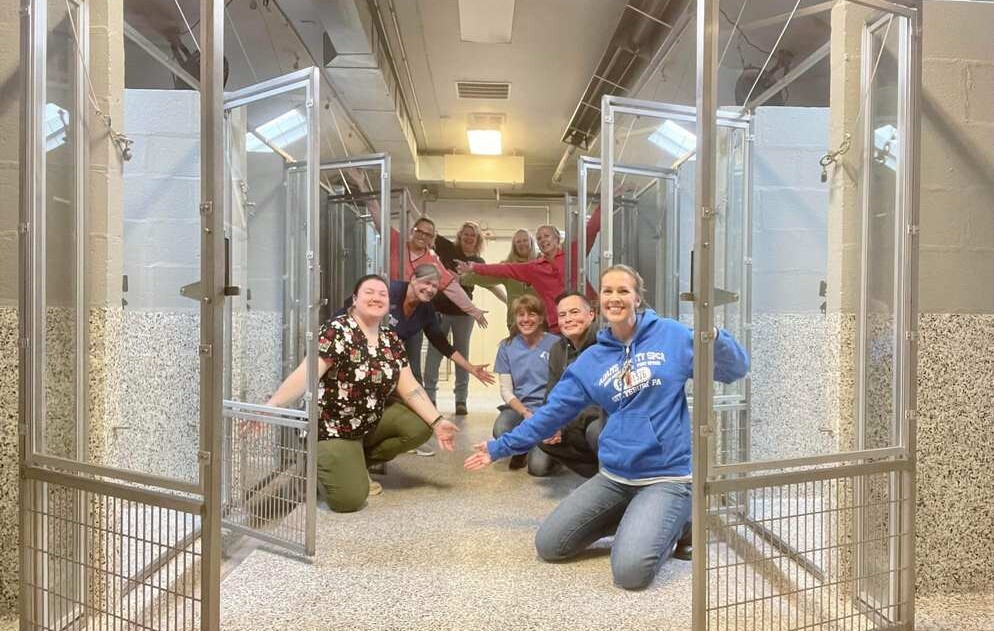
For the pooches and purr-babies in the SPCA shelter of Adams County Pennsylvania, Christmas came early.
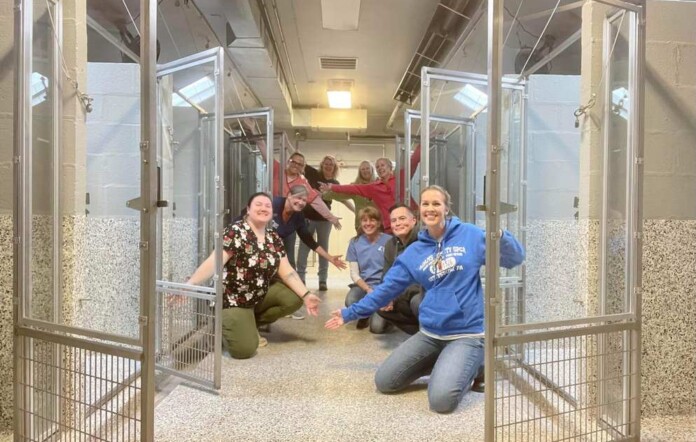
By Saturday two days before Christmas, every last one of them had found a new owner, leaving the kennels vacant on Christmas Day for the first time in 47 years of operations.
The staff says one stray cat arrived on Saturday night after the team took the photograph celebrating above.
“To say that we are beyond excited is an understatement! The staff and volunteers have worked VERY hard to take care of the animals in our care and to make sure they got adopted to the right home!” the team wrote on Facebook.
“This year we have adopted out 598 animals and reunited 125 strays with their owners!”
But this triumph isn’t just good for the dogs and cats who got to spend Christmas with their new moms and dads, but for dogs and cats whom the Adams County SPCA will now take off the hands of overcrowded shelters and kennels in the area—increasing every paw’s chance of landing in a new home.
“We will be pulling animals from other shelters in PA next week in hopes of relieving some of their stress,” the Adams County SPCA said in a Facebook post. “Right now, we are going to enjoy this accomplishment! Merry Christmas!”
Quote of the Day: “Eagles come in all shapes and sizes, but you will recognize them by their attitudes.” – E. F. Schumacher
Photo by: Sylvain Mauroux
With a new inspirational quote every day, atop the perfect photo—collected and archived on our Quotes page—why not bookmark GNN.org for a daily uplift?
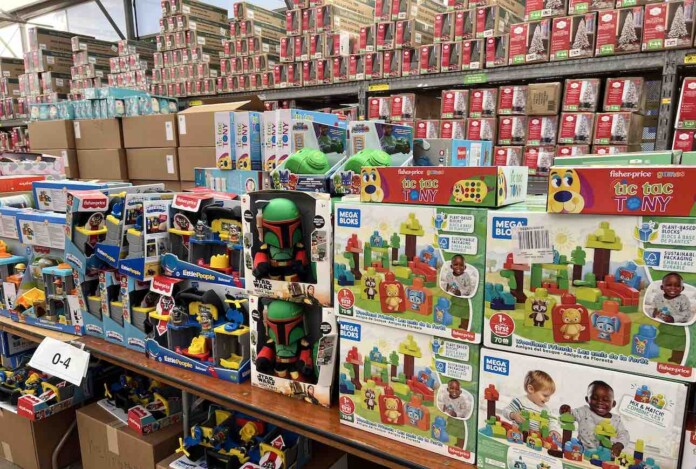
Each child got a big bag to fill with toys at Maui Walmart
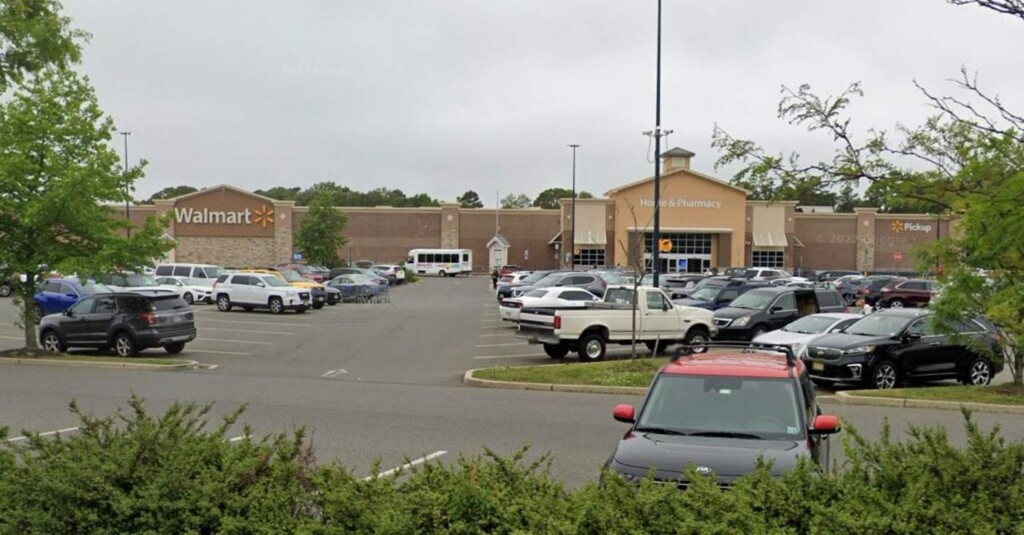
The Walmart in Lanoka Harbor where the event had originally been planned
A New Jersey man had the rather unorthodox idea of throwing a party at the Walmart self-checkout counter. Perhaps driven by rage and cynicism, a bit of his motivation can be found in the event description on Facebook, which reads” celebrating another successful year of picking, paying, and bagging your own groceries while actual employees just stand around and check receipts.”
When he saw that 21,000 people had marked the event as ‘interested,’ he decided to turn his cynicism into goodwill. Walmart was unwilling to host the event, but creator Andrew Delgado wasn’t going to give up so easily.
“While this started as a joke, it has me thinking. What if… I was to organize a big toy drive where we have a Santa Claus and then we all purchase toys from the store, pile them outside, and then donate them to whatever children happen to come to the store?” Delgado wrote on the Facebook event page.
“I genuinely believe that something good can come from this. Times are tough for a lot of people. I think this would be perfect.”
Writing to his local Elks Lodge community organization, which agreed to offer their Lacey Township location as a drop-off site, the stage was set to see how many of those 21,000 people, a number which by that point had grown even larger, would show up.
The groundswell of support, and coverage from local news, became so great that Delgado had to reiterate twice on the event discussion section that it was absolutely not going to be held at Walmart, despite the original description.
The turnout was stunning, with over 7,000 people participating and trucks of presents, food, pet food, and other donations flooding the Elks Lodge. (SEE the Video here on Facebook.) At least one local store got involved, and the news of the event made it all the way onto USA Today.
Delgado posted regular updates, in which he estimated the gifts would make it to over 1,000 families in the Lacey area of New Jersey.
“Well, our journey has finally reached the official end. We rolled over to Popcorn Park Zoo to deliver the last of their donations and then stopped at Lacey Food Bank to drop off the literal SHIPMENT of boxes full of food and toys to them as well,” Delgado wrote on the ‘final update’.
“We didn’t have a whole lot of time to plan this but we did an amazing job nonetheless.
Also, the manager of the local Walmart store drove a truck to the event and unloaded a ton of toys food etc. He’s actually a really great guy and I really appreciate him coming through for us,” he said, adding as a postscript to the whole bonanza, “I don’t actually hate self-checkout.”
SHARE This Joker Turning His Cynical Jibes Into Gestures Sweet…
There’s nothing like a good story of destiny, and in a time when three continents are engulfed in war, CBC News brings a story of reunion by two star-crossed soldiers.
The Iran-Iraq War became the longest conventional war of the 20th century and claimed over 1 million casualties, but this inspiring tale of former foes Najah Aboud from one side, and Zahed Haftlang from the other, is unforgettable.
“I didn’t know much about Iran. I knew it was a neighboring country. And that they were people next door to us,” Najah Aboud, an invading soldier from Iraq told CBC’s show Ideas. “We enjoyed their music. They enjoyed ours. They were just like us.”
A conscript assigned to a tank unit, Aboud was told to occupy a bunker in the city of Khorramshahr which the Iraqis had captured. Shortly after he got there, the bunker was cleared out in a massive take-no-prisoners counterattack by the Iranian Revolutionary Guard Corps and their militia support, in which Zahed Haftlang was assigned as a medic.
Haftlang was ordered to go into the bunker and treat his wounded countrymen, and that’s where he came upon Aboud, lying with injuries to the head, back, and chest. While each worried that the other might do them violence, it eventually happened that Haftlang found a picture of an infant son and woman in Aboud’s breast pocket: his family.
It was at that moment when the Persian, who couldn’t speak Aboud’s native language of Iraqi Arabic, decided to save him, even against the will of his comrades.
In some cases he had to physically fight his barracks mates off, with one Iranian soldier hitting the prone Aboud’s face with the stock of his rifle. Against all odds, Haftlang got Aboud to a field hospital and asked the attending doctors to treat him—which they didn’t want to do at first.
Even they relented though, and Aboud was successfully saved before being dumped in a POW camp for 17 years. Haftlang visited him one time, but the two men could only communicate with gestures—the kissing of a hand.
The war took everything the two men had. Aboud was eventually released and returned to his home in Basra to find his fiance and his son long gone. Haftlang spiraled into years of depression and violent jobs before jumping ship in Vancouver after getting into a scrap with the Iranian sailors on board.
After a brief stint in homelessness, Haftlang ended up in a halfway house where he would try to commit suicide. But in an incident indicative of fortune, some coworkers came in, rescued the poor Iranian, and recommended he visit a hospital for mental health crises. Haftlang relented.
It was there in the waiting room that Haftlang saw an obviously Middle Eastern fellow about his age come into the same mental hospital. The two opened a conversation, and the Iranian found that the newcomer spoke his language.
“I was a prisoner of war,” the newcomer replied, explaining how he had come to know Farsi.
“I remember taking an Iraqi to a field hospital. His teeth were broken,” Haftlang recounted to Ideas, before mentioning that he hadn’t finished speaking before he saw that the man’s teeth were in fact broken.
“He’d mentioned that he’d been captured in Khorramshahr. In a bunker. And I asked him, ‘Which bunker, where?’ And then I said to him, ‘Did you keep a photograph of your family in your pocket?’ and he said, ‘Yes, how did you know that?’ And I said, ‘I’m the guy! I’m the soldier who was with you, caring for you!'”
In the most unbelievable coincidence, the two men had immigrated to the same country, and visited the same hospital on the same day at the same time. Their joy—their hugs and kisses, caused the staff of the mental hospital—who are probably easily triggered by raised voices, to come rushing in, only to burst into tears alongside the former soldiers turned friends after hearing their story.
Without family and without their homes, the two men admitted that their friendship is the most precious thing in the world to them.
SHARE This Story Of Star-Crossed Adversaries Turned Dear Friends…