












It’s not just homes that collapse during an earthquake, but cell towers and the networks they maintain.
On February 6th, 2023, earthquakes devastated southern Türkiye and northern Syria. When they were needed most, the miracles of modern instantaneous communications were absent as cellular and internet infrastructure was damaged or destroyed.
Seeing that, a high school student hundreds of miles away in Istanbul began to work on a crisis-specific messaging app, one that would work when others wouldn’t.
Emirhan Durham took a unique approach. He abandoned cellular signal, satellite connection, or mobile data in favor of shortwave frequencies—perfect for getting a message out of a smashed car or collapsed building. Yet rather than try to sell walkie talkies, he leveraged the most well-known shortwave frequency used today: Bluetooth.
“I’ve been building Crisis Connect, an open-source project addressing communication outages during disasters, on my own since April 2025,” Durham, still only 17, told GNN.
“The idea grew out of the communication outages during the February 2023 earthquakes in Türkiye. The app is designed to help nearby phones exchange messages over Bluetooth when internet access or mobile networks are unavailable.”
Writing for a United Nations blog, Durham described Bluetooth as “an untapped communication network sitting in millions of pockets.”
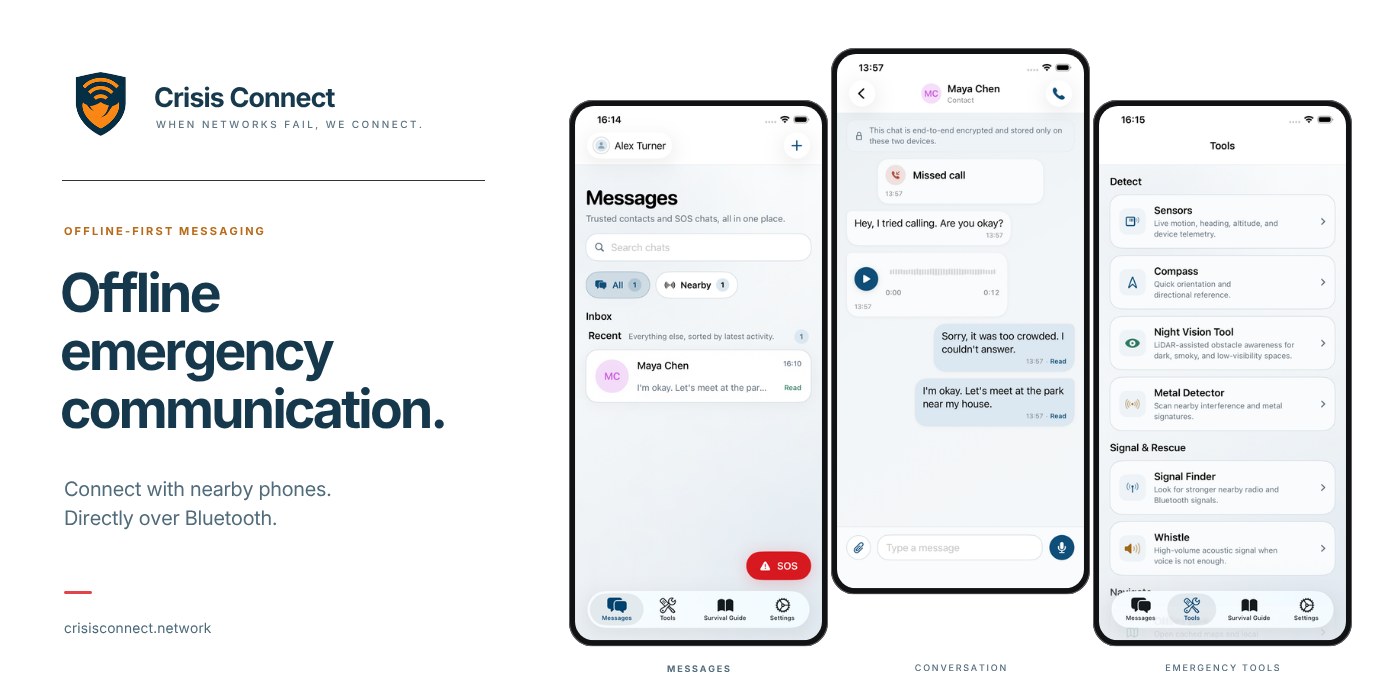
Crisis Connect, his ultimate creation, allows users to send messages and calls over Bluetooth when 4G and cellular communications are interrupted by disasters.
The real party trick of the messaging platform is that it can use all shortwave connections in a given area to send a message “hopping” from phone to phone until it reaches the receiver. The phones act as relays, allowing each Crisis Connect-enabled device to pass messages closer and closer to the ultimate address. In this way, a neighborhood or community can help keep everyone in contact with everyone else.
By default, this feature is disabled to save battery life, but in an emergency, it can be switched on not only to help the user connect with family, friends, authorities or rescuers, but also everyone else to connect with whomever they need to reach.
Durham admits freely that by nature this requires forward planning. Crisis Connect can do no good to anyone if they wait for their house to collapse before trying to download the app.
“The design starts before an emergency. Users connect with family members, neighbors or teammates by scanning a QR code or establishing a nearby Bluetooth connection,” Durham wrote at Prevention Web, a disaster management platform maintained by the UN Disaster Risk Response program. “Those connections are then designed to keep working when internet and cellular services are unavailable.”
DISASTER TOOLS: Woman Who Lost Her Sister Invents a Child’s Car Seat Sticker That Doubles as Hospital Bracelet
It supports vital rescue and emergency features like SOS beacons, a compass, an ultra-high frequency digital whistle, live location broadcast, an offline mode that continues to work without a central server, and even a metal detector. All messages and calls are encrypted to reduce the security risks from the multi-hop network function.
As excited and proud as Durham no doubt should be over developing such an innovative disaster contingency, he remains sanguine on what it can and cannot do, and wrote that overpromising its capabilities, or underestimating the challenges of disaster zones, will undermine confidence in the product, and inhibit potential improvements.
EMERGENCY APPS: Elon Musk’s Starlink Offers Free Emergency Phone Coverage in Wilderness Areas Worldwide
“Smartphone mesh communication will not replace satellite links, emergency radio or official early warning systems—nor should it try to,” he wrote. “It can help fill a gap during the first hours after impact, when survivors need to reach nearby people and communication infrastructure is damaged, overloaded, or unavailable.”
Crisis Connect is available for free on the App Store and Google Play store, while the open-source code is available for any developer in any country to tweak or improve.
SHARE This Intrepid Teen’s Brilliant Invention With Your Friends…