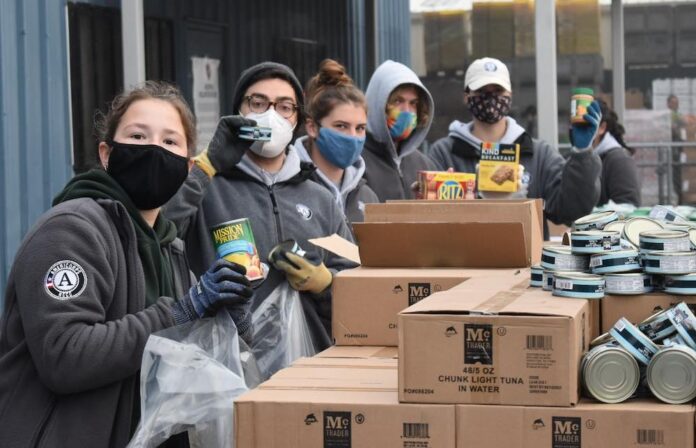
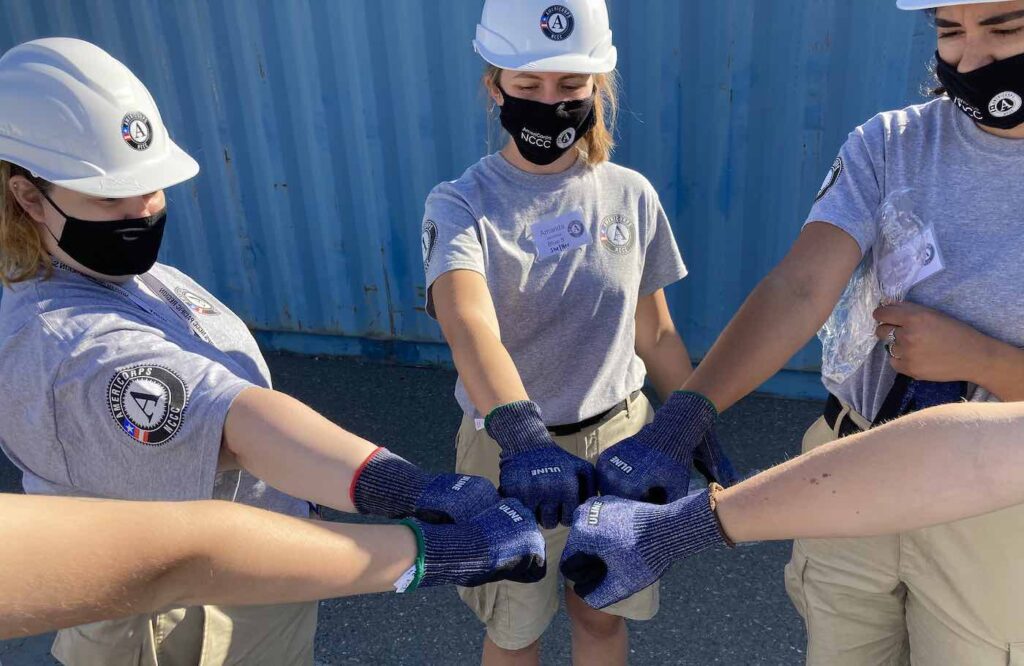
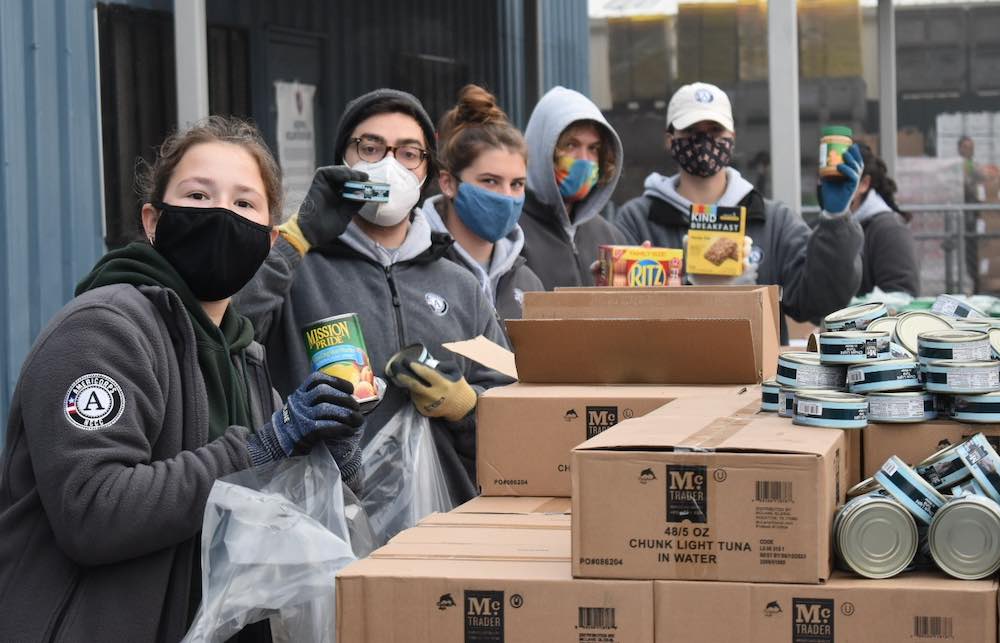
230 energetic young adults from across the nation have piled into vans to begin a new adventure serving others through the AmeriCorps’ National Civilian Community Corps (NCCC).
AmeriCorps / NCCC
Two weeks ago, they deployed in 24 teams across the country, assisting community groups that are responding to the COVID-19 pandemic or implementing wildfire management in the West.
“It feels amazing to know that during these unprecedented times I have the chance to make a real difference,” Wilhemina Solley told GNN.
“It was so rewarding to talk to homeowners and know that because of the work I was doing, they are going to be safer and more protected from wildfires. I know that this is an experience I will take with me for the rest of my life.”
The training for AmeriCorps began in October and emphasized Covid-19 safety, teamwork, leadership development, and communication.
From tackling food insecurity to providing affordable housing, these youth are bridging the gap by providing much-needed volunteers and people power.
Habitat for Humanity is one of the groups that is benefitting from the ten week deployments. Two of the teams are wielding hammers and power tools assisting with affordable home construction in Sacramento.
One team traveled to Stockton, California to help with food distribution. Like another group in California assisting with fire management, one team arrived in Oregon to work on similar projects and upkeep the environment.
AmeriCorps / NCCC
From ‘Purple 6 team’ serving in Salt Lake City, Utah, Bode Anderson-Brown discovered the most impactful aspect was getting out of his comfort zone.
“Talking to people on the phone and getting them the assistance they need… I previously considered this to be out of my wheelhouse, but have now discovered that I have a talent for it!”
Other groups are assisting the Health Department by supporting coronavirus testing sites and delivering hygiene supplies to residents.
“Being able to step up and help places that really need it has been such a gratifying way to take a year that would otherwise have been staying at home, and make it a life-changing experience,” Solley said.
They each will graduate from NCCC on July 14th, after completing 3-5 long-term service projects investing over 1,700 hours. In exchange, members receive $6,395 to help pay for college or pay back existing student loans.
The 10-month residential program funded by the U.S. government engages around 2,100 young people every year between the ages of 18 and 26. It was originally envisioned by a bipartisan group of Senators and signed into law by President Bill Clinton in 1993.
SHARE Their Experience and Inspire Friends on Social Media…
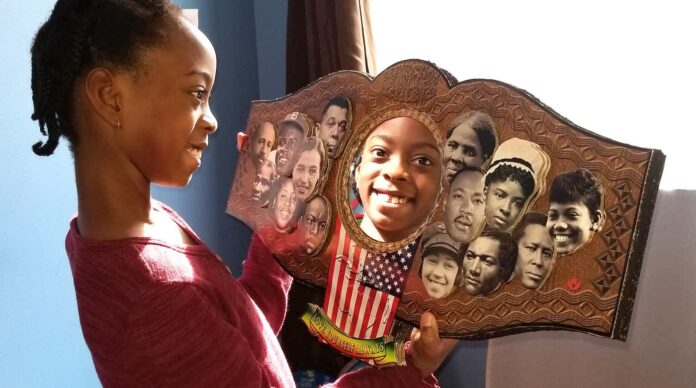
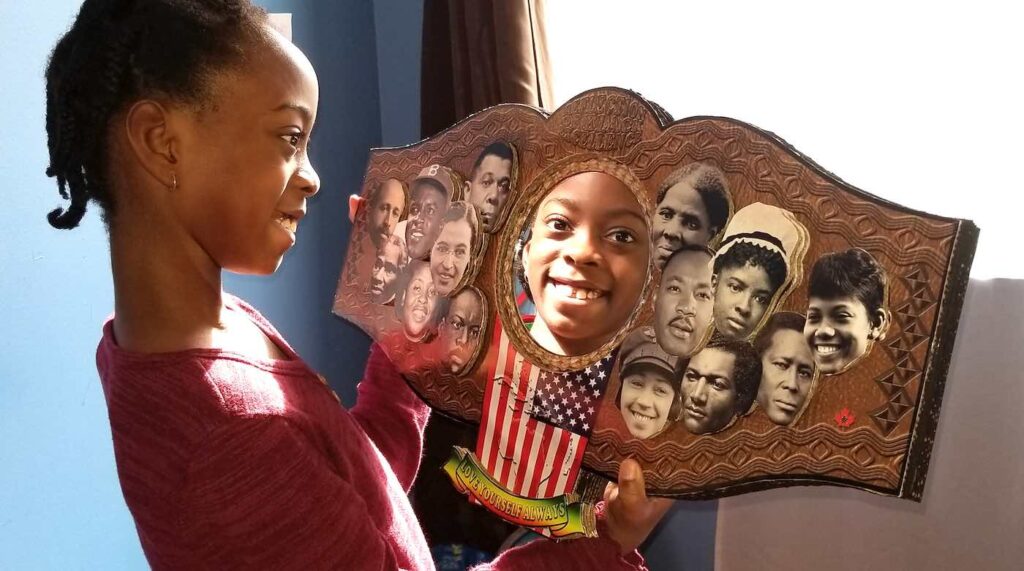
In honor of Black History Month, an African-Canadian artist created a way to reflect back to young people the heroes of yesterday—and inspire them to greatness tomorrow.
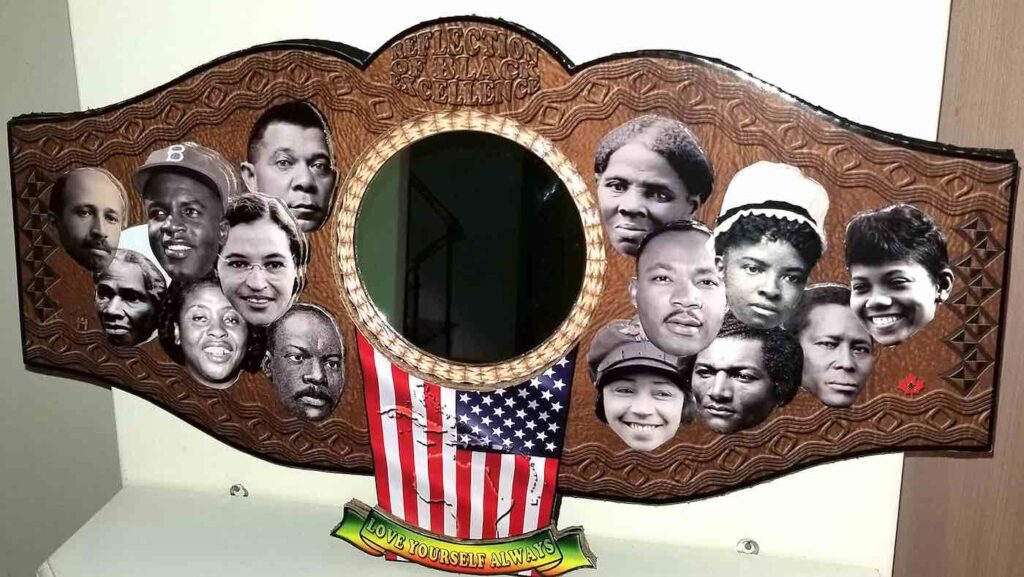
The small business owner in Mississauga, Ontario, calls himself a ‘cardboard artist’—and his new limited edition design features a mirror in the center, surrounded by the faces of 14 legendary Black heroes of history.
Zelpha Comics Ltd.
Luanga Nuwame told GNN he saw news reports in December about an uptick in depression during the 2020 pandemic, especially among kids.
“For the first time in recent history, you have kids with no school interactions… and many are questioning their potential future. From there, the idea for my Reflection of Black Excellence design just hit me.”
From Dr. King and Bessie Coleman, to George Dixon and Rosa Parks, each of those great people, Nuwame says, “were once unsure and scared kids.”
Looking in the mirror, children and teens can be inspired to see the best in themselves, their potential as young future leaders.
Until now, the 43 year-old inventor mostly identified as a ‘geeky nerd-boy’ whose online business, Zelpha Comics Ltd. focused on publishing his array of indie comic book titles likePaper Rock Scissors N’ Stuff Wars and The Adventures of Little Petalianne. Since its inception in 2012, Zelpha Comics has branched out into publishing trading cards, board game concepts, cardboard novelties, and providing custom design services for individuals or businesses.
Luanga Nuwame
With this new product, Nuwame hopes he can do some good. “I hope it can inspire at least some kids to want to be just as great as the greats. Like all my work, I make everything by hand—just me, cardboard, glass, and a cutting blade in my home office.”
The mirror can be wall-mounted and is surrounded by six hand-cut layers of industrial cardboard, made with locally-sourced renewable materials.
He made two versions, a fact that may be fascinating to Americans. The Black legends from the U.S. are household names in the States—people like Booker T. Washington, Frederick Douglass, Harriet Tubman, and Jackie Robinson. The Canadian edition features faces not so familiar—Carrie Best, Elijah McCoy, and George Bonga.
By Luanga Nuwame
Both feature an inspiring reminder printed at the bottom: Love Yourself Always.
The price is $49.99, with only 50 copies available of each version. But, he told us, “If the 50 copies are bought, I will definitely create another edition with other great Black History legends featured around the mirror. I want each edition to feature different faces. So, this idea will continue on for sure.”
See all the details on his website, including lead times on products which are made-to-order: HandmadeCardboardInnovations.
Canadian born and raised, his father was from Togo and his mother, Jamaican. On his YouTube channel, Homemade Game Guru, he has shared his love of cardboard, tallying 6 million views of his craft videos ranging from cardboard swimming pools to cardboard furniture, and comic book crafts. Nuwame is also the author of the DIY manual The Cardboard Bible.
SHARE This Inspiring Gift For Black History Month on Social Media…
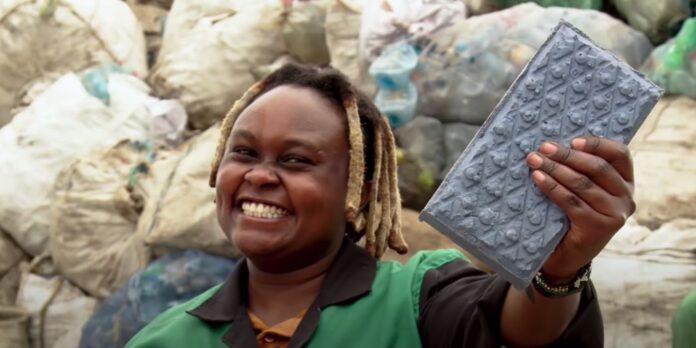
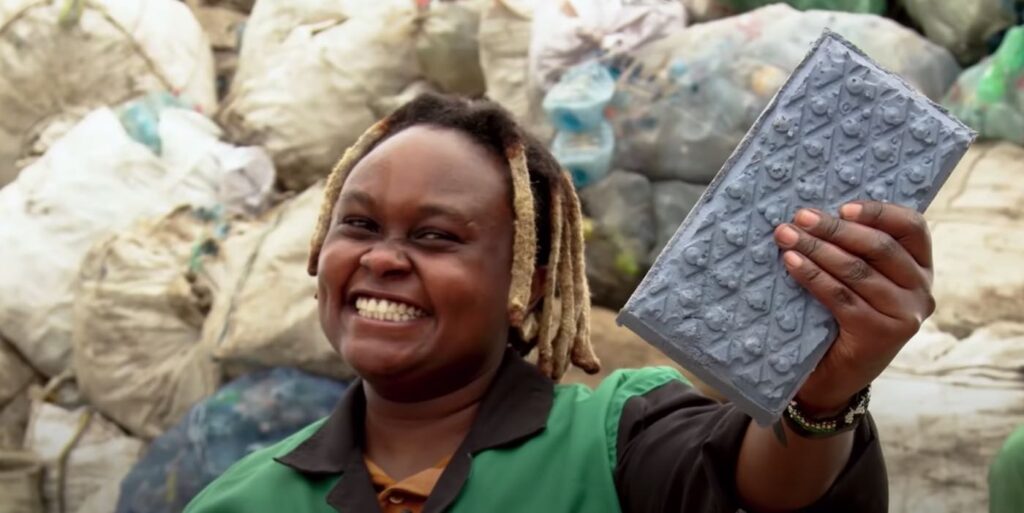
An absolutely brilliant young woman in Kenya has started a company manufacturing bricks from recycled plastic.
UNEP – YouTube
Nzambi Matee says she was “tired of being on the sidelines” while civil servants struggled against plastic waste in the capital city of Nairobi, so the materials engineer created a product that is 5 to 7 times stronger than concrete.
Founder of Gjenge Makers, which transforms plastic waste into durable building materials, Matee also designed the machines that manufacture the bricks in her factory.
Getting dumps of plastic low and high-density polyethylene and polypropylene from local packaging plants for free, Gjenge Makers produces a variety of different paving stones after the plastic polymer is heated and mixed with sand.
“There is waste they cannot process anymore; they cannot recycle. That is what we get,” Matee told Reuters.
The result is a line of versatile building materials pressed via hydraulic machine into different thicknesses, that sell in a variety of colors that cost an average of $7.70 per square meter.
So far, she has employed more than 110 people, helping to churn out about 1,500 bricks every day. She told Reuters that they have recycled about 20 metric tons of plastic waste since the company was founded in 2018.
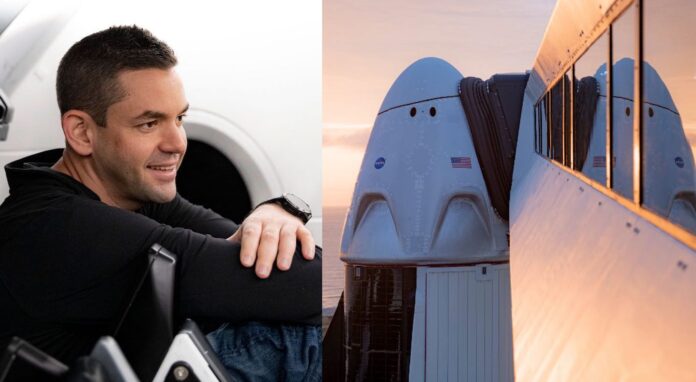
SpaceX announced plans for the world’s first all-civilian mission to space. Targeted for late 2021, the flight will be commanded by Jared Isaacman, a 37-year-old entrepreneur and accomplished pilot—and they’re looking for co-adventurers.
Dragon – SpaceX
Named Inspiration4 in recognition of the four-person crew’s mission to inspire support for St. Jude Children’s Research Hospital, the journey punctuates a new era for human spaceflight and exploration.
Isaacman is donating the three mission seats alongside him to crew members who will be selected to represent the mission pillars of leadership, hope, generosity, and prosperity—and they are using a Super Bowl to announce the search for players.
“Inspiration4 is the realization of a lifelong dream and a step towards a future in which anyone can venture out and explore the stars,” said Isaacman, the founder and CEO of Shift4 Payments. “I appreciate the tremendous responsibility that comes with commanding this mission and I want to use this historic moment to inspire humanity while helping to tackle childhood cancer here on Earth.”
Isaacman and the Inspiration4 crew will undergo commercial astronaut training by SpaceX on the Falcon 9 launch vehicle and Dragon spacecraft, including a specific focus on orbital mechanics, operating in microgravity, zero gravity, and other forms of stress testing, according to this week’s announcement. They will receive emergency preparedness training, spacesuit and spacecraft ingress and egress exercises, as well as partial- and full-mission simulations.
The mission will launch from NASA’s Kennedy Space Center in Florida and will be carefully monitored at every step by SpaceX mission control as the spacecraft orbits the planet every 90 minutes along a customized flight path. Upon conclusion of the multi-day journey, Dragon will reenter Earth’s atmosphere for a soft water landing off the coast of Florida.
Isaacman has given St. Jude two seats on the Inspiration4 mission. The first seat is reserved for a St. Jude ambassador with direct ties to the hospital’s vision. This month, members of the public can enter for a chance to join the flight in the second seat and pledge support to the lifesaving mission of St. Jude.
Jared Isaacman -SpaceX
Isaacman has committed to give $100 million to St. Jude and is inviting everyone to join him in attempting to raise upwards of $200 million in support of St. Jude’s multi-billion dollar expansion aimed to accelerate research advancements and save more children worldwide. He will also offer additional support to the St. Jude fundraising effort in the form of other prizes, including flights in a military jet and flight gear.
Rated to fly both commercial and military aircraft, Isaacman holds several world records including a Speed-Around-The-World flight to raise money and awareness for the Make-a-Wish Foundation.
He has flown in over 100 airshows as part of the Black Diamond Jet Team, dedicating every performance to charitable causes. In 2011, Isaacman co-founded what would become the world’s largest private air force, Draken International, to train pilots for the United States Armed Forces.
Dragon, the reusable spacecraft, made history when it was launched into orbit by SpaceX to resupply the International Space Station in 2012, after its maiden flight two years earlier marked the first commercially built and operated spacecraft to be recovered successfully from orbit.
Shift4 Payments is providing marketing support for the mission and will use the Super Bowl broadcast this Sunday, to dramatically introduce the mission and its purpose to the public. A 30-second spot will air during the first quarter of the Big Game and invite all viewers to support and be part of this historic journey through the St. Jude.
“This partnership brings two missions together to create one incredible moment in time that will make an impact for years to come on the global effort to cure childhood cancer,” said Richard C. Shadyac Jr., CEO of ALSAC, the fundraising and awareness organization for St. Jude.
Isaacman concluded, “Today’s announcement is the first step of a very exciting journey. In the lead-up to launch, we’ll share new ways to support and follow our mission preparation and execution with a focus on inspiring and helping others.”
LAUNCH This Opportunity to Space Fans and Entrepreneurs on Social Media…
Quote of the Day: “The more you are focused on time—past and future—the more you miss the Now, the most precious thing there is.” – Eckhart Tolle
Photo by: Fabrizio Verrecchia
With a new inspirational quote every day, atop the perfect photo—collected and archived on our Quote of the Day page—why not bookmark GNN.org for a daily uplift?
You’re walking through a Japanese forest on the southern island of Kyushu. Among the trees you hear the sounds of bird song. A gentle breeze rustles the leaves. A melody you’ve heard before rings faintly through the air. What is that? Bach.
Mori Inc/YouTube
This magical experience is real, thanks to Creative Director Morihiro Harano and his team at Mori Inc.
In a collaboration with the carpenter Mitsuo Tsuda and sound engineer Kenjiro Matsuo, they made and placed an enormous xylophone that’s designed to play Jesu, Joy of Man’s Desiring—the final movement to Bach’s renowned cantata Herz und Mund und Tat und Leben.
The xylophone is made of hundreds of pieces of different-sized wood; each panel along its length makes a different sound when it’s struck by a cascading wooden ball placed at the top of instrument.
As anyone who’s ever spent any time there can tell you, Chicago is called ‘the Windy City’ with good reason. In winter, when there’s a stiff breeze blowing off Lake Michigan pedestrians often feel more like popsicles than people, making getting in out of the bitter cold a priority.
But when your job is strictly outdoors, staying warm and toasty isn’t an option—unless someone comes to your rescue, that is.
Chicago restauranteur Robert Magiet was driving across town one morning when he spotted a shivering tamale vendor braving the frigid January temperatures. On the spur of the moment, he decided to make her an offer she couldn’t refuse.
Rather than let the woman—who was wearing so many layers of clothing she looked a bit tamale-like herself—turn into a tamale popsicle, Magiet bought out her entire day’s supply—close to 10 dozen tamales, gave her a big tip, and sent her on her way.
After she’d gratefully gone home, Magiet loaded up the copious quantities of tamales he’d purchased and distributed them to some of Chicagoland’s homeless population.
Pleased with the outcome of the morning’s events, Magiet took to Facebook to see if he could continue the trend: “Anyone know of any Tamale Cart vendors that will be out this weekend in the cold weather?” he posted.
“I went to Yolanda near Humboldt Park and bought her out so she could go home today. I’d love to do the same for other Vendors and distribute the Tamales to our Neighbors experiencing homelessness. Let me know of any leads please.”
In the following days, armed with suggestions, Magiet bought up all the tamales from vendors at three different locations. And again, after generously tipping the sellers whose trade had been severely curtailed by both the weather and the lockdown, he shared their wares with people in need.
Helping the hungry in his community is nothing new for Magiet. Having seen firsthand the devastating impact the coronavirus pandemic had on his own industry, he feels lucky to be in a position to provide much-needed relief for those struggling to put food on the table.
After opening a Love Fridge community food pantry outside his TaKorea Cocina restaurant this past June, Magiet teamed up with the owners of Fatso’s Last Stand and Jack & Ginger’s restaurants to prep and deliver 1,300 Thanksgiving meals for the needy.
But Magiet wasn’t through. After Christmas, he partnered with Jason Vincent, owner of Logan Square eatery Giant, to provision and man a food truck serving breakfast and lunch to the homeless.
Next, he reached out to his friend Taylor Hammond, owner of The StopAlong, a Bucktown pizzeria, to ask if he’d be willing to donate his kitchen once a week to help ease food insecurity for families in need. Knowing how much kids love pizza, Hammond readily agreed.
“It’s like, I have a restaurant. I have food. I know people who have restaurants and food. Let’s help people who need food,” Magiet told the Chicago Tribune.
Magiet plans to continue his tamale runs for the remainder of the winter. Pizzas are still on the table as well.
“If somebody in our neighborhood is struggling, we all struggle,” Magiet said. “I’m not trying to save the world. I’m just trying to help people who need food. If I have the ability to go help somebody, I’m just going to go help somebody. To me, it’s literally that simple.”
The food Magiet collects will be distributed to several Love Fridges locations around town, Breakthrough Urban Ministries in East Garfield Park, and to Franciscan Outreach’s homeless shelter in North Lawndale. If you’d like to help, donations can be made to Zelle at 773-807-0057 or venmo: @takoreacocina.
SHARE It While It’s Hot—Send This Story to Your Pals…
By ALICE AUERSPERG, University of Vienna's Goffin Lab
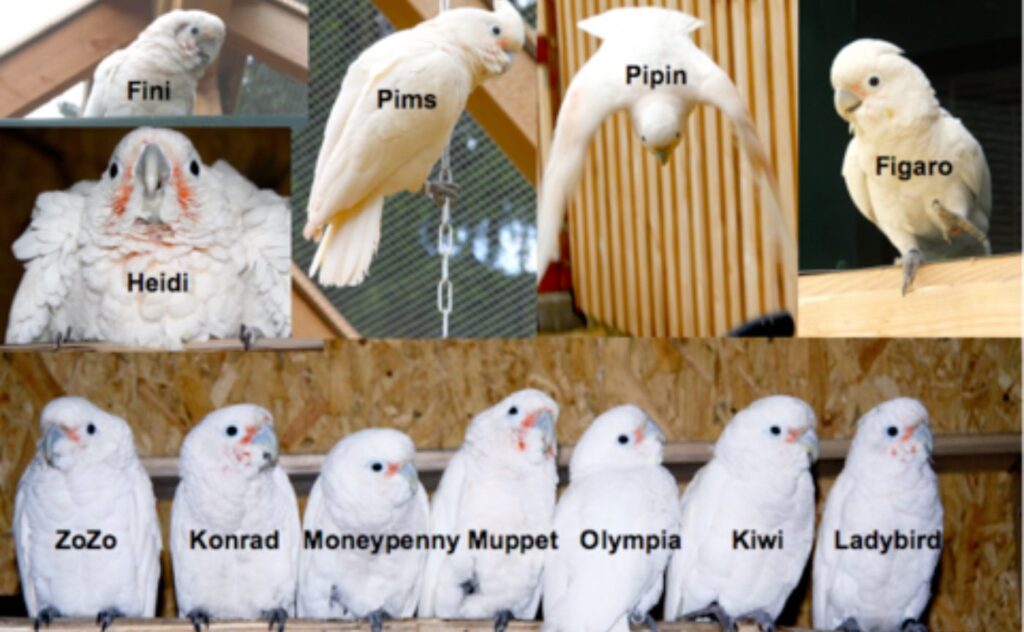
A Goffin’s cockatoo named Figaro and his friends have long been stunning researchers with their ability to craft and use tools, requiring levels of intelligence thought to be similar to a 3-year-old human.
By ALICE AUERSPERG, University of Vienna’s Goffin Lab
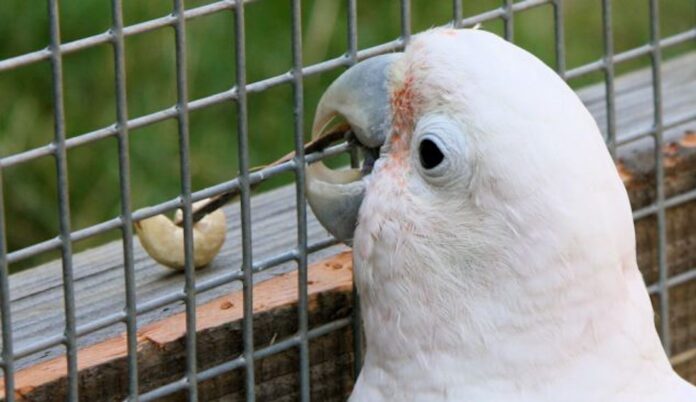
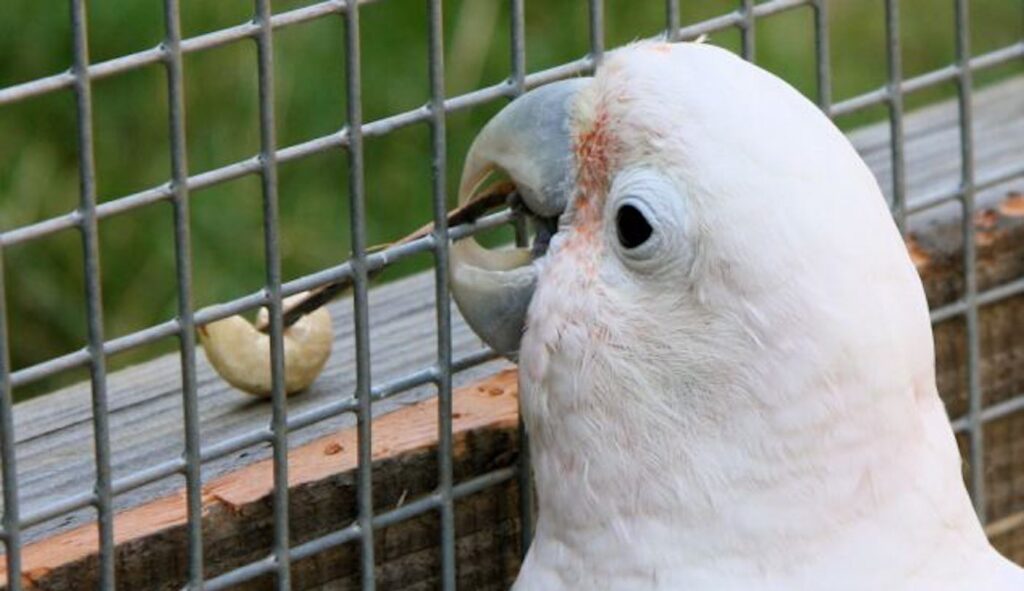
Even without possessing the natural wild behavior for making tools, or even the proper beaks normally thought of as sufficient for tool-making, three of these birds managed to craft different tools to fish out cashew nuts from a sealed box.
Tool-making, either with sticks or hooks, is well-documented in the Aves class. As Jennifer Ackerman brilliantly details in her work The Genius of Birds, new Caledonian crows and a few other birds can not only craft sticks to reach larvae in trees, they can actually fashion sticks with hooks on the end, even going so far as to use composite material to make the grub-grabbing a breeze.
Goffin’s cockatoos live on the Tanimbar Islands, a small archipelago in Indonesia. They’ve become a model species for avian intelligence.
Unlike crows, whose bills are quite straight and useful for manipulating the world around them, cockatoos have curled beaks, designed simply for cracking nuts and seeds.
One day four years ago, at the Goffin Lab in Vienna, a center for avian intelligence, Figaro noticed a pebble outside his cage resting on a wooden beam. Desiring this pebble for his own purposes, he tried to pull it towards him using a shard of bamboo.
Impressed, the researchers replaced the pebble with a cashew, triggering Figaro to stick his beak through the bars of his cage and gnaw off a splinter of wood from the very beam the cashew was resting on, before using the splinter to reel the cashew into his tensile beak.
Class is in session
At the Goldegg Goffin Lab, part of the Messerli Institute for Research, the avian clubhouse where Figaro and his friends live, lab director Alice M.I. Auersperg wanted to see if Figaro could impart this self-generated wisdom onto his peers.
Goffin Lab, University of Veterinary Medicine Vienna
Figaro shares the lab with 15 other cockatoos, none of whom are wing clipped, and all of whom participate in trials voluntarily, with the option of simply flying away always available.
“Twelve Goffin’s saw either demonstrations by Figaro, or ‘ghost’ controls where tools and/or food were manipulated using magnets,” writes Auersperg, in the corresponding research paper.
“Subjects observing demonstrations showed greater tool-related performance than ghost controls, with all three males in this group… acquiring tool-using competence.”
Tool-use competence was pretty extreme. Demonstrations by Figaro included trimming the branches off a twig, splitting a thin board of larch wood, and even using his beak like a scissor to painstakingly bite cardboard into a long enough tool.
Figaro’s best pupil was Dolittle, who mastered the twig-trimming, cardboard-cutting, and larch-woodworking, while Pipin only managed the twig, having some kind of phobia towards larch wood.
Kiwi managed both the larch wood and the twig-trimming, but failed with the cardboard, which researchers predicted would be the hardest task.
In a moonshot, Auersperg also gave them beeswax, which none of the four birds could manage to work with.
The ‘Innovation Arena’
Tool-use was just the start of the Silicon Valley careers of Figaro and his friends, as Auersberg has more recently been comparing their intelligence to those of cockatoos that have spent, unlike Figaro, only a short time in captivity.
With a controlled environment to study both innovation behavior and innovation rate, Auersberg created the “Innovation Arena,” (IA) a semicircle of 20 different challenges all baited with a preferred food reward. Each avian would then have 20 minutes to freely explore, innovate, and get as many treats as they cared to work for.
“It is, to our knowledge, the first study specifically targeting innovation rate per time unit in animals and the first systematically controlled direct comparison of problem-solving between captive-born and temporarily wild-caught animals,” read the study, published in 2020 in the journal Scientific Reports.
“It yielded a number of interesting findings, with the most significant one being that long-term captivity does not seem to affect the Goffins’ overall capacity to innovate in the IA but rather their motivation to do so.”
“Captivity bias” is a term used by animal researchers to describe the bump in intelligence, as related to problem-solving, seen in animals subject to long term captivity when compared with their wild peers.
Auersperg’s work presents a new paradigm, at least with birds, that group-identity (captive, wild-caught) could not predict the probability of finding solutions to the 20 problems.
Instead, the unmotivated birds (five wild-caught and one laboratory) consistently couldn’t be bothered to interact with the IA, while the other participants, (three wild-caught and 10 laboratory) “consistently maintained their interest in the setup and discovered a similar number of solutions at the same rate.”
This research presents a series of fascinating conclusions. First, that cockatoos can use tools, and that they may have evolved this behavior either in the wild, or more astoundingly, without ever having had to use it in the real world. Second, cockatoos don’t need to inherit intelligence through genetic instinct, but can actually learn by watching a peer—characteristics reserved for the smartest of animals.
Lastly, it demonstrates that cockatoos should maybe be viewed as seriously difficult pets. They can not only live 40 years, but with the intelligence of a 3-year old, require constant mental stimulation if one is to keep them healthy.
(WATCH the video of Figaro making tools below.)
Share This Fascinating Finding With Your Friends on Social Media…
The idea of billions of people going through a few masks a week during this pandemic definitely rings alarm bells, but a team of researchers in Melbourne, Australia, may have the solution.
Royal Melbourne Institute of Technology
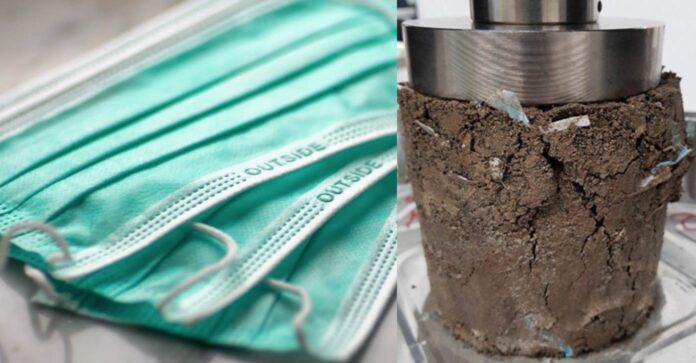
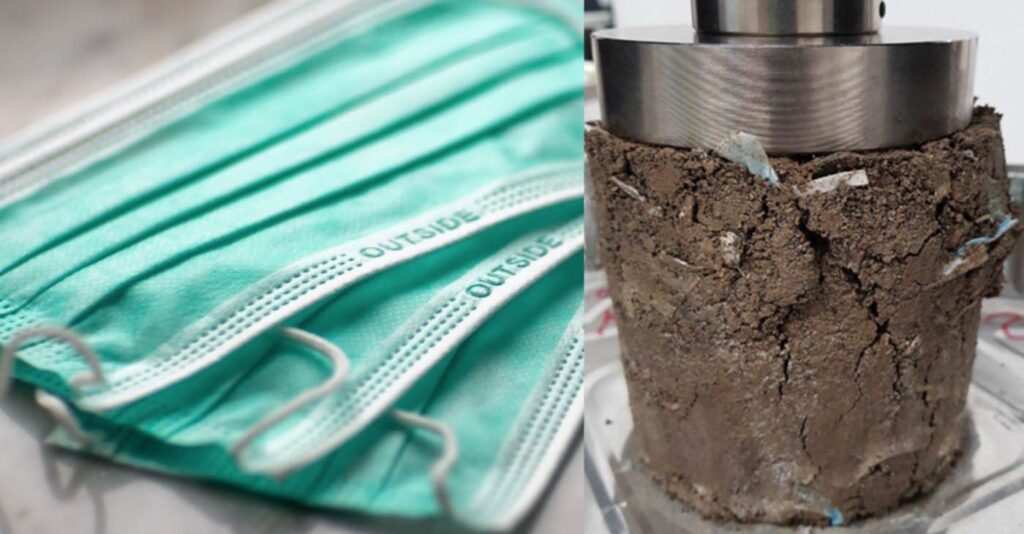
They’ve discovered that adding millions of discarded face masks to road-paving mixtures would actually lowered the cost of the road, while diverting billions of them from landfills.
Just one kilometer of road would need three million masks, and the polypropylene plastic used to make single-use surgical face masks also increased the flexibility and durability of the road.
Jie Li and other scientists at Royal Melbourne Institute of Technology and Melbourne Technical College published a paper in the journal Science of the Total Environment describing the development.
The new composite material is a mixture of about 2% shredded masks, with recycled concrete aggregate (RCA)—a material derived from waste concrete and other minerals from demolished buildings.
This ultra-recycled material was found in the study to be ideal for two of the four layers generally required to create roadways. Paving a kilometer of two-way road with the RCA and three million face masks would result in a rerouting of 93 tons of waste from landfills.
Plastic roads
The roads actually gained greater flexibility as well, since the polypropylene helped reinforce the bindings of rubble particles, as well as giving a bit of stretch to the particle aggregates.
The final product then is more resistant to wear than normal asphalt, as well as being cheaper too, provided there was a method for collecting masks.
Li and his team did a cost-analysis and found that, at $26 per ton, the RCA was about half the cost of mining virgin materials from quarries, and as much as a third of the cost of shipping the used masks to a landfill.
The scaling up would be ideal for large infrastructure projects. For example Washington, a notably progressive state, has the 11th worst roads in terms of unaddressed repairs in the U.S.
If the percentage of damaged roads in Washington state were repaired with Li’s RCA/mask mixture, it would reuse nearly 10 billion masks, sparing American landfills hundreds of millions of tons of trash.
According to Fast Company, Li and his team are looking for private industry partners or governments willing to give their plastic mask road an opportunity for a large-scale test.
DON’T Waste the Good News—Share This Story With Your Friends…
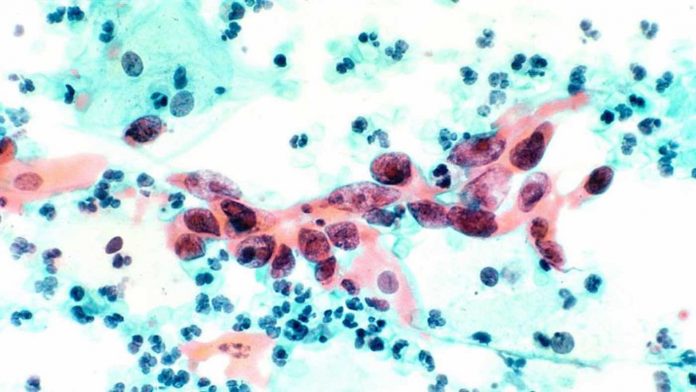
Scottish scientists have developed a system of lasers that melt away cancer cells without damaging normal healthy cells.
National Cancer Institute, CC license
The revolutionary treatment relies on a series of pulses that are short enough to melt the cancer cells, but too short for the heat to transfer to neighboring ones—a major hindrance in past work in the field.
Heriot-Watt University in Edinburgh is carrying on the long and celebrated tradition of Scottish medical breakthroughs nearly a hundred years after physician Alexander Fleming isolated penicillin. The research in the laser tech was funded by a £1.2 million ($1.6 million( grant from the Engineering and Physical Sciences Research Council.
Professor Jonathan Shepherd led the project, which he told Sky News successfully eliminated colorectal cancer cells in lab tests.
“We proved in the lab that our laser system can remove cancer cells in a way that restricts damage to the surrounding, healthy cells—within the width of a human hair,” he said.
“We’re building on our understanding of lasers in colorectal cancer surgery towards clinical application, and working on adapting it for brain, head, and neck cancers, where it could have huge benefits for patients,” he added.
The technique involves firing the laser in pulses, each measuring about one trillionth of a second, thus preventing the transfer of heat to surrounding tissues.
Light therapy
Three years is the current timeline for further R&D, presumably before the device is ready for clinical tests, which will also include research into an optical fiber-based device that can target and kill cancer cells three times smaller than the ones the laser can remove.
These two aren’t the first light-related therapy projects pursued by Heriot-Watt. Indeed, last September it was announced that the university had secured a £6.1 million ($8.3 million) grant to investigate deep ultraviolet light therapy in the practice of germicide.
Deep ultraviolet light doesn’t occur on Earth, but it has been shown to kill germs including those that have built up antimicrobial-resistance.
Professor Robert Thomson from Heriot-Watt University told the university press: “Some wavelengths of ultraviolet light are known for their germicidal properties, but can cause cancer in human tissues. That’s the problem we’ll solve.”
“We will develop technologies that generate ultraviolet light at just the right wavelength, where the light remains germicidal but without the harmful effects. We’ll also develop technologies to deliver this light precisely, such as optical fibers to transport it into the body without causing further harm,” he said.
Ultraviolet radiation is something astronauts and spaceship builders have to constantly account for, as even brief exposure to it beyond the confines of the atmosphere can lead to cancer and other diseases.
CURE Negativity by Sharing This Story With Your Friends…
Quote of the Day: “If you’re brave enough to say goodbye, life will reward you with a new hello.” – Paulo Coelho
Photo by: Bobby Johnson
With a new inspirational quote every day, atop the perfect photo—collected and archived on our Quote of the Day page—why not bookmark GNN.org for a daily uplift?
The town of Tipton, Indiana might want to think about changing its name to “Tip Town” after almost an entire community rallied together to give their favorite pizza deliveryman an incredible gratuity in the form of a new car.
Robert Peters has been delivering the goods for Pizza Hut for 31 years and counting. While ‘pizza delivery man’ may not be a long-term career goal high school kids talk over with their guidance counselors, Peters knows he’s found his niche.
“There were people in my family that were like, ‘Maybe you should consider something a little more financially stable,’” he told Steve Hartman during an ‘On the Road’ segment of the CBS Evening News. “But it’s my purpose in life—trying to make people happy. You know, when you’re delivering to somebody, you may be the only face they see all day.”
Whenever folks in Tipton saw Peters and his 28-year-old Oldsmobile heading their way, they knew they were in for service with a smile. “The town of Tipton calls him ‘Mr. Smiley,’” Tanner Langley, one of Peters’ longtime regular customers, told Good Morning America. “He’s a very kindhearted individual.”
That’s why when Langley learned Peters’ elderly Olds was on its last legs—or wheels—he turned to the community to help make sure their beloved mobile pizza purveyor would be able to keep up his appointed rounds.
Within three days, thanks to the power of social media, Tiptonites raised close to $19,000, which was enough not only to buy Peters a late-model Red Chevy Malibu, but to also cover fees, taxes, and insurance—with plenty left over for gas money to see Peters through a lot more deliveries.
While Peters admits when he first learned his loyal customers were gifting him with a car, it felt “almost surreal,” at the end of this day—and every day— he’s simply thankful.
“I just hope that all those who made this happen will be blessed as much as they have blessed me,” Peters told GMA. “This has really been an awesome experience that I’ll remember for the rest of my life.”
As for Langley, who’s been having pizzas delivered by Peters since he was a kid, his community’s generous show of gratitude to the man who serves up courtesy, empathy, and a big smile with every order came as no surprise. “That’s the type of impact he has on people,” Langley said.
(WATCH the inspiring CBS video below – EDITOR’S NOTE: Viewers outside the US can view this video on the CBS website, here.)
TIP Your Friends With Some Kindness—Share This Story With Them…
A small mouse found to live only on and surrounding a volcano in the Philippines has seemingly remained unscathed after the mountain exploded in what was the largest eruption in the 20th century.
Field Museum
Details on the long-nosed Luzon apomys are scant in good times, but after surveying the damage the eruption caused to the ecosystem, it was presumed they would have mostly vanished.
Much to Erik Rickart’s surprise, the apomys, sometimes called the Mount Pinatubo volcano mouse, is doing just fine.
Rickart works at the splendid Museum of Natural History in Utah, and after the 1991 Mount Pinatubo eruption that caused a typhoon, earthquake, devastating land and mudslides, and ash rain which fell almost an inch thick across 1,500 square kilometers, he was quite content to consign the apomys to history.
“It was a surprise,” Rickart recounts on CBC’s As it Happens. “But then when we thought about it—and particularly when we put together the things we knew in general about the kind of environment that has existed during the evolutionary history of all of the animals of the Philippines and the plants as well—it makes sense.”
“Even though the 1991 eruption of Pinatubo was devastating and destroyed most of the forest on the mountain, it was actually very mild, or at least, it was not as intense as previous eruptions that had occurred during the geological history of the mountain. And there were several of them,” he said.
To us humans, a big volcanic eruption may seem like a world-ending event, and in our early history, around 75,000 years ago, there are suggestions that the Lake Toba supervolcano went off with such incredible violence that the resulting geological and climatic disturbances nearly caused our species to die off.
Field Museum
The theory is controversial, as are most narrative-challenging scientific theories.
Unlike us, though, tiny rodents can likely survive such conditions more readily, since they eat plants or insects, require less water, and live underground.
It’s thought that a group of small rodents were among the few animals that survived the comet impact which wiped out the dinosaurs, and that they gradually evolved into all the mammals we see today.
The long-nosed Luzon apomys’ resilience is a great discovery as scientists begin to speculate on how biodiversity will cope with our changing climate. Some species are evolved to deal with massive disturbances, giving them a bit of a cushion as we attempt to reduce our impact on the planet.
As many times as Nike has revolutionized the shoe, their latest groundbreaker is an option designed not for elite athletes, but to answer a specific need that has gone largely unaddressed.
Nike
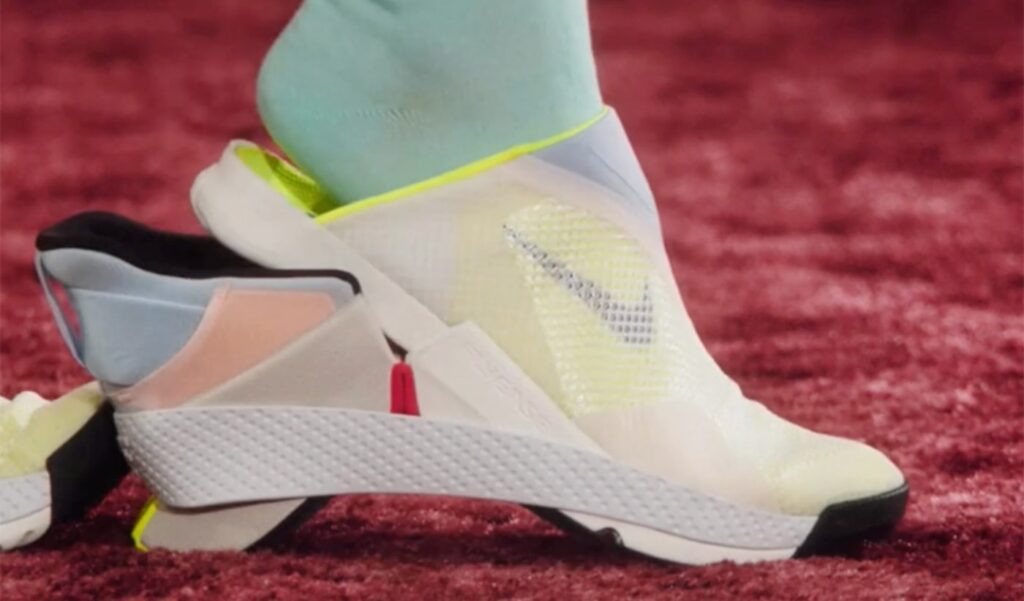
Called the Flyease Go, it is the first totally hands-free shoe, enveloping and releasing your feet solely through natural motion—a bit like Tony Stark putting on his Iron Man suit.
The revolutionary shoe is perfect, says a top Nike designer, for pregnant women in their third trimester, arthritis patients, or those who have lost some or all of the use of their arms—such as stroke victims or injured military veterans.
In a chipper article on Fast Company, Nike designer Tobie Hatfield recounted the story of how in 2008, the world’s largest athletic shoe and sportswear company received the unfortunate news that their very first employee had suffered a stroke and could no longer use one of his arms.
Hatfield was put in charge of designing a special shoe to accommodate one of their most treasured staff members, and came up with one involving a zipper and Velcro.
Now the genesis of that idea has led to the creation of the Flyease Go, an “everyday performance lifestyle shoe,” that is totally hands-free, and will be released in a slow rollout this year starting at $120.
Universal design
Divided in two halves restrained by a neoprene tension band, but with a limited, two-stage hinge in the middle of the outsole, the slipper or loafer-like front portion of the shoe arches up to a 30-degree angle as the hinge opens when the shoe is not being worn.
The heel bends the same, but in the opposite direction, and when the foot is inserted into the loafer-like front, a simple pressing motion closes the hinge, refastening the neoprene band and pulling the two halves together snug around your feet.
In the past, Nike has drawn inspiration from the titans of human athleticism—Mohammed Salah, LeBron James and the like—but here they’ve taken inspiration from one of the most iconic and universal biomechanic motions of our species.
The back heel of the shoe has a hard plastic shell, terminating in a small ledge, called “the kickstand heel,” which is the hands-free mechanism for opening the hinge, and is based on the motion we all do with our sneakers when we don’t feel like untying the laces.
You know the one we mean, when you press down on the back of the heel with one foot in order to pull your foot out of the shoe.
“What I love about this shoe in particular is we listened to the extreme needs of [people with specific limitations],” Sarah Reinertsen, the Senior Director of Nike Ease, tells Fast Company. “But with this solution we feel like it’s a universal proposition.”
“We talk a lot about universal design and what universal design does when it creates an invitation for every and any athlete,” said Chief Design Officer John Hoke also. “And when we solve that problem really, really, well—like I think the Nike Go does—it creates universal appeal. It’s not going to be bound by one unique audience. It welcomes any audience because it’s so clever.”
(WATCH the Nike video below to go ‘behind the design.’)
SWOOSH This Story Over to Your Pals on Social Media…
Dutch designer and artist Daan Roosegaarde has turned a field of ordinary leeks into a dazzling light-show in celebration of the crops that feed us.
Studio Roosegaarde
Using LED light beams, the show, called GROW, is based on photobiological science that has suggested certain combinations of light spectrums can actually raise healthier crops.
No stranger to big inventive ideas, this latest project from Studio Roosengaarde is one of what will be called Dreamscapes, which look to “make the farmer the hero,” and celebrate the fields that grow our life-sustaining food with a combination of art and science.
The humble field of leeks is transformed by night into a stage upon which millions of red and blue spirits appear to dance, as beams of light cast from projectors at the boundaries of the paddock catch on every leaf and every drop of dew.
“GROW is the dreamscape which shows the beauty of light and sustainability. Not as a utopia but as a protopia, improving step by step,” says Roosengaarde on the project website.
Studio Roosegaarde
The particular colors and intensity are based on new agri-science that demonstrates how different spectrums of light can enhance plant growth, meaning that GROW is not a light show for the sake of it, but that it also provides larger, healthier food to consumers which can be grown using fewer pesticides.
Studio Roosegaarde has a tendency for great ideas of combining science and art. Good News Network has featured his work before, including a series of billboards in Monterrey, Mexico, that purify the air as well as 30 trees, and an art installation in China that turns smog into diamonds.
(WATCH the short film from Studio Roosegaarde below.)
GROW the Good News—Send This Story to Those in the Know…
Perhaps the world’s most infamous phishing racket, the Emotet malware network has been taken down by police, sparing people around the globe millions of dollars in data-theft and computer, software, and network maintenance fees.
In what was the cyber-equivalent to a massive international police raid, the governments of the US, UK, Canada, Lithuania, Holland, France, Ukraine, and Germany all participated in the bust.
First observed in Europe in 2014, Emotet expanded its reach over the years and was behind millions of costly cyberattacks across the globe. The FBI opened its first related investigation when a North Carolina school district was compromised by Emotet in 2017.
“The Emotet malware has evolved substantially since it was first observed by industry,” said Jessica Nye, a cyber team supervisor at the FBI of the announcement. “It became increasingly stealthy in its ability to gain access to your computer, which then opened the door to additional malware.”
Characterized by Word Document attachments that would ask you to “Enable Macros,” a harmless-enough sounding feature of Microsoft Word, an article from the BBC claimed that the robotic network (botnet) sent over 150,000 phishing emails with 100,000 different subject lines and file names.
The FBI notice of the bust described Emotet malware coding as “nimble,” and “ever-mutating. Once the unsuspecting victims pressed ‘Enable Macros’, it created a backdoor into computers, the access to which would then be sold to cyber criminals who would upload their own malware—normally trojans that would record banking information.
Europol reported this week that international cybercrime police took control of Emotet’s infrastructure from the inside, which effectively meant seizing roughly half of the total devices spreading the malware, and took it apart server by server.
“Through the combined efforts of the incredible FBI team, foreign partners, and private sector partners, the command and control network of Emotet was significantly impacted,” Nye said. “To recreate this botnet, the criminals would have to rebuild from scratch.”
Amazingly, the Dutch members of the cyber raid managed to get hold of an enormous rolodex of email addresses that had been successfully infiltrated by the botnet, and they are encouraging people to search for their email addresses in their system to see if yours sat in Emotet’s records.
SHARE This Fascinating Crime Story With Friends on Social Media…
Quote of the Day: “Don’t be afraid to give up the good to go for the great.” – John D. Rockefeller
Photo by: Gabriella Clare Marino
With a new inspirational quote every day, atop the perfect photo—collected and archived on our Quote of the Day page—why not bookmark GNN.org for a daily uplift?
It’s not often that making a killing on Wall Street winds up being a boon for ‘Main Street’, but that’s what happened, beginning last week, when internet users began buying up shares of the sagging retail company GameStop on the stock market.
The ‘crowd-vesting’ strategy paid off for the Reddit users who had banded together against hedge fund titans by using a nontraditional disruptive trading tactic.
GameStop’s stock price went through the roof—from $43 to $325 in one week—leaving the Reddit band of Merry Men with a sizable profit, which inspired an idea of paying it forward.
Hunter Kahn, a 20-year-old Cornell University mechanical engineering student raked in close to $30,000 in GameStop profits. While the bulk of that windfall will be spent financing his education, Kahn also used part of his newfound stash o’ cash to purchase and donate Nintendo Switch games and consoles valued at $2,000 to a local children’s hospital.
“As a beneficiary of the recent events on Wall Street I think it is important that myself and others pay forward our good fortune,” Kahn posted to his Instagram.
“I am proud to announce my humble donation of 6 Nintendo Switches and games to go with them to the Children’s Minnesota Hospital.”
But, the ‘Robin Hood’ of the group might be maverick billionaire venture capitalist Chamath Palihapitiya, who was an early executive at Facebook. His initial $115,000 purchase of GameStop shares turned into a $500,000 payout, and he donated it all to the Barstool Fund, a new COVID-19 charity that gives cash payments to small businesses who are about to go out of business.
“I want to announce that I’m taking all the profits that I made plus my original position—so I’m gonna take $500,000—and I’m gonna donate to the Barstool Fund for small businesses,” Palihapitiya revealed during a segment on CNBC.
While fortunes are made and lost on the stock market every day and no one can predict where the market will close when the final bell rings, this is just the kind of generous investing trend we’d love to be able to report about a whole lot more often.
INVEST in the Good News—Tip This Story Off to Your Pals…
As a thank you for their tireless service during the pandemic, NFL has announced it’s inviting around 7,500 vaccinated health care workers to Super Bowl LV as honored guests.
The majority of these health care workers will come from hospitals and health care systems in the Tampa and central Florida area. They’ll receive free Super Bowl tickets and gameday experiences directly from the NFL. All 32 NFL clubs will also be selecting health care workers from their communities to attend the Super Bowl this Sunday.
“These dedicated health care workers continue to put their own lives at risk to serve others, and we owe them our ongoing gratitude,” said NFL Commissioner Roger Goodell in a statement. “We hope in a small way that this initiative will inspire our country and recognize these true American heroes. This is also an opportunity to promote the importance of vaccination and appropriate health practices, including wearing masks in public settings.”
There will also be 14,500 additional fans in attendance at Raymond James Stadium to crown the champion of an unprecedented NFL season.
“Our local healthcare workers have worked around the clock to ensure the health and safety of our community,” said Mayor Jane Castor, City of Tampa, “and I cannot think of a better way to honor them than with the eyes of the world on our hometown for Super Bowl LV. Our country has endured so much over the last year and we can’t lose sight of those who worked day in and day out to keep us safe. Thank you to the NFL for helping make this happen.”
BOWL Your Friends Over With the News—Share This Story on Social Media…
With so many scary coronavirus headlines these days, we thought we would revise our very popular article series highlighting all the positive updates about the COVID-19 pandemic that we can find from around the world.
If these hopeful headlines uplift you—don’t forget to share, and make some good news go viral across the globe…
1)Coronavirus Numbers Are Finally Dropping in the U.S.
January 26 marked two weeks of a substantial decline in COVID-19 hospitalizations in the United States.
Not only hospitalizations, but the 7-day average of coronavirus cases has dropped significantly, too—cut by a one-third since its Jan. 12 peak—according to the COVID Tracking Project maintained by The Atlantic.
Falling hospitalizations are occurring across 36 states, with numbers holding steady in 12 more states. California, for instance, reported a 20 percent decrease in hospitalizations over three weeks.
“It’s a stable indicator pointing in the right direction,” as you can see from the chart below from the CDC (Centers for Disease Control).
2) Medical Schools Are Being Inundated With Applications From Those Who Want to Join the Field
The number of students applying to medical school for the upcoming 2021 academic year is up by 18%.
It’s a “huge spike” compared to the previous year and also a record “considering that the Association of American Medical Colleges usually sees an increase about 1 to 3 percent year over year.”
The surge is being compared to the flood of military enlistments that followed the 9/11 attacks, when Americans became inspired to serve.
3) Drug Companies Say They Don’t Want to Make a Profit On Their Vaccines
Both Oxford-AstraZeneca and Johnson & Johnson have decided that, until the pandemic ends, they’ll sell their COVID-19 vaccines using a not-for-profit model.
According to the Financial Times, Oxford-AstraZeneca is currently priced at about $3-$4 per dose—which just covers costs.
Johnson and Johnson’s vaccine, which is still to be authorized, will be priced at around $10, but it only needs one dose in order to be effective.
4) India and New Zealand Are Buying Vaccines For Neighboring Countries Who Can’t Afford Them
It’s inspiring to see countries pledging to deliver vaccines to neighboring nations who might otherwise have trouble getting doses for their populations.
Daniel Schludi
As part of its ‘vaccine diplomacy’ campaign, India plans to offer 20 million vaccines to Nepal, Bhutan, Sri Lanka, Myanmar, Bangladesh, Afghanistan, the Maldives, and Mauritius, with many of these aid shipments being completely free.
Meanwhile, the New Zealand government has earmarked $53 Million to make sure its Pacific-Island neighbors have access to safe and effective COVID-19 vaccines, which they might not otherwise be able to afford.
5) Chick-fil-A Manager Fixes Traffic Backup At Drive-Through Vaccination Clinic
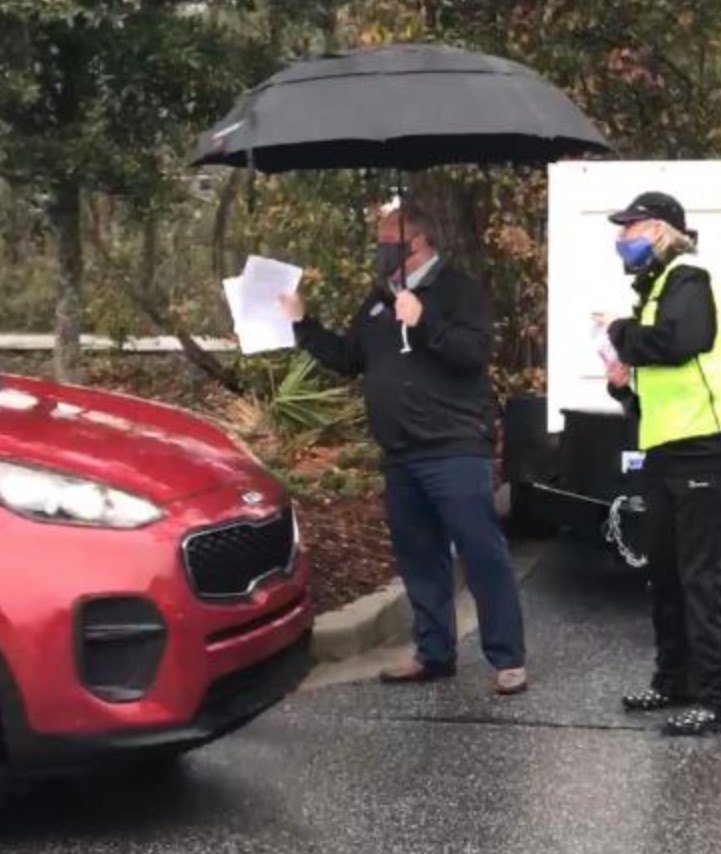
After the computer system handling registrations went down during a South Carolina drive-thru coronavirus vaccine clinic, the back-up of cars left people waiting for hours.
Sandy Morckel
In the midst of the chaos, the town mayor decided to contact the local manager of a Chick-fil-A fast-food restaurant, tweeting, “When you need help, call the pros.”
After he looked over the situation, he knew right away what to do. ‘There’s your problem right there,’ he told Mount Pleasant Mayor Will Haynie. ‘It’s backed up because you have one person checking people in.’ Then Chick-fil-A manager Jerry Walkowiak showed them how to do it.
With the help of a few Rotary club volunteers, they slashed the one-hour wait time to just 15 minutes, transforming the messy traffic jam into a smooth operation that vaccinated 1,000 people that day.
6) The Moderna Vaccine Can Vanquish Viral Variants, Too
The Massachusetts-based biotech company Moderna has tested their vaccine against two new, rapidly spreading strains of COVID-19.
According to Nature, it appears that the vaccine works as effectively against the UK variant as it does against the original form. While the vaccine appears less effective at neutralizing the South African 501Y.V2 variant, it still provides protection.
Moderna is now planning to test a booster jab that will enhance immunity against emerging forms of the coronavirus.
7) This All-Female Team Delivers COVID-19 Vaccines by Snowmobile in Harsh Rural Alaska Conditions
Dr Katrine Bengaard
People living in the remotest parts of Alaska are receiving the COVID-19 vaccine early so they can continue to get visits from family members—all thanks to a determined group of women.
The team of four is using planes, snowmobiles, and sleds—whatever it takes—to deliver the vaccine across rural northern Alaska. Consisting of a pharmacist, a doctor, and two nurses, the adventurous medical team has delivered 65 vaccinations, so far, traveling hundreds of miles to villages to get the job done.
8) After Recovery From COVID-19, Immune Cells ‘Remember’ For at Least Half a Year
Good news for those who have already contracted COVID-19: The immune system appears to remember how to make antibodies that can fight off the virus for at least six months following the initial infection—and likely for much longer.
A study led by scientists at Rockefeller University and published in Nature, found that—perhaps due to the “exposure to remnants of the virus hidden in the gut”—participants continued to improve their antibodies months after contracting the coronavirus.
9) Group is Giving Away Free Bags of Marijuana to People Who Get Vaccinated
Joints for Jabs
Dubbed “Joints for Jabs,” a community effort has been planned for Washington, D.C. for whenever public vaccination sites open.
DC Marijuana Justice will celebrate the “momentous occasion” by thanking people for getting vaccinated, with dozens of DC homegrowers lawfully distributing free bags of cannabis outside vaccination centers as soon as the general public is able to get vaccinated.
“We are looking for ways to safely celebrate the end of the pandemic and we know nothing brings people together like cannabis,” says DCMJ co-founder Nikolas Schiller.
10) People Are Using Their Free Time to Pick up Books and Read Again
With more downtime than usual, it seems that many people have turned back to books.
Borrowing books also grew exponentially in the US. National Geographic reported that weekly e-book lending increased across the nation by nearly 50% in the months following March 2020.
A survey in Canada showed similarly positive reading trends, with 58% of respondents in a survey from the non-profit BookNet saying they planned on reading more because of lockdowns.
MAKE GOOD Spread Like a Virus—Share With Friends On Social Media…